About Us
 Careers
 Leadership
 Board
 Newsroom
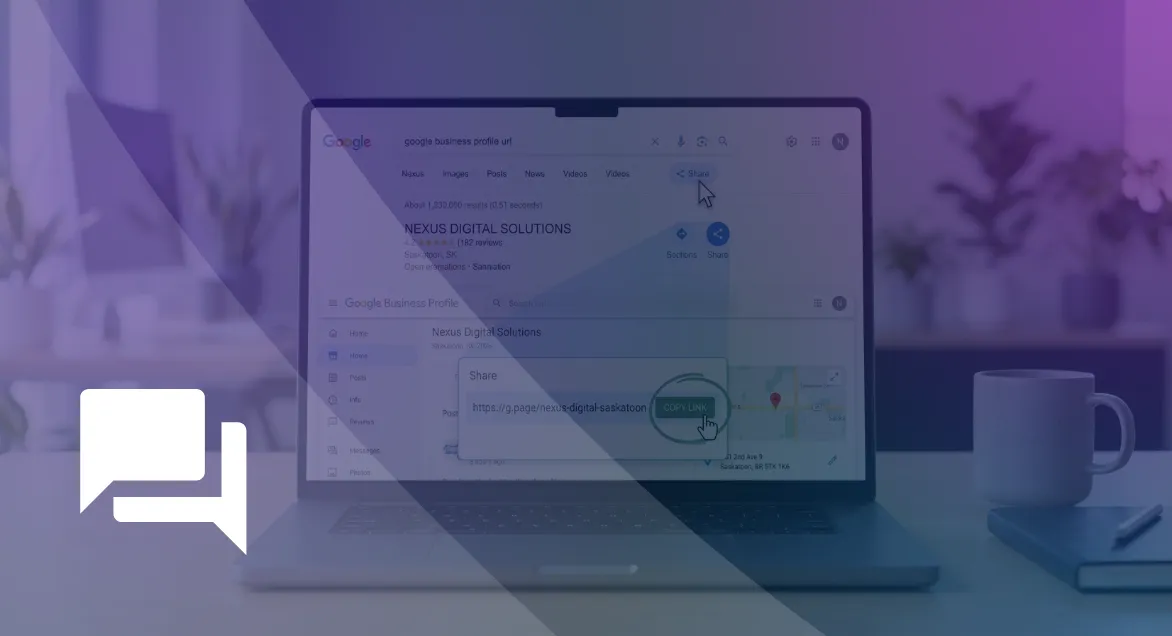
Your Google Business Profile URL is the link that opens your listing on Google Maps, and you can copy it in under a minute: search your business in Maps, open the listing, click Share, then Copy link. Send that link, or the separate review link Google generates behind the Ask for reviews button, and a customer lands on your listing or your write-a-review form instead of scrolling past the other roofers in the results.
Below are the exact desktop and mobile steps, the four link formats your business may already have in circulation, and the profile-link-versus-review-link mix-up. It also covers the website field inside the profile and UTM tracking, then shows how to fix a profile that will not appear, all part of a broader strategy to get more customers online.
Boost local rankings with AI-powered insights and automation
TL;DR
- Profile links and review links open different screens: Maps → Share → Copy link gives the profile link, which opens your listing; Read Reviews → Get more reviews → Copy gives the review link, which opens the write-a-review form directly. The two are not interchangeable.
- Most customers who are asked for a review write one: BrightLocal’s 2026 survey found that 78% of consumers were asked to write a review in the last 12 months, and 65% of those asked went on to write one.
- Vendasta can automate the review request itself: Its AI Reputation Specialist can send automated review requests after each job once the workflow and integration are configured, answer Google and Facebook reviews under rating thresholds you set, and log every action.
How to Find Your Google Business Profile URL in 4 Steps
The fastest path runs through Google Maps: search the business, open the listing, hit Share, copy the link.

Google returns a maps.app.goo.gl short address that opens your listing in the Maps app on a phone and in the browser on a desktop.

Anyone can share a listing, but signing in to the account that manages your profile first lets you confirm you are copying the verified profile and not a duplicate that carries your business name.

On a desktop:
- Open Google Maps while signed in to the account that manages your profile, then search your business name plus city.
- Click the listing so the profile opens in the left panel, and check the contact details and primary category against what you know to be correct.
- Click Menu at the top left, choose Share or embed map, then choose Send a link.
- Click Copy link. A maps.app.goo.gl address confirms you copied the profile link rather than a directions or street-view link.
On an Android phone, iPhone, or iPad:
- Open the Google Maps app and search your business name.
- Tap the business name or address at the bottom of the screen so the listing expands.
- Tap Share.
- Pick where to send it. Google’s Help documents the mobile path as Share, then choose an app, so the copy option appears in your phone’s share sheet rather than as a labeled Copy link button inside Maps.
The Business tab at the bottom right of the Maps app opens the profile you manage and its Edit profile control. Google’s Help does not document a share button on that owner tab, so share from the public listing instead. Google also cautions that features “may differ between Search and Maps and your device’s operating system,” which is why a screenshot from a colleague’s iPhone may not match your Android.
Two gotchas catch service businesses. A service-area business with a hidden address still has a shareable listing, so the missing street address is not a sign you grabbed the wrong one. And a short link that works today should still be opened in a private browser window before it goes on 500 door hangers, because the redirect, not the printed text, is what customers depend on.
Finding It From Google Search Instead
Searching your business name and city on Google while signed in as the verified owner opens a panel labeled Your business on Google at the left of the results, and that panel is the quickest source of your review link. Sterling Sky’s guide to the Performance tab documents this in-search interface, which Google calls the New Merchant Experience, and which replaced the standalone dashboard for single-location owners. Owners who manage several locations in bulk can still use Business Profile Manager at business.google.com.
Inside the panel, the confirmed controls are Edit profile, Performance, Read Reviews, and Ask for reviews. To copy the review link, select Read Reviews, then Get more reviews, then Copy. Clicking Ask for reviews lands you on the same sharing screen, which offers Email, WhatsApp message, Facebook post, and Copy, plus a QR code you can right-click and save with Save image as.
Google’s Help does not document a labeled Copy profile link button in this panel, and the interface changes often enough that button positions shift without announcement. For the listing link itself, use the Maps steps above or build the CID URL described in the next section. The review link is the one this panel is built to hand you, and Google’s instructions for creating a review link or QR code note that Google generates the QR code only in a computer browser, not on a phone.
What Your Google Business Profile URL Looks Like
A Google Business Profile URL is any web address that opens your listing’s place-details view, the card with your name, hours, photos, reviews, and Directions button. The Share button hands you the short form, something like maps.app.goo.gl/AbCd12. That address is a redirect: it detects whether the visitor is in the Maps app or a browser and opens the listing in either.
Behind the redirect sits the long form, which reads https://maps.google.com/?cid=10281119596374313554. The part before the equals sign is Google’s listing endpoint, and the typically 19- or 20-digit number after it is your CID, also called the ludocid, a numeric identifier for the listing record itself. You can recover the CID by viewing the page source of your Maps listing and searching for ludocid; the digits that follow it, before #lrd, are the number you want.
Keep both. The short link is for sharing; the CID URL belongs in the same file as your business license, because it is the address a support agent or listing tool will ask for when something goes wrong.
The Four Link Formats a Business Can End Up With
A business that has been on Google for several years usually has all four of these formats scattered across old flyers, invoice templates, and a website footer, and they do not age the same way.
| Format | Example | Documented as permanent? | Failure mode | Use it for |
|---|---|---|---|---|
| maps.app.goo.gl short link | maps.app.goo.gl/XXXX |
No. Google exempted links generated by Maps sharing from the August 25, 2025 goo.gl shutdown, but targeted links with no activity in late 2024 were deactivated after that date | Inactive link returns a 404 | Texting or emailing customers; open it in a browser before printing |
| CID URL | https://maps.google.com/?cid=1234… |
No. Google changed CID numbers during a suggested-edits bug, and reviews detached from affected listings | Reassignment breaks the link and strands reviews | Internal records, citations, support tickets |
| Place ID URL | https://search.google.com/local/writereview?placeid=ChIJ… |
You can store it indefinitely, though Google recommends refreshing IDs older than 12 months | Closure, move, or database update returns NOT_FOUND | Review links, QR codes, anything printed |
| g.page short name | g.page/yourcustomname |
Legacy only. No new names since June 2021; hidden from customers since February 11, 2026 | Deletion is irreversible | Existing materials you have already tested |
The shutdown exemption comes from the Google Developers post on goo.gl links, which states that goo.gl links generated through Google apps such as Maps sharing continue to function. The CID incident is documented in Search Engine Land’s report on the disappearing-reviews bug, where Google’s automated suggested-edit processing reassigned CIDs and reviews vanished with them. Google acknowledged the bug and restored many of the affected reviews, but the episode is why the CID is worth recording.
The Place ID is the alphanumeric string, for example, ChIJgUbEo8cfqokR5lP9_Wh_DaM, and it is not the same thing as your numeric CID. Google’s Place ID documentation includes a Place ID Finder tool and notes that a truncated ID returns INVALID_REQUEST, so copy the whole string. For anything you print, the Place ID review link is the format to build on, with a check of the live link once a year.
Profile Link vs Review Link: Which One to Send Customers
Send the review link when you want a review and the profile link when you want a visit, because the two open different screens. A profile link drops the customer on your listing, where they still have to find and tap Write a review. A Google review link opens the write-a-review dialog directly, with the star selector already on screen.
| Profile link | Review link | |
|---|---|---|
| What it opens | Your listing (place-details view) | The write-a-review dialog |
| Format | maps.app.goo.gl/… or https://maps.google.com/?cid=… |
https://search.google.com/local/writereview?placeid=YOUR_PLACE_ID |
| Where you get it | Maps listing, Share, Copy link | Read Reviews, Get more reviews, Copy (or Ask for reviews) |
| Taps left for the customer | Find and tap Write a review | None |
| Best use | Directions, hours, website footer, directory listings | Post-job texts, QR cards, email signature, invoices |
Google formalizes the split in its Places API, which exposes separate placeUri, reviewsUri, and writeAReviewUri fields for the listing, the reviews page, and the review-writing page. The Ask for reviews button in the Search panel is the shortcut to that third field without touching any API, and the QR code Google generates there points to the same writereview address.
Every tap you remove matters because the customer is standing in a driveway, not at a desk. Moz’s report on local business reviews puts the number of customers who skip reviewing because the process confuses them at 30%, which is the gap a direct link closes. The message that invites customers to leave a Google review should carry the review link, and only the review link.
One rule governs both links. Google’s prohibited and restricted content policy permits asking customers to leave a review through a link or QR code but prohibits offering anything in exchange, and it also bans review gating, the practice of steering only happy customers to the form. Google may temporarily block new reviews, remove fake reviews, or display a public warning on your profile.
Can You Still Customize Your Short Name (g.page)
Google’s Help page on short names states, “You can no longer create or edit short names.” The ability to create or edit them disappeared in June 2021, and as of February 11, 2026, Google stopped displaying existing short names on Business Profiles in Search and Maps, a change Search Engine Roundtable documented the same day.
A g.page/yourname URL you already own still resolves. Google’s short-names Help page says existing short names and URLs continue to work but are no longer shown to customers, and it warns that once you delete a short name, you cannot recreate it. That guarantee is written for the base short name; it says nothing about the g.page/r/…/review deep-link variant, so scan any old review QR code before you rely on it.
Google’s replacement is the review link from Read Reviews, then Get more reviews, then Copy. It is longer than g.page/yourname, which is why the QR code on the same screen exists. For a service business, the practical swap is a fresh QR card in the truck and an updated link in your invoice template; the old g.page address can stay on materials you have already printed and tested.
The Other URL: The Website Link Inside Your Profile
The website field inside your profile points the other direction: your profile URL brings people to Google, and the website URL sends them from Google to you. You edit it by selecting Edit profile in the Search panel or the Business tab in the Maps app and updating the website entry. Google’s guidelines for representing your business require that the address start with http:// or https://, represent that individual business location, not redirect to an unrelated landing page, and Googlebot must be able to reach it.
Google’s business links policy adds that the link must return a 200 OK response. Spaces and backslashes trigger removal. So do duplicated protocols such as https://https://. A dead or malformed website link is a missing piece of the profile, and profile completeness correlates with rank. Whitespark’s analysis of 1.8 million profiles, published on Search Engine Land, scored profiles on five items: website, description, hours, photos, and claimed status, and found average rank improved from 62 to 43 and the top-10 rate tripled from 4% to 13% between a score of 0 and 5. The authors state that correlation does not equal causation, since owners who complete profiles also tend to request reviews and maintain citations.
For a single-location business, the homepage is the right target. For a business with several locations, each profile should point to its own location page, so the Chicago profile lands on the Chicago page rather than a national homepage. The same rule holds for citations: point every listing at the location it actually describes. Whitespark’s 2026 Local Search Ranking Factors survey ranks a website’s name, address, and phone (NAP) matching the profile’s NAP as the 15th-strongest local pack factor. A location page earns that match by repeating the same business name and address. It should use the same phone number as well. The same completeness logic applies to photos, which sit in the same five-item index.
Tracking Clicks on Your Profile Links With UTM Parameters
UTM parameters let you isolate Google Business Profile website sessions in Google Analytics 4. A tagged website field for a plumbing company looks like this:
https://www.example.com/?utm_source=google&utm_medium=organic&utm_campaign=gbpwebsite
Three choices are baked into that string. Search Engine Land’s UTM guide recommends lowercase throughout, because Google Analytics treats capital letters as different values. Keeping utm_medium=organic preserves the visit in GA4’s Organic Search channel; a custom medium such as gbp pushes the traffic into Unassigned unless you build a custom channel group. And the campaign value is where the profile becomes visible: in GA4’s acquisition reports, add the session campaign dimension and filter for gbpwebsite, and the sessions and engaged sessions, along with conversions from the profile, separate from ordinary search.
Practitioners disagree on the source value. Some use utm_source=google, others utm_source=gbp; either works, but pick one and write it down, because the two produce different rows in every report. Tag the booking and menu links, plus product links, the same way if you use them, and leave the review link and profile link alone; they point at Google, not your site.
Google publishes no policy on UTM parameters, and BrightLocal’s UTM tracking guide attributes most reports of stripped parameters to redirects and to listing-management platforms that overwrite the tagged URL when pushing data back through the API. Forum reports from January and June 2025 traced dropped parameters to an http-to-https hop and a www forwarding rule. Tag the final destination URL, with the exact protocol and www form your site serves, and the parameters survive.
Untagged clicks scatter across sources. A local pack click in a browser reports as google / organic, a browser-based Maps click as maps.google.com / referral, and Search Engine Land’s UTM guide notes that clicks from mobile mapping apps often arrive as direct. UTM parameters carry no ranking weight in any reviewed source; they exist to show you whether the profile is producing booked jobs.
Where to Share Your Profile Link for Reviews and Local Visibility
The link only works where the customer sees it, and the highest-yield placements are the ones a service business already touches after every job. BrightLocal’s survey found consumers were most likely to write a review when asked by email (40%), with an in-person request second (27%). The placements worth setting up are:
- Post-job text message: send the review link while the truck is still in the driveway. Reputation AI integrates with Jobber and QuickBooks Online to support automated review-request workflows rather than relying on memory.
- Email signature and invoice footer: put the review link under your name and on every PDF invoice. Both go out anyway, and both reach the customer at the moment they have decided whether they are happy.
- QR code on a card: Whitespark recommends printing the QR code on the back of your existing business cards and handing one over after a positive conversation. Google’s native QR code opens the add-review form directly, and you generate it once from a computer browser.
- Social channels: Google’s own sharing screen offers Email, WhatsApp message, and Facebook post. Our guide to Google Business Profile URLs on social media platforms covers adding those profiles to the listing so the two point at each other.
- Directories and citations: use the profile link, not the review link, wherever your business is listed. Keep the business name and address identical to the profile, and use the same phone number. Vendasta Listing Sync Pro pushes one set of business data to 50+ listing sites, so an old phone number does not linger on three of them.
The payoff is rank. Google’s own local ranking guidance names relevance and distance as factors, with prominence as the third, and states, “More reviews and positive ratings can help your business’s local ranking.” In Whitespark’s 2026 Local Search Ranking Factors survey of 47 local search experts, High Numerical Google Ratings ranked sixth and Quantity of Native Google Reviews ninth among local pack factors, above the citation signals that once dominated. For a company competing for the three spots that appear on Google Maps and in the local pack, review volume and rating are the inputs you can move this month.
Business owners protect that visibility by keeping their contact details consistent across listings. An old phone number on a directory sends the call somewhere else, and conflicting data can lead search engines to treat one business as two. The profile link you paste into every directory is part of your digital marketing strategy because it tells Google every listing describes the same company.
Shortcuts here backfire. Attempts to buy Google reviews fall under the incentive ban covered above, and fake Google reviews trigger the public warning label that sits on the profile where prospects see it. The compliant version is a real request, sent to a real customer, with a working link.
How to Automate the Review Request
Sending that request by hand after every job is where most owners stall, because the owner is on the next job.
Vendasta is a customer acquisition and engagement platform with AI Employees that do the sales and marketing work for a local business, rather than one more review tool sitting beside the others. When the workflow and integration are configured, its AI Reputation Specialist can send the review request after each job. It also replies to Google and Facebook reviews using platform rules and the rating or timing thresholds you configure, then answers plain-language questions about sentiment trends across the reviews it monitors.

Profile upkeep is its own job. The Vendasta AI Search Specialist, in open beta through September 2026 and included with Vendasta Local SEO Pro, answers plain-language questions about rankings and listings, optimizes business profiles across Google, Bing, Apple Maps, and Facebook when you turn that setting on, and runs on-demand brand visibility reports covering ChatGPT, Gemini, and Perplexity.
Blue River Digital used Vendasta’s tools to help an auction house generate 21 five-star reviews in 30 days, the kind of volume a two-truck HVAC shop rarely reaches by texting links between service calls.
Structured Google review management turns the feedback from customers into the prominence signal Google describes, and it feeds the wider customer acquisition work of getting found before the competitor down the street.
Troubleshooting: Profile Not Showing, Unverified, Suspended or Claimed by Someone Else
If the Share button turns up nothing or the panel is missing when you search your own business, common causes include the following profile states, each with a documented fix and timeline. Work through them in order:
- Unverified profile: Google states that content on unverified profiles might not appear across Google. Google chooses which verification methods you see and recommends video recording where offered, a live clip of at least 30 seconds from your phone showing the business; review takes up to five business days. Postcards usually arrive within 14 days, and the code expires after 30 days; you should not edit the name, address, or category while waiting. If the screen says there are no more ways to verify, the verification Help page routes you to a support form that Search Engine Land reports typically answers in two to three business days.
- Suspended profile: a hard suspension removes the listing, reviews, and photos from Search and Maps; a soft one leaves the listing visible but shows Claim this business and locks you out. Appeal once through Google’s reinstatement process, attach the business license, registration, tax certificate, or utility bill showing the same name and address as the profile, and do not create a new profile or file a second appeal while it is pending. Google’s stated decision time is up to five business days, though Sterling Sky’s suspension guide reports real waits of one to six weeks and notes that reinstated profiles have been asked to reverify at a higher rate since July 2025.
- Profile missing from Search and Maps: a profile Google considers a duplicate does not show anywhere. If you created it by mistake, remove it from your account; if two Maps entries describe the same location, report a suggestion in Maps to request a merge, knowing that merged reviews combine but owner replies can be lost and Google cannot unmerge. A service-area business must hide its address and can set up to 20 service areas, and a new profile can take up to a month to rank.
- Claimed by someone else: go to business.google.com/add, enter the business name and address, and select Request Access when the message says someone else may manage the profile. Google’s ownership-request process gives the current owner three days to respond; after that, Google may offer you the option to claim it, and new owners face a seven-day restriction on some actions.
- Reviews missing or under attack: the CID reassignment issue covered earlier may explain reviews that vanish after a profile edit, and the guide to why Google reviews don’t show up covers the other causes. A sudden burst of one-star reviews from accounts that never hired you is review bombing, and the fix is flagging each one rather than replying to all of them.
- Reviews you dislike but cannot remove: you cannot turn off Google reviews on a live profile. Start by disputing dubious ones that violate policy, then answer the legitimate ones publicly, especially if they are negative.
The Google Business Profile Help Community is the last stop, not the first. The Product Experts who answer there are volunteers rather than Google employees, so they cannot make changes to your account, though they can escalate a case to Google for manual review. Bring your appeal reference and the exact search you ran, along with your CID URL, because the first question will be which listing you mean.
Why Your Google Business Profile URL Is Worth Getting Right
Your Google Business Profile URL is the shortest route between a finished job and a new review, and reviews are among the few local ranking inputs a service business controls directly. The profile link belongs on customer-facing and citation surfaces where your core business information needs to match. The review link belongs in the text you send before you pull out of the driveway and on physical placements such as the card or QR code at the counter. Point the website field at a live location page and tag it once with lowercase UTMs. File the CID and Place ID next to your business license.
Most owners skip the sending itself. When configured for the workflow, the AI Reputation Specialist in Vendasta Reputation AI Premium sends review requests after jobs, replies to Google and Facebook reviews under the thresholds you set, and records every request and reply in its activity log and executive reporting. To see that workflow running on your own profile, book a Vendasta demo.
Google Business Profile URL FAQs
1. How do I copy a Google Business Profile link?
Open Google Maps, search your business name and city, and click the listing. Click Share, choose Send a link, then click Copy link. On the Maps app, tap the business name, tap Share, and pick Copy from your phone’s share sheet. The result is a maps.app.goo.gl address that opens your listing.
2. How do I get my business page URL?
Your business page URL is the Maps listing link. Search the business on Google Maps, open it, click Share, and copy the link. For the long, stable version to keep in your records, view the listing’s page source, search for ludocid, and paste the number that follows into https://maps.google.com/?cid= to build the CID URL.
3. What does the listed URL mean on a Google Business Profile?
The URL shown on your profile is the website field, the link customers click to leave Google and visit your site. It points away from the profile, unlike the profile URL that points to it. Google requires it to begin with http:// or https://, represent that specific location, and avoid redirecting to an unrelated page.
4. How do I find my Google URL link?
Search your business name and city in Google Maps and copy the Share link, which returns an maps.app.goo.gl address. For the review link instead, search your business on Google while signed in as the owner, then choose Ask for reviews, or Read Reviews followed by Get more reviews, and select Copy.
5. What is the difference between a profile URL and a review link?
The profile URL opens your listing, where a customer still has to find and tap Write a review. The review link, formatted as https://search.google.com/local/writereview?placeid=YOUR_PLACE_ID, opens the write-a-review dialog immediately. Google’s Places API treats them as separate fields: placeUri and writeAReviewUri. Send the review link whenever the goal is a review.
6. Can I change my g.page short name?
Google’s Help states that you can no longer create or edit short names, a change made in June 2021, and since February 11, 2026, existing short names no longer display on profiles. An existing g.page URL still resolves, but deleting it is permanent. Use the review link from Get more reviews for new materials.
7. Where should I share my Google Business Profile link?
Put the review link in the text you send after each job, in your email signature, on invoices, and on a QR card you hand to customers. Google’s share screen offers Email, WhatsApp message, and Facebook post. Reserve the profile link for directions, website footers, and directory listings where name, address, and phone must match.
8. Why can’t I find my Google Business Profile?
Four causes cover most cases: the profile is unverified, so Google may not display it; it was suspended, which removes a hard-suspended listing entirely; Google flagged it as a duplicate, which hides it; or someone else claimed it. Check the status while signed in, then verify, appeal, request a merge, or request access at business.google.com/add.
9. How do I get my Google review link?
Sign in to the Google account that manages your profile, search your business name on Google, and open the Your business on Google panel. Select Read Reviews, then Get more reviews, then Copy. The same screen offers a QR code you can right-click and save, though Google generates QR codes only in a computer browser.
10. Why can’t I find the review QR code on my phone?
Google generates review QR codes only in a computer browser, not in the Maps app or a phone browser. Open Google on a laptop, search for your business while signed in, choose Get more reviews, right-click the QR code, and select Save image as. Text the saved image to your phone afterward for use in the field.