About Us
 Careers
 Leadership
 Board
 Newsroom

Google Business Verification proves to Google that you run the business. Until it clears, you can edit only some basic details on your Google Business Profile (formerly Google My Business), and Google withholds Performance data.
To verify a Google Business Profile, every business type follows the same five steps: sign in to the Google Account that manages the profile, find the listing on Google Search or Maps, select Claim or Get verified, complete the verification method Google assigns, and wait for Google’s decision, which takes up to 5 business days for video and other submitted methods.
An unverified profile for your business may already exist on Google, but verification is the first step in Google Business Profile management because it confirms your authority to run the listing and helps get more customers. The guide below covers each step, the method Google assigns each business type, what to film, and how to recover a denied or stuck verification.
Acquire and serve 10x more clients with AI-powered software
TL;DR
- Verification gives you control: Google notes that an unverified profile for your business may already exist, but only a verified owner can edit all profile details and see Performance data.
- Video appears 8 in 10 times: Search Engine Land’s guide reports video as the main option about 8 out of 10 times, and Google reviews submissions within up to 5 business days.
- A verified profile feeds AI search too: Vendasta’s AI Search Specialist optimizes profiles across Google, Bing, Apple Maps, and Facebook and reports how the business appears in ChatGPT, Gemini, and Perplexity answers.
Why Google Business Verification Matters
Verification turns a listing customers may already see into one you control. Google’s local ranking help says verification tells Google you’re authorized to represent the business, “so it’s more likely to show up in search results.”
For a local service business, Google’s verification decision determines whether you can do the following:
- Claim the listing Google already has: Google’s claim guidance tells a business to claim an existing unverified profile, or add a new one, and then verify it.
- Manage important Local Pack signals: An expert survey summarized in Advice Local’s analysis ranks Google Business Profile signals as the top Local Pack and Maps ranking factor group at 32%.
- Edit the full profile: Google’s editing help lets unverified profiles change some info, such as name, category, address, hours, phone, and website, but says to verify the profile “to edit all your info,” including photo management.
- Read Performance data: Google states that “Performance data is available only for verified Business Profiles,” so Performance features such as calls and website clicks, along with direction requests, stay hidden until then.
Once you claim and complete it, a complete profile can also support stronger Google rankings. Search Engine Land’s analysis of 1.8 million profiles found that moving from 0 to 5 on a completeness index improved average rank by about 19 positions. The index counts claimed status with website and description information, plus hours and photos.
A completed Business Profile scoring 5 of 5 reached the top 10 in 13% of cases in that dataset, against 4% for a profile scoring 0. Whitespark, which produced the analysis, notes that correlation does not equal causation, and claims that status represents one of five equally weighted parts. Treat verification as the first line of a local search engine optimization (SEO) strategy, with category and hours followed by photos and reviews.
How to Verify Your Business on Google in 5 Steps
Google uses the same general flow for every business type: sign in, find the listing, request verification, complete the method Google offers, and wait for the decision. The active steps take minutes on a phone; the wait afterward accounts for most of the calendar time, and it varies by method.
Step 1: Sign In to the Google Account That Manages the Profile
Use the Google Account that owns or manages the profile, or the one you want to own it. Google ties verification to that account: it routes ownership requests, appeals, and status checks through the same login. If Google restricts the account, appeal that restriction before submitting a profile appeal. After verification, the business profile owner can edit the profile and add managers from that account.
Step 2: Find Your Business on Google or Maps
Search the exact business name on Google or Maps while signed in. If a profile exists, the business listing appears in results with its name and category, plus a prompt to claim or verify it when nobody has done so. If another account already verified it, Google shows the notice “Someone else may manage this Business Profile” instead.
Step 3: Select Claim or Get Verified
Select Get verified on a profile your account created, or Claim on a listing nobody has verified; the button sits on the profile itself in Search and Maps. If the search returns nothing, create a Business Profile at business.google.com/add by entering the name and address. Google then matches an existing listing or opens a new one. The someone-else notice sends you into an ownership request rather than verification.
Step 4: Complete the Method Google Assigns You
Google picks the method, and you complete it. Google’s verification help states that verification methods “are automatically determined by Google and can’t be changed.” The options shown depend on business type, public information, region, and hours. Google sometimes requires more than one method for a single profile, and when video appears in the list, Google recommends taking it.
Step 5: Wait for Review
Expect Google to send a decision within up to 5 business days for video and the other submission methods. Google notes that review takes longer on rare occasions. Postcards run on a slower clock: most codes arrive within 14 days and expire 30 days after issue. During a postcard wait, Google says not to edit the business name, address, or category and not to request a new code.
Which Verification Method Google Gives You by Business Type
Storefronts, service-area businesses, and hybrids can all receive video recording, while Google offers the other methods conditionally based on the profile. Google’s eligibility page sets the floor first: a business must make in-person contact with customers during its stated hours, which rules out several setups before Google offers any method.
Match your setup to the likely method:
- Storefront: Expect video recording, with live video call, phone, text, email, or postcard as possible extras. Google’s service-area help directs a business without permanent on-site signage to list as a service-area business. Plan to film street signs or building numbers, the signage, and an employee-only area.
- Hybrid (storefront that also visits customers): Google offers the same methods as for a storefront, with both the address and a service area on the profile. Google’s example is a dine-in restaurant that also delivers.
- Service-area business (plumber, cleaner, landscaper): Expect video recording. Show street signs or landmarks, tools or a branded vehicle, and a permit, invoice, or utility bill matching the profile name. Remove the address from the profile and enter up to 20 service areas within about two hours of driving time from your base. Service-area businesses cannot use bulk verification.
- Home-based: Google’s business guidelines tell owners who run the business from a residential address to clear that address from the profile, which makes it a service-area business. Film landmarks and street signs in your immediate neighborhood.
- Co-working space: Google’s guidelines allow an office at a co-working space only when it maintains clear signage, receives customers during business hours, and is staffed by your business during those hours.
- Virtual office or P.O. box: Google rules out P.O. boxes and rented mailing addresses, and it allows a service-area business to list a virtual office only when that office is staffed during business hours.
- Office suite in a high-rise: Google publishes no separate rule, so the storefront standard applies. Expect video, and make the building number, your suite signage on a permanent fixture, and the staffed office visible.
- Online-only: The business does not qualify for a Business Profile, so Google offers no method. Brands, artists, lead-generation companies, and rental or for-sale properties sit in the same excluded group.
Region and hours shape the offer as well; Google runs live video calls, for example, only within your listed business hours.
The Verification Methods Google Offers
Seven methods are in play, each with its own requirement, wait, and eligibility gate:
| Method | Requirement | Timeline | Eligibility |
|---|---|---|---|
| Video recording | Record at least 30 seconds live on a mobile device through the profile without edits; show the location and business, plus proof that you manage it | Google reviews it within up to 5 business days | Google recommends it when your business is eligible |
| Live video call | Be at the location and show a Google representative outside signs and business equipment, plus employee-only access | Google publishes no fixed wait | Google does not offer it to every business and conducts calls only during business hours |
| Phone or text | Answer the call or open the text and enter the code; interactive voice response (IVR) systems will not receive it | Google delivers the code during the call or text | Google offers it only to eligible profiles |
| Access the address shown on the verification screen and enter the code | Google verifies the profile when you enter the code | Google offers it only to eligible profiles | |
| Postcard | Enter the mailed code; do not edit the name, address, or category or request a second code | Most codes arrive within 14 days; the code expires 30 days after issue | Google does not offer it to every business; BrightLocal reports that it is rare today |
| Instant verification | Meet Google’s conditions, such as verifying your website with Google Search Console | Google may verify the profile immediately | Google applies it automatically when its conditions are met; you cannot select it |
| Bulk (10+ locations) | Upload a spreadsheet of all managed profiles, then request verification under Verifications, Chain, Start | Google provides no fixed duration and contacts you if it needs more information | Available for 10 or more locations of the same business; service-area businesses and agencies with more than one business in one account are excluded |
Bulk verification is the one route built for multiple locations, and it carries the longest checklist. Google’s bulk verification page requires a business group and a spreadsheet listing every managed profile. Google’s spreadsheet guidelines require each entry to have a unique business code, a business name, a primary category, and a website or primary phone number.
You must then submit a separate request because uploading the spreadsheet alone does not send a verification request. Duplicate, suspended, or disabled profiles do not count toward the 10, and Google may still ask you to confirm the business with video verification.
Agencies with more than one business in one account cannot use bulk verification, and neither can service-area businesses.
Once Google verifies the main owner of a business group, it also verifies the group’s eligible profiles, so a chain can manage profile listings from one confirmed account. Optimizing each location’s Google Business Profile starts the same way: confirm verified status before touching categories or hours.
Video Verification: What to Film and in What Order
Film one continuous take on your phone, inside the Business Profile upload flow, for at least 30 seconds. Google’s video verification page requires footage captured live, with no edits or breaks, and you cannot record offline and upload later. Google requires evidence of the location and the business itself, plus proof that you manage it.
BrightLocal reports Google’s guidance that the most successful videos run one to two minutes, which gives you enough time for every shot below without padding.
Google does not mandate a filming order, but this sequence covers the required evidence in an order a reviewer can follow:
- Street sign or building number: Start outside and hold on a street sign, the building number, or a neighboring business so the reviewer can match the footage to the pin on Maps.
- Exterior signage: Pan to your business name on a permanent fixture, whether a signboard, wall, or window. Google requires the name shown in the video to match the name on the profile.
- Entry: Walk to the door and unlock or open it, showing the reviewer that you have access to the location.
- Interior: Keep rolling through the space customers use, then enter an area only an employee can access, such as the storage room, kitchen, or back office.
- Point of sale or tools: Open the cash register or point-of-sale system. Service-area businesses can instead show the professional tools, equipment, or products they use for work.
- Proof of management: Finish by unlocking a van with your business branding or holding up a business permit, invoice, or utility bill that matches the profile’s name. Keep account numbers and other people’s faces out of frame.
Service-area businesses with a vehicle can shoot the whole sequence from the truck. Search Engine Land’s article advises parking at a nearby intersection or shopping plaza where street signs are visible. Show the business name on the vehicle and the tools inside, then unlock and start the vehicle to prove management control.
Google’s privacy rules apply to every shot. Do not show bank account, tax, or ID numbers. Keep private information about you or others off camera, including other people’s faces. You can delete the video at any time, and Google deletes it later if you do not. If you cancel the upload, both you and Google lose access to the video.
How to Check If Your Business Profile Is Already Verified
Sign in to the account you believe manages the profile, then search the exact business name on Google or Maps. A verified profile you control shows management controls and Performance data. An unverified one shows a Get verified button and no Performance because Google restricts that data to verified profiles. If Google displays “Someone else may manage this Business Profile,” a different account has verified the listing.
Unverified profiles can still edit some info, such as the business name, category, address, hours, phone, and website. Google asks you to verify before you edit everything else, including the business description, and Google’s policy overview says it “may reject content added to unverified profiles.”
A failed attempt leaves a trace as well. After a video is not accepted, Google shares the reasons it was rejected; select Review issues on the profile to see them, which is the first place to look before reshooting.
Documents Google Accepts as Proof You Manage the Business
Google names four kinds of documents on its official evidence list: official business registration, a business license, tax certificates, and utility bills for the business covering electricity, phone, water, or internet.
Google’s suspension help asks you to check that the business name and address on each document match the profile you are appealing for. Lease agreements, bank statements, insurance papers, and franchise agreements are absent from Google’s lists, so Google assigns them no documented weight on their own.
During verification itself, you show documents on camera rather than uploading them through a form. In a video recording, you can hold up a business permit, invoice, or utility bill that matches the profile name. During a live video call, the representative reviews business equipment and access on camera. Phone, text, email, and postcard verification require no documents.
Google provides the upload form only inside the appeals tool, and the form has a clock. Follow these steps:
- Open the Google Business Profile appeals tool at support.google.com/business/?p=manage_appeals and confirm the signed-in account.
- Select the profile, select Continue, then select Submit Appeal in the bottom right and Submit.
- When Google prompts you, select Add evidence, review the business details, and select Choose file in the Upload documents section.
- Add context text if useful, then submit within 60 minutes. After that point, Google does not attach the evidence to the appeal.
Whitespark’s suspension guide recommends bundling several documents into a single zip file of up to 20 MB, which keeps the whole submission inside that window.
Claiming a Listing Someone Else Already Verified
Request access rather than starting a duplicate. Google’s ownership help lays out the flow:
- Go to business.google.com/add and enter the business name and address.
- Select the business from the list; Google shows “Someone else may manage this Business Profile.”
- Select Request Access, fill out the form, and select Submit.
Google emails the current owner, who has 3 days to respond, and you can track the request by signing in to your profile or using the link in the confirmation email. If the owner approves the request, Google emails you and grants management access. If the owner rejects it, you can still suggest edits to the profile and appeal the decision.
If the owner stays silent for more than 3 days, Google may show you the option to claim the profile, although Google says the option “isn’t always available.” When it appears, open the confirmation email, select View request, then Verify, and complete the assigned method.
A Claim or Verify button may also appear on the profile after sign-in. Service-area businesses with no shopfront skip the form and contact Google support directly with “Transfer ownership of listing” in the help field. Bulk-verified accounts request ownership through the bulk upload spreadsheet.
Why Google Asks You to Re-Verify and How to Avoid It
Moving your address forces a new verification; other edits might. Google’s edit help says a business that moves “must verify your business again,” while a name change might require it.
BrightLocal adds that re-verification “could be triggered by changes to your business name, address, category, or opening hours,” so treat choosing a category and updating business hours as edits that carry some risk.
Phone edits carry a suspension risk of their own. Whitespark describes owners who edit the phone field and receive a suspension, in part because the new number no longer matches the company website or other listings.
Before changing the profile, make sure the new number matches the number published on your website. Whitespark identifies address and map pin as sensitive fields, along with phone and primary category. Website URL and business name complete the list.
Spacing your edits reduces the exposure:
- Change one sensitive field at a time; Whitespark spaces these edits about a week apart and warns that too many changes at once can trigger a suspension.
- Update your website and other listings before the profile so the edit matches what Google already sees. Keep your business contact information consistent across platforms, including your website, Google Business Profile, and professional email addresses using a custom email domain.
- Leave the profile alone during a postcard wait because Google says not to edit the name, address, or category until the code arrives.
- Plan address changes as a re-verification event because Google requires a new verification every time you move.
Search Engine Land warns that changing the name, address, or categories within the first two weeks after verification can trigger a suspension. A practitioner survey in Search Engine Land’s analysis found 73.3% of respondents confirmed that address edits make a listing more susceptible to verification loops. Each loop delays the search ranking work you completed on categories and reviews.
A Pending label after an edit is not re-verification. Google says edits usually take up to 10 minutes to review, though some take up to 30 days. Re-verification means the Get verified button has returned.
Why Verification Fails and What to Do About Each Reason
Most rejections trace to a missing piece of evidence or a guideline violation, and each has a specific fix. Google handles repeated verification failures through support and suspended or disabled profiles through a separate appeals path.
Denied Video Verification
Google’s video help page gives example rejection reasons, and each maps to a reshoot:
- Business name not visible on the storefront
- No nearby area shown to confirm the location
- Missing proof of authorization to operate the business
The same page sets requirements that also cause problems when missed: a business name that does not match the profile, footage that is pre-recorded, edited, or under 30 seconds, and sensitive information such as account numbers or other people’s faces on screen. Fix the named gap and film again in one take. Each failed attempt counts, because repeated failures can end in the message described below.
Postcard Never Arrived
Wait out the delivery window from Step 5 before doing anything. Requesting a new code while one is in the mail goes against Google’s instructions. Confirm that nobody edited the business name, address, or category in the meantime.
After the window closes, request a new code or contact support. A code that arrives late still works until its 30-day expiry.
The No More Ways to Verify Message
After repeated failed attempts, owners can see a “No more ways to verify” message that removes the self-serve options; Google does not publish the exact number of attempts. Search Engine Land reports that owners then have to submit images of signage and business documents, and that after 2–3 business days Google emails to say a live video call is now the only way to verify.
This differs from the earlier period when businesses sometimes uploaded 10 or more videos. Prepare the signage shots and a matching utility bill before the first attempt, so you already have the evidence an escalation may require.
Suspended or Disabled Profile
Google’s policy overview says Google disables a profile when it determines that the business does not exist at the claimed location, and it suspends profiles that use P.O. box addresses.
Google’s business guidelines also rule out unstaffed virtual offices, co-working offices without signage or staffing, phone numbers or URLs that redirect users elsewhere, and business names that differ from the real-world name. Fix the violation first because the appeals tool shows the violated policy beside the profile, and resubmitting the same problem changes nothing.
Submit one appeal through the appeals tool using the upload steps in the documents section, then wait. Google’s appeals help instructs owners not to submit multiple appeals for the same issue before receiving a decision.
If Google restricts the Google Account itself, appeal that restriction first at myaccount.google.com/restrictions and file the profile appeal separately. For more than 10 profiles, submit one appeal and attach a spreadsheet containing evidence and Business Profile IDs for the rest.
Escalation Path and Overdue Reviews
When standard verification keeps failing, Google’s verification help instructs owners to contact Google Support at support.google.com/business/gethelp. For appeals, Google states that reviews and decisions can take up to 5 business days. The tool shows a status of Submitted, Approved, Not Approved, Can’t be appealed, or Eligible for appeal.
Observed waits run longer. Search Engine Journal’s report by Mike Blumenthal found that appeal resolution stretched from about five days to nearly five weeks during a 2025 surge in suspensions.
Whitespark’s Miriam Ellis declines to estimate a duration at all, calls the process unpredictable, and notes it can run from a few days to six weeks. Plan for weeks, keep the profile untouched, and skip the second appeal.
A denied appeal has one more door. If Google denies a reinstatement request, it may conduct an additional review through support.google.com/business/contact/local_appeals. Use this route to add evidence missing from the original appeal, such as a utility bill you have since located.
Turn a Verified Profile Into More Booked Jobs
Verification gives you control of the profile; it does not guarantee a Local Pack position. Customers book through the profile only when the business keeps working it, and most owners stop at the confirmation email. Keep the profile accurate, space out sensitive edits, and keep verification evidence ready before Google asks for it.
Vendasta, an AI customer acquisition and engagement platform for local businesses, gives that routine to its AI Workforce. Its AI Employees are purpose-built AI workers that complete defined work using the business’s own data.
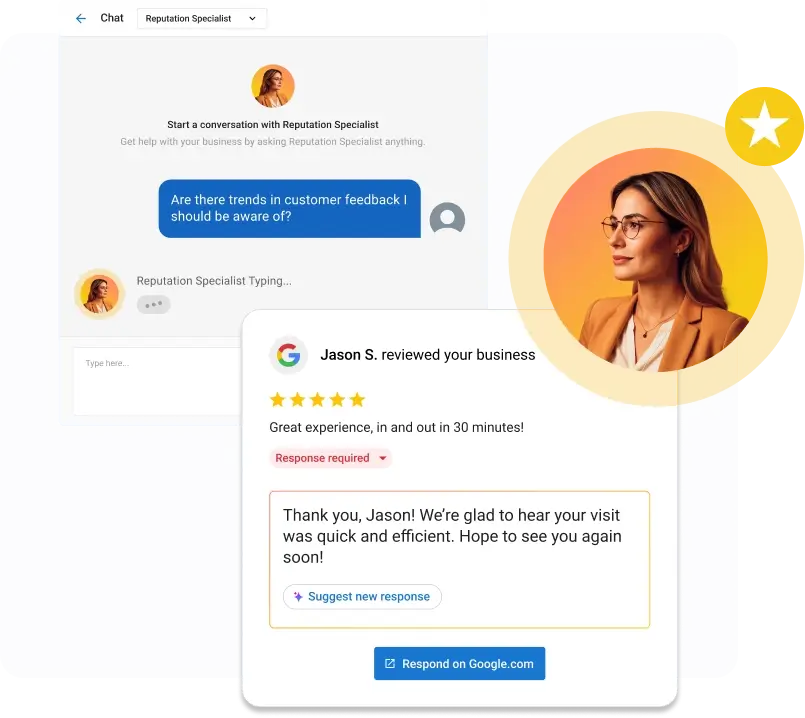
The AI Reputation Specialist sends review requests and answers Google reviews under rules you set, with every action logged.
The AI Search Specialist, part of Vendasta Local SEO, answers plain-language questions about rankings and listings, optimizes profiles across Google, Bing, Apple Maps, and Facebook, and reports how the business appears in ChatGPT, Gemini, and Perplexity answers.
Listing Sync Pro keeps the name, address, and phone number consistent across 50+ listing sites, so a mismatched phone number does not undercut the profile.
For an owner on a roof, that means reviews get answered at 9 p.m., and the profile stays current without adding payroll. Fred Astaire Dance Studio’s franchise network grew search traffic 37% and averaged 50 reviews per store with Vendasta. To see how Vendasta keeps a verified profile working for your business, book a Vendasta demo.
Google Business Verification FAQs
1. How do I check if my Google Business Profile is verified?
Sign in to the Google Account you use for the business and search the business name on Google or Maps. Management controls and Performance data mean Google has verified it. A Get verified button means it has not. A notice that someone else may manage the profile means another account verified it.
2. Why can’t I verify my business on Google?
The usual reasons involve eligibility or missing evidence. Google excludes online-only businesses, P.O. boxes, rented mailing addresses, lead-generation companies, and rental properties. For eligible businesses, Google may deny video that omits signage, the surrounding area, or management proof. A mismatched business name can also cause denial. Select Review issues on the profile to see why.
3. How long does Google My Business verification take?
Google reviews video and other submissions within up to 5 business days. Postcards are slower, with most codes arriving within 14 days and expiring 30 days after issue. Instant verification can happen immediately, while bulk verification has no fixed duration. Google warns that some reviews take longer than the standard window.
4. Why does Google want me to verify my business again?
Google requires re-verification when you move to a new address, and it may require another check after you change the business name. BrightLocal reports that category and opening-hours changes can also trigger it, and Whitespark reports that phone edits can lead to suspensions. Change one sensitive field at a time.
5. What should I show in the verification video?
In one unedited take of at least 30 seconds, show evidence of the location and the business itself, followed by proof that you manage it. Useful shots include a street sign, building number, permanent business signage, an employee-only area, a cash register, or a matching permit or utility bill. Film live through the profile on your phone.
6. How do I verify a service-area or home-based business with no storefront?
Google offers video recording to service-area businesses, including home-based ones. Film street signs or landmarks near your base and show your tools, equipment, or branded vehicle. Finish by unlocking the vehicle or showing a permit, invoice, or utility bill matching the profile name. Keep the residential address cleared from the profile.
7. What if someone else has already claimed my business listing?
Go to business.google.com/add, enter the business name and address, select the listing, and choose Request Access. Google emails the current owner, who has 3 days to reply. If the owner approves, you receive management access. If the owner ignores the request, Google may let you claim the profile from the confirmation email, although that option isn’t always available.
8. What does “No more ways to verify” mean and what should I do?
The message appears after repeated failed attempts and removes the self-serve options. Search Engine Land reports that owners then submit images of signage and business documents and may be offered a live video call as the remaining path. Gather clear signage photos and a utility bill in the profile’s name, then follow Google’s prompts.
9. Can I choose which verification method Google gives me?
Google determines the available methods from your business type, public information, region, and hours, and you cannot change the options. Video recording appears most often, and Google recommends it when offered. Phone, text, email, postcard, and live video call appear only for some profiles. Google may also require more than one method.
10. What documents can I use to prove I manage the business?
Google’s evidence list includes official business registration, a business license, tax certificates, and business utility bills. Each document should show the name and address on the profile. In a video, you can show a permit, invoice, or utility bill. Lease agreements, bank statements, insurance papers, and franchise agreements do not appear on Google’s official evidence lists.