About Us
 Careers
 Leadership
 Board
 Newsroom

Searching for Birdeye alternatives often starts after a paid lead reaches voicemail while you are on a job, then books with the next local service business that responds, which is the opposite of what you pay for when you try to get more customers. Birdeye is an AI review and reputation platform with listings and messaging that sells only by quote and auto-renews annual contracts unless you give 90 days’ written notice.
The 10 platforms below compete with part or all of Birdeye’s work, with disclosed starting prices from $19 to $99 per month. Vendasta leads the list as the one option here that pairs review management with AI Employees that also answer calls, sync listings, and update a built-in customer relationship management (CRM) system. This guide also covers Birdeye’s cost structure, migration steps, and the Federal Trade Commission (FTC) and SMS rules that apply either way.
Attract, convert, and retain more customers with less manual work
TL;DR
- Vendasta is the Birdeye alternative that does more than manage reviews: its AI Reputation Specialist answers Google and Facebook reviews in the reviewer’s language under rules you set, and the same platform answers calls, syncs listings, and keeps your CRM up to date. Reputation AI runs $19 to $99 per month as part of Vendasta’s all-in-one platform, and you can try it free for 14 days with no credit card.
- Birdeye sells by quote on auto-renewing annual contracts: stopping a renewal takes 90 days’ written notice, renewals add an 8% Innovation Fee, and the Better Business Bureau (BBB) lists 104 complaints, with Order Issues the largest category.
- Point tools cover one piece: BrightLocal ($31 per location), NiceJob ($75 flat), and GatherUp ($99 for one location) publish prices but don’t combine reviews with messaging, voice, and CRM. Podium, Yext, and Swell sell by quote, like Birdeye.
Looking for Birdeye.so, the Solana and multi-chain token tracker? That is an unrelated platform, not Birdeye the review software; comparable crypto tools include DexScreener, plus GeckoTerminal and DEXTools.
Why Look for Birdeye Alternatives
In BBB complaints and low-star reviews, contract terms come up most; support response times and per-location cost follow. The product itself scores well: Birdeye holds 4.7/5 across 4,234 G2 reviews, 86% of them five stars, and G2 tags Customer Support as a positive in 720 reviews. Owners who see concerns about the commercial relationship in low-star reviews and BBB complaints often compare reputation management software options before their next renewal date.
Cost and Per-Location Pricing Creep
Birdeye bills by location on annual agreements, so cost scales with the number of sites you run. Birdeye’s pricing selector sorts accounts by location count before showing a quote form.
Birdeye’s own cost explainer states there is no fixed pricing and that annual agreements are standard operating practice. Add-ons stack on top: Capterra reviewers note that mass texting campaigns cost extra, while Birdeye’s terms pass carrier application-to-person (A2P) 10-digit long code (10DLC) texting fees through to the client.
One Capterra complaint reads, “The pricing can be high, especially for smaller businesses.” GetApp’s review summary lists “high costs, confusing pricing, extra fees for features, and recent price increases reducing value.”
Contracts and Notice Periods
Birdeye’s terms require 90 days’ written notice before the renewal date to stop an auto-renewal, and the contract otherwise renews for the same length as the original term. The same terms give the breaching party a separate 30-day written cure period after a breach notice.
Birdeye’s terms classify payments as non-cancellable and non-refundable, and its cancellation policy states that the company can close an account early only when the signed contract includes an opt-out clause. The 8% Innovation Fee applies to all recurring fees at renewal for agreements signed since April 2024.
Owners cite those terms most often in BBB complaints. The BBB’s complaint file shows 104 complaints over three years, with 31 Order Issues as the largest category, and customers say Birdeye “never made adequately clear” the 90-day requirement during sales or onboarding.
One Trustpilot reviewer wrote, “they said they needed 90 days notice to cancel.” Other Trustpilot reviews describe payments continuing across four locations for three months after Birdeye confirmed a cancellation date.
Support and Onboarding Gaps
Support complaints concentrate on escalation rather than first response. A Head of Digital at a local business wrote on G2 that “support tickets often took days if not weeks to be resolved,” and another reviewer said escalated issues became feature requests and received no further follow-up. TrustRadius groups these under “Customer Support and Account Management Issues” alongside a steep learning curve, and G2’s Learning Curve tag appears in 139 reviews. G2 reviewers tag Missing Features 232 times, the most common complaint tag in the set.
Onboarding complaints follow the same shape. One reviewer described features that sales promised as easy additions during pre-contract discussions taking months to arrive. When a feature you bought for the crew’s scheduling flow arrives a quarter late, you are still paying for the location every month while waiting.
What Birdeye Actually Costs per Month and per Location
Birdeye publishes no rate card. Its pricing page shows only a location-count selector with six bands (1–3, 4–9, 10–39, 40–249, 250–999, 1000+), and each band leads to a quote form. G2 lists no dollar amounts for Birdeye, and Capterra says “Contact vendor for pricing.”
What Birdeye’s own documents do confirm is the contract shape:
| Term | What Birdeye Documents |
|---|---|
| Plan or tier names | Not listed |
| Price per location | Not published; quote required |
| Contract length | Annual agreements described as standard practice |
| Setup fees | Not stated in dollar terms |
| Renewal | Auto-renews for the same term without 90 days’ written notice |
| Renewal price change | 8% Innovation Fee on recurring fees |
| Texting fees | Carrier 10DLC fees passed through to the client |
User-reported figures commonly put Birdeye around $299 per location per month, but Birdeye confirms none of them. The comparisons below rely on published vendor prices and mark quote-only pricing plainly.
Top Birdeye Alternatives at a Glance
Six of the 10 platforms publish a per-location or flat price; the rest sell by quote. The table lists each option’s best fit and the feature that most separates it from Birdeye:
| Alternative | Best For | Starting Price | Key Differentiator |
|---|---|---|---|
| Vendasta | Local businesses that want reviews, calls, listings, and CRM working together, and the agencies and franchisors serving them | Reputation AI $19 to $99/mo, part of an all-in-one platform; 14-day free trial | AI Workforce: AI Reputation Specialist plus AI Employees that answer calls, book appointments, and write social posts and blogs, with listings and a built-in CRM |
| Podium | Service businesses that want texting, reviews, and phone answering from one vendor | Quote only | Voice AI add-on with HVAC scheduling; white-label prohibited |
| Reputation.com | Multi-location operators up to 125 locations | $80/location/mo (Rep Core) | Published per-location pricing; 0–100 sentiment scoring |
| BrightLocal | Single-location owners who also want local rank tracking | $31/location/mo (Track); $49 (Grow) | Cheapest published entry; 14-day trial without a card |
| ReviewTrackers | Businesses that want analytics and a contractual anti-gating clause | ~$89/location/mo (G2-reported; official page quote-based) | Proprietary natural language processing (NLP) categorization; Business Associate Agreement (BAA) on request |
| NiceJob | Home-services businesses that want flat pricing | $75/mo flat (Starter); $125 (Pro) | Flat pricing, no contract, field-service integrations |
| GatherUp | Two- to ten-location businesses and agencies | $99/mo (1 location); $60/location (2–10) | 100% white-label with custom domains; anti-gating in terms |
| Yext | Chains where listings accuracy leads reviews | Quote only | Generative replies trained on 5,000-character brand instructions |
| Swell | Healthcare practices | Quote only | AI drafting built for Health Insurance Portability and Accountability Act (HIPAA) compliance, not an add-on |
| Grade.us | Agencies that want anti-gating in the contract and their own domain | $99/mo; Agency $400+/mo (10+ seats) | Unlimited review sites; premium white-label for $440/yr |
Top Birdeye Alternatives in Depth
Every entry below applies the same four criteria Birdeye competes on: review generation, listings, messaging, and AI. Ratings come from G2 and Capterra, and each limitation comes from the vendor’s documentation. Birdeye’s side of each table uses the same baseline throughout: email and SMS review requests, listings management, an inbox with webchat and paid mass texting, and its Review Response, Review Tagging, and Front Desk agents.
Vendasta
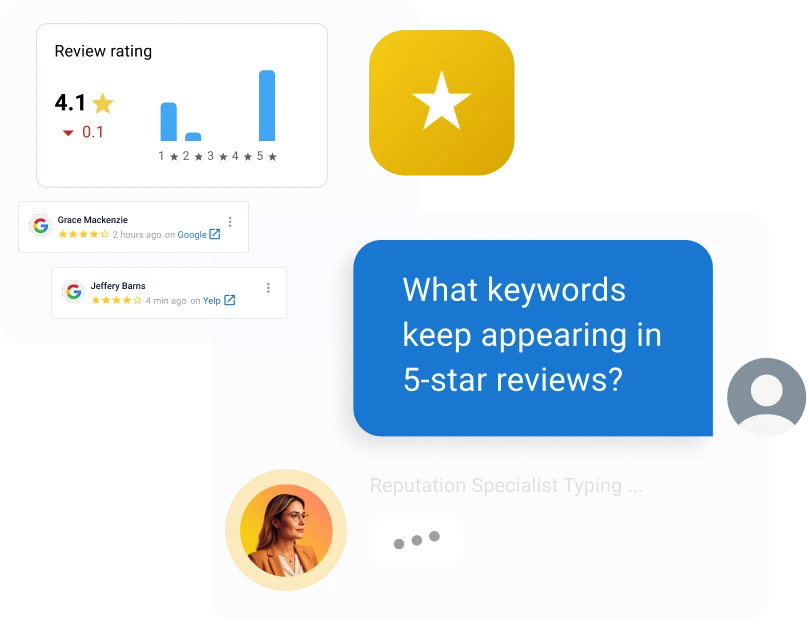
Vendasta bundles reviews with the rest of its AI customer acquisition and engagement platform, so the same account that requests reviews can also answer the phone, sync listings, and keep a sales CRM up to date. Vendasta’s Reputation AI sends automated review requests by email and SMS, triggers them from real transactions through integrations with Jobber, QuickBooks Online, and PetExec, and monitors 100+ review sources.
Best for: local service businesses that want review requests fired from completed jobs and the same platform answering missed calls, and the partners (agencies, franchisors, software companies) serving them.
AI Reputation Specialist, one of Vendasta’s AI Employees, responds to Google and Facebook reviews in the reviewer’s language under rating thresholds, delays, and approval workflows you configure. It also suggests responses for 100+ other review sources, sends review requests and NPS surveys, and answers questions about review and sentiment trends through chat. Full automation runs on the Reputation AI Premium edition. Vendasta logs every reply and request, so you can see what the AI did in Business App rather than infer it.
Reputation AI list prices run from $19 to $99 per month as part of Vendasta’s all-in-one platform, so reviews sit alongside calls, messaging, listings, and CRM instead of in a separate tool. You can try it free for 14 days with no credit card. Expert setup for the AI Reputation Specialist is available as a $129 one-time service, or as part of the $29-per-month AI Workforce Optimization Plan (12-month commitment), which includes expert setup in month one.
Partners run on spend-offset subscriptions: the Starter plan carries a $99 monthly minimum with no contract, and every dollar of product spend credits a dollar of subscription, so the platform fee drops to $0 once the partner hits the minimum.
On the listings side, Local SEO Standard syncs core profiles for free, and Listing Sync Pro extends local listings coverage to 50+ sites, or 70+ on the US premium tier. Businesses with many locations, and the agencies managing listings for them, can add Citation Builder, which submits business data to networks reaching 300+ platforms.
- Starting price: Reputation AI list prices run $19 to $99 per month as part of the all-in-one platform, with a 14-day free trial and no credit card. Partner plans for agencies, franchisors, and ISVs start at $99 per month.
- Channels: Conversations AI puts phone, web chat, SMS, WhatsApp, email, Facebook Messenger, and Instagram in one inbox, with built-in A2P SMS registration.
- Ratings: Vendasta earned 72 badges in the G2 Fall 2026 reports, including Leader in 12 categories, Momentum Leader, and Highest User Adoption.
- Documented limitation: Vendasta limits its AI Voice Receptionist to the US and Canada.
Vendasta vs Birdeye
Vendasta covers all four of Birdeye’s pillars and adds a built-in sales CRM and full white-label delivery:
| Criteria | Vendasta | Birdeye |
|---|---|---|
| Review generation | Email and SMS review requests triggered from Jobber, QuickBooks Online, and PetExec transactions; NPS surveys | Email and SMS requests |
| Listings | Local SEO Standard (free core sync); Listing Sync Pro 50+ sites, 70+ US premium; Citation Builder to 300+ platforms | Listings management across locations |
| Messaging | Seven channels in one inbox with CRM logging; built-in A2P SMS registration | Inbox, webchat, mass texting |
| AI | AI Reputation Specialist replies in the reviewer’s language with configurable thresholds; sentiment analysis; AI Receptionist voice and chat; Custom AI Employees | Review Response Agent; Review Tagging Agent; Front Desk Agent voice |
| Sales CRM | CRM AI with pipelines and an AI Sales Assistant that updates records | Integrates with external CRMs |
| White-label | Full rebrand: portal, reports, and AI Employees | Partner program with limited options |
Proof: Fred Astaire Dance Studio averaged 50 reviews per store and grew search traffic 37%, and a 43-location equipment dealer automated review responses across every location.
Pros
- Vendasta includes Reputation AI in an all-in-one platform with a 14-day trial without a card, and it integrates with Jobber, ServiceTitan, Housecall Pro, and QuickBooks.
- Seven communication channels feed one inbox with CRM logging, and partners can package and sell the AI Employees under their own brand.
Cons
- The AI Voice Receptionist serves the US and Canada only.
- Full AI Reputation Specialist automation requires the Reputation AI Premium edition.
See further breakdown here: Vendasta vs Birdeye
Podium
Podium pairs review requests with a shared text inbox and now sells a voice add-on available on any plan, including HVAC scheduling and a Note Taker mode. Pricing is quote-only, and Podium’s Partner Program Terms explicitly prohibit white-labeling, so agencies cannot resell it under their own brand. Best for: single- and multi-location service businesses that want texting and phone answering from one vendor and do not need agency branding.
Podium is among the few platforms here with detailed compliance documentation. Its policy requires opt-out keywords such as STOP in the initial message, offers in-app guided A2P 10DLC registration, and incorporates a BAA for HIPAA covered entities. Release 25.9 added a Healthcare Privacy Mode for AI review responses.
- Starting price: Podium does not publish a rate; you request a quote on its pricing page.
- Channels: Podium runs SMS and a shared inbox with a voice AI add-on. Its API creates Google review invites using Google channel values.
- Ratings: Podium scores 4.6/5 on G2 (1,913 reviews) and 4.2/5 on Capterra (526 reviews).
- Documented limitation: Podium’s partner terms prohibit white-labeling, and Podium does not publish listings management.
Podium vs Birdeye
Podium matches Birdeye on messaging and voice but not on published pricing transparency, since both sell by quote:
| Criteria | Podium | Birdeye |
|---|---|---|
| Review generation | Text invites; Google channel via API | Email and SMS requests; direct Google review links |
| Listings | Not published by the vendor | Listings management across locations |
| Messaging | Shared text inbox; Intent Routing categorizes conversations | Inbox, webchat, mass texting at extra cost |
| AI | Review reply suggestions (Core), full AI responses (Pro), voice AI add-on | Review Response Agent, Review Tagging Agent, Front Desk Agent voice |
What users say: Podium’s scores rest on the second-largest peer review base here, so they reflect deployment across many industries rather than one niche.
Pros
- Podium offers Voice AI on any plan and incorporates a HIPAA BAA into its standard legal terms.
- It provides in-app 10DLC registration with required opt-out language.
Cons
- Podium publishes no pricing and prohibits partner white-labeling.
- It also documents no dedicated review sentiment scoring or auto-tagging.
Reputation.com
Reputation.com publishes per-location pricing at three tiers: Rep Core at $80 per location per month, Rep Core plus Pulse at $115, and Rep Core plus Surveys at $150, with custom pricing above 125 locations. Its Post Review Link feature is non-optional, which means every customer receives the same public review options and the platform enforces anti-gating through product design rather than contract language. Best for: multi-location operators up to 125 locations, above which pricing goes custom, that want location-level sentiment scoring and predictable per-site cost.
The AI stack goes beyond reply drafting. Experience Insights scores category sentiment on a 0–100 scale, ReputationIQ answers natural-language questions about review data, and Voice of Brand replies added four EU languages. Every outbound SMS carries a mandatory “Reply STOP to Unsubscribe” line.
- Starting price: Rep Core costs $80 per location per month.
- Channels: Reputation.com sends SMS review requests with an optional YES-reply opt-in and offers one-step and two-step review flows.
- Ratings: Reputation.com scores 4.6/5 on G2 (2,343 reviews) and 4.4/5 on Capterra (184 reviews).
- Documented limitation: Reputation.com treats white-label dashboards as non-standard features available only on request, and its 10DLC support covers carrier fee pass-through only.
Reputation.com vs Birdeye
Reputation.com leads on analytics depth and published pricing; Birdeye leads on voice:
| Criteria | Reputation.com | Birdeye |
|---|---|---|
| Review generation | Post Review Link, one-step or two-step flow | Email and SMS requests |
| Listings | Not published by the vendor | Listings management across locations |
| Messaging | SMS with mandatory STOP line | Inbox, webchat, mass texting |
| AI | Voice of Brand replies with brand-consistency score; 0–100 sentiment; ReputationIQ queries | Review Response Agent; Front Desk Agent voice |
What users say: Reputation.com carries more peer reviews than any other option here at 2,343 on G2, weighted toward enterprise and multi-location buyers.
Pros
- Reputation.com publishes three per-location tiers and provides category sentiment scoring on a 0–100 scale.
- It also offers a HIPAA addendum with a BAA under NDA.
Cons
- Reputation.com documents no voice AI and provides custom dashboards only on request.
- Its $80 per-location price can also exceed flat-priced tools for one-location operators.
BrightLocal
BrightLocal is the cheapest published entry point on this list, with Track at $31, Manage at $40, and Grow at $49 per location per month, and annual billing saves 25%. The Grow plan monitors 80+ review sites, sends review requests by email, SMS, and in-store, and adds local rank tracking and a Google Business Profile (GBP) post scheduler. Best for: single-location owners who want reviews and local search tracking in one login and can live without a messaging inbox.
The tradeoffs sit in scale and branding. Multi-location accounts require a custom plan, and while white-label reports come with every paid plan, BrightLocal’s white-label FAQ confirms reports cannot run on an agency’s own domain. AI reply assistance is capped at three responses per review per 24 hours.
- Starting price: Track costs $31 per location per month, and Grow at $49 includes AI reply help.
- Channels: BrightLocal sends email, SMS, and in-store review requests, and replies go directly to Google and Facebook only.
- Ratings: BrightLocal scores 4.6/5 on G2 (227 reviews) as reported, and 4.8/5 on Capterra (283 reviews).
- Documented limitation: Reconnecting a profile replaces all previously held reviews in the Reputation Manager report with a fresh pull, so historical Birdeye exports cannot be imported.
BrightLocal vs Birdeye
BrightLocal wins on price and trial access; Birdeye wins on messaging and AI breadth:
| Criteria | BrightLocal | Birdeye |
|---|---|---|
| Review generation | Email, SMS, in-store campaigns; review widget | Email and SMS requests |
| Listings | Local rank tracking and GBP post scheduler; no directory sync published | Listings management across locations |
| Messaging | SMS requests with automatic suppression after STOP; no inbox | Inbox, webchat, mass texting |
| AI | Reply assistance (three per review per 24 hours); AI Insights on Grow | Review Response Agent; tagging; voice |
What users say: BrightLocal rates higher on Capterra (4.8) than on G2 (4.6), and its reviewer base skews toward agencies and solo operators rather than enterprise teams.
Pros
- BrightLocal costs $31 to $49 per location and offers a 14-day trial without a card.
- It bundles local rank tracking with review management and automatically suppresses SMS after recognized opt-outs.
Cons
- BrightLocal offers no messaging inbox or voice AI, and reports cannot run on your own domain.
- The vendor also does not confirm 10DLC registration support.
ReviewTrackers
ReviewTrackers builds its case on analytics and contract clarity. Its Terms of Service state that “Review gating by you is strictly prohibited,” one of the few platforms here with an explicit contractual clause, and its Experience Analysis uses a proprietary NLP engine to categorize review themes automatically. Best for: businesses that want theme-level reporting and a vendor that prohibits gating in its terms.
Pricing is the weak spot. The official plans page uses a dynamic slider that does not display a dollar figure, and the roughly $89 per location per month figure comes from a G2 comparison page rather than ReviewTrackers directly. ReviewTrackers also requires a human to proofread every AI-generated response before posting, which keeps a person in the loop but rules out unattended auto-reply.
- Starting price: ReviewTrackers runs about $89 per location per month on annual terms, as reported by G2; the official page requires a quote.
- Channels: ReviewTrackers sends review requests and supports dashboard replies as a self-described Google My Business Featured Partner.
- Ratings: ReviewTrackers scores 4.6/5 on G2 (161 reviews) and 4.7/5 on Capterra (172 reviews).
- Documented limitation: ReviewTrackers requires a human to proofread every AI-generated response before posting.
ReviewTrackers vs Birdeye
ReviewTrackers trades Birdeye’s automation for analytics and a stricter contract:
| Criteria | ReviewTrackers | Birdeye |
|---|---|---|
| Review generation | Requests with recommended unchecked opt-in checkbox | Email and SMS requests |
| Listings | Not published by the vendor | Listings management across locations |
| Messaging | Opt-out language recommended, not automated | Inbox, webchat, mass texting |
| AI | AI Review Response (Starter and Essential); NLP categorization; human proofreading required | Review Response Agent with approval rules; voice |
What users say: ReviewTrackers’ feedback sits in the low hundreds on both sites, so weigh a trial and a demo more heavily than the score.
Pros
- ReviewTrackers combines a contractual anti-gating clause with automatic theme categorization through its proprietary NLP engine.
- Agencies can also request a white-label option with a multi-tenant account structure.
Cons
- The official page publishes no price.
- ReviewTrackers documents neither a voice product nor automated SMS opt-out handling.
NiceJob
NiceJob prices per business rather than per location: Starter at $75 per month and Pro at $125, no contract, with a 14-day free trial. Starter automates review requests and follow-ups by SMS and email, posts new reviews to Facebook and X, and connects to CRM and field-service platforms; Pro adds AI Replies, referral campaigns, net promoter score (NPS) surveys, and competitive intelligence. Best for: home-services businesses that want review requests to fire from their CRM or field-service software after each completed job without a per-location bill.
The AI has narrow edges. NiceJob’s AI Replies page documents that replies run once daily at roughly 6 p.m. Eastern and cannot address historical reviews, and the help center confirms NiceJob cannot edit a response once it posts to Google. Feedback Routing offers every customer both a feedback form and a public review link, which keeps the flow compliant with Google’s anti-gating policy.
- Starting price: Starter costs $75 per month flat and Pro costs $125 per month.
- Channels: NiceJob sends SMS and email requests and auto-posts reviews to social, with a Sites add-on at $99/mo plus $199 setup.
- Ratings: NiceJob scores 4.8/5 on G2 (369 reviews) and 4.9/5 on Capterra (203 reviews).
- Documented limitation: NiceJob cannot edit review responses once they post to Google.
NiceJob vs Birdeye
NiceJob undercuts Birdeye on price and contract terms while giving up the inbox and voice:
| Criteria | NiceJob | Birdeye |
|---|---|---|
| Review generation | Automated SMS and email requests and follow-ups; widgets; Feedback Routing | Email and SMS requests |
| Listings | Not published by the vendor | Listings management across locations |
| Messaging | No inbox; opt-outs handled by manual unenroll or block | Inbox, webchat, mass texting |
| AI | AI Replies on Pro with configurable tone; Topic Insights; AI Leads listed as coming soon | Review Response Agent; tagging; Front Desk Agent voice |
What users say: NiceJob holds the highest ratings on this list on both G2 (4.8) and Capterra (4.9), and it is one of the few options here you can leave after a month.
Pros
- NiceJob charges a flat $75 or $125 with no contract and holds the highest G2 and Capterra ratings in this list.
- CRM and field-service integrations can trigger requests from completed jobs.
Cons
- NiceJob documents no 10DLC registration or automated opt-out handling.
- AI replies run once daily, skip older reviews, and do not yet include a launched voice product.
GatherUp
GatherUp sells at $99 per month for one location and drops to $60 per location for two to ten, with annual billing saving 20%. Each location gets 300 SMS and 3,000 email credits per month, unlimited users, and monitoring across 100+ review sites, and its current Terms of Use prohibit “any form of review gating” with a same-options mandate. Best for: two- to ten-location businesses that want per-location pricing that drops at scale, and the agencies serving them, since GatherUp is 100% white-labeled with custom domains and lets the agency set client prices.
AI coverage is broad but layered. SmartReply drafts responses, Suggested Replies in beta routes negative feedback for email approval, and Auto Reply Templates fire automatically for positive reviews only, up to 50 templates. Auto-Tagging and Smart Insights on Pro and above surface the top 10 recurring themes and emerging topics. A separate Review Defense product runs $50, $150, or $375 per month.
- Starting price: GatherUp charges $99 per month for one location and $60 per location per month for 2–10.
- Channels: GatherUp sends SMS and email requests and offers Web-to-Text, which is unavailable during the trial.
- Ratings: GatherUp scores 4.5/5 on G2 (50 reviews) and 4.6/5 on Capterra (41 reviews).
- Documented limitation: Auto Reply Templates do not send for negative reviews, and the 14-day trial requires a card afterward and excludes SMS marketing.
GatherUp vs Birdeye
GatherUp matches Birdeye’s contractual anti-gating stance and adds agency branding with published pricing:
| Criteria | GatherUp | Birdeye |
|---|---|---|
| Review generation | Ratings & Review Flow (two-step); 300 SMS and 3,000 email credits per location | Email and SMS requests |
| Listings | Not published by the vendor | Listings management across locations |
| Messaging | SMS, email, Web-to-Text | Inbox, webchat, mass texting |
| AI | SmartReply; Suggested Replies (beta); Auto Reply Templates (positive only); Auto-Tagging on Pro+ | Review Response Agent; Review Tagging Agent; voice |
What users say: GatherUp’s 4.5 and 4.6 scores rest on roughly 50 and 41 reviews, the thinnest base among the rated platforms here.
Pros
- GatherUp publishes prices that fall at scale and offers full white-label branding with custom domains.
- Its current terms also prohibit review gating while its two-step flow gives every customer the same review options.
Cons
- GatherUp has the smallest G2 and Capterra review base in this list and documents no voice product.
- It also does not publish consent-capture, 10DLC, or BAA tooling.
Yext
Yext sells per location and quote-only, with Generative Review Response gated behind a separate Review Response subscription. Best for: chains where listings accuracy across locations comes first and review response comes second.
Yext’s Generative Review Response accepts up to 5,000 characters of brand instructions, supports Few Shot Training on your best replies, and can post automatically or route to approval. Yext has a Sentiment Analysis module, and it applies large language model (LLM) summarization to the latest 100 reviews. Review Labeling Rules tag reviews by rule. First-party reviews can remain in quarantine for up to 120 days, which applies to Yext’s own review pages rather than filtering public Google reviews by sentiment.
- Starting price: Yext does not publish a price; its FAQ describes negotiated per-location pricing.
- Channels: Yext covers review generation and response, and it does not publish messaging channels.
- Ratings: Yext scores 4.4/5 on G2 (~1,124 reviews) as reported, and 4.2/5 on Capterra (114 reviews).
- Documented limitation: Generative replies require a separate Review Response subscription, and Yext documents no voice product.
Yext vs Birdeye
Yext leads Birdeye on listings reach and reply customization; Birdeye leads on messaging and voice:
| Criteria | Yext | Birdeye |
|---|---|---|
| Review generation | Review Generation with 120-day first-party quarantine option | Email and SMS requests |
| Listings | Listings sold per location | Listings management across locations |
| Messaging | Not published by the vendor | Inbox, webchat, mass texting |
| AI | Generative replies with 5,000-character brand instructions and Few Shot Training; LLM summarization; Review Labeling Rules | Review Response Agent; tagging; voice |
What users say: Yext’s 4.4 on G2 and 4.2 on Capterra trail most of this list, and its reviewer base is weighted toward large chains.
Pros
- Yext sells listings per location alongside review tooling and lets teams train generative replies on strong examples.
- Reseller partners can also request white-label options.
Cons
- Yext sells by quote and ties for the lowest Capterra rating in this list at 4.2.
- The vendor confirms neither a voice product nor a texting inbox.
Swell
Swell builds for healthcare, and its AI review drafting is HIPAA-compliant as a native capability rather than an add-on. A human reviews every draft before posting, sentiment classification flags emotionally charged comments, and thematic clustering breaks feedback down by location and provider. Best for: dental, medical, and specialty practices that need patient-safe drafting and provider-level reporting.
Swell’s workflow sends a survey first and then a public review link, with low-star responses opening a ticket after the review rather than filtering before it. Pricing is per location and quote-only, and Swell does not publish its consent-capture or BAA documentation, so ask for the compliance package in writing during the sales call.
- Starting price: Swell does not publish a price; you request a per-location quote on its pricing page.
- Channels: Swell runs a survey-to-review flow and does not publish its messaging channels.
- Ratings: Swell scores 9.0/10 on G2 (256 reviews), roughly 4.5/5 on the standard scale, and 4.6/5 on Capterra (358 reviews).
- Documented limitation: A human must review every AI draft before posting, and Swell has no voice product.
- How to read the ratings: G2 uses a ten-point scale for Swell, so divide the score by two before comparing it with the five-point scores elsewhere on this list.
Swell vs Birdeye
Swell is narrower than Birdeye by design, trading breadth for healthcare fit:
| Criteria | Swell | Birdeye |
|---|---|---|
| Review generation | Survey, then public review link; post-review low-star ticketing | Email and SMS requests |
| Listings | Not published by the vendor | Listings management across locations |
| Messaging | Not published by the vendor | Inbox, webchat, mass texting |
| AI | HIPAA-native draft generation with human approval; sentiment and emotion flags; clustering by provider | Review Response Agent; Myna for healthcare; voice |
What users say: Swell’s 358 Capterra reviews outnumber its G2 base, and both skew toward dental and medical practices.
Pros
- Swell builds HIPAA-compliant drafting into the platform and provides thematic clustering by provider.
- It also offers a wholesale partner model.
Cons
- Swell sells only by quote and confirms neither a voice product nor a messaging inbox.
- Its consent-capture and BAA terms also remain unpublished.
Grade.us
Grade.us publishes $99 per month for a single business with unlimited review sites, email request campaigns, basic white-labeling, and scheduled reports, with a 14-day trial that needs no card and annual billing that saves 20%. Its contract includes an explicit anti-gating clause and its request flow is feedback-first. Best for: single-location owners and agencies that want a low-cost, contract-protected review tool they can run on their own domain.
For a single-location owner, $99 buys review monitoring and email request campaigns across an unlimited number of review sites, though the supplied plan documentation does not confirm AI reply drafting. Agency plans start at $400 per month for 10 or more seats, premium dashboard white-labeling adds $440 per year with CNAME support that puts the client dashboard on your subdomain, and independent partner users require a 10-seat minimum.
- Starting price: Grade.us charges $99 per month, with Agency plans from $400 per month.
- Channels: Grade.us runs email review request campaigns and does not publish SMS support.
- Ratings: Grade.us scores 4.6/5 on G2 (143 reviews) and 4.8/5 on Capterra (244 reviews).
- Documented limitation: The premium white-label dashboard is a paid add-on restricted to Agency plans.
Grade.us vs Birdeye
Grade.us covers review generation and monitoring at a fixed price and leaves the rest of Birdeye’s stack alone:
| Criteria | Grade.us | Birdeye |
|---|---|---|
| Review generation | Email campaigns; feedback-first flow; unlimited review sites | Email and SMS requests |
| Listings | Not published by the vendor | Listings management across locations |
| Messaging | Email only confirmed | Inbox, webchat, mass texting |
| AI | AI reply generation not confirmed in the supplied plan documentation | Review Response Agent; tagging; voice |
What users say: Grade.us scores 4.8 on Capterra across 244 reviews, high for a tool at this price point.
Pros
- Grade.us publishes a $99 price and offers a trial without a card.
- Its contract prohibits review gating, and Agency plans support client dashboards on your own subdomain through CNAME.
Cons
- The supplied plan documentation confirms neither AI replies nor SMS or inbox messaging.
- Independent partner users also face a 10-seat minimum.
Do Alternatives Match Birdeye’s AI, and Do Reviews Still Post to Google
Most platforms above draft review replies, but AI reply generation remains unconfirmed in the supplied Grade.us plan documentation. Birdeye moved its Review Response Agent into standard Reviews plans in September 2026, with configurable approval for reviews under three stars, then added Review Tagging Agent and Front Desk Agent across voice, chat, text, and email. TrustRadius reviewers temper the picture: “AI replies can sound robotic at times,” and several describe editing repetitive drafts by hand.
Platforms that leverage AI to suggest a response for customer reviews split into three levels of depth.
- Reply generation with limited analytics: BrightLocal drafts replies and adds AI Insights on Grow but documents no per-review sentiment scoring. Grade.us does not confirm AI reply generation in the supplied plan documentation.
- Reply generation plus sentiment scoring or theme tagging: NiceJob, Reputation.com, ReviewTrackers, GatherUp, Yext, Swell, and Vendasta add a second analytical layer on top of drafting.
- Reply generation plus a voice agent and AI Workforce: Vendasta’s AI agents, called AI Employees, pair review replies with call and chat answering, appointment booking, social publishing, and CRM updates. Podium adds a voice agent to its texting inbox.
If your goal is catching a one-star spike before it becomes a reputation crisis, the middle tier’s sentiment alerts matter more than reply speed.
On Google syndication, the answer is uniform. Google’s Business Profile API exposes only list, get, deleteReply, and updateReply for reviews, so no vendor can post a customer review into Google’s corpus. Birdeye, Podium, BrightLocal, ReviewTrackers, NiceJob, and every other option can send a Google review-request link, read reviews, and post your reply, but the customer must submit through Google’s own form. BrightLocal states plainly that adding review schema to your website will not transfer website reviews to Google, and Google can independently display labeled third-party reviews on a profile without the business choosing the source.
How to Choose the Right Birdeye Alternative
Pick by location count first, then by which Birdeye feature you cannot lose. A one-location electrician needs flat pricing and job-triggered requests; a 12-location dental group needs per-location reporting and a BAA; an agency needs its own domain on the client portal.
Budget Considerations
Buyers who calculate per-location costs can change the ranking quickly. At one location, BrightLocal Grow ($49), NiceJob Starter ($75), GatherUp ($99), and Grade.us ($99) all publish a price you can check before signing, which Birdeye’s quote-only annual agreement does not. At five locations, GatherUp costs $300 a month and Reputation.com Rep Core costs $400, while NiceJob and BrightLocal require custom multi-location pricing.
Buyers should also compare annual discounts: BrightLocal saves 25% on annual billing, while GatherUp and Grade.us save 20%. Vendasta Reputation AI list prices run from $19 to $99 per month as part of an all-in-one platform that also covers calls, messaging, listings, and CRM, so one subscription can replace several point tools. You can test it with a 14-day free trial and no card.
Factor in what Birdeye charges separately. Capterra reviewers flag mass texting as an extra cost, and Birdeye passes 10DLC carrier fees through, so compare total monthly outlay rather than base price.
Migration Considerations
Leaving Birdeye cleanly is a sequence, and the order protects both your review history and your texting compliance. Birdeye’s help center documents the export paths, and the SMS consent step comes from carrier industry rules rather than Birdeye:
- Read your signed order form for an early opt-out clause; without one, Birdeye closes accounts only at term end. Send written non-renewal notice at least 90 days before the renewal date (email to legal@birdeye.com is accepted per the terms), keep delivery confirmation, and calendar the date.
- Export reviews from Reviews → Bulk Actions → Download as XLS, which covers up to 40,000 reviews; the PDF option holds only the top 100. Download Review Reports from Reports → Reviews in XLS, PDF, PPT, or PNG.
- Export contacts from Contacts → More → Download contacts. Clear every filter first, because Birdeye downloads only the filtered contacts visible on screen.
- Copy inbox templates by hand. Birdeye’s help center documents no template export.
- Export your full opt-out and suppression history, then import it into the new platform before any active contact list, and confirm suppressed numbers are blocked.
- Remove Birdeye as a manager under Business Profile settings → People and access, revoke its app access at myaccount.google.com/permissions, and remove the Birdeye integration under Facebook Settings → Business integrations.
- Connect Google and Facebook in the new platform through its sign-in flow. BrightLocal re-pulls live reviews and replaces prior report data; Podium accepts CSV contact files under 5MB and 100,000 rows; NiceJob needs name and email columns at minimum.
- Re-collect SMS consent under the new sender before any campaign runs.
Step 8 is the one owners skip. The messaging principles from CTIA, the US wireless industry association, state that a consumer opt-in applies only to the specific message sender that obtained it and is not transferable. Keep the historical consent log with timestamps, medium, and exact language; FTC telemarketing rules require five-year retention, and the Federal Communications Commission (FCC) requires do-not-call requests be honored for five years. Plan the cutover so the new platform runs in parallel during your final Birdeye month, because one TrustRadius practitioner described not noticing for months that a client’s review-request setup had drifted out of sync after an integration broke.
Review Gating, FTC Rules, and SMS Compliance Before You Switch
Review requests must follow public-review solicitation and commercial text-message rules. Healthcare requests must also protect health information. Check all three areas before moving a contact list or turning on an automated campaign.
Review Gating Rules
Review gating means sending the public review link only to customers who rate you highly. It can now cost up to $53,088 per violation under the FTC’s civil-penalty adjustment for the Consumer Reviews and Testimonials Rule, 16 CFR Part 465. The FTC’s rule guidance explains that the rule prohibits suppressing reviews by rating and then implying the displayed set is representative, and that selectively soliciting only satisfied customers “could violate the FTC Act” as an unfair or deceptive practice. The FTC sent warning letters to 10 companies in December 2025 and finalized a $750,000 order against TruHeight’s parent in July 2026.
Google enforces the same line. Its contribution policy bars merchants from discouraging negative reviews or selectively soliciting positive ones, with penalties that include losing the ability to receive new reviews for a period. Search Engine Land reported a 2026 update adding undisclosed incentivized reviews to Google’s structured-data guidelines.
Platform stances split between contract and product design:
- Contractual prohibition: Birdeye, ReviewTrackers, and GatherUp state in current terms that customers cannot implement any form of review gating.
- Feedback-first flow that still offers everyone the public link: Reputation.com’s Post Review Link, BrightLocal’s Enable Additional Feedback setting, NiceJob’s Feedback Routing, GatherUp’s two-step flow, and Swell’s survey-then-link sequence.
- Policy in documentation only: Podium and Yext warn against gating in help content or blogs rather than in terms.
SMS Consent and Opt-Out Rules
SMS review requests carry their own rules. Under 47 CFR § 64.1200, marketing texts require prior express written consent, and businesses cannot send messages before 8 a.m. or after 9 p.m. local time.
The FCC’s revocation order recognizes STOP, QUIT, END, REVOKE, OPT OUT, CANCEL, and UNSUBSCRIBE as per se opt-outs that businesses must honor within 10 business days, with most provisions in force since April 11, 2025. Texas, Virginia, and Oregon added state text-message rules in 2025 and 2026, and Virginia requires businesses to honor STOP requests for at least 10 years.
Under carrier rules, unverified brands cannot register A2P 10DLC campaigns through The Campaign Registry, and opt-in plus STOP handling is mandatory. Podium and Birdeye both document in-app registration, and Vendasta’s Conversations AI includes built-in A2P SMS registration.
HIPAA Requirements for Healthcare
Healthcare adds HIPAA. Guidance from the US Department of Health and Human Services (HHS) treats a patient name combined with an appointment reference as protected health information (PHI), so a review request text that says “Thanks for your cleaning today, Maria” is PHI in transit.
You need a BAA from the platform. BAA availability varies by vendor:
- Birdeye: BAA on request.
- Podium: BAA incorporated into its terms.
- Reputation.com: BAA under NDA.
- ReviewTrackers: BAA on request.
- Swell: markets HIPAA-native drafting but does not publish its BAA terms.
- BrightLocal: points to a HIPAA help article without published BAA terms.
- NiceJob, GatherUp, and Yext: no published BAA documentation, so a practice should ask before signing.
Final Recommendations
The best Birdeye alternative depends on how many locations you run and which compliance rules apply to you. For most local businesses, and the agencies and franchisors serving them, Vendasta is the strongest choice: one platform where AI Employees respond to reviews, answer calls, keep listings accurate, and log every action so you can see the results. If you only need one piece, here is where the point tools fit:
- Single location: Vendasta if you want reviews, calls, and listings handled together, with Reputation AI from $19 per month inside the all-in-one platform; NiceJob Starter at $75 flat with no contract, or BrightLocal Grow at $49 if you only need reviews and local rank tracking. All three offer 14-day trials.
- Multi-location: Vendasta to deploy AI Employees across every location from one account, with account templates for consistency and roll-up reporting; Reputation.com at $80 per location if you want per-location sentiment scoring on its own; Yext if listings accuracy is the only problem.
- Agency needing white-label: Vendasta to package, brand, and sell AI Employees like the AI Reputation Specialist as your own service, buying at up to 80% off list and setting your own prices, with no contract to start; GatherUp for custom domains and agency-set pricing at $60 per location; Grade.us for a published agency tier. Podium is excluded by its own partner terms.
- Healthcare: Swell for HIPAA-native drafting with provider-level clustering, or Podium for a BAA incorporated into standard terms plus Healthcare Privacy Mode.
- Home services: Vendasta if you want review requests fired from completed Jobber and QuickBooks Online jobs and an AI Receptionist that books the 10 p.m. call you miss on a ladder; NiceJob if you only need review requests at a flat price. Podium’s voice AI includes HVAC scheduling.
Reputation management and SEO reinforce each other, so whichever platform you pick, confirm it keeps your listings accurate for every location you add.
Why Vendasta Is a Strong Birdeye Alternative
Birdeye’s strongest features, automated replies and a messaging inbox, come bundled with quote-only pricing and a 90-day renewal window. Vendasta Reputation AI covers the same review work as part of an all-in-one platform, with a 14-day trial and no credit card.
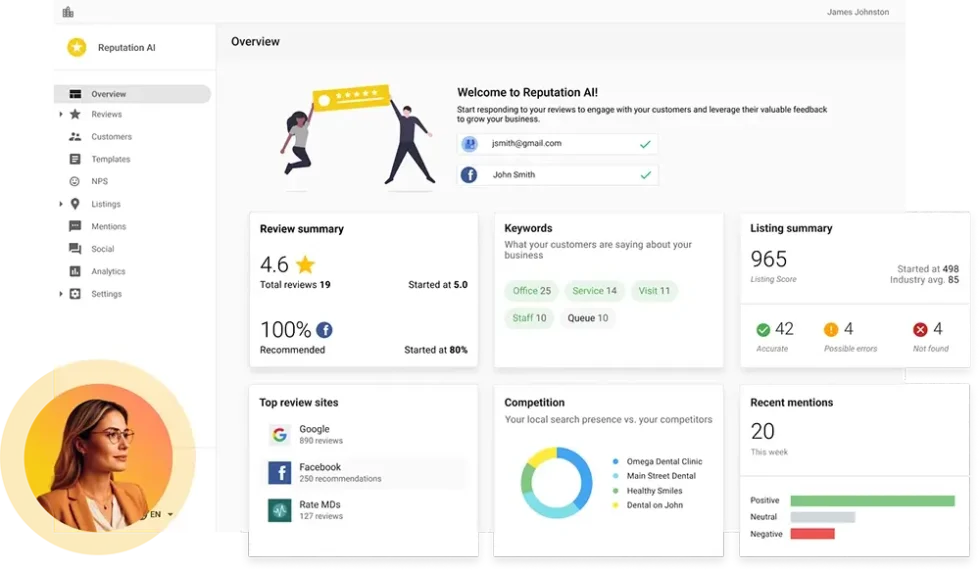
Inside it, AI Reputation Specialist answers Google and Facebook reviews in the reviewer’s language under thresholds you set, suggests responses for 100+ other review sources, sends review requests triggered from Jobber and QuickBooks Online transactions, and runs NPS surveys. Vendasta logs every reply and request, giving you proof of performance rather than an unsupported automation claim, and the same platform adds a sales CRM, a seven-channel inbox, and listings management, whether you run the business yourself or deliver it to clients under your own brand.
Fred Astaire Dance Studio averaged 50 reviews per store and grew search traffic 37% on the platform, and agency partner Blue River Digital generated 21 five-star reviews in 30 days for an auction house client. To see how the AI Reputation Specialist can address this workflow in your business, book a Vendasta demo.
Birdeye Alternatives FAQs
1. How much does Birdeye cost per month?
Birdeye publishes no rate card. Its pricing page shows six location bands from 1–3 to 1000+, each leading to a quote form, and its own cost blog states there is no fixed pricing. User-reported figures commonly put it around $299 per location per month, which Birdeye does not confirm. Annual agreements are standard, and renewals add an 8% Innovation Fee.
2. Is Birdeye legit and trustworthy?
Birdeye is an established platform rated 4.7/5 across 4,234 G2 reviews, with 86% of them five stars. Complaints concentrate on contracts and billing: the BBB shows 104 complaints over three years, with Order Issues the largest category. The software works; the risk sits in the 90-day non-renewal notice and auto-renewal terms.
3. Does Birdeye post my reviews to Google?
No platform can. Google’s Business Profile API exposes only list, get, deleteReply, and updateReply methods for reviews, so Birdeye and every alternative can send review-request links, read reviews, and post owner replies, but the customer must submit the review through Google’s own form. Reviews collected on a vendor’s site stay there.
4. Do Birdeye alternatives have the same AI features?
Many do, but not every platform confirms AI reply generation. NiceJob, Reputation.com, Yext, ReviewTrackers, Swell, GatherUp, and Vendasta add sentiment scoring or theme tagging. Vendasta goes furthest: its AI agents, called AI Employees, answer calls and chats, book appointments, and update the CRM in addition to responding to reviews. Podium also sells voice as an add-on.
5. Why do businesses leave Birdeye?
Verified low-star reviews cluster on four issues: cancellation requests that went unacknowledged while billing continued, renewal pricing that rose 8%, support tickets that took days or weeks to resolve, and features promised in sales that arrived months later. Pricing that feels high for local operators is the most common Capterra complaint.
6. What is the best Birdeye alternative for multi-location businesses?
Vendasta deploys the AI Reputation Specialist and AI Receptionist across every location from one account, with account templates for consistency and roll-up reporting across locations; a 43-location equipment dealer automated review responses this way. Reputation.com publishes a clear per-location price at $80 per location per month for Rep Core, with custom pricing above 125 locations. Yext fits chains that prioritize listings but sells by quote. GatherUp drops to $60 per location for two to ten locations, and Swell clusters feedback by location and provider.
7. Which Birdeye alternative offers white-label for agencies?
GatherUp and Grade.us offer white-label client portals on the agency’s own domain, and Grade.us charges $440 per year extra for premium dashboard branding on Agency plans. Vendasta lets partners deliver its platform and AI Employees under their own brand and set their own retail prices. Podium’s partner terms prohibit white-labeling entirely, while BrightLocal provides white-label reports that cannot sit on your domain.
8. Is there a free or cheap Birdeye alternative for a single location?
Vendasta Reputation AI starts at $19 per month as part of an all-in-one platform, with a 14-day free trial and no card. Google Business Profile is free and covers Google review replies plus a shareable request link, and Trustindex and Trustpilot have permanent free tiers with limits. Among other paid tools, BrightLocal starts at $31 per location, NiceJob at $75 flat with no contract, and GatherUp and Grade.us at $99, all with 14-day trials.
9. How do I cancel Birdeye and how much notice is required?
Birdeye requires 90 days’ written notice before your renewal date, or the contract renews for the same term. Early closure is possible only if your signed agreement includes an opt-out clause. Send notice in writing, keep delivery confirmation, and calendar the renewal date, since verified reviews describe billing continuing after cancellation requests.
10. How do I migrate my reviews and contacts from Birdeye?
Download reviews from Reviews → Bulk Actions → Download as XLS, which covers up to 40,000 reviews. Export contacts from Contacts → More → Download contacts after clearing every filter. Copy inbox templates manually since no export exists. Then reconnect Google and Facebook in the new platform and re-collect SMS opt-ins under the new sender.