
Your business is investing time and budget into customer engagement, but many tools are disjointed, complex, and don’t deliver meaningful results.
Meanwhile, competitors are adopting modern AI-powered solutions that deliver personalized experiences, boost loyalty, and drive customer lifetime value, leaving your business behind.
In this article, you’ll get a clear roadmap for identifying, comparing, and adopting the best AI tools for customer engagement. You’ll learn what capabilities matter most and how to choose a platform that helps you build stronger, more consistent customer relationships.
Automate the entire customer journey from first touch to repeat business
TL;DR
- AI helps businesses engage customers more effectively by automating personalization, predicting behavior, and improving retention.
- Specialized AI tools can support different stages of the customer journey from awareness to advocacy.
- Vendasta brings it all together, providing an all-in-one AI platform that simplifies customer acquisition and engagement.
Why AI Matters More Than Ever for Customer Engagement
What Customer Engagement Means Today
Customer engagement has evolved far beyond marketing campaigns and support emails. It now represents the continuous relationship between your business and your customers, defined by every touchpoint from their first interaction to their tenth purchase and beyond.
In the past, engagement was often measured by clicks or transactions. Today, it’s about creating meaningful, consistent, and personalized experiences that build loyalty and trust over time.
Customers expect businesses to understand their needs, anticipate their questions, and provide value at every stage of their customer journey.

Modern customer engagement focuses on:
- Personalization: 71% of consumers expect personalized interactions, and 76% get frustrated when they don’t receive them (McKinsey, 2024). AI tools help by analyzing behavior, preferences, and purchase history to deliver relevant messages automatically.
- Omnichannel Experiences: Customers want to engage across multiple platforms (email, social media, chat, voice, and SMS) and expect a seamless transition between them. AI enables consistency across these channels by syncing data and automating responses.
- Real-Time Responsiveness: Patience is shrinking. According to HubSpot, 90% of consumers expect an immediate response to customer service questions. AI chatbots and predictive tools make it possible to deliver 24/7 engagement without adding staff.
- Emotion and Empathy: Beyond efficiency, customers seek authentic human-like interactions. AI sentiment analysis helps detect emotions in feedback or messages, enabling businesses to respond more empathetically.
- Continuous Value Delivery: Engagement doesn’t end after a sale. AI-powered retention and loyalty systems ensure customers continue to see value, helping reduce churn and increase lifetime value.
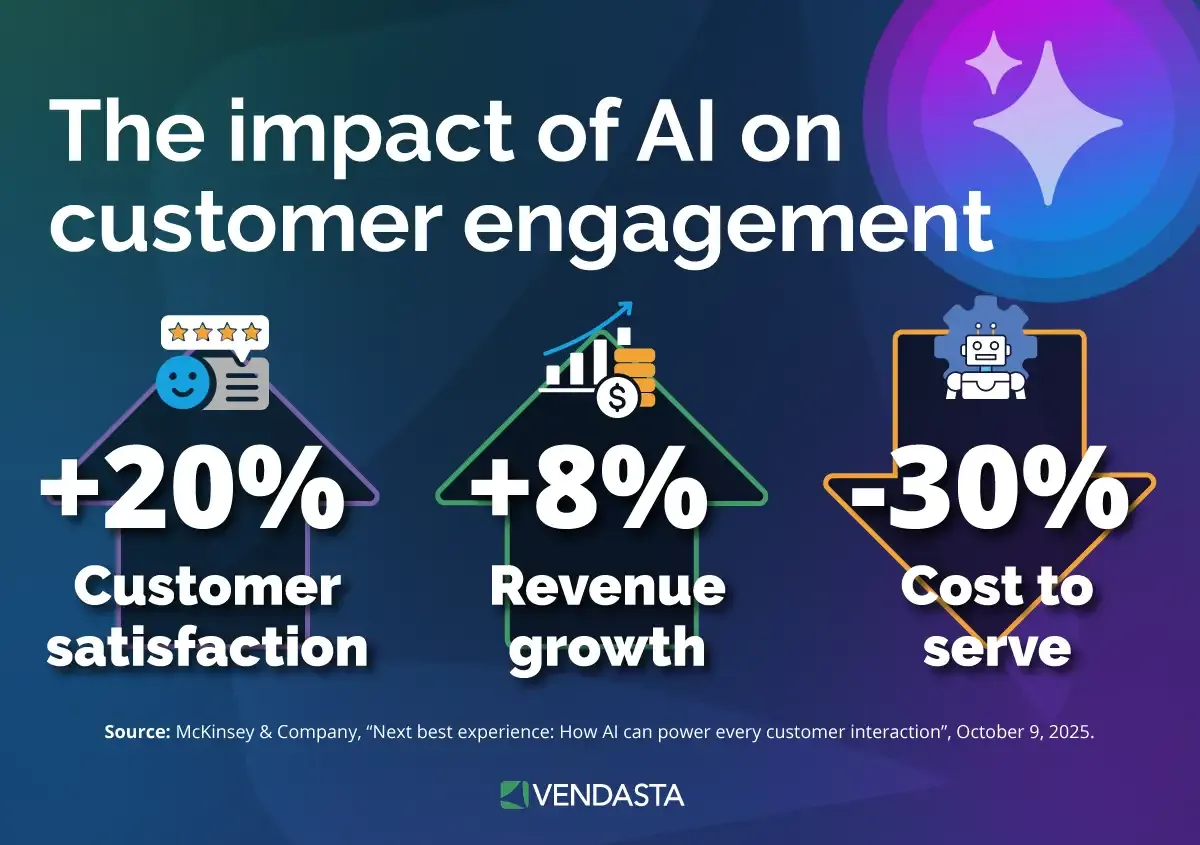
AI plays a major role in this evolution. According to McKinsey, companies that use AI in their customer engagement strategies see up to a 20% increase in customer satisfaction, up to 8% revenue increase, and up to 30% reduction in cost to serve.
Key takeaway: Customer engagement today isn’t about one-off interactions. It’s about orchestrating a connected experience where every conversation, campaign, and touchpoint works together to build trust and loyalty.
The Key Components of Customer Engagement
Every customer engagement strategy can be viewed as a journey that unfolds in five key stages. Each stage represents an opportunity for your business to use AI to create personalized, consistent, and measurable interactions that strengthen customer relationships.
When you understand and optimize these stages, you can identify exactly where to focus your efforts, whether that’s attracting more qualified leads, improving onboarding, or building long-term loyalty.
Awareness: Reaching the Right Audience
The first stage of engagement is awareness—helping potential customers discover your brand. In a noisy digital marketplace, AI gives your business the power to cut through the clutter.
How AI adds value:
- Analyzes search intent, audience segments, and behavior patterns to identify your most promising prospects.
- Personalizes ad placements, social media posts, and email campaigns for higher relevance.
- Optimizes ad budgets by automatically prioritizing high-performing channels.
Example: With Vendasta MatchCraft, your business can automatically identify which platforms (LinkedIn, Google, or Facebook) are delivering the best engagement. The system then reallocates your ad spend in real time to the top-performing channels, ensuring every marketing dollar drives maximum visibility and ROI.
Result: Better reach, higher engagement rates, and improved marketing ROI.
Acquisition: Turning Interest into Action
Once prospects are aware of your brand, the next challenge is converting that interest into action. AI supports this by personalizing outreach and streamlining communication across every channel.
How AI adds value:
- Sends automated follow-ups based on real-time interactions like visiting your pricing page or downloading an eBook.
- Uses conversational AI to answer questions, qualify leads, and schedule demos 24/7.
- Predicts which leads are most likely to convert using behavioral AI lead scoring.

Example: A local business using Vendasta’s AI Receptionist saw a major lift in lead conversion after integrating AI into its acquisition process. When a lead visited the website or called after viewing a digital ad, the AI Receptionist instantly engaged by answering questions, capturing contact details, and booking appointments in real time.

Result: Faster conversions and less manual effort for your sales team.
Activation: Helping Customers See Value Early
Activation is where engagement truly begins. This stage focuses on turning new customers into confident, active users. The faster they see value, the more likely they are to stay.
How AI adds value:
- Personalizes onboarding experiences with step-by-step tutorials or dynamic product tours.
- Detects early friction points, such as repeated helpdesk visits, and triggers proactive assistance.
- Sends timely nudges to encourage adoption—for example, “Try this feature next” or “Set up your account to get started.”
Example: With Vendasta’s CRM, onboarding new clients becomes faster and more efficient. Sales reps can close deals and submit order approvals within the same workflow, ensuring services are delivered right away.
Smart Lists automatically update to include new contacts who meet specific criteria, such as recently purchased products, making it easy to send timely onboarding emails or SMS campaigns.

Result: Higher adoption rates, reduced early churn, and improved customer satisfaction.
Retention: Building Loyalty Over Time
Keeping customers engaged is often more valuable than acquiring new ones. AI helps businesses maintain loyalty by delivering ongoing, personalized customer experiences.

How AI adds value:
- Monitors engagement data to detect when a customer’s activity starts to decline.
- Predicts churn risk and automatically launches re-engagement campaigns or special offers.
- Provides support automation to resolve issues faster and increase satisfaction.
Example: In Vendasta’s CRM, Smart Lists automatically flag customers who meet specific criteria, such as those nearing subscription renewal or showing reduced engagement.
Your team can then trigger a targeted upsell campaign directly from the CRM, offering relevant upgrades or additional services.
Result: Longer customer lifecycles and increased lifetime value.
Advocacy: Turning Loyalty into Promotion
The final stage is advocacy, which is when customers become brand promoters who influence others. AI reputation management makes it easier to identify these advocates and reward them for their loyalty.

How AI adds value:
- Uses sentiment analysis to identify happy customers based on reviews, surveys, and interactions.
- Automates review requests and referral campaigns at the right moments.
- Analyzes referral patterns to pinpoint top promoters and repeat buyers.
Example: After a positive customer service interaction, the AI Reputation Specialist automatically sends a short survey and follow-up link encouraging the user to post a review.

Result: Increased credibility, more referrals, and sustainable word-of-mouth growth.
How To Evaluate AI Tools For Customer Engagement
Choosing the right AI tools for customer engagement is about finding technology that fits your business model, connects your systems, and scales as you grow.

With dozens of options promising automation and personalization, it’s important to separate what truly drives results from what simply adds complexity.
The best AI solutions deliver measurable impact by improving customer satisfaction, retention, and operational efficiency while saving time for your team. Use the following criteria to evaluate tools before making an investment.
1. Integration Capabilities
Your engagement tools should work together seamlessly. AI is most powerful when it connects your marketing, sales, and service data to facilitate customer journey automation and customer journey optimization.

What to look for:
- Integration with your existing CRM, marketing automation, and billing systems.
- Easy connection with third-party tools such as email, chat, and analytics platforms.
- Data synchronization in real time so all teams work from the same customer insights and eliminate data silos.

Example: Vendasta integrates directly with the solutions you sell, allowing your sales and fulfillment teams to manage campaigns, approvals, and billing from one place. That kind of connected experience is key to delivering consistent engagement across every channel.
2. Automation And Workflow Efficiency
AI should reduce manual work, not create more of it. Look for tools that automate repetitive tasks like follow-ups, reminders, lead scoring, and message personalization.

What to look for:
- Built-in workflow automation for marketing, onboarding, or retention.
- Trigger-based actions (for example, send an email when a lead opens a proposal).
- Tools that adapt to user behavior and adjust campaigns automatically.
Action tip: Choose tools that allow both prebuilt workflows and custom automation rules so your business can scale efficiently while maintaining control.
3. Personalization And Predictive Intelligence
Modern customers expect experiences tailored to them. The best AI tools use predictive analytics to identify needs before customers even voice them.

What to look for:
- Behavior-based recommendations for next-best actions.
- Smart segmentation to group customers by interests, location, or buying stage.
- Tools that deliver dynamic content personalized in real time.
Example: An AI-powered CRM like Vendasta’s can use Smart Lists to automatically segment customers who match specific criteria, like subscription type or product interest, and target them with personalized campaigns.
4. Data Accuracy, Privacy, And Compliance
AI depends on good data. Inaccurate or incomplete information limits its effectiveness and can even damage trust. Your chosen tools should prioritize secure, compliant data handling.
What to look for:
- Strong data encryption and privacy protection.
- Transparent policies on how customer data is used and stored.
- Features that unify data from multiple sources to eliminate duplication.
Pro tip: Ask vendors about GDPR and CCPA compliance. Protecting your customers’ data should always be a non-negotiable standard.
5. Analytics And Reporting
If you can’t measure it, you can’t improve it. AI tools should give you client dashboards with actionable insights into customer behavior and campaign performance.

What to look for:
- Clear visualization of engagement metrics like open rates, click-throughs, and conversions.
- Predictive analytics that highlight churn risks and upsell opportunities.
- AI reporting for teams and campaigns.

Example: Vendasta’s Executive Report helps businesses track sales performance and campaign effectiveness across clients and locations, so teams can see exactly where engagement efforts pay off.
6. Scalability And Flexibility
As your business grows, your AI systems should grow with you. Choose platforms that support new users, larger data sets, and more complex workflows without needing costly upgrades.
What to look for:
- Multi-user functionality for teams or franchise networks.
- White-label or customizable options for agencies and resellers.
- Modular add-ons that expand features as your business matures.
Pro tip: Avoid niche tools that solve only one small problem. Unified platforms, such as Vendasta, offer greater scalability and long-term cost efficiency.
7. ROI And Total Cost Of Ownership
It’s easy to get caught up in AI features, but the bottom line matters. Evaluate both short-term and long-term marketing automation ROI, including setup costs, training, integrations, and support.

What to look for:
- Transparent pricing and minimal hidden fees.
- Automation that delivers measurable time savings.
- Demonstrated ROI from other businesses in your industry.
Action tip: Start with a free trial or pilot project to test usability and impact before committing to a full rollout.
The Best AI Tools for Customer Engagement
Customer Journey Orchestration: Connecting It All
1. Vendasta – The all-in-one AI customer acquisition and engagement platform
Goal: Connect every stage of the customer journey in one platform.
Most businesses rely on separate systems for marketing, sales, and customer service, causing data silos, fragmented experiences, and inefficiency.
Vendasta solves this by combining AI, automation, and customer data into one unified platform that powers the entire engagement lifecycle.
Summary:
Vendasta enables businesses to attract, engage, and retain customers seamlessly. Its AI workflow automation orchestrates campaigns across marketing, sales, and fulfillment.

Who It’s For:
SMBs and the partners who support them, such as marketing agencies, franchisors, MSPs, and ISVs, looking for a unified customer engagement platform.
Pros:
- Single customer view that centralizes all interactions across marketing, sales, and operations.
- Predictive insights that identify churn risks and upsell opportunities before they happen.
- AI-powered automation for timely, relevant engagement across every channel.
- Built-in billing and reporting that streamline back-office operations.
Cons:
- Works best as a centralized system—businesses using many niche tools may need time to consolidate data.
Key takeaway: Vendasta acts as the command center for customer engagement, integrating data, automating workflows, and enabling consistent, personalized communication at scale.
Awareness: Attracting the Right Audience
Goal: Build brand awareness and drive traffic with content and campaigns that connect.
2. HubSpot Marketing Hub
Summary:
A robust AI marketing platform that automates email, ad targeting, and lead scoring to improve campaign precision and efficiency.

Who It’s For:
Mid-sized businesses or marketing teams that want to centralize campaign planning and analytics.
Pros:
- Predictive lead scoring for higher-quality targeting.
- AI content recommendations improve engagement and conversions.
- Integration with multiple ad networks.
Cons:
- Can become costly as features scale.
- May require onboarding time for smaller teams.
Pro Tip: Explore the 5 best Hubspot alternatives.
3. Jasper
Summary:
An AI writing tool that generates optimized blog posts, ads, and social media content tailored to audience intent and SEO goals.

Who It’s For:
Content marketers, freelancers, and businesses producing frequent digital content.
Pros:
- Quick content creation with consistent tone and brand style.
- Built-in SEO automation tools for better search performance.
- Integrates with content management platforms.
Cons:
- Requires human editing for tone and nuance.
- Limited campaign automation capabilities.
Acquisition: Converting Interest into Customers
Goal: Turn interested leads into paying customers through personalized, real-time engagement.
4. Drift
Summary:
Conversational AI that engages website visitors instantly through chat, answers questions, and routes qualified leads to sales teams.

Who It’s For:
B2B companies, agencies, and SaaS providers looking to accelerate lead qualification and scheduling.
Pros:
- AI-driven chatbots that qualify leads 24/7.
- Real-time routing to the right sales rep.
- Integrations with major CRMs and calendars.
Cons:
- Best suited for medium to large teams.
- Premium features are behind higher-tier pricing.
5. ActiveCampaign
Summary:
A customer experience automation platform that personalizes marketing and sales messaging across email, SMS, and chat.

Who It’s For:
Small and mid-sized businesses focused on nurturing relationships at scale.
Pros:
- Predictive sending and lead scoring.
- Highly customizable automation workflows.
- Built-in CRM capabilities.
Cons:
- Interface can be complex for beginners.
- May require integration with other analytics tools.
Activation: Helping New Customers See Value Quickly
Goal: Deliver a seamless onboarding experience so customers realize value early and stay engaged.
6. Userpilot
Summary:
An AI-driven product experience platform that helps businesses design personalized onboarding flows, in-app tips, and product tours.

Who It’s For:
SaaS companies or businesses offering digital services that need guided onboarding.
Pros:
- Behavior-based messaging adapts to user actions.
- No-code design for easy implementation.
- Real-time engagement analytics.
Cons:
- Focused primarily on software products.
- Limited use outside digital or app environments.
7. Whatfix
Summary:
A digital adoption platform that provides step-by-step interactive guides and self-service learning experiences for customers and employees.

Who It’s For:
Enterprise companies with complex tools or multi-step onboarding processes.
Pros:
- Customizable, contextual walkthroughs.
- Supports both customer and employee onboarding.
- Reduces onboarding-related support requests.
Cons:
- Pricing may not fit smaller businesses.
- Requires setup time for customized flows.
Retention: Keeping Customers Engaged and Loyal
Goal: Strengthen relationships with existing customers and prevent churn through timely, personalized engagement.
8. Tidio
Summary:
A live chat and AI-powered automation platform that improves customer support responsiveness and satisfaction.

Who It’s For:
E-commerce brands and service-based businesses needing fast, automated customer communication.
Pros:
- AI chatbots handle routine questions instantly.
- Unified inbox for chat, email, and social messages.
- Easy setup for small and mid-sized businesses.
Cons:
- Limited CRM capabilities.
- Advanced analytics require premium plans.
9. Zendesk AI
Summary:
A customer service platform enhanced by AI for predictive ticket routing, proactive support, and sentiment analysis.

Who It’s For:
Customer support teams managing high ticket volumes.
Pros:
- AI identifies intent and urgency for faster routing.
- Sentiment detection improves customer satisfaction.
- Integrates with major helpdesk systems.
Cons:
- More complex setup for smaller teams.
- Focused mainly on support—not full lifecycle engagement.
Advocacy: Turning Happy Customers into Promoters
Goal: Encourage satisfied customers to share feedback, reviews, and referrals that grow your brand organically.
10. NiceJob
Summary:
A review management platform that automates review requests and testimonial collection via email and SMS.

Who It’s For:
Small to medium-sized business owners who rely on customer reviews to attract new clients.
Pros:
- Automated review campaigns post-service.
- Integrates with Google, Facebook, and other platforms.
- Helps improve local SEO performance.
Cons:
- Focuses mainly on reviews, not broader engagement.
- Limited advanced analytics.
11. SurveySparrow
Summary:
An AI-enhanced survey platform that collects feedback through conversational and mobile-friendly surveys.

Who It’s For:
Businesses seeking insights to improve customer experience or identify promoters.
Pros:
- Conversational survey design increases completion rates.
- Real-time analytics to measure satisfaction trends.
- Automations for follow-ups or review requests.
Cons:
- Limited integrations on basic plans.
- Requires human oversight for deeper sentiment analysis.
The table below summarizes the top AI tools for customer engagement, outlining who each tool is best suited for, what its core AI capability is, and the unique strengths it brings to each stage of the customer journey.
| Stage | Tool | Ideal For | Core AI Capability | Key Strengths |
| Customer Journey Orchestration | Vendasta | SMBs, digital agencies, franchisors, MSPs, and ISVs | AI-powered automation and unified data orchestration | Connects marketing, sales, and operations; predicts churn and upsell opportunities; centralizes customer data |
| Awareness | HubSpot Marketing Hub | Mid-sized businesses and marketing teams | Predictive lead scoring and campaign optimization | Automates marketing workflows; recommends high-performing content and ad placements |
| Jasper | Content marketers, freelancers, and in-house teams | AI text generation and SEO optimization | Produces high-quality content quickly; adapts tone and keywords for audience intent | |
| Acquisition | Drift | B2B and SaaS companies | Conversational AI and intent-based engagement | Real-time chatbots that qualify and route leads instantly |
| ActiveCampaign | Small to mid-sized businesses | Predictive automation and behavioral targeting | Personalizes multi-channel outreach; automates lead nurturing sequences | |
| Activation | Userpilot | SaaS and digital service providers | Behavioral analytics and contextual messaging | Creates personalized in-app onboarding and product tours |
| Whatfix | Enterprises with complex processes | Adaptive learning and interactive guidance | Builds step-by-step onboarding experiences with no code required | |
| Retention | Tidio | E-commerce and service-based businesses | AI chatbot automation and sentiment detection | Manages multi-channel support; provides instant responses to common inquiries |
| Zendesk AI | Customer service teams managing high ticket volumes | Predictive ticket routing and intent recognition | Improves response time and prioritization; detects customer sentiment in real time | |
| Advocacy | NiceJob | Small to medium-sized business owners | Automated review generation | Encourages testimonials and reviews to boost credibility and local SEO |
| SurveySparrow | Customer experience teams and small businesses | Conversational AI for surveys and feedback | Collects and analyzes feedback through interactive surveys |
How Your Business Can Implement the Best AI Tools for Customer Engagement in 5 Steps
Adopting AI for customer engagement doesn’t need to be complicated. The key is to start with a clear process: understanding where you are today, unifying your data, and building the right foundation before scaling automation.
The five steps below outline how your business can implement AI tools effectively, avoid common pitfalls, and maximize return on investment.
Step 1: Map the Current Customer Journey and Engagement Gaps
Before adding new tools or automation, take a step back and evaluate your current customer journey.
Start by asking:
- Where are customers dropping off or losing interest?
- Which touchpoints (website, chat, email, SMS, voice) drive the most engagement?
- Are there stages where response times are too slow or communication feels inconsistent?
Mapping this journey helps your business pinpoint the friction points that AI can help solve. Use your CRM, analytics tools, and customer feedback to visualize every stage from awareness to loyalty.
Action tip: Create a visual journey map highlighting engagement gaps. You’ll likely discover areas where automation, personalization, or proactive communication could make the biggest impact.
Step 2: Clean and Unify the Data You Already Have
AI is only as smart as the data it receives. Many businesses rush into implementation without addressing fragmented or incomplete data sources.
Here’s what to check before you deploy AI tools:
- Data consistency: Are customer names, emails, and purchase histories complete and standardized?
- Duplicate records: Are there overlapping profiles that could confuse your automation system?
- Integration gaps: Do your CRM, marketing, and billing systems communicate with each other?
Poor data hygiene leads to ineffective personalization and flawed insights.
Why it matters: Learning how to train AI on your own data starts with ensuring that your data is clean and unified so the AI can deliver accurate targeting, better timing, and more meaningful customer interactions..
Pro tip: If your business uses multiple systems, consider consolidating them into one platform. Vendasta unifies marketing, sales, and operations data in a single dashboard, giving your team a complete, real-time view of every customer interaction.
Step 3: Choose Your Core Engagement Platform (Foundation)
Before layering multiple tools, establish your core engagement foundation—the platform that connects your customer journey end to end.

A strong foundation like Vendasta’s AI customer acquisition and engagement platform ensures that all your tools and workflows work together instead of in isolation.

What to look for in a core platform:
- Centralized data management: Keeps all customer information in one place.
- AI-powered automation: Handles repetitive tasks like follow-ups and scheduling.
- Scalability: Supports growth across teams, brands, or clients.
- Reporting and analytics: Offers visibility into engagement performance.
Once you’ve implemented your foundational platform, you can integrate specialized tools for niche use cases, like sentiment analysis, customer surveys, or onboarding assistants, without disrupting your main system.
Key takeaway: Don’t build your engagement strategy around disconnected apps. Start with a unified platform, then expand strategically.
Step 4: Design the AI-Powered Engagement Workflows
Once your platform and data are ready, it’s time to design workflows that bring your engagement strategy to life.
AI can help you automate touchpoints that once required manual effort, ensuring consistent, personalized communication.
Examples of effective AI workflows:
- Welcome sequence: Automatically send a tailored onboarding email or video when a new customer signs up.
- Re-engagement: Identify inactive customers and send personalized offers or check-ins.
- Loyalty automation: Trigger reward messages or thank-you notes based on milestones or purchase frequency.
- Predictive churn alerts: Detect when a customer’s engagement drops and automatically prompt your team to reach out.
How to make it work:
- Use behavior-based triggers to send messages when specific actions occur (e.g., purchase, login, or inactivity).
- Personalize communication by incorporating dynamic fields like name, product type, or service level.
- Track engagement metrics such as:
- Response time.
- Click-through or open rates.
- Retention rate.
- Customer Lifetime Value (CLV).

Step 5: Pilot, Measure, Optimize, and Scale
AI adoption is most successful when it starts small and scales gradually. Begin with one campaign, one business segment, or one SMB client, then refine your workflows based on data.
How to approach it:
- Start small: Launch a pilot campaign targeting a specific stage of engagement (e.g., reactivation).
- Measure progress: Capture baseline metrics before launch, then track improvements over time.
- Optimize: Use A/B testing to compare different messages, triggers, or workflows.
- Scale strategically: Once proven, replicate successful workflows across other client segments or business units.
Key metrics to monitor:
- Engagement rate (clicks, opens, and responses).
- Conversion rate.
- Retention rate and churn reduction.
- Average revenue per customer.
Action tip: Use real-time dashboards to monitor progress and identify opportunities. Vendasta’s reporting tools let businesses measure campaign performance, track upsell success, and forecast growth—all within the same platform.
What Success Looks Like: Real-World Results
A powerful example of AI-driven customer engagement in action comes from Blue River Digital, an Indiana-based marketing agency that turned rapid growth into scalable success with Vendasta.
What started as a local agency built on relationships soon expanded across 33 states, serving nonprofits, contractors, auction companies, and equipment dealers.
As their reach grew, so did operational complexity. Manual processes and scattered reporting tools couldn’t keep pace, making it difficult to balance high-touch service with national-scale growth.
At that crossroads, Blue River Digital turned to Vendasta. The platform gave them structure. “Vendasta didn’t just give us tools—they gave us structure. They pushed us to get organized, to scale responsibly, and to keep showing up for our clients in the way we always have,” says founder Nick Prentice.
By adopting Vendasta, Blue River Digital streamlined processes, centralized client data, and improved reporting.
Through Business App Pro, clients gained direct access to dashboards that provided real-time transparency into marketing performance through AI reporting.
The result was stronger relationships, higher trust, and a foundation for long-term engagement. As Nick explains, “Reporting has always been a headache, but Business App brings everything together. We now have monthly meetings with every digital client to walk through the dashboard. It keeps us front of mind and helps clients see the value we’re delivering.”
That visibility also opened new upsell opportunities, helping the agency drive adoption of additional services like Google Ads and Social Media Management. Their 2025 goal is to quadruple Business App Pro subscriptions, creating a more engaged and loyal client base.
Early adoption of Vendasta’s AI-powered tools, such as Web Chat, Social Marketing, and Reputation Management, has further fueled growth.
One of their largest clients generated 13 high-value leads in just a few weeks through AI Web Chat, potentially worth millions in revenue.

Today, Blue River Digital operates at a national level with more efficiency than ever before. They’ve achieved over $240K in marketplace revenue, maintained a 99% client retention rate, and built a scalable, data-driven model that keeps their “people-first” philosophy intact.

By unifying marketing, sales, and client engagement through Vendasta, Blue River Digital proved that you don’t have to choose between growth and personal service. You can have both.
Conclusion: The Future of Customer Engagement Is Unified
Customer engagement has evolved. What used to rely on manual effort and disconnected tools can now be powered by AI, automation, and real-time data.
The businesses that will thrive aren’t just those who adopt AI—they’re the ones who use it to create consistent, personalized experiences across every stage of the customer journey.
Platforms like Vendasta make this transformation accessible. By unifying marketing, sales, operations, and customer support, your business can attract, engage, and retain customers seamlessly all within a single, scalable system.
Whether you’re an agency, franchise, or growing SMB, you don’t need to juggle a dozen tools to deliver results. You just need one that connects everything.
Ready to see how Vendasta can help your business grow smarter? Book a demo today to experience how AI-powered customer engagement can help you drive loyalty, boost retention, and scale with confidence.
Best AI Tools for Customer Engagement FAQs
1. What are the best AI tools for customer engagement?
The best AI tools for customer engagement are those that connect marketing, sales, and support seamlessly. Vendasta stands out as an all-in-one platform that unifies these functions, while other tools like HubSpot, Drift, and Zendesk enhance specific engagement stages.
2. How does AI improve customer engagement?
AI improves customer engagement by analyzing behavior, predicting needs, and automating communication. It helps businesses deliver faster responses, personalized messages, and proactive support that build long-term loyalty.
3. What is the difference between customer engagement and customer experience?
Customer engagement focuses on the ongoing interactions that shape how customers connect with your brand. Customer experience is broader, encompassing the overall perception of your business. AI-powered engagement tools like Vendasta enhance both by ensuring every touchpoint feels consistent and personalized.
4. Why should my business use an all-in-one AI platform like Vendasta?
An all-in-one platform like Vendasta eliminates data silos and tool switching. It centralizes marketing, sales, and customer operations in one place, saving time, improving collaboration, and delivering a unified experience across every channel.
5. How can AI help retain customers?
AI can detect when engagement drops, predict churn, and automatically trigger personalized outreach. For example, Vendasta’s CRM uses Smart Lists to identify at-risk customers and launch tailored campaigns that keep them connected.
6. What metrics should I track to measure engagement success?
Track engagement metrics like open rates, click-throughs, response time, churn rate, and customer lifetime value (CLV). Platforms like Vendasta offer integrated reporting dashboards that make it easy to measure and optimize these KPIs in one place.
7. How do I know if my business is ready for AI-powered engagement?
If you already collect customer data but struggle to act on it efficiently, you’re ready. Start by unifying your systems. Vendasta helps consolidate your data and build automated workflows that improve engagement right away.
8. Can small businesses benefit from AI engagement tools?
Absolutely. AI isn’t just for large enterprises. Tools like Vendasta’s AI Employees help small businesses automate repetitive tasks, manage leads, and engage customers 24/7 without adding staff or complexity.
9. What are common mistakes when implementing AI for engagement?
The biggest mistakes include poor data hygiene, over-automation without personalization, and using disconnected tools. A unified platform like Vendasta prevents these issues by ensuring accurate data and consistent messaging.
10. How quickly can I see results after implementing Vendasta?
Many businesses notice improvements within weeks, such as faster response times, higher engagement rates, and better retention. The exact timeline depends on your workflows, but Vendasta’s out-of-the-box automations make it quick to start seeing value.