Most small businesses want to adopt AI, but choosing the right tools can feel overwhelming. There are thousands of options on the market, and many of them promise more than they deliver. Without the right guidance, your business can spend time and budget testing tools that never move the needle.
The frustration grows when competitors start using AI more effectively. They automate tasks that still slow your team down. They respond to customers faster. They create more consistent marketing.
This guide is designed to change that. This research-backed breakdown highlights the best AI tools for small businesses, including AI voice agents that support marketing, sales, customer service, and other key functions.. You will find what each tool does well, how to compare features, and which categories actually drive the strongest return.
At the top of the list is Vendasta. It is one of the few AI customer acquisition and engagement platforms built specifically for SMBs and the partners who support them.
Instead of toggling between multiple tools, your business can use Vendasta’s AI employees, unified CRM, and automated workflows to attract customers, engage them, and turn them into long-term relationships.
It brings everything together in one system so your team can spend less time managing software and more time growing the business.
Automate the entire customer journey from first touch to repeat business
TL;DR
- SMBs are investing heavily in AI, but most struggle to identify which tools offer real impact.
- Disconnected apps drain time and money, while competitors gain an edge with smarter automation.
- This blog breaks down the best AI tools for small businesses across every core function, with Vendasta leading the way as the only unified customer acquisition and engagement platform built for SMBs and the partners who serve them.
What Are the Best AI Tools for Small Businesses in 2026?
The best AI tools for small businesses are platforms that use artificial intelligence to automate customer acquisition, marketing, sales, support, finance, and day-to-day operations.
They help SMBs work faster, reduce manual tasks, and improve customer engagement. According to studies, 42% of SMBs say AI is already improving efficiency and lowering operating costs.
The most complete option is Vendasta, an all-in-one customer acquisition and engagement platform that brings CRM, marketing automation, AI employees, and analytics together in one place.
It gives your business a unified system that eliminates data silos.

How to Choose the Best AI Tools for Your Small Business
Choosing the right AI tools starts with knowing what outcomes you want to improve. Many SMBs look for gains in customer acquisition, efficiency, or service quality, but the best-fit tools depend on how your business operates today and where you want it to go.
Use the criteria below to make a confident, strategic decision.
Identify Your Highest-Impact Use Cases
- Look for tasks that drain time, delay customer response, or create bottlenecks.
- Common AI-ready areas include marketing, customer support, appointment scheduling, sales follow-ups, and reporting.
Prioritize Tools That Integrate Easily
- Disconnected systems slow teams down.
- Choose platforms that centralize data and workflows, or support strong integrations.
- Unified platforms like Vendasta help avoid the “tool sprawl” most SMBs struggle with.
Evaluate Automation Depth
- Check whether the tool simply assists with tasks or fully automates them.
- Deep automation includes proactive recommendations, end-to-end workflows, and hands-off execution by AI employees.
- Look for features that scale without adding headcount.
Compare Ease of Use and Onboarding
- Your team should be able to use the tool with minimal training.
- Ask whether AI features work out of the box or require a complex setup.
- Vendasta’s AI employees, for example, can be deployed in minutes, which is especially helpful for fast-moving teams.

Consider Data Security and Compliance
- Confirm the provider follows industry standards like SOC 2, GDPR, and proper data-handling practices.
- SMBs rely on customer information, so secure systems are non-negotiable.
Check Pricing Transparency
- Look for clear pricing models that grow with your business.
- Avoid tools that require expensive add-ons just to access essential AI features.
Review Vendor Track Record and Support
- Look for a platform invested in long-term innovation.
- Check documentation, support quality, and community resources.
- Platforms backed by years of SMB data, like Vendasta’s 17+ years powering local businesses, provide more accurate AI outputs.
A clear selection process helps your business avoid costly experimentation. Prioritizing unified, scalable systems ensures you get real marketing automation ROI and lay a strong foundation for long-term growth.

Best AI Tools for Small Business by Category
One of the most practical applications is an AI virtual assistant for small business, which can handle lead capture, customer service, and scheduling, reducing the burden on small teams..
Whether you want to improve marketing, speed up customer support, manage finances, or streamline operations, each category has standout platforms built for specific needs.
The sections below highlight the strongest options for 2026, along with the situations in which each performs best.
This makes it easier for your business to compare features side by side and choose tools that deliver the most impact on your AI business transformation.

What is the Best AI Platform for Customer Acquisition?
Vendasta
Vendasta is the best all-in-one AI platform for SMB customer acquisition and engagement. It gives your business a complete system to attract, convert, and retain customers without juggling multiple tools.
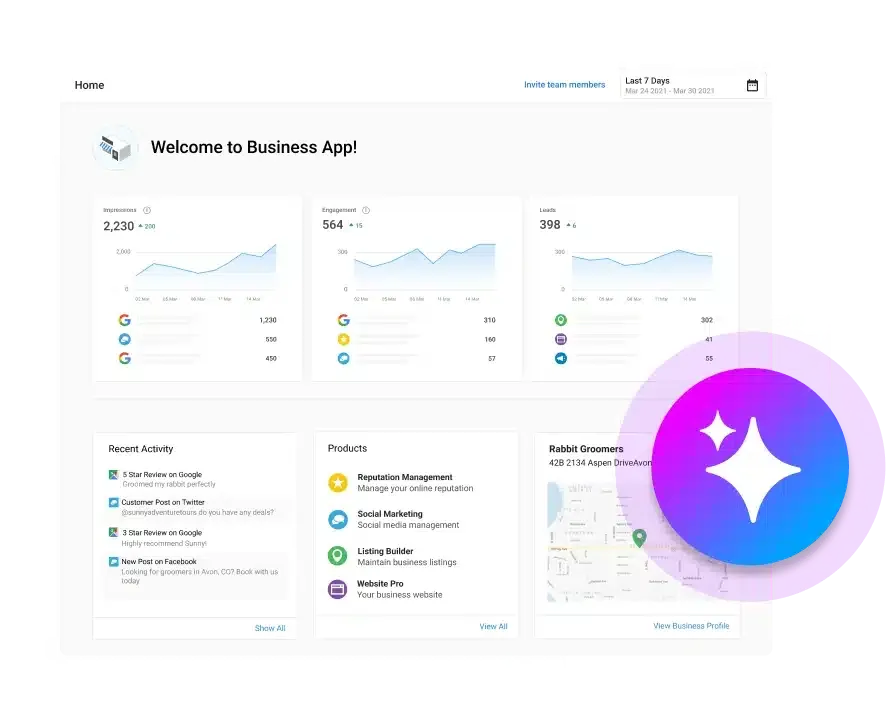
With AI employees that include a variety of tasks, such as AI appointment booking and AI lead scoring, Vendasta optimizes the entire customer journey.
The platform also benefits from 17 years of SMB data, which helps its AI deliver more accurate recommendations and actions.
Key Features:
- AI receptionists powered by Conversations AI that handle inquiries, scheduling, and follow-ups.
- Unified CRM with contact management, pipeline tracking, and automated workflows.
- Reputation management and review generation tools.
- Reporting and insights built on long-term SMB data.
Ideal Use Cases:
- Your business wants a single platform to manage marketing, sales, and customer engagement.
- You support multiple SMB clients and need a scalable system that deploys fast.
- You want AI employees that go beyond simple chatbots and take meaningful action.
- You need a solution that helps teams work smarter, reduce manual work, and create consistent customer experiences.
What is the Best AI Tool for Marketing and Content Creation?
The best AI tools for marketing and content creation help small businesses produce campaigns faster and with more consistency.
In 2026, leading options like Jasper, Copy.ai, and Canva AI support various parts of the creative workflow.
Many SMBs use a combination of these tools. Below is a breakdown of each tool, how it works, and where it fits best.
Jasper
Jasper specializes in long-form and branded content. It helps teams build blog posts, emails, ad copy, and brand messaging frameworks with a strong focus on voice consistency.
Key Features:
- Brand voice training.
- Structured content workflows.
- Long-form writing assistant.
- Templates for ads, blogs, and product copy.
Ideal Use Cases:
- You need polished long-form writing.
- You want brand-consistent messaging across channels.
- You produce regular blogs or campaign assets.
Copy.ai
Copy.ai is known for quick idea generation and short-form content. It is simple, fast, and helpful for drafting copy on the fly.
Key Features:
- Short-form content generator.
- Prompt-based workflows.
- Brainstorming for headlines, captions, and ideas.
Ideal Use Cases:
- You want quick drafts or creative ideas.
- You produce a high volume of social posts.
- You need fast content without complex workflows.
Canva AI
Canva AI focuses on visuals, offering AI-powered image creation, video editing, layouts, and social templates. It is especially useful for teams without a dedicated designer.
Key Features:
- AI image and design generation.
- Video editing and presentation templates.
- Drag-and-drop interface.
- Brand kit support.
Ideal Use Cases:
- You want to produce branded graphics and videos.
- You need quick, easy-to-use visual content tools.
- You create social and advertising visuals regularly.
Where These Tools Fall Short—and Why SMBs Often Add Vendasta
While Jasper, Copy.ai, and Canva AI are powerful for creation, they function as standalone tools. They do not offer unified CRM data, omnichannel automation, AI employees, or end-to-end customer acquisition workflows.
Most importantly, they cannot connect your content directly to actions like booking appointments, engaging leads, prompting reviews, or tracking conversions across channels.
That is where Vendasta becomes the more complete solution. It brings content, automation, CRM insights, and customer engagement into one system.
What is the Best AI CRM for Small Businesses?
The best AI CRM for small businesses is one that helps you manage customer relationships, automate follow-ups, track pipelines, and deliver personalized experiences without adding more tools or manual work.
In 2026, leading options include Vendasta, Zoho CRM AI, HubSpot AI CRM, and Freshsales. Each CRM offers strong capabilities, but they differ in how deeply AI supports real workflows.
Below is a breakdown to help your business choose the right fit.
Vendasta
Vendasta offers an AI-driven CRM built for SMB customer acquisition and engagement.
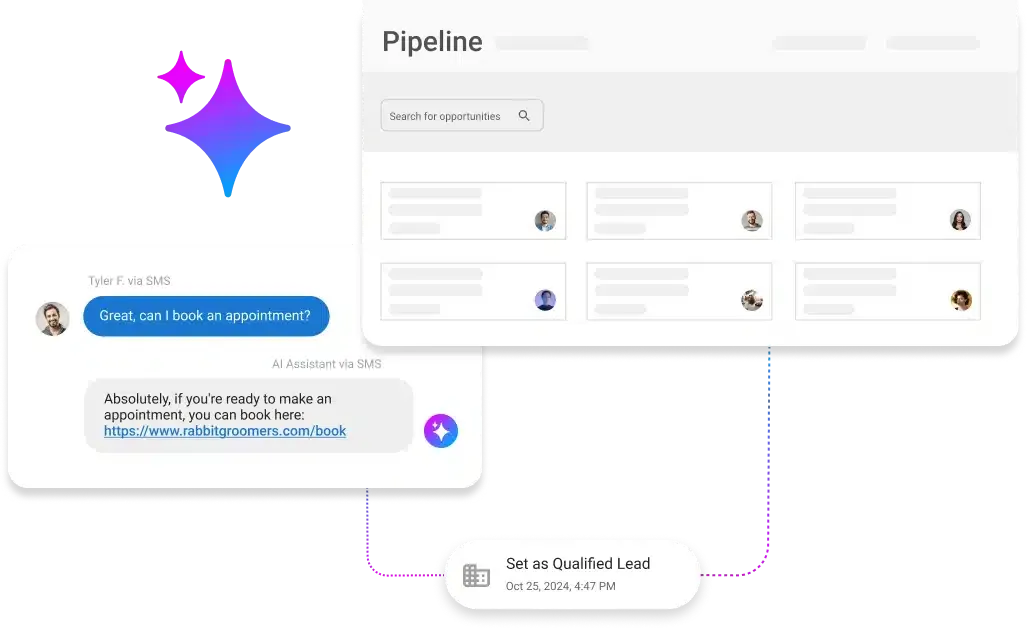
The platform brings together contact management, deal tracking, automated communication, and AI employees who engage leads the moment they show interest.
With 17 years of SMB data behind it, Vendasta delivers more accurate predictions, smarter workflows, and a CRM experience that feels unified.
Key Features:
- AI-powered lead capture through Conversations AI, available 24/7.
- Custom AI training that uses your website, business details, and knowledge base to represent your brand accurately.
- Immediate engagement via AI that answers questions, captures visitor details, and routes hot leads for fast follow-up.
- Unified deal tracking, task management, email, and SMS tools.
Ideal Use Cases:
- You want a single platform to manage marketing, sales, and customer engagement.
- You support multiple SMB clients and need a scalable CRM you can rebrand and deploy quickly.
- You want AI employees that act as 24/7 sales teammates who capture leads, qualify prospects, and share details instantly.
- You need to eliminate manual follow-up tasks and deliver consistent customer experiences across every touchpoint.
Vendasta stands out because it is more than a CRM. It is a complete AI customer acquisition platform your business can use internally or offer to clients as part of a modern, scalable service offering.
Zoho CRM AI (Zia)
Zoho CRM’s AI assistant, Zia, helps with predictions, insights, and workflow suggestions. It is strong for SMBs that already use Zoho’s suite of tools.
Key Features:
- Sales forecasting and lead scoring.
- Conversational AI for tasks and insights.
- Workflow automation and analytics.
- Integrations across the Zoho ecosystem.
Ideal Use Cases:
- You already use Zoho tools for operations.
- You want AI insights but prefer manual execution.
- You need affordable CRM options with decent breadth.
HubSpot AI CRM
HubSpot’s AI features support email writing, forecasting, deal insights, and customer communication. Its CRM remains one of the most popular, especially for marketing-driven teams.
Key Features:
- AI-assisted email and content creation.
- CRM-based insights and predictions.
- Automated workflows for marketing and sales.
- Deep integration with HubSpot’s hubs.
Ideal Use Cases:
- You already run marketing inside HubSpot.
- You want AI tools connected to your customer data.
- You need powerful enterprise features as you scale.
Freshsales (Freshworks AI)
Freshsales uses Freshworks’ AI engine, Freddy, to support lead scoring, forecasting, and communication automation. It is simple and cost-effective for small teams.
Key Features:
- AI lead scoring and deal insights.
- Automated follow-ups and reminders.
- Built-in phone, email, and chat tools.
- Intuitive UI designed for small teams.
Ideal Use Cases:
- You want an easy CRM that’s quick to onboard.
- You need built-in communication tools.
- You prefer a streamlined CRM with basic AI assistance.
Why Vendasta Often Becomes the Better Choice for SMBs
Most CRMs rely on AI for suggestions or predictions. Vendasta goes further by pairing CRM data with AI employees that handle real tasks: following up with leads, answering calls, booking appointments, sending reminders, responding to customers, and escalating when needed.
Vendasta is ideal if your business wants:
- A single CRM that supports marketing, sales, and customer engagement.
- AI employees who take meaningful action.
- Fast deployment across multiple SMB clients.
- Clean workflows that reduce admin work and create consistent customer experiences.
For SMBs and the partners who support them, Vendasta provides a level of automation and intelligence that most CRMs simply do not offer.
What is the Best AI Tool for Customer Support and Service?
The best AI tools for customer support help small businesses respond faster, reduce manual work, and deliver consistent experiences at scale.
In 2026, leading platforms include Vendasta’s AI Receptionist, Intercom AI, Zendesk AI, and Tidio AI.
Each tool supports a different level of automation and customer interaction, but they vary widely in depth, accuracy, and how well they integrate with real business workflows.
Vendasta AI Receptionist
Vendasta offers fully trained AI receptionists who handle customer inquiries, calls, and follow-ups 24/7.
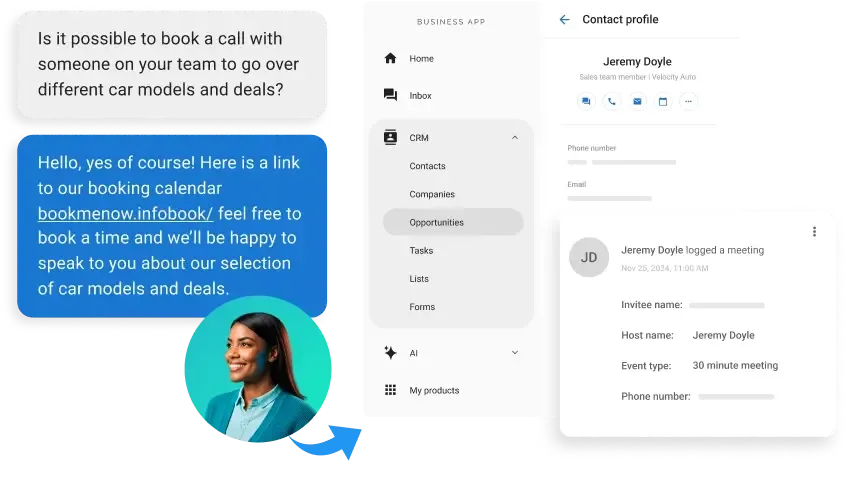
These AI employees go beyond basic chatbots by taking real action: booking appointments, sending reminders, capturing lead details, routing messages, and representing your brand using custom training.
They integrate directly with Vendasta’s CRM and automation tools, creating a complete loop from inquiry to conversion.
Key Features:
- 24/7 AI chat and voice receptionists that respond instantly.
- Custom AI training using your website and business details.
- Automated scheduling, follow-ups, and lead capture.
- Voice-enabled call handling for SMBs who rely on the phone.
- Unified data flow into CRM, pipeline, and reputation tools.
Ideal Use Cases:
- You want AI employees who can answer calls, respond to chats, and complete tasks, not just provide scripted responses.
- You support multiple SMB clients and need fast deployment under your own brand.
- You rely on appointments, inbound calls, or service requests.
Intercom AI
Intercom AI uses conversational automation and bots to support customer inquiries and reduce ticket volume. It works well for businesses with high website traffic and strong self-service needs.
Key Features:
- AI chatbots and automated replies.
- Conversation routing and triage.
- Knowledge base integration.
- AI-assisted agent replies.
Ideal Use Cases:
- You need automated chat for SaaS or digital-first environments.
- You want to reduce support volume with self-serve answers.
- You already use Intercom for sales or onboarding.
Zendesk AI
Zendesk AI supports traditional ticketing systems with automated insights, suggested replies, and routing. It is built for structured support teams that manage large volumes of requests.
Key Features:
- AI-powered ticket triage.
- Automated macros and reply suggestions.
- Self-service tools connected to knowledge articles.
- Reporting and analytics across support channels.
Ideal Use Cases:
- You manage a formal support team with ticket queues.
- You need analytics across email, chat, and help centers.
- You want AI to assist agents rather than fully automate tasks.
Tidio AI
Tidio AI provides an affordable chatbot solution for small businesses that need quick automation without complex setup. It is simple and effective for handling repetitive customer questions.
Key Features:
- An AI chatbot that answers common questions.
- Automated workflows and basic routing.
- Multichannel chat inbox.
- Templates for e-commerce and service businesses.
Ideal Use Cases:
- You want a budget-friendly chatbot.
- You run an e-commerce shop or small service business.
- You need fast setup and simple automation.
Why Vendasta Often Provides the Most Complete Support Solution
Intercom, Zendesk, and Tidio are powerful tools, but they are largely focused on chat support or ticketing.
Vendasta delivers something broader: AI employees who handle support, sales, scheduling, and engagement together.
Because the receptionists connect directly to CRM data, appointment booking, reputation tools, and automated workflows, they enable the entire customer journey automation.

What is the Best AI Tool for Finance and Bookkeeping?
The best AI tools for finance and bookkeeping help small businesses stay organized, automate routine accounting tasks, and reduce the risk of human error.
They categorize transactions, reconcile accounts, manage payroll documents like cvs paystub, and provide real-time financial insights that help owners make smarter decisions.
Below are the top tools to consider.
QuickBooks AI
QuickBooks adds AI to automate transaction categorization, expense tracking, invoice reminders, and financial forecasting. It is one of the most widely adopted accounting tools for SMBs.
Key Features:
- Smart expense categorization.
- AI-powered cash flow forecasting.
- Automated invoice follow-ups.
- Receipt capture and organization.
Ideal Use Cases:
- You need a reliable, all-in-one bookkeeping system.
- You want automation to reduce manual accounting tasks.
Xero AI
Xero uses AI to streamline bank reconciliations, billing, and reporting. Its clean interface and strong integrations make it popular with accountants and bookkeepers supporting multiple SMBs.
Key Features:
- Automated bank reconciliation.
- Smart invoice reminders.
- Real-time business insights.
- Integrations with hundreds of apps.
Ideal Use Cases:
- You work closely with an external accountant.
- You want straightforward reconciliation and reporting.
Wave AI
Wave is an easy, free accounting platform with growing AI capabilities. It’s especially helpful for freelancers or smaller SMBs that need basic bookkeeping without complex systems.
Key Features:
- Automated bookkeeping for income and expenses.
- Smart categorization of transactions.
- Simple invoicing and payment tracking.
- Low-cost payroll add-ons.
Ideal Use Cases:
- You need a free or budget-friendly solution.
- You have straightforward bookkeeping needs.
Pilot AI
Pilot offers bookkeeping-as-a-service, supported by AI and human accountants. It is ideal for businesses that want to fully offload accounting tasks.
Key Features:
- Automated transaction processing.
- Human-reviewed financials.
- Monthly bookkeeping and reporting.
- Integrations with QuickBooks, Xero, and Slack.
Ideal Use Cases:
- You want a hands-off bookkeeping solution.
- You prefer human oversight supported by AI.
Summary:
- QuickBooks AI: Best for all-in-one accounting and automation.
- Xero AI: Best for clean reporting and accountant collaboration.
- Wave AI: Best for budget-conscious small businesses.
- Pilot AI: Best for outsourcing bookkeeping with AI-assisted oversight.
What is the Best AI Tool for Project Management and Productivity?
AI-powered project management tools help teams stay organized, eliminate repetitive tasks, and keep projects moving without constant manual updates.
In 2026, Notion AI, ClickUp AI, Asana AI, and Trello AI lead the category. These platforms support workflow automation, brainstorming, document generation, and task summarization that save teams valuable time.
Notion AI
Notion AI turns your workspace into a flexible system for planning, writing, and knowledge management. It generates documents, summarizes pages, and helps convert ideas into structured project plans.
Key Features:
- AI writing and document generation.
- Automatic page summaries.
- Project planning templates.
- Collaborative knowledge base.
Ideal Use Cases:
- You need an all-purpose workspace for notes and planning.
- You want AI to help brainstorm and summarize content.
ClickUp AI
ClickUp AI focuses on deep workflow automation. It supports complex processes, from content workflows to operational checklists, making it a favorite for fast-moving teams.
Key Features:
- AI task creation and templating.
- Workflow automation across teams.
- Goal tracking and dashboards.
- Document and brief generation.
Ideal Use Cases:
- You manage detailed, multi-step workflows.
- You want customizable automation for different departments.
Asana AI
Asana AI enhances task coordination by predicting blockers, summarizing updates, and helping teams prioritize the highest-impact work.
Key Features:
- AI task prioritization.
- Project summaries and updates.
- Automated routing and assignments.
- Timeline and workload insights.
Ideal Use Cases:
- You coordinate large projects with multiple collaborators.
- You need AI support for prioritization and planning.
Trello AI
Trello AI adds automation and summarization to Trello’s simple, card-based system. It’s beginner-friendly and great for visual project mapping.
Key Features:
- AI-powered card summaries.
- Automated workflows through Butler AI.
- Visual boards and checklists.
- Easy onboarding for non-technical teams.
Ideal Use Cases:
- You prefer a simple, drag-and-drop system.
- You need an easy way to manage small to medium projects.
Step-by-Step: How to Implement AI Tools in Your Small Business in 30 Days
AI adoption doesn’t have to be complicated. With the right structure, your business can start seeing results in as little as a month. Here is a practical 30-day plan you can follow.
1. Audit Your Current Workflows
Look at where your team spends the most time. Common areas include customer communication, scheduling, marketing, reporting, and follow-ups. Document every repetitive task, how long it takes, and what systems you currently use.
2. Identify AI-Ready Tasks
AI works best when the work is predictable and repetitive. Tasks like answering inquiries, booking appointments, generating content, categorizing data, or sending campaigns are strong candidates. Aim for the tasks that slow growth or frustrate customers.
3. Choose Tools Based on Data Requirements and Integrations
Select solutions that can pull from and contribute to a single data source. Avoid tools that work in isolation. A unified customer engagement platform like Vendasta prevents tool sprawl and ensures customer interactions are tracked in one place.

4. Start With Customer Acquisition Tools for the Fastest ROI
Customer acquisition usually delivers the quickest return. By deploying Vendasta’s AI employees, CRM, and automated workflows first, your business can capture more leads, book appointments faster, and reduce missed opportunities right away.
5. Set Up Automations
Automate tasks like follow-ups, reminders, welcome messages, lead routing, and report generation. Make sure each automation has a clear trigger and outcome. Test each one to ensure accuracy and smooth customer experiences.
6. Train Your Team
Walk your team through new processes. Show them how AI tools support their day-to-day work and what tasks they no longer need to manage manually. Create a simple playbook for reference.
7. Measure and Optimize
Track metrics such as response time, lead conversion, task completion time, and customer satisfaction. Review what’s working and refine your automations. Small adjustments can create major improvements in customer experience over time.

Common Mistakes SMBs Make When Choosing AI Tools
Many small businesses rush into AI adoption without a clear strategy, which leads to wasted budget and scattered tools. Here are the most common mistakes to avoid.
Buying Disconnected Apps That Do Not Share Data
Multiple standalone tools make it hard to track performance and create consistent customer experiences. Look for platforms that centralize workflows.
Choosing Tools With No Automation
Some tools offer AI “assistance” without real automation. Prioritize tools that take action on your behalf, not just generate suggestions.
Forgetting About Security and Compliance
Account for data handling practices, permissions, and compliance requirements. Not all tools meet industry standards.
Not Tracking ROI
If you aren’t measuring productivity gains, customer response times, or conversion improvements, it’s difficult to know what is working.
Overinvesting Before Testing
Start small, test workflows, and expand once you see positive results. AI works best when adoption is incremental and supported by real metrics.
Conclusion
AI has become essential for small businesses that want to grow faster, work more efficiently, and deliver better customer experiences without adding extra overhead.
The right tools can streamline marketing, strengthen customer relationships, improve support, and bring clarity to your operations. But the real advantage comes when everything works together in one system.
That is where Vendasta stands out. With AI employees, a unified CRM, and built-in automations, your business can create a customer journey that is consistent, scalable, and far easier to manage.
If you are ready to simplify your tech stack, reduce manual work, and turn more leads into long-term customers, book a free demo of Vendasta and see how the platform can help your business grow.
Best AI Tools for Small Business FAQs
1. What are the best AI tools for small businesses?
The best AI tools for small businesses support customer acquisition, marketing, sales, support, finance, and productivity. Many teams combine platforms such as Vendasta, with tools like Jasper, QuickBooks, and Notion AI to automate workflows, reduce manual tasks, and create more consistent customer experiences.
2. How can AI tools help small businesses cut costs?
AI tools help small businesses cut costs by automating repetitive work, reducing manual data entry, speeding up customer responses, and improving accuracy in areas like bookkeeping and forecasting. This allows teams to scale without increasing headcount or stacking unnecessary software.
3. Do small businesses really need an AI platform, or are point solutions enough?
Point solutions can work for simple, single-use cases, but they often create tool sprawl and data silos. An AI platform like Vendasta brings CRM, automations, AI employees, and engagement tools together so your business reduces subscription bloat and gets clearer, end-to-end insights.
4. What is the best AI CRM for a small business?
The best AI CRM centralizes contacts, deals, communication, and automation in one system. Vendasta, Zoho CRM AI, HubSpot AI CRM, and Freshsales all compete in this space, with Vendasta standing out for AI employees that act directly on CRM data.
5. How do I choose the right AI tools for my small business?
Start by auditing your workflows, then identify bottlenecks. Choose tools that integrate well, offer real automation, and have transparent pricing. Platforms like Vendasta are ideal if you want a single system for marketing, sales, customer engagement, and ongoing automation.
6. What AI tools help small businesses with customer support?
AI customer support tools include Vendasta AI receptionists, Intercom AI, Zendesk AI, and Tidio AI. They can answer common questions, route conversations, and automate follow-ups. Vendasta goes further by connecting support directly to CRM data, scheduling, and reputation workflows.
7. Can AI tools help small businesses get more customers?
Yes. AI tools support customer acquisition by qualifying leads, responding faster to inquiries, booking appointments, and running targeted campaigns. Vendasta’s AI employees and unified automation tools help your business turn more leads into revenue.
8. Are AI tools for small businesses expensive to implement?
AI tools range from free to enterprise-level pricing. Many small businesses start with affordable tools for content, bookkeeping, or chat, then expand to platforms like Vendasta for full customer acquisition and engagement automation once ROI is proven.
9. How do I implement AI tools in my business in under 30 days?
Begin with a workflow audit, choose one or two high-impact use cases, and deploy tools that integrate with your existing systems. A platform like Vendasta helps you set up AI receptionists, CRM, and automations quickly so you can capture leads and measure results within a month.
10. Is Vendasta a good fit if I resell AI solutions to multiple SMB clients?
Yes. Vendasta is built for agencies, MSPs, media companies, and franchisors who serve many SMBs. You can white-label the platform, deploy AI employees and CRM under your brand, and manage multiple client accounts from one system while offering your own services on top.