About Us
 Careers
 Leadership
 Board
Board Newsroom
The best CRM with AI helps your business sell smarter, respond faster, and retain more customers. According to Salesforce, 84% of sales teams now use AI in their workflow, leading to a 15% increase in conversion rates. That shows how artificial intelligence is changing how companies build relationships and close deals.
An AI-powered CRM goes beyond storing contact data. It predicts buying behavior, scores leads automatically, and creates personalized communication that builds trust.
Businesses using AI-driven systems see higher retention and stronger sales outcomes because every action is based on real insights, not guesswork.
This guide explains what makes a CRM truly intelligent, how to choose the right one for your goals, and why Vendasta, the leading AI customer acquisition and engagement platform, is built to help businesses serving SMBs grow faster.
Sell smarter and scale faster with AI-powered CRM
TL;DR
- AI-powered CRMs help businesses sell smarter, respond faster, and retain more customers, boosting conversion rates by up to 15%.
- Automation and predictive insights replace manual data entry, enabling faster lead scoring, better forecasts, and stronger customer relationships.
- Vendasta’s AI CRM unifies sales, marketing, and reporting, built for businesses that want to scale smarter and prove ROI with ease.
What Is a CRM with AI?
A CRM with AI is a customer relationship management system that uses artificial intelligence to automate routine work, analyze customer data, and predict future behavior. It transforms information into insights so your business can focus on relationships instead of repetitive admin tasks.
Traditional CRM vs. AI CRM vs. AI-Powered CRM Platform
Not all CRMs are equal — and the difference between a traditional system and a truly AI-powered platform is significant. Here’s how they compare.
| Capability | Traditional CRM | AI CRM | AI-Powered CRM Platform (e.g. Vendasta) |
|---|---|---|---|
| Data entry | Manual | Partially automated | Fully automated — logs calls, emails, and interactions in real time |
| Lead scoring | Manual or rule-based | AI-scored by engagement signals | Predictive scoring with recommended next actions |
| Forecasting | Spreadsheet-based or static | ML-based revenue forecasting | Real-time pipeline forecasting with deal risk alerts |
| Customer communication | Manual outreach | Automated sequences | AI-personalized messaging across email, SMS, voice, and chat |
| Churn detection | Not available | Basic engagement monitoring | Behavioral pattern analysis with proactive retention triggers |
| Reporting | Manual exports | Automated dashboards | White-label Executive Reports delivered automatically to clients |
| Multi-client management | Complex and siloed | Limited | Centralized multi-account management with consistent brand experience |
| Pricing (approx.) | $10–$30/user/month | $30–$80/user/month | Partner-based pricing — scales with client base, not seat count |
The takeaway: A traditional CRM stores data. An AI CRM analyzes it. An AI-powered CRM platform like Vendasta acts on it — automatically, across every channel, for every client.
Modern AI CRM software combines machine learning, natural language processing, and predictive analytics to help teams capture leads, score opportunities, and deliver personalized communication.
According to McKinsey, businesses that integrate AI into sales see productivity gains of up to 40%, proving that automation directly accelerates performance.
An AI-powered CRM acts like a smart business assistant that automatically records interactions, recommends next steps, and crafts messages tailored to each customer.
When paired with intelligent tools such as Vendasta’s AI software and AI marketing automation, it becomes a complete engine for customer acquisition and retention.
Why Your Business Needs AI in CRM
Adopting AI CRM software helps your business operate smarter and scale faster. According to Super AGI, 80% of companies using AI in CRM gained more qualified leads in under six months. McKinsey also reports that AI-powered teams achieve up to 40% higher sales productivity through automation and better decision-making.
Reduce Manual Work and Save Time
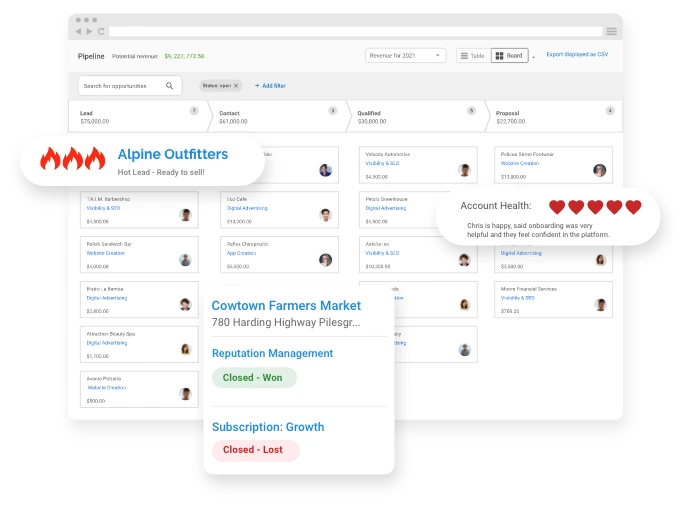
An AI-powered CRM automates repetitive tasks like data entry, pipeline updates, and follow-ups, freeing teams from manual admin work.
How it helps:
- Automatically logs emails, calls, and messages
- Updates customer records in real time
- Suggests next steps for each lead
- Keeps pipelines accurate and up to date
This combination of AI automation and workflow optimization ensures your team spends more time selling and less time managing systems.
Increase Conversions with Predictive Insights
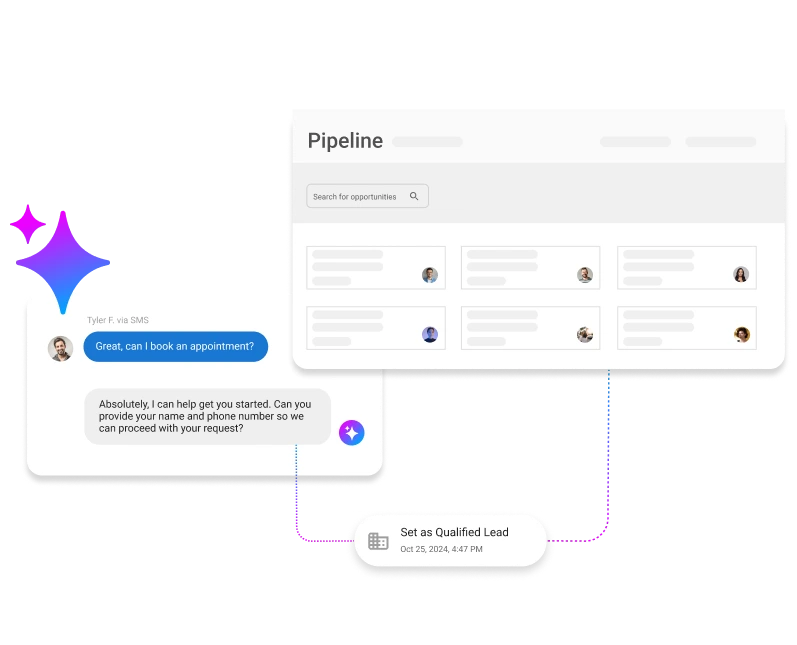
A CRM with Artificial Intelligence goes beyond tracking. It uses predictive analytics to forecast revenue, identify potential deal risks, and prioritize the leads most likely to convert.
Key advantages:
- Smarter AI lead scoring for higher-quality pipelines
- Forecasting that predicts close probabilities
- Recommendations based on real-time performance data
Vendasta’s AI-powered CRM showcases these predictive capabilities in action by automatically surfacing next steps, highlighting high-probability deals, and helping teams capture, qualify, and convert leads faster across multiple channels.
Strengthen Customer Relationships and Retention
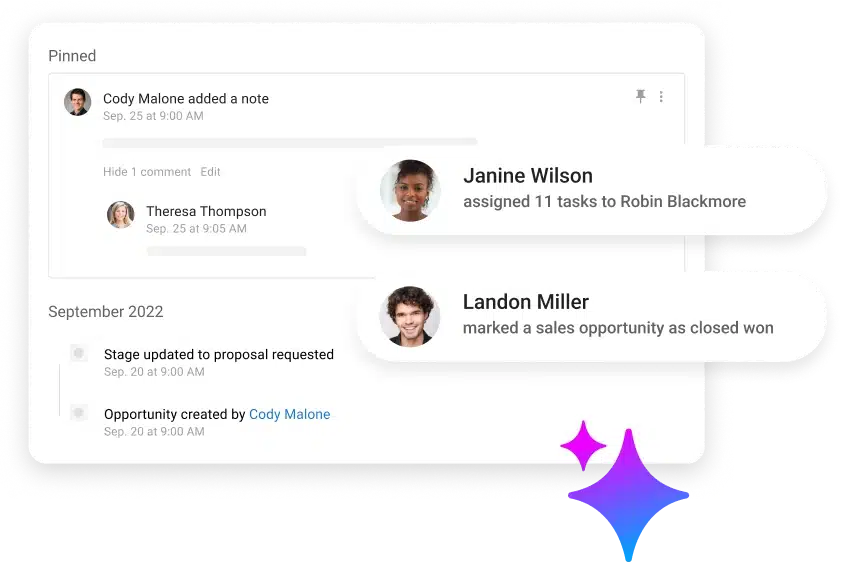
An AI-driven CRM helps businesses stay connected with customers through intelligent engagement. AI tracks customer sentiment and behavioral patterns, triggering personalized follow-ups when engagement drops.
What it does:
- Monitors response rates and customer satisfaction
- Sends tailored messages automatically
- Identifies clients at risk of churn
- Creates reminders for proactive check-ins
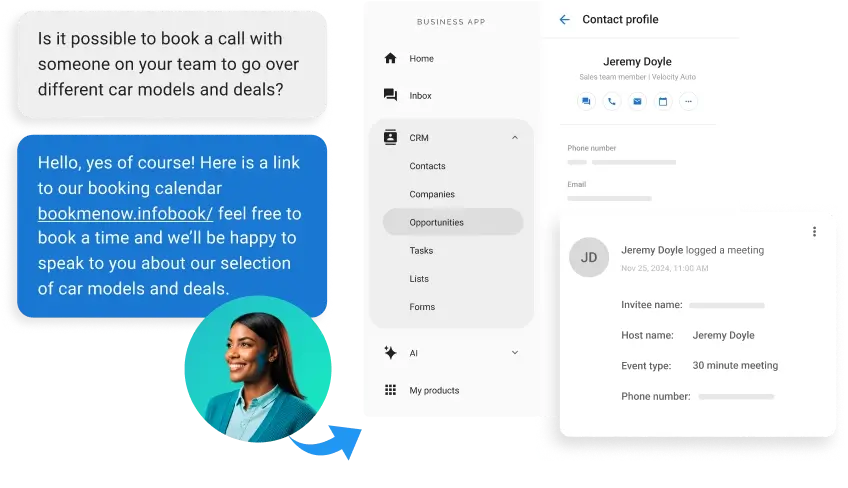
Vendasta’s AI Receptionist is a great example of this capability. It uses conversational AI to answer inquiries instantly, improving customer experience and ensuring no lead or client message goes unanswered.
Simplify Multi-Client and Multi-Location Management
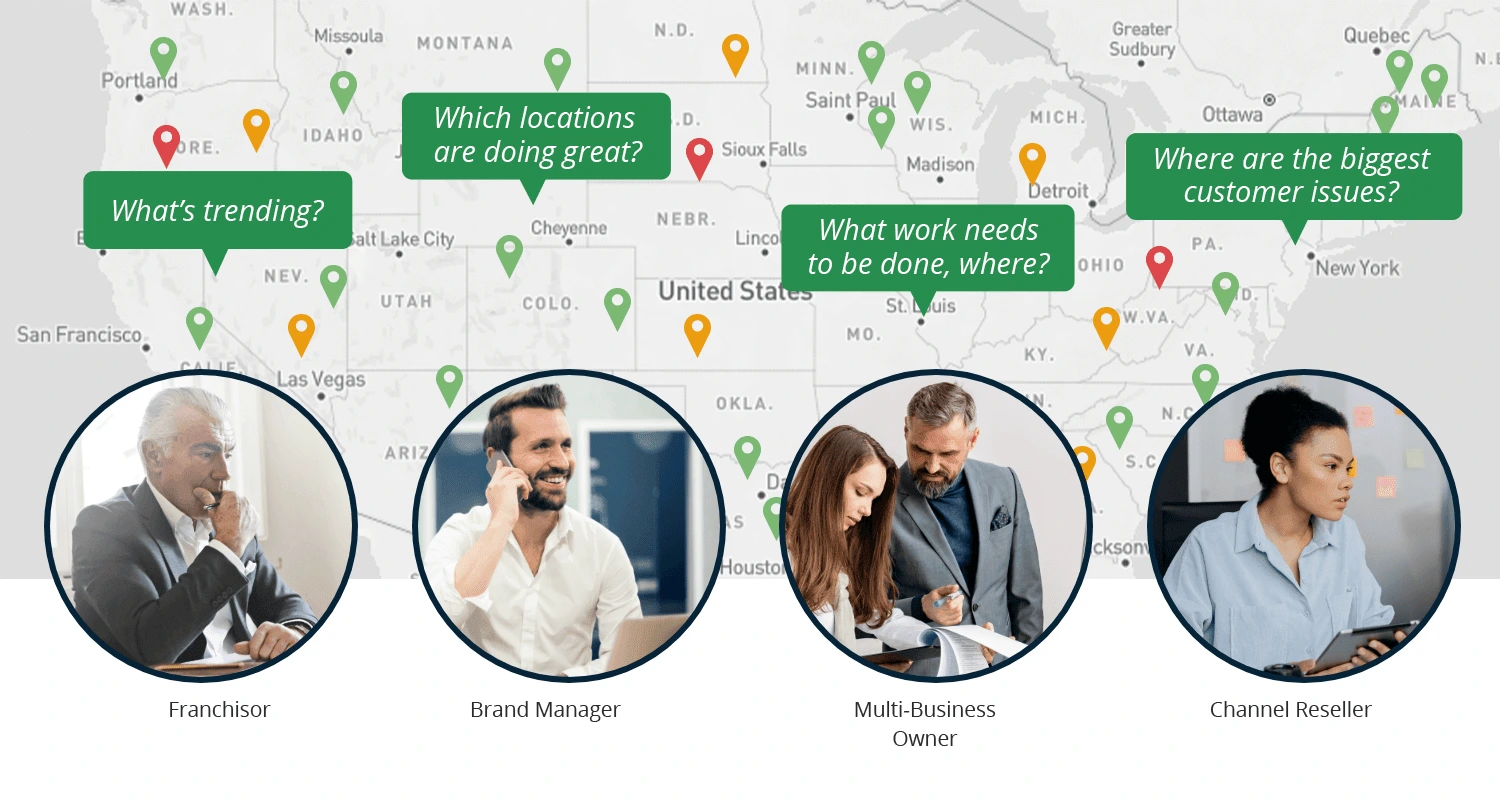
For agencies, franchisors, and MSPs, managing multiple clients or locations can be complex. An AI-powered CRM centralizes all data into one intelligent dashboard, giving you complete visibility and control.
Why it matters:
- Centralized reporting for all clients or locations
- Easier collaboration across teams and regions
- Consistent brand experience using white-label CRM tools
- Streamlined performance tracking and reporting
Vendasta’s multi-location solutions help larger networks standardize operations, automate insights, and deliver consistent results across every branch or franchise.
How to Choose the Best CRM with AI (Step-by-Step Guide)
Selecting the best CRM with AI depends on your business goals, client base, and long-term growth strategy. A platform that’s ideal for one organization might not meet another’s needs. Follow these five steps to choose a system that enhances performance and delivers measurable results.
Step 1: Identify Business Goals
Start by defining your main objective. Are you aiming for faster customer acquisition, stronger client retention, or more automation across teams? Clarifying this focus helps you select a CRM that aligns with your priorities.
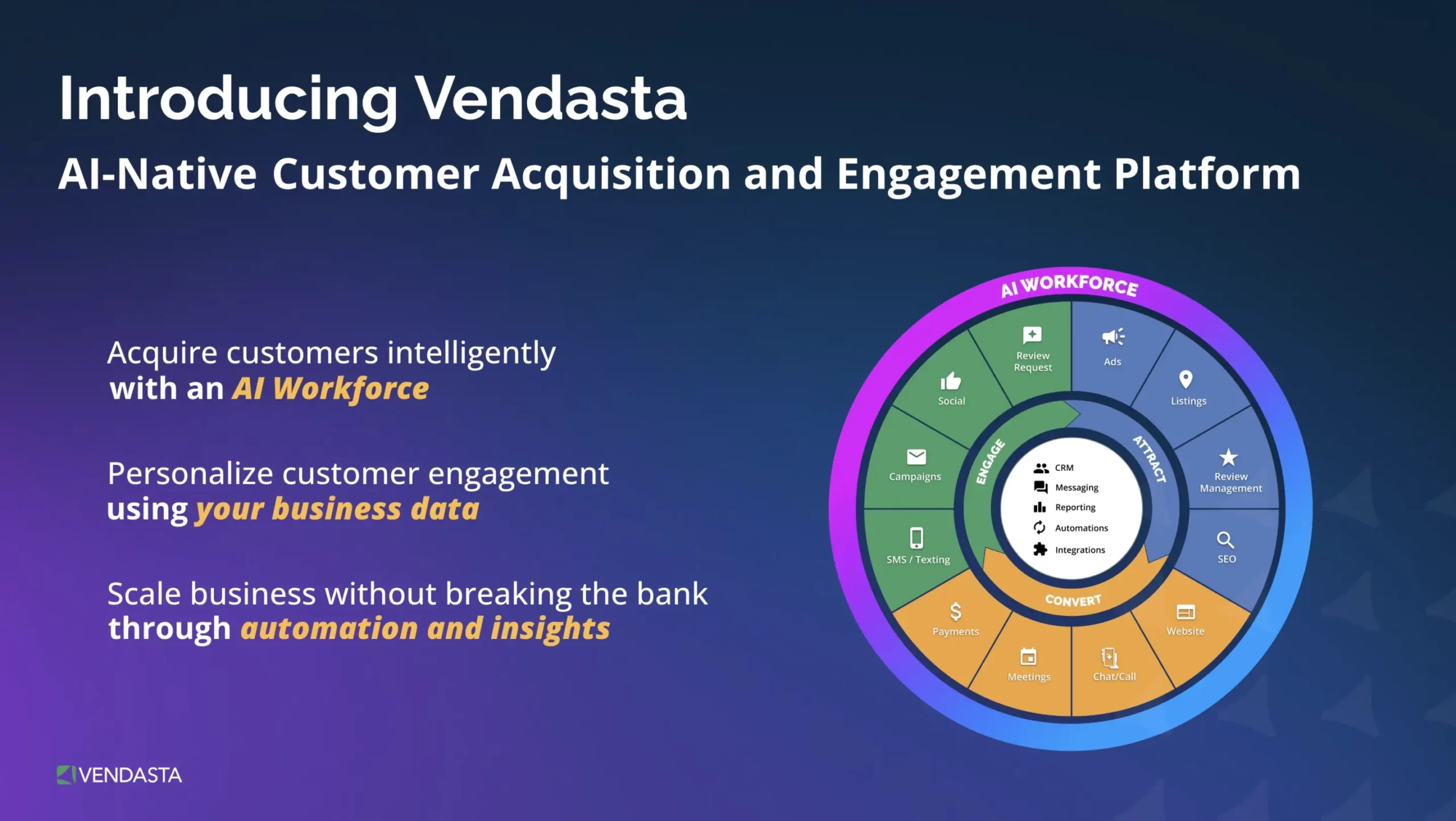
Vendasta supports all three with flexible AI workflows that connect marketing, sales, and support. By automating client onboarding, engagement, and reporting, your team saves time and improves accuracy across every process.
Step 2: Evaluate Core AI Features
Look for features that go beyond traditional CRM capabilities. A high-performing AI-powered CRM should include:
- AI lead scoring to qualify prospects efficiently
- Automated outreach for personalized communication
- AI data enrichment to keep contact records current
- CRM integration that connects all marketing and sales tools
- Predictive analytics for smarter forecasting
When evaluating platforms, consider how automation supports your workflows. Solutions like Vendasta’s CRM for agencies showcase how automation and client reporting streamline daily operations and simplify multi-account management.
Step 3: Review Integration and Scalability
A modern AI-driven CRM should integrate seamlessly with your existing tools. Ensure it connects with essentials like Google Business Profile, QuickBooks, and automation platforms such as Zapier or ConnectWise.
Vendasta’s connected ecosystem enables these integrations effortlessly through its intelligent AI workforce. This structure eliminates fragmented workflows and allows marketing, sales, and customer engagement to operate from one synchronized platform.

Step 4: Prioritize White-Label and Reporting Capabilities
For agencies and franchisors, brand consistency builds credibility. Choose a white-label CRM that allows you to deliver a fully branded experience with custom dashboards, visuals, and reports.
Look for:
- Client-facing dashboards that provide transparency
- AI reporting that updates automatically
- CRM analytics that visualize campaign performance
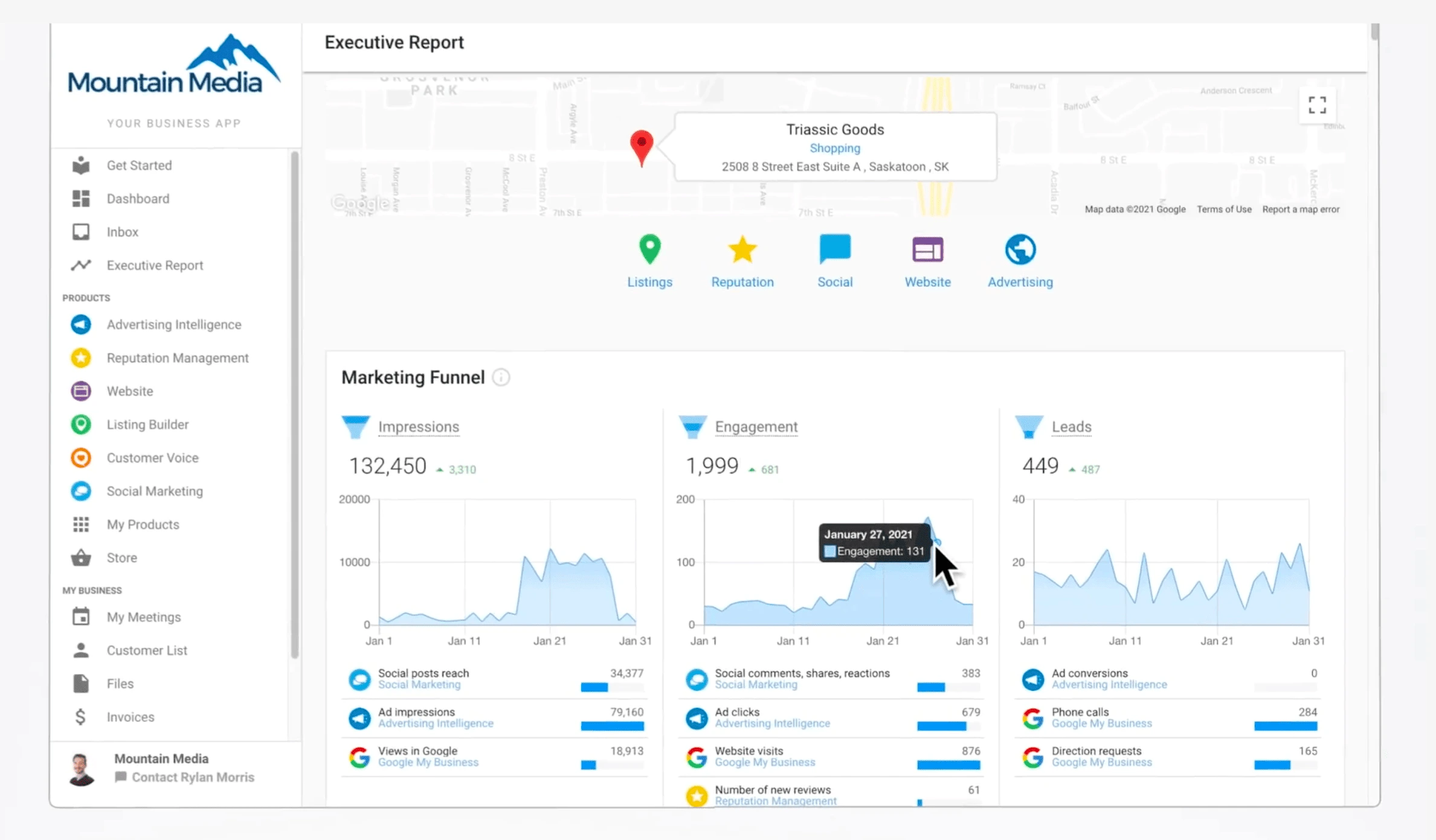
Vendasta makes this possible through its Executive Report and Business App, combining automation, analytics, and branding into one unified experience that proves ROI for every client.
Step 5: Test, Train, and Scale
Before implementing at scale, start with a 60-90-day pilot to evaluate metrics like conversion rate, follow-up response time, and retention improvement.
Once your system is in place, train your team to use its AI tools effectively. Vendasta’s partner ecosystem provides continuous enablement and AI training, helping businesses improve adoption and performance. Its approach to AI readiness ensures your organization can scale automation confidently and sustainably.
CRM with AI Use Cases by Business Type
An AI-powered CRM looks different depending on who is using it and what they need it to do. Here’s how the most common business types in Vendasta’s ecosystem put it to work.
Digital Agencies
The challenge: Agencies manage multiple client accounts simultaneously while trying to demonstrate ROI, reduce churn, and grow recurring revenue — often with lean teams.
How AI CRM helps:
- Automates client reporting so account managers spend time on strategy, not spreadsheets
- Scores inbound leads automatically so sales teams focus on the highest-probability opportunities
- Flags accounts showing signs of disengagement before they become churn risks
- White-label dashboards give every client a branded portal to track their own results
Result: Agencies using Vendasta’s AI CRM reduce manual reporting time, improve client retention, and create a scalable foundation for growing their account base without hiring proportionally.
ISVs (Independent Software Vendors)
The challenge: ISVs need to manage a large base of software customers, track product adoption, identify expansion opportunities, and reduce silent churn — all while keeping sales and customer success teams aligned.
How AI CRM helps:
- Tracks product usage signals inside the CRM to identify customers who are underusing key features and are at risk of non-renewal
- Scores accounts by expansion potential — surfacing customers who are ready for an upsell based on usage patterns and engagement history
- Automates onboarding sequences for new customers so every user gets a consistent activation experience without manual involvement
- Connects customer success, sales, and product data in one platform so every team works from the same picture of each account
Result: ISVs reduce churn by acting on early warning signals, increase expansion revenue through better-timed upsell conversations, and improve onboarding consistency without scaling their customer success headcount proportionally.
Franchisors and Multi-Location Brands
The challenge: Delivering a consistent customer experience across dozens or hundreds of locations while giving corporate the visibility to track performance and identify outliers.
How AI CRM helps:
- Centralizes performance data across all locations in one dashboard
- Standardizes lead capture, follow-up sequences, and customer communication brand-wide
- Surfaces location-level anomalies — underperforming branches, low review scores, slow response times — before they escalate
- Automates onboarding for new franchise locations so every branch starts with the same setup
Result: Corporate gains real-time visibility. Individual locations get the same quality of CRM support regardless of their size or technical capacity.
The Best CRMs with AI in 2026 (Comparison Listicle)
Finding the best CRM with AI is about more than just features. It’s about how well the system automates your workflows, supports your clients, and scales with your business. The comparison below highlights the top-performing platforms leading the way in 2026.
| Platform | Best For | Key AI Features | Unique Value |
| Vendasta | Agencies, franchisors, MSPs | AI Employees, CRM, white-label client portal, Executive Report, marketplace, automation, predictive insights | Built for SMB-focused partners. Combines acquisition, engagement, and retention through a single, integrated suite powered by Vendasta AI. |
| HubSpot | Inbound marketing teams | AI content generation, predictive scoring, automation, chatbots, deal forecasting | Known for its intuitive interface and strong inbound marketing ecosystem that simplifies lead nurturing. |
| Zoho CRM | Small teams & budgets | AI assistant (Zia), workflow automation, sales predictions, data enrichment | A budget-friendly AI-powered CRM ideal for startups and small agencies looking for customizable automation. |
| Pipedrive | Sales-focused teams | AI deal insights, smart recommendations, automation prompts, visual pipeline | Simple, efficient, and built to accelerate deal closures with minimal setup. |
| Salesforce | Enterprise organizations | Einstein AI, advanced analytics, forecasting, and automated reporting | Designed for enterprises that need deep customization and advanced data intelligence. |
| Monday Sales CRM | Cross-functional teams | AI data capture, workflow automation, and project tracking | Combines CRM and project management for teams managing multiple departments. |
| Freshsales by Freshworks | SMB sales and support teams | AI lead scoring, chatbots, and email automation | Streamlines communication and follow-ups to help smaller businesses stay organized. |
| Insightly | Service-based businesses | Workflow automation, AI recommendations, analytics | Great for agencies managing multiple client accounts and ongoing service projects. |
Why Vendasta Leads the Pack
While several tools perform well, Vendasta stands out as the most complete, partner-ready platform. It brings together CRM, marketing, automation, reputation management, and reporting in one system. Its AI employees automate client engagement, analyze performance, and keep communication consistent across every channel.
The Executive Report delivers ready-to-share insights that help agencies prove ROI and retain clients with ease. Through the white-label Business App, clients can access campaign data anytime, reinforcing transparency and trust.
When evaluating AI CRM software, AI-powered CRM, or AI-driven CRM, focus on how deeply each platform integrates automation, analytics, and client visibility.
Vendasta offers all three, making it the best fit for CRM for small businesses, agencies, and partners that want scalable CRM automation tools built to deliver long-term success.
How to Implement an AI CRM Successfully
Implementing the best CRM with AI is about preparation, customization, and consistency. A structured rollout ensures your team sees value fast while keeping data clean and processes scalable.
Step 1: Clean Your Data
- Before introducing automation, start with a clean foundation.
- Remove duplicates, standardize naming formats, and connect all communication logs to ensure accuracy across every customer record.
- Use AI data enrichment to fill missing fields and validate contact information automatically. A strong AI-powered CRM does this for you, giving your sales and marketing teams reliable data that drives better decisions.
Step 2: Customize AI Workflows
- Every business has its own rhythm, so tailor your AI settings to match how your team works. Automate key processes such as lead scoring, follow-ups, and client reporting to improve response time and performance.
- Vendasta’s AI Employees make this simple by handling repetitive tasks like summarizing calls, sending updates, and analyzing campaign outcomes.
- With built-in automation tools, your team can focus more on strategy while AI manages execution behind the scenes.
Step 3: Track ROI and Optimize
- Once your system is active, monitor the results closely. Measure metrics such as response rate, conversion rate, and client retention to track success over time.
- Vendasta’s Executive Report turns performance data into actionable insights, helping your business prove ROI to clients with ready-to-share visual reports.
- By reviewing these insights regularly, you can fine-tune your campaigns, improve accuracy, and scale efficiently.
Step 4: Scale Across Clients or Locations
- After refining your setup, expand usage across all clients or locations. A centralized CRM with Artificial Intelligence lets you standardize campaigns, automate reporting, and deliver consistent service quality everywhere.
- Vendasta’s partner ecosystem supports this growth model with multi-account management, white-label tools, and scalable automation workflows.
- Whether you’re managing ten clients or hundreds, the system adapts to your structure and keeps your entire operation aligned.
Common Mistakes When Implementing a CRM with AI (and How to Avoid Them)
Most AI CRM implementations that underperform don’t fail because of the technology — they fail because of how the rollout is handled. Here are the most common mistakes and how to avoid them.
Mistake 1: Importing Dirty Data
Migrating duplicate contacts, outdated records, and incomplete fields into an AI system doesn’t give you a clean start — it gives the AI bad inputs. Garbage in, garbage out. Your lead scoring, forecasting, and personalization will all be off from day one.
Avoid it: Audit and clean your existing data before migration. Use AI data enrichment tools to fill missing fields and validate contact information before your first import.
Mistake 2: Automating Before You Understand Your Process
Businesses often rush to automate workflows before they’ve mapped out what those workflows should actually look like. The result is automated chaos — the wrong messages sent at the wrong time to the wrong people.
Avoid it: Document your current sales and follow-up process first. Then identify which steps are genuinely repetitive and low-judgment enough to automate. Build automation around a working process, not instead of one.
Mistake 3: Undertraining the Team
An AI CRM that your team doesn’t trust or understand will be bypassed. Staff will revert to spreadsheets, skip logging interactions, and manually do tasks the AI was supposed to handle.
Avoid it: Invest in proper onboarding and training before go-live. Vendasta provides dedicated partner enablement resources to make adoption smoother. Start with power users who can champion the platform internally.
Mistake 4: Measuring the Wrong Metrics
Many businesses measure CRM success by how many contacts are in the system rather than whether it’s actually improving outcomes. Activity metrics — emails sent, calls logged — don’t tell you if the AI is driving results.
Avoid it: Track outcome metrics from day one: lead-to-close rate, average deal cycle length, client retention rate, and revenue from upsells. These are the numbers that show whether your AI CRM is earning its keep.
Mistake 5: Treating AI as a Set-and-Forget System
AI CRMs improve over time — but only if you actively review performance, update your knowledge base, and refine your workflows based on what the data shows. Businesses that set it up and walk away stop getting better results after the initial gain.
Avoid it: Schedule monthly reviews of your AI workflows. Check which automations are performing, which leads are being scored accurately, and which clients are showing early churn signals. Adjust accordingly.
Data Privacy and AI Transparency in CRM
An AI-powered CRM processes significant volumes of customer data — call recordings, email threads, purchase history, behavioral patterns. Before selecting a platform, it’s important to understand how that data is handled, stored, and protected.
GDPR and CCPA Compliance
If your business operates in the EU or handles data from California residents, your CRM must comply with GDPR and CCPA, respectively. This means customers have the right to access, correct, and delete their data. Your AI CRM should support data export, deletion requests, and consent management out of the box.
Data Ownership
Confirm that you — not the CRM vendor — own your customer data. Some platforms retain the right to use anonymized customer data to train their AI models. Review the terms of service carefully and ask vendors directly how your data is used beyond your own account.
How AI Models Are Trained
Understand whether the AI features in your CRM are trained on your data alone or on aggregated data across all customers. Aggregate training can improve accuracy but raises questions about competitive data exposure. Ask your vendor to clarify this before signing.
Security Standards
Look for platforms that offer data encryption in transit and at rest, role-based access controls, audit logging, and SOC 2 compliance. For businesses in healthcare, legal, or financial services, additional compliance standards such as HIPAA may apply to how the CRM stores client communications and records.
AI Transparency With Your Clients
If your AI CRM is sending automated messages or generating reports on behalf of your agency, consider disclosing this to clients. Transparency about automation builds trust rather than eroding it — especially as AI becomes a standard part of how agencies operate.
Why Vendasta Is the Best CRM with AI for Businesses Supporting SMBs
The best CRM with AI does more than organize contacts. It helps your business attract new leads, engage customers, and retain clients without adding complexity. Vendasta was created for agencies, franchisors, managed service providers, and media companies that support SMBs. It combines automation, CRM, and reporting in one connected platform to help your business scale smarter.
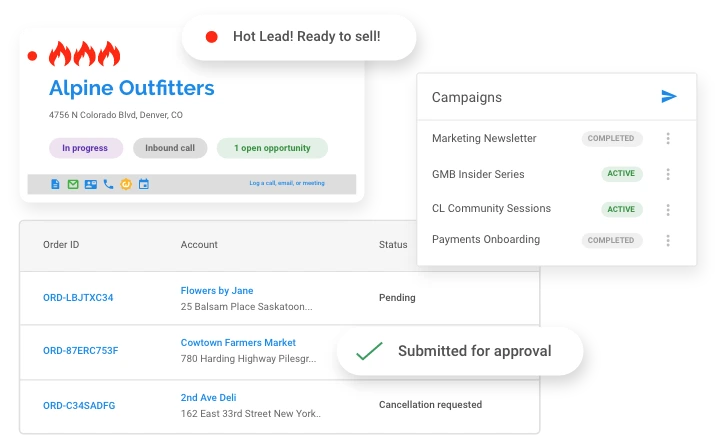
Built for Partners Who Serve SMBs
Vendasta was designed for businesses that manage multiple clients or locations. It unifies sales, marketing, customer service, and reporting in a single system, making it easier to deliver consistent results across all accounts.
As a white-label CRM, Vendasta lets you customize dashboards, reports, and portals so clients see your brand, not a third-party tool. This partner-ready platform helps you maintain brand control, improve communication, and deliver transparency through automated AI reports that build long-term trust.
AI Employees That Automate the Entire Journey
Vendasta’s intelligent AI Employees handle repetitive work, giving your team more time to focus on growth. They manage AI lead management, automate AI customer engagement, and ensure every follow-up or message happens on time.
The AI Receptionist makes communication effortless by answering calls, capturing leads, and sending updates through an AI phone answering service. Combined with tools such as AI chatbots, AI assistants, and virtual AI receptionists, your business stays responsive and available to customers around the clock.

All-in-One Platform with CRM, Marketing, and Reporting
Vendasta connects every part of your business in one place. It combines AI-powered CRM automation, marketing tools, and detailed reporting into a single, easy-to-manage system.
This all-in-one structure allows you to track campaigns, manage pipelines, and share insights effortlessly. With unified automation, your business can monitor performance, strengthen customer relationships, and scale faster without switching between multiple systems.
Vendasta gives you everything you need to manage the complete customer journey from first contact to long-term client loyalty in one streamlined platform.
Empower Your Business with the Best CRM with AI
The best CRM with AI should do more than store data. It should automate engagement, improve client retention, and scale effortlessly as your business grows.
By connecting marketing, sales, and reporting, an AI-powered system turns every customer interaction into an opportunity to build stronger relationships and long-term value.
Vendasta stands out as the most complete solution for businesses that support SMBs. It is purpose-built for agencies, franchisors, managed service providers, and media companies that want to unify their operations and deliver results faster.
With intelligent automation, advanced reporting, and an all-in-one platform, Vendasta helps you focus less on tools and more on growth.
Ready to see how Vendasta’s AI-powered CRM and automation tools can help your business scale? Explore Vendasta AI or book a demo today to experience the future of client management.
Best CRM with AI FAQs
1. What is a CRM with AI?
A CRM with AI is a customer relationship management system that uses artificial intelligence to automate routine tasks, analyze customer data, and predict future behavior. Unlike a traditional CRM that stores and organizes contact records, an AI-powered CRM actively surfaces insights — scoring leads by likelihood to convert, flagging at-risk accounts, recommending next steps, and triggering personalized communication without manual input. For businesses managing multiple clients or locations, it replaces hours of manual work with intelligent automation that runs continuously in the background.
2. What is the best CRM with AI?
The best CRM with AI depends on your business model and goals. For agencies, franchisors, and MSPs that support SMBs, Vendasta is the strongest all-in-one option — combining AI employees, predictive CRM, white-label reporting, and a built-in marketplace in one platform. For inbound marketing teams, HubSpot offers a polished AI-assisted experience. Salesforce Einstein is the leading choice for enterprise organizations with complex customization needs. Zoho CRM is a strong budget-friendly option for smaller teams. For most SMB-focused partners, Vendasta offers the deepest integration of AI across the full client lifecycle.
3. How does AI improve a CRM?
AI improves a CRM by replacing manual, judgment-based tasks with automated, data-driven ones. It scores leads based on real engagement signals rather than gut instinct, forecasts revenue with greater accuracy than spreadsheet models, personalizes outreach at scale without requiring a larger team, and detects churn risk early enough to act on it. According to McKinsey, teams using AI in their sales workflows see up to 40% higher productivity — not because they work harder, but because the AI handles the repetitive work and surfaces the right actions at the right time.
4. Is there a free CRM with AI?
Several CRM platforms offer free tiers with limited AI features. HubSpot’s free plan includes basic automation and some AI-assisted tools. Zoho CRM has a free tier for up to three users. However, genuinely useful AI capabilities — predictive lead scoring, behavioral analytics, automated multi-channel communication, and white-label reporting — are almost always behind a paid plan. For SMB-focused businesses and agencies, the cost of a mid-tier AI CRM is typically recovered quickly through improved lead conversion and reduced manual labor.
5. What is the best CRM with AI for SMB-focused businesses?
Vendasta is the strongest choice for agencies, franchisors, and managed service providers that support SMBs. It combines AI employees, CRM automation, marketing tools, and white-label client reporting in one platform purpose-built for multi-client management. Unlike general-purpose CRMs that require significant customization to serve an agency or franchise model, Vendasta is designed from the ground up for businesses that manage many clients or locations and need scalable, branded, AI-powered tools to do it efficiently.
6. What features should I look for in an AI CRM?
The most important features to evaluate are AI lead scoring, predictive analytics and revenue forecasting, automated follow-up sequences, multichannel communication support (email, SMS, voice, chat), CRM integration with your existing tools, white-label client dashboards, and automated reporting. For agencies and MSPs, multi-account management and white-label capability are non-negotiable. For franchisors, look for centralized visibility with location-level customization. The depth of integration between these features — rather than the presence of each in isolation — is what separates a genuinely AI-powered platform from a traditional CRM with AI features bolted on.
7. Do I need AI in my CRM?
If your business is managing more than a handful of client relationships, the answer is almost certainly yes. Manual data entry, reactive follow-up, and static reporting are all bottlenecks that AI removes. Businesses that adopt AI CRM software reduce time spent on admin, improve lead quality through better scoring, and retain more customers through proactive engagement — all without adding headcount. The 80% of companies that adopted AI in their CRM reported gaining more qualified leads within six months, according to Super AGI. The question is less whether you need it and more how quickly you can implement it effectively.
8. How does Vendasta’s CRM differ from others?
Vendasta’s CRM is designed specifically for businesses that serve other businesses — agencies, franchisors, MSPs, and media companies. Most CRMs are built around a single company’s sales pipeline. Vendasta is built around managing many clients simultaneously, with tools for multi-account visibility, white-label branding, automated client reporting, and AI employees that handle ongoing engagement without human involvement. It connects CRM, marketing automation, reputation management, and performance reporting in one platform — which means your team doesn’t have to manually sync data between multiple tools to get a complete picture of any client relationship.
9. Can an AI CRM improve customer retention?
Yes — and this is one of the clearest ROI cases for AI CRM adoption. Retention improves because AI CRMs monitor engagement signals continuously and act before disengagement becomes churn. When a client’s response rate drops, engagement with their portal falls, or their NPS score declines, the system can automatically trigger a check-in, escalate to an account manager, or adjust the communication cadence. Vendasta’s AI Receptionist extends this by ensuring no inbound inquiry — call, chat, or SMS — goes unanswered, which is one of the leading causes of early client attrition. Businesses that combine CRM automation with proactive engagement tools see measurably higher retention rates than those relying on manual outreach.
10. How does AI CRM integration work?
AI CRM integration connects your CRM with the other tools your business relies on — marketing automation platforms, calendar and scheduling tools, communication channels, reporting dashboards, and third-party data sources. When these systems share data in real time, the AI has a complete picture of every customer interaction across every channel. Vendasta integrates with tools like Google Business Profile, QuickBooks, Zapier, and ConnectWise, and its AI employees operate across this connected ecosystem to automate engagement, log interactions, and surface insights without requiring manual data movement between platforms.
11. How much does a CRM with AI cost?
AI CRM pricing varies widely. Most standalone AI CRM tools are priced per user per month, typically ranging from $30 to $150 depending on the platform and features. Enterprise platforms like Salesforce can run significantly higher with full AI feature sets enabled. Vendasta uses partner-based pricing that scales with your client base rather than seat count, which makes it more cost-effective for agencies and MSPs managing many accounts. When evaluating cost, factor in what you’re replacing — a full-time data entry role, a manual reporting process, or an outsourced call handling service — to get an accurate picture of total ROI.
12. Which CRM with AI is best for agencies?
Vendasta is the strongest option for agencies, followed by HubSpot and Zoho CRM for specific use cases. Vendasta leads because it was built for the agency model — multi-client management, white-label branding, automated client reporting, and AI employees that handle ongoing engagement. HubSpot is a good fit for agencies with strong inbound marketing practices and a need for deep content and nurture automation. Zoho CRM suits smaller or budget-conscious agencies that need customizable automation without enterprise pricing. For any agency managing more than ten client accounts, the multi-account infrastructure and white-label capabilities in Vendasta justify the investment.
13. What is the future of CRM with AI?
The next phase of AI in CRM is moving from automation to autonomous action. Current AI CRMs automate tasks based on rules and predictions. The near future involves AI agents that can independently initiate outreach, negotiate scheduling, qualify leads through conversation, and adjust strategy based on real-time performance — all without waiting for human instruction. Voice AI embedded directly in CRM workflows, real-time sentiment analysis during live calls, and AI that manages entire client onboarding sequences without human oversight are already emerging. Platforms like Vendasta are positioning for this shift with AI employees that already handle significant portions of the customer journey end to end.
14. How can I prepare my team for AI CRM adoption?
Start by communicating clearly why the change is happening and what it means for daily work — specifically, what tasks the AI will take over and how that frees up time for higher-value work. Identify two or three internal champions who can learn the platform first and support their colleagues during rollout. Run training on the specific workflows your team will use most, not a generic platform overview. Set realistic expectations for a 60-to-90-day adoption curve before you evaluate performance. Vendasta provides dedicated partner enablement resources, AI readiness training, and ongoing support to help businesses get the most from their AI CRM investment from day one.