



If you’re a franchise owner looking to increase your local customer base, then you need to focus on local search engine optimization (SEO). Local SEO is the process of optimizing your website and online presence to rank higher in local search results. This is especially important for franchises, as each location needs to be visible to potential customers in their given area.
White-label local SEO services for franchises can help you reach more customers and increase your revenue. Optimizing your website and local search strategy can ensure your business appears when people search for your products or services in their area. This can lead to increased foot traffic to your physical locations, as well as more website traffic and online sales.
Boost local rankings with AI-powered insights and automation
Key Takeaways:
- Local SEO boosts visibility: Franchises use local SEO to reach local customers. By optimizing your online presence, you increase the chances of appearing when people search for products or services nearby.
- Essential local SEO steps: When designing your local SEO strategy, it is important to consider several factors, such as mobile-friendliness, brand consistency, and your website’s setup.
- Measuring success: To know if your local SEO is working, track key indicators like local search rankings, website traffic, conversion rates, and online reviews. Use tools like Google Analytics and Vendasta’s Local SEO tool for insights and improvements.
Understanding local SEO
Local SEO is different from traditional SEO because it focuses on location-based searches. For example, if someone searches for “pizza near me,” multi-location marketing strategies combined with local SEO can ensure your pizza franchise appears at the top of search results for each location.
To improve your local SEO, you need to focus on a few key areas. First, make sure your website is optimized for local searches. This includes adding location-specific keywords to your content and metadata, optimizing your Google Business Profile, and building local citations.
Second, create location-specific landing pages for each of your franchisees. These pages should include information about the location, such as the address, phone number, and hours of operation. They should also include content that is relevant to the local area, such as information about local events or attractions.
Finally, make sure your website is mobile-friendly. 60 percent of total web traffic comes from mobile devices, so it’s important that your website is easy to navigate on a smartphone (Statista).
Related topics: How Google local listings information is collected and sourced
Why local SEO matters for franchises
As a franchise owner, you know how important it is to have a solid online presence. However, what’s exciting is that local SEO can significantly boost your franchise’s visibility to potential customers. Let’s explore why mastering local SEO is a big deal for franchises:
Boosting online visibility
Optimizing your website and business listings with relevant keywords and location information can help you to increase your chances of showing up at the top of search engine results pages (SERPs). This means more visibility for your franchise and more opportunities to connect with potential customers.
Increasing organic traffic
Giving attention to local SEO can simplify the process for residents to discover and connect with your franchise on the internet. When your franchise secures a top spot in search engine results, you’re more likely to capture the attention of individuals actively searching for businesses similar to yours. This can result in a boost in organic website traffic, ultimately translating into an increase in potential leads and sales.
Improving local reputation
One of the key benefits of local SEO services for franchises is that they can help you improve your franchisees’ reputation in their local community. Encouraging satisfied customers to leave reviews on sites like Google and Yelp is a great way to build a positive online reputation that can help you attract more customers in the future. Additionally, responding to negative reviews professionally and effectively demonstrates your commitment to customer satisfaction and improves your overall reputation in the local area.
Tip: Get your free step-by-step checklist for a complete local SEO audit. Download the checklist here.
10 key elements of local SEO for franchises
If you’re running a franchise business, local SEO is essential to make sure that each location is visible to potential customers in its area. Here are ten key elements of local SEO that you should consider to make sure your franchise locations are well-optimized for search engines:
1. Organize and manage every Google Business Profile listing
Your Google Business Profile (GBP) listing is a crucial element of your local SEO strategy. Make sure that each of your franchise locations has its own GBP listing, and that they are all verified and up-to-date. Ensure that the name, address, and phone number (NAP) of each location are consistent across all online directories and platforms.
Here are some resources to help you out with this:
- Everything you need to know about GBP location groups and business groups
- 15 tips to improve your Google Maps SEO
- Your guide to adding and managing products on Google Business Profile
- How to optimize Google Business Profile for local SEO
- How to add your social media profiles to Google Business Profile
- How to add & manage multiple locations on Google Business Profile
- How to level up your Google Business Profile with questions and answers
2. Optimize for location-based keywords
To make sure your franchise location pages show up in local search results, it’s essential to use the right location-specific keywords. First, research and find the keywords that match each location. Then, make sure to include these keywords in the title, meta description, and content of each location page on your website. This helps search engines understand what each page is about and can improve your chances of showing up when people search for businesses in those specific areas.
3. Optimize for mobile
With searching mobile devices becoming the norm, it’s essential to ensure that your franchise location pages are optimized for mobile. Check that your website is mobile-responsive and that all of your location pages are easy to navigate and load quickly on mobile devices. Consider enabling mobile-friendly features like click-to-call buttons, larger fonts, spaced-out links, and mobile-friendly graphics.
4. Consistent branding
When it comes to building trust, consistency is key. Make certain that your logo, color palette, and brand message remain consistent across all online platforms, including social media, directories, and your website. This uniformity helps create a cohesive and reliable brand identity that customers can recognize and trust wherever they encounter your franchise online.
5. Encourage online reviews for each location
Promoting online reviews for each of your franchise locations is a valuable practice. Encourage your customers to share their experiences on platforms like Google, Yelp, and other relevant review sites. It’s important to respond promptly and professionally to all reviews, regardless of whether they are positive or negative. This not only fosters engagement with your customers but also demonstrates your commitment to providing excellent service at every location.
6. Have a local content creation strategy
Create location-specific content, such as blog posts, videos, and infographics, that are relevant to each of your franchise locations. Coming back to what we said about consistency, ensure that each location receives the same amount of attention paid to its content as the rest. All content produced for all franchisees should carry the same level of quality and be informative and engaging.
7. Choose your website architecture wisely (microsite vs. corporate website)
When deciding whether to employ a microsite or a corporate website for your franchise locations, it’s important to weigh the pros and cons of each option, as it can impact how you conduct your local SEO strategy. Here are the main differences between a microsite and a corporate website architecture:
Microsite
- Focus: Microsites are small, specialized websites designed for specific purposes, such as promoting individual franchise locations.
- Content: They feature highly targeted content that revolves around particular aspects like local store information, special offerings, and promotions.
- Domain: Microsites often have their own unique domain or subdomain (e.g., www.city-franchise.com).
- Local SEO benefits: Microsites excel in hyper-local SEO as they are optimized for targeting specific keywords and crafting location-based content to boost local visibility.
Corporate website
- Focus: A corporate website serves as the primary online presence of the franchise business, offering an overview of the entire brand.
- Content: These websites typically provide broader content that caters to the brand as a whole, often featuring standardized information.
- Domain: Corporate websites usually maintain a single domain (e.g., www.franchise.com).
- Local SEO benefits: While corporate websites can be optimized for local SEO, they are less granular in targeting specific locations compared to microsites. They serve as a central hub for maintaining consistent NAP information.
Some key considerations:
Microsite
| Pros |
|
| Cons |
|
Corporate website
| Pros |
|
| Cons |
|
8. Perform local link building for each location
Local link building is the practice of acquiring hyper-local backlinks that connect your franchise location’s website to other local websites. These backlinks act as digital endorsements, signaling to search engines that your business is a credible and authoritative source within the local community.
Types of local links:
Local directories: Seek out and list your franchise locations in local business directories and citation sources like Yellow Pages, Yelp, and Google.
Industry associations: If your franchise is affiliated with any industry-specific associations or organizations, ensure that your locations are listed on their websites. These links reinforce your credibility within your industry and local area.
Local bloggers and influencers: Collaborate with local bloggers and influencers who have a strong online presence within your community. Guest posting, sponsoring content, or participating in local events they organize can lead to valuable backlinks and increased visibility.
9. Utilize social media for each location
Social media can be a great way to promote your franchise locations and improve your local SEO rankings. Ensure that you have a social media presence established for each location and that you are posting regularly and engaging with followers for the biggest impact.
10. Add location-specific schema
Adding location-specific schema markup to your franchisee pages helps search engines understand the content and context of each location. Ensure that you add things like the business name, address, phone number, and opening hours to your schemas to get the most out of this search feature.
Rich results (formerly rich snippets) are the extra pieces of information you would see in the search results that go beyond the blue text and the meta description. Rich results include things like breadcrumbs, review stars, site links, and FAQ sections. Let’s take a look at a few examples below:
Breadcrumb rich results example

(source: Google)
Sitelink rich results example
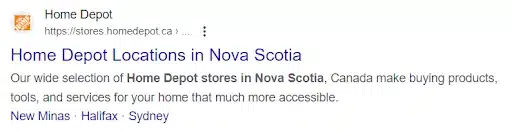
(source: Google)
It’s important to note that not all schema formats are one-size-fits-all. It is best to choose the appropriate one for your industry or business type to get the best results for local SEO.
Visit Schema’s Local Business page for general layouts, examples, and options for more specific types of schemas, ranging from animal shelters to travel agencies.
Looking for franchise marketing tools? Check these out:
Challenges in local SEO for franchises
When it comes to local SEO, franchises face unique challenges that other businesses may not encounter. These challenges can make it difficult to maintain consistency across multiple locations and manage the online presence of each franchisee effectively. Here are two of the most significant challenges in local SEO for franchises:
Maintaining consistency
Each franchisee may have its own website, social media accounts, and local listings, making it challenging to ensure that all information is accurate and consistent. Inconsistencies in information can lead to a poor user experience and negatively impact search engine rankings.
To maintain consistency, have a clear brand identity and guidelines for each franchisee to follow. This includes guidelines for website design, content creation, and social media management. Additionally, ensure that all local listings are claimed and optimized with accurate and consistent information.
Managing multiple locations
Each franchisee may have their own unique hurdles, such as different competitors, target audiences, and local search trends. That’s why it’s important to design a comprehensive local SEO strategy that can be tailored to each location’s specific needs.
To manage multiple locations effectively, have a centralized system for tracking and managing local SEO efforts. This can include tools for monitoring local search rankings, tracking online reviews, and local listings management. Additionally, have a regular rapport with each franchisee and provide them with the support and resources they need to succeed.
Also see: White-label Listings Management Services
How to measure success in local SEO for franchises
When it comes to local SEO for franchises, it’s important to track your progress to see how well your efforts are working. Here are two ways to gauge your success in local SEO for franchises:
Key performance indicators
Key performance indicators (KPIs) are metrics used to track progress toward a specific goal. For local SEO for franchises, some KPIs you may want to track include:
- Local search rankings: Track your rankings for local keywords to see if your website is appearing in the top results for relevant searches.
- Organic traffic: Monitor your organic traffic to see if your SEO efforts are driving more visitors to your website.
- Conversion rate: Measure the percentage of visitors who take a desired action on your website, such as filling out a contact form or making a purchase.
- Online reviews: Keep track of your online reviews and ratings to see if they are improving over time.
When monitoring these KPIs, you can see if your local SEO efforts are paying off and adjust your strategy accordingly.
Using SEO analytics tools
To track these KPIs, you can use a variety of SEO analytics tools. Some popular options include:
- Google Analytics: This free tool can help you track website traffic, user behavior, and conversions.
- Google Search Console: Use this tool to monitor your website’s performance in Google search results, including search queries, impressions, and click-through rates.
- Vendasta’s Local SEO tool: Use this tool to manage and update listings across directories, GPS sources, and voice search, for every one of your franchise locations. It helps to eliminate errors, suppress duplicates, and enhance each location’s local SEO.
Using these tools can give you valuable insights into your local SEO performance and make data-driven decisions to improve your results.
Local SEO for franchises FAQs
1. What is local SEO for franchises?
Local SEO for franchises is the process of optimizing each franchise location’s online presence to rank higher in local search results. This ensures every location appears when nearby customers search for your products or services, increasing visibility, foot traffic, and sales.
2. Why is local SEO important for franchise businesses?
Local SEO is crucial for franchises because each location competes in its own geographic area. Optimizing for local search helps every franchise rank individually while maintaining consistent brand identity across all markets.
3. How does Vendasta help franchises with local SEO?
Vendasta’s AI-powered Local SEO platform helps franchises manage listings, monitor reputation, and track performance across all locations. With centralized control and automation, franchise owners can ensure accuracy, improve rankings, and strengthen visibility at scale.
4. What are the biggest challenges in local SEO for franchises?
Franchises often struggle with maintaining consistent information across multiple locations and managing local listings efficiently. Using tools like Vendasta’s Local SEO helps overcome these challenges by centralizing management and automating updates across directories.
5. How can franchises manage Google Business Profiles for multiple locations?
Each franchise should have its own verified Google Business Profile. Managing them through a centralized platform like Vendasta ensures all listings are consistent, optimized, and updated with accurate NAP (Name, Address, Phone) information for better local visibility.
6. What are the best local SEO strategies for franchise networks?
Effective strategies include optimizing location-specific pages, collecting customer reviews, maintaining consistent NAP data, building local backlinks, and using schema markup. Vendasta simplifies this process with automated tracking, reporting, and AI-powered optimization tools.
7. Do franchisees need individual websites for local SEO?
Not necessarily. Franchises can use either location pages on a corporate website or individual microsites. What matters most is optimizing each location’s online presence with local keywords, accurate contact details, and localized content to attract nearby customers.
8. How can local SEO improve a franchise’s online reputation?
Local SEO and reputation management work hand in hand. Encouraging reviews, responding to feedback, and maintaining consistent listings build trust with local audiences. Vendasta’s Reputation Management tool helps automate and streamline this process for franchises.
9. How can I measure the success of local SEO for my franchise?
Track KPIs like local search rankings, organic traffic, online reviews, and conversion rates. Tools like Google Analytics, Search Console, and Vendasta’s Local SEO dashboard help monitor these metrics and show which locations are performing best.
10. How do I get started with local SEO for my franchise?
Start by auditing your online presence, claiming and optimizing all listings, and ensuring brand consistency across locations. Partnering with Vendasta gives you access to automated tools, AI insights, and centralized reporting to accelerate franchise-wide SEO success.
