Your customers are asking for AI. Your sales team is losing deals to AI-native competitors. And your engineering team is already stretched thin, staring down a backlog that never gets shorter. Every quarter, the build-vs-buy conversation gets deferred again, and every quarter, the pressure grows.
This is the reality for a growing number of software companies today. The window to add AI to your product is narrowing fast, and a poorly structured SaaS product roadmap is often what stands between you and shipping something meaningful.
The good news: you don’t have to burn your roadmap down to compete. With the right framework, the right inputs, and the right partners, you can ship AI capabilities in weeks, not quarters, without pulling your engineers off the core product.
This guide walks you through everything you need to know about building a product roadmap for SaaS businesses, from foundational strategy to AI-era execution. Whether you’re a CPO trying to defend against churn, a VP of Product prioritizing a packed backlog, or a product leader evaluating build vs. buy decisions, this is your playbook.
Attract, convert, and retain more customers with less manual work
TL;DR
- Engineering is a finite resource: A well-structured SaaS product roadmap protects your team by separating core product development from strategic capability additions like AI.
- AI is no longer optional: Gartner predicts that by 2026, over 80% of enterprises will have used generative AI APIs or deployed AI-enabled applications up from less than 5% in 2023. SaaS companies without AI features are already losing deals.
- Build vs. buy is already decided: Embedding pre-built AI capabilities through platforms like Vendasta lets you skip months of infrastructure work and go from roadmap item to customer revenue in days.
What Is a SaaS Product Roadmap?
A SaaS product roadmap is a strategic document that communicates what you’re building, why you’re building it, and when it’s expected to ship. It aligns product, engineering, sales, and leadership around a shared vision and translates high-level business goals into an executable plan.
Unlike a project plan, a product roadmap is not a fixed schedule of features with hard delivery dates. It’s a living document that evolves with customer feedback, market signals, and business priorities.
For SaaS businesses specifically, the roadmap serves a few critical functions:
- Aligning internal stakeholders on product strategy and priorities
- Communicating upcoming capabilities to sales, marketing, and customer success teams
- Helping with engineering plan and sequence development sprints
- Enabling leadership to make informed resource allocation and investment decisions
- Creating transparency with customers and reducing churn caused by unmet expectations
A roadmap is most valuable when it’s structured around outcomes rather than feature lists. Instead of committing to “add AI chat by Q2,” a strong roadmap frames the goal as “reduce lead response time and improve conversion for SMB customers” with AI chat as one potential path to get there.
Is ChatGPT a SaaS Product?
Yes — ChatGPT is a SaaS product. It is a cloud-based software application delivered over the internet via a subscription model, which is the defining characteristic of Software as a Service. Users access it through a browser or API without installing software locally, and OpenAI manages all underlying infrastructure, model updates, and scaling on the vendor side.
ChatGPT fits the standard SaaS model in four specific ways:
- Cloud delivery: The application and its underlying models run entirely on OpenAI’s infrastructure. No local installation is required.
- Subscription pricing: ChatGPT offers a free tier alongside paid plans billed on a recurring monthly basis — the defining SaaS revenue model.
- Continuous updates: OpenAI updates the underlying models and features without requiring users to upgrade anything. This is the core operational characteristic of SaaS delivery.
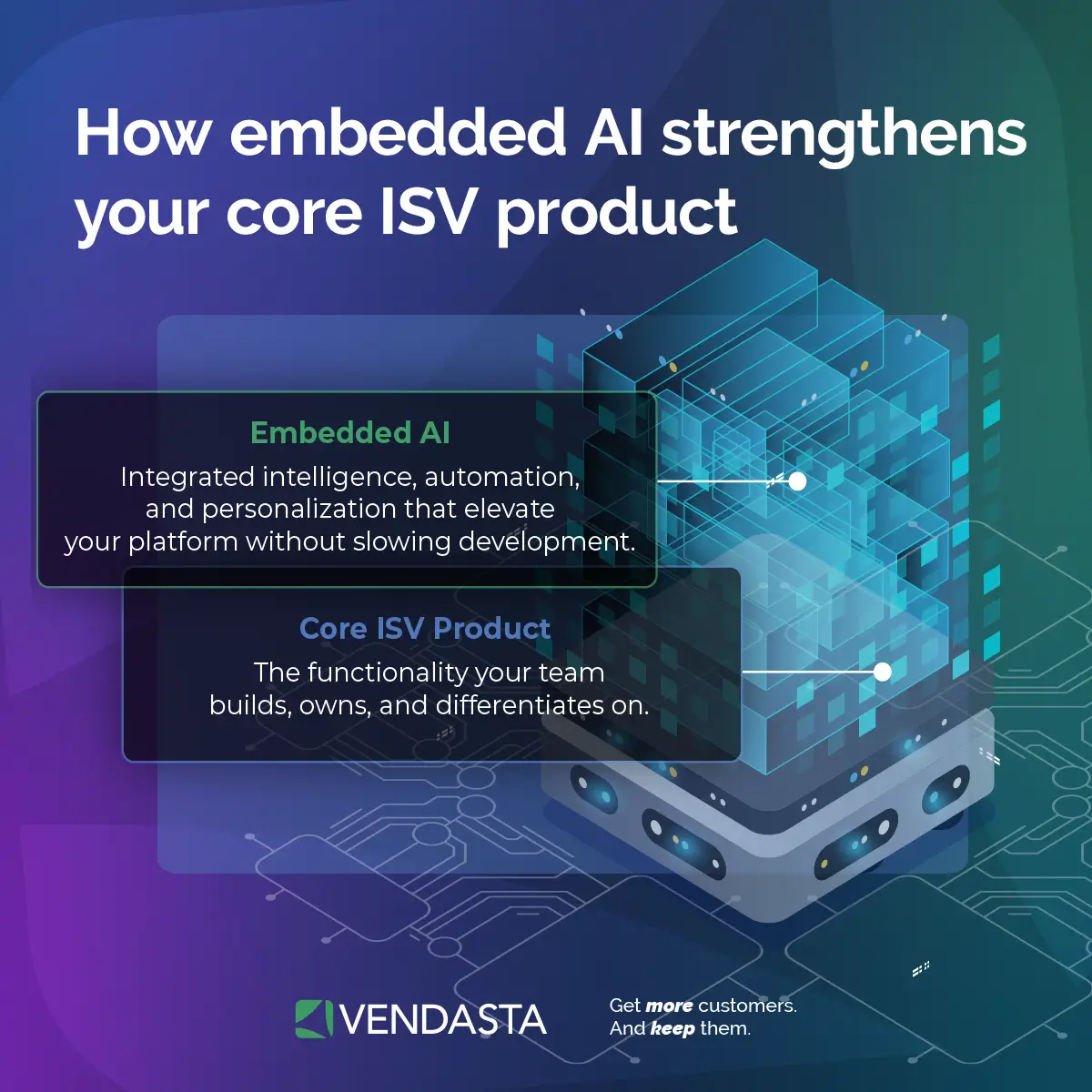
- API access for builders: OpenAI’s API allows ISVs and developers to build products on top of ChatGPT’s capabilities — a platform-as-a-service distribution model that many software companies are evaluating as part of their AI roadmap strategy.
What this means for ISVs building their own SaaS roadmap:
ChatGPT’s emergence as one of the most rapidly adopted SaaS products in history has direct implications for every ISV’s product roadmap. It has reset customer expectations around what AI-powered software should feel like, established a baseline for conversational intelligence, and raised the competitive bar for what “intelligent software” means to SMB buyers in 2026.
For ISVs, the strategic question is not whether ChatGPT is a competitor — it is whether your product can do things autonomously on behalf of your customers that ChatGPT cannot do as a standalone tool. ChatGPT requires a human to open it, prompt it, and manually apply its output back into a workflow. Purpose-built embedded AI agents — like those available through Vendasta’s AI Workforce — act autonomously using each SMB customer’s specific business data, without requiring a prompt, without requiring the user to leave your platform, and without requiring your engineering team to build AI infrastructure from scratch.
That distinction — AI as a tool versus AI as a worker — is the competitive frontier that ISV product roadmaps need to address. The ISVs that embed autonomous AI capabilities into their platforms are not just matching what ChatGPT can do. They are doing something ChatGPT structurally cannot: delivering AI that works inside the customer’s existing workflow, on the customer’s own data, around the clock, without any manual involvement.
Why SaaS Product Roadmaps Are More Critical Than Ever
The SaaS market has changed dramatically in the last two years. AI-native startups are shipping faster. Enterprise platforms are moving downstream. And SMB customers, the backbone of most vertical SaaS businesses, are increasingly sophisticated in what they expect from software.
Consider the numbers:
- According to McKinsey’s State of AI report, 65% of organizations are now regularly using generative AI, nearly double the adoption rate from just a year prior.
- Gartner projects the global SaaS market will reach $247 billion in 2024, with AI-enabled features becoming a primary driver of differentiation and pricing power.
- Product-led churn caused by missing features now accounts for a significant portion of involuntary churn. Customers don’t always tell you they’re leaving because of your roadmap; they just leave.
The implication for CPOs and product leaders is clear: the SaaS product development roadmap is no longer just an internal planning tool. It’s a competitive asset. What you choose to build (and what you choose to buy or embed) directly determines your ability to retain customers and grow ARPU.
The challenge is that engineering capacity is finite. Every item you add to the roadmap displaces something else. That trade-off has never been more consequential than it is today. Understanding the AI marketing trends shaping buyer expectations is an essential input for any product leader mapping priorities right now.
What Is the Lifecycle of a SaaS Product?
The lifecycle of a SaaS product is the progression a software product moves through from initial development to eventual sunset or transformation. For ISVs, understanding where your product sits in this lifecycle is one of the most critical inputs to your roadmap — because the right priorities at each stage look fundamentally different, and misreading your stage is one of the fastest ways to allocate engineering capacity to the wrong problems.
The SaaS product lifecycle typically moves through five stages:
- Introduction: The product has launched with a limited feature set and an early customer base. For ISVs at this stage, the roadmap priority is learning — rapid iteration based on customer feedback, establishing product-market fit within a defined vertical, and resisting the temptation to build breadth before depth. Engineering capacity should be concentrated entirely on the core value proposition.
- Growth: Customer acquisition is accelerating, and the product is demonstrating repeatable value in a specific niche. The roadmap priority shifts to expanding capabilities, improving retention, and beginning to build competitive differentiation. This is the stage where build-vs-buy decisions become critical — growth-stage ISVs rarely have the engineering capacity to build every customer-requested feature from scratch without stalling core product momentum. Embedding table-stakes capabilities through a platform partner preserves engineering for the work that actually differentiates the product.
- Maturity: Customer growth stabilizes, competition intensifies, and pricing pressure increases. For ISVs in this stage — which describes the majority of vertical SaaS companies serving SMBs today — the roadmap priority is defending and expanding ARPU through upsells, deepening value for existing customers, and adding AI capabilities that competitors cannot easily replicate. Retention becomes the primary growth lever, and every roadmap decision should be evaluated against its impact on churn.
- Decline or Disruption: Growth stalls, churn rises, and AI-native competitors begin winning deals that previously went to the incumbent. Many established ISVs are encountering this stage now, even without labeling it explicitly. The roadmap priority here is transformation: shipping AI capabilities quickly, repositioning the product, or expanding into adjacent verticals before the competitive gap becomes unrecoverable. This is the stage where the build-vs-buy decision is most consequential — ISVs that try to build AI from scratch at this stage rarely move fast enough.
- Renewal or Sunset: The product either successfully repositions and re-enters a growth trajectory through meaningful innovation, or it is deprecated and replaced. ISVs that navigate the AI transition by embedding AI capabilities quickly — protecting engineering for core differentiation — are the ones that reach renewal. Those who defer the decision until churn forces it are the ones who face sunset.
Why lifecycle stage matters for your ISV roadmap: A growth-stage ISV and a mature-stage ISV serving the same vertical need fundamentally different roadmaps. The growth-stage company should be building aggressively toward differentiation. The mature-stage company should be embedding AI to defend retention and expand ARPU before churn compresses its runway. Most ISVs serving SMBs are operating in the maturity or early disruption stage right now — which means the AI gap on the roadmap is not a future problem. It is a present one.
The 3 Core Inputs to a Strong SaaS Product Roadmap
Building a great product roadmap starts with getting the inputs right. SaaS Academy founder Dan Martell, whose company Clarity.fm scaled rapidly by applying this framework, breaks roadmap inputs into three essential categories. Knowing these categories changes how you prioritize and what you ship.
1. Market Needs and Customer Feedback
What are customers asking for in numbers? What are they expecting that your product doesn’t yet deliver? This input comes from support tickets, churn interviews, sales call recordings, NPS surveys, and customer advisory boards.
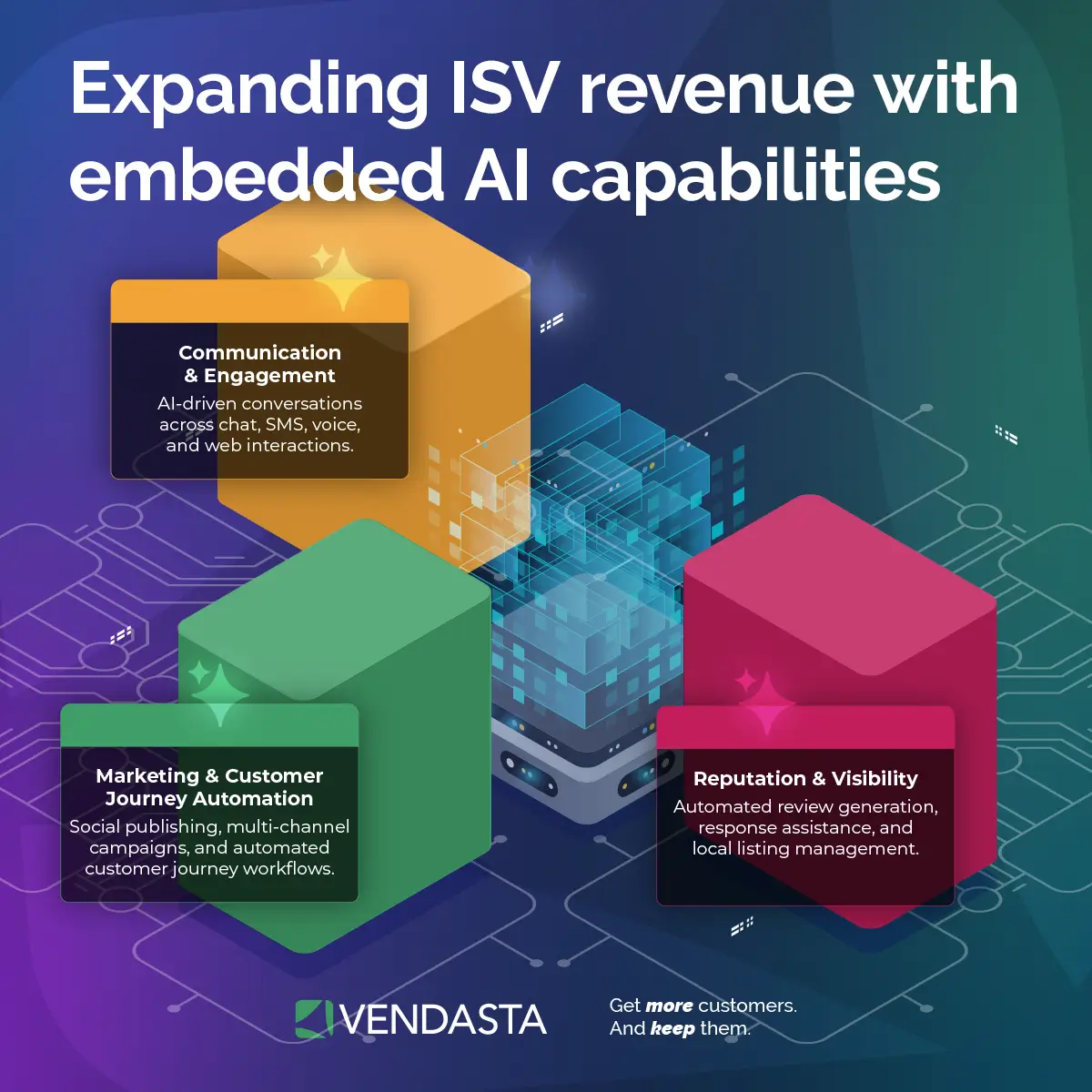
For SaaS companies serving SMBs, this bucket is increasingly dominated by AI requests. Customers want automated review responses, AI chat on their website, automated follow-up sequences, and smart insights from their data.
2. Business Goals and Revenue Drivers
Which features or capabilities will directly move the needle on MRR, ARPU, or churn? This input aligns product development with the financial outcomes the business needs to hit.
For product leaders at growing SaaS companies, the most urgent business goal right now is defending ARPU. If your average revenue per user is flat or declining, adding a compelling AI upsell for your SaaS product is one of the highest-leverage moves available.
3. Differentiators and Key Features
What makes your product different from every competitor in your space? This input is about protecting and extending your product’s unique value — the reason customers chose you in the first place.
Critically, this is also the input that should guide the build-vs-buy decision. If a capability is core to your differentiation, you should probably build it. If it’s table-stakes functionality that customers expect but that doesn’t define your product, buying or embedding it is almost always faster, cheaper, and lower-risk.
Types of SaaS Product Roadmaps (And When to Use Each)
There’s no single right format for a product roadmap. Different stakeholders need different views, and different stages of your business call for different levels of detail. Here are the most commonly used roadmap types and what they’re best suited for.
Product Strategy Roadmap
This is the highest-level view. It communicates the product vision, key strategic themes (e.g., “Improve SMB onboarding,” “Launch AI-powered communication tools”), and major initiatives over the next 12 to 18 months. It’s designed for leadership, board members, and cross-functional alignment.
Theme-based roadmaps are particularly effective here. Rather than committing to specific features, grouping work under strategic outcomes preserves flexibility as market conditions shift.
SaaS Product Development Roadmap
This is the most granular roadmap type. It breaks down work into sprints, assigns features to engineering teams, and tracks dependencies. The time horizon is typically 4 to 8 weeks, because forecasting anything beyond that with sprint-level detail creates more confusion than clarity.
The audience for this roadmap is primarily engineering. It should not be widely circulated because specific sprint-level commitments tend to become hard expectations for stakeholders who weren’t meant to see them.
Quarterly Release Plan
This is the most useful roadmap for sales and marketing alignment. It shows what capabilities are likely to ship in each quarter without locking engineering into exact feature sets or dates. It gives the go-to-market team enough runway to prepare launch materials, train AEs, and adjust messaging.
For SaaS companies that are actively upselling AI features, the quarterly release plan is an underutilized tool. Sales teams need to know what’s coming so they can plant seeds with existing accounts before a feature is even available.
UX/UI Roadmap
Design and user experience work doesn’t always get its own roadmap, but it should. UX research, prototyping, usability testing, and UI refinement all have dependencies that affect engineering timelines. Giving this work its own visibility ensures it doesn’t become an afterthought that delays shipping.
Marketing and Launch Roadmap
The best product in the world won’t generate revenue if it isn’t taken to market effectively. A dedicated launch roadmap ensures that positioning, enablement, and demand generation are aligned with your ship dates. Pairing this roadmap with a clear AI marketing strategy gives your go-to-market team the context they need to position new capabilities compellingly.
How to Build a SaaS Product Roadmap Step by Step
Building a roadmap that actually gets used (and actually reflects reality) requires more than a spreadsheet and a quarterly planning meeting. Here’s a step-by-step process that product leaders at high-growth SaaS companies use to build roadmaps that drive results.
Step 1: Anchor on Business Objectives
Start with the business goals for the next 12 months. What does the company need to achieve? Typical objectives for SaaS companies include growing ARPU, reducing churn below a specific threshold, expanding into a new vertical, or hitting a revenue milestone. Every item on the roadmap should map to one of these objectives. If it doesn’t, it doesn’t belong on the roadmap.
Step 2: Collect and Categorize Inputs
Gather feedback from all three input categories: customer needs, business goals, and differentiators. Synthesize data from your support team, sales team, and customer success team. Run churn win/loss interviews. Audit competitor feature sets. Look at what AI-native competitors in your space are offering that you’re not.
Step 3: Prioritize Using a Structured Framework
Don’t prioritize by gut or by whoever shouts loudest in the planning meeting. Use a structured prioritization framework such as RICE (Reach, Impact, Confidence, Effort) or the Value vs. Effort matrix to score and rank initiatives objectively.
Factor in the build-vs-buy decision at this stage. For any item on your list that involves AI capabilities, customer communication, reputation management, or marketing automation, ask: Can this be embedded or licensed rather than built from scratch? If the answer is yes and the integration is clean, buy or embed every time.
Step 4: Sequence and Scope
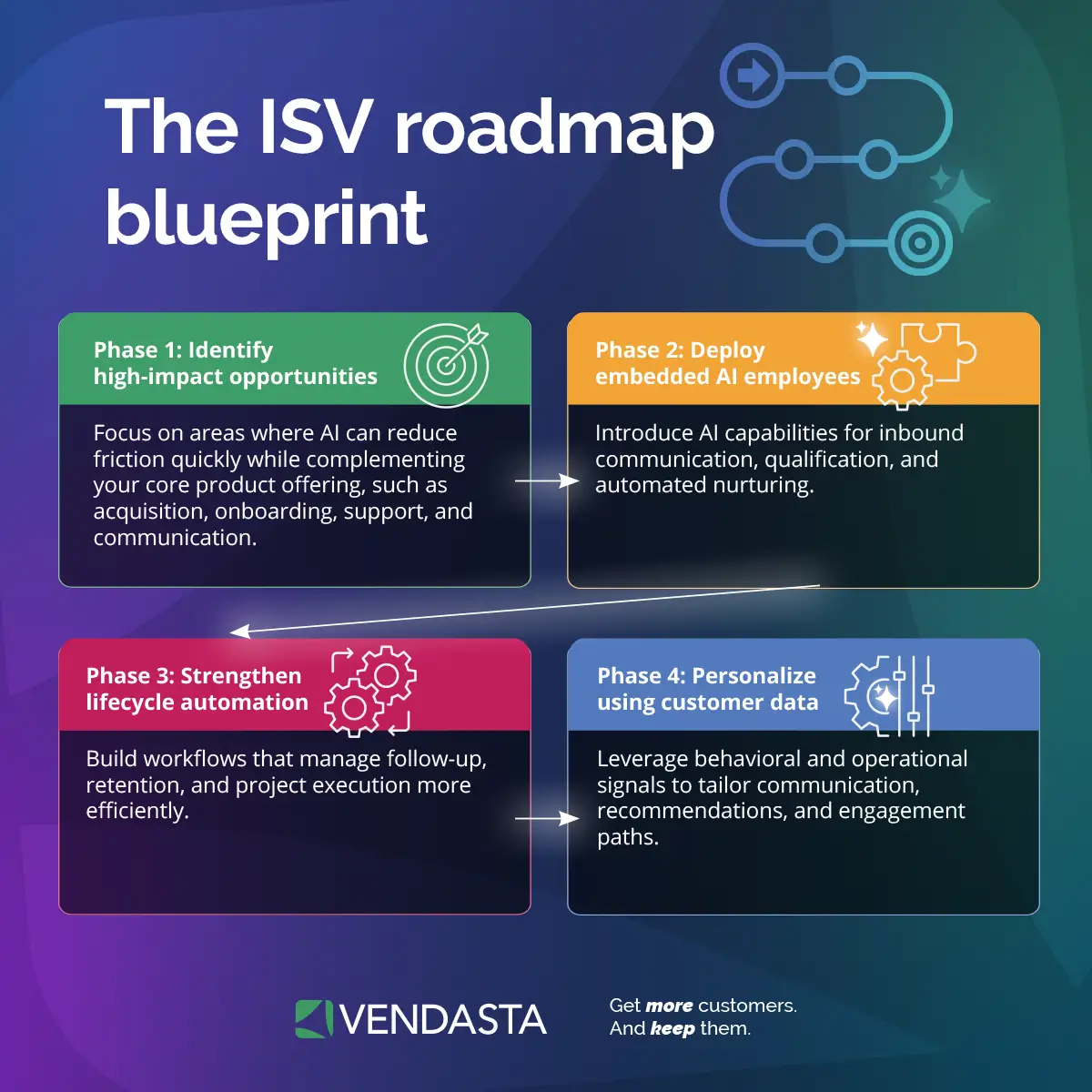
Once priorities are set, work with engineering to scope each initiative and create a realistic sequencing plan. Identify dependencies between workstreams. Flag any items where a third-party integration could replace a build effort entirely.
This is where product leaders at growing SaaS companies often find the most leverage. A two-quarter build effort that gets replaced by a three-week integration frees up significant engineering capacity for core product work.
Step 5: Create Roadmap Views for Different Audiences
One version of the roadmap doesn’t serve every audience. Build out:
- A strategic view for leadership and the board (12 to 18 months, theme-based)
- A quarterly release plan for sales and marketing (3 to 6 months, initiative-level)
- A sprint-level development roadmap for engineering (4 to 8 weeks, feature-level)
Step 6: Review, Update, and Communicate Regularly
A roadmap that isn’t reviewed regularly becomes a liability. Schedule quarterly reviews at a minimum to incorporate new customer feedback, updated market intelligence, and changes to engineering capacity. Communicate changes proactively to internal stakeholders rather than letting outdated versions circulate.
SaaS Product Roadmap Example: What Good Looks Like
Let’s walk through a practical SaaS product roadmap example for a vertical SaaS company serving SMBs in home services.
The company has $25M ARR, 50 AEs, and a core product built around scheduling and job management. Customers have been asking for AI features. Competitors are shipping AI-powered communication tools. The CPO needs to add AI capabilities without pulling engineering off the core product.
The Before State
The roadmap has AI listed under “Explore” for the third consecutive quarter. Engineering is focused on performance improvements and a mobile app refresh. The sales team has no AI story to tell. Three enterprise accounts churned to an AI-native competitor in the last six months.
The Restructured Roadmap
| Quarter | Theme | Key Initiatives | Build or Embed |
|---|---|---|---|
| Q1 | AI-Powered Customer Communication | Embed an AI receptionist for lead capture and appointment booking; launch an AI web chat on customer websites | Embed (via Vendasta) |
| Q1 | Core Product Reliability | Mobile app performance improvements; API stability enhancements | Build (core) |
| Q2 | Reputation and Retention | Embed AI review generation and response management; launch upsell packaging for AI features | Embed (via Vendasta) |
| Q2 | Scheduling Intelligence | Smart routing for job assignments; calendar AI suggestions | Build (core differentiator) |
| Q3 | AI Sales Acceleration | CRM AI for meeting transcription and automatic record updates; AI inside sales persona for follow-up | Embed (via Vendasta) |
| Q3–Q4 | Platform Expansion | New vertical modules; API extensibility for enterprise accounts | Build (core) |
In this example, embedding AI capabilities through a platform like Vendasta frees the engineering team entirely from building AI infrastructure, training models, managing multi-tenant deployments, or maintaining communication pipelines. Engineering stays on core product work. AI goes live in weeks.
The Build vs. Buy Decision: How to Get It Right on Your SaaS AI Roadmap
The build-vs-buy question lives at the center of every SaaS product roadmap conversation today. Getting it wrong costs time, and in a fast-moving AI market, time is what you have the least of.
When to Build
Build when the capability is your core differentiator. If your unique value comes from how you do something, that’s where your engineering resources should be focused. Building a proprietary scheduling algorithm, a unique data model for your vertical, or a specialized workflow automation that no competitor has — that’s worth building.
When to Buy or Embed
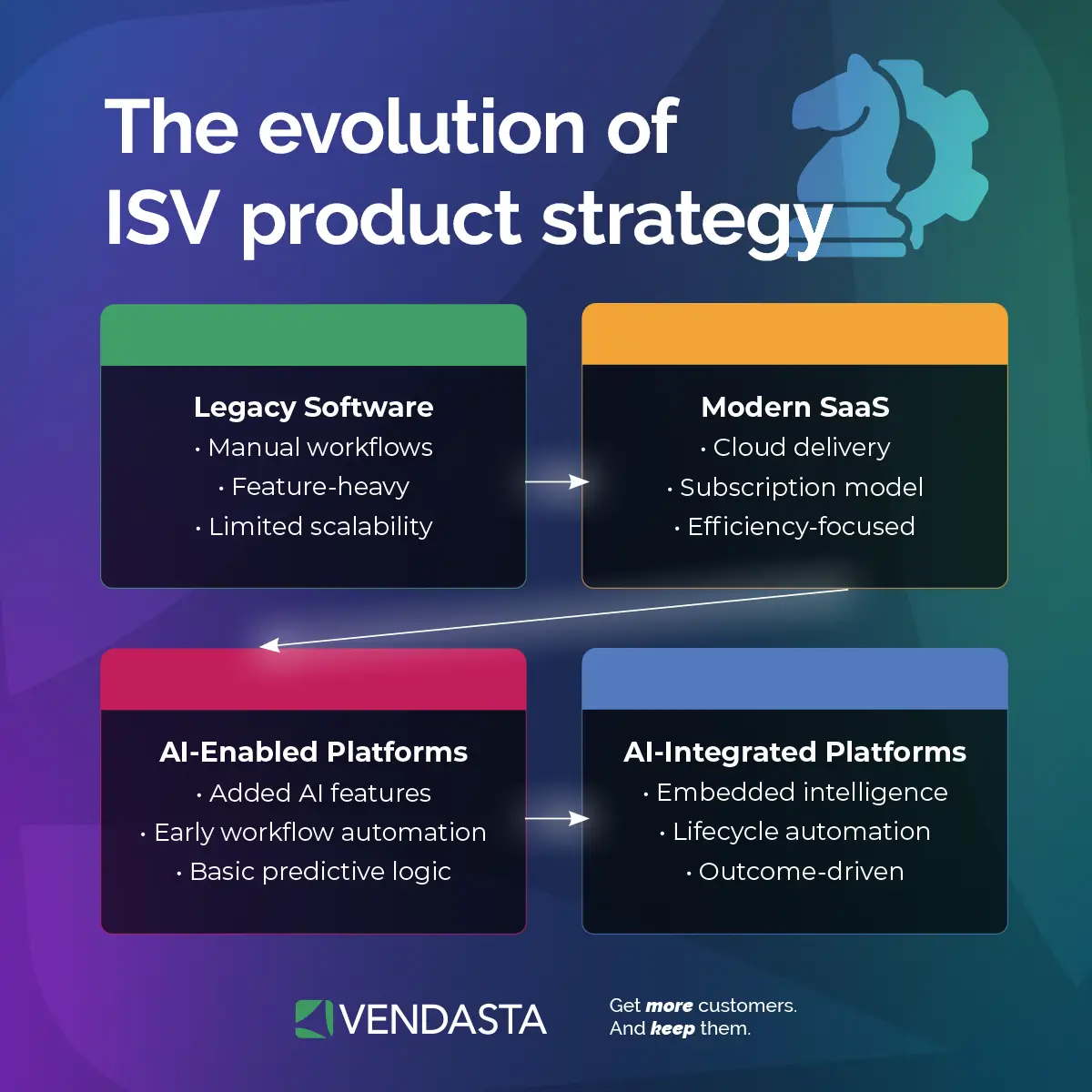
Embed when the capability is expected, but not differentiating. Conversational AI, review management, automated follow-up sequences, appointment booking, and reputation monitoring — these are features your customers expect from modern software. They are not the reasons customers chose your platform specifically. Building them from scratch means:
- 6 to 18 months of development time before anything ships
- Ongoing infrastructure costs for hosting, scaling, and maintaining AI models
- Continuous investment to keep pace with rapidly evolving AI capabilities
- Engineering headcount pulled from your core product for years
A clean integration with a purpose-built platform eliminates all of those costs and gets AI features in front of your customers in weeks.
The Hidden Cost of Deferring the Decision
Every quarter that the AI roadmap item sits under “Explore” is a quarter your competitors are shipping. Research from Bain & Company consistently shows that increasing customer retention by just 5% can increase profits by 25% to 95%. If your customers are leaving because your product doesn’t have AI, deferring the build-vs-buy decision is directly costing you on the bottom line.
A customer retention platform that includes embedded AI gives your customers a tangible reason to stay, and that competitive moat compounds every month you have it and competitors don’t.
The pattern repeats across the ISV market. One Vendasta partner spent roughly six months building a multi-tenant CRM in-house before concluding the deadline was unattainable. After pivoting to Vendasta, they shipped a white-label CRM, AI Workforce, and marketing automation stack in under nine months — meeting their original customer commitment, and freeing engineering to return to core platform work.
Eighteen months later, that same partnership is generating roughly $1.5M in annual run rate at 75% gross margins, with 2,000 accounts deployed.
How AI Is Reshaping the SaaS Product Roadmap in 2026
AI has moved from a differentiator to a baseline expectation. In 2026, SMB customers increasingly evaluate software based on whether it can do work autonomously on their behalf, not just whether it can store and display their data.
This shift has two implications for SaaS product teams.
AI Features Are Now a Retention Tool, Not Just an Upsell
Companies that have shipped AI capabilities are seeing measurable retention improvements. Customers who use AI features show higher engagement, higher NPS scores, and lower churn rates. According to data from Vendasta’s platform, companies using AI-driven lead and communication tools have seen a 372% increase in lead-to-revenue conversion — a figure that resonates deeply with SMB customers focused on growth.
When AI is embedded in your product and working on behalf of your customers, it creates daily value and daily stickiness. That’s a fundamentally different retention dynamic than a product customers log into when they remember to. Products that leverage AI for customer engagement are consistently outperforming those that rely on passive, session-based usage patterns.
The SaaS AI Roadmap Assistant Is Becoming a Standard Role
A growing number of product operations teams are investing in dedicated AI product operations capacity, often called a SaaS AI roadmap assistant role, to manage the evaluation, integration, and optimization of AI capabilities across the product suite. This role sits at the intersection of product management and technical architecture, ensuring that AI features are rolled out consistently, measured against clear KPIs, and updated as the underlying models improve.
If your organization doesn’t have this capacity yet, partnering with a platform that handles the ongoing AI infrastructure and model updates on your behalf is the functional equivalent — and it’s significantly less expensive than headcount. Understanding how AI is transforming business operations at the structural level helps product leaders make that case internally and win the investment they need.
SaaS Product Roadmap Best Practices for CPOs and Product Leaders
A strong product roadmap isn’t just a planning artifact. It’s a communication tool, a prioritization framework, and a cultural signal about how your team makes decisions. Here are the practices that separate high-performing product teams from those that are perpetually behind.
Separate the What from the How
Roadmaps should define outcomes, not implementation details. Leave the how to engineering. When you conflate the two, you end up with a roadmap that becomes outdated the moment the implementation approach changes.
Timebox the Backlog Review
Unreviewed backlogs are roadmap graveyards. Schedule a recurring monthly review to prune items that are no longer relevant, reprioritize based on new data, and ensure the roadmap reflects current reality rather than last quarter’s assumptions.
Make Trade-offs Explicit
Every item you add to the roadmap removes something else. Make that trade-off visible to leadership. When the CEO asks to add a feature mid-quarter, the right answer isn’t yes or no — it’s “here’s what moves out to make room for that.” Explicit trade-offs create better decisions.
Use Roadmap Items as Sales Enablement
Your AEs should know what’s on the roadmap. Not the sprint-level detail — the quarterly themes. When a customer asks, “Are you going to have AI?” your sales team should be able to say, “Yes, and here’s what’s coming and when” rather than hedging. Roadmap visibility reduces sales cycle length and increases win rates on competitive deals.
Measure Roadmap Accuracy Over Time
Track what percentage of roadmap items actually ship within the committed time window. This metric is a leading indicator of planning quality, estimation accuracy, and engineering capacity health. Teams with high roadmap accuracy tend to have shorter sales cycles and better customer relationships. Pairing roadmap discipline with AI-driven workflow automation inside your product operations function can meaningfully reduce the manual overhead that slows planning cycles down.
Can ChatGPT Create a SaaS Product Roadmap?
ChatGPT can assist with specific parts of the roadmap process, but it cannot build a meaningful SaaS product roadmap for an ISV. A roadmap requires proprietary inputs — customer churn data, engineering capacity constraints, vertical market intelligence, competitive feature gaps, and business objectives specific to your product and your customers — that ChatGPT has no access to. Without those inputs, what it generates is a generic template, not a strategic plan.
Where ChatGPT adds genuine value for ISV product teams:
- Synthesizing customer feedback at scale: If you feed ChatGPT a large volume of support tickets, churn interview transcripts, or NPS comments from your SMB customer base, it can surface recurring themes and patterns faster than manual analysis. For ISVs managing hundreds or thousands of SMB accounts, this is one of the highest-value applications in product operations.
- Structuring and formatting roadmap artifacts: ChatGPT can quickly generate roadmap templates, RICE scoring matrices, theme-based frameworks, and audience-specific views — the structural scaffolding that product managers then populate with real data from their own systems.
- Drafting roadmap communications for different stakeholders: ISV product leaders regularly need to translate the same roadmap into different formats — a board-level strategic overview, a quarterly update for the sales team, and an engineering sprint brief. ChatGPT handles that translation efficiently.
- Competitive research and feature gap analysis: Given a set of competitor names and target verticals, ChatGPT can help compile feature comparisons and identify gaps between your current product and market expectations — useful input for roadmap prioritization.
- Brainstorming initiative options: Given a business goal specific to your ISV context (reduce SMB churn, grow ARPU through AI upsells, expand into a new vertical), ChatGPT can generate a list of potential roadmap initiatives for your team to evaluate and refine.
Where ChatGPT falls short for ISV roadmap planning:
- It has no access to your product or customer data. Without real churn signals, real engineering velocity data, and real customer feedback specific to your vertical, any roadmap ChatGPT produces is disconnected from the business reality that makes a roadmap useful for an ISV.
- It cannot make build-vs-buy decisions. For ISVs, this is the highest-stakes roadmap decision — whether to build AI capabilities in-house or embed them through a platform like Vendasta. ChatGPT can outline pros and cons, but it cannot weigh the specific trade-offs between engineering capacity, time-to-market, and competitive urgency that only your team has the context to evaluate.
- It cannot replace the stakeholder alignment process. A roadmap’s value for ISVs comes partly from the organizational process of building it — the conversations between product, engineering, sales, and leadership that surface hidden constraints and create shared ownership. ChatGPT cannot substitute for that work.
- It cannot execute. ChatGPT produces outputs when prompted. It does not monitor your pipeline, update your roadmap when customer feedback shifts, flag when engineering velocity falls behind, or automatically surface the next highest-priority item. ISVs that need AI to actively manage product operations need purpose-built tooling, not a general-purpose language model.
The practical approach for ISV product teams: Use ChatGPT as a productivity layer for the mechanical work — synthesizing feedback, drafting communications, formatting artifacts — while reserving strategic decisions for the product leadership team that holds the context. A product manager who uses ChatGPT to analyze three months of SMB customer feedback in two hours instead of two weeks has more time for the high-judgment work that determines whether the roadmap is actually right for the market.
Vendasta: The Fastest Path to AI on Your SaaS Roadmap
For software companies serving SMBs, Vendasta offers a direct answer to the build-vs-buy dilemma. Rather than spending quarters building AI infrastructure, training models, and managing multi-tenant deployments, ISVs can embed Vendasta’s AI capabilities directly into their product using standard REST APIs, webhooks, and enterprise authentication.
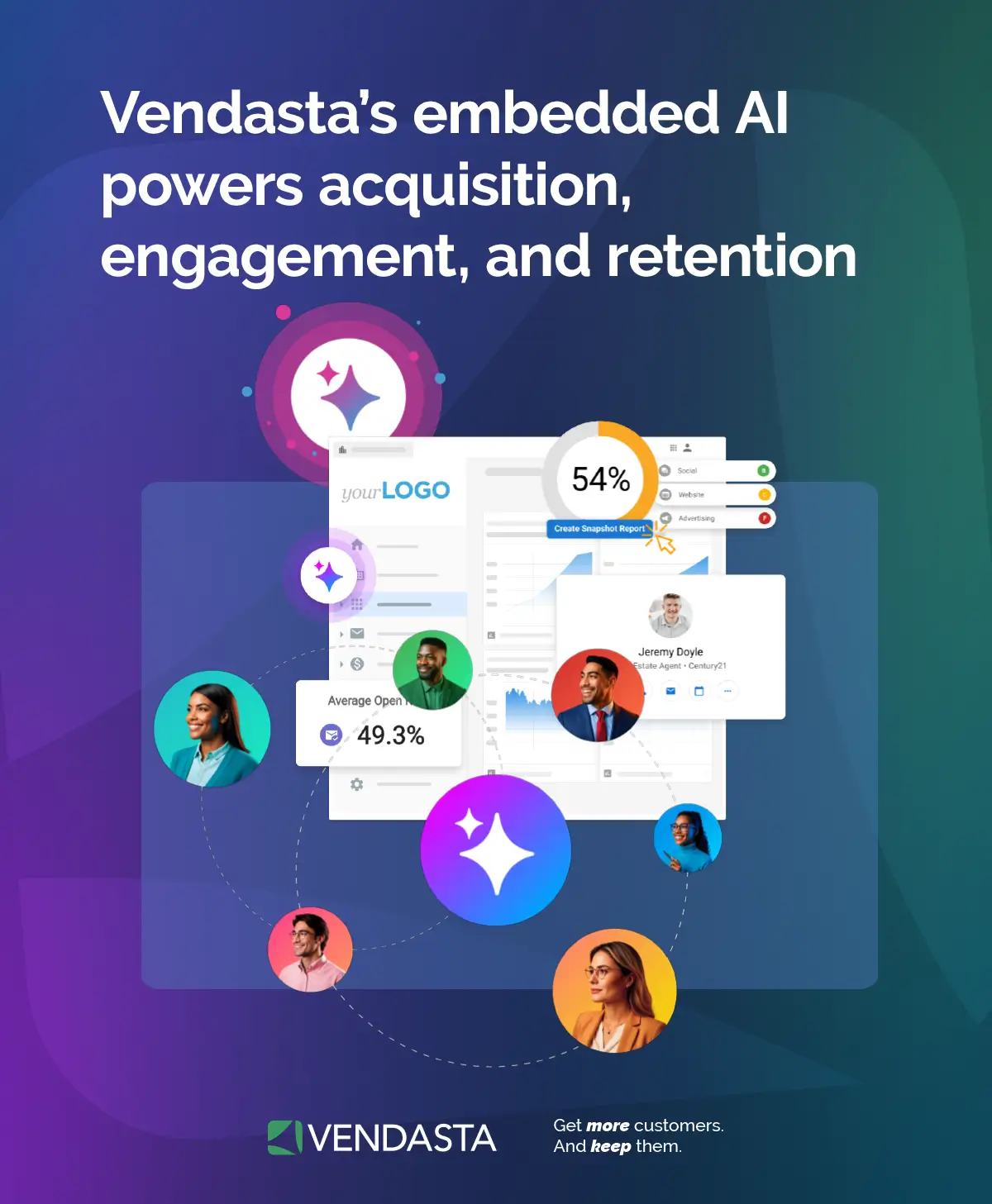
Vendasta’s AI Workforce is a collection of purpose-built AI Employees that automate marketing, sales, and operations using each SMB’s own business data. These are production-ready AI agents that automatically learn each SMB’s business context by ingesting data from Google Business Profiles, websites, and your platform. No manual setup is required per customer.
What You Can Embed and Resell
- AI Receptionist: A 24/7 AI Employee that handles incoming leads via phone, SMS, WhatsApp, and web chat. Captures leads, answers customer questions, and books appointments without human involvement.
- AI Reputation Specialist: Automates review requests, generates personalized review responses, and surfaces feedback trends so your customers’ online reputation improves without manual effort.
- AI Inside Salesperson: Qualifies leads, sends follow-ups, and updates your CRM through governed workflows so your customers’ sales process runs automatically between human touchpoints.
- AI Support Agent: Handles common customer inquiries using the SMB’s specific data, so support volume is reduced and response times improve.
- AI Sales Assistant: Transcribes meetings, updates CRM records automatically, and surfaces next-step recommendations so sales reps spend time selling instead of doing data entry.
Vendasta also serves as an extensibility layer beyond AI. When customer demand for a new capability arrives, you turn it on rather than scoping a new build cycle. One Vendasta partner started with a CRM and AI stack and has since activated six additional product lines without writing a single line of new integration code.
How the Integration Works
Vendasta integrates into your existing infrastructure without forcing architectural changes. It acts as a normalization layer that handles orchestration, automation, and extensibility while your core systems remain the source of truth. You define what data the AI agents access from your systems and which actions require human approval, giving you the governance controls you need to deploy confidently at scale.
Monetization is also handled. Vendasta’s ordering and provisioning system connects to your existing billing infrastructure via API, so you can package AI features, set pricing, and create bundles without any billing engineering work.
The result: you go from “AI is on the roadmap” to “customers are paying for AI” in weeks rather than quarters, and your engineering team never has to context-switch away from the core product.
Common SaaS Product Roadmap Mistakes to Avoid
Even experienced product teams make roadmap mistakes that create downstream pain. Here are the most common ones and how to avoid them.
Treating the Roadmap as a Promise
Roadmaps communicate intent and direction, not contractual commitments. When sales teams or customers treat roadmap items as promises, it creates enormous pressure to ship things that may no longer be the highest priority. Set expectations clearly: the roadmap represents your best current thinking and will evolve as you learn more.
Confusing Roadmap Inputs with Roadmap Decisions
Customer requests are inputs, not decisions. A hundred customers asking for the same feature is a strong signal, but it still needs to be evaluated against business goals, engineering capacity, and strategic fit before it earns a spot on the roadmap. Skipping that evaluation leads to a roadmap that reacts rather than leads.
Ignoring the AI Gap Until It’s a Crisis
Many SaaS companies know they have an AI gap, but treat it as a future problem. By the time it becomes a visible churn driver, the competitive disadvantage is already compounding. The right time to address the AI gap in your roadmap is before you start losing deals because of it, not after. The best AI tools for SMB-focused platforms are already in production at your competitors — waiting is not a neutral decision.
Overloading Engineering With Build Items
Every build item on the roadmap consumes engineering capacity. When the roadmap is 100% build, there’s no room to respond to unexpected customer needs, technical debt, or competitive developments. A healthy SaaS product development roadmap has a mix of build (core differentiators), embed (table-stakes capabilities), and improve (existing feature refinement).
Skipping the Stakeholder Communication Layer
A roadmap that lives in a product management tool and never gets actively communicated is a roadmap that doesn’t drive alignment. Schedule regular roadmap reviews with leadership, sales, and customer success. Make roadmap updates a standing agenda item, not an emergency briefing.
Building a SaaS Product Roadmap That Wins in the AI Era
The SaaS product roadmap has always been the operational backbone of smart product development. But in the current environment, it’s become something more: a direct reflection of how seriously your company is taking the AI transition, and how strategically you’re managing the engineering capacity required to get there.
Product leaders who build great roadmaps in 2026 will do three things well. They’ll anchor every decision on measurable business outcomes rather than feature lists. They’ll make build-vs-buy decisions deliberately and early, protecting engineering for the work that truly differentiates their platform. And they’ll ship AI capabilities fast, because every quarter that AI sits under “Explore” is a quarter that a competitor is using it to win your customers.
The framework is clear. The inputs are knowable. And the fastest path to AI on your roadmap doesn’t require rebuilding your infrastructure or stretching your team. Platforms like Vendasta exist precisely to solve the embedding problem so you can stay focused on what you do best.
Software vendors running this playbook are shipping category-expanding capabilities in under nine months, hitting deployment targets ahead of schedule, and running embedded platform businesses at 75% gross margins — without adding a single engineer to non-core work.
Ship AI in weeks, not quarters. Keep your engineers on the roadmap. Grow ARPU without growing your backlog. Book a demo with Vendasta today!
SaaS Product Roadmap FAQs
1. What is a SaaS product roadmap?
A SaaS product roadmap is a strategic planning document that outlines what a software company intends to build, why, and roughly when. It aligns product, engineering, sales, and leadership around shared priorities and communicates product direction to stakeholders without committing to rigid feature-delivery schedules.
2. How is a SaaS product roadmap different from a regular product roadmap?
SaaS product roadmaps account for the continuous delivery nature of cloud software, where updates ship frequently, and customer feedback loops are shorter. They tend to be theme-based and outcome-focused rather than feature-and-date-specific, because the pace of change makes hard commitments counterproductive for most SaaS teams.
3. What should be included in a SaaS product development roadmap?
A strong SaaS product development roadmap includes strategic themes aligned to business goals, prioritized initiatives with effort and impact estimates, a build-vs-buy classification for each major item, sprint-level detail for engineering, and a quarterly view for go-to-market alignment. It should be reviewed and updated at least every quarter.
4. How do I prioritize items on a SaaS product roadmap?
Use a structured framework like RICE (Reach, Impact, Confidence, Effort) or a Value vs. Effort matrix. Weigh customer feedback volume, business impact, strategic fit, and engineering cost for each item. Avoid prioritizing by loudest internal voice or most recent customer request alone.
5. How can SaaS companies add AI features to their roadmap without overloading engineering?
The fastest path is embedding pre-built AI capabilities from a purpose-built platform rather than building from scratch. Vendasta lets software vendors embed white-label AI Employees for automated lead capture, reputation management, and customer communication using standard APIs, without adding to the engineering backlog or building AI infrastructure in-house.
6. What is a SaaS product roadmap example for a company serving SMBs?
A strong example organizes initiatives by quarterly themes: Q1 might focus on AI-powered customer communication (embedded), Q2 on reputation and retention features (embedded), and Q3 on core vertical workflow improvements (built). This structure separates core product work from capability additions and gives sales a clear story for each quarter.
7. What does a SaaS AI roadmap assistant do in product operations?
A SaaS AI roadmap assistant in product operations manages the evaluation, integration, and performance tracking of AI features across a product suite. This role identifies which AI capabilities to embed or build, tracks adoption and ROI metrics, and ensures AI features remain current as underlying models evolve. Some companies outsource this function to a platform partner like Vendasta instead.
8. How often should a SaaS product roadmap be updated?
Most high-performing SaaS teams review and update their roadmap quarterly at a minimum, with a standing monthly backlog review for smaller adjustments. Roadmaps should be updated whenever significant new customer feedback, competitive intelligence, or engineering capacity changes arise, not just on a fixed schedule.
9. What is the biggest mistake SaaS companies make with their product roadmap?
The most common and costly mistake is treating the roadmap as a list of features and delivery commitments rather than a strategic communication tool. This leads to overpromising to customers, under-delivering to engineering, and a roadmap that doesn’t adapt fast enough to market changes, including the AI transition reshaping SaaS buyer expectations today.
10. How does Vendasta help software vendors ship AI features faster?
Vendasta enables ISVs to embed white-label AI capabilities, including AI Receptionists, AI reputation management, review generation, CRM automation, and more, into their existing product using REST APIs and standard integrations. This eliminates months of infrastructure development and lets product teams ship AI to customers in weeks rather than quarters, without diverting engineering from core product work.