About Us
 Careers
 Leadership
 Board
Board Newsroom
Your customers are asking for AI. Your competitors are shipping it. And your engineering team is already three sprints behind on the core roadmap.
The build vs. buy AI question isn’t a new one, but in 2026, the stakes have never been higher. Every quarter this decision gets deferred, you risk losing deals to AI-native competitors, watching churn climb, and falling further behind on a gap that gets harder to close. Meanwhile, the landscape of available AI tools has matured to the point where “we’ll build it ourselves eventually” is no longer a defensible strategy.
This guide breaks down every angle of the build vs. buy AI decision, from cost and time-to-market to agent orchestration, voice AI, and everything in between, so you can stop deferring and start shipping.
Automate the entire customer journey from first touch to repeat business
TL;DR
- The clock is ticking: The AI agent market is projected to grow from $7.92 billion in 2025 to $236 billion by 2034, and 32% of SaaS revenue growth is now attributed to AI-powered features. Waiting is not a neutral position.
- Build rarely wins on speed: Building a mid-complexity AI agent from scratch takes 3 to 5 months minimum; full multi-agent systems can take 6 to 12 months, while a buy or embed approach can get you to market in weeks.
- The smartest path is often a hybrid: Platforms like Vendasta let software vendors embed production-ready AI employees into their product without pulling engineers off the core roadmap, combining the speed of buying with the differentiation of owning the customer relationship.
What Does “Build vs. Buy AI” Really Mean?
At its core, the build vs. buy AI decision is about where your engineering resources go and who owns the infrastructure powering your AI capabilities.
When you build, your team designs, develops, trains, and maintains every component in-house. When you buy, you license or embed a third-party AI solution into your product. But as MIT Sloan researchers Nick van der Meulen and Barbara Wixom outlined in their widely cited framework, there’s actually a third path that many product leaders overlook: boost.
Here’s how the three paths break down:
- Buy: You acquire a fully packaged AI solution from a vendor and embed or resell it. The vendor builds, runs, and maintains everything.
- Boost: You start with a vendor’s AI model but enhance it with your own proprietary data, fine-tuning, or retrieval-augmented generation (RAG) to improve accuracy and relevance for your specific use case.
- Build: You take full ownership, developing your own models, pipelines, and infrastructure from the ground up.
Most product leaders frame this as a binary choice. It isn’t. The most successful software vendors are combining all three: buying commodity capabilities, leveraging proprietary data, and building only where they have a genuine competitive moat.
This balanced approach to AI integration for SaaS allows companies to scale quickly while maintaining high standards for innovation and performance.
The MIT Sloan Framework for Build vs. Buy AI Decisions
The most academically rigorous framework for the build vs. buy AI decision comes from researchers at the MIT Center for Information Systems Research (CISR). Research scientists Nick van der Meulen and Barbara Wixom outlined three pathways for acquiring generative AI solutions — buy, boost, and build — and emphasize that understanding your organization’s current strengths and weaknesses is essential, because it informs the strategic choices you make about how to acquire or develop AI solutions. Their full framework is published at MIT Sloan.
A critical distinction in their research that most product teams overlook: van der Meulen and Wixom distinguish between two types of generative AI — broadly applicable tools that enhance personal productivity, and solutions that are business-case-driven and address strategic objectives. Each type demands a different acquisition path.
Here’s how that maps to ISV decision-making in practice:
Broadly applicable tools (content generation, summarization, research assistance) are internal productivity capabilities. These almost always belong in the “buy” category — off-the-shelf tools like ChatGPT, Gemini, or Copilot. There is no competitive advantage in building your own version of a general-purpose productivity layer.
Business-case-driven solutions (AI that directly serves your customers — lead capture agents, voice receptionists, review management, appointment booking) require a more deliberate analysis. The MIT framework asks: do you have proprietary data, a unique integration requirement, or a genuine competitive moat that justifies the build cost? If the honest answer is no, the boost or buy path will deliver more value faster with lower risk.
Wixom and van der Meulen are currently researching the guardrails companies need to establish to effectively and safely deploy AI solutions without compromising compliance, values, and ethics — a dimension that is particularly relevant for ISVs deploying AI to SMB customers who may lack in-house compliance expertise. Their ongoing research suggests governance requirements are a growing reason the build path becomes more expensive over time, as regulatory requirements tighten and internal AI systems require continuous compliance maintenance. Vendors building for scale have already absorbed those costs.
Build vs Buy AI: Why This Decision Can’t Wait
The urgency isn’t manufactured. The data tells the story clearly.
The global AI agent market is projected to grow from $7.92 billion in 2025 to $236 billion by 2034. Roughly 51% of enterprises already have AI agents running in production, and another 78% have active plans to deploy them. Voice AI alone is a $2.4 billion market today, expected to reach $47.5 billion by 2034, growing at a CAGR of 34.8%.
For B2B software vendors targeting SMBs, the competitive pressure is even more direct:
- While traditional software grows at roughly 18-20%, the AI segment is surging at a 38% CAGR.
- SMB customers churn at 3 to 7% per month, and product-feature gaps are a leading driver of that churn.
- 42% of businesses abandoned AI projects in 2024, up from 17% in 2023, largely because the build path proved more complex and costly than anticipated.
The future belongs to companies that combine the best of vendor platforms with selective, strategically placed custom development. Waiting for a perfect build strategy while competitors ship working AI is not a defensible plan.
For software vendors with AI on the roadmap but nothing shipped, every quarter of delay is a quarter of compounding disadvantage.
The Hidden Costs of Building AI In-House
When product and engineering leaders estimate the cost of building AI, they almost always undercount. The visible costs are clear: engineer salaries, infrastructure, model API fees. The invisible costs are what sink timelines and budgets.
Time-to-Market Is Longer Than You Think
Independent estimates consistently show that:
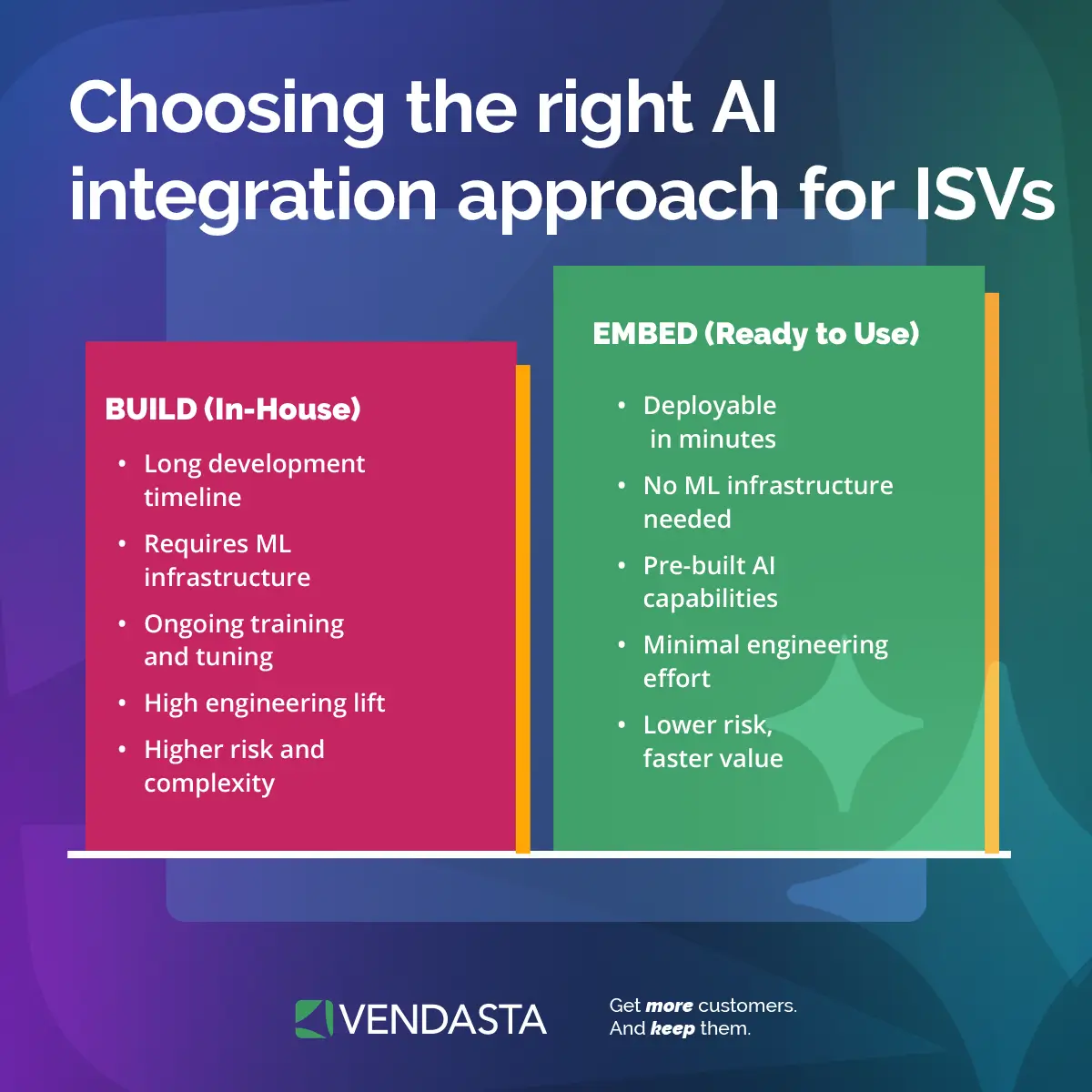
- Simple AI agents take 4 to 8 weeks to build.
- Mid-complexity LLM or RAG agents take 3 to 5 months.
- Full multi-agent systems take 6 to 12 months to reach production quality.
That’s not a prototype. That’s a production-grade system with error handling, multi-tenant support, scaling infrastructure, security reviews, and ongoing model maintenance.
The Dollar Cost of Building
AI development costs in 2025 and 2026 range widely, depending on complexity:
| Build Complexity | Estimated Cost | Timeline |
|---|---|---|
| AI MVP / Prototype | $50,000 – $100,000 | 3+ months |
| Mid-complexity AI agent | $100,000 – $250,000 | 4–6 months |
| Full multi-agent system | $250,000 – $400,000+ | 6–12 months |
| Ongoing maintenance (annual) | 40–60% of initial build cost | Perpetual |
One often-cited benchmark: 65% of total software costs occur after the initial deployment. AI systems compound this dynamic because models drift, context windows change, APIs deprecate, and regulatory requirements evolve.
The Opportunity Cost No One Puts in a Spreadsheet
Here’s the cost that rarely shows up in a build-vs-buy analysis: every engineer working on your AI infrastructure is not working on your core product.
For software vendors with 50 to 200 employees, engineering is the most constrained resource in the business. Pulling two senior engineers onto an AI side project for six months isn’t just a budget line item. It’s a delayed core feature, a slower sales cycle for your non-AI customers, and a higher risk of technical debt on the systems those engineers were originally responsible for.
Building AI in-house makes sense in specific, well-defined circumstances. But for most software vendors, it means mortgaging the roadmap to ship something a vendor can already give you in weeks.
What Does It Cost to Build vs. Buy AI? (Full Cost Breakdown)
The true cost of the build vs. buy AI decision is almost always higher on the build side than initial estimates suggest — and lower on the buy side than product teams assume.
Build costs in 2026
Gartner projects that more than 40% of agentic AI projects will be cancelled by the end of 2027, citing escalating costs, unclear value, and inadequate risk controls — meaning a significant share of build investments never deliver a return at all. The ongoing maintenance burden compounds this: 65% of total software costs occur after initial deployment, and AI systems drift faster than conventional software as models update, APIs deprecate, and regulatory requirements shift.
The fully-loaded build cost for a $20M ARR ISV typically includes:
- Engineer salaries (3–4 senior engineers for 6–12 months): $300,000–$500,000
- Cloud infrastructure and model API costs: $24,000–$60,000/year ongoing
- Compliance, security review, and audit tooling: $20,000–$50,000
- Annual maintenance at 40–60% of initial build cost: $60,000–$150,000/year
- Opportunity cost of engineers pulled off the core roadmap: uncapped
Buy costs in 2026
Embedded AI platforms typically charge on a usage, per-seat, or per-location basis. For a software vendor serving 500 SMB customers, a white-label AI Workforce platform can run $15–$50 per location per month, depending on capability tier — a total infrastructure cost that is often recoverable in a single pricing tier increase to customers. The first dollar of AI revenue is reachable in weeks, not quarters.
The number most CFOs miss: Engineering opportunity cost. For a software vendor with 15 engineers, pulling two senior engineers onto an AI build for nine months represents roughly 18 engineer-months — the equivalent of your entire roadmap for two product lines sitting idle. That cost never shows up in a build-vs-buy spreadsheet, but it’s often the largest single factor in the decision.
Bottom line: For commodity AI capabilities like lead capture, voice reception, review management, and appointment booking, buying almost always wins on total cost of ownership when opportunity cost is included. Build economics only favor in-house development when the AI capability is the product itself.
When to Build AI Tools
The buy vs build AI decision factors make it clear that building is the right call only when a specific set of high-stakes conditions is met.
Your AI Capability Is Your Core Product
If the AI model itself is what customers are paying for, and differentiating that model is your competitive advantage, then you need to own it. Companies like Harvey (legal AI) or Abridge (medical documentation) built proprietary models because the AI is the product.
You Have Highly Sensitive, Regulated, Or Proprietary Data
If your AI needs to ingest PHI, financial records, or other regulated data that cannot be passed through a third-party vendor’s infrastructure without compliance risk, building in-house or a closely managed boost strategy is often the only option.
Deep, Proprietary System Integration Is Required
If your AI needs to interact with systems that have no APIs or where the integration complexity is genuinely unique to your business, building may be unavoidable.
You Have A Long-Term Strategic Asset Perspective
Building is a compounding investment. If AI is central to your five-year product strategy and you have the runway to invest, owning the infrastructure gives you control over model quality, data access, and product direction that a vendor relationship never fully provides.
The Key Test: Is this AI capability part of what makes your product uniquely valuable, or is it a feature customers expect, and competitors are already shipping? If it’s the latter, building is likely the wrong call.
When to Buy AI Tools
Buying or embedding a third-party AI solution is the right call for the majority of software vendors in the SMB space today. Here’s why:
Speed to Market Is a Competitive Requirement
If your customers are churning or your sales team is losing deals to AI-native competitors, you cannot wait 6 to 12 months for an internal build. Buying gets you to a working, production-grade capability in weeks.
The Capability Is Not Your Core Differentiator
AI-powered review management, appointment scheduling, lead capture, voice receptionists, and reputation monitoring are valuable to your customers, but they are not what make your specific platform unique. They are table-stakes capabilities that enterprise vendors already offer, and that SMBs increasingly expect.
Your Engineering Team Is Stretched
Adding AI to the roadmap means deprioritizing something else. For most product teams, the honest answer is that there is no room. Buying removes the tradeoff.
You Need Multi-Tenant Infrastructure
Deploying AI to hundreds or thousands of SMB customers requires orchestration, provisioning, billing, and tenant isolation that takes months to build correctly. Most vendors offering embeddable AI have already solved this problem for you.
You Want Ongoing Feature Improvements without Maintenance Burden
AI models improve. Regulations change. New capabilities emerge. A good AI vendor updates their product continuously; you get the benefits without the maintenance work.
The Third Path: Boost Your AI Strategy
The boost approach sits between buying and building, and it’s often the most strategically sound path for software vendors who want differentiation without the full cost of a from-scratch build.
In a boost model:
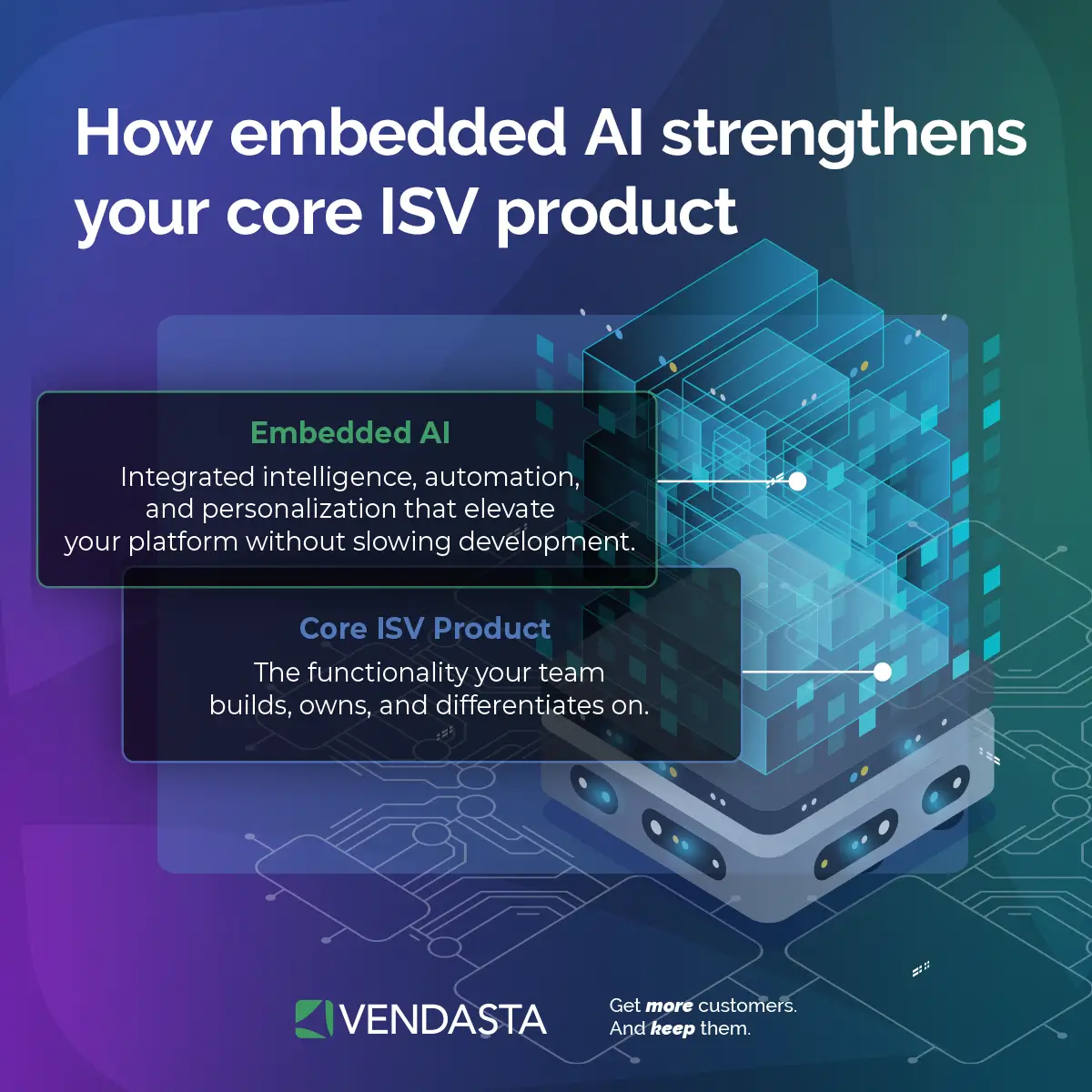
- You start with a vendor’s AI infrastructure (handling orchestration, compliance, hosting, and base model capability).
- You layer your proprietary data on top to customize and improve performance for your specific customer base.
- You own the customer relationship and the branded experience, even if the underlying model is shared.
For example, a software vendor serving home services companies might embed a white-labeled AI receptionist that handles inbound calls and books appointments. The base capability comes from the vendor. But by feeding in each SMB’s specific service list, pricing, and hours, the AI delivers a personalized experience that feels built for that business.
This is the model Vendasta’s AI Employees are designed to support. They automatically learn each SMB’s business context by ingesting data from sources like Google Business Profiles, websites, and the partner platform.
No manual setup. No prompt engineering by your team. The AI is production-ready, but it behaves like it was built specifically for each customer.
Build vs. Buy AI: A Decision Framework
| Factor | Build | Boost | Buy |
|---|---|---|---|
| AI is a core product differentiator | Yes | No | No |
| Regulated or sensitive proprietary data | Yes | Conditional | No |
| Speed to market is critical (weeks, not quarters) | No | Conditional | Yes |
| The engineering team is stretched | No | Conditional | Yes |
| Need multi-tenant deployment at scale | No | Yes | Yes |
| Want ongoing vendor-managed improvements | No | Yes | Yes |
| Need white-label / branded experience | No | Yes | Yes |
| Long-term budget for maintenance | Yes | Conditional | No |
When to Build vs. Buy AI Tools: The Honest Questions
Ask your team these questions honestly before making the call:
- Is this AI capability part of our core IP, or is it a feature customers expect?
- Do we have the engineering headcount and runway to build and maintain this for 2+ years?
- What is the opportunity cost of pulling engineers off the core product?
- How quickly are customers and prospects asking for this?
- Does a vendor already offer this at a quality level our customers would accept?
If the honest answers point toward “we need this fast, and it’s not our core IP,” the buy or boost path will almost always outperform an internal build on total value delivered.
Pro Tip: To navigate the complex build vs buy AI landscape, download Vendasta’s AI Integration Playbook for ISVs to access a practical framework for choosing the right development path without slowing down your product roadmap.
What Does Gartner Say About Build vs. Buy AI?
Gartner’s research on the build vs. buy AI question offers a clear warning for teams leaning toward building: the execution risk is higher than most organizations plan for.
Gartner projects that more than 40% of agentic AI projects will be cancelled by the end of 2027, driven by escalating costs, unclear value, and inadequate risk controls. That statistic is not about small experiments — it reflects mid-market and enterprise deployments where organizations committed real engineering resources and budget before abandoning the effort.
On the buy and embed side, Gartner’s forecast is equally directional. According to Gartner research, more than 80% of independent software vendors will have embedded generative AI capabilities into their enterprise applications by 2026, up from less than 5% in 2024. For ISVs, that trajectory isn’t aspirational — it’s a competitive baseline. The vendors who reach 80% aren’t building AI from scratch; they’re embedding it.
Gartner’s Composable AI report found that 65% of enterprises now use hybrid AI architectures combining commercial APIs with in-house models and tools, and projects that by 2026, 70% of enterprise AI workloads will operate on hybrid architectures combining vendor and in-house components.
For ISVs, the practical implication of Gartner’s data is this: the debate is not “build everything” vs. “buy everything.” It’s how to architect a hybrid approach where vendor-provided infrastructure handles the commodity capabilities — multi-tenancy, orchestration, voice, compliance — while your engineering investment is concentrated on the layer where you have a genuine moat. The companies cancelling their AI projects in 2027 will largely be the ones that tried to own the entire stack without the resources to do it well.
The MIT Sloan Framework for Build vs. Buy AI Decisions
The most academically rigorous framework for the build vs. buy AI decision comes from researchers at the MIT Center for Information Systems Research (CISR). Research scientists Nick van der Meulen and Barbara Wixom outlined three pathways for acquiring generative AI solutions — buy, boost, and build — and emphasize that understanding your organization’s current strengths and weaknesses is essential because it informs the strategic choices you make about how to acquire or develop AI solutions. Their full framework is published at MIT Sloan.
A critical distinction in their research that most product teams overlook: van der Meulen and Wixom distinguish between two types of generative AI — broadly applicable tools that enhance personal productivity, and solutions that are business-case-driven and address strategic objectives. Each type demands a different acquisition path.
Here’s how that maps to ISV decision-making in practice:
Broadly applicable tools (content generation, summarization, research assistance) are internal productivity capabilities. These almost always belong in the “buy” category — off-the-shelf tools like ChatGPT, Gemini, or Copilot. There is no competitive advantage in building your own version of a general-purpose productivity layer.
Business-case-driven solutions (AI that directly serves your customers — lead capture agents, voice receptionists, review management, appointment booking) require a more deliberate analysis. The MIT framework asks: do you have proprietary data, a unique integration requirement, or a genuine competitive moat that justifies the build cost? If the honest answer is no, the boost or buy path will deliver more value faster with lower risk.
Wixom and van der Meulen are currently researching the guardrails companies need to establish to effectively and safely deploy AI solutions without compromising compliance, values, and ethics — a dimension that is particularly relevant for ISVs deploying AI to SMB customers who may lack in-house compliance expertise. Their ongoing research suggests governance requirements are a growing reason the build path becomes more expensive over time, as regulatory requirements tighten and internal AI systems require continuous compliance maintenance. Vendors building for scale have already absorbed those costs.
Build vs. Buy AI Agents: What Makes Agents Different
The build vs. buy AI agents question has a few dimensions that don’t apply to simpler AI features like content generation or basic chatbots.
Agentic AI Requires Orchestration, Not Just a Model
AI agents don’t just respond. They take actions: querying databases, updating CRMs, booking appointments, sending follow-ups, and escalating to humans when needed. Building this level of orchestration from scratch means designing and maintaining:
- Action routing and tool-calling logic
- Guardrails and human-in-the-loop approval workflows
- Multi-tenant context isolation (so one SMB’s agent doesn’t surface another’s data)
- Error handling and fallback behavior
- Governance and audit logging
For most software vendors, this is an enormous undertaking. And the complexity compounds when you’re deploying agents to hundreds or thousands of SMB customers who each have unique business contexts.
The Multi-Tenant Challenge Is Real
An AI agent that works perfectly for one business is not automatically ready to deploy to a thousand businesses. A multi-tenant platform requires:
- Isolated customer data and context
- Per-tenant configuration and permissions
- Scalable provisioning and lifecycle management
- Usage tracking and billing integration
This infrastructure alone can take a dedicated engineering team 3 to 6 months to build correctly.
Buying AI Agents Means Instant Multi-Tenant Scale
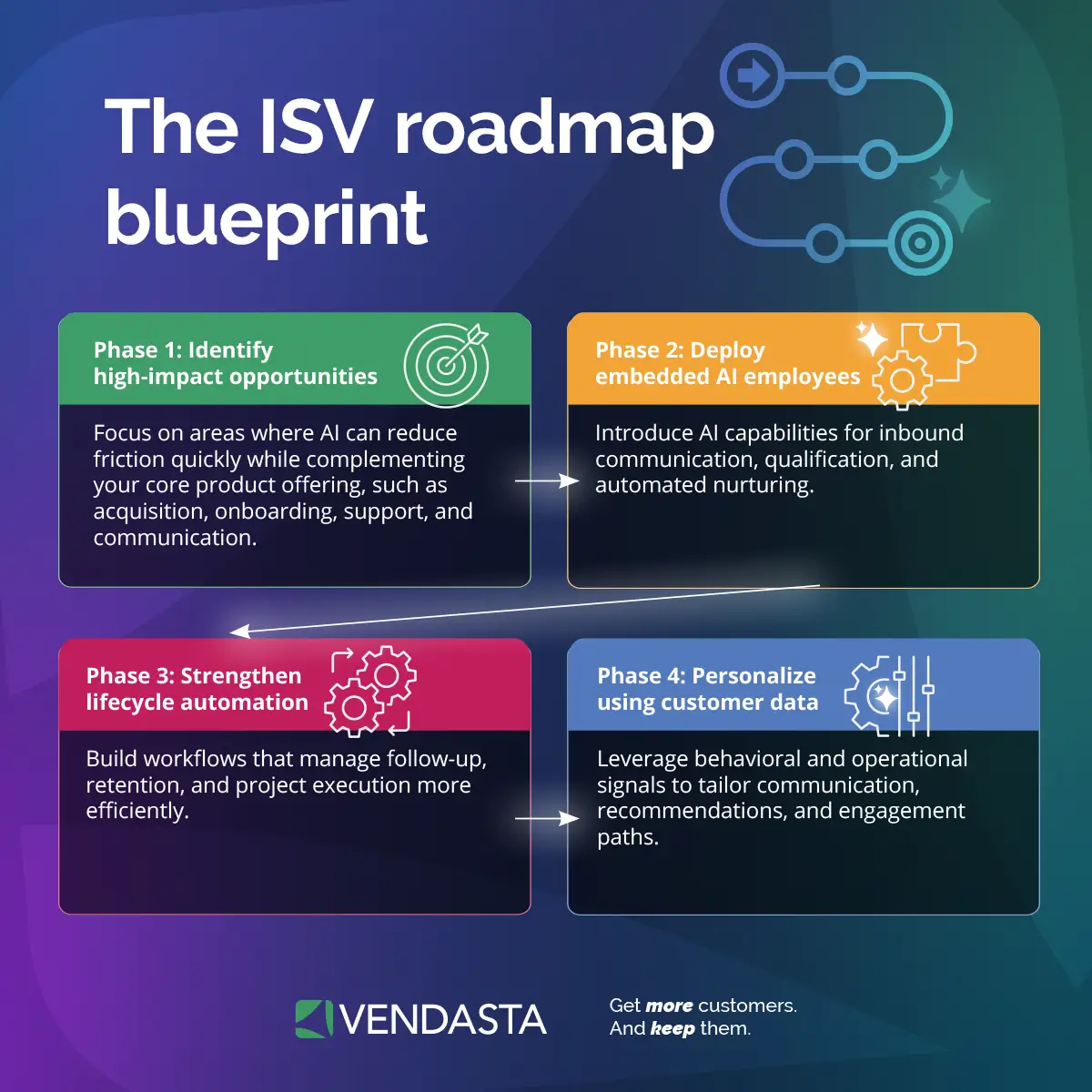
Platforms like Vendasta have already built this infrastructure. When a software vendor embeds Vendasta’s AI Employees, they get multi-tenant agent deployment out of the box, complete with REST APIs, webhooks, and enterprise authentication. You define what data agents access and which actions require human approval. The platform handles the orchestration, scaling, and maintenance.
That’s the difference between shipping AI in weeks versus spending a year building infrastructure your customers never directly see.
Build vs. Buy AI Voice Agents: A Special Case
Voice AI deserves its own discussion because the technical and regulatory complexity is substantially higher than that of text-based agents.
Why Voice Is Harder to Build
Building a voice agent isn’t just connecting a language model to a microphone. Every interaction involves:
- Speech-to-text transcription (with accuracy requirements for accented speech, noisy environments, and domain-specific vocabulary)
- Language model inference (with latency that must stay under 500 to 600 milliseconds for the conversation to feel natural)
- Text-to-speech synthesis (the TTS component alone must complete in under 100 milliseconds)
- Call routing, fallback, and escalation logic
- CRM and calendar integration (a voice agent without access to deal stages and booking systems is not useful)
The latency requirements alone are engineering-intensive. Any lag in the speech-to-text, inference, or TTS steps degrades the user experience in a way that text-based agents never have to handle.
Regulatory Complexity in Voice AI
The regulatory environment for AI voice is strict and tightening. The FCC clarified in early 2024 that AI-generated voices are subject to TCPA regulations, including consent and disclosure requirements. U.S. consumers received 52.5 billion robocalls in 2025, and regulators have taken notice.
When you choose to buy vs. build AI assistant capabilities for voice, consider that a reputable vendor transfers much of this compliance burden. They maintain audit trails, manage consent workflows, update their systems as regulations change, and hold required certifications.
Building your own voice AI means owning all of that, including legal liability, ongoing compliance monitoring, and the engineering cost of keeping up with regulatory changes.
When to Buy AI Voice Agents
For most software vendors serving SMBs in home services, healthcare, or professional services, buying AI voice agents is almost always the right call. The technical complexity, latency requirements, regulatory burden, and multi-tenant infrastructure needs combine to make this one of the clearest cases where buying dramatically outperforms building.
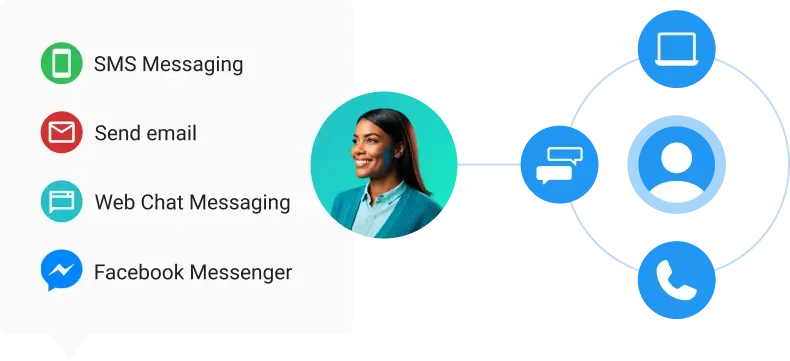
Vendasta’s AI Receptionist, available in both voice and chat, handles inbound and outbound communication 24/7, capturing leads, answering questions, and booking appointments, without your team or your customers’ teams needing to lift a finger. It’s deployed through standard APIs, works with existing CRMs, and requires no manual setup per customer.
What the Numbers Mean for a $20M ARR Software Vendor
Assume a software vendor with 100 employees and an engineering team of 15 decides to build an AI receptionist, AI review management, and a basic AI sales assistant in-house. Conservative estimates:
- Engineering time: 3 to 4 engineers for 6 to 9 months
- Direct cost: $300,000 to $500,000 in fully loaded engineering salaries
- Opportunity cost: 1,500 to 2,000 engineer-hours diverted from core product development
- Time to first dollar of AI revenue: 9 to 18 months
Compare that to embedding a solution like Vendasta’s AI Workforce:
- Engineering time: API integration, a few weeks
- Direct cost: Vendor pricing with usage-based scale
- Time to first dollar of AI revenue: Weeks, not quarters
- Engineering focus: Stays on core product
Top AI Platforms Software Vendors Can Embed Today
If you’re evaluating the buy or boost path, here are the leading platforms purpose-built for software vendors who want to embed AI capabilities without building the infrastructure themselves.
1. Vendasta
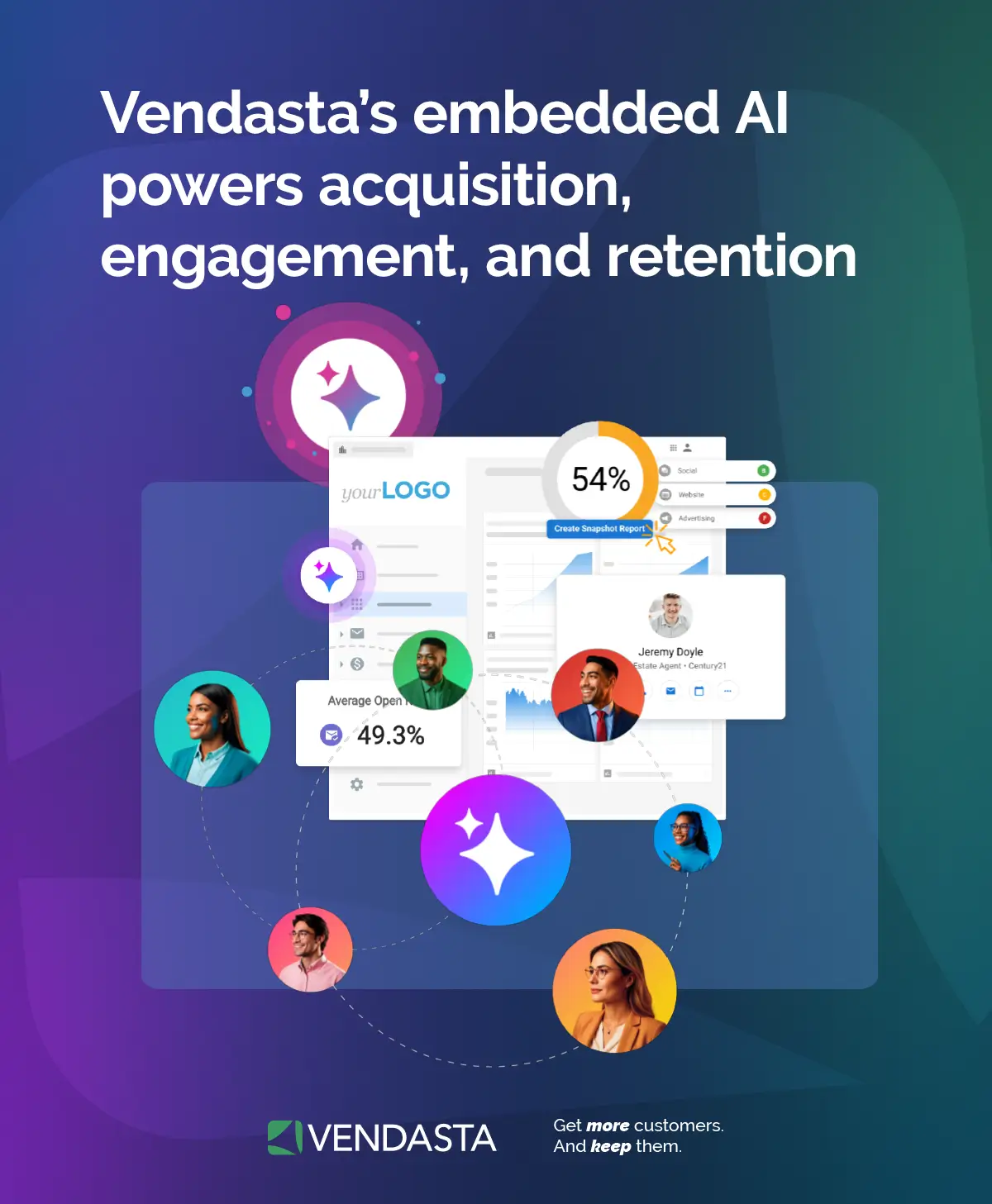
Vendasta provides an end-to-end AI infrastructure designed specifically for software vendors and ISVs. Unlike raw AI building blocks, Vendasta offers a white-label AI workforce: production-ready agents that handle lead generation, reputation management, appointment booking, and customer communication.
These agents automatically ingest SMB data from sources like Google Business Profiles and CRMs, allowing for immediate deployment without manual configuration. By providing the underlying multi-tenant infrastructure, billing, and provisioning, Vendasta allows vendors to launch sophisticated AI features in weeks rather than years.
- Pros: Rapid speed to market; fully white-labeled; handles complex multi-tenancy and data ingestion out of the box; no specialized AI engineering required.
- Cons: Less suitable for companies building a unique, proprietary LLM from scratch; focused specifically on the SMB-serving software segment.
- Best for: CPOs and engineering leaders at software companies who need to ship AI capabilities fast without pulling engineers off the core roadmap.
2. Twilio
Twilio is the industry standard for programmable communication, providing a massive suite of APIs for voice, SMS, and email. In the AI era, Twilio has introduced tools like “Segment” for customer data and “Voice Intelligence” to extract insights from conversations.
It acts as the plumbing for AI-driven communications, allowing developers to build custom workflows. However, it is fundamentally a developer tool; it provides the “pipes,” but your engineering team must build the “brain” that decides what flows through them.
- Pros: Maximum flexibility and control over the communication flow; highly reliable global infrastructure; extensive documentation and developer support.
- Cons: High build responsibility; requires significant engineering resources to develop and maintain AI logic; costs can scale rapidly with high volume.
- Best for: Engineering teams that need flexible, developer-centric communication infrastructure and want to build highly customized, programmable AI workflows.
3. Intercom
Intercom has pivoted heavily into AI with “Fin,” an AI agent designed to resolve customer support tickets using your company’s existing help center content. It is a plug-and-play solution for support teams, offering a sophisticated chat interface and seamless hand-offs to human agents.
While it is incredibly powerful for internal support teams, it is built as a standalone SaaS product, meaning it is difficult to fully rebrand or embed as a native feature within another software platform.
- Pros: Top-tier accuracy for support-related queries; very low setup time; excellent user interface for both customers and support reps.
- Cons: Not designed for white-labeling; expensive per-resolution pricing; limited to customer support use cases rather than general business automation.
- Best for: B2B or B2C support teams that want high-quality AI-powered chat with strong helpdesk integration and minimal setup.
4. Salesforce Einstein
Einstein is a layer of artificial intelligence integrated directly into the Salesforce CRM ecosystem. It provides predictive lead scoring, automated activity capture, and generative AI features for sales and service teams.
For companies whose entire business logic lives within Salesforce, Einstein is a powerful way to add intelligence to existing data. However, for an ISV looking to build its own product, Einstein is more of an internal productivity tool than a component you can easily embed into your own external-facing software.
- Pros: Deeply integrated with the world’s most popular CRM; powerful predictive analytics; requires no additional data migration.
- Cons: Restricted to the Salesforce ecosystem; can be complex to configure; lacks the flexibility for non-CRM-related AI applications.
- Best for: Software vendors and enterprises already deeply integrated into Salesforce who want to enhance internal sales and service productivity.
5. Microsoft Azure AI
Azure AI (including Azure OpenAI Service) provides the raw industrial power needed to build custom AI models and applications. It offers a suite of Cognitive Services for vision, speech, and language, as well as the AI Studio for fine-tuning large language models.
This is a Build or Boost path—while the infrastructure is managed by Microsoft, your team is responsible for the application logic, the UI, the tenant management, and the ongoing model optimization.
- Pros: Access to OpenAI’s GPT models with enterprise-grade security and compliance; massive scalability; comprehensive toolset for data scientists.
- Cons: Extremely high engineering overhead; no out-of-the-box user features; requires specialized AI and DevOps talent to move from pilot to production.
- Best for: Large engineering teams that want to build custom, proprietary AI solutions from the ground up and require total control over the model layer.
How to Build the Business Case for Buying AI (Instead of Building It)
For many product and engineering leaders, the hardest part of the build vs. buy AI decision isn’t the analysis — it’s selling the “buy” recommendation internally to stakeholders who default to “we should own this.”
Here’s a practical framework for building that business case:
Step 1: Anchor on competitive urgency, not just cost.
The question isn’t “can we afford to buy?” — it’s “can we afford to wait?” Gartner research projects that more than 80% of ISVs will have embedded AI by 2026, up from less than 5% in 2024, which means your competitors are shipping AI now. Frame the business case around customer retention and deal velocity, not just engineering budget. If even 5% of your SMB base churns per month to an AI-native alternative, the math on lost ARR vastly outweighs any build cost savings.
Step 2: Quantify the true cost of the build path.
Use the full cost model: direct engineering costs, infrastructure, compliance, maintenance at 40–60% of build cost annually, and the opportunity cost of every engineer-month diverted from core product development. Present this as a three-year total cost of ownership, not a one-time build estimate.
Step 3: Map customer demand to specific AI capabilities.
Pull your last 90 days of support tickets, churn surveys, and sales loss reasons. Identify how many reference AI features or competitor AI capabilities explicitly. This converts the business case from a strategic argument to a data-backed revenue defense.
Step 4: Benchmark the buy option against the build estimate.
Calculate the monthly cost of an embedded AI platform at your current customer scale. For most ISVs serving SMBs, the all-in platform cost is recoverable within a single pricing tier adjustment. Show the payback period in months, not years.
Step 5: Define what “build only where it matters” means for your roadmap.
The strongest internal business case isn’t “never build AI” — it’s “stop building AI we can buy, so we can build AI that creates a genuine moat.” Identify the one or two capabilities where your proprietary data or customer context creates a real advantage. Commit to investing there. Commit to buying everything else. This framing converts the “buy vs. build” debate into a resource allocation strategy, which is a much easier decision for most leadership teams to endorse.
Among early AI adopters, 74% report ROI within the first year and 88% report ROI on at least one AI use case — compared with 74% across all other organizations. The gap between early movers and late movers on AI ROI is already measurable and widening. The business case for acting now, and buying rather than building commodity capabilities has never been easier to make.
Conclusion: Making the Call
The build vs. buy AI debate has a clear answer for most software vendors in 2026: buy or boost first, build only where it creates a genuine competitive advantage.
The companies that will win the next five years in SMB software are not the ones that spent 2024 and 2025 architecting AI infrastructure. They’re the ones that shipped AI capabilities fast, proved value with customers, and used the revenue and retention data to inform smarter decisions about where to invest in proprietary AI development later.
If you’re a CPO or VP of Product at a software company with $20M+ ARR, AI on the roadmap, and an engineering team that’s already stretched, the honest answer is this: you don’t need to build AI. You need to ship it.
Vendasta’s AI Workforce gives software vendors a production-ready path to do exactly that, white-labeled, API-connected, and deployable in weeks. Your engineering team stays on the roadmap. Your customers get AI that works. Your sales team gets a compelling upsell story. And your competitors lose the one advantage they thought they had.
Ready to ship AI without building it? Book a demo to learn how Vendasta helps software vendors embed AI in weeks, not quarters.
Build vs. Buy AI FAQs
1. What is the difference between build vs. buy AI?
Build vs. buy AI refers to the strategic choice of developing AI capabilities in-house with your own engineering team versus purchasing or embedding a third-party AI solution. Building offers maximum control and differentiation but requires significant time and resources. Buying accelerates time to market but involves vendor dependency. Most companies benefit from a hybrid approach.
2. How long does it take to build AI features in-house?
Timeline depends heavily on complexity. Simple AI features or basic chatbots can take 4 to 8 weeks. Mid-complexity AI agents using LLMs or RAG typically require 3 to 5 months. Full multi-agent systems often take 6 to 12 months to reach production quality, and ongoing maintenance adds cost indefinitely.
3. When should a software company build AI vs. buy it?
Build when the AI capability is your core product differentiator, involves highly sensitive proprietary data, or is genuinely unique to your business architecture. Buy when speed to market is critical, engineering resources are constrained, the capability is a customer expectation rather than a differentiator, or you need multi-tenant deployment at scale.
4. What are the main factors in a build vs. buy AI decision?
The key factors include: time to market, engineering capacity and opportunity cost, total cost of ownership (including long-term maintenance), whether the capability is a core differentiator or a commodity feature, regulatory and compliance requirements, and the availability of vendor solutions that meet your quality bar.
5. What are AI voice agents, and should I build or buy them?
AI voice agents are AI-powered systems that handle inbound and outbound phone calls, capture leads, answer questions, and book appointments automatically. For most software vendors targeting SMBs, buying is the right call due to the high technical complexity of real-time latency requirements, regulatory compliance (TCPA), and the need for multi-tenant infrastructure. Platforms like Vendasta’s AI Receptionist offer production-ready voice AI that can be embedded in weeks.
6. How does Vendasta help software vendors avoid the build vs. buy problem?
Vendasta provides a white-label AI Workforce platform that software vendors can embed under their own brand without building multi-tenant infrastructure. AI Employees for receptionist, reputation management, and sales assistance work out of the box, automatically learning each SMB customer’s business context. Vendors go from zero to AI revenue in weeks, not quarters, without pulling engineers off the core roadmap.
7. What is the boost approach to AI, and how is it different from build or buy?
Boosting is a middle path where you embed a vendor’s AI model but enhance it with your own proprietary data. Techniques like fine-tuning and retrieval-augmented generation (RAG) let you customize AI behavior without building core infrastructure. The boost approach is ideal when you want differentiation without the full cost and risk of an in-house build.
8. What does it cost to build an AI agent from scratch in 2026?
AI development costs in 2026 range from approximately $50,000 to $100,000 for a basic MVP, to $250,000 to $400,000 or more for full multi-agent systems. Importantly, 65% of total software costs occur after initial deployment, meaning ongoing maintenance, model updates, and infrastructure costs can exceed the initial build cost over a 2 to 3 year period.
9. How can software vendors add AI features without distracting their engineering team?
The most effective approach is to embed a pre-built AI platform via API. Platforms like Vendasta offer REST API and webhook integrations that connect to existing product infrastructure without requiring architectural changes. This lets engineering teams stay focused on core product development while the vendor handles AI infrastructure, updates, and compliance.
10. What is the difference between build vs. buy AI for SMB vs. enterprise customers?
For software vendors serving SMBs, the buy or embed path is almost always preferable due to SMBs’ need for fast, simple, out-of-the-box solutions and the vendor’s need to support thousands of small accounts efficiently. Enterprise customers may have more specific data governance requirements that push toward a build or boost model. Vendasta’s platform is specifically designed to serve SMB-focused software vendors at scale.