Most businesses are still bogged down by manual work—replying to customer inquiries, drafting proposals, updating records, and juggling multiple disconnected systems. These are all tasks that AI could already handle. Every hour spent on repetitive work is time not spent growing revenue or deepening customer relationships.
Meanwhile, your competitors are adopting AI to automate the busywork, scale faster, and deliver experiences their customers love. They’re freeing their teams to focus on strategy and creativity while technology manages the rest. The result? Leaner operations and happier clients.
This blog breaks down a process to help your business identify quick AI wins today and build toward full transformation. You’ll learn how to audit your workflows, measure impact, and prioritize opportunities that save hours every week.
AI business transformation means embedding AI as the core of how you acquire, engage, and retain customers. Platforms like Vendasta make this possible by giving your business AI Employees, data-driven automation, and AI automation workflows that streamline marketing, sales, and operations.
Automate the entire customer journey from first touch to repeat business
TL;DR
- AI business transformation reimagines how your business operates by embedding intelligence, automation, and data-driven insights into every workflow to boost efficiency and growth.
- Companies leading this shift are achieving 10–25% higher profitability and stronger valuations by using AI to automate operations, personalize customer engagement, and make faster decisions.
- The key to success is starting small and scaling strategically: focus on quick wins like automating repetitive tasks, then expand AI across marketing, sales, and customer service to create lasting transformation.
What Is AI Business Transformation?
Definition & How It Differs From “Digital Transformation”
Digital transformation was about moving from analog to digital—taking existing processes and making them more efficient with technology. It meant adopting software tools, moving data to the cloud, or creating online versions of traditional workflows.
While valuable, this approach mostly focused on digitizing what already existed rather than reimagining what could be possible.
AI business transformation, on the other hand, goes deeper. It’s about redefining how your business creates value, engages customers, and operates day to day, with AI built into every layer. Instead of simply automating old processes, AI rethinks them entirely.
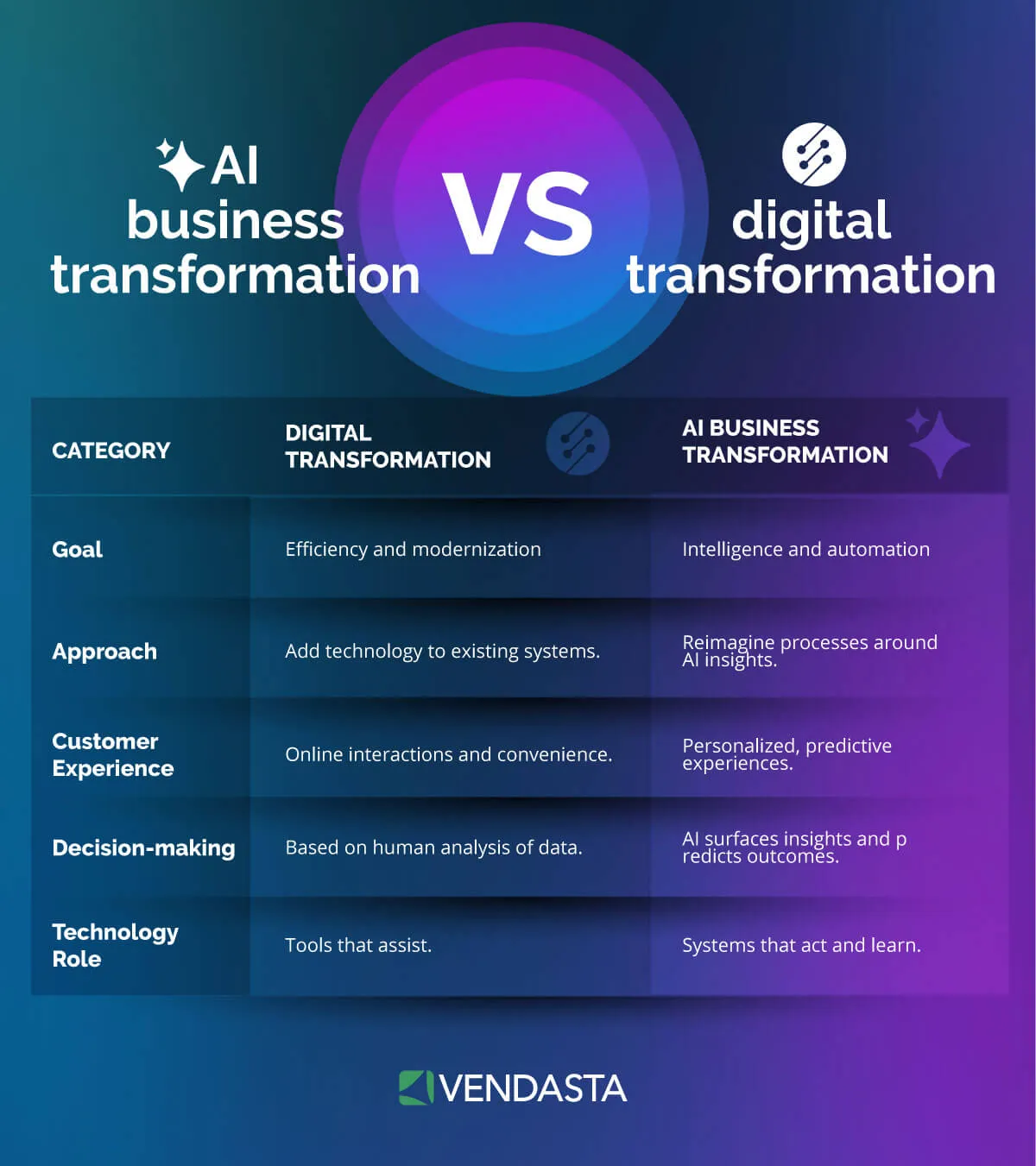
For example, a business leveraging traditional marketing automation workflows might say, “We received 200 leads through email this week.” With AI transformation, that shifts to, “AI predicts which prospects are most likely to convert, automatically engages them with personalized messaging, and hands qualified leads to the right team member.”
In short, digital transformation made work more efficient. AI business transformation makes it intelligent—turning your workflows, customer engagement, and decision-making into adaptive systems that continuously learn and improve.
Key Terms and Concepts to Know
Understanding the core concepts behind AI business transformation helps you see where your business fits into the bigger picture. Here are the essentials to keep in mind.
AI Employees / Intelligent Agents / Generative AI
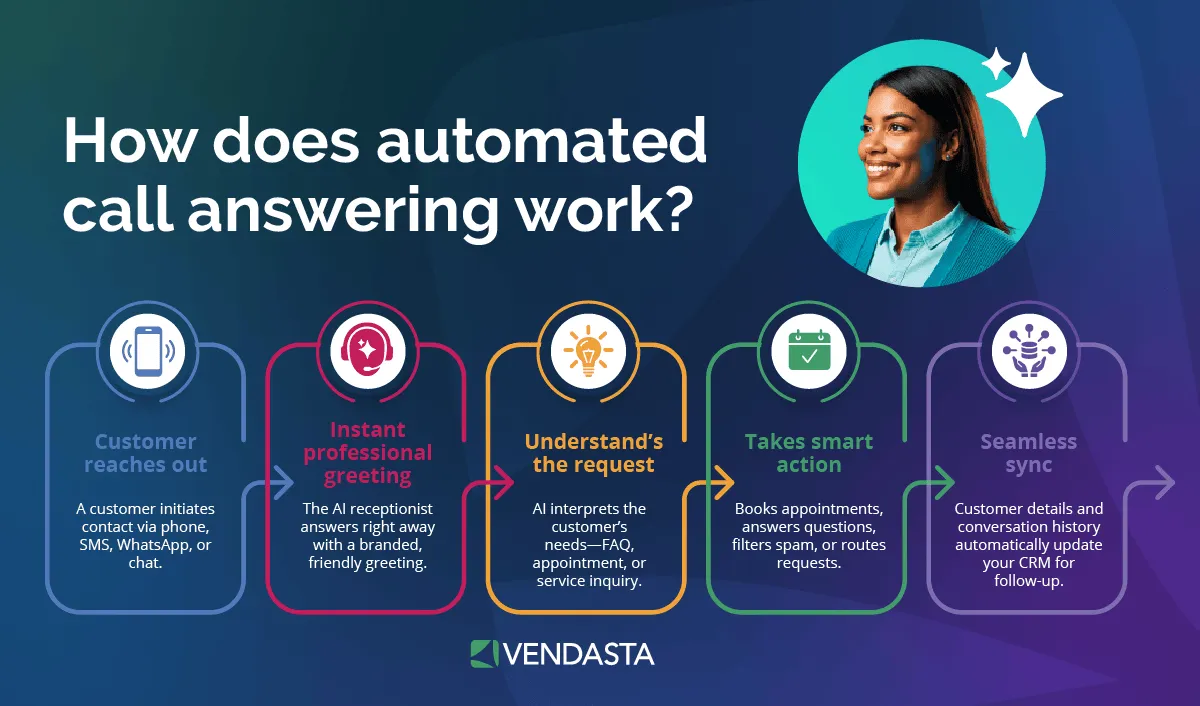
AI Employees are intelligent digital assistants that go beyond automation by learning, adapting, and taking action. Think of them as specialized team members who can answer calls, draft content, manage leads, or analyze performance data.
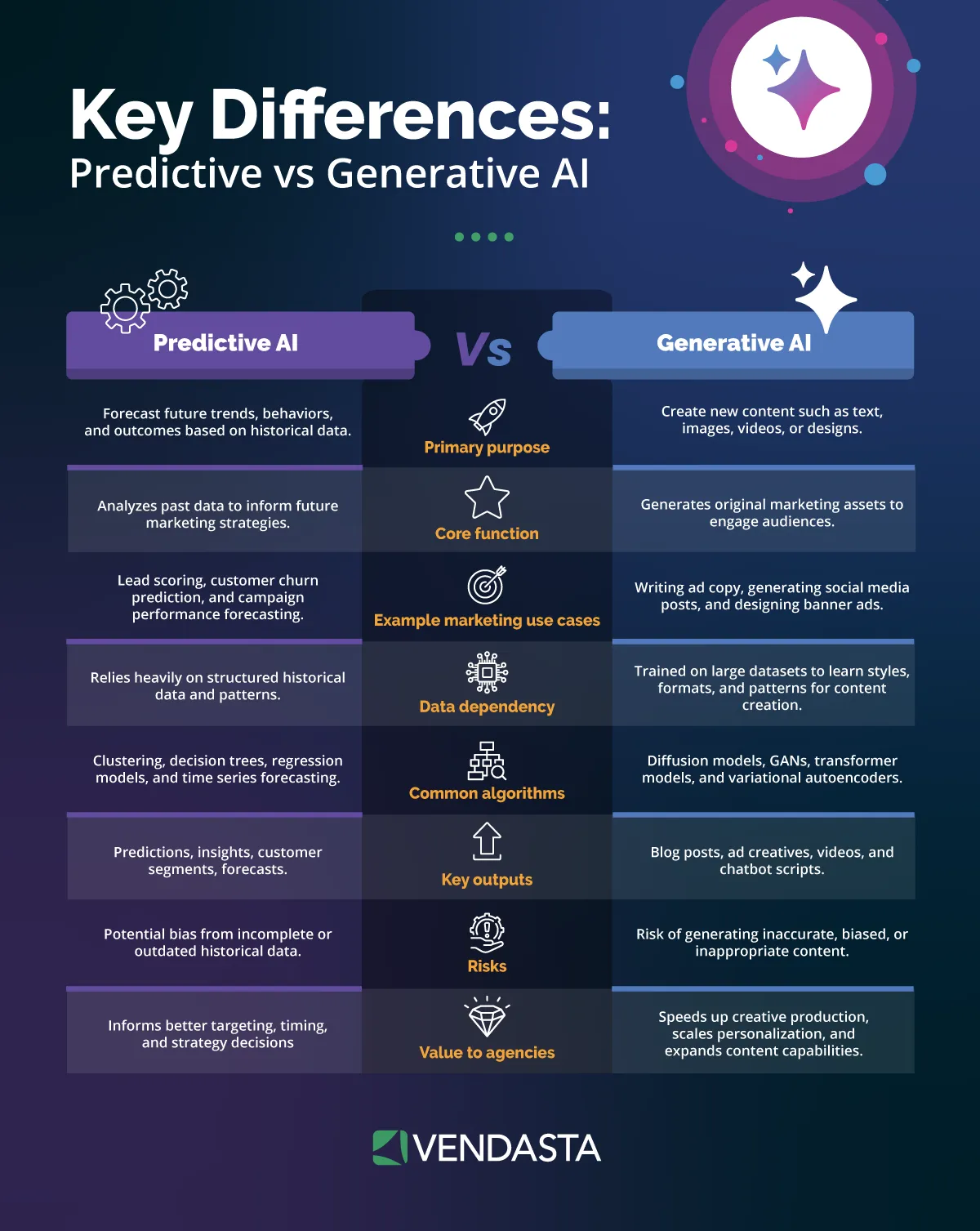
Generative AI underpins much of this capability, creating content, predictions, or insights from your business’s unique data.
Operating Model Redesign
True AI transformation isn’t about layering new tech onto old workflows. It’s about rethinking how work gets done. This includes redefining roles, responsibilities, and processes so humans and AI can collaborate efficiently.
For example, your marketing team might shift from producing campaigns manually to overseeing AI-driven systems that generate and optimize campaigns in real time.
Data Foundation & Connected Systems
AI is only as powerful as the data it runs on. When you connect your marketing, sales, and operations systems, you build a strong data foundation that enables AI to identify trends, automate responses, and predict outcomes.
Without unified, high-quality data, AI insights remain fragmented and less effective.
Business Outcome vs. Tool Deployment
Installing AI tools doesn’t equal transformation. The goal isn’t to “use AI”, it’s to embed AI to achieve measurable business outcomes, like faster customer response times, higher retention, or increased profit margins. The focus must stay on solving real problems, not on adopting technology for its own sake.
Quick Wins vs. Transformation Long-Game
AI success starts small. Quick wins like automating repetitive tasks or improving customer response times build momentum and prove value early.
But long-term transformation requires continuous scaling, cultural adoption, and system-wide integration.
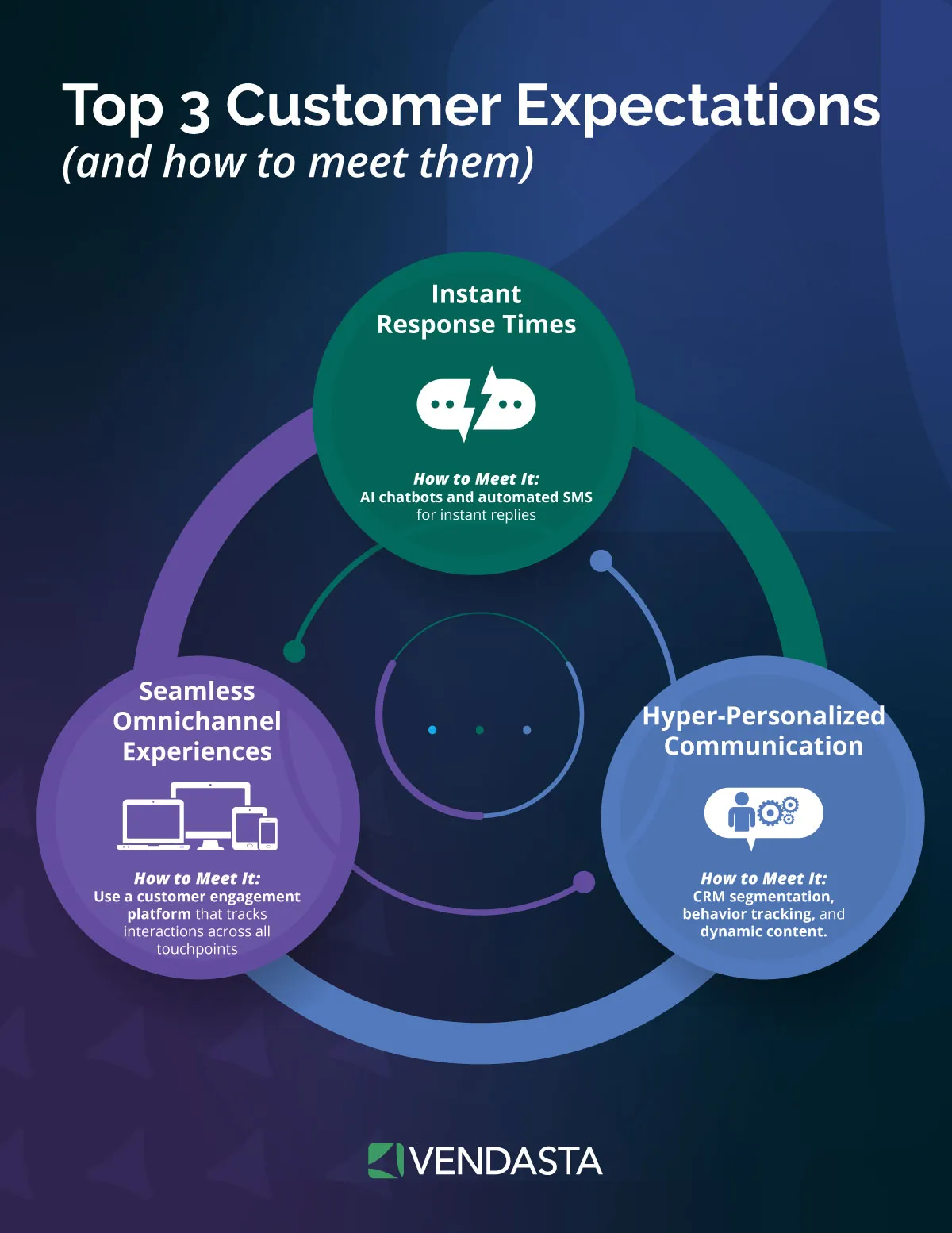
The businesses that thrive combine both: celebrating small wins while building toward a future where AI powers every stage of customer engagement to meet customer expectations.
Why AI Transformation Is 20% Tech and 80% People
The most common post-mortem for failed AI initiatives isn’t “the algorithm was broken”; it’s “the organization wasn’t ready.” While the “AI” in transformation gets the headlines, the “Transformation” is a human endeavor. To succeed, leadership must treat AI not as a software upgrade, but as a fundamental shift in corporate culture and operational DNA.
The “Shiny Object” Trap: Why Tech is Only 20%
It is tempting to believe that buying a state-of-the-art LLM or deploying autonomous agents will automatically yield ROI. However, technology is merely the engine. Without a driver, a map, and fuel, the engine sits idle.
- Tooling vs. Utility: You can give every employee a premium AI subscription, but without specific use cases tailored to their daily friction points, the tool becomes “digital shelfware.”
- The Integration Floor: High-performing AI requires clean data and interconnected systems. This isn’t a coding challenge; it’s a governance challenge that requires humans to agree on data standards and privacy ethics.
The 80% Heavy Lifting: The Human Element
The bulk of a successful AI rollout happens in the minds of your workforce. If your team views AI as a replacement rather than an assistant, subconscious sabotage and “shadow workflows” will inevitably stall progress.
1. Overcoming the “Fear Factor”
Transformation requires psychological safety. Employees need to know that their value isn’t tied to the tasks AI can do (data entry, drafting, scheduling), but to the judgement AI lacks. Shifting the internal narrative from “AI is replacing me” to “AI is liberating me for higher-value work” is a leadership task, not a technical one.
2. Upskilling and “AI Fluency”
The 80% includes the massive undertaking of literacy. This isn’t just about “prompt engineering”; it’s about teaching your team to:
- Critically Evaluate Output: Moving from “doers” to “editors.”
- Identify Opportunities: Recognizing where a workflow is “AI-ready.”
- Maintain Accountability: Ensuring humans remain the “final mile” for ethical and brand-aligned decisions.
3. Redesigning the Operating Model
When AI handles 40% of a department’s manual workload, you don’t just have 40% more free time—you have an entirely different department. The 80% of work involves reimagining roles. This means rewriting job descriptions, changing KPI structures, and potentially flattening hierarchies where AI has removed the need for middle-management data aggregation.
The Strategist’s Take: In 2026, the competitive advantage isn’t having AI—everyone has AI. The advantage is having a workforce that knows how to partner with it.
Where Most Businesses Trip Up and How to Avoid the Trap
Top Mistakes
Even as businesses rush to leverage AI adoption, many fall into common traps that stall real transformation. Avoiding these pitfalls can mean the difference between surface-level automation and long-term competitive advantage.
Treating AI Like Just Another Tool or Project
One of the biggest missteps is viewing AI as a single technology initiative rather than a core business strategy.
Most companies remain in the experimentation stage because they fail to integrate AI into their overall operating model and decision-making. AI business transformation succeeds only when leadership treats it as a strategic priority—one that reshapes how the business delivers value, not just how it completes tasks.
Continuing Siloed Operations and Disconnected Data
The shift to AI-first transformation requires breaking down organizational silos. Many companies still keep marketing, sales, and customer data in separate systems, which limits AI’s ability to generate insights and automate workflows.
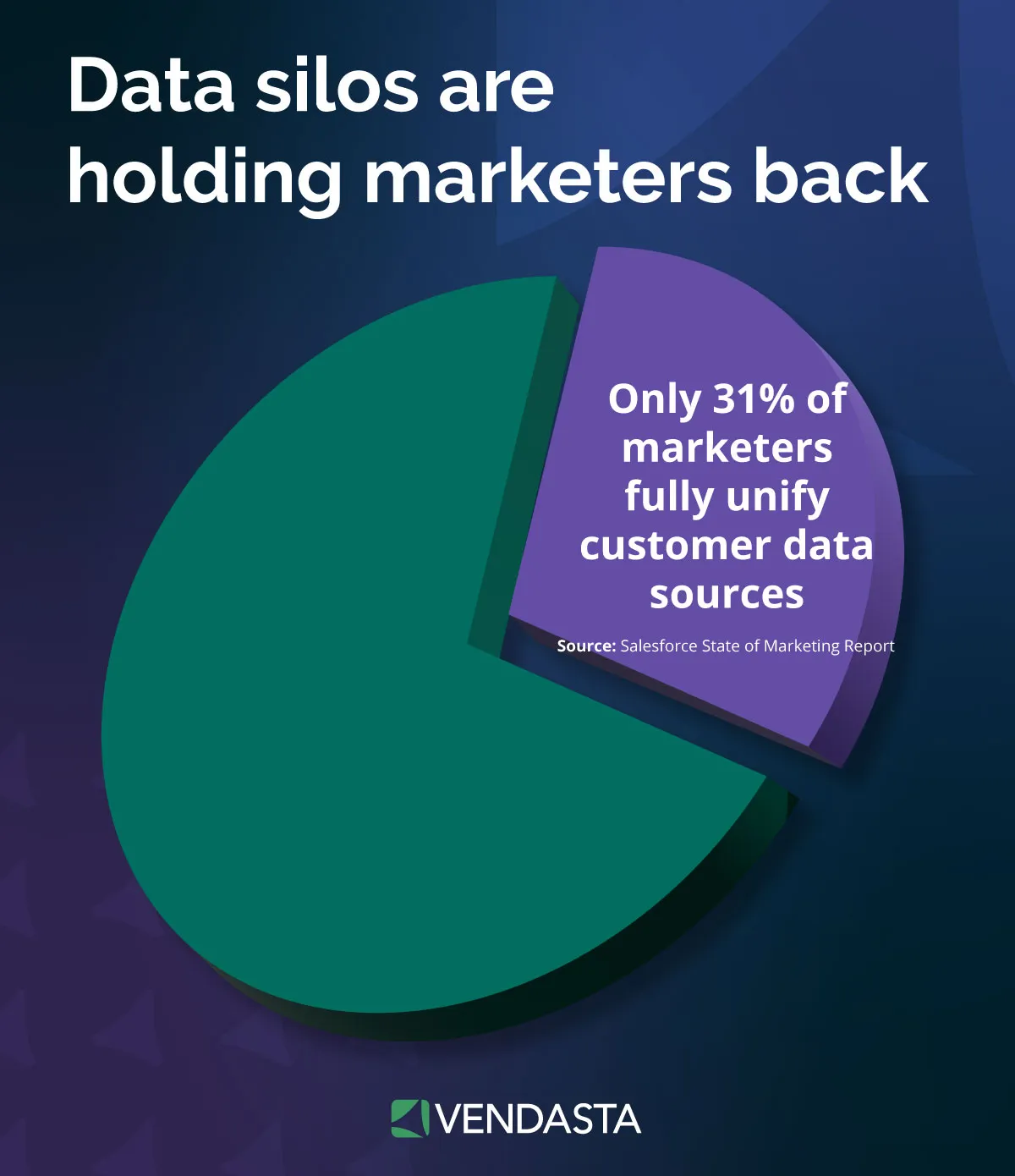
AI thrives on connected data, and without it, businesses end up with fragmented results and inconsistent customer experiences.
Over-Focusing on Novelty Rather Than Value or Scalability
Another frequent mistake is chasing the latest AI trend instead of focusing on scalable, high-impact use cases.
Generative AI tools can look impressive in demos, but unless they deliver measurable outcomes like time savings, cost reduction, or customer growth, they risk becoming distractions.
The businesses that win with AI focus first on solving real pain points, not showcasing flashy experiments.
Failing to Adapt Operating Model and Culture
True transformation demands more than new technology—it requires cultural and operational change. When teams cling to old workflows or resist collaboration with AI systems, progress stalls.
A modern operating model empowers humans and AI to work together, using automation to handle routine work while freeing people for creative and strategic tasks. AI business transformation is as much about mindset as it is about machines.
How Your Business Can Sidestep the Trap
Avoiding the common pitfalls of AI adoption starts with building a smarter, outcome-driven approach. Rather than diving into tools or trends, your business should focus on AI readiness: alignment, data readiness, and long-term cultural change. It is also helpful to practice AI leadership.
Prioritize Business Outcomes First, Then Choose AI Use Cases
Start with the “why,” not the “what.” Before introducing any AI solution, define the outcomes you want to achieve, such as faster response times, improved customer retention, higher campaign ROI, or reduced operational costs.
Once those goals are clear, select AI use cases that directly support them. This ensures that every AI initiative is tied to measurable business value rather than curiosity or hype.
Re-Architect Data and Workflows to Support AI
AI marketing automation needs a strong foundation to function effectively. This means an architecture where data flows seamlessly across systems and departments.
That means eliminating silos, cleaning up inconsistent data, and redesigning workflows so AI can learn, act, and improve over time. The more integrated your systems are, the more powerful your AI results will be.
Build Change Management Capacity: Culture, Metrics, and Governance
Transformation doesn’t succeed on technology alone. It also depends on people and structure. Create clear governance for how AI is used, set performance metrics that track progress, and invest in team education so employees understand how to collaborate with AI systems.
Encourage experimentation, transparency, and accountability—AI transformation thrives in cultures that adapt quickly and measure outcomes continuously.
As you deploy AI into customer-facing workflows, AI risk management helps you set guardrails for privacy, bias, and escalation paths before small ‘quick wins’ become enterprise-wide exposure.
A Step-by-Step Guide to Transforming Your Business with AI
Step 1: Conduct an AI Audit – Identify Quick Wins
Before you dive into major AI investments, start small by identifying where automation and intelligence can create an immediate impact.
An AI audit helps you pinpoint the everyday tasks that drain time, reduce efficiency, or leave room for error—both within your business and across your SMB clients’ operations.
Use this five-question checklist to find the “low-hanging fruit” where AI can deliver leverage fast:
- Frequency: Which tasks happen every day or several times a week? The more often something occurs, the greater the payoff when you automate it. Think of automated call answering, lead follow-ups, or posting to social media.
- Repetition: Are the steps basically the same every time? Tasks like creating standard reports, replying to common customer questions, or checking stock levels are perfect candidates for AI.
- Error-Prone: Do mistakes in this task cost time, money, or customer trust? Manual data entry, scheduling errors, or missed follow-ups are all areas where AI can significantly reduce human error.
- Low-Skill but Necessary: Are staff spending time on tasks that don’t require creativity or judgment? Scheduling appointments, sending reminders, or formatting proposals are essential but repetitive—and easily handled by AI.
- Customer Impact: Does the task directly affect how customers experience your business? Faster replies, proactive updates, and consistent follow-ups build loyalty—and AI excels at these.
By walking through this checklist, you’ll see patterns emerge. The same five factors—frequency, repetition, error-proneness, low-skill necessity, and customer impact—consistently reveal the best opportunities for AI automation.
For SMB-focused businesses like agencies, franchisors, and MSPs, this audit does double duty. You can use it to streamline your own organization and uncover scalable AI solutions you can offer to SMB clients.
That means every quick win you implement internally can become a service or value-add you provide externally, helping both you and your clients grow faster with AI.
Step 2: Prioritize and Plan Use Cases
Once you’ve identified potential areas for AI through your audit, the next step is to prioritize which use cases to tackle first. Not every process needs automation, and not every opportunity will deliver the same return.
The goal here is to focus on the few, high-value domains that can drive the biggest impact for your business and for the SMBs you support.
Start by mapping each potential AI use case in a simple prioritization table like this:
| Use Case | Frequency | Impact | Effort | Priority |
| Example: AI receptionist for inbound calls | Daily | High | Low | High (Quick Win) |
| Example: Predictive lead scoring for sales teams | Weekly | High | Medium | Medium |
| Example: AI-driven customer churn prediction | Monthly | Very High | High | Big Bet |
| Example: Automated content generation for social posts | Daily | Medium | Low | High (Quick Win) |
How to use this table:
- Quick wins: Focus first on low-effort, high-impact opportunities. These deliver fast ROI, boost team confidence, and prove the value of AI quickly.
- Big bets: Once the early wins are in place, plan longer-term transformations—projects that may require more integration but yield exponential results over time.
- Avoid overreach: Transformation isn’t about doing everything at once. Spreading resources too thin dilutes results. Instead, commit to a small number of meaningful initiatives that align with your strategic goals.
For additional inspiration, explore Vendasta’s AI cheat sheet, a practical resource that breaks down real-world use cases, from AI receptionists and content generation to predictive analytics.
It’s a valuable reference to help you refine priorities and identify the right starting points for your own transformation journey.
Step 3: Build the Foundation – Data, Systems & Operating Model
Before AI can deliver meaningful results, your business needs a strong foundation. That means connecting your data, simplifying your systems, and reshaping your operating model so humans and AI can work together seamlessly. Without this groundwork, even the most advanced AI tools will struggle to produce consistent, scalable outcomes.
Data:
AI thrives on clean, connected data. Start by breaking down silos between departments—marketing, sales, customer service, and finance should all share information within a unified system.
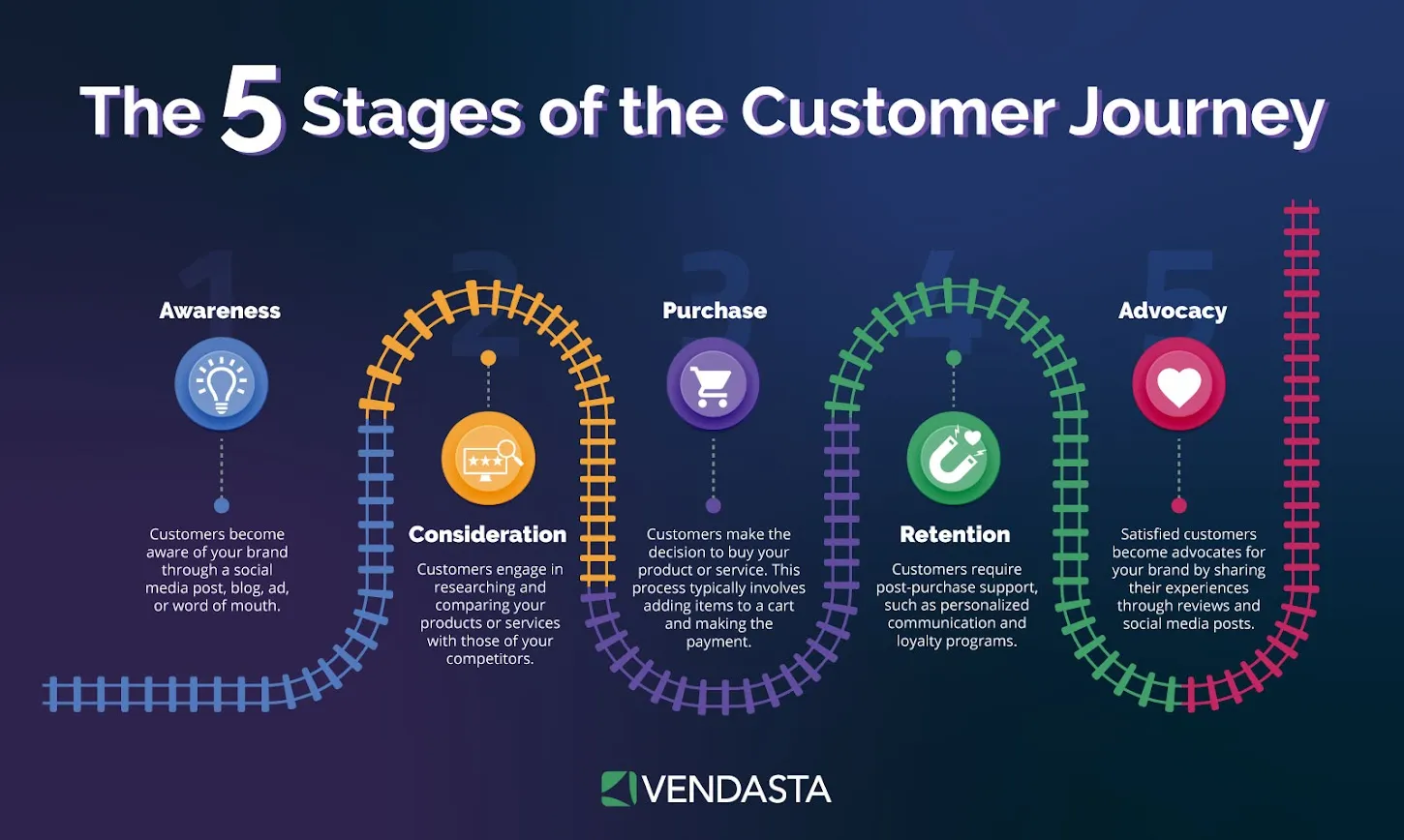
Ensure data accuracy, eliminate duplicates, and standardize formats so AI can analyze trends and generate reliable insights. The goal is a single, unified view of each customer that reflects their customer journey from first contact to long-term loyalty.
Systems:
Adopt platforms that simplify rather than multiply your tech stack. Many businesses fall into the trap of adding new tools for every function, creating inefficiency and fragmentation. Instead, invest in integrated systems that centralize marketing, sales, and operations—making it easier for AI to learn and act across all workflows.
This is where Vendasta stands out; its all-in-one AI customer acquisition and engagement platform replaces multiple disjointed systems with one connected ecosystem.
With built-in AI Employees, automation, and dashboards, it streamlines collaboration across teams and ensures data consistency.
Operating Model:
True transformation requires adapting how your organization works. Redesign workflows so AI handles repetitive tasks while people focus on strategic, creative, and relationship-driven work.
Define clear data governance policies and update metrics to measure both human and AI performance.
When your operating model supports continuous learning and collaboration between humans and technology, AI becomes a trusted business partner, driving sustained growth.
Step 4: Deploy, Scale, and Integrate AI-Enabled Workflows
With your data and systems in place, it’s time to put AI to work. This is where transformation moves from strategy to action. The key is to start small, measure impact, and refine before scaling across your entire business or client base.
Start Small, Measure, Iterate, Then Scale
Begin with one or two use cases that deliver clear, measurable outcomes—such as automating lead responses, deploying an AI receptionist, or generating content drafts.
Track key metrics like time saved, conversion rates, or customer satisfaction. Use those early results to make improvements, then gradually expand AI into other workflows.
This agile approach keeps your investment focused while building confidence and adoption across teams.
Embed AI Into Core Workflows
AI shouldn’t sit on the sidelines as a one-off tool. It needs to be woven into how work actually happens—automating tasks, surfacing insights, and supporting decision-making in real time.
For example, AI can automatically update CRM data, send personalized follow-ups, or prioritize leads based on predicted value.
When AI becomes part of your everyday processes, efficiency compounds naturally over time.
Extend AI Across Your Partner Network
If your business supports SMBs—as an agency, franchisor, MSP, or media company—your transformation shouldn’t stop at internal operations.
You should also be able to deploy AI Employees to client accounts, manage shared client dashboards, and provide actionable insights from connected data. This not only drives measurable outcomes for your SMB clients but also positions your business as their trusted AI partner.
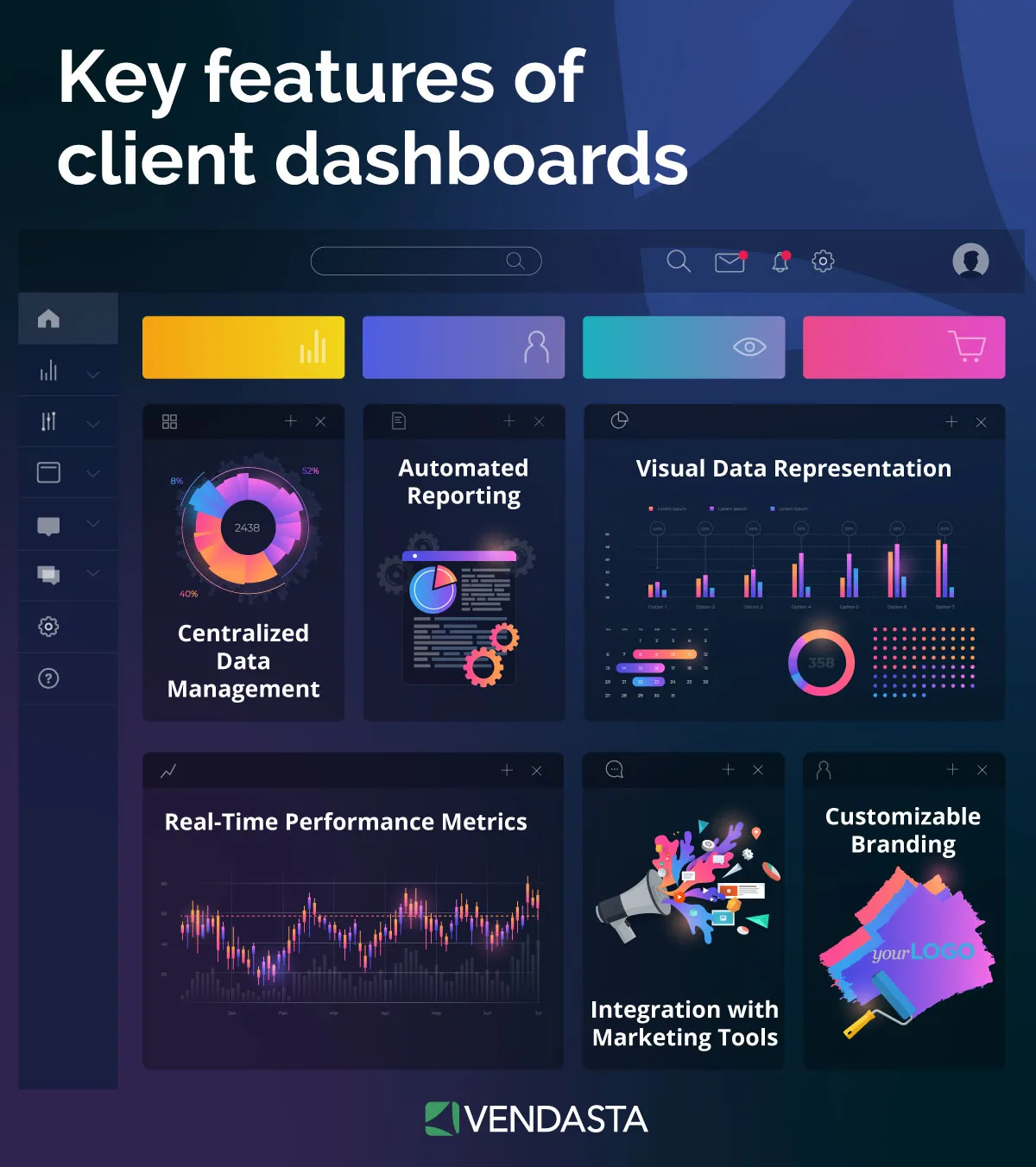
Platforms like Vendasta make this scalable by giving partners centralized control. You can monitor performance, automate client-facing workflows, and deliver AI-powered results across dozens or even hundreds of SMBs—all from one place. By starting small and scaling strategically, your business creates lasting impact for itself and for every client it serves.
Pro Tip: For a comprehensive overview of how to find your first 5 AI wins in just 6 minutes, watch this video:
Real-World Examples of AI Business Transformation
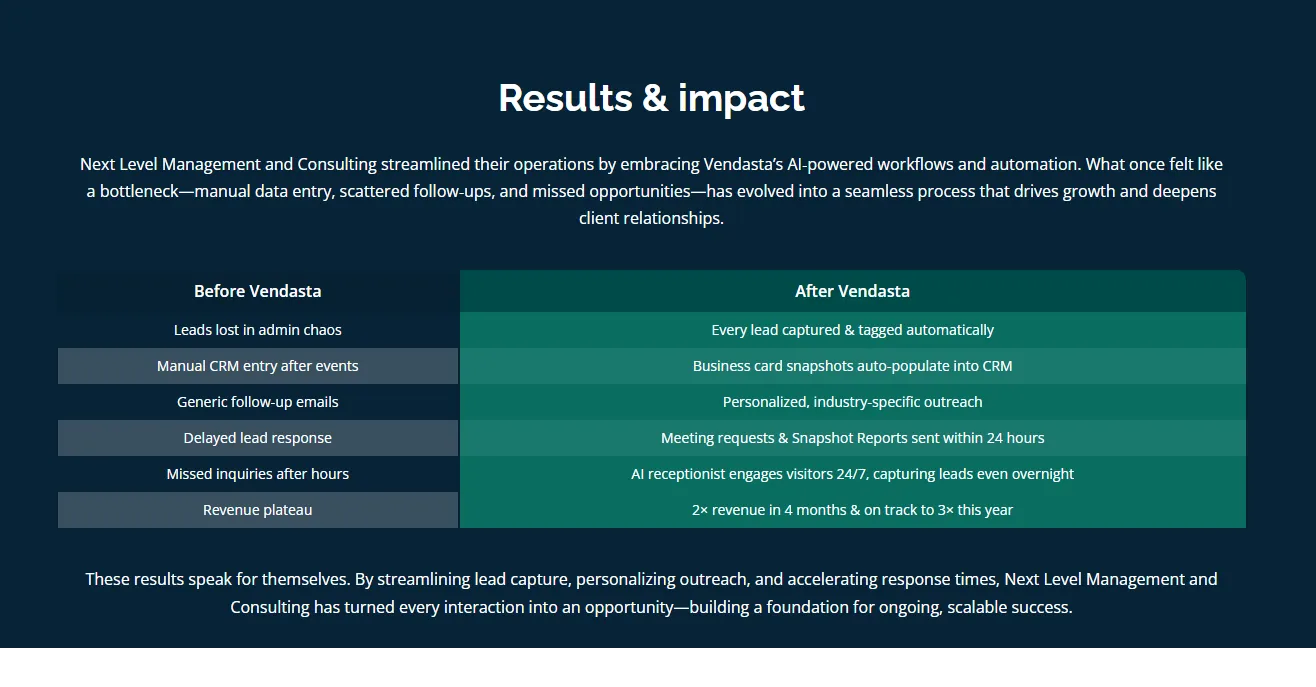
A great example of AI business transformation in action comes from Next Level Management and Consulting, a fast-growing agency dedicated to helping small businesses simplify operations, marketing, and growth.
Like many partner-led organizations, they faced the classic scaling challenge—too many leads, too much manual work, and not enough time.
The Challenge:
As networking success brought in hundreds of leads from conferences and events, the team struggled to keep up. Manual CRM entry consumed hours, follow-up emails lacked personalization, and valuable prospects were slipping through the cracks.
President and CEO Mark Huffman knew they needed a scalable way to capture every opportunity and maintain the personal touch that set their agency apart.
The Solution:
Next Level turned to Vendasta’s AI-powered customer acquisition and engagement platform, combining automation, AI Employees, and CRM integration to overhaul their workflows.
- Business Card to CRM Automation: Using Vendasta, Zapier, and BizConnect, Mark’s team built a seamless system that converts networking interactions into CRM entries instantly. Team members can snap a photo of a business card, add quick notes, and let Vendasta automatically populate the CRM. Many agencies are moving towards these integrated workflows and exploring blinq alternatives to ensure their digital networking tools sync perfectly with their lead management systems, triggering personalized follow-up sequences instantly.
- AI-Driven Follow-Up Campaigns: Within 24 hours of an event, every contact receives a personalized email referencing where they met the team, plus a tailored Snapshot Report highlighting new opportunities. This personalization, powered by Vendasta’s automation, led to significantly higher engagement and faster bookings.
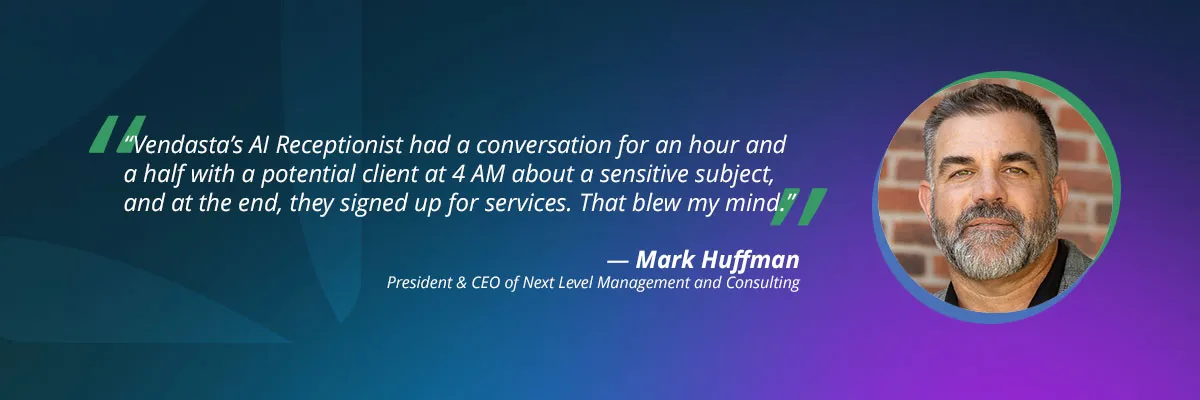
- Conversations AI for 24/7 Engagement: The agency extended automation beyond events by deploying Vendasta’s Conversations AI, including both chat and voice receptionists. One client, a brain-injury therapy provider, gained a new customer after an overnight AI chat conversation. Another client, a retailer, reduced phone interruptions by having the AI Receptionist handle routine inquiries.
- Building a Fully Automated Agency: Beyond follow-ups, the agency now automates nearly every part of its funnel—from lead capture to campaign execution.
The Results:
Next Level Management and Consulting transformed from a team bogged down by admin tasks to a fully automated, AI-powered agency—without hiring additional staff.
 AI-Native vs. AI-Integrated: Which Path Is Right for Your Business?
As businesses race toward AI business transformation, a critical strategic fork in the road has emerged. Is your goal to “sprinkle” AI onto your existing processes, or to rebuild your company around an AI core?
Understanding the distinction between AI-Integrated and AI-Native is the difference between a marginal efficiency gain and a total market disruption.
The AI-Integrated Approach: Evolution, Not Revolution
Most established businesses begin here. AI-Integrated businesses take their existing workflows, built on legacy systems and human-centric hierarchies, and insert AI “plugins” to accelerate specific tasks.
- The Mechanism: Adding a chatbot to customer service, using AI to draft emails in a CRM, or employing predictive analytics in an existing supply chain dashboard.
- The Goal: Efficiency and incremental ROI. You are doing the same things, just faster and cheaper.
- The Risk: “Technical Debt.” If your underlying data is siloed and your processes are bureaucratic, adding AI is like putting a Ferrari engine in a horse-drawn carriage. It’s faster, but the frame can’t handle the speed.
The AI-Native Approach: Built for the Machine
An AI-Native business is designed from the ground up (or radically reconstructed) under the assumption that AI is the primary operator, with humans providing oversight and strategic direction.
- The Mechanism: Autonomous agents handle end-to-end workflows (e.g., an AI that identifies a lead, researches their pain points, generates a personalized demo, and schedules the call without human intervention).
- The Goal: Scalability and new business models. AI-Native companies can handle 10x the volume of traditional competitors with 1/10th the headcount.
- The Advantage: Real-time adaptation. Because the “brain” of the company is digital, it learns and pivots in milliseconds, not months.
Comparison: Which Path Should You Take?
| Feature | AI-Integrated (The “Upgrader”) | AI-Native (The “Disruptor”) |
| Primary Focus | Task automation | Outcome orchestration |
| Implementation | Low friction; plugs into current tools | High friction; requires structural change |
| Data Strategy | Cleans data for specific reports | Unified “Data Lake” for autonomous learning |
| Workforce Role | Humans do the work, AI assists | AI does the work, humans govern |
| Best For | Stable industries with heavy legacy tech | Startups or units seeking rapid market share |
Making the Choice: The “North Star” Test
To decide which path is right for your transformation, ask yourself: “If my competitors started from scratch today with 2026 technology, what would their workflow look like?”
If the answer is radically different from yours, an AI-Integrated approach may only delay the inevitable. You might need a phased transition: integrating AI into your current “cash cow” operations while simultaneously building an AI-Native pilot program to eventually replace them.
Strategic Note: The gap between having an AI insight and taking a business action—is significantly smaller in AI-Native firms because the “action” layer is built into the software from day one.
How to Choose the Right Platform for AI Business Transformation
Selecting the right platform is one of the most important decisions in your AI transformation journey. The goal is to build a connected ecosystem that supports automation, insight, and collaboration across every part of your business. You need a solution built for scale, flexibility, and shared success.
Must-Have Features for Your Business as a Partner
AI Employees Ready to Deploy Quickly
Look for a platform that offers pre-built AI Employees, such as chat and voice receptionists, that can be deployed in minutes. These AI assistants handle calls, messages, and lead responses 24/7, ensuring no opportunity slips through the cracks. Rapid deployment is key to delivering immediate value for your team and your SMB clients.
Unified Dashboard for Data Visibility
No matter the size or type of your business, success with AI depends on visibility. A unified dashboard brings all your key data—marketing performance, sales activity, customer engagement, and operational metrics—into one place. When teams can see the full picture in real time, they make faster, smarter decisions based on facts, not guesswork.
Dashboards also promote alignment across departments by giving everyone access to the same insights. Instead of working in silos, marketing, sales, and service teams can collaborate around shared data to improve customer experiences and business outcomes.
Workflow Automation Across Marketing, Sales, Billing, and Service
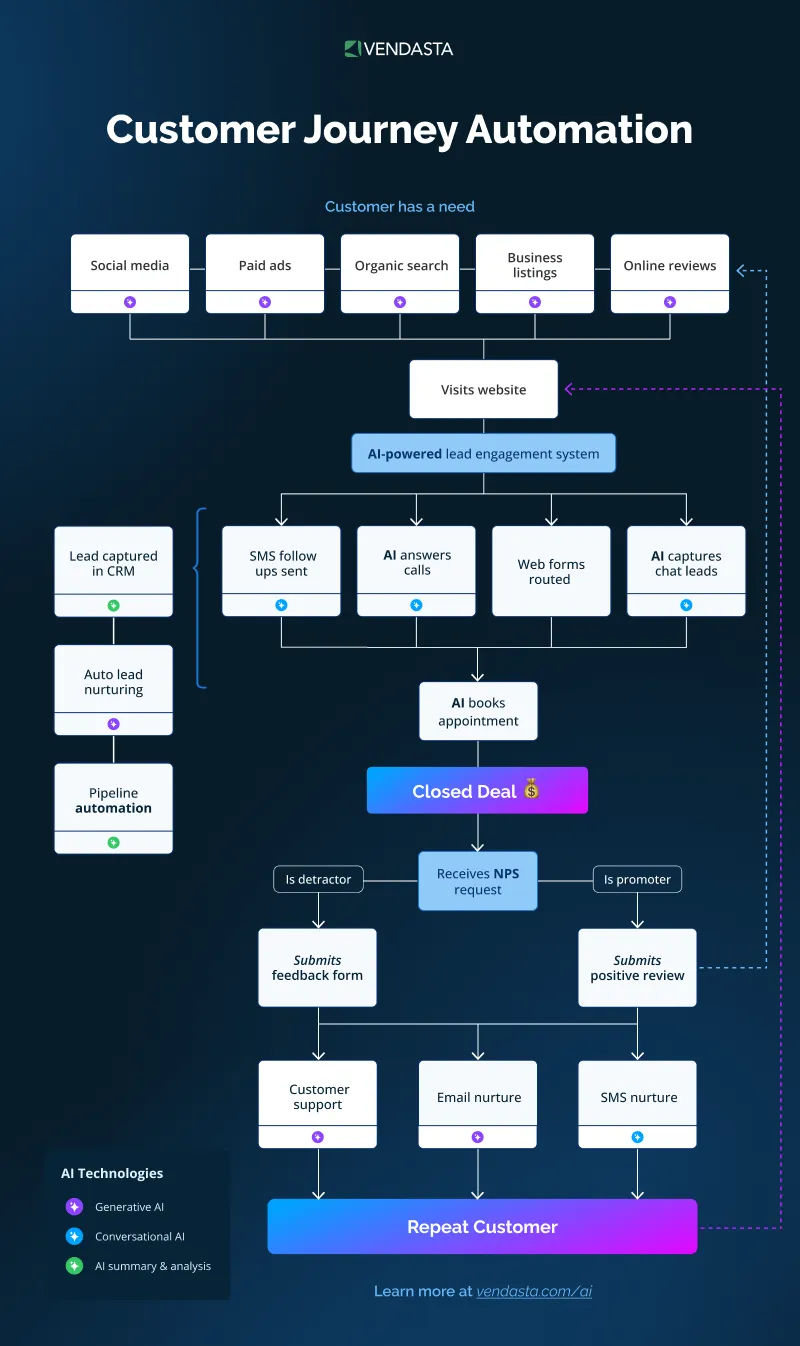
A true AI business transformation platform automates entire workflows—not just isolated tasks. That means marketing campaigns that trigger follow-ups automatically, sales pipelines that prioritize high-intent leads, billing processes that run seamlessly, and service teams that use AI to resolve requests faster.
Each workflow should connect to the next to achieve seamless customer journey automation.
Data-Driven Insights Leveraging Your Unique Business and Client Data
AI is only as powerful as the data it can access. Choose a platform that allows you to harness your proprietary data, such as purchase history, customer behavior,and campaign performance, to generate actionable insights. The best systems use this data to personalize outreach, predict churn, and recommend next-best actions for both your business and your clients.
Integration That Replaces Multiple Disjointed Systems
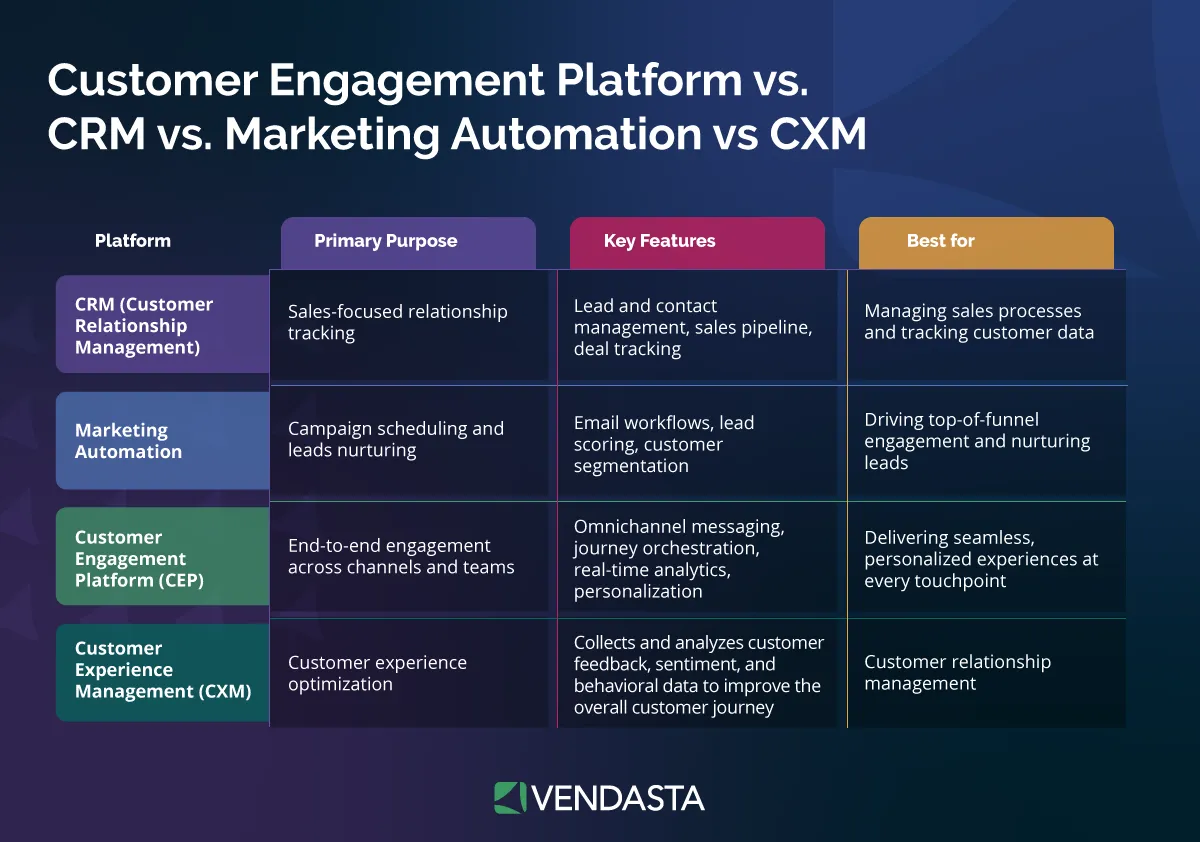
Finally, aim for simplification. Many businesses struggle with a patchwork of CRMs, automation tools, and analytics dashboards that don’t communicate with each other. Your AI customer engagement platform should unify all of these under one roof—reducing costs, minimizing complexity, and creating a single source of truth for your operations.
Why Vendasta Stands Out
When it comes to powering AI business transformation, Vendasta stands out for its ability to deliver immediate, scalable results without the complexity or cost of building custom AI systems.
It has everything businesses need to automate marketing, operations, and drive growth.
Out-of-the-Box AI Employees Ready for Scale
Vendasta’s AI Employees can be deployed in minutes, not months. They handle customer interactions, scheduling, and follow-ups 24/7, helping your business scale efficiently without adding headcount.

Unlike bespoke AI builds that require heavy development and maintenance, Vendasta’s AI Employees work instantly and continuously learn from real-world data.
Partner-Friendly for Agencies, MSPs, and Franchisors
Vendasta was built with partners in mind. Its platform allows you to manage your own business while offering AI-powered solutions directly to SMB clients.
You can deploy, monitor, and optimize AI workflows across multiple accounts from a single interface. This helps clients grow while generating recurring revenue for your business.
Also, collaboration is built into every part of the Vendasta experience. Shared dashboards, task management, and unified reporting enable transparent communication between you and your SMB clients.
This creates stronger relationships and ensures both parties have access to the same data, insights, and outcomes in real time.
17+ Years of Local Business Data Powering Smarter AI
With over 17 years of data on local businesses and consumer behavior, Vendasta gives its AI models a unique advantage. This data depth allows Vendasta’s AI to make smarter, context-aware recommendations—whether it’s predicting customer intent, AI lead scoring, suggesting marketing campaigns, or identifying new revenue opportunities.
An Integrated Suite for Complete Business Management
Unlike point solutions that only cover one function, Vendasta offers a fully integrated suite that connects marketing, sales, operations, and billing. This all-in-one approach eliminates the need for multiple disjointed systems, reduces administrative overhead, and provides a single source of truth for your business and your clients.
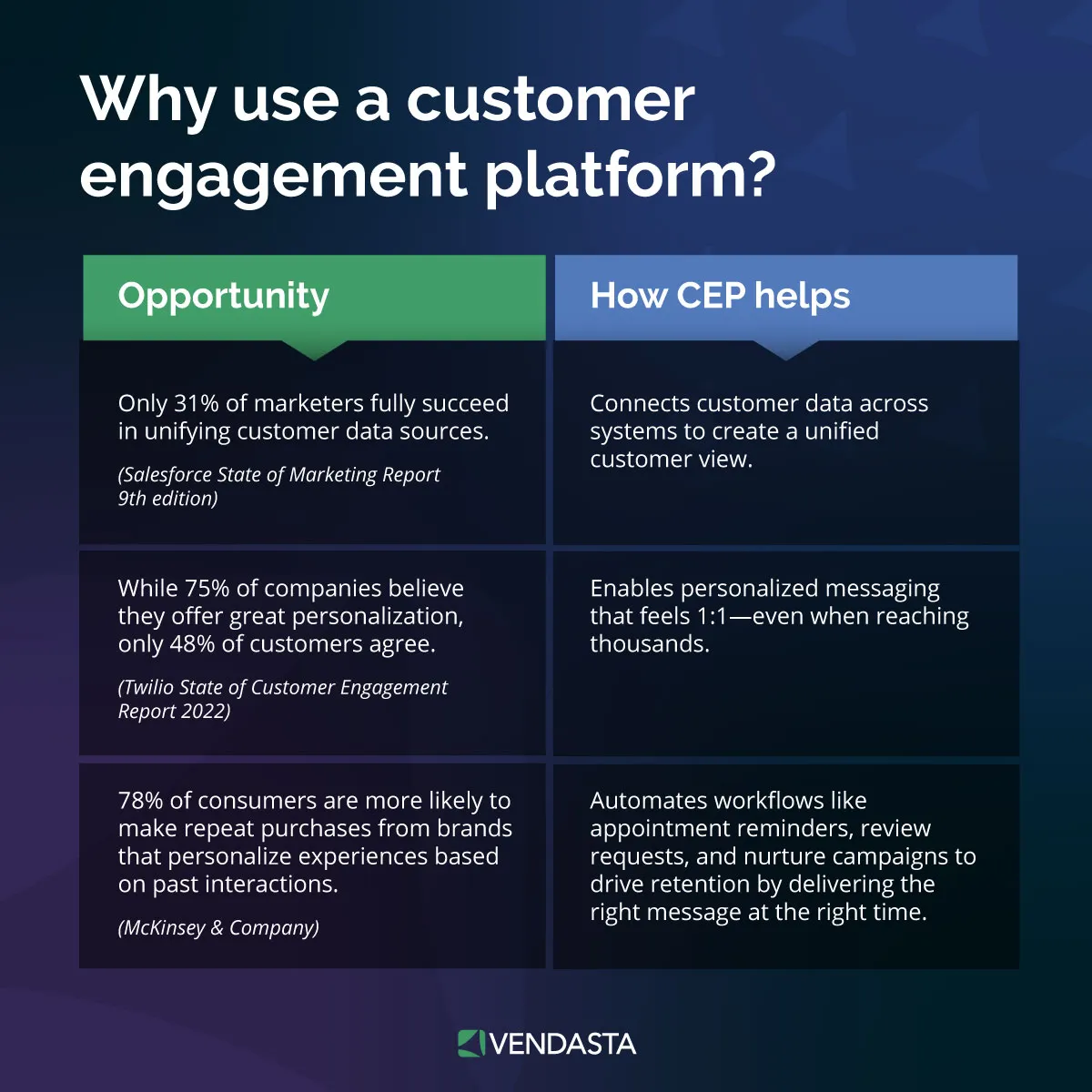
With Vendasta, you’re not just adopting AI, you’re transforming how your business grows, collaborates, and competes in an AI-first economy.
How to Evaluate ROI and Build Your Business Case
AI business transformation is a growth strategy.
To gain leadership and client buy-in, you’ll need a clear business case that demonstrates measurable value.
The good news: with the right framework, proving ROI from AI is straightforward and compelling.
Start with the Audit Checklist
Revisit your AI audit (frequency, repetition, error-prone, low-skill, and customer-impact tasks) and estimate how much time and cost each automation could save. For example:
- If your team spends 10 hours per week on manual data entry and AI reduces that by 80%, that’s 8 hours saved weekly.
- Apply similar logic to response times, proposal creation, or lead follow-ups to calculate total labor hours reclaimed and revenue opportunities gained.
Benchmark Against Industry Gains
Compare your estimates with real-world benchmarks. Research from Bain & Company shows that AI leaders often achieve 10–25% EBITDA gains through improved efficiency, higher conversions, and faster decision-making.
If your results align or even approach those figures, you’re already on the right path.
Create a Phased Roadmap
A well-structured plan builds momentum and credibility:
- Year 1: Focus on quick wins—automating repetitive workflows, deploying AI Employees, and improving customer response times.
- Years 2–3: Scale the transformation—connect data systems, introduce predictive analytics, and embed AI deeper into operations and strategy.
This phased approach ensures steady ROI growth while minimizing disruption.
Factor In New Revenue Streams
For agencies, franchisors, and MSPs supporting SMBs, the ROI doesn’t end with internal efficiency. AI platforms like Vendasta open new revenue opportunities through:
- Recurring services: Ongoing management of AI workflows for clients.
- Upsells: Offering premium AI-driven solutions such as predictive insights or automated customer engagement.
- Managed services: Providing full-service AI integration and optimization for SMBs.
By combining operational savings with new revenue potential, your business case for AI becomes both practical and future-focused.
Why AI Business Transformation Is So Important
The growing valuation trends across the AI industry make one thing clear: AI isn’t just a technology shift—it’s a business model revolution.
According to Finrofca’s 2025 AI Revenue Multiples Report, companies that have embraced AI at the core of their operations are commanding significantly higher revenue multiples than those still operating in traditional digital frameworks.
This surge in valuation highlights why AI business transformation is now a competitive necessity rather than an optional upgrade.
AI Drives Enterprise Value Across Every Industry
Across the 11 key AI niches identified in the report—from Marketing Tech and Data Intelligence to Health Tech and Cybersecurity—AI-enabled companies are capturing outsized market share and higher profitability.
Their strength lies in scalable automation, predictive intelligence, and data-driven personalization, all of which translate directly to revenue growth and investor confidence.
For instance:
- Marketing Tech companies using AI to optimize targeting and personalization are seeing consistent valuation growth due to measurable ROI for clients.
- Data Intelligence firms, which extract actionable insights from large datasets, are now indispensable to enterprise decision-making.
- AI-powered Infrastructure and Cybersecurity providers, meanwhile, command the highest revenue multiples because their solutions are foundational and mission-critical in a digital-first economy.
Market Signals Favor Businesses That Operationalize AI
Finrofca’s analysis shows that investors now prioritize clear, scalable AI revenue models over traditional tech innovation. In other words, valuation isn’t just about having AI—it’s about how deeply it’s embedded in a company’s daily operations.
Businesses that use AI to drive automation, predict customer needs, and optimize workflows are rewarded with stronger growth trajectories and higher market confidence.
Why This Matters for Your Business
Whether you’re an agency, franchisor, MSP, or media company supporting SMBs, these trends have direct implications. The market is proving that AI-led companies are more efficient, more adaptable, and more valuable.
By investing in AI transformation now and embedding intelligence into your sales, marketing, and service workflows, you’re not only improving performance but also increasing your business’s long-term valuation.
Navigating Ethical AI: Transparency and Governance in 2026
As we move deeper into 2026, the conversation around AI business transformation has shifted. Organizations are no longer asking if AI works; they are being asked to prove that it is trustworthy, auditable, and accountable.
With the EU AI Act entering its full enforcement phase as of August 2, 2026, governance is a competitive necessity. Companies that fail to govern their AI face not just legal fines, but a total erosion of customer trust.
The Three Pillars of Modern AI Governance
Your transformation strategy must be built on three core pillars:
- Transparency (The “Glass Box” Approach): Moving away from “black box” algorithms. In 2026, users and regulators expect Explainable AI (XAI).
- Algorithmic Fairness: Proactive bias mitigation is now a standard operational procedure. This involves regular “bias audits” to ensure your training data doesn’t reinforce historical prejudices in hiring, lending, or customer service.
- Human Accountability: The “Human-in-the-Loop” (HITL) model is the gold standard. Every high-stakes AI output must be reviewed and “owned” by a human professional to ensure it aligns with both company values and legal standards.
2026 Regulatory Landscape: What You Need to Know
The global regulatory environment has converged, making it harder for businesses to “ignore” compliance based on geography.
- The EU AI Act Milestone: By August 2026, transparency requirements and strict rules for “High-Risk” AI systems will become legally binding.
- Watermarking & Provenance: There is now a global push for digital watermarking. Any content, report, or communication generated by AI should be machine-readable as “AI-generated” to prevent misinformation.
- Agentic Liability: As we move toward Agentic AI (AI that takes actions, not just suggests them), the legal question shifts. In 2026, businesses are increasingly held liable for the “actions” of their autonomous agents as if they were human employees.
Operationalizing Ethics: From Policy to Control
Strategic leaders are moving beyond static PDF policies and into active oversight.
Pro Tip: Implement an “AI Risk Registry.” Just as you track financial risks, you should maintain a central record of every AI model in use, its purpose, its risk rating, and its human “owner.”
Turning AI Potential Into Lasting Growth
AI business transformation isn’t a passing trend—it’s the foundation of how modern businesses grow, compete, and thrive. The shift is about rethinking how your organization operates, serves customers, and unlocks value from data.
For businesses that support SMBs, whether you’re an agency, franchisor, MSP, or media company, this transformation represents a defining opportunity. By embedding AI across marketing, sales, and operations, you can scale efficiently, deepen customer relationships, and create entirely new revenue streams.
Platforms like Vendasta make that transformation achievable today. With out-of-the-box AI Employees, intelligent automations, and unified dashboards that connect every part of your business, Vendasta enables you to deliver smarter service and measurable results—without the complexity of building AI systems from scratch.
The future of business is intelligent. Start small, focus on outcomes, and let AI become the multiplier that helps you and your SMB clients grow faster, work smarter, and stay ahead of what’s next.
Request a demo today and discover how our AI-powered platform can help you automate workflows, engage customers, and scale profitably.
AI Business Transformation FAQs
1. What Is AI Business Transformation?
AI business transformation is the process of reimagining how a company operates by integrating artificial intelligence across marketing, sales, operations, and customer service. Unlike digital transformation, which digitizes workflows, AI transformation uses automation and data intelligence to drive efficiency, growth, and smarter decision-making.
2. How Does AI Business Transformation Help Small and Medium-Sized Businesses?
AI helps SMBs save time and increase revenue by automating repetitive tasks, personalizing customer engagement, and improving decision-making. Platforms like Vendasta make this transformation accessible, offering AI Employees and automation software that streamline operations without requiring technical expertise.
3. Why Is AI Business Transformation Important in 2025?
As AI adoption accelerates, companies using it effectively are seeing higher profitability and market valuations. In 2025, AI isn’t optional—it’s the key to staying competitive. Businesses that transform now will lead in customer experience, efficiency, and long-term growth.
4. What Are the First Steps to Starting an AI Business Transformation?
Begin with an AI audit to identify high-impact areas, such as tasks that are frequent, repetitive, or error-prone. Then, prioritize quick wins and choose an AI platform like Vendasta to implement scalable automation that supports both short-term improvements and long-term transformation.
5. How Long Does It Take to See Results from AI Transformation?
You can start seeing quick wins within weeks, such as faster response times or reduced admin work. Full transformation typically unfolds over 12–24 months as AI becomes embedded across systems, workflows, and customer interactions.
6. Do I Need a Big Team or Technical Expertise to Use AI in My Business?
No. Modern AI platforms like Vendasta are designed for simplicity. With out-of-the-box AI Employees, workflow automation, and built-in integrations, you can start transforming your operations without hiring data scientists or developers.
7. What Is the Difference Between AI and Automation in Business?
Automation performs repetitive tasks using rules, while AI learns and adapts based on data. For example, automation can send follow-up emails, but AI can personalize timing and content for each customer. Vendasta combines both for smarter, more efficient operations.
8. How Can AI Improve Customer Engagement?
AI tools personalize interactions, respond instantly, and anticipate customer needs. Vendasta’s AI voice receptionists, for example, engage customers 24/7, provide helpful information, and automatically book appointments—improving satisfaction while saving staff time.
9. What Are Common Challenges Businesses Face When Implementing AI?
Common challenges include disconnected data, unclear goals, and resistance to change. The best way to overcome these is to focus on measurable outcomes, build strong data systems, and choose a platform like Vendasta that simplifies AI adoption end-to-end.
10. How Can I Measure the ROI of AI Business Transformation?
Track key metrics like time saved, response rates, conversion lift, and customer retention, and compare them against industry benchmarks. AI leaders often see 10–25% gains in EBITDA. With Vendasta’s platform, you can view all your metrics in unified dashboards and performance reports.