About Us
 Careers
 Leadership
 Board
Board Newsroom
The AI automation agency business model is emerging as a necessary shift for agencies and service providers feeling the squeeze. Tool stacks keep expanding. Delivery is still manual. Margins are getting thinner. At the same time, businesses are being told AI automation is no longer optional, yet most struggle to turn it into something that actually works day to day.
The disconnect is not adoption. It is execution. According to McKinsey’s Global Survey on AI, 65% of organizations now use generative AI regularly, but most see value only in isolated use cases, not across core operations. AI is everywhere, but scalable results are rare.
That is exactly what this blog is about.
In this guide, we break down the AI automation agency business model, explain how it works in practice, and show how agencies and service providers can move from one-off automations to repeatable, outcome-driven services.
You will learn the core components of the model, real-world examples, and how platform-led delivery with AI employees and workflow automation changes how services scale across businesses inside your agency.
Streamline your daily operations with automated workflows
TL;DR
- The AI automation agency business model scales by productizing services, not selling custom work
- Platform-led models outperform tool-first agencies in speed, margin, and consistency
- Vendasta’s AI employees enable repeatable delivery across businesses, not just individual clients
What is the AI Automation Agency Business Model?
The AI automation agency business model is a service model where agencies deliver measurable business outcomes using AI agents, automation, and productized services rather than manual execution. Instead of building one-off solutions, agencies design repeatable systems that can be deployed, managed, and optimized across many businesses.
At its core, this model combines three elements:
- AI handles decision-making and execution
- Automation connects systems and workflows end-to-end
- Productized services turn complex delivery into standardized, scalable offerings
Together, they allow agencies to move faster, reduce costs, and deliver consistent results.
This approach is different from a traditional AI agency business model, which often focuses on custom builds or isolated tools. An artificial intelligence automation agency is not selling technology alone. It is selling outcomes, delivered through systems that continue to work long after onboarding is complete.
How the AI Agency Business Model Has Evolved
The AI agency business model did not appear overnight. It evolved as agencies tried to solve a growing problem: how your agency can deliver more value without adding more people.
As businesses demanded faster results and more accountability, traditional agency structures started to break under their own weight. AI and automation did not just add new tools to the stack. They changed how services are designed, delivered, and scaled.
From Traditional Agencies to AI-Driven Delivery
Traditional agencies were built on manual execution:
- Marketing campaigns were planned, launched, and optimized by people.
- Operations depended on teams moving data between systems, updating reports, and managing follow-ups by hand.
- Pricing was tied directly to hours worked or the number of people required to deliver the service.
As demand grew, agencies added more tools to stay competitive. Over time, this led to tool sprawl. Each new platform solved a narrow problem but increased overall complexity. Growth meant hiring more staff, managing more software, and accepting thinner margins.
AI-driven delivery shifts this model. Instead of people doing the work inside tools, systems are designed to do the work automatically. Humans focus on strategy, oversight, and improvement, while AI and automation handle execution at scale.
Why Automation Changes the Economics
Automation fundamentally changes how agency services grow. Once a workflow is designed and tested, it can be reused across clients or business units with minimal additional cost. Marginal cost drops significantly. Services become repeatable rather than being rebuilt from scratch.
AI takes on execution tasks such as follow-ups, content creation, lead handling, and customer engagement. Humans move into orchestration roles, setting goals, reviewing outcomes, and making adjustments. This is sometimes described as AI-powered agency services, but the real shift is structural. Agencies stop selling time and start delivering scalable results through systems that work continuously.
Core Components of an Artificial Intelligence Automation Agency
An artificial intelligence automation agency is built around systems that consistently deliver results, not one-off tactics or isolated tools.
Agencies that scale focus on a small set of foundational components that allow services to be deployed, managed, and improved across many businesses without increasing manual effort. Two components define this model: AI workflow automation and AI employees.
AI Workflow Automation for Agencies
AI workflow automation is what turns services into systems. Rather than automating single tasks, it connects entire processes from start to finish so work moves automatically from one stage to the next.

In a mature agency model, workflow automation links data, actions, and outcomes into a continuous flow. Customer data triggers actions. Actions drive engagement. Engagement produces measurable results that feed back into the system. This is how agencies replace manual coordination with delivery that runs reliably in the background.
When delivery is standardized through end-to-end workflows, your agency can reuse proven systems across multiple businesses while maintaining consistency and control. Scaling no longer requires rebuilding processes for every new client.
Many agencies believe they are already “automated” because they use rule-based workflows. But there is a significant difference between traditional workflow automation and AI workflow automation.
Traditional systems follow fixed logic such as “If X, then Y.” AI-driven workflows are data-driven, adaptive, and capable of learning from outcomes to improve future performance.
The comparison below highlights how these two approaches differ in scalability, flexibility, and long-term value:

As automation becomes more intelligent, agencies are no longer limited to repetitive task execution. They can design systems that evolve and optimize over time.
AI Employees for Agencies
While workflows define how work moves, AI employees define who is responsible for doing it. AI employees are not assistants or tools that wait for instructions. They are role-based systems designed to own specific responsibilities and execute them continuously.

For agencies, AI employees can take on roles such as lead follow-up, customer communication, content execution, or reputation response. These roles operate across functions and time zones without relying on staff availability. Execution becomes always-on, while humans focus on strategy, oversight, and improvement.
As agencies grow, managing multiple roles across many businesses requires structure. An organized AI workforce gives agencies a way to deploy, monitor, and optimize AI employees at scale, ensuring accountability and consistency across service delivery.
When additional flexibility is required, custom AI employees allow agencies to tailor roles to specific industries, services, or operating models while preserving repeatability. This balance between customization and standardization is what makes the model scalable.

Common AI Automation Agency Business Model Examples
AI automation agencies tend to follow a few recognizable patterns. Each approach affects how services scale, how margins behave, and how much manual effort is required. The examples below illustrate what an AI automation agency business model looks like in practice.
Tool-First AI Agencies (low scalability)
Tool-first agencies build services around individual automation tools and point solutions. These setups are often quick to launch, but they introduce fragility. Each workflow depends on specific tools and custom configurations, making maintenance increasingly difficult as client volume grows.
Because delivery is tightly coupled to tools rather than systems, margins remain thin. Small changes can break workflows, and scaling requires ongoing manual support. This model works for experimentation but struggles to grow sustainably.
Custom AI Development Agencies
Custom AI development agencies focus on bespoke solutions built for individual clients. These engagements are typically high-ticket and technically complex, but they do not compound.
Each project has a long delivery cycle and requires specialized expertise. Knowledge stays locked within individual builds instead of becoming reusable systems. Growth depends on adding more developers rather than increasing efficiency, which limits scalability over time.
Platform-Led AI Automation Agencies (preferred)
Platform-led AI automation agencies are designed for scale from the start. They rely on unified data, standardized workflows, and pre-built AI employees that can be deployed repeatedly across businesses.
Because services are created once and refined continuously, delivery becomes predictable. Onboarding is faster. Margins are more stable. Most importantly, outcomes are consistent. This model allows agencies to grow through systems that scale naturally, rather than through headcount expansion.
What Services AI Automation Agencies Deliver to Businesses
Most businesses do not struggle because they lack tools. They struggle because their teams are stretched thin trying to manage too many systems at once. Leads come in and sit unanswered. Appointments fall through the cracks. Reviews go unresponded. Past customers quietly disappear.
AI automation agencies exist to solve these exact problems.
Instead of layering on more software or more manual work, they deliver services that take ownership of critical customer-facing workflows. The focus is not automation for its own sake. It is removing friction from how businesses acquire, engage, and retain customers, especially as they grow across locations or teams.
AI Automation Services for SMBs and Growing Businesses
For many businesses, the biggest losses happen in moments that seem small. A missed inquiry. A delayed follow-up. A forgotten customer. Over time, these moments add up.
AI automation services address these gaps directly. Lead capture and follow-up ensure every inquiry is acknowledged quickly, even outside business hours. Appointment booking removes back-and-forth scheduling and reduces no-shows. Review management helps businesses stay responsive and credible as feedback volume increases. Customer reactivation brings past customers back into active conversations instead of letting them fade away.
These services become far more effective when coordinated through AI marketing automation, where outreach, timing, and messaging work together instead of operating in silos. The result is not just efficiency, but consistency. Customers experience the business as responsive and reliable, even when teams are busy.
Marketing Automation for SMBs Using AI
Marketing is often where businesses feel the most pressure. Campaigns need to run. Messages need to feel personal. Engagement needs to stay active. All of this is difficult to sustain manually.
Marketing automation using AI changes the dynamic. Campaign execution no longer depends on someone remembering to launch or adjust it. Personalization happens automatically as customer data shapes messaging at scale. Engagement stays active across channels without constant monitoring.
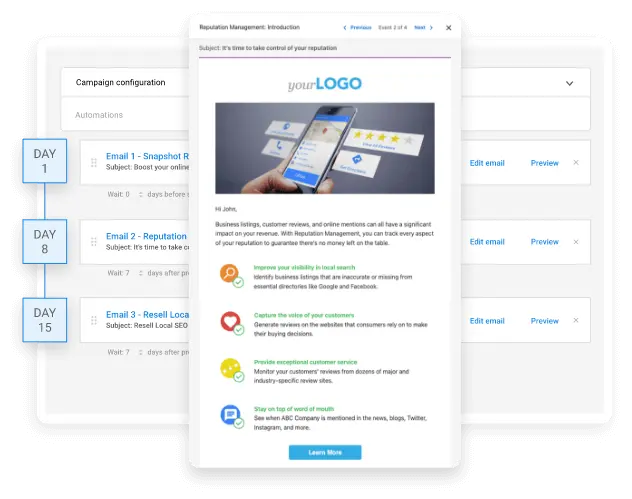
For agencies, this means fewer manual interventions. For businesses, it means marketing that keeps working in the background while teams focus on higher-value decisions.
Why AI Employees Outperform Traditional Automation
Many organizations already use automation and still feel overwhelmed. The reason is simple. Most automation handles tasks, not responsibility.
AI employees change that.
Tasks vs Roles
Traditional tools automate individual steps. They send an email. Then moves data. They trigger a workflow. Someone still has to decide what should happen next, check if it worked, and step in when something breaks.
AI employees are built around roles. A role owns an outcome, such as responding to leads or engaging customers after a purchase. Instead of waiting for manual input, AI employees operate continuously, adjusting actions based on results. This shift reduces the burden on teams and makes execution far more reliable.
Even with automation in place, many organizations are still operating on rigid, rule-based systems. Traditional automation follows predefined instructions and stops when conditions break. AI-driven systems, on the other hand, adapt, learn, and respond dynamically to real-world inputs.
The difference becomes clear when you compare conversational AI with traditional phone-tree automation:

This shift from static automation to adaptive AI is what allows agencies to move from reactive workflows to proactive execution.
AI Customer Acquisition Platform Advantage
AI employees are most effective when they operate inside an AI customer acquisition platform. Shared context allows them to understand customer history instead of starting from scratch. Unified data ensures actions are informed by what is actually happening across the business. Continuous learning allows performance to improve over time rather than staying static.

For agencies and the businesses they support, this creates a system where customer acquisition and engagement are no longer reactive. They become structured, repeatable, and scalable, even as complexity grows.
Reputation, Trust, and Automation at Scale
As businesses automate more of their customer interactions, trust becomes the deciding factor between growth and churn. Automation can improve speed and efficiency, but when it lacks context or care, it quickly damages credibility. Customers notice delayed responses, generic replies, or silence after feedback. At scale, those small moments shape how a brand is perceived.
This is why reputation cannot be treated as a side function in AI-driven services. It has to be designed into the system from the start.
Why Reputation is Critical in AI-Driven Services
Automation without trust fails. Businesses can automate outreach, scheduling, and follow-up, but if reviews are ignored or responses feel disconnected, customers lose confidence.
Reputation lives in the details. Reviews signal credibility before a customer ever engages. Responses show whether a business is paying attention. Sentiment reveals how customers actually feel, not just what they click. When these signals are managed inconsistently, automation amplifies the problem instead of solving it.
This is where Reputation AI plays a critical role. By embedding reputation management into automated workflows, agencies ensure businesses stay responsive, aligned with brand voice, and trustworthy, even as interaction volume increases. Trust is maintained not through more effort, but through better systems.

How Agencies Turn AI Automation into Scalable Services
Many agencies adopt AI automation and still struggle to scale. The reason is not technology. It is delivery. When services are built as custom projects, automation becomes harder to repeat, harder to price, and harder to manage.
Scalable agencies approach automation differently. They design services to be reused, refined, and deployed consistently across businesses.
Productized Offers vs Custom Work
Custom work feels flexible, but it creates friction. Every client requires new discovery, new configuration, and new oversight. Timelines stretch. Margins shrink. Onboarding becomes unpredictable.
Productized offers solve this by defining a fixed scope with clear outcomes. Clients know what they are getting. Agencies know what they are delivering. Onboarding is faster because workflows are already proven. Improvements benefit every client instead of just one.
This shift allows agencies to spend less time rebuilding services and more time optimizing results.
Using Pre-Built Frameworks to Accelerate Delivery
Even productized services can stall if setup takes too long. This is where pre-built frameworks make the difference.
Industry-ready configurations reduce the effort required to launch services across similar businesses. Instead of starting from a blank slate, agencies begin with workflows, roles, and logic already aligned to common needs. Setup time drops. Consistency improves. Delivery becomes easier to manage as volume grows.
The industry-ready AI workforce recommended package supports this approach by giving agencies a structured starting point that balances speed with scalability. Services launch faster, and refinement happens over time instead of during onboarding.
Key Metrics that Define a Successful AI Automation Agency
AI automation agencies do not succeed because they adopt new technology. They succeed because they measure the right things. Without clear metrics, automation becomes activity instead of impact. The agencies that scale focus on performance indicators that show whether systems are actually doing the work.
Gross Margin
Gross margin is the clearest signal of whether automation is working. In a manual service model, margins shrink as delivery grows. More clients require more people. More people increase costs.
In a successful AI automation agency, margins improve over time. As workflows and AI employees take on more execution, delivery costs stay flat while revenue grows. Healthy margins indicate that services are truly productized and not quietly propped up by manual effort.
Time to Value
Time to value measures how quickly a client or business sees real results after onboarding. Long setup periods create frustration and slow momentum. They also increase the risk of churn before value is realized.
Automation-driven agencies prioritize fast activation. When workflows are standardized and AI employees are preconfigured, value shows up quickly. Faster time to value builds trust and reinforces the decision to adopt AI-driven services.
Retention
Retention reveals whether automation is delivering lasting impact. If services require constant explanation, manual fixes, or ongoing intervention, clients eventually disengage.
High retention signals that systems are working in the background without disruption. Businesses stay because outcomes are consistent, not because teams are constantly reminding them of progress. Automation that reduces friction naturally improves long-term retention.
Automation Coverage
It measures the percentage of work handled by AI rather than humans. Low coverage indicates that automation is superficial. High coverage shows that AI is embedded deeply into service delivery.
As automation coverage increases, agencies rely less on people for execution and more on oversight and optimization. This shift is essential for scaling without burning out teams or inflating costs.
Who Should Adopt the AI Automation Agency Business Model?
The AI automation agency business model is not limited to one type of organization. It is suited to any group that delivers recurring services and wants to scale without increasing operational complexity.
Marketing Agencies
Marketing agencies are often the first to feel the strain of manual execution. Campaign management, follow-ups, and reporting take time and attention. Automation allows these agencies to shift from task execution to outcome ownership while serving more clients consistently.
Managed Service Providers
MSPs already think in systems and recurring delivery. AI automation extends that mindset into customer engagement, communication, and support. This model allows MSPs to expand beyond infrastructure into higher-value services without overloading teams.
Franchisors and Multi-Location Brands
Franchisors struggle with consistency across locations. Automation provides a way to standardize customer experience while still allowing local flexibility. AI-driven services ensure every location follows the same playbook without constant oversight.
Independent Software Vendors
ISVs that support businesses can use the AI automation agency model to layer services on top of their software. Instead of selling tools alone, they deliver outcomes through automation, increasing stickiness and long-term value.
Service-Based Businesses Expanding Into AI Delivery
Many service-based businesses already have deep industry knowledge and client relationships. AI automation allows them to package that expertise into scalable services. The model makes it possible to grow offerings without growing headcount at the same pace.
The Future of the AI Automation Agency Business Model
The AI automation agency business model is not a short-term trend. It reflects a deeper shift in how services are delivered, scaled, and valued. As AI becomes embedded into everyday business operations, agencies that rely on manual execution or disconnected tools will struggle to keep up.
The future belongs to agencies that design systems where AI does the work and humans guide the outcomes.
AI Employees as a Digital Workforce
AI employees are evolving into a true digital workforce. Instead of supporting isolated tasks, they take responsibility for ongoing roles across marketing, sales, and customer engagement. This allows agencies and businesses to operate continuously, without being limited by hours, capacity, or team size.
As these roles become more sophisticated, agencies will spend less time executing and more time orchestrating performance. The value shifts from doing the work to designing how the work gets done.
Usage-Based Pricing Becomes the Norm
Automation increases, pricing models change. Flat retainers and hourly billing give way to usage-based pricing tied to real activity and outcomes. Agencies charge based on interactions handled, workflows executed, or results delivered.
This aligns incentives on both sides. Businesses pay for value. Agencies benefit as automation scales without increasing delivery costs. The model rewards efficiency rather than effort.
Fewer Tools, More Platforms
Tool sprawl is already showing its limits. Managing dozens of disconnected systems slows teams down and creates fragile workflows. The future favors platforms that unify data, workflows, and execution in one place.
For agencies, fewer tools mean less maintenance and more consistency. For businesses, it means clearer visibility and better outcomes. Platform-led delivery becomes the foundation for scalable service models.
Agencies as Orchestrators of AI
As AI takes on execution, agencies step into a new role. They become orchestrators. Instead of managing tasks, they manage systems. Instead of running campaigns, they design how AI employees operate, learn, and improve.
This shift elevates the agency relationship. Agencies move from service providers to strategic partners who help businesses operate more effectively through AI-driven systems.
Conclusion
The AI automation agency business model represents a long-term shift in how agencies and service providers create value. It replaces manual execution with systems that scale, adapt, and improve over time.
Platform-led delivery is what makes this model sustainable. When AI employees and workflow automation are built into the service itself, results become repeatable and predictable. Growth no longer depends on adding people or managing more tools.
Agencies that embrace this model position themselves for the next phase of service delivery. AI employees and automation are not add-ons. They are the foundation for scalable, resilient, and future-ready agencies.
Ready to see how this model works in practice? Schedule a demo to explore how AI employees and workflow automation can power your agency’s next stage of growth.
AI Automation Agency Business Model FAQs
1. What is the AI automation agency business model?
An AI automation agency is a service model where you deliver measurable outcomes using AI, automation, and repeatable service packages. Instead of selling custom builds, you deploy systems that keep running, improving, and producing results after onboarding.
2. How is this different from a traditional agency model?
Traditional agencies sell time and manual execution. This model sells systems and outcomes. Your team moves from “doing the work” to designing, monitoring, and improving automated delivery.
3. What is the difference between automation and AI in this model?
Automation moves work from step to step. AI decides what to do inside the workflow and carries out role-based tasks like replying, qualifying, summarizing, and routing. Automation connects the process. AI drives the execution.
4. What are “AI employees” and why do they matter?
AI employees are role-based AI systems that own responsibilities like lead response, review replies, follow-ups, and customer engagement. The advantage is accountability. A role can run continuously, not just trigger a one-time task.
5. Which agency services become easiest to productize with AI automation?
The most repeatable agency services are:
- Lead capture and follow-up
- Appointment booking and reminders
- Review monitoring and responses
- Customer reactivation
- Reporting and insights
These work well because they follow patterns and happen continuously.
6. What does “platform-led” delivery mean, and why is it preferred?
Platform-led means your workflows, customer data, reporting, and AI execution live in one system instead of being stitched together across tools. It reduces breakage, speeds onboarding, and improves margin because you spend less time maintaining integrations.
7. What metrics prove the model is working?
Four metrics that matter most:
- Gross margin: should improve as delivery becomes less manual
- Time to value: how fast the client sees results after launch
- Retention: whether outcomes stay consistent without constant intervention
- Automation coverage: how much work the system handles without humans stepping in
8. Who is this model best for?
It fits teams that sell recurring services and want to scale without hiring at the same pace, including:
- Marketing agencies
- MSPs
- Franchisors and multi-location brands
- ISVs adding services on top of software
- Service providers expanding into AI-led delivery
9. What’s the biggest mistake agencies make when adopting this model?
The biggest mistake is over-customizing. Custom builds do not compound. They slow onboarding, reduce repeatability, and quietly push you back into manual delivery. The win is standard packages with controlled configuration, not endless variation.
10. How does Vendasta support agencies building this model?
Vendasta brings AI employees, workflow automation, customer engagement, and reporting into one platform so you can deliver repeatable services across many businesses. That makes it easier to standardize onboarding, track outcomes, and scale without turning delivery into a maintenance job.