About Us
 Careers
 Leadership
 Board
 Newsroom
Client retention strategies protect the revenue an agency already has: Forrester’s analysis found that renewals and expansion from existing customers make up 61% of business-to-business (B2B) revenue.
The client retention strategies that cut agency churn are 90-day onboarding, executive-sponsored quarterly business reviews, CRM-based personalization, loyalty and referral programs, and bundled services, supported by client health scoring and a service recovery protocol covered later in the article.
Vendasta’s retention research, based on 200,000 client relationships, anchors the measurement, lifecycle strategies, health scoring, recovery, and win-back guidance that follows. The article also covers AI Employees for retention.
Acquire, retain, and grow clients with end-to-end management software
TL;DR
- Client retention strategies start at $99: Vendasta’s Starter plan begins at $99 per month through its spend-offset subscription model, giving agencies a published entry point for running reporting and AI Employees across client accounts.
- Four products retain 80% of clients: Vendasta’s study of 200,000 client relationships found two-year retention rises from 30% with one product to 80% with four.
- AI Reputation Specialist collects NPS in Premium: Through Reputation AI Premium, Vendasta’s AI Reputation Specialist sends review requests and net promoter score surveys, supplying sentiment and NPS data an agency can add to its client health score; automated responses apply to Google and Facebook reviews, while for the other 100+ monitored sources it suggests responses rather than auto-posting.
What Client Retention Means and Why It Beats Acquisition
Client retention is the share of clients paying you at the start of a period who are still paying at the end. McKinsey’s report found that replacing one lost customer’s value can require three new ones, and that 80% of value creation at the strongest growth companies comes from the core business, principally new revenue from existing customers. Benchmarkit’s benchmarks put expansion annual recurring revenue (ARR) at roughly $0.80 per dollar against $1.63 for new-name ARR.
Bain’s research found a 5% increase in retention raised profits 25% to 95%, because acquisition costs make early-year relationships unprofitable. For an agency, replacing one lost $3,000 retainer’s value can take up to three new clients.
Retention differs from client acquisition in who owns it. Acquisition is a sales function measured in pipeline. Retention is a client management discipline measured in tenure and expansion, with proof of performance showing the value delivered.

Vendasta’s retention research highlights three primary drivers of client longevity:
- Proof-of-performance reporting lifts retention 38%: Clients receiving regular performance reports stay at a 38% higher rate.
- Needs-based selling lifts retention 30%: Selling against a documented client goal beats selling from a rate card, improving retention by 30%.
- One vertical lifts three-year retention 34%: Agencies in a single marketing niche retain clients 34% better after three years.
How to Measure Client Retention
Compute these five numbers consistently:
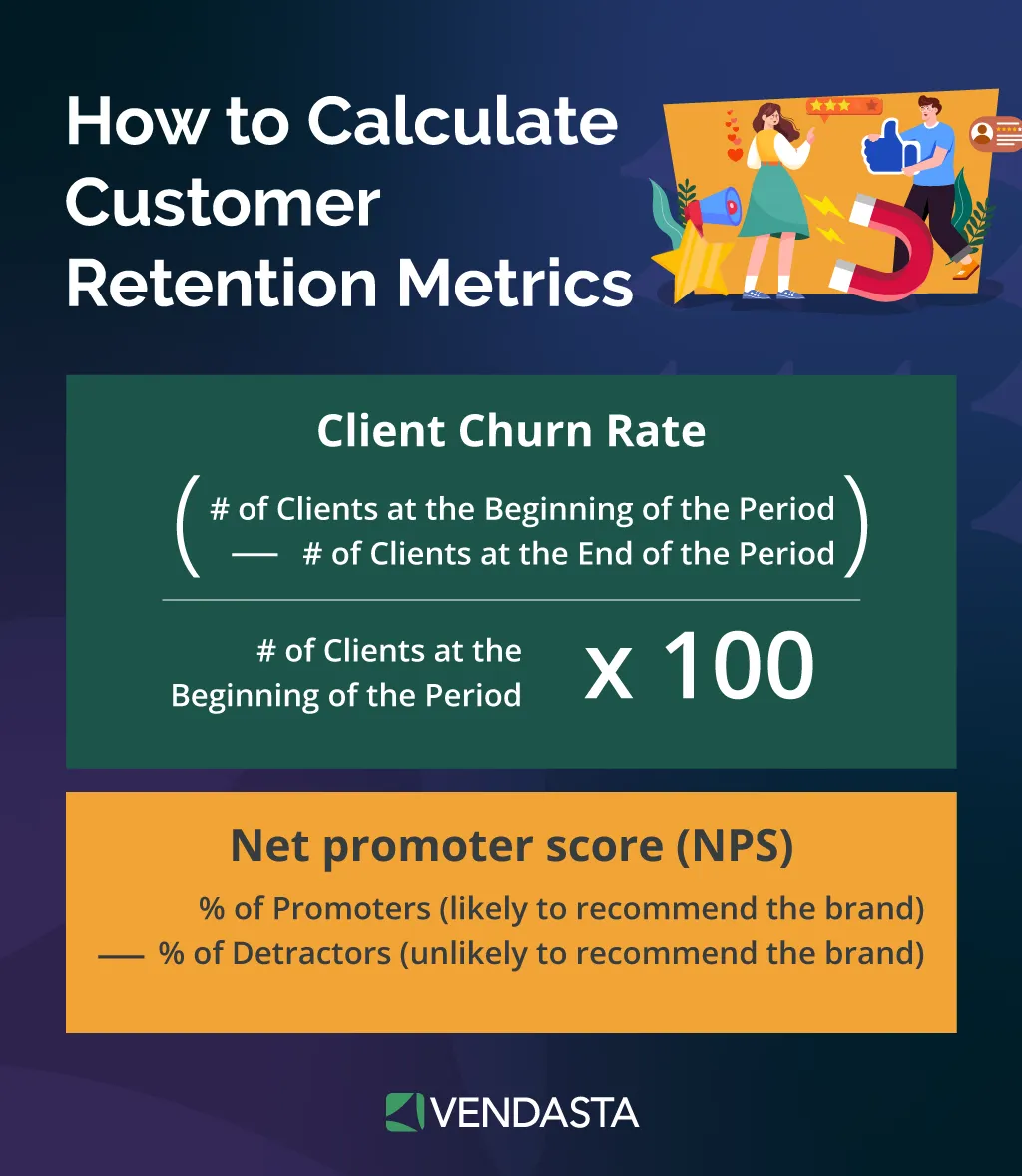
- Client retention rate (CRR): ((E − N) ÷ S) × 100 over 12 months, where S is clients at the start, E is clients at the end, and N is new clients added.

- Churn rate: Clients lost ÷ clients at the start. Compound monthly figures rather than multiplying by 12; 2% monthly is about 22% annually.
- Net revenue retention (NRR): (starting monthly recurring revenue (MRR) + expansion − contraction − churned MRR) ÷ starting MRR × 100. Gross revenue retention (GRR) drops expansion and cannot exceed 100%.
- Client lifetime value (CLV): m × r ÷ (1 + i − r), for annual margin per client m, retention rate r, and discount rate i.

- Net promoter score (NPS): Percentage of promoters (9–10) minus percentage of detractors (0–6) on the zero-to-10 scale.
An agency starts the year with 80 retainer clients at $3,000 per month ($240,000 MRR), ends with 90, and signed 18, so it lost eight. CRR is (90 − 18) ÷ 80 = 90%, and churn is 8 ÷ 80 = 10%.
- Churn: −$24,000 MRR: the eight lost clients.
- Downgrades: −$6,000 MRR: two accounts.
- Upsells: +$24,000 MRR.
NRR is $234,000 ÷ $240,000 = 97.5%, and GRR is $210,000 ÷ $240,000 = 87.5%. At a 40% gross margin ($14,400 annual margin per client), 90% retention, and a 10% discount rate, CLV is $14,400 × 0.9 ÷ 0.2 = $64,800. With 30 promoters and eight detractors among 50 respondents, NPS is 44.
SaaS Capital’s benchmarks put median GRR at 91%, median NRR at 101%, and 90% GRR as the parity floor. You sit below both marks, so expansion revenue is masking the downgrades you absorb.

The Top Client Retention Strategies That Reduce Churn
1. Build an Onboarding Program for the First 90 Days
The first three months provide an early indication of whether an account will reach year two. Vendasta’s retention research found that 62% of clients agencies do not upsell within three months churn within two years.
By day seven, the client has a login to a B2B customer portal showing baseline rankings and listings, plus review counts. By day 30, deliver one quick win such as synced listings or the first 10 reviews. By day 90, run a needs review that presents the second product.
Track the share of new accounts with a quick win by day 30 and a second product live by day 90 in Partner Center.
Looking for additional information to take your onboarding to the next level? Check out this video:
2. Run Proactive Check-Ins and Quarterly Business Reviews
Quarterly business reviews (QBRs) work as churn detector and expansion engine. Gainsight’s report found renewed B2B accounts held twice as many QBRs as churned accounts, only 16% held any, and 51% of cancellations arrived with no prior warning.
Standard retainers get a 30–60 minute QBR covering performance against goals and wins. Then address blockers and next-quarter recommendations. Send the pre-read three to five days ahead, the follow-up within 48 hours, and insist on an executive sponsor.

Open the renewal conversation 90 days before term end, at a QBR, with the client reporting trail in the room, and push for a multi-year term: SaaS Capital puts multi-year agreements at a 94% median gross revenue retention against 89% for month-to-month. Vendasta’s Executive Report delivers that monthly proof of performance under your brand.

Track QBR completion rate, the share of accounts with two or more named contacts, and whether every client relationship has a next review on the calendar.
3. Personalize Service Using Client Data
Personalization means acting on data you already hold: service mix, vertical, stated goals, response times, and review trends.

An AI-powered CRM turns that data into prompts account managers can act on. Vendasta CRM AI holds contacts and companies for each client, with pipelines organized alongside them. Its AI Sales Assistant updates records from sales activity and answers plain-language questions.
Measure the share of accounts with a documented goal and vertical tag, plus acceptance rate on the next recommended product.
4. Launch Loyalty and Referral Programs
Promethean Research’s analysis found referral and word-of-mouth clients stay 1.9 times longer than outbound or event clients. Schmitt’s study found referred customers about 18% less likely to defect and worth at least 16% more than non-referred customers.
Set the terms:
- Referral incentive: Pay roughly 10% of first-year contract value for a lead, 15% to 20% for a qualified opportunity, and 35% to 40% for a signed client.
- Tiered perks: Reward tenure and product depth with priority support and beta access to new AI Employees, with a renewal pricing lock rather than a permanent discount. Run these loyalty programs off your NPS data.

- Referrer selection: Ask clients at least six months in who match your ideal customer profiles.

Track referrals per 100 clients per quarter and referred-client 12-month retention versus outbound.
5. Deepen the Account With Bundled Services
Product depth is the largest retention lever in the evidence: two-year retention runs 30% with one product and 80% with four. AI Employees are the fulfillment layer that lets an agency add that depth without hiring a specialist for every service line, which is the Margin Engine.
Fulfillment is the constraint: each added service line once meant a specialist hire. Vendasta’s AI Reputation Specialist handles review responses and requests. AI Social Media Manager publishes content. AI Receptionist answers inbound calls and digital messages such as chats or texts, all under your brand. Wholesale discounts of up to 80% off retail, scaling with plan tier and volume, leave room to price the bundle at your core margin.
Fill remaining service lines with Custom AI Employees or optional white-label fulfillment, and roll reporting up per brand for multi-location marketing accounts. Land the first product’s quick win before selling the second; add-on-heavy bundles read as complexity. Measure average products per account and the share of accounts at two or more by month three.

Building a Client Health Score to See Churn Coming
A client health score gives account managers one weekly number per account from scattered signals. They can then spot cancellation risk before the notice arrives. Start with five weights, then adjust them using exit interviews:
- Portal login and usage (30%): Usage often falls before a cancellation, though roughly half arrive with no prior signal. McKinsey’s SaaS analysis found a three-month moving average of storage usage predicted discontinuation within six months at one vendor.
- Engagement (25%): QBR attendance, email reply rates, and the engagement metrics on your reporting emails.
- Stakeholder stability (20%): A single-contact account or a departing champion drops the score; Gainsight found 64% of renewing accounts had multiple contacts versus 33% of churned accounts.
- Support sentiment (15%): The account team tracks ticket volume and negative language, weighting complaints more heavily.
- Invoice behavior (10%): Late payments and disputed line items.
Green (75 and above) gets the expansion pitch at the next QBR. Yellow (50–74) gets an account manager call within five business days. Red (below 50) triggers an owner-level call within 48 hours and the service recovery protocol.
An agency can build a Custom AI Employee such as an AI Data Analyst, without code, on top of a paid Vendasta AI product, drawing on connected CRM, review, and social data for a weekly briefing with a next step per red account. Portal logins and invoice behavior need Custom Capabilities to feed in.
Service Recovery for Distressed Accounts
How quickly your team recovers determines whether a complaint costs the account. Goodman’s research found 82% stayed loyal when teams resolved the problem quickly, 54% when teams resolved it at all, and 19% when teams left it unresolved.
Document the protocol:
- Ownership: Assign an escalation owner within 30 minutes of a red flag or complaint.
- Contact: The owner calls the client within one business hour; a director joins within two hours for any cancellation threat.
- Cadence: An executive-level call within 24 hours, then updates every four hours for critical issues and daily for at-risk renewals.
- Concession authority: Account managers approve credits up to 10% and 45-day terms; directors approve 60-day terms; only the owner approves 20%-plus discounts or 90-day terms.
Without a protocol, a home services client emails Friday that leads fell 40%. With one, the account manager reviews Thursday’s flagged drop, calls within the hour with a 10% credit, and brings the owner in Monday with the repaired page’s lead data.
Offboarding, Exit Interviews and Win-Back Sequences
Exit interviews close a perception gap agencies rarely see. Setup’s survey found 61% of clients left over delivery, 61% over value, and only 39% over budget cuts, while 75% of agencies believed budget was the top reason.
Have someone other than the account manager ask five questions by phone:
- What result did you expect by now, and what did you see?
- Which deliverable first made you consider leaving?
- Who else did you consult, and what did they offer that we did not?
- What would have to change for you to return?
- May we contact you in 90 days?
Kumar’s study found bundled discount-plus-upgrade offers won back 47% of screened lapsed customers, and that price defectors returned more readily than service defectors.
Run three touches: a 30-day check-in with one result from a similar client, a 90-day offer keyed to the exit reason, and a 180-day note introducing a new capability. Log every exit answer in the CRM so recurring reasons reset your health score weights.
How AI Employees Keep Clients Longer
AI Employees support retention by supplying the always-on service it depends on: answered calls, responded reviews, and logged proof of the work. This is the Retain layer of Vendasta’s Customer Acquisition and Engagement Platform.
AI Receptionist answers calls, web chats, texts, and messages 24/7, qualifies leads, and books appointments, unlocked by Conversations AI. AI Reputation Specialist responds to reviews and collects net promoter scores that your agency can add to the health score.
Business App logs every action, and white-label reporting shows the work under your name.

Gartner’s survey found 53% of customers would consider switching to AI customer service, so disclose where AI handles interactions and keep a human escalation path.
- Blackfeather Digital retained 100% of clients: Using Vendasta with a three-person team, the Pennsylvania revenue enablement agency generated $1 million in first-year revenue.
- Xcite Group lifted conversion to 70%: Using Vendasta AI products, Xcite raised lead-to-appointment conversion from 50% to 70%, retained 100% of AI clients, and generated $745,000 in gross market revenue.
Vendasta’s case studies report both results, not guarantees.
The Bottom Line on Client Retention Strategies
Client retention strategies pay off when they change what an account experiences in its first 90 days and how many products it holds by year two. The 38% lift from proof-of-performance reporting means a branded report in front of every client every month. Measure CRR, churn, NRR, CLV, and NPS the same way each quarter.
Work the health score tiers on a weekly cycle so a red account gets an owner call months before its renewal date, and use the wholesale margin headroom to add the third and fourth products without a third or fourth hire. QBRs with executive sponsors, a referral program paying on signed clients, and a written recovery protocol handle the rest. To see how that retention layer would run across your client portfolio, book a Vendasta demo.
Client Retention Strategies FAQs
1. What are the five main client retention strategies for agencies?
The five with the strongest evidence are a 90-day onboarding program, quarterly business reviews with executive sponsors, personalization built on CRM data, loyalty and referral programs, and bundled services. Vendasta’s retention research shows the largest single lift from product depth: 80% two-year retention at four products.
2. What are the 8 C’s of customer retention?
No single canonical framework exists. The peer-reviewed version, Srinivasan et al.’s study, lists customization, contact interactivity, cultivation, care, community, choice, convenience, and character. The researchers built it for ecommerce consumers, so agencies should map each C to B2B service delivery.
3. What are the three types of customer retention strategies?
The standard typology comes from Berry and Parasuraman’s work on relationship bonds. Financial bonds use discounts and break easiest; social bonds use personal relationships and customized reporting. Structural bonds embed your dashboards, workflows, and integrations into the client’s operations, and break hardest.
4. How do you calculate client retention rate and churn rate?
Client retention rate is ((clients at end − new clients added) ÷ clients at start) × 100, over 12 months. Churn rate is clients lost ÷ clients at start; the two sum to 100%. Annualize monthly churn by compounding, not multiplying by 12, which puts 2% monthly near 22% a year.
5. Is retaining a client cheaper than acquiring a new one?
Usually, though the evidence is narrower than the folk statistic. The popular 5-to-25 times multiple has no traceable primary source. McKinsey found replacing one lost customer can take three new customers, and Bain found a 5% retention increase lifted profits 25% to 95%.
6. What is a good client retention rate for a marketing agency?
No single agency-wide percentage exists, because retainer and project agencies count churn differently. SaaS Capital sets 90% gross revenue retention as the B2B parity floor, with a 91% median. Promethean Research reports average agency tenure of 27.2 months, and 42% of agencies exceed two years.
7. How can you tell when a client is about to leave?
Watch usage first: falling portal logins, unread reports, and skipped QBRs. Then watch contacts: account teams built multiple relationships in 64% of renewing accounts versus 33% of churned accounts. Also watch late payments, disputed invoices, and emotionally neutral complaints, which some sentiment tools may miss.
8. How is B2B client retention different from B2C?
B2B retention runs on fewer, larger accounts with multiple stakeholders and contract renewal dates, so QBRs, executive sponsorship, and multi-threading carry the weight. Contract length also shows in the numbers: multi-year deals retain gross revenue at a 94% median against 89% month-to-month.
9. What is a client health score and how do you build one?
It is a weighted number per account that your team refreshes weekly from portal usage (30%), engagement (25%), stakeholder stability (20%), support sentiment (15%), and invoice behavior (10%). When exit interviews keep naming one cause, raise the weight on the signal that missed it.
10. How do agencies win back lost clients?
Start with an exit interview; clients cite delivery and value more often than agencies assume. Then run a 30/90/180-day sequence: a result from a similar client, an offer keyed to the exit reason, a new capability. Bundled discount-plus-upgrade offers won back 47% of screened lapsed customers.