About Us
 Careers
 Leadership
 Board
 Newsroom

The average US marketing agency earned $163,000 in revenue per full-time employee in 2025, according to Promethean Research’s 2026 State of Digital Services. For most agency owners, the standard fix for growth has always been the same one: win more accounts, hire more people, and repeat. Revenue climbs, but so do payroll, training time and the number of hands touching every client.
That fix is getting more expensive. Promethean’s own summary of the 2026 report notes that revenue per full-time employee fell for the first time in years, a sign of weaker efficiency across much of the market. Every new hire is buying less output than it used to, which means the agencies still solving capacity with payroll are now competing against agencies that solved it with a system. An AI agency operating model is what that system looks like when somebody builds one and runs it for years.
That is why we sat down with Simon Papadopoulos, COO and Head of Strategic Partnerships at Social Ordeals, a 14-year-old agency in Glendora, California that Simon says has grown 12 times in revenue since he joined in 2017 and has acquired three other agencies in the last two years.
Simon rebuilt the account manager role around an AI workforce that handles repeatable client fulfillment, more than doubled accounts per manager without raising churn, and simplified pricing so clients cannot cherry-pick their way to a weak result.
He is also a former Vendastian, which means he knows exactly how the platform works and has no problem calling us when something is not ready.
Watch the full episode:
Automate every step of the customer journey with AI employees
TL;DR
- Headcount is a capacity ceiling, not a growth signal. Social Ordeals was hiring every 60 to 75 days and spending two to three months training each hire, with account managers capped at 40 to 50 accounts. After rebuilding the role around an AI Workforce, each manager runs 60 to 90 accounts and carries $30,000 to $40,000 in monthly recurring revenue (MRR), against an industry average of $163,000 in annual revenue per full-time employee.
- The AI does the volume, the humans do the judgment. In 90 days, two AI Employees alone completed more than 5,200 jobs across the client base. Churn sits under 2% because account managers finally have time to play offense instead of defense.
- The proof is in the client results, not the dashboard. A nine-location veterinary group deployed the AI Receptionist across four websites, captured 57 new clients in its launch month and now attributes $47,698 in monthly revenue to AI intake. Simon says they have since become a six-figure digital ads client.
What Is an AI Agency Operating Model?
An AI agency operating model is a way of running a digital agency where repeatable fulfillment work is handled by AI Employees and human staff are redeployed to strategy, relationships and growth. Capacity stops being a function of headcount and starts being a function of the system. The practical test is simple: when you win ten new clients, does your cost base move?
In an AI agency operating model:
- Account managers direct an AI Workforce instead of doing the production work themselves
- Review responses, social posting, listings upkeep, reporting and first-touch lead response run without a human starting them
- Accounts per manager rise without a matching rise in churn or complaints
- Revenue per person becomes the metric leadership watches, not team size
- Humans stay on the work that requires empathy, negotiation and judgment
Simon puts the shift in one line:
Most agencies view headcount as this great badge of honor. I view it as an operational bottleneck.
The Linear Grind: Why Hiring Stopped Working
Simon calls the old model the linear grind. It is the pattern most agency owners will recognize before they finish reading the sentence.
We were hitting a wall where every spike in revenue was immediately wiped out by recruiting and onboarding and overhead. The delivery costs scaled in lockstep with sales and then margins stalled, and human errors obviously start compounding.
There was no single moment where he decided to change it. There rarely is. The grind just kept taking a little more each quarter until the math stopped working.
Hiring Great People to Do Mechanical Work
The cruelest part of the linear grind is what it does to good staff. Social Ordeals was hiring brilliant strategists and then handing them a queue.
Simon comes from a restaurant family, so the analogy arrived fully formed:
If you’re paying a gourmet chef a gourmet chef salary, but you’re making them wash dishes.
That is what the work looked like. Logging into different dashboards. Keeping client details in different places. Copying and pasting copy. Manually replying to reviews. He describes it as drowning the team in operational noise, and the cost shows up twice: once in the salary you are paying, and once in the strategy nobody has time to do.
Monday Morning Was Pure Defense
Ask any agency owner what Monday looks like, and you will get a version of this.
A few years ago, Mondays were pure tactical defense. They’d log in, they’d get drowned. They’re checking their task manager, triaging tickets, chasing approvals, trying to talk to clients. By the time they cleared that weekend backlog, it’s probably Tuesday afternoon.
His estimate: account managers burned about 30% of the week just surviving the checklist. That left little cognitive bandwidth for the thing they were hired to do, which is drive client growth.
At that point, each manager topped out at 40 to 50 accounts, and the only lever left was another hire. Every 60 to 75 days. Two to three months of training each time, during which the new person is a cost, not capacity.
This is the ceiling the whole industry has been pushing against. Promethean’s 2026 data puts the average agency at $163,000 of revenue per full-time employee, while agency consultant Karl Sakas advises specialist agencies to target $250,000 or more and puts $120,000 as the line below which an agency faces structural risk, according to Haus Advisors’ breakdown of agency revenue per employee.
You do not climb that ladder by adding rungs. You climb it by changing what a person does all day.
From Account Manager to AI Orchestrator
The single highest-leverage change Social Ordeals made was not a tool purchase. It was a job description.
Simon told his team the thing every agency owner should say out loud before deploying anything:
Don’t fear AI is going to replace anybody. You guys are going to be AI orchestrators.
The way he describes the new role is specific. An account manager logs into one command center. Waiting for them is a social manager, a reputation manager, a task manager, and an SEO manager, all of which have already been working.
These things are going to be working and orchestrating stuff and bringing everything forward to you so you can do quality work and do that work that you really want to do and that you’re successful at.
The ownership framing is just as important as the tooling. Simon tells his managers their book is their own company:
Those 60, 70, 80 accounts, you’re the CEO of that.
What Changed, in Numbers
Here is the headline, in Simon’s words:
A couple of years ago, we were hiring someone every 60 to 75 days and spending two to three months training each one. I felt like we were becoming more of a staffing agency than anything. Today, our account managers run 60 to 90 accounts each, and our churn is under 2%. And in the last 90 days, AI did over 5,000 tasks for our clients.
- Accounts per account manager: 40 to 50 before the AI operating model; 60 to 90 today
- Hiring cadence: a new hire every 60 to 75 days before; today, Social Ordeals scales the system instead of the team
- Ramp time per hire: two to three months before; today, hiring is no longer the growth lever
- Week spent on reactive checklists: about 30% before; today, that time is reclaimed for growth work
- MRR carried per account manager: not tracked at this level before; $30,000 to $40,000 today
- Revenue per account manager vs. a traditional agency: 3x to 4x before; 7x today, by Simon’s estimate
- Client churn: higher before, with regular save calls; under 2% today
Run the math on that MRR line. An account manager carrying $30,000 to $40,000 a month is carrying $360,000 to $480,000 a year. The 2026 industry average sits at $163,000 of revenue per full-time employee. Even allowing that an account manager is not the same denominator as total headcount, the gap is the whole argument.
The Weekend Test
The clearest picture of what orchestration means is what happens when nobody is working. Simon describes it this way:
Over the weekend, the Reputation AI engine had already analyzed, drafted, and queued up 150 responses across their entire book. Social AI had built the next month’s posting plan.
Monday morning, the account manager is not starting from zero. They are reviewing, approving and deciding. That is the difference between a 40-account book and a 90-account book, and it is why agency productivity gains from AI show up in retention rather than just in hours saved.
Simon is clear that this is a review job, not a hands-off one:
Just like, you know, if this was an employee that’s answering all this, you got to train them too.
5,200 Jobs in 90 Days, From Two AI Employees
When Vendasta’s team visited Simon in Los Angeles, they asked him to guess how much work AI was doing inside his platform. He guessed a couple of thousand. He was not close.
The real number, through October 31 and covering the previous 90 days, was more than 5,200 completed jobs. The part that matters: that count came from only two AI Employees, the AI Reputation Specialist and the AI Receptionist working web chat. The AI Social Media Manager and the rest of the AI Workforce were not in the total.

“Tip of the iceberg,” as Simon put it. He also points out the uncomfortable follow-up: only 20% to 25% of his own client base has AI turned on. The runway inside his existing book is larger than the growth he has already booked.
The Whiteboard Line: How to Decide What AI Takes First
Most agencies start their AI rollout by picking a tool. Simon says that is backwards, and he is blunt about what happens when you do it.
If you’re going to inject AI into broken workflows, you’re not going to get efficient. You’re just going to ultimately what I call automate chaos. And you’re going to scale mistakes.
His fix is a whiteboard and a marker. Draw a line down the middle.
Left Side: Everything That Needs a Human
Strategic and relational work. Anything requiring judgment, empathy, negotiation and client trust. The save call. The pricing conversation. The moment a client is upset and needs to hear a person. This side does not get automated, and saying so out loud is how you get your team to stop quietly fearing the project.
Right Side: Everything Mechanical
Repetitive, high-frequency, rules-based work. Report formatting. Review replies. Dealing with the same numbers over and over. Scheduling queues. Listings upkeep. First response to an inbound lead at 10 p.m.
Then Pick One Thing, Not Everything
This is where Simon has watched agencies hurt themselves, including his own.
Don’t try and automate everything at once, or everything even on that right side at once. Pick that one high-frequency bottleneck.
For Social Ordeals, the obvious first candidate was review management. They respond to thousands of reviews per month, which made it the highest-volume mechanical task in the building. So they turned on AI reputation management first, on their own agency, before any client saw it.
The sequence he describes is worth copying exactly:
- Audit the workflow before you automate it. If the process is broken, AI makes it broken faster and at greater volume.
- Draw the line. Strategic and relational on the left, mechanical and repetitive on the right.
- Pick the single highest-frequency bottleneck on the right side. Volume is the filter, not importance.
- Run it on yourself first. “We used it, we felt it, we tweaked it, we worked with it, we understand it.”
- Then take the next item off the right-hand side. Not all of them. The next one.
Drink Your Own Champagne
Step four is not optional in Simon’s world, and it is the thing he pushes hardest on other agency owners.
Just like Vendasta, we drink our own champagne. So we had to test this thoroughly, and we had to make sure it was working for us first and then proceed to launch it and push it.
He takes it further, into the sales conversation itself:
You’ve got to utilize this for yourself. You’ve got to see it. You’ve got to feel it. You’ve got to dial into your own business. You’ve got to look at those workflows. Because these small business owners have the same challenges. If you’re not utilizing this stuff, why should they?
It is also a credibility test you will fail in public if you skip it. Somebody will eventually ask to see your own Snapshot Report, or ask why there is no chatbot on your own site.
Three Client Wins That Prove the Model
An operating model is only worth copying if the clients notice. Account counts and churn rates tell an agency owner whether the system is efficient, but a local business owner only cares whether the phone rings, whether the leads are real, and whether somebody at the agency is paying attention to their numbers.
The three stories below came out of the episode, and they are deliberately different sizes: a multi-location veterinary group, a one-person roofing company, and a long-time med spa client. Two of them show AI Employees catching revenue that would otherwise have walked away. The third shows what account managers do with the time AI gives back, including recommending that a client spend less.
1. The Veterinary Group: 57 New Clients in a Month
The origin story is very on-brand for a fast agency. Simon’s business partner Chris sold the deal before the product was priced.
Chris is the superpower of selling the airplane while I’m still reading the assembly manual.
The chatbot had been live on Social Ordeals’ own website for roughly a day when Chris walked past and mentioned he had closed a multi-location veterinary group, four websites, chatbot included.
Simon’s reaction was not celebration. It was the realization that he now had to make it work across a multi-location network he had never tested.
The build was not trivial, and he is direct about that. The group includes 24-hour emergency hospitals alongside its standard clinics, so the other sites needed routing logic to push after-hours cases to the right place.
We had a lot of constructing to do, but we were transparent with the client. So, listen, this isn’t going to be perfect, but you know what, we’re here, we’re going to handhold you and we’re going to make it right.
Then the email came. The group’s chief marketing officer forwarded their internal numbers: 57 brand-new clients captured in the launch month, with invoice numbers attached. Their interim president called it a very effective tool and started running it for client data. Vendasta later published the result for the nine-location group: $47,698 in monthly revenue attributed to centralized AI intake.
Two things about that number are easy to miss.
First, new client count undersells it. Simon explains:
The value here isn’t even; a lot of folks will look at the number of new. But to me, it’s like, look at how much value there is even for their current clients. You’re helping those folks out by answering their questions, and booking more effectively.
Plus every call the front desk did not have to take.
Second, it compounds. Simon says a second email arrived two years later: the vet group is now a six-figure digital ads client, which means more traffic hitting a site that converts better than it used to. He calls the chatbot “that extra net,” the thing catching what the paid spend would otherwise drop.
The conversations themselves became the proof point nobody expected. Pet owners were having 15- to 20-minute exchanges with it, asking questions like:
My dog ate chicken wing bones, should I just monitor him for now?
The clinic eventually asked Social Ordeals to label the widget as an automated AI chatbot and not a real person, because customers assumed they were talking to staff.
2. The Florida Roofer Who Sold a $20,000 Roof in Spanish
The opposite end of the market, and arguably the better story.
The client is a one-man roofing operation in Florida. Outstanding craftsman, completely unreachable between eight and five, because he is physically balancing on a two-story pitch with a nail gun in his hand. Storms roll through, people call about leaks, and the calls go nowhere.
Simon did not sell him anything. He turned it on.
We’re just gonna turn this on for you. I want to deploy this for you. Just trust me and let’s just run this thing.
Website chat plus an AI Receptionist on the phone line, free for a month.

Then a call came in entirely in Spanish, which the roofer does not speak.
This thing had a full-on Spanish conversation. And it literally sent me the whole transcribed conversation and laid everything out and answered everything perfectly.
The roofer did the walkthrough that week.
It was a done deal. It was a $20,000 roof.
The roofer, who was annoyed he had not had it sooner, went on to buy a website off the back of it.
3. The Orange County Med Spa: Knowing When to Pull Back on Ads
This one is in the post because it is not an AI Employee story, and that is the point.
Social Ordeals has had a med spa client in Orange County for five and a half years, running the foundational package the whole time. For the last year, they had been pushing digital ads. Orange County med spas are a brutally competitive auction, and the return on ad spend was not good enough.
Normally ads are the final step for them.
Once we get them to that point where now we’re making a phone ring, those are lifers.
This time they pulled back instead, and went looking at the on-page side where they could see real room.
They strengthened the client’s local SEO foundation inside Vendasta SEO AI and grew organic traffic, which AI search then amplified. A few weeks later, the owner called them to say the difference was day and night.
The lesson for any agency building an AI operating model: automation gives your people the hours to notice a strategy is failing and the standing to recommend spending less. That is a retention event disguised as a downgrade.
Two Packages, No Cherry-Picking
Simon and his partner each take about a call a month from other Vendasta partners, and the question that comes up most is pricing. His answer is probably the most counterintuitive thing in the episode: Social Ordeals sells two packages, and that is it.
The logic is about comprehension as much as margin. A local business owner comparing agencies is already overwhelmed, and a long rate card forces them to make technical decisions they are not equipped to make. Two clear tiers turn the conversation into a single question about how much help they want, which is the same idea behind building an AI agency pricing strategy around simple entry points.
What I find is the rate cards are just extensive, or they’ve got things in there that I don’t even understand. And I’m a digital agency. So how is that prospect or that roofer or that vet or that doctor going to understand it if I don’t even know what you’re offering?
What Is in Each One
Both packages share the same foundation. The difference is who does the day-to-day work.
- Base package (more do-it-yourself): listings and listing distribution, a local SEO foundation, AI reputation management and AI social marketing. Social Ordeals handles onboarding and connections, and day-to-day execution is client-led with agency support. Price before AI was in the stack: $149 to $189 per month. Price today: $249 to $299 per month.
- Premium package (fully managed): everything in the base package, with review responses written for the client and social posts created and published for them. Onboarding, connections and day-to-day execution are agency-led end to end. Price before AI was in the stack: around $300 per month. Price today: $449 to $499 per month, targeting $500.
Upsells sit above the packages, not inside them: websites, on-page SEO and digital advertising.
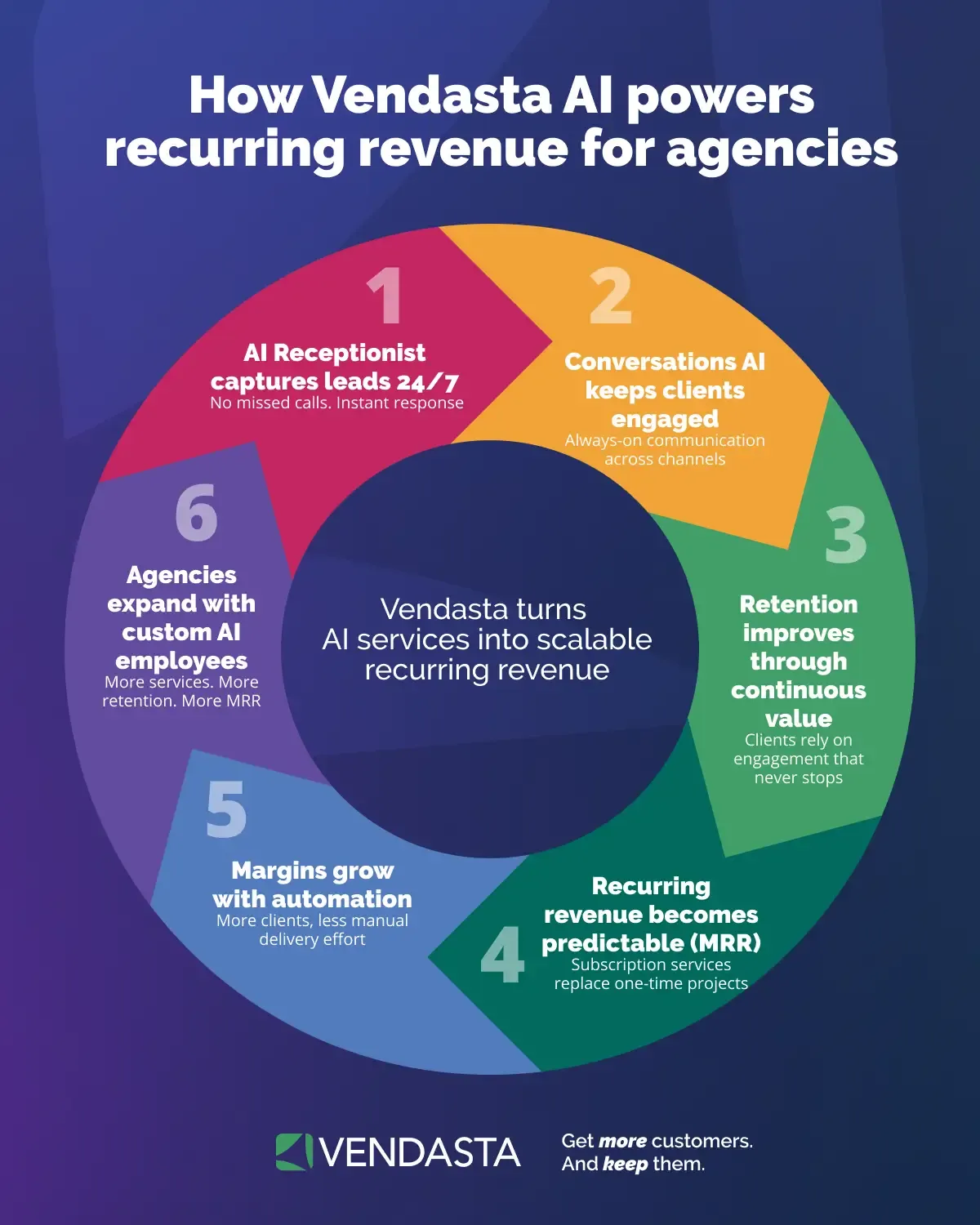
Notice what happened to pricing. Adding AI Employees to the same two packages moved the base roughly $100 per month and the premium roughly $150 to $200 per month. Nothing about the sales conversation got more complicated. The client just got more, and the agency kept the difference. That is how recurring revenue for agencies compounds.
The Rule That Makes It Work: No Peeling
Partners ask Simon constantly what to do when a prospect wants to drop the reputation piece or skip listings.
His answer:
Then they’re not a client for you. If they’re not willing to invest in that online presence, I’m willing to lose that client, because they don’t understand how important that is.
That sounds like bravado until you consider the fulfillment side. Every peeled component is a custom configuration, a custom report, and a workflow your AI Employees cannot run the same way twice. Standardization is what makes 90 accounts per manager possible. The day you let clients build their own bundle, you are back in the linear grind.
There is also a results argument, which Jeff Tomlin framed well on the episode: you would not buy a car without the tires and the battery. If the foundation is not in place, nobody can tell what is broken when the ads underperform.
Vendasta’s own client data backs the structure. Vendasta’s study of 200,000 clients found that a single product retains 30% of clients after two years, while four products retain 80%. In Vendasta’s published case study, Social Ordeals averages 3.75 products per client with 98% client retention. The packaging is the retention strategy.
The Sales Motion: Diagnose, Then Show a Client Who Looks Like Them
Social Ordeals runs the same sequence on every deal: diagnose the prospect’s online presence, present the findings in a meeting, show a live client whose business looks like theirs, then onboard with the expectations set in writing. None of it is complicated, and that is deliberate. A repeatable sales motion is what lets new account managers sell the same way the founders do.
Simon has strong opinions about two of those steps, because he sees most agencies get them wrong. They send the diagnostic too early, before the prospect has any reason to engage with it, and they lean on anonymized case studies when a real client with the same struggles would close the deal faster.
Keep the Snapshot Report in Your Back Pocket
The Snapshot Report is where every prospect conversation starts, and Simon’s advice is to resist sending it.

I find that it’s such a powerful and critical report that sometimes I tell agencies, don’t just throw it out there. Keep that thing in your back pocket, get them to come to your presentation, bring it forth, and then share it with them afterwards.
The report is the reason they get the meeting. The meeting is where the deal is won.
Then Show a Real Client Who Looks Like Them
This is the part Simon says agencies underuse, and it costs them deals.
If I’m going to bring a roofer on, show the roofer off. Be like, man, this guy has had the same struggles as you, dear John the plumber.
Skip the anonymized case study full of numbers. Walk them through the Snapshot Report, talk about their actual business, then open the platform and show them a live client whose situation mirrors theirs.
He is emphatic that you do not need a perfect industry match. You need a match on shape: solopreneur or multi-location. Simon describes using a four-location client to win an eight-location deal, then using that to win a bigger multi-location group, with a 52-location prospect lined up for the week after the episode.
That is the ladder, stated plainly. Every deal you close becomes the proof asset for the next one up.
Onboarding Is Where Retention Is Won or Lost
Simon is firm on this:
Set the expectations. The onboarding is super important. Not just throwing them out there and being like, alright, you’re done. Go connect your stuff.
Social Ordeals runs the onboarding call themselves, connects every account and profile on the client’s behalf, launches the products and listings properly, then confirms everything is tidy before anything goes live. Fulfillment then runs through Vendasta’s project management layer, with reputation and social handled by AI Employees.
For a busy owner, the handholding is the product. As Simon puts it:
We know they’re busy and they don’t want another thing that is going to take time. So we’re all about service.
The Certification Changed the Conversation
Social Ordeals is one of Vendasta’s AI Certified Partners, and Simon says it changed how they position the relationship entirely.
Back in the day, Chris and the team used to hide the fact, or not bring forth Vendasta. Things have changed. I truly believe that there’s so much business out there, and being a certified agency partner, we bring a lot of information forth.
His reasoning is simple and worth sitting with:
Digital agencies, we can’t build software like Vendasta.
Naming the technology behind the service no longer weakens the pitch. It is what makes the AI claims credible.
The Upsell Engine Nobody Plans For
Here is the second-order effect Simon did not expect.
When account managers stopped drowning, they started noticing things. A client who has not posted in a month. A client ignoring their reviews. A website that is embarrassing for a business they are now driving real traffic to.
We’re actually driving people to that thing; that’s embarrassing, let me call into them, where we never had time to do stuff like that. So everything kind of works in a full circle. AI is helping us not only execute tasks, but it’s helping our churn, like we’re having to play defense less, and it’s helping our upsells.
They also started collecting reviews for the agency itself, something Simon used to have to nag people about. More reviews means more stories, which means more case studies, which means more business. Account management backed by AI Employees turns out to be a growth function rather than a cost center.
The proof landed in his inbox in September. A large client emailed to say the account managers were unreal and that they had built deep trust with the team. One of those account managers, Monique, had a raise the Monday he got back.
Buying Books of Business: The Model’s Real Stress Test
Social Ordeals has acquired three agencies in the last two years. That is only possible because of everything above, and it is the clearest evidence that the operating model is real rather than a story about one good quarter.
What Simon finds when he opens an acquired agency is always the same.
They were very segregated, not managed well.
Clients spread across different platforms, no consistent process, nothing standardized.
The fix is to migrate them onto one platform and set expectations with every inherited client.
Migrating them to the Vendasta platform obviously was the best thing. We had to reel those clients in, set the expectations, bring them into a great platform and execute.
One acquisition is a particularly good illustration of what an AI operating model lets you buy. The seller had a solid book of 80 to 90 accounts and was a phenomenal salesperson who had no interest in running an agency.
He was like, Simon, I just want to sell. And I’m like, well, let’s reel all this stuff in. Let’s build that Vendasta CRM around you and let’s have you sell, and we’ll take care of everything on the other end.
That trade only works if your fulfillment capacity is close to elastic. If every inherited account needs a hire, you cannot absorb 90 of them at once, and you certainly cannot do it three times in two years. The AI Workforce is what turns an acquisition from a staffing problem into a migration project.
Worth noting for anyone modeling this: Simon is clear the growth has not been easy.
There’s nothing easy about it. We’ve never worked harder in the last year. I swear I put in as much time as I did my very first year here almost ten years ago.
The system removes the grind from fulfillment. It does not remove the work of running a business.
The Two-Minute Test You Should Run Tonight
Before any of this is about AI, it is about whether your clients are losing money at 10 p.m. Simon has a test for that, and he runs it on his own agency.
I love calling my own digital agency. I love putting a lead into my own digital agency.
A couple of weeks before the episode, he found one of his account managers’ voicemail greetings had been set up by a previous account manager who no longer works there. A prospect calling that line would have had no idea who they reached.
Here is the test, in his words:
Run that two-minute test tonight. Call your own phone line at 9:30pm, see how it feels. Fill out your website’s contact form at 10 o’clock at night and see what your actual prospective customer experiences. Because if the answer is a voicemail box or a dead-end auto-reply that says thanks, we’ll get back to you in 24 hours, that lead is walking right into the arms of that next competitor on Google.
How Vendasta Turns an AI Agency Operating Model Into Infrastructure
Everything Simon describes depends on one condition: the AI Employees, the client data, the fulfillment workflow and the client-facing reporting all have to live in the same place. The moment they do not, your account managers are back to logging into five dashboards and copying between them, which is the exact problem the model was built to solve.
Vendasta is an AI customer acquisition and engagement platform for local businesses and the agencies, franchisors and software vendors that serve them. For agencies, the promise is the one Simon is living: grow MRR without growing headcount, with AI Employees as the fulfillment layer. Social Ordeals has earned $4.7M in revenue through the platform with 98% client retention and an average of 3.75 products per client. Here is where the platform does the heavy lifting in the model above.
An AI Workforce Your Account Managers Direct
The AI Workforce is what makes the orchestrator role possible. The AI Receptionist answers calls, web chats, and texts around the clock, captures and qualifies leads, and books appointments. The AI Reputation Specialist responds to reviews with configurable rules, rating thresholds, and approval workflows across an entire book. The AI Social Media Manager generates, schedules, and publishes posts without anyone opening a calendar.
AI Employees are powered by each business’s own data, which is why a vet group’s AI Receptionist can distinguish a routine appointment from an emergency case and route it to the right location. Every action is logged and reported, so the agency and the client can see what the AI did.

Most AI Employees deploy in under 30 minutes, and partners can deploy them across their whole client portfolio from Partner Center under their own brand. That is the difference between deploying AI to one client and deploying it to a book of ninety. It is also where Vendasta differs from a build-it-yourself toolkit like GoHighLevel: agencies get a productized, brandable AI Workforce they can sell, with AI included in core plans, instead of assembling and metering automations themselves.
One Platform Instead of Five Logins
Simon’s description of the old Monday, logging into different dashboards and keeping things in different places, is the problem a unified platform exists to solve. Listings, local search, reputation, social, Vendasta CRM AI, project management, billing and client reporting all run from one rebrandable system.
Local search is a good example of how much work that consolidation absorbs. Vendasta SEO AI keeps each client’s listings accurate across Google, Facebook, Apple, Bing, Instagram and X, tracks rankings block by block on a local search grid, and reports rankings, listings and Google Business Profile insights in one place. On the Premium edition, the AI Search Specialist checks whether ChatGPT, Gemini and Perplexity recommend the business over its competitors, then drafts the website fixes, FAQs and blog posts to improve it, which the agency can approve one at a time or let run automatically.
That consolidation is what lets an account manager hold 90 relationships in their head. It is also what lets Social Ordeals absorb an acquired agency’s book without rebuilding the operation each time.
Proof the Client Can See for Themselves
The reason Social Ordeals keeps clients is that clients can watch the work happen. The client-facing portal, Business App, and the executive report compile performance automatically, under the agency’s brand.
Vendasta’s client churn study found that local businesses receiving regular proof-of-performance reports retain 38% better than those that do not. Automated reporting is a churn control, not an admin convenience.
A Sales Motion That Starts With a Diagnosis
The Snapshot Report gives an agency a needs assessment on any local business before the first conversation, pulling listing data from more than 70 directories and review data from more than 30 review sites into a branded report card. That is why Simon treats it as the asset that earns the meeting. It supports the whole ladder: diagnose, package, onboard, fulfill with AI, then upsell websites, on-page SEO and advertising from a position of proof.
Partners who want to go further can get Vendasta AI certified, which is the credential Simon credits for changing how openly Social Ordeals talks about the technology behind their work.
Capacity Is a Design Choice Now
For two decades, agency capacity was a payroll question. You wanted more clients, you hired more people, you accepted that margins would stay where they were. Nobody questioned it because there was no alternative.
There is now, and Simon’s numbers are the argument. Same leadership, same market, same clients. Twelve times the revenue since 2017, double the accounts per manager, churn under 2%, and three acquired agencies absorbed without a hiring spree. The change was not a tool. It was deciding that headcount is a bottleneck rather than a trophy, drawing a line down the middle of the whiteboard, and giving his people a job worth doing.
The agencies that stay on the old model are not going to lose dramatically. They will just quietly compete against firms whose cost base no longer moves when they win.
Start with the two-minute test tonight. Call your own line at 9:30. Then pick the one mechanical task your team hates most and give it to an AI Employee you have tested on yourself first.
If you want to see what an AI Workforce looks like running across a book of clients, book a demo with Vendasta today.
AI Agency Operating Model FAQs
1. What is an AI agency operating model?
An AI agency operating model is a way of running an agency where repeatable fulfillment work is handled by AI Employees and human staff are redeployed to strategy, relationships and growth. Capacity stops depending on headcount. The test is whether winning ten new clients moves your cost base. In a working model, it barely does.
2. How many accounts can one account manager handle with AI?
Social Ordeals moved from 40 to 50 accounts per manager to 60 to 90, with churn under 2%. The ceiling depends on how standardized your packages are and how much mechanical work your AI Employees own. Agencies that let clients cherry-pick services stay stuck near the lower number, because every account becomes a custom configuration.
3. Does AI replace account managers or marketing staff?
No. It changes what they do. Simon Papadopoulos tells his team they are becoming AI orchestrators, reviewing and directing work that is already drafted rather than producing it from scratch. Vendasta builds AI Employees on the same principle, removing repetitive work so people focus on judgment, negotiation and client relationships.
4. Where should an agency start with AI automation?
Start by auditing workflows, not by buying tools. Draw a line down the middle of a whiteboard, with strategic and relational work on the left and mechanical, repetitive work on the right. Pick the single highest-frequency bottleneck on the right side, usually review responses or first-touch lead response, and run it on your own agency before any client sees it.
5. What is the biggest mistake agencies make when deploying AI?
Automating a broken process. In Simon’s words, injecting AI into broken workflows means you automate chaos and scale mistakes. The second mistake is doing everything at once, which leaves nobody with the time to tune any of it. Fix the workflow, then automate one thing, then move to the next.
6. How does AI improve agency client retention?
In two ways. Client-facing results improve because leads get answered immediately instead of at 9 a.m. the next day. And account managers gain time to work proactively, which means fewer save calls. Vendasta’s study of 200,000 clients shows clients with four products retain at 80% after two years, compared with 30% for a single product.
7. How should an agency package AI services?
Keep it simple and do not allow components to be removed. Social Ordeals sells two packages, a base tier and a fully managed premium tier, with websites, on-page SEO and advertising as upsells above them. Adding AI Employees let them raise both tiers by roughly $100 to $200 per month without making the sales conversation any more complex.
8. How does Vendasta support an AI agency operating model?
Vendasta is an AI customer acquisition and engagement platform that runs AI Employees, CRM, listings, local search, reputation, social, fulfillment and client reporting from one rebrandable system. Most AI Employees deploy in under 30 minutes and can be rolled out across an agency’s whole client portfolio, which makes deploying AI across an entire book of clients practical rather than theoretical.
9. What results have agencies seen using Vendasta’s AI Workforce?
Social Ordeals completed more than 5,200 AI jobs in 90 days from two AI Employees alone, and has earned $4.7M in revenue through the platform at 98% client retention. On the client side, a nine-location veterinary group captured 57 new clients in its launch month and now attributes $47,698 in monthly revenue to centralized AI intake.
10. Why should an agency choose Vendasta to scale with AI?
Because the AI Employees run on each business’s own data rather than generic scripts, and because everything lives in one platform instead of across five tools your account managers have to reconcile. Vendasta also gives partners a path to monetize the expertise through white-label packaging and AI certification, rather than just handing them software.