About Us
 Careers
 Leadership
 Board
Board Newsroom
Your agency is growing. Revenue is up, your client roster is expanding, and on paper, things look great. But behind the scenes, something isn’t adding up. Every new client you sign seems to demand a new hire: another account manager buried in dashboards, drafting review responses, and copy-pasting reports before they can get to the work that actually moves the needle.
Your margins are flat. Your team is stretched. And you’ve hit that invisible ceiling where scaling feels less like growth and more like survival.
Here’s what most agency owners eventually realize: the problem isn’t your clients, your team, or even your pricing. The problem is your operating model. When fulfillment scales in lockstep with headcount, growth becomes a trap. The good news? AI account management is changing that equation entirely — and the agencies that figure it out first, often through Vendasta’s partner program, are pulling ahead fast.
This guide breaks down exactly how AI is reshaping the account manager role, what tools are leading the shift, and how your agency can implement an AI-powered operating model that lets you grow revenue without growing your payroll. For the wider view beyond account management, start with the AI Employees playbook for agencies.
Empower your team with AI that adapts to every client’s needs
TL;DR
- AI account management is the operating shift agencies need: AI handles the repetitive layer of account work (review responses, reporting, social posts, lead follow-up) so your account managers can focus on strategy and client relationships.
- The results are real: Agencies using AI-powered platforms are managing 40–90 client accounts per account manager, compared to the traditional 20–30, without adding headcount.
- Vendasta gives you the infrastructure: Vendasta’s AI Workforce automates fulfillment across reputation management, lead capture, communications, and CRM, so you can scale your book of business, not your org chart.
What Is AI Account Management?
AI account management refers to the use of artificial intelligence to automate, enhance, and streamline the tasks that account managers handle on behalf of clients, from reputation monitoring and review responses to lead follow-up, reporting, and campaign execution.
It’s not about replacing account managers. It’s about removing the operational weight that keeps them from doing high-value work. When AI agents handle the repetitive layer, your team shifts from keyboard-bound executors to strategic orchestrators — the people making decisions, building relationships, and driving growth.
Think of it this way: most agencies hire talented, creative account managers and then bury them in busywork. AI fixes that. It handles the tasks that don’t require human judgment, so your people can focus on the ones that do.
AI Account Management vs. Traditional Account Management
| Task | Traditional AM | AI-Powered AM |
|---|---|---|
| Review responses | Manual, one by one | AI drafts and queues in bulk |
| Reporting | Manual dashboard checks | Automated insights surfaced proactively |
| Lead follow-up | Human-managed, often delayed | AI responds instantly, 24/7 |
| Content scheduling | Written and posted manually | AI builds posting plans and drafts |
| CRM updates | Manual data entry | Auto-updated from conversations |
| Client accounts per AM | 20–30 | 40–90 |
| AM role | Task executor | Strategic orchestrator |
Why Traditional Agency Account Management Doesn’t Scale
If you’ve been running an agency for more than a few years, you’ve probably felt this. You land a solid cohort of new clients, celebrate the revenue bump, and then immediately post a job listing because you know what’s coming: more work, more oversight, more onboarding, more cost.
Simon Papadopoulos, COO of Social Ordeals and one of Vendasta’s inaugural AI Certified Partners, described this cycle perfectly during a recent Vendasta webinar. “Every time we brought on new clients, we had to go back to job boards, hire success managers, and spend sixty to ninety days training them,” he said. “Our margins were pinned because our cost of delivery scaled in lockstep with our sales.”
The problem wasn’t growth. The problem was a model in which humans had to do everything, including tasks that didn’t actually require human judgment.
The Real Cost of Manual Account Management
The operational toll of traditional account management adds up fast. Consider what a typical account manager’s week actually looks like:
- Logging into multiple dashboards to check campaign performance
- Manually responding to reviews, one by one, for every client location
- Writing social posts and scheduling content across multiple platforms
- Building and sending monthly reports
- Following up on leads that came in after hours
- Updating CRM records after every client call
By the time an account manager clears that backlog, it’s often Tuesday afternoon. The strategic work (the calls, the growth planning, the proactive client conversations) gets pushed to the back. This is exactly the kind of agency productivity problem that compounds quietly until it’s too expensive to ignore.
According to McKinsey, generative AI has the potential to automate up to 70% of the tasks that currently occupy knowledge workers’ time. For agency account managers, that’s not a distant forecast. That’s the opportunity sitting on the table right now.

What AI Can Actually Do for Account Managers
Let’s get specific. AI account management tools don’t just shave time off individual tasks. When implemented well, they restructure the entire operating rhythm of your account management team.
1. Automated Review Management
Responding to reviews is one of the most time-consuming recurring tasks in local business marketing, and one of the most automatable. AI can analyze incoming reviews, generate personalized responses aligned with the business’s tone and brand, and queue them up for approval in bulk.
Instead of your AM writing responses one by one, they review a queue of AI-drafted replies and approve in bulk. What used to take hours becomes minutes. Platforms built around AI reputation management make this workflow the default rather than the exception.
2. AI Receptionists and Lead Capture
One of the most compelling use cases for AI in account management is after-hours lead capture. When a high-intent prospect hits a client’s website at 10 PM, the difference between capturing that lead and losing it to a competitor often comes down to response time.
AI receptionists can qualify leads, answer FAQs, discuss services, and even handle initial bookings — all while your client’s staff is offline. Social Ordeals deployed Vendasta’s AI Receptionist for a multi-location veterinary group and captured $47,000 in monthly revenue in their very first month, including 57 brand-new clients, with zero additional headcount. If you want to see how this works as a service line, the case for a white-label AI receptionist is compelling for any agency looking to add a high-margin, recurring offer.
As Papadopoulos put it: “The website is an active asset rather than a passive billboard.” AI turns it into a 24/7 transactional gateway.
3. Automated Reporting and Data Surfacing
AI-powered platforms can monitor performance across all client accounts simultaneously, flag anomalies, and surface the insights that need attention — without requiring an account manager to manually check every dashboard.
Instead of spending Monday morning digging through data, your team walks into a prioritized view: which accounts need attention, which are performing above benchmark, and what actions to take. The decisions still require human judgment. The data gathering doesn’t.
4. Content and Social Publishing
AI can generate social media content calendars, write blog posts, and schedule publishing across multiple platforms for multiple clients simultaneously. Account managers shift to a review-and-approve workflow rather than a create-from-scratch one.
At Social Ordeals, AI builds the next month’s posting plan and writes content for client approval over the weekend. By Monday morning, the account manager’s job is to review and refine the outliers and approve them in bulk. This is the same principle behind broader AI social media marketing workflows that leading agencies are now running at scale.
5. CRM Updates and Sales Intelligence
Every client call, every meeting, every touchpoint used to mean manual CRM updates. AI can now extract meeting outcomes, update records automatically, and surface opportunities that would otherwise get buried in notes.
This keeps your client data current without adding admin burden and ensures that when an account is at risk, your team knows about it before it becomes a cancellation. A CRM with built-in AI makes this kind of real-time intelligence available without adding another tool to your stack.
6. Client Communication and Follow-Up
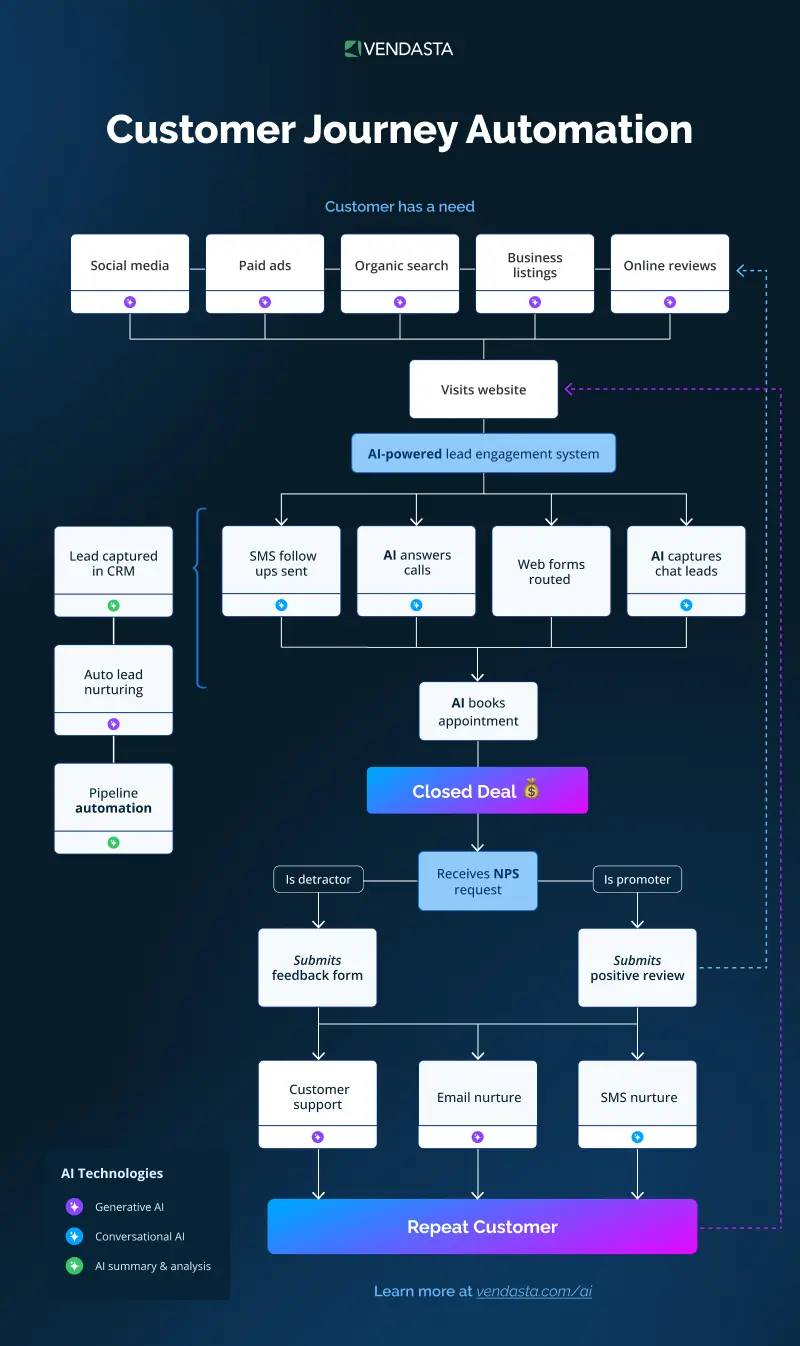
AI can handle routine follow-up via SMS, email, and chat — keeping clients informed and engaged without requiring your team to personally manage every touchpoint. For agencies managing hundreds of accounts, this is where customer journey automation delivers some of its clearest ROI.
The Best AI Tools for Account Management in 2026
The market for AI account management software has grown quickly, and not all tools are built the same. Below is a breakdown of the leading options, organized by use case, with a focus on what matters most for agencies managing local business clients at scale.
1. Vendasta
Vendasta is a purpose-built platform for agencies and partners that manage marketing services for local businesses. The AI Workforce is a suite of AI Employees that automate fulfillment across reputation management, lead capture, content, communications, and CRM in a single connected platform.
What makes Vendasta different is the infrastructure it provides for agencies specifically. You can centrally deploy AI Employees to thousands of client locations at once, manage everything through a unified dashboard, and resell AI-powered services under your own brand.
Key AI Employees within the Vendasta platform include:
- AI Receptionist: Available via chat and voice, captures leads, answers questions, and books appointments 24/7 across phone, SMS, WhatsApp, and web chat.
- AI Reputation Specialist: Automates review monitoring, personalized responses, and review request campaigns.
- AI Sales Assistant: Captures meeting outcomes, updates CRM records, and surfaces sales opportunities automatically.
- Conversations AI: The intelligent engine powering all client-facing communication workflows, with a documented 372% increase in lead-to-revenue conversion.
- CRM AI: A self-updating sales solution that eliminates manual data entry and keeps your pipeline current without lifting a finger.
Pros:
- Full-stack platform purpose-built for agencies managing local business clients
- Central deployment of AI Employees across thousands of client locations simultaneously
- White-label ready — deliver everything under your own brand
- Covers the full client lifecycle: lead capture, reputation, social, CRM, and communications
- AI Employees work 24/7 with no additional headcount required
Cons:
- Designed specifically for partners (agencies, franchisors, software vendors) and their SMB clients — not a standalone CRM
- Full value is realized when multiple AI Employees are deployed together, rather than piecemeal
Best for: Agencies managing local business clients at scale that want a single platform for AI-powered fulfillment, client communications, and account management — without stitching together multiple point solutions.
2. Gong
Gong is a revenue intelligence platform built around conversation analytics. It records and analyzes client and prospect calls, surfaces coaching insights, tracks deal health, and identifies patterns across your team’s interactions. It’s most valuable for agencies with a strong inside sales function that want to improve call quality and pipeline visibility at scale.
Pros:
- Deep call recording, transcription, and conversation analytics
- AI-generated coaching insights tied to real sales interactions
- Strong pipeline and deal risk visibility for sales leaders
- Integrates with major CRMs, including Salesforce and HubSpot
Cons:
- Not designed for local business fulfillment or multi-client agency workflows
- Primarily focused on the sales motion — limited value for ongoing account management or client delivery
- Higher price point that may not suit smaller agency teams
Best for: Agencies with a dedicated inside sales team that want to analyze sales conversations, coach reps at scale, and improve close rates. Less suited for day-to-day account management or client fulfillment work.
3. AskElephant
AskElephant is built around post-meeting execution, turning client calls into structured CRM updates, churn alerts, and handoff-ready context. It integrates deeply with Salesforce and HubSpot, making it a strong fit for account management teams that need disciplined follow-through after every client interaction.
Pros:
- Automatically converts meeting notes into CRM field updates and action items
- Churn and deal risk alerts surface early warning signs without manual review
- Strong handoff support for sales-to-CS transitions
- Accessible entry price point compared to enterprise revenue intelligence tools
Cons:
- Scope is limited to post-meeting execution — does not handle fulfillment, client communications, or reputation management
- Value is largely realized inside Salesforce or HubSpot; less useful for teams outside those ecosystems
- Not designed for agencies managing local business marketing services
Best for: Account management teams operating inside Salesforce or HubSpot that need structured CRM follow-through and early churn signals after customer calls without adding manual admin work.
4. Fireflies.ai
Fireflies.ai is a meeting transcription and summarization platform. It joins calls automatically, generates transcripts, creates searchable conversation records, and produces AI summaries. It’s lightweight, affordable, and easy to deploy — useful for agencies that need basic note capture across a high volume of client interactions.
Pros:
- Automatic meeting transcription and AI-generated summaries across major video platforms
- Searchable conversation history across all client calls
- Generous free plan; affordable paid tiers for growing teams
- Quick to set up with minimal onboarding required
Cons:
- Narrow scope — transcription and notes only, with limited downstream action
- Does not update CRM records, trigger workflows, or automate client communications
- No fulfillment capabilities for agency service delivery
Best for: Teams that want lightweight, affordable meeting transcription and a searchable record of client conversations. Works well as a supplementary tool but does not replace a full account management or fulfillment platform.
5. HubSpot AI
HubSpot’s AI features are embedded throughout its CRM and marketing suite, covering AI-generated email copy, meeting summaries, predictive lead scoring, and content assistance. For agencies already operating in the HubSpot ecosystem, these features add meaningful efficiency without requiring a separate tool purchase.
Pros:
- AI features are natively embedded — no separate integration required for HubSpot users
- Broad coverage across CRM, email, content, and sales workflows
- Strong reporting and pipeline visibility out of the box
- Scales well for agencies managing their own sales and marketing operations
Cons:
- Not designed for multi-client agency fulfillment or local business marketing delivery
- AI features are CRM- and marketing-centric, not built for reputation management, review responses, or client-facing AI receptionists
- Costs scale quickly as contact lists and feature tiers increase
Best for: Agencies already using HubSpot as their internal CRM that want to layer AI into their own sales and marketing workflows. Not a substitute for a local business fulfillment platform.
AI Account Management Tool Comparison
| Tool | Best For | Agency-Native | Local Business Fulfillment |
|---|---|---|---|
| Vendasta | Full-stack AI fulfillment for agencies | ✓ Yes | ✓ Yes |
| Gong | Call analytics and revenue intelligence | ✗ No | ✗ No |
| AskElephant | Post-meeting CRM execution | ✗ No | ✗ No |
| Fireflies.ai | Lightweight meeting transcription | ✗ No | ✗ No |
| HubSpot AI | CRM and marketing automation | Partial | ✗ No |
Will AI Replace Account Managers?
This is the question every agency owner and every AM eventually asks. The honest answer: AI will replace certain tasks that account managers currently perform. It will not replace account managers.
The distinction matters. McKinsey research consistently distinguishes between tasks that can be automated (data entry, routine communications, report generation) and work that requires human judgment, relationship-building, and strategic thinking. Account managers do both, and AI should absorb the former so your people can do more of the latter. For a deeper look at how this plays out in practice, the AI vs. human breakdown is worth reading alongside this guide.
Simon Papadopoulos addressed this directly with his own team when AI anxiety started surfacing internally. “A year and a half ago when we were positioning AI, a lot of my agency had fear — is this gonna take away my job? And we’re literally pushing like, no. We want you orchestrating and guaranteeing that quality. We want you overseeing it, managing things so that you’re doing more important work. I have not let a body go from this agency in years because we’re making them better and better success managers.”
The opportunity isn’t headcount reduction. It’s capacity expansion. When AI absorbs the operational layer, a single account manager can handle 40, 60, or even 90 accounts instead of 20. That’s the leverage that changes your margin structure — and it’s the foundation of a sustainable model for recurring revenue for agencies that doesn’t depend on constant hiring to grow.

How to Implement AI Account Management at Your Agency: A Step-by-Step Guide
If you’re ready to move from theory to action, here’s a practical framework for introducing AI account management into your agency operations.
Step 1: Audit Your Current Fulfillment Workload
Before implementing anything, map out where your account managers actually spend their time. Interview your team. Pull time-tracking data if you have it. Categorize every recurring task into two buckets:
- Operational/repetitive: Tasks that follow a predictable pattern and don’t require human judgment (review responses, report pulls, content scheduling, data entry)
- Strategic/relational: Tasks that require human insight, relationship management, or creative thinking (client strategy calls, problem-solving, upsell conversations)
This audit tells you exactly where AI can unlock the most immediate capacity — and gives you a baseline to measure improvement against.
Step 2: Prioritize High-Volume, High-Impact Tasks
Not everything needs to be automated at once. Start with the tasks that consume the most time and are most consistent across your client base. For most agencies, this is review management and reporting. Both are high-volume, repetitive, and well-suited to AI automation from day one.
Step 3: Choose a Platform Built for Your Operating Model
This is where tool selection matters more than most people realize. A transcription tool won’t solve a fulfillment problem. A CRM add-on won’t replace a broken workflow. You need a platform that’s built for the specific work your agency does — managing marketing services for local businesses at scale.
Look for a platform that offers:
- Multi-client account management from a centralized dashboard
- Automated fulfillment for the core services you sell (reputation, social, listings, communications)
- AI Employees that work 24/7 on behalf of your clients
- White-label capabilities so you can deliver under your own brand
- Reporting that surfaces insights without requiring manual data pulls
Step 4: Redesign the AM Role Around AI
This step is often skipped — and it’s the most important one. Deploying AI tools without restructuring how your AMs work means you’ll get incremental gains instead of transformational ones.
The goal is to shift your account managers from a task-execution model to an orchestration model. Instead of doing the work, they’re reviewing AI output, approving in bulk, identifying strategic opportunities, and spending the majority of their time on client relationships and account growth.
At Social Ordeals, this shift meant account managers open Monday morning to an AI-generated queue: reviews drafted, content planned, anomalies flagged. Their job became review, refine, and approve — not create from scratch. That’s also what makes agency automation a structural advantage rather than a productivity shortcut.
Step 5: Start with One Client Segment and Expand
Don’t try to roll out AI across your entire client base at once. Choose a segment — a vertical, a package tier, a geography — and build your AI workflow there first. Use it to refine your processes, train your team, and document what works. Then scale it systematically.
Step 6: Measure, Iterate, and Expand
Track the metrics that matter: accounts per AM, time spent on operational tasks vs. strategic work, client retention rates, and margin per client. Use these to demonstrate ROI internally and to justify expanding your AI investment. Understanding your marketing agency profit margins before and after gives you the clearest picture of what the shift is actually worth.
Real-World Results: What AI Account Management Looks Like in Practice
Theory is useful. Numbers are more convincing. Here’s what happens when agencies actually implement AI-powered account management.
Social Ordeals: From Headcount Ceiling to High-Leverage Growth
Social Ordeals is a multimillion-dollar marketing agency that hit the classic scale ceiling: every new client required new headcount, and labor costs were eating their margins. The answer wasn’t hiring more carefully — it was changing the operating model entirely.
By layering Vendasta’s AI Workforce into their account management workflow, Social Ordeals restructured how their team operates. Where a typical agency account manager handles 20–30 accounts, Social Ordeals’ team now runs 40–90 accounts per person, because AI handles the repetitive layer.
For one veterinary client with nine locations, their AI Receptionist captured $47,000 in monthly revenue and 57 new clients in month one alone. After-hours leads that used to go straight to a competitor were now being triaged and converted automatically with zero additional staff. This is the same outcome agencies are driving through lead capture software that works around the clock, not just during business hours.
The result: Social Ordeals moved from being a marketing vendor to becoming an operational partner embedded in their clients’ daily business. That shift changed the conversation from “What does your marketing cost?” to “We can’t operate without you.”
The Monday Morning Difference
Before AI: Account managers arrived Monday to overflowing inboxes, weekend review backlogs, and a full day of catch-up before any strategic work could begin. Cognitive bandwidth for actual client strategy: close to zero.
After AI: Account managers open an AI workforce control center. Reviews are drafted and queued. Social content for the month is planned and ready for approval. Anomalies are flagged. Strategic calls are already on the calendar. The week starts from a position of leverage, not deficit.
Want to hear Simon walk through exactly how Social Ordeals made this shift? Watch the full webinar:
Key Benefits of AI Account Management for Agencies
Pulling it all together, here’s what AI-powered account management actually delivers for growing agencies:
- Higher capacity per account manager: Your AMs can manage 2–4x more accounts without sacrificing client experience.
- Better margins at scale: Revenue grows faster than headcount, which is the margin expansion every agency owner is looking for.
- Faster client response times: AI handles routine communications instantly, 24/7, so clients always feel attended to.
- Consistent quality across accounts: AI doesn’t have bad days. Review responses, content, and communications maintain quality standards across every client, every time.
- Reduced employee burnout: When the tedious work is handled by AI, your team does more meaningful work — which helps with retention too.
- A differentiated service offering: Agencies with AI-powered fulfillment can offer faster results, 24/7 responsiveness, and capabilities competitors without AI simply can’t match.
- Stronger client retention: When AI keeps clients informed, engaged, and experiencing consistent results, churn goes down. Your team’s strategic attention goes toward growth, not damage control.
Common Mistakes When Implementing AI Account Management
The agencies that struggle with AI adoption usually make one of a handful of predictable mistakes. Here’s what to avoid.
Treating AI as a Point Solution
Adding a single AI tool to a broken workflow doesn’t fix the workflow. If you bolt a review-response AI onto an account management process that’s still fundamentally manual, you’ll get a small efficiency gain at best. The real value comes from redesigning the workflow around AI, not patching it.
Skipping the Role Redesign
Deploying AI without redefining what account managers actually do is the most common missed opportunity. If your AMs are still expected to do everything manually, they’ll use AI as a nice-to-have rather than a structural shift in how they operate.
Choosing the Wrong Tool for Your Use Case
Enterprise CRM AI tools are built for enterprise sales teams. Meeting transcription tools are built for internal call notes. If you’re an agency managing local business marketing for hundreds of clients, you need infrastructure built for that specific operating model, not a repurposed enterprise tool. The guide to marketing tools for agencies serving small businesses covers this distinction in more depth.
Overwhelming the Team with Too Many Tools
One of the most common frustrations agency owners share is feeling overwhelmed by how many AI tools are available and how to build a coherent workflow across them. Start with a platform that consolidates capabilities rather than adding more fragmentation. The goal is fewer systems, more clarity.
Conclusion
The agencies winning right now aren’t necessarily the ones with the biggest teams or the longest client lists. They’re the ones that figured out how to deliver exceptional results at scale without letting labor costs eat their margin. AI account management is the mechanism that makes that possible.
The shift isn’t coming. For the leading agencies, it’s already happened. They’ve moved from a model where growth requires headcount to a model where growth requires the right infrastructure — and AI is that infrastructure. Their account managers aren’t buried in busywork. They’re acting as strategic partners to their clients, doing the kind of work that builds relationships, drives retention, and creates referrals.
If your agency is still scaling headcount every time you scale revenue, the operating model is the problem — and AI is the fix. The question isn’t whether to implement AI account management. The question is how fast you can make the shift before the gap between you and your AI-powered competitors gets too wide to close.
Vendasta gives agencies the platform to make that shift today: a complete AI Workforce that handles fulfillment, automates client communications, and lets your team focus on what they’re actually great at. Book a demo with Vendasta today!
AI Account Management FAQs
1. What is AI account management?
AI account management uses artificial intelligence to automate the repetitive, operational tasks that account managers handle on behalf of clients — including review responses, reporting, lead follow-up, content scheduling, and CRM updates. It allows account managers to shift from task execution to strategic oversight, handling more accounts without sacrificing quality.
2. How does AI account management software work?
AI account management software connects to your client data, communication channels, and business systems, then automates recurring workflows. It monitors performance, drafts responses, generates content, updates records, and surfaces insights — all without requiring manual input. Your team reviews and approves AI output rather than creating everything from scratch.
3. What are the best AI tools for account managers?
The best AI tools for account managers depend on your use case. For agencies managing local business clients at scale, Vendasta’s AI Workforce is the most comprehensive option, covering reputation management, lead capture, CRM, and client communications in one platform. Other tools like Gong, AskElephant, and Fireflies.ai address narrower use cases like call analytics or CRM updates.
4. Will AI replace account managers?
No. AI automates the operational, repetitive layer of account management — data entry, routine responses, report generation — but it doesn’t replace the strategic and relational work that account managers do. When AI handles busywork, account managers can manage more accounts, focus on client relationships, and deliver higher-value strategic work.
5. How many accounts can an AI-powered account manager handle?
Agencies using AI-powered platforms report account managers handling 40–90 client accounts, compared to the traditional range of 20–30. The exact number depends on account complexity and the depth of AI automation in place. Vendasta’s AI Workforce is specifically designed to support this kind of scale for agencies managing local business clients.
6. What tasks can AI automate in account management?
AI can automate review monitoring and responses, lead capture and follow-up, social media content planning and publishing, CRM data entry and updates, performance reporting, appointment scheduling, and routine client communications via SMS, email, and chat. These are the highest-volume, lowest-judgment tasks in most agency workflows.
7. How do I get started with AI account management at my agency?
Start by auditing how your account managers currently spend their time, then identify the highest-volume repetitive tasks. Choose a platform designed for your operating model — ideally one that consolidates fulfillment, communications, and reporting in one place. Redesign your AM role around AI output review and strategic work, rather than task execution. Vendasta’s platform is built specifically for agencies making this transition.
8. What is the ROI of AI account management for agencies?
ROI comes from two directions: capacity expansion and margin improvement. When account managers handle 2–4x more accounts without adding headcount, revenue grows faster than labor costs. Agencies also see improved client retention because AI keeps clients engaged and informed consistently. Real-world results include an AI Receptionist generating $47,000 in monthly revenue for a single client in its first month.
9. How does Vendasta support AI account management for agencies?
Vendasta provides a complete AI Workforce platform designed for agencies managing local business clients. It includes an AI Receptionist for 24/7 lead capture, an AI Reputation Specialist for automated review management, an AI Sales Assistant for CRM automation, and Conversations AI for all client-facing communication. Agencies can deploy these tools centrally across thousands of client locations and resell them under their own brand.
10. Is AI account management right for small agencies?
Yes, and in some ways it’s even more impactful for smaller agencies. If you’re a small team managing a growing client base, AI is what lets you take on more clients without burning out your staff or immediately hiring. Platforms like Vendasta are designed to scale with you — supporting a single AM managing dozens of accounts all the way up to enterprise deployments across thousands of locations.