About Us
 Careers
 Leadership
 Board
Board Newsroom
Most businesses are feeling the drop in website performance. Traffic is steady, yet forms are ignored, and inboxes stay quiet. An AI chatbot for lead capture gives you a faster way to turn anonymous visitors into real conversations, rather than hoping someone fills out a static form.
The gap widens every time a visitor leaves your site without an answer. While your team is juggling emails or following up hours later, a competitor’s chatbot is already welcoming that same prospect, answering questions, and routing them to sales.
This guide walks you through how an AI chatbot for lead capture works, the exact steps to deploy it for your business, and the metrics that prove it is working. Along the way, you will see how Vendasta’s AI employees handle lead capture, qualification, and scheduling across web chat, SMS, and phone so your team can focus on closing, not chasing.
Capture leads and book appointments 24/7 with AI voice and messaging
TL;DR
- An AI chatbot for lead capture replaces passive forms with real-time conversations that collect contact details, qualify prospects, and move them into your pipeline automatically.
- Vendasta’s AI employees use your business’s unique data to personalize answers, ask smarter qualifying questions, and book meetings across multiple channels without extra manual work.
- Your business can increase conversions and response speed by adding AI chat to key pages, syncing it with your CRM, and tracking lift in leads, opportunities, and booked appointments.
What Is an AI Chatbot for Lead Capture?
An AI chatbot for lead capture is a conversational tool that engages website visitors in real time, collects their information, and guides them toward the next step in the buying process.
Instead of waiting for someone to submit a form, the chatbot starts the conversation, asks qualifying questions, and instantly routes or books the lead so your team can act quickly.
This creates a smoother experience for the visitor and increases the number of opportunities entering your pipeline.
At its core, an AI chatbot works by using modern conversational AI technology powered by large language models (LLMs).

These models understand questions, respond naturally, and adapt to the flow of a conversation. Because the interaction feels more like talking to a helpful assistant than a scripted widget, visitors are more likely to share information, ask questions, and move closer to becoming a customer.
A well-implemented lead-capture chatbot does much more than collect a name and an email address. It can also:
- Ask context-specific qualifying questions so you immediately know whether a visitor is a good fit.
- Guide people to the right service, product page, or resource based on their intent.
- Route high-value leads to your team or automatically book meetings.
- Record conversations and sync every detail into your CRM.
This last point is where the real value shows up. Today’s AI chatbots integrate with your CRM to capture new contacts, enrich lead profiles, and track conversation history.
For businesses that manage multiple communication channels, the chatbot can also pair with AI phone receptionists to create a unified customer experience.

If someone prefers calling over chatting, the AI receptionist can pick up the workflow by answering questions, capturing details, and booking appointments using the same logic and business data that powers the site chatbot.
When your AI works together, your business covers every entry point in the customer journey:
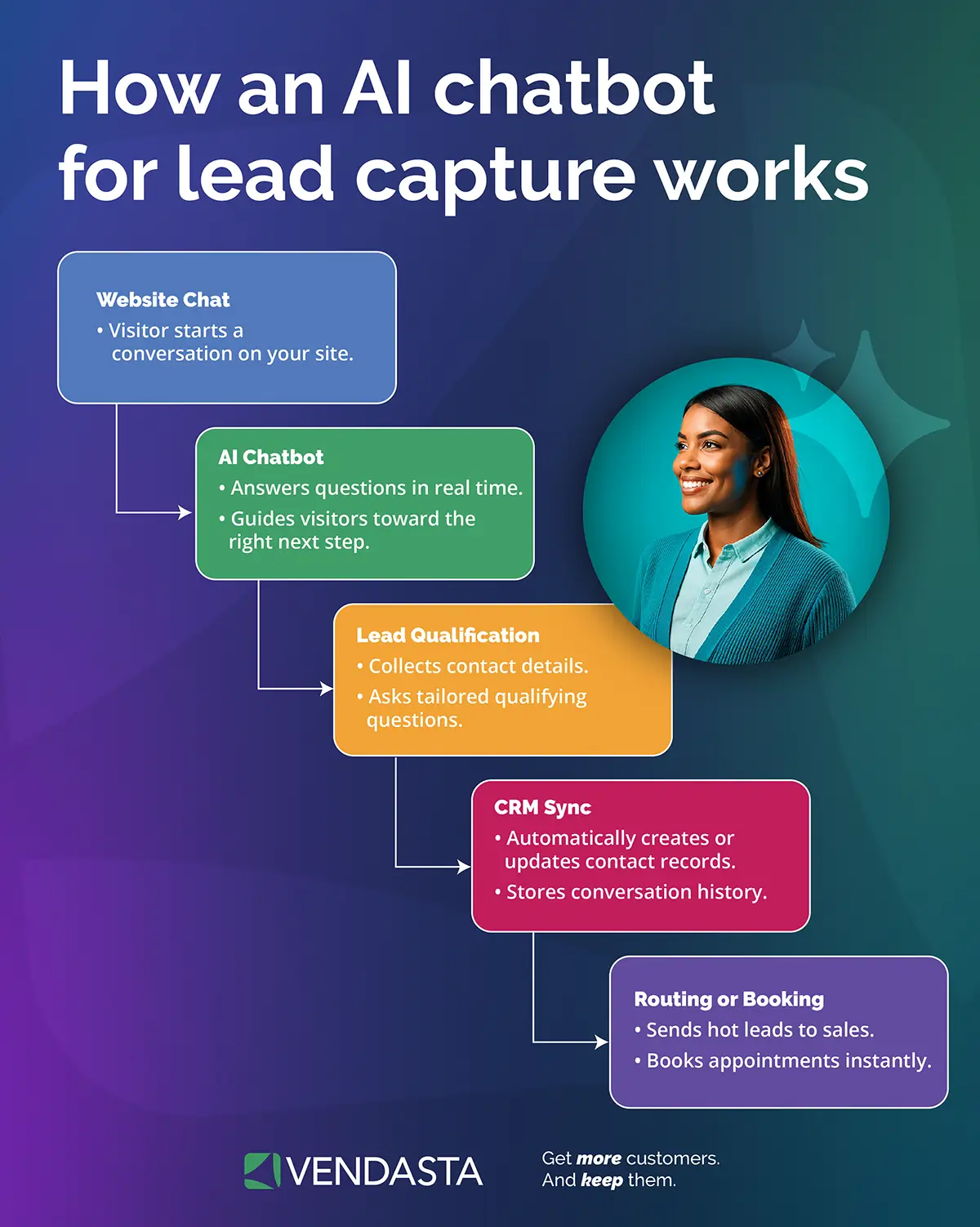
Website Chat → AI Chatbot → Lead Qualification → CRM Sync → Routing or Booking
Phone Call → AI Receptionist → Lead Capture → CRM Sync → Same Routing Logic
This multi-channel support ensures leads never slip through the cracks, no matter how they choose to connect.
In short, an AI chatbot for lead capture works around the clock and fits seamlessly into your broader sales and engagement AI workflow automations.

Top 5 Benefits of AI Chatbots for Your Business
Implementing an AI chatbot for lead capture isn’t just about adding a widget to your site. It’s about deploying a tireless digital specialist dedicated to growth. Here are the five primary ways this technology transforms your pipeline:
- 24/7 Availability: Your business never closes its doors to a prospect. Most leads browse after hours, but traditional teams aren’t always there to answer. An AI chatbot ensures that whether a lead arrives at 2:00 PM or 2:00 AM, they receive an instant response, preventing them from bouncing to a competitor.
- Zero Lead Friction: Chat feels like a text message, not a chore. Static forms feel like paperwork; a conversation feels like help. By replacing intimidating 10-field forms with a friendly, interactive dialogue, you lower the barrier to entry and see a significant lift in conversion rates.
- Instant Lead Scoring: Automatically tag “Hot Leads” in your CRM. Not all traffic is created equal. AI chatbots analyze responses in real-time, identifying high-intent visitors based on their needs and budget. When synced with Vendasta’s AI CRM, these prospects are tagged immediately, so your sales team knows exactly who to call first.
- Reduced Cost Per Lead (CPL): Automating the top of the funnel reduces the need for large SDR teams. Hiring humans to manually vet every “Contact Us” submission is expensive and slow. AI handles the repetitive task of initial qualification at scale, allowing your human staff to focus exclusively on closing high-value deals.
- Data Enrichment: AI gathers hidden data points from conversations. Beyond just a name and email, AI picks up on intent, sentiment, and specific pain points mentioned during the chat. This hidden data is automatically mapped to the lead’s profile, giving your sales reps a complete playbook before they even pick up the phone.
How Does an AI Chatbot Capture Leads? (Step-By-Step)
An AI chatbot captures leads by guiding visitors through a structured, personalized conversation that feels natural while still collecting the information your sales team needs.
The process is fast, consistent, and available around the clock. Below is the full breakdown of how modern chatbots turn anonymous website traffic into qualified opportunities.
1. Detects a Visitor and Starts the Conversation
The first step is engagement. An AI chatbot does not wait passively for a visitor to click. It can initiate a conversation based on a variety of trigger points, such as:
- Time spent on a page.
- Scroll depth or user inactivity.
- Exit intent (cursor moving to close the tab).
- Campaign source (example: a chatbot greeting tailored specifically to people coming from a Google Ads campaign or a franchise location page).
This approach is a proactive engagement strategy. Instead of overwhelming a visitor with noise, the chatbot appears at the right time with a short, helpful prompt—something as simple as:
“Can I help you find the right service?”
This small shift dramatically improves the chance of a conversation beginning.
2. Asks Targeted Questions
Once the visitor responds, the chatbot starts guiding the conversation using targeted, context-aware questions. This is where AI prompt engineering becomes helpful.
Building an effective chatbot experience is not about writing long scripts. It is about structuring clear, modular prompts that teach the AI how to behave, what information to collect, and how to match the visitor’s intent.
Good prompt engineering includes defining the chatbot’s role (“You are a helpful onboarding assistant”), setting rules and boundaries (“Always summarize the visitor’s needs before asking for contact details”), and supplying business data that shapes responses (service descriptions, pricing ranges, availability, FAQs).
Good lead capture chatbots do not ask every visitor the same sequence of questions. Instead, they tailor their engagement strategies based on:
- The page the user is viewing.
- Industry-specific needs (home services vs. healthcare vs. financial services).
- The visitor’s responses so far.
For example:
- A home services client may have questions about location and service type.
- A B2B SaaS client might require questions about company size and purchasing timeline.
- A franchise network may want to route visitors to the correct location based on zip code.
Actionable Tip for Partners:
Build reusable prompt templates for each client vertical. Start with a base prompt that defines the chatbot’s personality, goals, and guardrails, then layer industry-specific modules on top (example: qualification prompts for home services vs. multi-location franchise brands).
This helps you deploy AI chatbots faster, ensure tighter message control, and maintain consistent quality across every client you support.
3. Qualifies the Lead in Real Time
After gathering initial details, the chatbot begins qualifying the lead. Many businesses use classic frameworks like BANT (Budget, Authority, Need, Timeline), but the criteria can be customized to match your sales process.
4. Captures Contact Details
Once the visitor shows interest, the chatbot prompts them to share contact information. Unlike rigid forms, AI chat collects details conversationally, which increases completion rates.
To build trust and ensure compliance, the chatbot should:
- Explain why the information is needed.
- Be transparent about how the data will be used.
- Provide a short, frictionless request (email, phone number, or both).
Example:
“I’ll share your details with our team so they can send pricing and next steps. What’s the best email to reach you?”
This approach is more effective than dropping a long web form in front of a busy visitor.
5. Books Meetings or Sends Leads to Your CRM
Once contact information is collected, the chatbot closes the loop by taking action. Depending on your workflow, it can:
- Book a meeting directly on your calendar.
- Route leads to the right sales representative.
- Send the contact record to your CRM with full conversation history.
- Trigger automated nurturing campaigns.
Key Benefits of Using an AI Chatbot for Lead Capture
An AI chatbot is one of the most effective tools for increasing conversions, improving response times, and reducing the manual workload on your sales team.
When designed well, it becomes a core part of your customer acquisition engine. Below are the benefits that matter most.
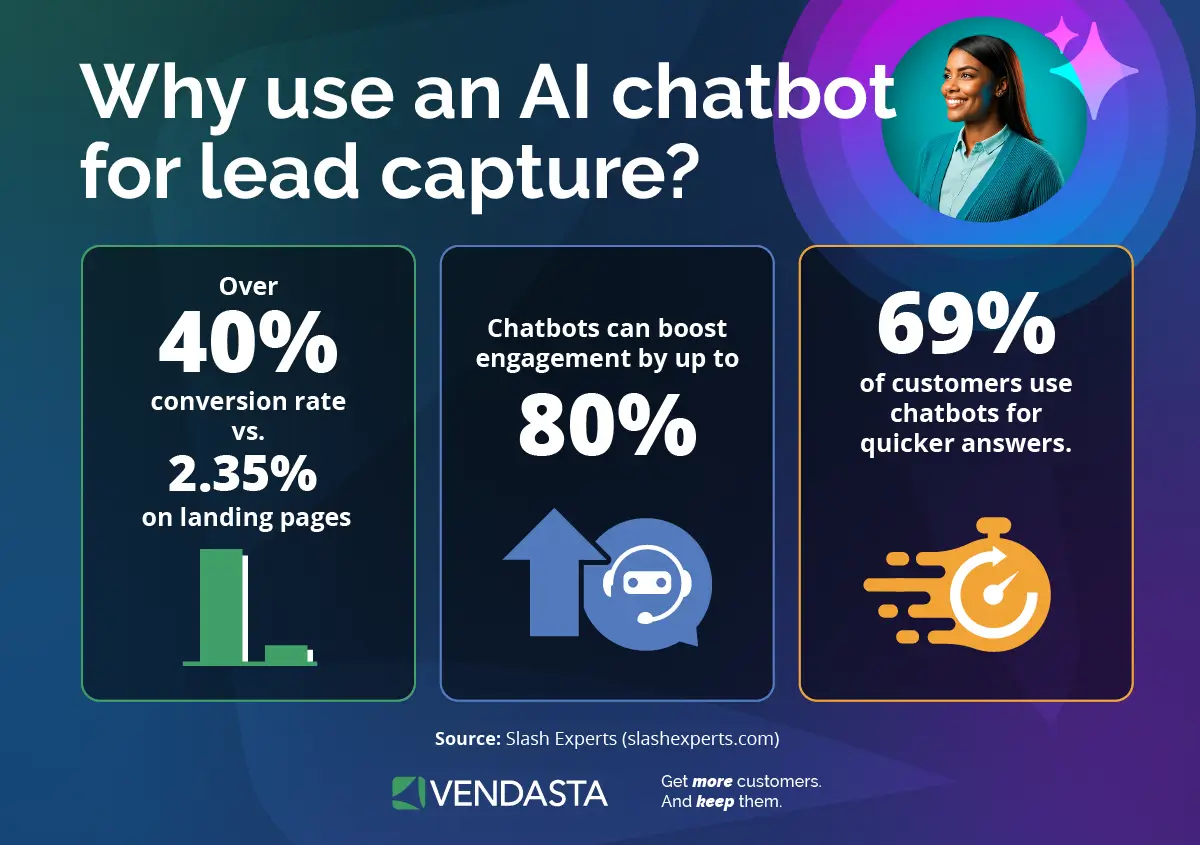
Higher Conversion Rates
People overwhelmingly prefer conversational interactions over static web forms.
This shift directly affects how many leads your business can generate. When visitors can ask questions, get answers in seconds, and move forward without friction, they are far more likely to convert.
Faster Responses Increase Conversion Probability
Speed matters more than almost anything else in lead capture.

AI chatbots solve this instantly. Instead of waiting for someone on your team to reply, the chatbot responds the moment a visitor engages. It can handle early questions, document needs, and move the visitor closer to becoming a qualified lead.
Automatic Pre-Qualification Reduces Sales Workload
Most sales teams spend too much time sorting through low-quality inquiries. An AI chatbot can pre-qualify leads in real time by asking targeted questions about:
- Budget or willingness to invest.
- Timeline and urgency.
- Business size or location.
- Services or products they need.
By the time a conversation reaches your CRM or sales rep, the information is already organized and scored. This allows your team to spend time on the right opportunities instead of chasing unqualified prospects.
A strong example of this comes from Elite Web Professionals, who deployed Vendasta’s AI Receptionist to qualify leads for Choice Signature Luxury Car Rental. Owner Christopher Williams customized the AI Receptionist’s knowledge base with prompts and qualifying questions tailored to the rental company’s unique requirements.
One of the custom flows asks callers whether they hold a chauffeur’s license before renting certain luxury vehicles for ride-share purposes. This single question filters out unqualified leads and immediately educates prospects about essential requirements.
It also prevents the sales team from spending time on inquiries that will never convert, making their pipeline cleaner and more predictable.
Pro Tip: If you want to build smarter qualifying flows like this, explore AI receptionist prompting techniques. They can help you craft stronger instructions, industry-specific questions, and guardrails that improve both accuracy and lead quality. You can also build an AI report writer, qualification employee, or something more specific to your business.
Always-On Coverage For Nights, Weekends, And High Volume
Most businesses cannot staff evenings, weekends, and holidays. Yet these are often the moments when prospects browse websites, research services, or compare vendors.
An AI chatbot fills that gap by providing:
- 24/7 availability.
- Consistent support during unexpected traffic spikes.
- Quick answers when a human team member is unavailable.
This type of always-on coverage is especially valuable for:
- Agencies with clients in multiple time zones.
- Franchisors supporting dozens or hundreds of locations.
- ISVs managing high-ticket inbound inquiries.
Every conversation is captured, logged, and sent into your pipeline even when your office is closed.
Personalized Interactions Using First-Party Data
Visitors expect more than generic responses. They want answers that reflect their intent, their location, and the services they’re interested in.

AI chatbots excel at personalization because they use your business’s unique first-party data:
- Service descriptions
- Pricing ranges
- Availability
- FAQs
- Customer history
This allows the chatbot to give relevant guidance instead of broad, one-size-fits-all answers. Personalized conversations build trust more quickly and move prospects toward action.
Seamless CRM Enrichment And Pipeline Visibility
One of the most overlooked benefits of AI chatbots is how well they integrate into your broader sales and operations systems. When connected to your CRM, every captured lead is automatically enriched with:
- Contact details.
- Conversation transcripts.
- Qualification data.
- Source attribution.
- Next-step recommendations.
This creates cleaner records, consistent reporting, and far better forecasting accuracy.
What Types Of Leads Can an AI Chatbot Capture?
An AI chatbot is versatile enough to support almost any industry. Because it adapts to visitor intent, business rules, and first-party data, it can guide prospects through the early stages of the customer journey and collect the information your team needs to move them forward.

Below are the primary lead types AI chatbots handle effectively, along with examples and actionable tips for deploying them across different verticals.
Service-Based Businesses
Service-based industries depend on fast follow-ups and smooth scheduling. An AI chatbot acts as an always-on intake assistant, helping visitors get the information they need and book appointments instantly.
It can capture and qualify leads for businesses such as:
- Home services (HVAC, plumbing, electrical).
- Beauty and wellness (salons, spas, clinics).
- Automotive (repairs, rentals, detailing).
- Healthcare (dentists, chiropractors, physiotherapists).
Because scheduling is often the biggest bottleneck, service businesses benefit most from AI appointment booking.
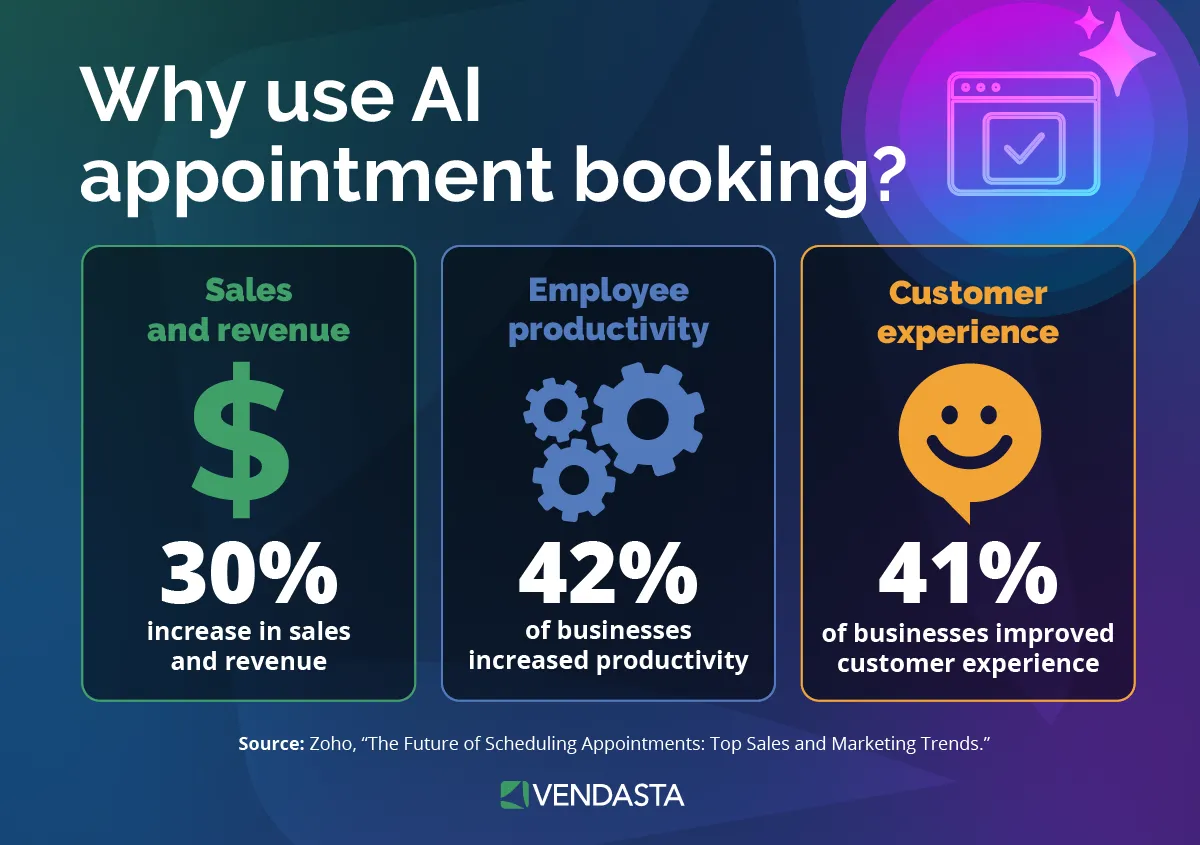
When a chatbot handles appointment requests, it eliminates back-and-forth communication and delivers immediate confirmation.
Multi-Location or Franchise Brands
Franchise and multi-location businesses often struggle with consistency. Each location may have different hours, pricing, or services, making it difficult to manage customer interactions at scale.
An AI chatbot solves this by offering a unified, brand-approved experience while still adapting responses to the visitor’s specific location.
What This Looks Like in Practice:
- Visitors enter their zip code.
- The chatbot identifies the correct location’s hours, services, and pricing.
- It answers questions based on location-specific data.
- It routes and logs all leads centrally for the franchisor.
Franchisors can also integrate automated call answering to capture calls the same way the chatbot captures chats, giving them a complete multi-channel experience with shared data and logic.

Professional Services and B2B
Professional services and B2B sales cycles are longer and more complex, which makes qualification critical.
AI chatbots help by asking the right discovery questions early in the journey, gathering essential details before a human ever gets involved.
B2B chatbot leads often include:
- Businesses evaluating new software.
- Companies exploring outsourced services.
- Teams researching consulting, legal, or financial support.
AI chatbots can quickly qualify leads by gathering key information such as:
- Budget range or buying authority.
- Timeline for implementation.
- Key pain points.
- Team size or company structure.
This saves time for sales teams who would otherwise spend hours on unproductive discovery calls.
eCommerce and Retail
For eCommerce and retail, AI chatbots play a different role: they improve the buying experience and reduce cart abandonment.
Key capabilities include:
- Personalized product recommendations.
- Helping customers compare options.
- Providing shipping, return, or sizing information.
- Re-engaging visitors who show exit intent.
- Recovering abandoned carts with incentives or reminders.
Because chatbots answer questions instantly, they prevent customers from leaving the site to research elsewhere, which is a major cause of abandoned carts.
When paired with CRM enrichment and automated follow-ups, retail businesses see more repeat purchases and improved customer lifetime value.
Software Vendors (ISVs)
ISVs often serve high-intent buyers looking for technical solutions, which means visitors have specific questions that require accurate, product-aware answers. AI chatbots help ISVs by:
- Explaining features, integrations, and use cases.
- Helping visitors understand pricing tiers.
- Directing prospects to technical documentation.
- Qualifying leads based on company size, infrastructure, or tech stack.
- Scheduling demos with sales engineers.
ISVs also benefit from the chatbot’s ability to provide context-aware onboarding for trial users, such as offering setup guidance or troubleshooting common roadblocks.
The Best AI Chatbots For Lead Capture in 2026
Choosing the right AI chatbot for lead capture is essential when your business relies on consistent inbound pipelines, fast responses, and accurate qualification.
The tools below all serve different needs, but the biggest differences come down to how well each platform handles personalization, data usage, workflow automation, and multi-channel engagement.
The comparison table that follows is designed to help agencies, franchisors, ISVs, and SMBs quickly evaluate which solution fits their goals.
Vendasta appears first because it offers a unique advantage: AI employees powered by your business’s own data, not just generic chat scripts or pre-trained models.
| Platform | Best For | Key Features | Integrations | What Makes It Unique |
| Vendasta | Agencies, franchisors, ISVs, and SMBs looking for unified lead capture across chat, SMS, and phone. | AI employees for web chat and phone, real-time lead qualification, automated scheduling, CRM syncing, multi-location logic, workflow automation. | Native CRM, AI phone receptionist, calendar tools, marketing automation, sales pipelines. | Vendasta’s AI employees behave like actual staff by answering questions, capturing leads, booking appointments, and adapting to brand guidelines. |
| Salesforce Einstein Chat | Enterprise teams already using Salesforce CRM and marketing cloud. | AI chat automation, CRM-native workflows, enterprise routing rules, analytics. | Deep Salesforce ecosystem integration. | Best suited for enterprises needing CRM-native automation. Less accessible for SMBs or agencies due to setup complexity and licensing costs. |
| Landbot | Businesses that want no-code, visually built chatbot flows. | Drag-and-drop flow builder, templates, conditional branching, lead forms. | Zapier, HubSpot, Slack, Google Sheets. | Strong UI and ease of use. Great for simple bots but lacks advanced reasoning, multichannel orchestration, and deep data-driven interactions. |
| Eesel AI | Startups and small teams looking for lightweight, AI-first website chat widgets. | Instant chat widget setup, conversational responses, simple qualification scripts. | Basic integrations; primarily used on websites. | Clean, modern UX with quick deployment. Limited for complex operations, multi-location organizations, or partners supporting multiple SMB clients. |
Introducing Vendasta’s AI Chatbot for Lead Capture: AI Receptionist
As more businesses rely on AI chat to capture leads, the difference between a basic chatbot and a revenue-driving one comes down to speed, accuracy, and follow-through. Vendasta’s AI Receptionist ensures every website visitor, text, or phone inquiry turns into a real conversation instead of a missed opportunity.

Vendasta’s AI Receptionist engages prospects instantly, answers questions using your business’s information, and captures contact details conversationally. Because responses feel natural and helpful, visitors are more likely to engage, ask questions, and move forward, resulting in higher conversion rates and better-qualified leads.
Unlike standalone chat widgets, Vendasta’s AI Receptionist works across web chat, SMS, and phone, giving businesses consistent, always-on coverage wherever prospects choose to reach out. Whether someone chats from your website, texts after hours, or calls directly, the AI applies the same qualification logic and routes or books leads automatically, so no opportunity slips through the cracks.
Most importantly, the AI turns conversations into action. Every interaction is captured, summarized, and logged in your CRM, giving your team full visibility and faster follow-up. By combining instant engagement with automated lead capture and qualification, Vendasta helps businesses convert more traffic into pipeline without adding manual workload or extra tools.
How to Set Up an AI Chatbot for Lead Capture (Step-By-Step Guide)
Setting up an AI chatbot for lead capture is easier than most businesses expect, especially when you follow a structured framework.
The goal is to create a conversational flow that feels natural to your visitors, collects the right information, and seamlessly feeds your CRM and sales process.
Below is a complete step-by-step guide you can follow or adapt for your clients.
1. Define Your Lead Goals
Before configuring any tool, you need clarity on what counts as a lead and what qualifies someone for your pipeline. This ensures the chatbot asks the right questions and routes leads appropriately.
Start by answering these core questions:
- What makes someone a marketing-qualified lead (MQL)?
- What makes someone a sales-qualified lead (SQL)?
- What information does your team need before a rep reaches out?
- Which services or products are priority offers?
This clarity makes your chatbot more effective and reduces unnecessary back-and-forth for your team.
2. Map Your Conversation Flow
Once you know what a qualified lead looks like, it is time to map out the chatbot conversation. A clear conversation flow helps your AI guide visitors toward the right actions without overwhelming them.
Today’s AI offers a lot of flexibility, allowing your chatbot to adapt based on intent, page context, and your business’s first-party data.
Start by outlining the key paths you want the visitor to take. Most lead capture flows include a mix of education, qualification, and guided next steps.
Watch: How to Design Smart, High-Converting Chatbot Flows
For a deeper walkthrough of how to map chatbot logic, trigger the right questions, and streamline lead qualification, watch this practical training video:
It breaks down how to structure choices, guide visitors through branching paths, and refine your flow based on performance, making it an excellent resource when planning your first AI funnel.

Pro Tips for Better Conversations
- Keep questions short and easy to answer.
- Offer multiple-choice selections to reduce friction.
- Personalize the flow by referencing the service or page the visitor is viewing.
- Add logic that adjusts based on their responses, not a static script.
When your conversation flow is intuitive, your AI chatbot feels less like a widget and more like a knowledgeable guide.
3. Connect Your CRM and Data Sources
Your AI chatbot is only as powerful as the data it can access. Clean, up-to-date information allows the chatbot to respond accurately and enrich CRM records without manual intervention.
Why CRM Integration Matters
- All lead data is stored consistently.
- Sales teams get full context from previous interactions.
- Follow-up automation becomes possible (email, SMS, reminders).
- Attribution for campaigns becomes clear.
Vendasta includes a CRM that automatically enriches contact records with conversation transcripts, intent signals, and qualification data. You do not need to stitch together multiple tools because everything syncs instantly.

4. Set Up Triggers and Routing
Next, determine when the chatbot should appear and where each lead should go.
Common Trigger Types
- Time on page (ex: 5+ seconds)
- Exit intent
- Scroll depth
- Traffic source (ex: Google Ads vs. organic search)
- Specific pages (pricing, service pages, franchise location pages)
Routing Options
- Send high-intent leads directly to sales
- Book meetings automatically
- Route general inquiries to support channels
- Assign leads based on location, industry, or campaign source
Routing ensures the right team sees the right leads at the right time without you manually forwarding conversations.
5. Train the AI With Your Business’s First-Party Data
This is where Vendasta stands apart from standalone chatbot tools.
Vendasta’s AI employees improve dramatically when trained on your business’s:
- Historical conversations
- Product or service descriptions
- Pricing
- Hours and availability
- Industry-specific FAQs
- Multi-location variations
- Past customer behavior
This training helps your AI chatbot respond with real knowledge rather than generic answers. It also enables the chatbot to make better recommendations, ask more effective qualifying questions, and provide more accurate guidance for complex use cases.

6. Launch, Monitor, and Optimize
After your chatbot goes live, the real optimization begins. You should regularly review performance metrics, identify drop-off points, and refine the script to improve results.
Key Benchmarks to Track
- Conversation start rate
- Lead capture rate
- Qualification rate
- Appointment booking rate
- Average conversation length
These numbers help you understand where visitors are engaging, where they are dropping off, and what to improve.
Optimization Checklist
- Review transcripts weekly for unclear questions or repeated issues.
- Add more context to the AI if it frequently answers incorrectly.
- Shorten questions that cause drop-off.
- Add new routing rules based on lead quality.
- Update training data to include seasonal promotions or new services.
Chatbots are not “set it and forget it”. They get better with ongoing refinement.
How To Calculate ROI for an AI Lead Capture Chatbot
Before choosing a platform, it helps to understand the financial impact an AI chatbot can have on your business. Here is a simple ROI formula you can use:
ROI Formula
ROI = [(Increase in Leads × Close Rate × Average Deal Value) − Cost of Chatbot] ÷ Cost of Chatbot
Vendasta ROI Advantage
Vendasta automates attribution and reporting across all channels—chat, SMS, voice, and workflows—so you always know:
- Which campaigns generate the best leads
- How many qualified conversations your chatbot creates
- How many meetings are booked automatically
- How chatbot-driven revenue contributes to your pipeline
This gives SMBs and partners complete insight into performance, without needing extra analytics tools.
Common Misconceptions About AI Chatbots for Lead Capture
AI chatbots have come a long way in the last few years, yet many outdated assumptions still prevent businesses from adopting them.
These misconceptions often mirror the myths people have about AI phone receptionists, as shown in the visual below—misunderstandings about accuracy and customer preferences.

Here are the most common myths about AI chatbots for lead capture, along with what is actually true today.
1. “AI Chatbots Replace Human Staff.”
In reality, AI chatbots reduce repetitive tasks, not headcount. They handle routine questions, gather details, and pre-qualify leads so your team can focus on higher-value conversations. Businesses typically see more productive staff, not fewer.
2. “Customers Dislike Automated Chat.”
High-quality AI is now widely accepted because it feels faster and more convenient. The key is using a well-trained, data-informed chatbot instead of a rigid, scripted one.
3. “AI Chatbots Can’t Handle Real Questions.”
Modern conversational AI understands intent and context, much like a trained receptionist or support rep. When powered by your first-party data (as Vendasta’s AI employees are), chatbots can answer service questions, share pricing information, and guide visitors through complex workflows without sounding robotic.
4. “AI Chatbots Only Work for Tech Companies.”
AI lead capture tools work across nearly every industry. Examples include:
- Home services: booking estimates and qualifying job requests.
- Healthcare: capturing patient inquiries and scheduling appointments.
- Franchises: routing leads to the correct location.
- Automotive: rental requests and service bookings.
- Retail/eCommerce: product recommendations and cart recovery.
AI is now accessible and useful for businesses of all sizes, not just tech-forward brands.
5. “AI Chatbots Cause Bad Routing or Poor-Quality Leads.”
When configured properly, AI can route callers and chat leads more accurately than manual intake because they use data from your CRM, service catalog, and historical interactions to score leads, track intent, and push conversations to the correct team.
The Future: Multi-Channel Lead Capture
In the modern landscape, lead capture should not be confined to a single corner of your website. Your prospects are moving between browsers, social media, and their phone’s dialer, and your lead capture strategy must be equally mobile.
The next frontier of growth is unified conversational AI. This means that if a lead discovers your business on a mobile search and decides to call rather than chat, they shouldn’t encounter a voicemail or a busy signal. The same AI logic that powers your web chat can be applied to AI Phone Receptionists and SMS AI.
By using a platform like Vendasta, you can ensure that the AI answering the phone has the same knowledge of your pricing, services, and scheduling as the bot on your homepage. If a prospect starts a conversation via web chat but has to run, the AI can seamlessly transition that lead to SMS follow-up to keep the momentum alive.
Key Insight: A unified AI strategy ensures no lead falls through the cracks, regardless of the entry point. Whether it’s a click, a text, or a call, your business remains always-on, providing a consistent experience that builds trust and drives revenue.
AI Lead Capture Is Now Essential for Growth
AI chatbots are no longer a nice-to-have feature on your website. They have become one of the most effective ways to convert visitors, qualify leads, and deliver fast, reliable engagement at every stage of the customer journey.
When your business can respond instantly, personalize every interaction, and automatically route or book leads, you gain a real competitive advantage, especially as customer expectations rise and traditional forms continue to underperform.
Vendasta gives your business everything needed to activate this advantage. With AI employees that learn from your first-party data, integrate across channels, and handle both chat and phone conversations, you can capture more qualified leads without adding manual workload or juggling multiple tools.
It is a complete, unified system designed for agencies, franchisors, ISVs, and ambitious SMBs that want to scale with confidence. If you are ready to turn more of your traffic into real opportunities, see how Vendasta can help.
Book a free demo today and experience how AI-powered lead capture works in action.
AI Chatbot For Lead Capture FAQs
1. What is an AI chatbot for lead capture?
An AI chatbot for lead capture is a conversational tool that engages visitors, answers questions, and collects contact details in real time. It replaces static forms with interactive conversations that qualify leads and route them into your sales pipeline automatically.
2. How does an AI chatbot capture and qualify leads?
It asks targeted questions about needs, budget, timeline, or location, then uses those responses to determine fit. Platforms like Vendasta record the conversation, enrich the CRM profile, and route qualified leads or book appointments instantly.
3. Do I need an AI chatbot if I already have forms on my website?
Most websites with only forms see lower conversion rates. An AI chatbot for lead capture engages visitors proactively, answers questions immediately, and collects more complete information. Adding chat typically increases conversions and improves lead quality.
4. How accurate are AI chatbots today?
Modern chatbots powered by conversational AI are highly accurate when trained with business-specific data. Vendasta improves accuracy further by using your services, FAQs, pricing, and past customer behavior to generate more helpful and on-brand responses.
5. Can an AI chatbot book appointments automatically?
Yes. Many chatbots connect directly to scheduling tools. Vendasta’s AI Receptionist can book appointments, send confirmations, and sync everything to your CRM so your team does not have to follow up manually.
6. What types of businesses benefit most from AI lead capture bots?
Service providers, franchisors, B2B companies, eCommerce stores, and ISVs all benefit from chat-driven lead capture. Any business that needs faster responses, better qualification, or 24/7 availability can improve results with AI chat.
7. How much does an AI chatbot for lead capture cost?
Costs vary, but pricing is usually based on features, usage, or number of conversations. Vendasta offers partner-friendly pricing designed for agencies, ISVs, and franchisors that need to deploy AI chatbots across multiple SMB clients or locations.
8. How do I train an AI chatbot to answer correctly?
Training involves adding your services, hours, pricing, FAQs, and past conversations. Vendasta simplifies this by using first-party data and AI-powered enrichment, which helps the chatbot deliver accurate and consistent information from the start.
9. Can an AI chatbot integrate with my CRM or other tools?
Most AI chatbots offer CRM integrations, but the depth varies. Vendasta’s CRM syncs leads, transcripts, qualification data, and appointments automatically, creating one complete record without extra tools or manual updates.
10. How do I know if an AI chatbot is improving my lead generation?
Track metrics like conversation start rate, lead capture rate, qualification rate, and booked meetings. Vendasta includes automated attribution and reporting so you can see how many leads, appointments, and revenue opportunities come directly from AI chat.
11. When Should Your Business Use an AI Chatbot for Lead Capture?
You should use an AI chatbot for lead capture when your business needs faster responses, higher conversion rates, and more consistent qualification. Chatbots are especially valuable if you experience high website traffic, slow follow-up times, or operate across multiple locations.