About Us
 Careers
 Leadership
 Board
Board Newsroom
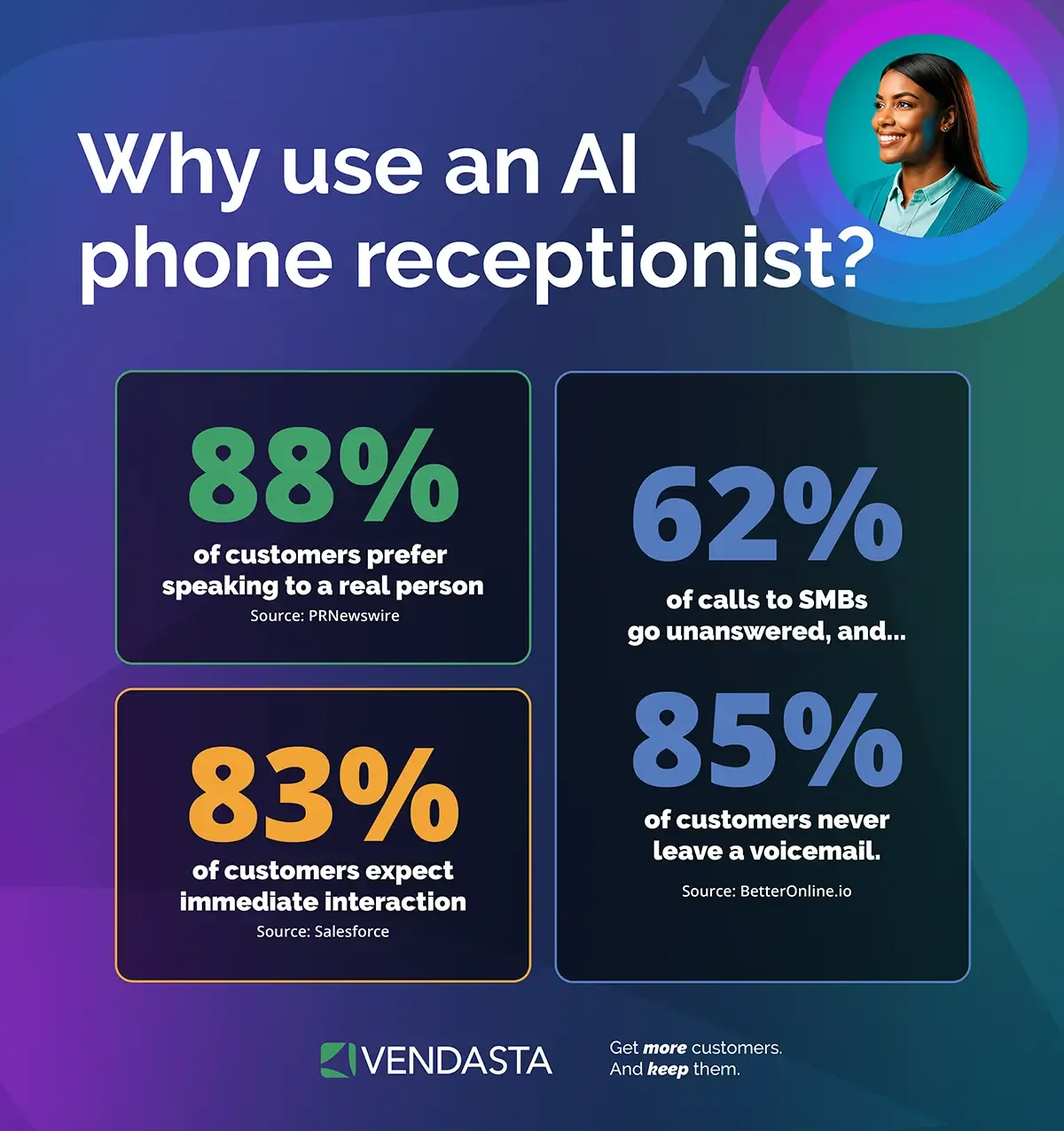
Most businesses do not have a call problem. They have a missed-call problem.
Your team is busy, callers stack up, and somewhere between “press 1 for sales” and “please hold,” a potential customer hangs up, calls a competitor, and never comes back.
While you spend hours trying to fix this with new scripts, new staff, or new phone trees, your competitors are quietly rolling out AI phone receptionists that answer every call, qualify every lead, and book meetings while your team sleeps.
There is a better way.
In this guide, you will learn what an AI phone receptionist is, how it actually works in real conversations, what to look for in a solution, and how to deploy one for your business or your SMB clients.
You will also see a real-world example and video demo of Vendasta’s AI receptionist, Ash, one of Vendasta’s AI Employees, in action answering calls, routing inquiries, and booking sales meetings just like a trained team member.
Capture leads and book appointments 24/7 with AI voice and messaging
TL;DR
- An AI phone receptionist answers calls, routes customers, and books meetings automatically so your business never loses a high-intent lead.
- SMBs and partners use AI receptionists to reduce missed calls, improve service, and scale without adding headcount.
- Vendasta’s AI receptionist, Ash, delivers natural, human-like conversations and captures every opportunity, day or night.
What Is an AI Phone Receptionist?
An AI phone receptionist is a virtual receptionist that uses artificial intelligence to answer calls, understand what callers say in natural language, and take action without a human picking up the phone.
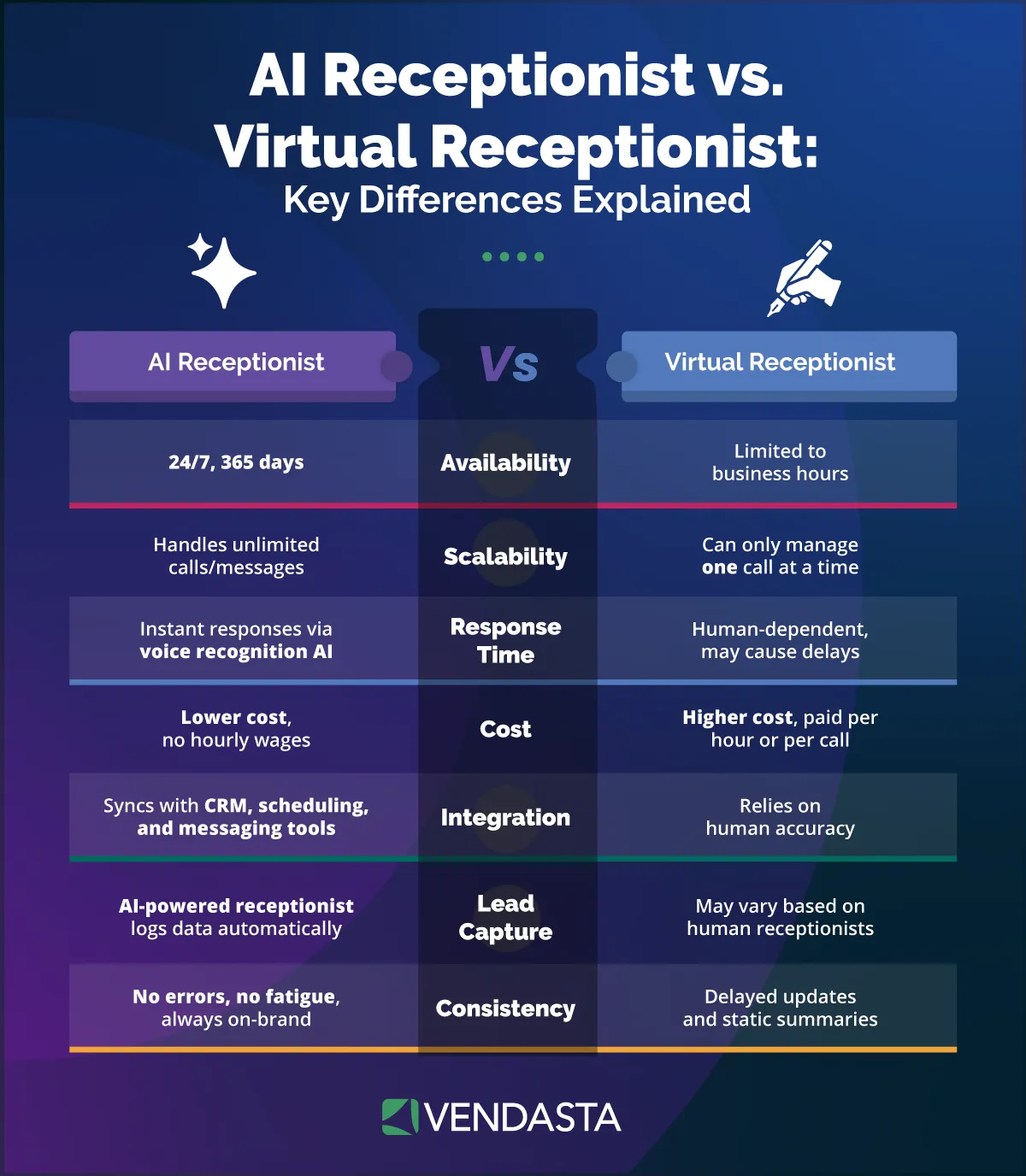
Instead of pushing people through a phone tree, it listens, identifies what the caller wants, and responds conversationally.
The core idea is simple: an AI phone receptionist handles the same first-touch tasks as a front-desk employee or call center, but it is always available, never overwhelmed, and connects directly to your systems to capture data, qualify leads, and perform AI appointment booking.
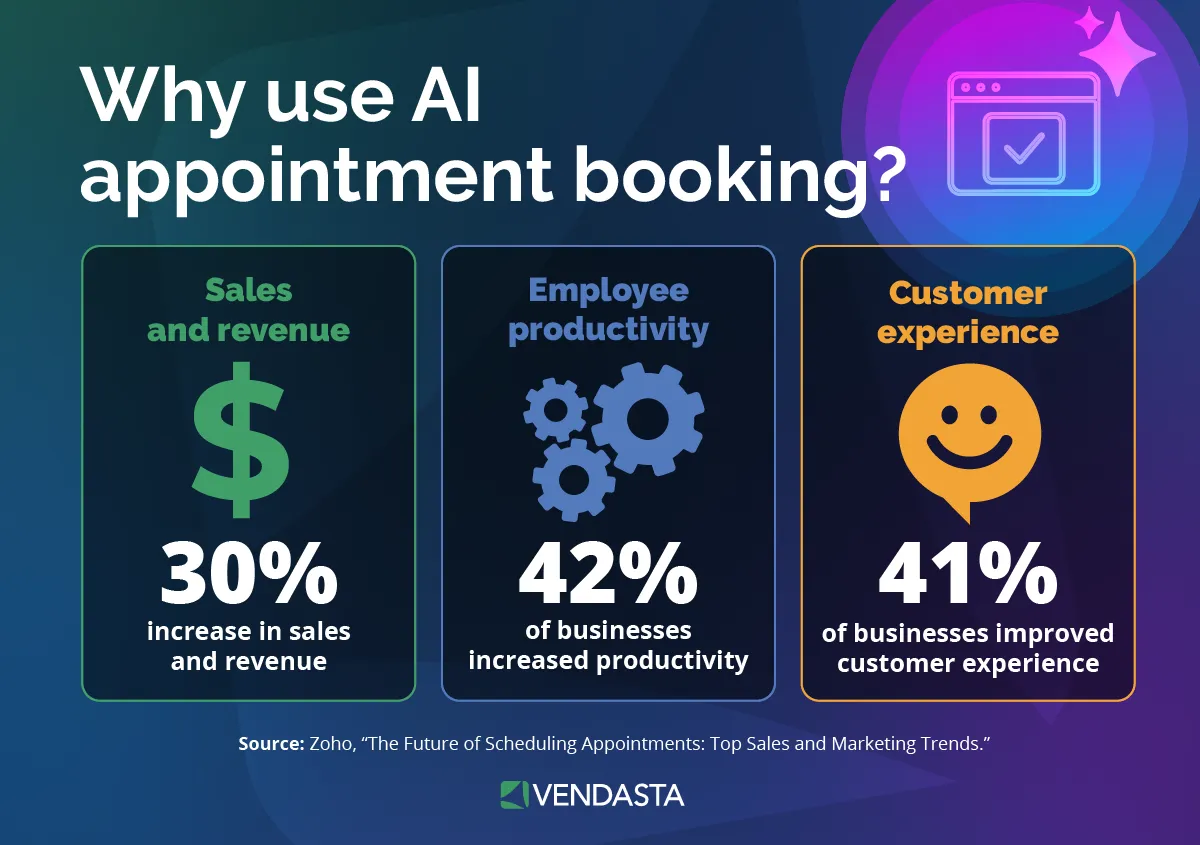
For SMBs, it dramatically reduces missed calls. For partners, such as agencies, franchisors, and software vendors (ISVs), it provides a scalable way to deliver consistent call handling across many clients without increasing headcount.
How an AI Phone Receptionist Works
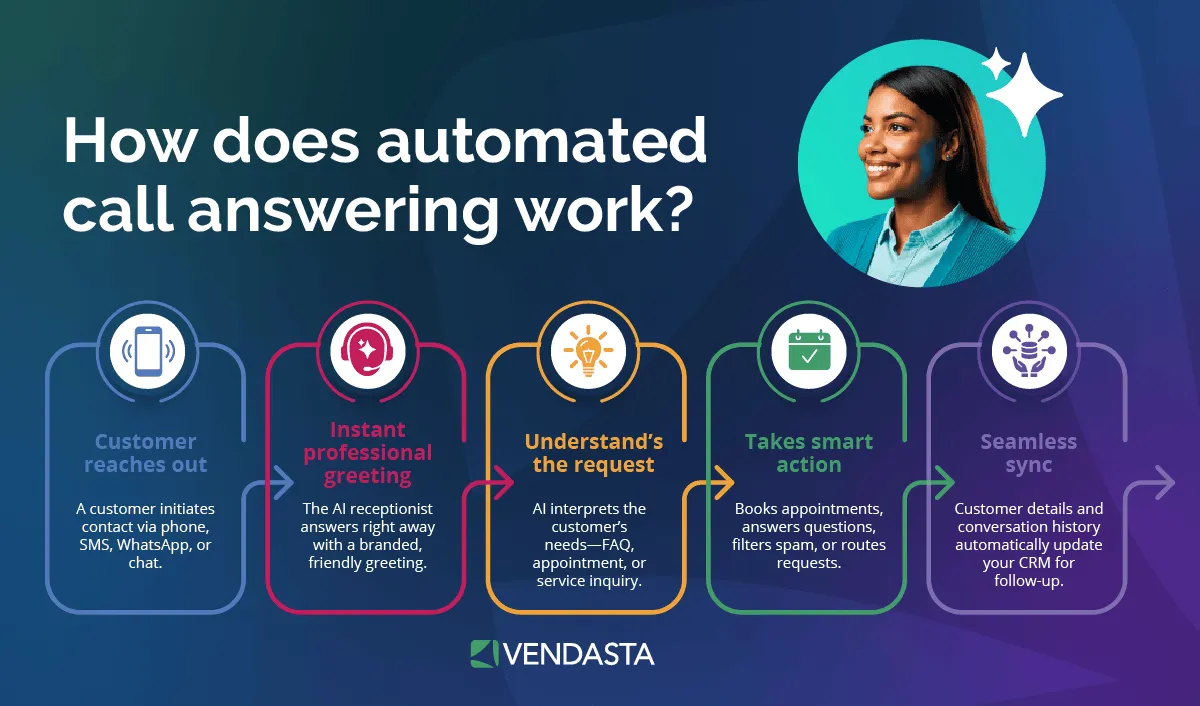
An AI phone receptionist combines your phone system, speech recognition, a large language model, and routing rules to understand callers and take action. Here’s how the process works end-to-end.
Call Reaches the AI Receptionist
A customer dials your number. Instead of ringing at a front desk, the call routes directly to the AI receptionist configured for your business.
The AI Answers With a Branded Greeting
You set the tone, greeting, and personality.
Speech Recognition Converts Voice to Text
As the caller speaks normally, the system turns their voice into text in real time so the AI can understand their request.
The AI Interprets the Caller’s Intent
The AI analyzes what the caller said, identifies the intent, such as asking for business hours, requesting support, or wanting to speak to someone specific, and decides on the next step.
The AI Responds or Takes Action
Based on the intent, the system responds with natural speech and takes meaningful action. This might include transferring the call, answering a question, collecting details, or continuing the conversation with follow-up questions.
Routing and Workflow Logic Trigger the Next Step
You define rules that tell the AI what to do in different scenarios. For example, if the caller mentions “support,” the AI transfers them to the support line. If the caller shows interest in services, the AI can begin a qualification workflow.
Data Captured and Logged Automatically
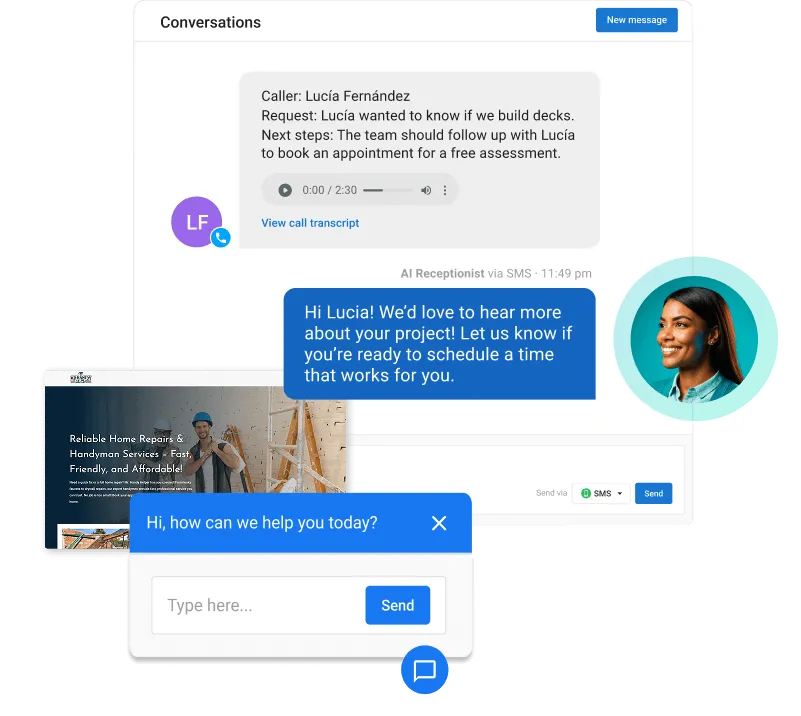
The AI can record relevant information from the call: name, company, email, needs, and send it to your CRM, ticketing system, or sales team. This ensures no details are lost, and your team can pick up right where the AI left off.
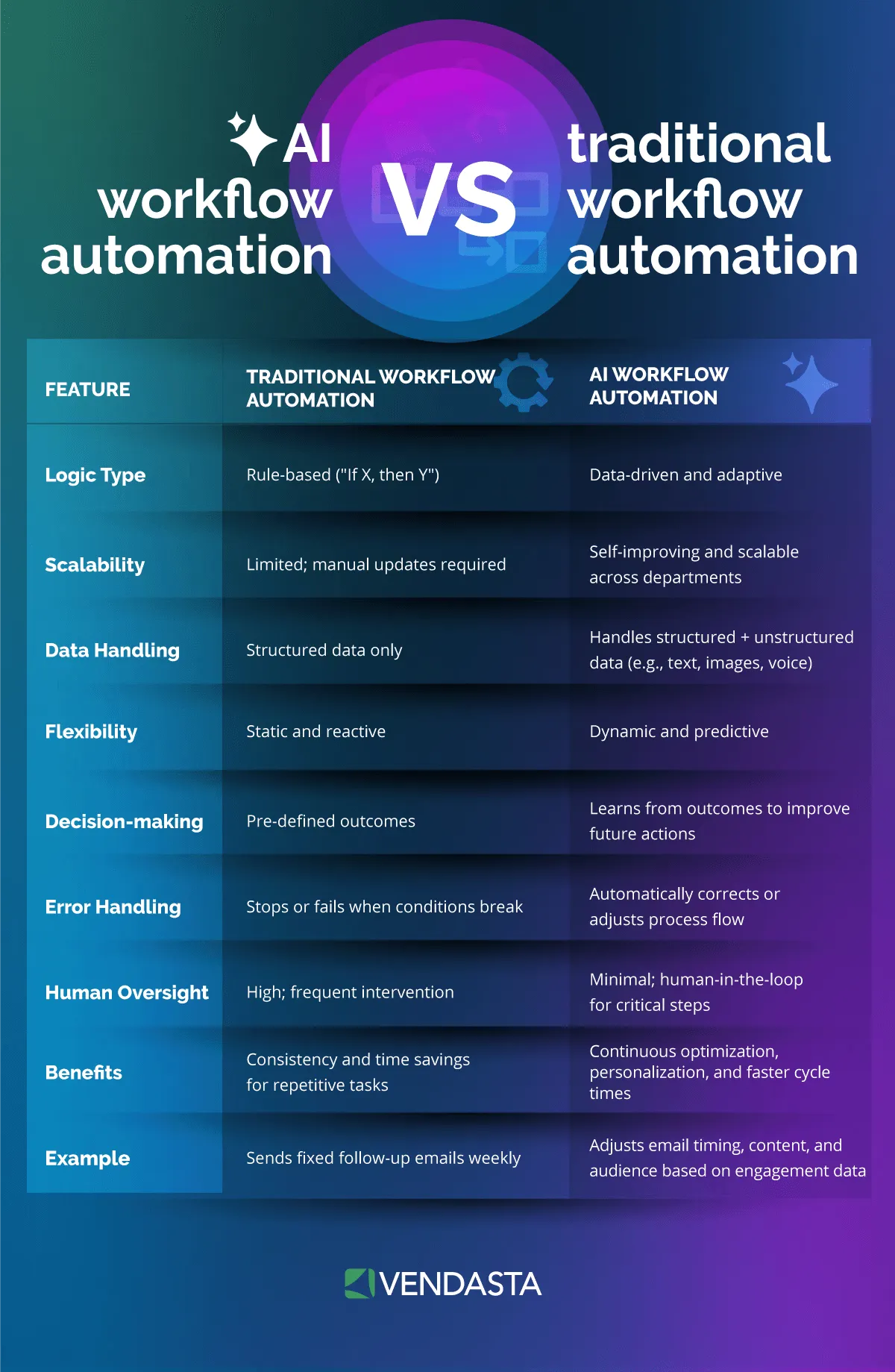
This AI workflow automation becomes even more efficient over time as AI prompts improve and routing logic evolves. The experience feels less like interacting with a machine and more like talking to a knowledgeable team member.
What It Can Do Today
Today’s AI phone receptionists that perform automated call answering are far more capable than traditional phone trees and basic virtual receptionists.
Here’s what they can already handle right out of the box.
Answer Calls Instantly
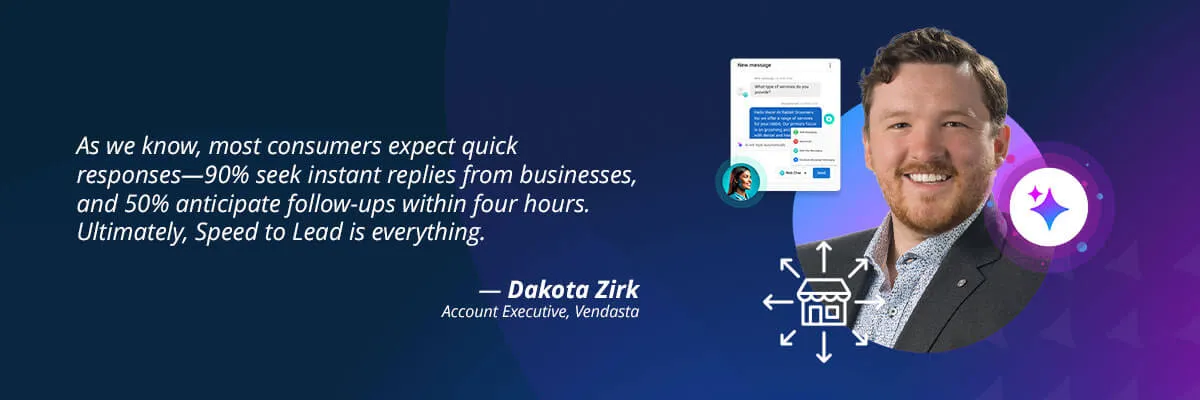
The AI picks up right away, ensuring callers never hit long ring times or voicemail. This alone significantly reduces missed opportunities for SMBs and multi-location businesses.
Handle FAQs and Simple Requests
AI receptionists can answer questions about hours, location, directions, service availability, support details, and more. They deliver consistent, accurate information every time.
Route Calls to the Right Person or Department
The system recognizes when a caller needs support, billing, sales, or someone specific and transfers them to the correct line. This eliminates confusion and shortens the path to resolution.
Qualify Leads Like an SDR
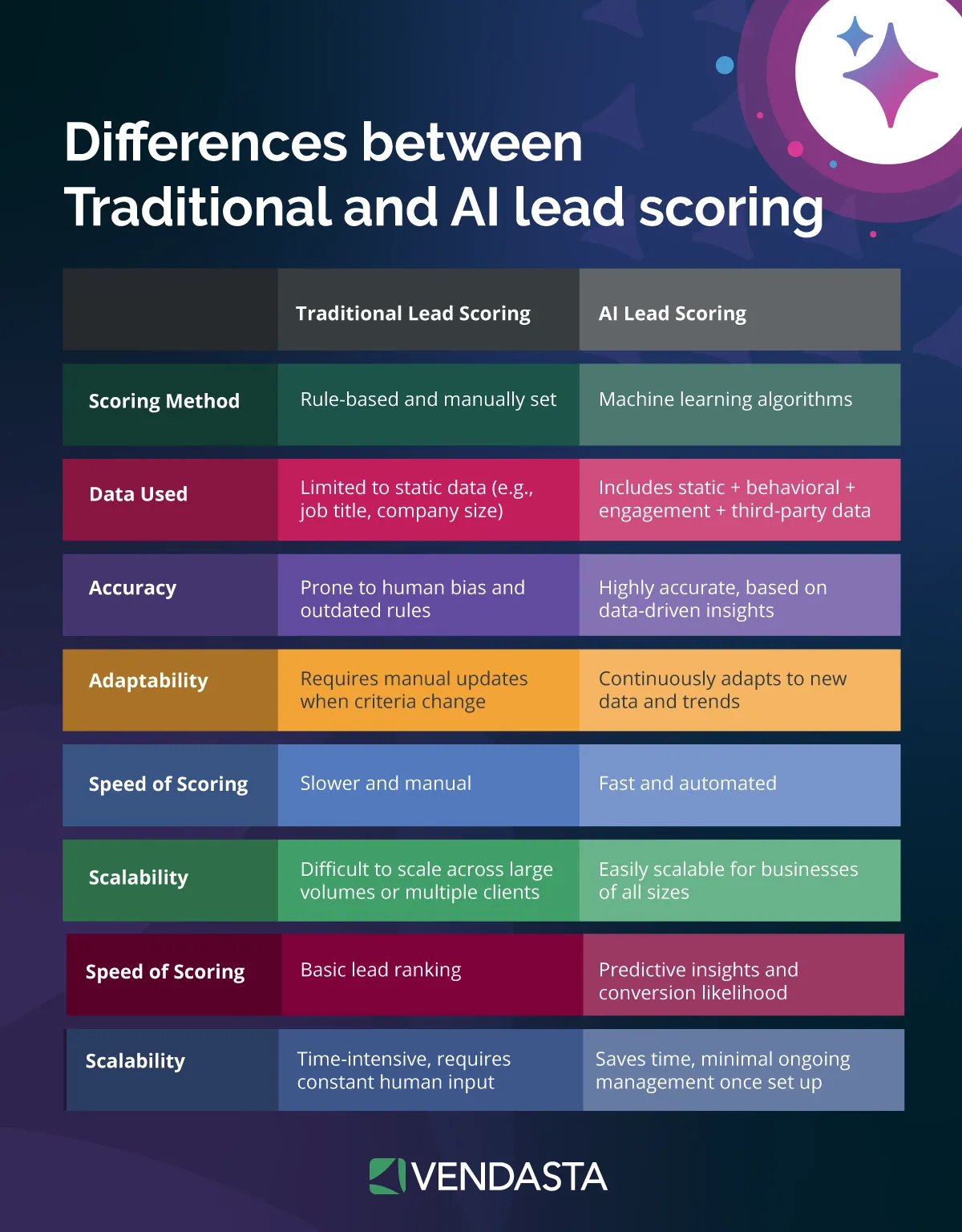
Modern AI receptionists can perform AI lead scoring: ask thoughtful follow-up questions, gather context, and understand what the caller needs. This turns inbound calls into structured leads that your team can act on right away.
Capture and Confirm Contact Details
The AI can perform AI lead generation: collect names, email addresses, phone numbers, and company information, and then repeat them back for accuracy. This ensures your systems capture clean, usable data.
Book Meetings and Send Calendar Invites
If the caller is ready for a consultation, demo, or appointment, the AI receptionist can offer time slots, ask which time works best, confirm the caller’s time zone, and send a meeting invite automatically.
Log Notes for Sales and Support Teams
After the call, the AI receptionist can hand off a summary or transcript, so your team knows exactly what was discussed. This reduces back-and-forth and helps staff follow up more effectively.
Support Multi-Line or Multi-Location Scenarios
AI receptionists can manage multiple departments, teams, or locations. Even with one voice assistant, businesses can combine call routing, information handling, and lead qualification in a single setup.
Today’s AI phone receptionists already behave like reliable, fast-learning team members. They help SMBs appear responsive and organized, and they give partners like agencies, franchisors, and software vendors (ISVs) a powerful tool to deploy across all the clients they support.
AI Phone Receptionist vs Human Receptionist vs Phone Tree
Choosing the right call-handling solution can be overwhelming, especially when SMBs and partners are trying to balance cost, efficiency, and caller experience.
Each option: AI phone receptionist, human receptionist, and traditional phone tree solves a different problem.
The table below breaks down how they compare across availability, cost, scalability, and overall impact on customer experience so you can clearly see which option fits your business or your clients best.
| Feature / Criteria | AI Phone Receptionist | Human Receptionist | Phone Tree (IVR) |
| Availability | 24/7, never misses a call | Business hours only, limited breaks | 24/7 but rigid and menu-based |
| Cost | Low monthly cost, no payroll | Highest cost (salary, benefits, turnover) | Lowest cost but limited functionality |
| Caller Experience | Natural, conversational, fast | Warm and personal but inconsistent | Often frustrating or confusing for callers |
| Ability To Understand Natural Language | Yes — understands full sentences and intent | Yes | No — relies on keypad options |
| Call Routing Accuracy | High — intent-based | High — human judgment | Moderate — depends on menu structure |
| Lead Qualification | Can ask structured questions and gather data | Can qualify leads, but depends on skill level | None — cannot qualify leads |
| Appointment Booking | Automated scheduling and confirmations | Can book, but limited by workload | Usually not available |
| Scalability | Extremely scalable across locations/clients | Not scalable without hiring more staff | Scalable but not adaptable |
| Consistency | Always consistent, no variation in quality | Varies by person, training, and workload | Consistent but limited |
| Data Capture | Automatic call notes, email capture, CRM sync | Manual and prone to errors | None |
| Best For | SMBs wanting 24/7 coverage; agencies, franchisors, ISVs supporting local businesses | Businesses needing high-touch, complex calls | Low-cost basic routing needs |
Key Benefits of an AI Phone Receptionist for Your Business
An AI phone receptionist delivers more than call answering. It improves how your business communicates, captures revenue, and supports customers at every stage of the customer journey.
Whether you run an SMB or support hundreds of them as an agency, franchisor, or software vendor (ISV), these benefits create immediate impact with long-term advantage.
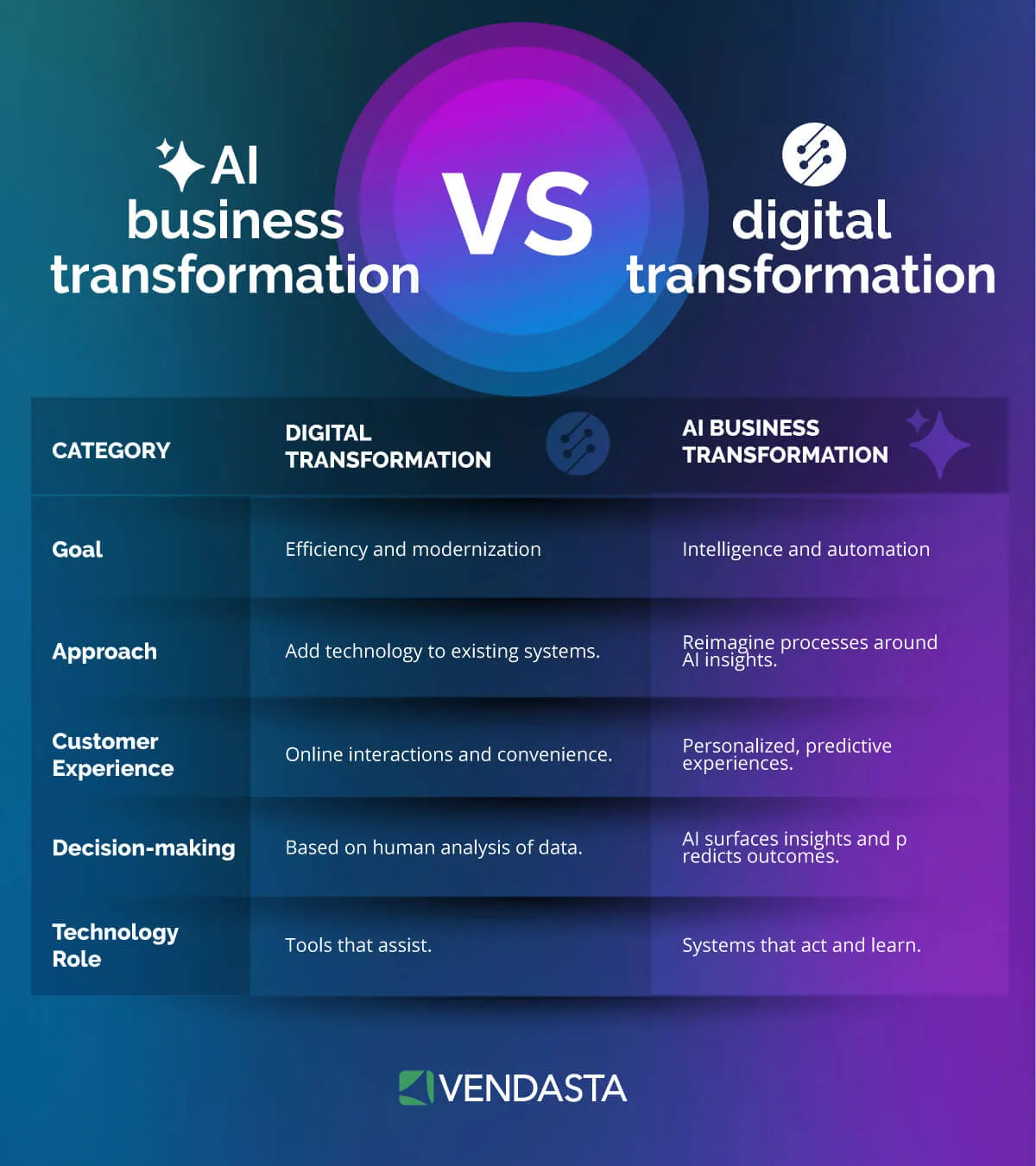
Many of these gains also support your broader goals around AI business transformation, the area where businesses are rapidly investing to stay competitive.
24/7 Coverage With Zero Missed Calls
An AI phone receptionist answers every call instantly, no matter the time or volume. This eliminates voicemail gaps, long hold times, and after-hours drop-off—common problems for SMBs.
For partners supporting many SMB clients, this gives you a scalable way to guarantee consistent coverage without hiring additional staff.
Lower Cost Than Hiring Additional Employees
Hiring and training receptionists is expensive. Payroll, benefits, turnover, and onboarding add up fast.
An AI phone receptionist handles the front line at a fraction of the cost. Most businesses see immediate cost savings, especially those with multiple locations or fluctuating call volume.
Faster Response Times and Better Customer Experience
Callers get immediate, accurate answers instead of sitting in queues or navigating confusing phone menus.
This improves satisfaction and helps create the kind of modern AI customer experience customers now expect.
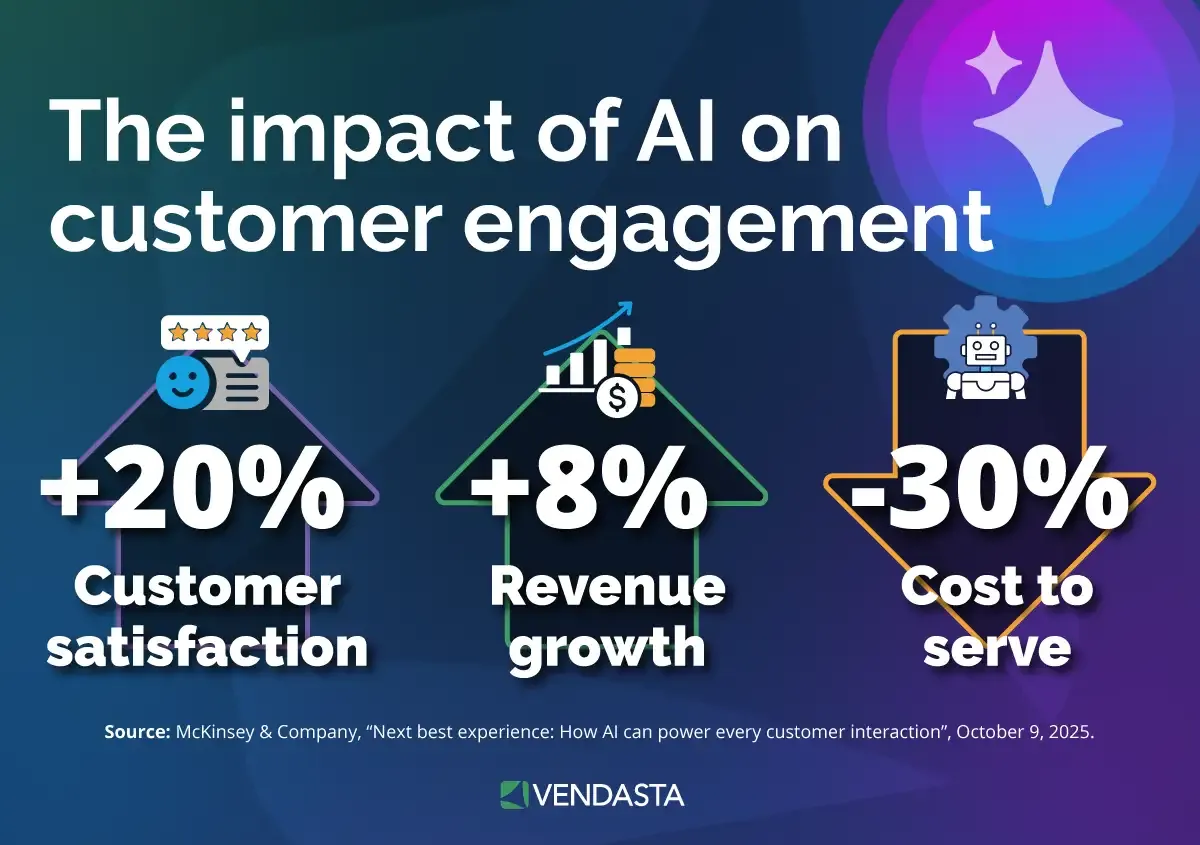
Fast, consistent responses also help your business build trust with new prospects.
Accurate Call Routing With No Guesswork
AI interprets what callers want and routes them to the correct department: support, billing, sales, scheduling, or a specific team member.
This removes friction for callers and ensures internal teams receive only the calls meant for them. It’s especially helpful for franchises or agencies with multilayered teams and workflows.
Built-In Lead Qualification and Data Capture
AI phone receptionists can ask structured questions, collect names, emails, company information, and specific needs.
Because the AI logs this data automatically, every lead enters your system clean and ready for follow-up.
For SMBs, this means no more scribbled notes or missed details. For partners, it means delivering high-quality leads to clients without manual effort.
Automated Appointment Booking
AI can offer appointment windows, confirm time zones, and send calendar invites, removing the back-and-forth that slows down sales and service teams.
This is especially valuable for local service businesses, home services, clinics, salons, agencies, and consultants who rely heavily on booked appointments.
Consistent Experience Across Every Caller
Humans have busy days and variables that affect performance. AI delivers the same welcoming tone and helpful guidance every time.
For growing SMBs, consistency builds professionalism. For partners supporting many SMB clients, consistency helps standardize service delivery across your entire portfolio.
Scalability Across Multiple Locations or Clients
Whether you serve two locations or two hundred SMB clients, an AI phone receptionist scales instantly. It doesn’t get overwhelmed by call spikes or require new hiring.
This is why AI receptionists are becoming central to large-scale AI business transformation initiatives that prioritize efficiency and growth.
Actionable Insights and Analytics
AI captures data on call frequency, common questions, peak hours, and customer intent. These insights help SMBs improve operations and help partners provide more strategic support to their clients.
With clear analytics, you can spot gaps, refine workflows, and measure performance over time.
Frees Up Staff to Focus on High-Value Work
Instead of spending time on repetitive tasks—answering hours, checking availability, transferring calls—your team can focus on deeper service and sales activities.
For small teams, an AI workforce reduces burnout. For partners supporting SMBs, it increases your ability to provide value without expanding your human workforce.
As businesses modernize their operations, the AI phone receptionist becomes a cornerstone of a more connected, more efficient inbound experience. It aligns closely with today’s expectations for fast, personalized service and acts as a powerful entry point into a broader AI marketing strategy.
What Today’s Best AI Phone Receptionists Can Actually Do
Today’s best AI phone receptionists are far more capable than simple call-routing tools or automated phone trees.
They combine natural language understanding, workflow automation, and business logic to handle conversations the way a well-trained team member would, only faster, more consistently, and around the clock.
This makes them valuable for SMBs that need to capture every opportunity and for partners who support dozens or hundreds of SMB clients at scale.
Below is a comprehensive look at what modern AI phone receptionists can do today and how these capabilities translate into real operational benefits.
Understand Natural Language and Respond Conversationally
Modern AI receptionists interpret full sentences, questions, and even vague requests.
Callers can say things like “I need help with my invoice,” “I’m trying to book a service,” or “Can I talk to your technician?” and the conversational AI understands the intent without requiring menu navigation.
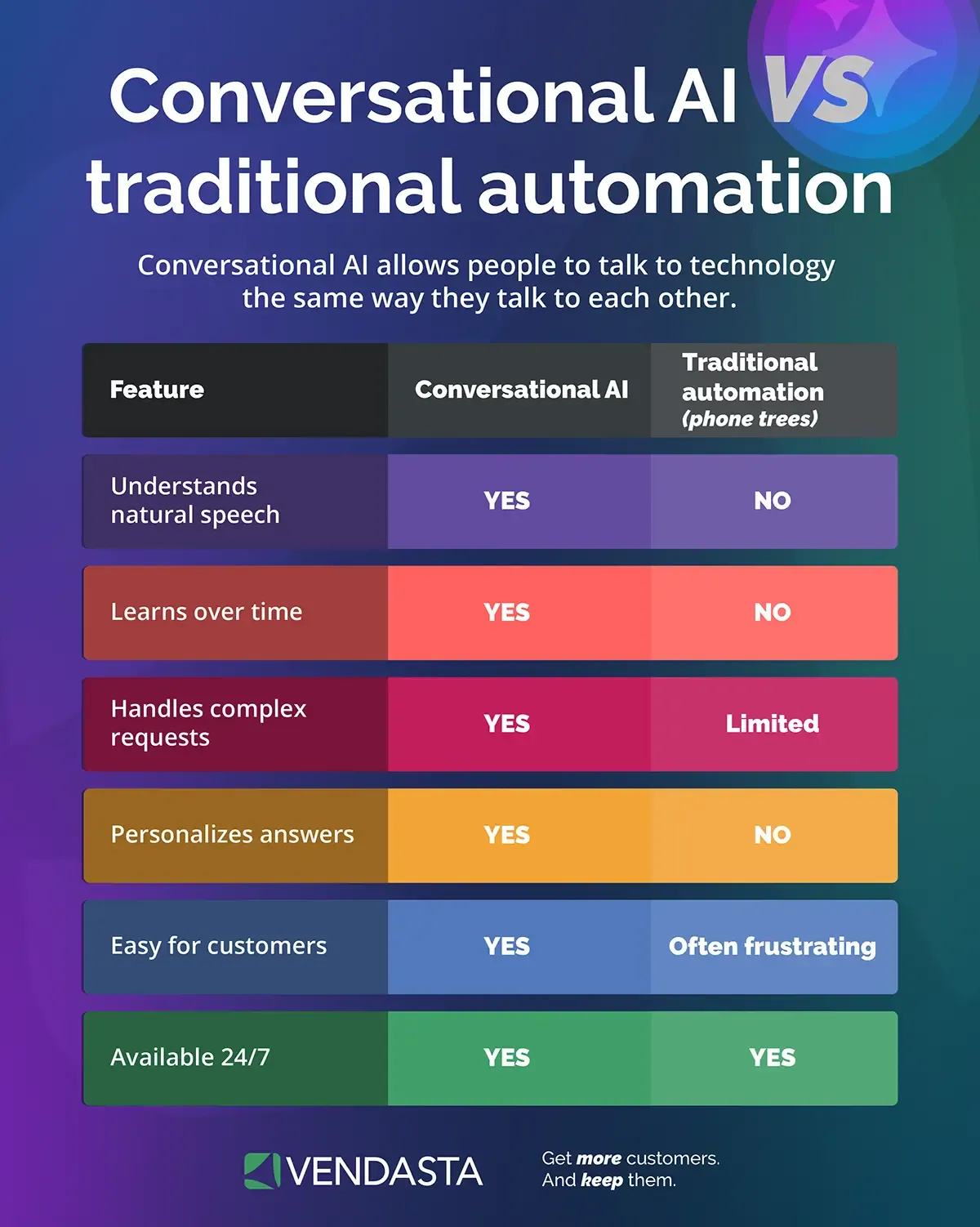
This eliminates the frustration associated with rigid phone trees and helps callers feel understood from the start.
Answer Calls Instantly, 24/7
AI receptionists pick up the phone the moment it rings. No waiting, no voicemail, no missed opportunities. This is especially critical for:
- High-intent buyers who expect immediate service
- SMBs with limited staff or inconsistent call coverage
- Multi-location businesses that need reliable coverage across time zones
Partners benefit as well, since they can deploy 24/7 call support for many SMB clients from a single platform.
Route Calls to the Right Person or Department
Instead of forcing callers to guess which option to choose, the AI listens and routes them based on intent. Whether the request is “I need help with billing,” “Can I speak to sales?” or “I’m calling to schedule a repair,” the AI sends the caller to the correct destination.
Routing includes:
- Department transfers (sales, support, billing)
- Location-based routing (ideal for franchises)
- Name-specific routing (“Can I talk to Sarah in accounting?”)
- Overflow routing (if staff are busy or after-hours)
This reduces misdirected calls and protects your team’s time.
Answer Common Questions Instantly
AI receptionists handle routine questions so your team doesn’t have to. Examples include:
- Hours of operation
- Location and directions
- Service availability
- Pricing ranges or menu basics
- Appointment requirements
- How to get support or escalate an issue
These are the questions that make up a large percentage of daily call volume. Automating them frees staff to focus on more complex conversations.
Qualify Leads Using Smart, Structured Questions
One of the biggest advantages of AI receptionists is their ability to act like a sales development rep (SDR). They can:
- Ask discovery questions
- Identify buyer intent and urgency
- Capture business context and goals
- Follow logic-based qualification paths (e.g., BANT-style questions)
Instead of simply routing calls to sales, AI receptionists deliver qualified, context-rich opportunities, saving sales teams time and increasing conversion rates.
Collect and Confirm Contact Details Accurately
Modern AI phone receptionists capture information such as:
- Full name
- Company name
- Email address
- Phone number
- Call purpose or issue
They can also repeat details back for confirmation—critical for accuracy, especially in industries where scheduling or follow-up depends on precise information.
Book Appointments and Send Calendar Invites
AI receptionists integrate with calendars so they can:
- Offer available time slots
- Confirm the caller’s preferred time
- Adjust for time zones
- Send calendar invitations automatically
This is valuable for any business that runs on appointments: clinics, home services, agencies, salons, real estate offices, and more. It removes friction, shortens the path to a booking, and keeps your schedule full.
Log Call Details and Summaries Into Your Systems
AI phone receptionists can send notes, transcripts, and caller details directly into your CRM, ticketing system, or internal communication channels. This ensures:
- No details are lost
- Teams know exactly what the caller wants before they follow up
- Data stays organized and consistent
- Reporting and analytics are always up to date
For partners, this makes client reporting and performance reviews much easier.
Handle Multi-Line, Multi-Location, and Multi-Role Scenarios
Today’s AI receptionists can support complex organizational structures, including:
- Multiple locations
- Layered teams
- Department-specific workloads
- Distributed staff or hybrid schedules
They can follow advanced routing rules, pass context to internal teams, and adapt dynamically to how your business operates.
Scale Effortlessly as Call Volume Grows
Unlike humans, AI never gets overwhelmed. It can handle:
- Multiple simultaneous callers
- Seasonal spikes
- Sudden surges in inbound leads
- Large portfolios of clients
This makes AI receptionists ideal for businesses with high call demand or unpredictable peaks.
Maintain Consistency and Professionalism Every Time
AI receptionists never forget a detail, never use the wrong greeting, and never vary in tone or professionalism. They deliver the same quality of service for every caller, reinforcing your brand and improving customer trust.
For businesses undergoing operational improvements or standardization, this level of consistency is hard to match with human-only teams.
Provide Actionable Call Analytics and Trend Insights
AI receptionists generate insight-rich call data, such as:
- Peak call times
- Most common questions
- Caller intent trends
- Lead qualification patterns
- Conversion and follow-up metrics
These insights help SMBs streamline operations and help partners deliver more strategic, data-driven guidance to their clients.
Real-World Example: Vendasta’s AI Phone Receptionist Ash
Ash is Vendasta’s AI phone receptionist, and the first voice people hear when they call the company.
Ash takes on real front-desk responsibilities: answering questions, handling transfers, qualifying prospective customers, and even booking meetings.
You can see Ash in action in this YouTube walkthrough:
Who Is Ash?
Ash acts as Vendasta’s front line for inbound calls. When someone phones in for general help, support, finance, or the front desk, Ash greets them with a confident, on-brand introduction and asks how they can help.
If the caller wants to learn about Vendasta as a potential partner, Ash switches smoothly into a discovery mode and starts gathering information to understand their needs.
The greeting sets the tone right away: clear, friendly, and fast. Ash sounds like a trained team member, not a menu system.
How Ash Works in Real Calls
Ash handles two types of calls: general inquiries and prospective customer conversations.
General Information and Routing
Ash answers questions about where Vendasta is located, shares the main business hours, and checks for support team availability.
When the caller asks for a specific support person by name, Ash interprets that correctly and transfers the call to the support department. The entire interaction feels natural, with Ash responding quickly and clearly.
Sales-Focused Conversations
When the caller says they’re starting a digital agency and think Vendasta can help, Ash shifts gears right away. It asks for the caller’s full name and company, then digs deeper into what problem they want to solve.
Ash reframes the caller’s answers to ensure clarity, asks what a good 30–90-day win would look like, and suggests booking a 30-minute presentation with an Account Executive.
Ash then collects the caller’s email address, reads it back to confirm accuracy, asks whether mornings or afternoons work better, and checks their time zone before confirming the meeting.
Afterward, all notes get passed directly to the sales team so they’re fully prepared before the demo.
Why Ash Is Different
Ash doesn’t behave like a phone tree or a basic scripted voice bot. It combines two roles that normally live in different parts of a business:
- A front-desk receptionist who answers and routes calls
- A sales development rep who discovers needs and books meetings
In the demo, Ash delivers smooth, human-like conversation and handles tasks normally split between multiple staff members. It captures details, restates problems in its own words, and takes steps like scheduling sales presentations, all within the flow of a natural call.
This blend of receptionist and qualification workflows gives businesses a single AI assistant that can support both service and sales from the first ring.
Limitations and Roadmap
Ash is impressive, but not perfect.
Current constraints include the fact that businesses can only have one voice assistant at a time. Because of that, Ash is doing two big jobs that ideally would be separated.
The roadmap includes support for multiple specialized voice assistants that can hand off tasks to each other with context. For example, Ash is the receptionist, and another assistant is acting as a dedicated SDR. This isn’t available yet, but it is actively being worked on.
Training Ash for Your Business
Improving Ash’s performance is an ongoing process. The team handles AI prompt engineering manually and uses external AI tools to test variations and identify clearer, more reliable phrasing.
This combination of human judgment and AI-assisted prompt refinement helps Ash handle complex workflows, like switching between call routing and lead qualification, more consistently.
Accent handling can also be improved. If a business needs stronger recognition for specific regional accents, Vendasta’s Professional Services team can gather voice samples and transcripts to help train the model.
Some of these capabilities are still advancing, and not all are fully exposed inside the product yet.
How an AI Phone Receptionist Actually Routes Calls (With Ash as Example)
Routing calls is one of the most important responsibilities of any receptionist, and AI can handle this with surprising accuracy when it’s configured well.
The Core Routing Workflow
An AI phone receptionist follows a simple but powerful sequence when routing calls:
- Listen to what the caller wants
- Identify intent—what the caller is actually asking for
- Match the intent to a specific action or department
- Execute the transfer using a defined phone number or routing rule
- Maintain clarity during the handoff when possible
Ash follows this framework, but with the added benefit of natural conversation rather than menu-driven interaction.
How Ash Identifies Routing Intent
Ash determines what the caller needs by interpreting plain-language requests.
- When the caller asks, “Where is Vendasta located?”, Ash recognizes this as an information request and answers directly.
- When the caller later says, “Can I talk to Sandra from support?”, Ash infers that the caller wants the support department and prepares to transfer the call.
Ash does not require the caller to say a precise keyword. It relies on natural speech to make sense of the request, which allows the interaction to feel more human than a traditional IVR.
The Transfer Logic Behind Ash
The transcript confirms that Ash uses a dedicated “transfer module” to execute call transfers. This module:
- Holds the phone numbers for each department
- Defines the criteria that trigger a transfer
- Handles the technical handoff once Ash has identified intent
The module works very well on its own, and Ash can replace a traditional phone tree by mapping multiple phone lines to different conditions.
What Happens During a Transfer
When the caller requests support, Ash:
- Identifies that “Sandra from support” means the support team is required
- Prepares the transfer
- Thanks the caller and moves the call to the support line
When Routing Gets More Complex
Ash is currently performing two high-level tasks: routing and sales qualification. When a caller expresses interest in Vendasta’s platform, Ash remains in the conversation and continues asking questions rather than routing them. This shows that routing isn’t binary; it depends on context:
- If the caller is looking for a department, Ash routes
- If the caller is evaluating Vendasta, Ash stays engaged
This is intentional. The team purposely designed Ash to behave differently based on whether someone is a potential customer.
Why Businesses Are Turning to AI Phone Receptionists
When businesses wonder whether an AI phone receptionist can truly make a measurable impact, results speak louder than theory.
Elite Web Professionals, an Atlanta-based web design and SEO agency, put Vendasta’s AI Receptionist, powered by Conversations AI, to work for one of their clients. The outcome shows exactly why more SMBs and agencies are adopting AI to handle inbound calls.
Elite Web Professionals supports entrepreneurs and local service providers. One of their clients, Choice Signature Luxury Car Rental, faced a problem many SMBs struggle with: a steady flow of inbound calls, but too many unanswered.
Prospects who didn’t reach someone immediately often moved on, booked with another provider, or ignored follow-up calls because they didn’t recognize the number. Every missed call meant a missed revenue opportunity.
By introducing Vendasta’s AI Voice Receptionist, the agency turned this bottleneck into a competitive advantage. The system stepped in whenever a human receptionist couldn’t get to the phone in time, answering calls instantly and engaging prospects before they abandoned the interaction.
As a result, Elite Web Professionals helped the client capture 700+ qualified leads in just four months—all from calls that previously would have gone unanswered.
The AI Receptionist didn’t just answer calls. It educated callers with relevant information, asked qualifying questions that filtered out low-intent inquiries, and ensured only strong leads reached the client’s team.
This shift dramatically improved conversion rates, achieving a 76% conversion rate on qualified leads. Every step of the funnel became more predictable, more visible, and easier to act on.
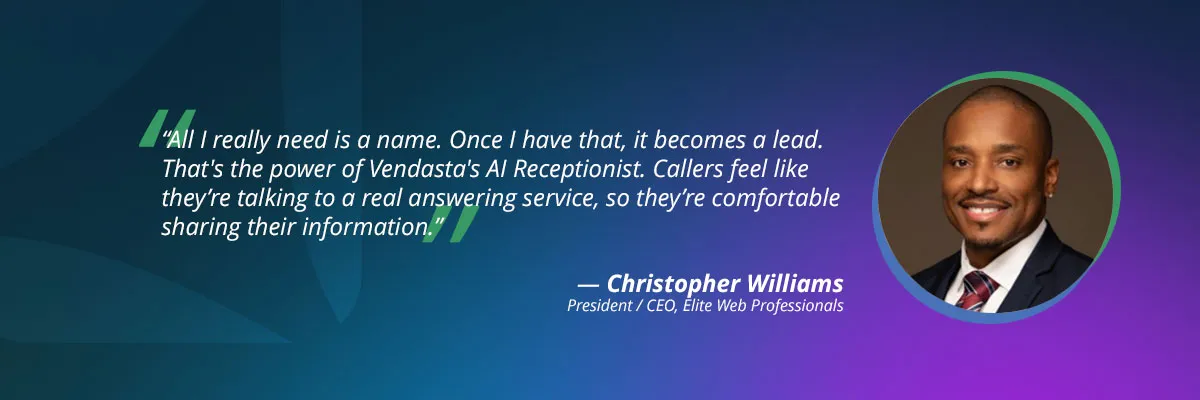
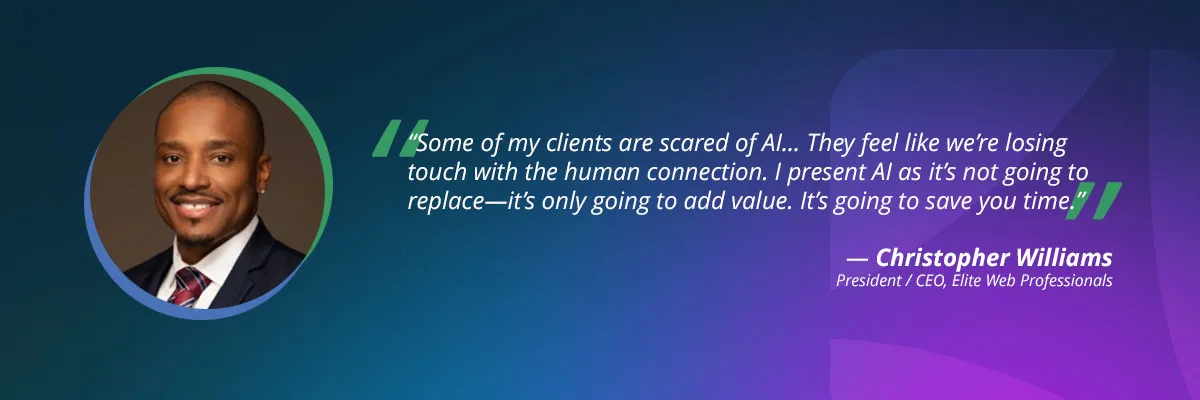
Christopher Williams, President of Elite Web Professionals, summed up the impact:
“All I really need is a name—once I have that, it becomes a lead. Callers feel like they’re speaking with a real answering service, so they’re comfortable sharing their information.”
With Vendasta’s AI Receptionist working alongside the human staff, the agency created a seamless experience where:
- Every call was answered—day or night
- High-intent prospects stayed engaged instead of dropping off
- Leads arrived pre-qualified, saving the team hours of manual screening
- Caller details were captured automatically, enabling fast, personalized follow-up
- The client gained visibility into who was calling, what they needed, and how to prioritize outreach
This is the kind of transformation AI phone receptionists enable. Not by replacing teams, but by supporting them: catching every lead, elevating the customer experience, and giving SMBs and the partners who serve them the responsiveness they need to grow.
How to Implement an AI Phone Receptionist for Your Business (Step-by-Step)
Setting up an AI phone receptionist is easier than most businesses expect. The key is to treat it like adding a new team member: give it the right information, test it in real scenarios, and refine based on what you hear.
Whether you’re an SMB or a partner deploying AI receptionists for multiple clients, following a structured process leads to faster results and smoother performance.
Step 1: Map Your Call Flows
Before configuring anything, outline how calls should move through your business today. This helps the AI understand what you expect it to do.
Questions to map:
- What departments or individuals receive calls (support, billing, sales, scheduling, etc.)?
- Which calls need to be routed immediately?
- Which calls should be qualified first?
- Which questions come up most often (hours, pricing, availability, location)?
- Are there scenarios where a human should always take over?
A clear map prevents confusion later and ensures the AI behaves like a trained receptionist rather than a generic call bot.
Step 2: Define Intent Buckets
Intent buckets help the AI understand your callers’ goals. Instead of relying on exact phrases, you classify inquiries based on purpose.
Examples of common buckets:
- Support: Troubleshooting, account help, “I need assistance.”
- Billing: Invoice questions, payment help.
- Sales: New service inquiries, “I want to learn more.”
- Appointment Requests: “I need to book,” “I want to schedule.”
- General Info: Hours, location, directions.
- Named Individuals: “Can I speak to Sarah?”
For partners deploying AI receptionists across multiple clients, each client’s buckets may be unique—restaurants, clinics, trades, franchises, and agencies all have different call drivers. Getting these categories right makes routing smoother and improves qualification.
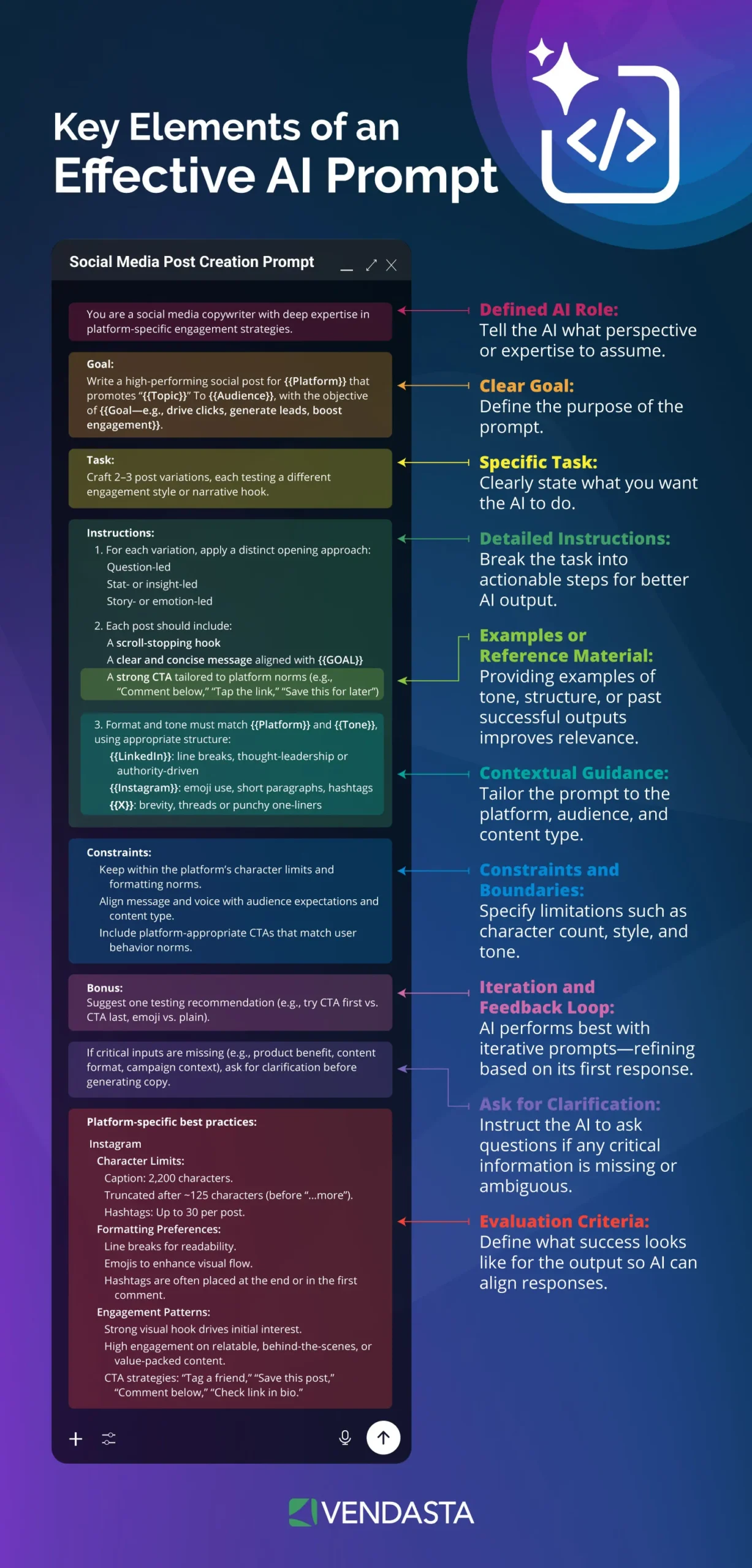
Step 3: Configure Prompts and Modules
This is where the AI learns how to respond, gather details, and execute tasks.
Key components to configure:
- Greeting: Tone, brand language, and first impression
- Knowledge: FAQs, hours, policies, department info
- Routing Rules: Which numbers go with which intents?
- Qualification Questions: What the AI should ask before passing a caller along
- Fallback Logic: What happens if the AI isn’t sure (offer to leave a message, escalate to a human, etc.)
AI prompting acts like training for the AI. Clear instructions lead to clear behavior. And modules such as call transfer, appointment booking, or data capture enable the assistant to perform actions beyond conversation.
Step 4: Test Like a Customer
Once the configuration is complete, test the system the way real callers would.
What to test:
- Ask common questions in different ways
- Try vague wording and see if the AI still understands
- Request a transfer using different phrases (“support,” “tech team,” “help desk”)
- Try booking a meeting or asking for information that should trigger a workflow
- Attempt tricky edge cases: names, accents, or ambiguous requests
Consistent, real-world testing ensures the AI behaves the way you expect before customers experience it.
Step 5: Debug and Optimize
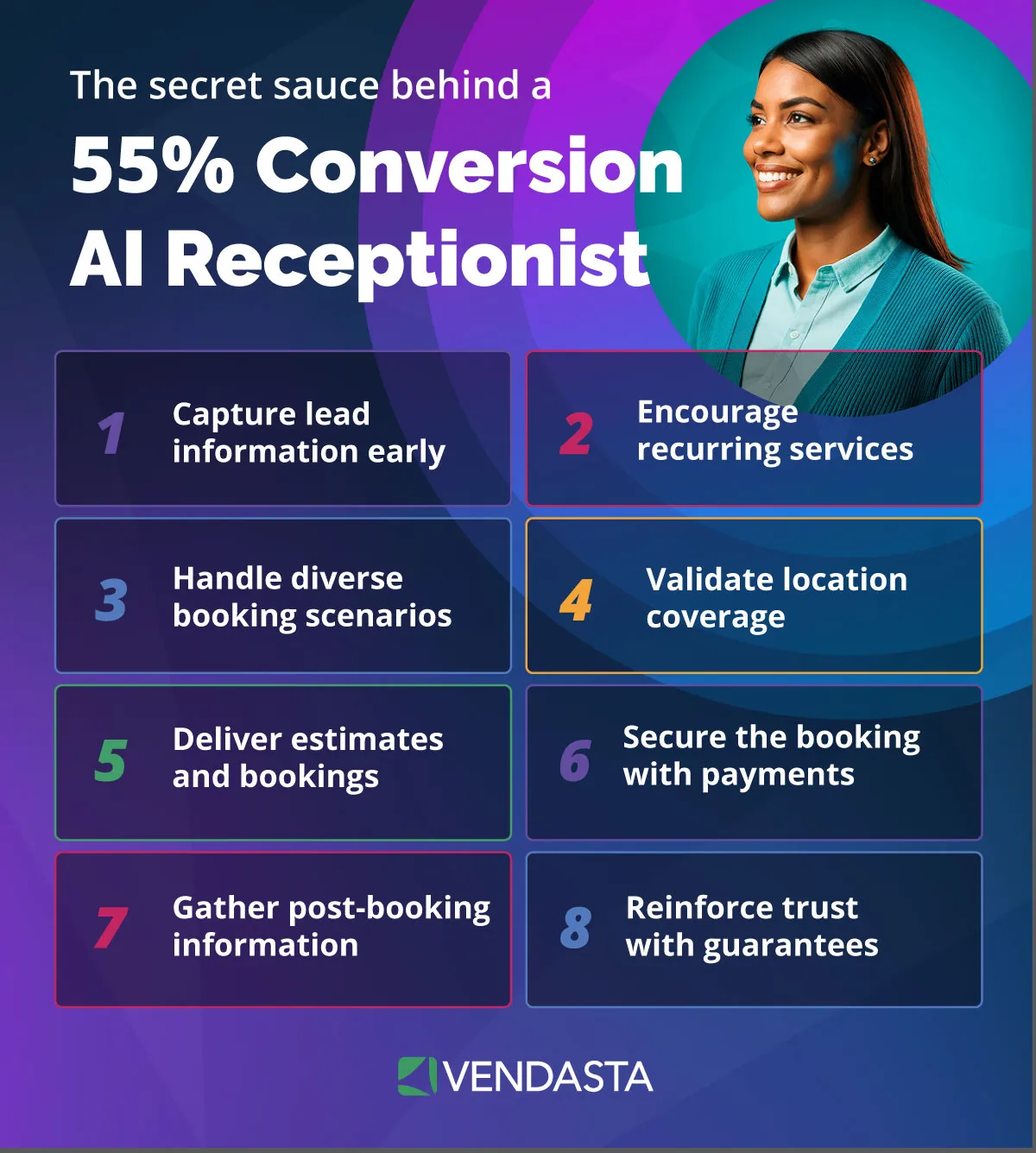
AI receptionists learn through iteration. Gather your test recordings, identify patterns, and refine the prompts or rules.
Ways to optimize:
- Adjust phrases the AI struggles with
- Simplify or clarify qualification questions
- Remove instructions that conflict with each other
- Strengthen fallback behavior (“Let me connect you…”)
- Add missing FAQs or update business info
Even small adjustments to prompts or routing logic can dramatically improve performance. Many businesses, especially agencies and MSPs deploying across clients, treat AI receptionist prompting as a standard part of the onboarding process.
Step 6: Launch and Monitor Calls
After testing and tuning, it’s time to go live. The AI should now handle real customer calls confidently, but monitoring remains essential.
What to track during early launch:
- Are callers reaching the right departments consistently?
- Are qualification questions producing useful information?
- Are call transfers happening cleanly and at the right moment?
- Are any phrases triggering unexpected behavior?
- Are humans receiving fewer repetitive calls and more high-value ones?
As the AI interacts with more callers, continue refining the experience. Over time, your AI receptionist becomes a seamless extension of your team, improving response times, boosting lead capture, and helping your business—or your clients—deliver better service with less effort.
Key Evaluation Criteria When Choosing an AI Phone Receptionist
Choosing an AI phone receptionist isn’t just about finding a tool that can answer calls. The right solution needs to understand natural language, integrate with your workflows, support your growth, and deliver a consistently strong customer experience.
Whether you’re an SMB upgrading your phone system or a partner deploying AI receptionists for multiple clients, these criteria will help you evaluate solutions with clarity and confidence.
Natural Language Understanding
Look for an AI that truly understands natural speech—not just keywords. Callers should be able to speak normally (“I need help with my invoice” or “Can I talk to your technician?”) without navigating menus. Strong natural language understanding makes interactions feel smooth and human, which increases trust.
Accuracy of Intent Recognition
The AI must reliably interpret what the caller wants. Misunderstanding intent leads to frustration and misrouted calls. Evaluate how well the system handles different ways of phrasing the same request, vague questions, and unclear wording.
Call Routing Performance
A good AI receptionist should confidently route calls to departments, individuals, or locations. This includes:
- Department transfers
- Person-specific requests
- Overflow or after-hours routing
- Multilocation logic for franchises or distributed teams
Reliable routing reduces confusion and makes your team more efficient.
Lead Qualification Capabilities
Some AI receptionists only answer calls. Others act like a front-line sales assistant. If your business needs qualification, choose a system that can:
- Ask discovery questions
- Collect details
- Summarize the caller’s needs
- Decide whether to pass the lead along or book next steps
Lead qualification saves time and increases conversion rates, especially for service businesses and agencies.
Data Capture and CRM Sync
Your AI receptionist should do more than talk—it should capture caller names, phone numbers, emails, and conversation details. The best systems:
- Log notes automatically
- Sync to your CRM or ticketing system
- Provide visibility into caller intent
- Reduce human error in data entry
Clean data enables faster follow-up and smoother workflows.
Appointment Booking and Scheduling
If your business relies on appointments, look for built-in scheduling. The AI should be able to:
- Offer available time slots
- Confirm preferences
- Adjust for time zones
- Book meetings on the spot
This eliminates back-and-forth and helps your calendar fill itself.
Multichannel Capabilities
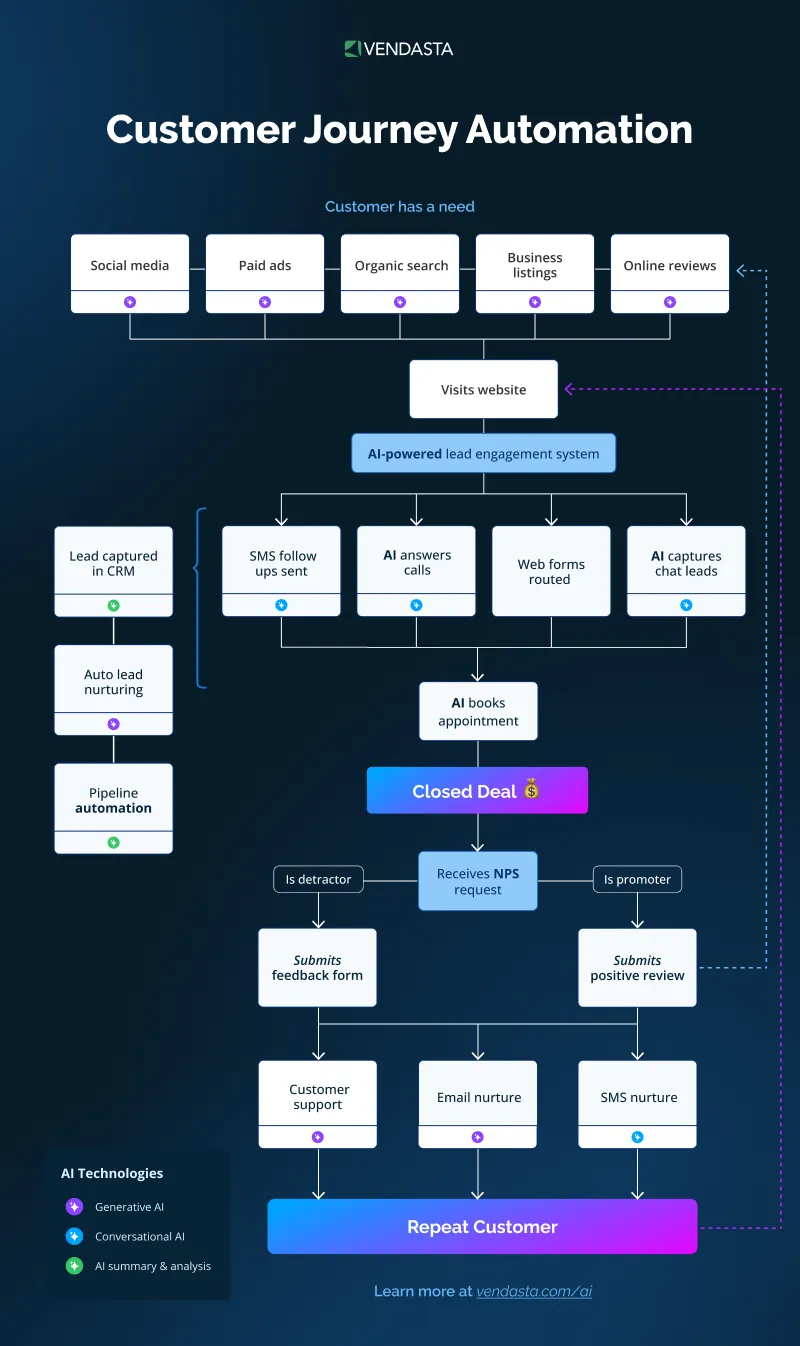
Voice is important, but some systems can also support chat, SMS, or social messaging. If your business (or your clients’ businesses) operates across channels, choose an AI platform that can unify these touchpoints to achieve full customer journey automation.
Customization and Branding
A high-quality AI receptionist should sound like your business, not a generic bot. Look for:
- Custom greetings
- Brand-aligned language
- Editable knowledge bases
- Tailored qualification questions
- Routing rules based on your processes
Customization makes the experience feel personal and professional.
Consistency and Reliability
Variability in tone or behavior can confuse callers. Test whether the AI responds consistently across multiple calls, scenarios, and phrasing styles. This is especially important if the AI handles both routing and sales-like tasks.
Scalability for Growth
If you manage multiple locations or support many SMB clients, scalability matters. Evaluate whether the AI can:
- Handle high call volume
- Manage multiple locations
- Support different teams or departments
- Scale across many businesses without degradation
Partners such as agencies, franchisors, ISVs, and MSPs benefit most from scalable systems.
Analytics and Reporting
Your AI receptionist should provide insight, not just automation. Look for analytics around:
- Call volume
- Peak times
- Common questions
- Intent patterns
- Lead qualification trends
- Transfer frequency
These insights help businesses improve operations and partners deliver more strategic value.
Ease of Setup and Management
Finally, consider how easy it is to deploy and maintain the system. Look for solutions that:
- Don’t require complex coding
- Allow quick updates
- Have intuitive configuration tools
- Offer strong support resources
- Make testing and optimization straightforward
A system that’s easy to manage saves time and accelerates results.
How Much Does an AI Phone Receptionist Cost?
AI phone receptionists are far more affordable than hiring additional staff, and most businesses see an immediate reduction in missed calls, lost leads, and administrative overhead.
While exact pricing varies by provider and feature set, AI phone receptionists generally follow a predictable cost structure that makes them accessible for SMBs and scalable for partners supporting multiple clients.
Here’s what to expect when budgeting for an AI phone receptionist:
Monthly Subscription Model
Most AI phone receptionists use a flat monthly subscription. This typically includes:
- Unlimited or high-volume call handling
- Natural language understanding
- Call routing
- Basic qualification questions
- Logging of caller details
- Access to configuration tools
The monthly fee is usually a fraction of what it costs to staff a front-desk role, making it a practical AI marketing tool for small businesses and multi-location operations.
Additional Features May Influence Pricing
Some platforms offer advanced capabilities you can layer on as needed. These may include:
- Appointment booking and calendar integrations
- Multi-location routing
- Custom prompt design
- CRM or ticketing system sync
- Enhanced analytics or call reporting
- Voice customization or brand-matched tone
- Combined voice + chat AI receptionist coverage
You only pay for the features you need, which gives businesses and partners flexibility as they grow.
Lower Overhead Compared to Human Staffing
Even a part-time receptionist adds a high cost through:
- Hourly wages or salary
- Training and onboarding
- Sick days, vacation, turnover
- Coverage gaps during breaks or after hours
An AI phone receptionist removes these variables entirely. It answers instantly, works 24/7, and never requires additional staffing resources.
Common Misconceptions About AI Receptionists (and What’s Actually True)
AI phone receptionists have come a long way, but many businesses still picture outdated phone trees or robotic scripts from years ago.
Clearing up these misconceptions is essential—especially for SMBs and the partners who support them—because modern AI receptionists behave very differently from the automated systems people are used to.
Here are the most common misunderstandings and what’s actually true today.
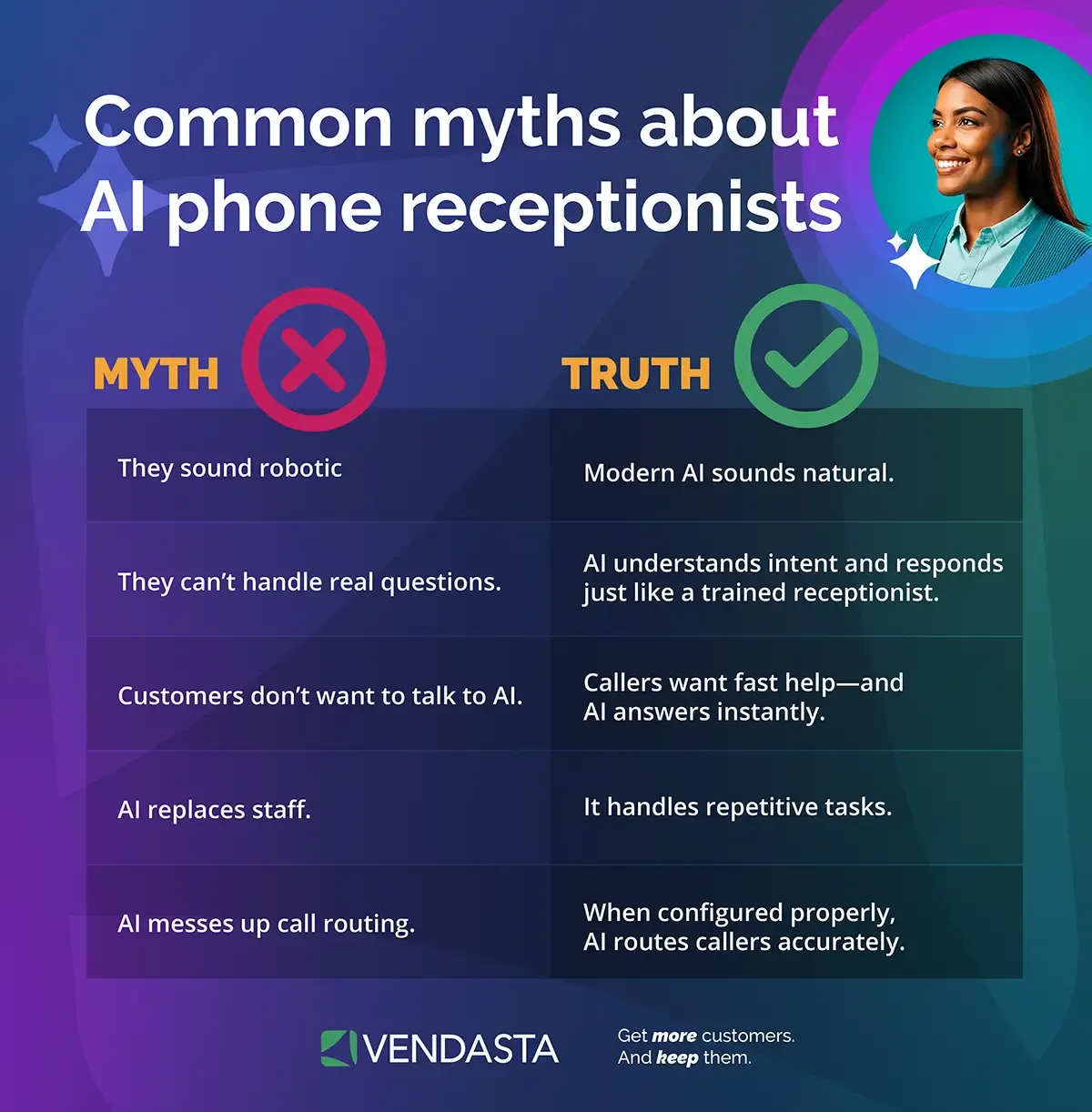
Misconception 1: “AI Receptionists Sound Robotic.”
What’s True: Modern AI sounds natural, friendly, and conversational. It can respond fluidly, adjust tone, and follow a back-and-forth exchange without rigid scripts. Callers can speak normally instead of forcing themselves into menu keywords.
Misconception 2: “AI Can’t Handle Complex Calls.”
What’s True: AI receptionists excel at answering common questions, interpreting intent, asking follow-up questions, and guiding callers to the right place. They can even handle qualification conversations for sales or service workflows when configured correctly.
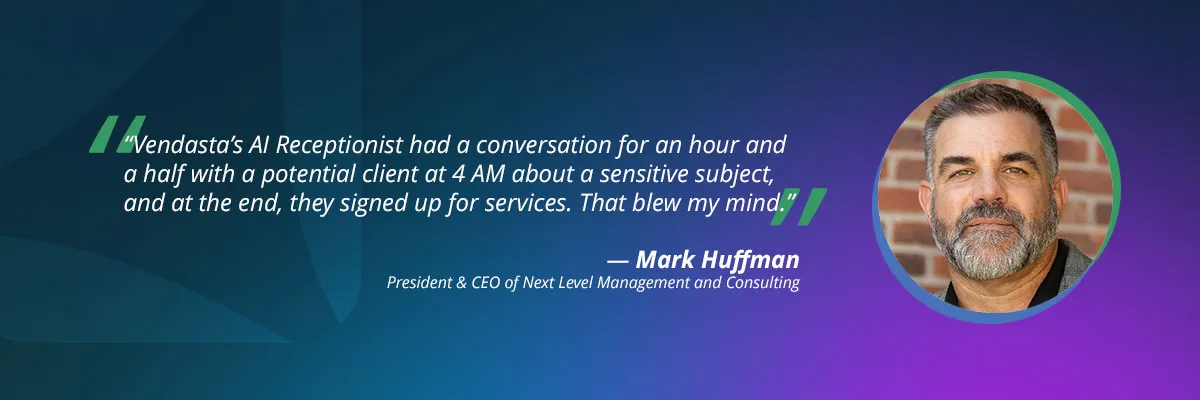
Misconception 3: “AI Won’t Understand My Customers.”
What’s True: AI receptionists can be customized with your business’s FAQs, policies, services, and routing rules. They learn from the data you give them and become better over time. With proper setup, they adapt to your specific business needs—not the other way around.
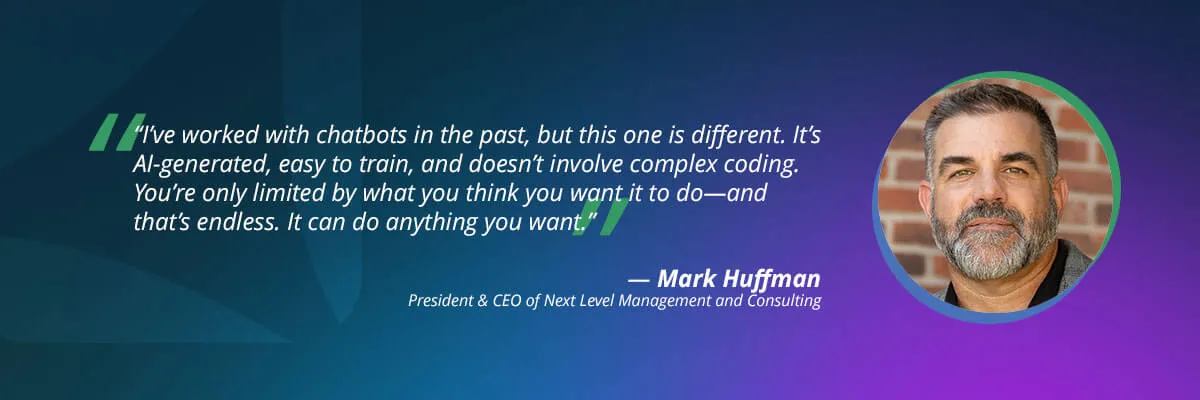
Misconception 4: “AI Will Replace My Team.”
What’s True: AI receptionists don’t replace employees. They handle repetitive tasks—answering basic questions, routing calls, capturing information—so your team can focus on human conversations that matter most. It’s a tool for efficiency, not a replacement.
Misconception 5: “AI Won’t Know When To Transfer A Call.”
What’s True: When configured with clear routing rules, AI transfers calls cleanly and quickly. It understands phrases like “billing question,” “I need support,” or “Can I talk to Sarah?” and sends callers to the right destination without forcing them through a menu tree.
Misconception 6: “AI Doesn’t Ask The Right Questions.”
What’s True: AI can ask structured discovery questions, collect details, and pre-qualify callers based on your criteria. This reduces wasted time on unqualified leads and ensures your sales or service team receives better-quality conversations.
Misconception 7: “AI Is Too Hard Or Expensive For Small Businesses.”
What’s True: Modern AI receptionists are built to be accessible, affordable, and easy to set up. Small businesses can adopt them without technical expertise, and partners can deploy them across multiple clients without huge overhead.
Misconception 9: “Once AI Is Set Up, It Can’t Be Improved.”
What’s True: AI receptionists are flexible. You can update prompts, refine responses, adjust qualification questions, and add new workflows whenever your business evolves. They improve continuously, especially as your team listens to call tests and fine-tunes behavior.
Misconception 10: “AI Receptionists Are Just Phone Trees With A Different Name.”
What’s True: Phone trees rely on rigid menus and keypad entries. AI receptionists use natural language understanding to interpret what callers actually mean. Instead of “press 1,” callers simply say what they need—and the AI handles it quickly and accurately.
Conclusion
AI phone receptionists are changing what’s possible for SMBs and the partners who support them. They answer every call instantly, qualify leads before they hit your team’s inbox, and deliver consistent, professional service without adding to your payroll.
Whether you manage a single business or dozens of client accounts, AI receptionists help you stay responsive, capture more opportunities, and create a smoother experience from the very first interaction.
Now is the moment to upgrade how your business handles inbound calls. With AI, you can eliminate missed opportunities, reduce manual work, and give customers the fast, reliable support they expect.
Ready to see what an AI phone receptionist can do for your business? Book a free demo and watch Vendasta’s AI employees transform your customer experience from day one.
AI Phone Receptionist FAQs
1. What is an AI phone receptionist?
An AI phone receptionist is software that answers calls, understands natural speech, and routes callers or collects information automatically. It replaces phone menus with conversational interactions, helping businesses deliver faster responses and reduce missed opportunities.
2. How does an AI phone receptionist work?
It listens to what callers say, identifies their intent, and takes the right action, such as answering questions, transferring the call, or booking an appointment. Modern AI receptionists use natural language understanding to respond conversationally instead of relying on rigid scripts.
3. Do I need an AI phone receptionist for my small business?
If your business misses calls, receives repetitive questions, or struggles with after-hours coverage, an AI phone receptionist can help. It provides instant responses and consistent service, which is especially valuable for small teams with limited bandwidth.
4. What can an AI phone receptionist do that a human can’t?
AI receptionists answer instantly 24/7, handle unlimited call volume, and never forget details. They can qualify leads, book appointments, and log information automatically, making them more scalable and cost-efficient than relying solely on human staff.
5. How can an AI phone receptionist improve customer service?
It eliminates hold times, ensures every caller gets attention, and provides accurate information right away. Customers appreciate fast, reliable responses, which helps businesses build trust and deliver a smoother customer experience.
6. How does Vendasta’s AI phone receptionist compare to other options?
Vendasta offers an AI voice receptionist that integrates with a broader customer acquisition and engagement platform. It not only answers calls but also connects to CRM, workflows, and AI employees, helping businesses manage the entire customer journey more effectively.
7. Can an AI phone receptionist book appointments for me?
Yes. Many AI phone receptionists can check availability, offer time slots, collect contact details, and schedule meetings automatically. This is especially useful for service businesses that rely on a steady appointment flow.
8. Is an AI phone receptionist difficult to set up?
Most solutions are easy to configure. You simply define your greeting, routing rules, FAQs, and any qualification questions. Platforms like Vendasta streamline setup by offering ready-to-use AI employees that can be deployed in minutes.
9. Will customers know they’re speaking to an AI?
Often, they won’t. Modern AI phone receptionists sound natural and handle questions conversationally. Even when callers do realize it’s AI, they usually care more about getting fast, accurate help than whether a human answers.
10. How much does an AI phone receptionist cost?
Pricing varies by platform, but AI receptionists are generally more affordable than hiring staff. They use predictable monthly pricing and can dramatically reduce the costs associated with missed calls, lost leads, and manual follow-up efforts.