


If you’re thinking of starting an AI agency, marketing automation will be a core component of your offering. These solutions save time and help small businesses reach their business goals faster, but they must do so profitably, getting a solid return on their investment (ROI).
Calculating marketing automation ROI enables AI agencies and consultancies to run more impactful campaigns and provide clients with data-backed evidence of the value of their work. Whether you want to land more leads, forge longer client relationships, or upsell existing customers, the ROI tips in this blog are for you.
Get detailed insights on where and when your prospects are engaging
What is Marketing Automation ROI and Why Does It Matter
Marketing automation ROI measures the profitability of an automation—that is, how much value it produces relative to its cost.
This calculation helps determine if a solution is worth investing in based on its ability to generate more revenue than the costs needed to run it. Understanding and tracking ROI enables AI startups and clients to develop more profitable marketing automation strategies.
Here’s why calculating and maximizing the ROI of marketing automation workflows need to be on your agency’s radar:
- Boost revenues: When properly implemented, marketing automation can give agencies higher conversion rates, happier customers, and impressive revenue growth. Agencies that meet client needs with high-value marketing automation integrations can also boost their sales.
- Control client costs: While AI lead generation and other automations come with a price tag, they also enable businesses to control other manual and operational costs, helping them save money overall.
- Deliver unforgettable customer experiences: From user segmentation to personalization, integrations using AI for small businesses can dramatically enhance customer satisfaction and brand loyalty.
With a solid grasp on automations and ROI tracking, you can be successful even as an agency of one—check out this video for insights on how to do just that:
Calculating Marketing Automation ROI
Let’s start with the formula for calculating marketing automation ROI, then we’ll break down each part step by step and discuss which inputs to use for your calculation.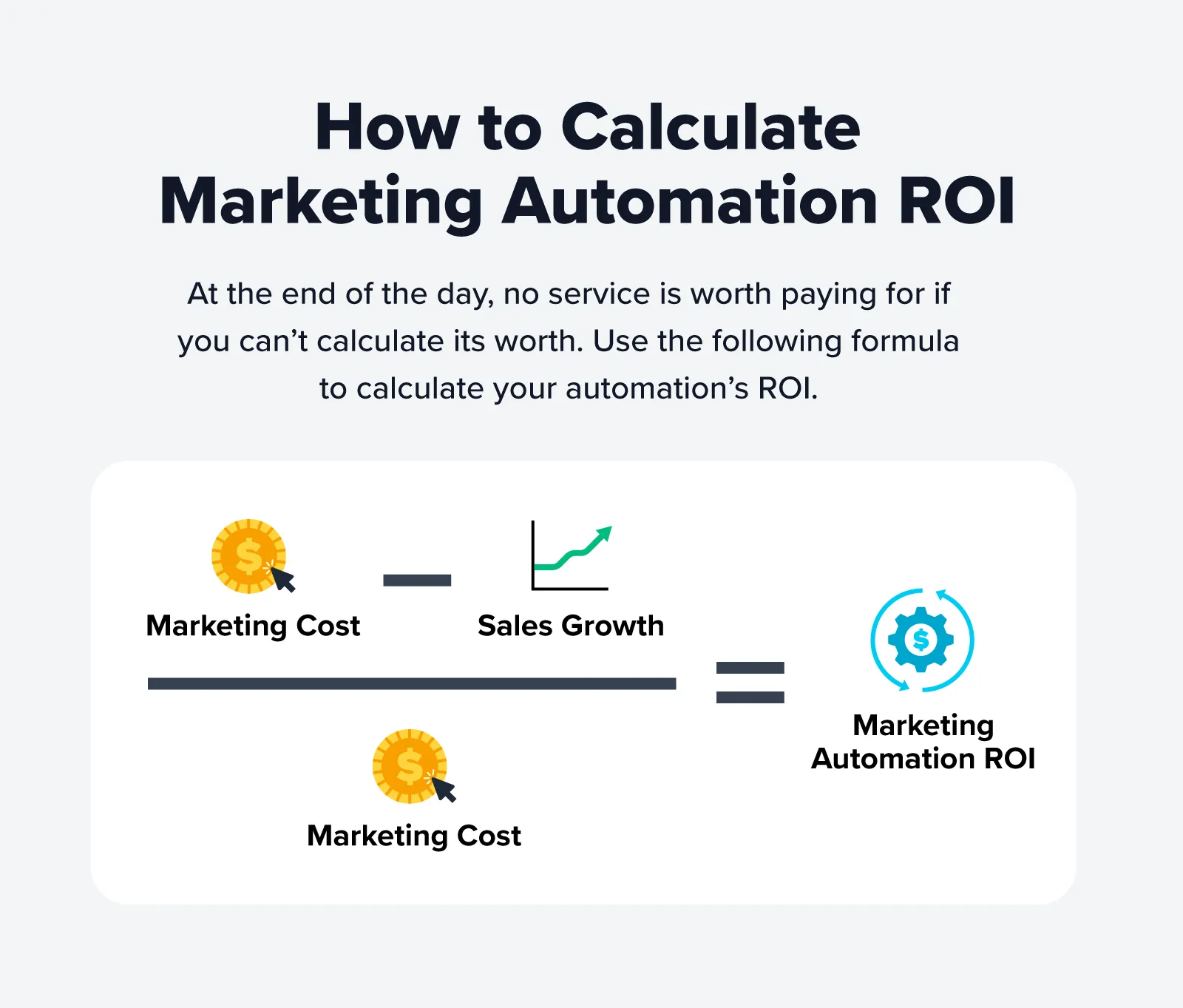 A simple formula to get a percentage automation ROI looks like this:
ROI = [(Automation Revenue – Automation Cost) / (Automation Cost)] x 100
For example, let’s say a lead automation produces $10,000 in revenue over a given period and costs $1500 to run over the same period. Plugging these numbers into the formula, we get:
ROI = [(10000 – 1500) / 1500] x 100 = 566.66, or an ROI of just over 566%. This can also be stated as an ROI of 5.6 (for every dollar spent, 5.6 dollars are earned).
This is a simple example with nice round numbers, but in reality, tracking revenue and costs correctly can be trickier. Let’s look at figures you should consider when running your calculator.
Identify Automation Costs
The automation cost portion of the formula may have multiple inputs rather that you need to add together. These can include:
- Subscription costs: Marketing automation platforms have costs. Often, for a new solution, businesses will sign up for more flexible monthly plans which are typically more expensive. Once familiar and satisfied with a solution, they can opt for cheaper annual plans.
- Data migration fees: AI integration services may include costs associated with transferring data between systems or to new systems.
- Training and staff time costs: Some solutions may require staff training, which can produce costs in terms of staff time. While this may not be significant and isn’t usually an ongoing cost, small business budgets are tight and it’s important to factor in every cost. Some staff time may also be needed to work in collaboration with the automation.
- Agency time: Agency time may be billed to maintain an automation, pull relevant data, and ensure a solid ROI.
Identify Automation Returns
Much like costs, returns can be made up of multiple components like the following:
- Increased leads: AI-powered funnels can generate more leads through automated campaigns. While these may not show up on the bottom line as revenue sources yet, they are of great value to businesses.
- More conversions: By setting up adequate conversion tracking, extra conversions can be attributed to specific solutions and added to market automation ROI.
- Lifetime value growth: Automations like AI email marketing can foster stronger client relationships, boosting their average lifetime value.
For a return like increased leads, you need to attribute a dollar value to each lead before plugging it into the formula above. This value will vary from one client to the next, but you could use a formula like this:
Average lead value = Average customer value x conversion rate
If the average customer value is $15,000 and the average conversion rate for leads in your client’s pipeline is 10%, the value of each lead would be $1500.
Tip: Grab our free ebook to learn more about using automation in your marketing strategy here –> Agency Marketing through Automation.
Industry Benchmarks for Marketing Automation ROI
An industry benchmark is a point of reference against which results can be assessed. These are important for marketers and their clients because they provide a realistic context for what can be expected in terms of marketing automation ROI.
However, ROI can vary significantly by activity and industry. For instance:
- Email open rates: On the upper end, email open rates are around 41.6% in industries like real estate, finance, health and fitness, and manufacturing. On the lower end, IT, online courses, and construction see open rates of around 33% (HubSpot).
- SEO: In a snapshot from August 2023, the median number of clicks on search engine results across all industries was 1730 (Databox). But this varies considerably by industry—for example, clients in the automotive space have a higher median number of clicks (8710), while SaaS companies have a lower median (1670). It’s important to look for benchmarks specific to your small business clients’ industries.
- Website conversions: Ecommerce website conversions range between 1.84% and 3.71% depending on the niche, while B2B websites generally see higher conversion rates, around 2.23% to 4.31% (Matrix Marketing Group).
Benchmarks are a useful starting point, but they aren’t the upper limit of what you can achieve. For example, this case study from Apartments.com showcases how using marketing automation best practices to boost review generation lead to an impressive 1112% review volume growth.
Strategies to Boost Marketing Automation ROI
Marketing automation ROI isn’t fixed: it’s always changing in response to tweaks in your campaigns. Here’s how to boost that number.
Lead Scoring and Nurturing
The best client relationship management (CRM) systems come with lead scoring capabilities, assigning priority to leads based on behavior. For example, if a lead opens every email and has a high level of engagement with content, they’re more likely to convert and would have a higher score.
To keep leads engaged—and get valuable behavioral data—lead nurturing campaigns are essential. These are automated email flows that deliver relevant content to email lists consistently, moving them along the sales funnel toward conversion. The aim is to send content that maximizes the likelihood of conversion and shortens the sales cycle, so consistent use of A/B testing is key to helping your clients craft more impactful emails.
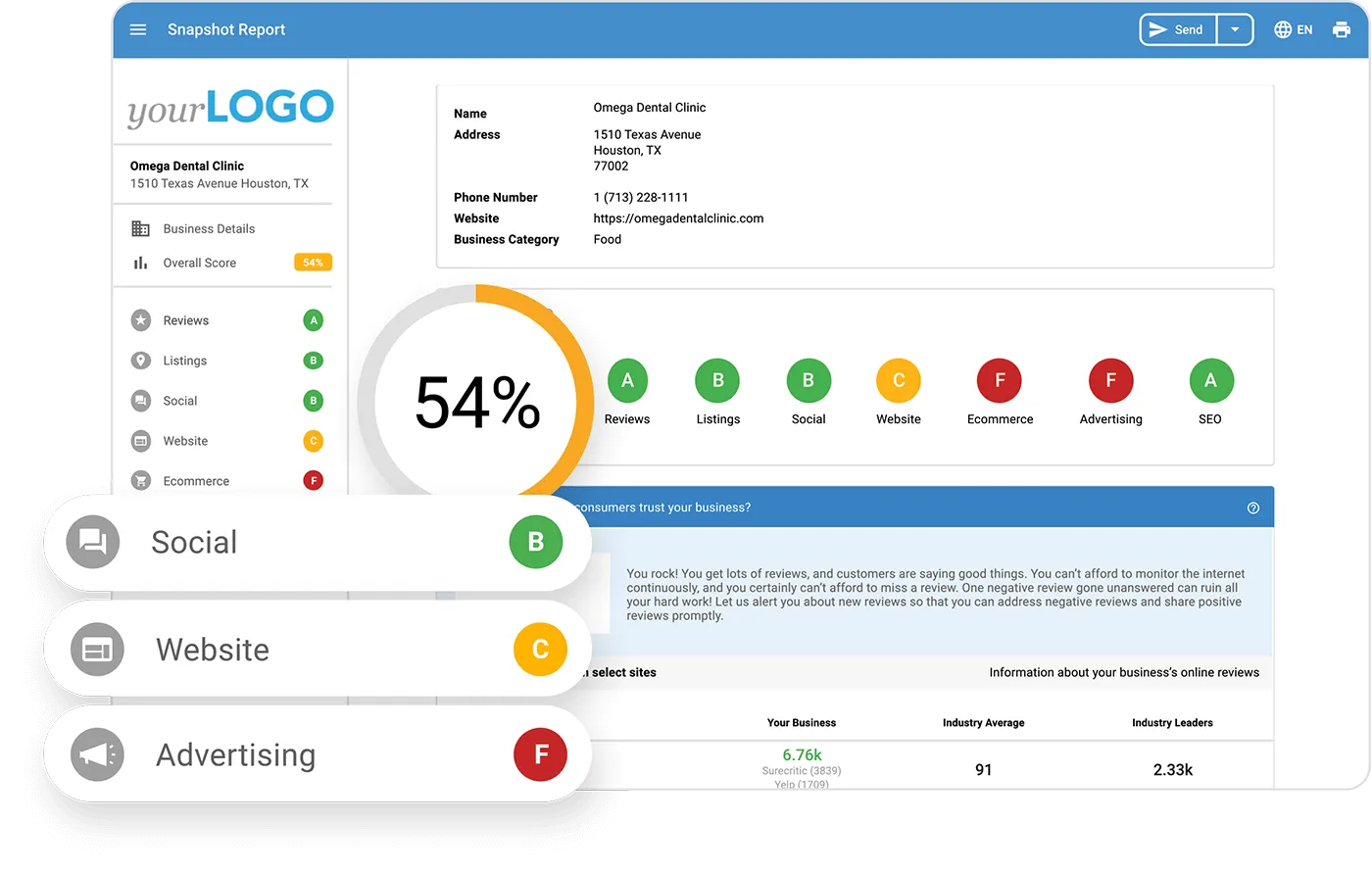
Tip: Get a report card of your prospect’s performance across a variety of channels so you can create powerful and persuasive messaging that you know will resonate. Learn more about Vendasta’s Snapshot Report here.
Personalized Customer Journeys
The idea of personalization has gotten a lot of traction in digital marketing spaces for years, but with AI making new business ideas and strategies possible, it’s more relevant than ever. The more you can cater the customer journey to each buyer’s unique needs, the more conversions you’ll achieve.
Using AI-powered email marketing platforms makes it easy to boost marketing automation ROI through audience segmentation. By creating segments of like audiences, you can deliver more relevant content to each group, from onboarding flows to lead re-engagement flows. Contextual messaging—that is, messages that are only delivered in a certain context, like when a user takes an action—enables businesses to get even more granular with their personalization, all through automation.
Email Marketing Automation
One of the best ways to maximize marketing automation ROI is through the use of email automations. The beauty of email campaigns is that once the bulk of the work is done, businesses can spend a relatively small amount of time tweaking designs and copy while the email platform does the heavy lifting of engaging leads, retaining customers, and even winning back lapsed customers.
Engagement tracking is essential to email success, so make use of a feature-rich platform that integrates with your CRM so that you and your clients can keep an eye on key performance indicators (KPIs) with a few clicks.
Customer Feedback and Support
Customer support is essential to client retention, and busy small businesses can struggle to deliver it at scale as they grow. Help them boost their marketing automation ROI by enabling them to gather customer feedback and deliver high-quality support at scale, even with a small team, with these techniques:
- Trigger automatic customer feedback surveys after an action is taken
- Use AI content tools to create high-quality self-service knowledge bases and resource centers for customers, and AI WordPress website builders to create an FAQ page or knowledge hub
- Deliver front-line customer support through trained, human-like chatbots, reducing the amount of staff time required for live chat.
Best Marketing Automation Tools for Maximizing ROI
Popular marketing automation platforms with robust automation and personalization features include Vendasta, HubSpot, and ActiveCampaign.
When choosing a tool to help your agency make money with AI and support your client’s goals, look for these features:
- Workflow automation
- Email marketing
- Lead scoring
- Audience segmentation
- Integration with other tools and with your CRM of choice
- Analytics and report generation
The more your platform can pull data from other tools and sources, the more accurate your picture of overall marketing automation ROI will be.
Vendasta’s marketing automation software allows agencies to attract, acquire, and convert local businesses that are ready to buy.
Measuring and Optimizing Marketing Automation ROI
To optimize ROI, you need an accurate picture of key metrics.
Important KPIs to track include:
- Conversion rates
- Leads generated
- Cost per lead
- Leads per conversion
- Average customer lifetime value
- Customer value by lead source
- Email open rates and conversion rates
A powerful analytics tool—ideally, one built into your marketing dashboard or CRM—makes all these metrics available at a glance.
Then, as you test and iterate variations of your campaigns, you can track precisely how each change impacts ROI. Automation saves vast amounts of time and resources, but if there’s one area where teams should double down on their efforts, it’s on measuring and optimization. When you understand which activities drive the most profits, scaling becomes a repeatable formula.
FAQs
1. What is marketing automation ROI?
Marketing automation ROI measures how much revenue a business earns compared to what it spends on automation tools and processes. It shows whether automations—like lead nurturing, email campaigns, or CRM integrations—are profitable and worth the investment.
2. Why is marketing automation ROI important for agencies and SMBs?
Calculating ROI helps agencies and small businesses understand which automation strategies deliver the best financial results. It ensures every marketing dollar spent drives measurable value, improves efficiency, and strengthens client relationships through data-backed decision-making.
3. How do you calculate marketing automation ROI?
Use the formula:
ROI = [(Automation Revenue – Automation Cost) / Automation Cost] x 100.
Include all costs such as subscriptions, training, and agency time, and factor in returns like increased leads, conversions, and higher customer lifetime value.
4. What costs should be included when calculating ROI?
Key costs include software subscriptions, setup and data migration fees, staff training, and time spent by agencies managing automations. Including all hidden and ongoing costs ensures your ROI calculation accurately reflects profitability.
5. What are examples of returns from marketing automation?
Returns include higher lead volume, increased conversions, reduced customer churn, and improved customer lifetime value. Automations also reduce manual labor costs, improve operational efficiency, and drive faster, more consistent sales growth.
6. What is a good marketing automation ROI benchmark?
The average ROI for digital marketing is about 3.6x, but automation can far exceed that. Many agencies report ROI between 400–600% from optimized email and lead nurturing campaigns. Results vary depending on industry, tools, and execution quality.
7. How can agencies boost marketing automation ROI?
Use lead scoring and nurturing workflows, personalize customer journeys, and track engagement through integrated CRMs. Vendasta’s AI-powered tools, like Snapshot Report and Marketing Automation, help agencies refine campaigns and target the highest-value opportunities.
8. How does personalization affect ROI?
Personalized campaigns drive stronger engagement and higher conversions. By tailoring emails, offers, and ads to customer behavior and preferences, businesses build trust and loyalty—leading to better performance and higher ROI.
9. What KPIs should you track to measure marketing automation ROI?
Track metrics like conversion rates, cost per lead, lead-to-customer ratio, customer lifetime value, and email engagement rates. Monitoring these KPIs helps identify which campaigns deliver the strongest financial results.
10. How can Vendasta help maximize marketing automation ROI?
Vendasta provides an all-in-one automation platform with CRM integration, AI-powered lead scoring, workflow automation, and detailed analytics. Agencies can use it to resell automation tools, optimize performance tracking, and drive measurable ROI for every small business client.
