About Us
 Careers
 Leadership
 Board
Board Newsroom
Something broke in the economics of software this year, and most agencies are still pricing like it didn’t. Vibe coding for entrepreneurs has moved from novelty to norm: 63% of vibe coding users are now non-developers, and Gartner forecasts that 40% of new enterprise production software will be created with vibe coding techniques by 2028. The people building software are no longer the people who know how to code. They are the people who know what the business needs.
Jon Cheney is the cleanest proof of that shift we have found. He is a founder who raised $13 million in venture capital, ran a team of 50+ developers, and served clients like Google, Meta, Lego, and Walmart. He also cannot write a single line of code. After exiting that company, he vibe coded an entire business (software, brand, billing, the works) in one weekend for about $400, landed a $15,000 contract five days after starting, and grew it to $1 million in revenue completely solo within six months.
That is exactly why we sat down with Jon Cheney, founder of the General AI Proficiency Institute (GenAIPI), on the Conquer Local podcast.
In this guide, Jon Cheney shows you how he built and sold his first product in five days, how he turned one-off projects into $10,000 to $25,000 monthly retainers as a fractional Chief AI Officer, and why agencies (not solo founders) are actually holding the best cards in this game.
He didn’t just build fast — he automated every part of starting a company that once required a team.
Turn a plain-English prompt into a live, branded client app
TL;DR
- The cost of starting a software business collapsed. Jon Cheney was quoted $105,000 by a dev shop for an app he later vibe coded in 20 minutes. His entire current business cost roughly $400 to launch and produced a $15,000 contract within five days.
- The money is in the retainer, not the build. Jon’s fractional Chief AI Officer model starts at $10,000 per month, averages $17,000, and took him to $1 million solo in six months. Recurring beats project every time.
- Agencies are the governance layer this wave needs. Gartner warns that ungoverned citizen-developer builds will increase software defects by 2,500% by 2028. Tools like Vendasta Vibe let agencies ship vibe-coded apps that are already wired to their clients’ CRM, brand, and data, so speed doesn’t come at the cost of quality.
What Is Vibe Coding for Entrepreneurs?
Vibe coding for entrepreneurs is the practice of building working software by describing what you want in plain language and letting AI generate, connect, and deploy the code. Instead of hiring developers or learning to program, an entrepreneur prompts an AI builder, reviews the result, and iterates in real time. The output is real, usable software: dashboards, client portals, voice agents, internal tools, and full products.
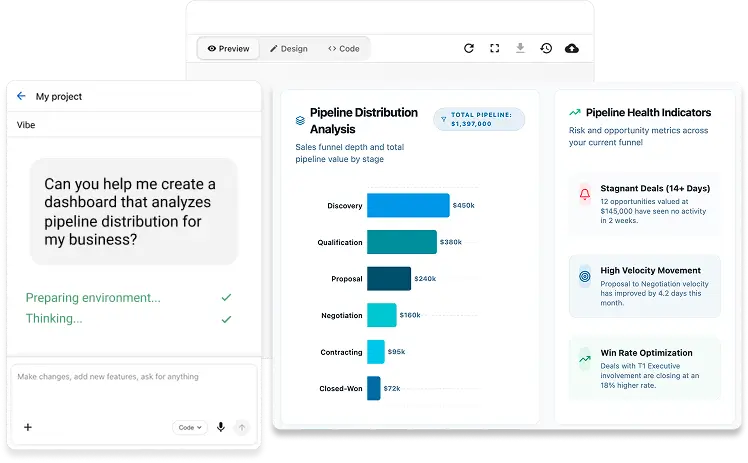
In practical terms, vibe coding lets a non-technical founder or agency owner:
- Turn an idea into a working prototype in minutes, not months
- Connect systems that don’t talk to each other (CRM, phone, spreadsheets, billing)
- Build custom internal tools instead of paying for another SaaS subscription
- Demo a solution live on a sales call instead of sending a proposal
Jon puts the ceiling on it bluntly: “We have absolutely moved into a world where founders do not need engineers.”
From $13 Million Raised to a $400 Weekend
Before any of this, Jon Cheney lived the version of entrepreneurship everyone cheers for on LinkedIn. He founded Seek, an augmented reality company, raised $13 million, employed more than 50 developers, and at his peak was burning $600,000 a month.
“That world where you’re raising a ton of money, you’re pushing towards an exit. Why? Because that’s how everybody makes their money. That’s how those investors make their money,” he told us. “In this business, I’ve really focused on building towards profitability.“
The unlock came from a LinkedIn post. A Bay Area VC described watching someone build software in ten minutes on a vibe coding platform. At that exact moment, Jon was about to sign a $105,000 dev shop proposal for a travel app idea. The shop had already sent over a seven-page architecture document.
So he ran an experiment. He dropped that architecture document into a vibe coding platform and typed, “Build this.”
Twenty minutes later, the first version existed. Within the hour, he was using it. “I don’t need this dev shop anymore,” he remembers thinking. “That was the unlock.”
He spent the next three to four months building roughly 20 apps, not to launch businesses, just to test the edges of what was possible. Then came the Thursday morning that changed his trajectory.
“I built the same software twice. The first time it cost me $3.2 million in 18 months. The second time it cost me $400 in one weekend.” — Jon Cheney, Founder, GenAIPI
The Five-Day Business: Idea on Thursday, $15,000 Contract by Tuesday
Jon set himself a public challenge: compress the entire zero-to-one experience of entrepreneurship into a single day. Start Thursday. First customer by Friday.
The idea: an “AI IQ test.” People would take a short assessment of their AI skills. High scorers could pay $59 for a full certification from the General AI Proficiency Institute. Low scorers would be offered courses. Everyone becomes a paying customer.
Here is what the build actually took:
| The weekend build | The numbers |
| Total build time | Roughly 35 to 40 hours across Thursday, Friday, and Saturday |
| Total cash outlay | About $400 (roughly $140 on vibe coding, the rest on an LLC, domain, logo, and banking) |
| Launch | Ads live by Saturday night, finished at 3 a.m. |
| Monday morning result | 140 ad clicks. Zero purchases. |
The Stripe checkout was misconfigured. The fix took five minutes. But Jon didn’t wait for the funnel to work. “I’m a sales guy and an entrepreneur,” he said. He jumped on LinkedIn, messaged his network, and offered to come test and train teams on AI. By Tuesday morning, one warm contact had signed a $15,000 contract (roughly $150 per person for a company of about 104 people).
Five days from discovering the idea to a $15,000 deal. Six weeks later, he had booked about $180,000 in business, completely solo.
His diagnosis of why most builders never see a dollar is worth taping to your monitor: “The reality is AI only helped the product come to life. Millions of people do this every day and they don’t get any customers. Why? Because they don’t talk about it enough.”
The build was never the hard part. The selling was. And that, as we’ll get to, is exactly why agencies should be paying attention. If you want the deeper mechanics of packaging and pricing this kind of offer, our guide on how to sell AI agents pairs well with Jon’s playbook.
The Pivot That Made It Recurring: Fractional Chief AI Officer
The one-day training model worked, but it had a ceiling. Then a former neighbor who owns a pool company asked the question that rewired the business: what happens after the training? How do people actually adopt this?
“Right there, my mind was like recurring revenue,” Jon said. On that same call, he invented a new offer: instead of $15,000 for a day, he would become the company’s fractional Chief AI Officer. Ongoing strategy, training, builds, and follow-up. The client’s response: “That’s what I want. Send me the contract.”
The economics of the pivot:
| Model | Price | What it buys |
| One-day training | $15,000 one time | Assessment plus a single training day |
| Fractional Chief AI Officer (entry) | $10,000/month | Embedded strategy, training, and builds |
| Fractional Chief AI Officer (average) | $17,000/month | Deeper implementation cadence |
| Fractional Chief AI Officer (top tier) | $25,000/month | Fastest transformation pace |
Six clients at roughly $150,000 per year each, plus other revenue, put him at the $1 million mark in six months, at one point taking home $80,000 a month solo. Only after crossing $1 million did he hire, deliberately trading short-term income for a model that could scale past his own calendar.
This is the same math behind Vendasta’s partner program: projects pay once, systems pay every month.
What Jon Actually Sells (and Who Buys It)
The ideal client: successful companies with no CTO
Jon’s targeting filter is refreshingly specific. He looks for businesses doing solid revenue that have no technical leadership. Law firms. Dental offices. Staffing companies. Pool companies.
“Go for the main street companies, the blue-collar ones. Piano stores, paint shops, HVAC companies. They don’t have tons of technology. A lot of them still use paper.” — Jon Cheney, Founder, GenAIPI
These CEOs are watching everyone talk about AI on LinkedIn; they’ve poked at ChatGPT, gone too deep too fast, and quietly given up. They are one confident conversation away from a retainer. Sound like anyone on your client roster?
Every sales call is the same call
Jon swears his first call is identical whether the prospect makes $6 million or $100 million:
- Five minutes of genuine pleasantries. Connection first.
- One question: “Tell me, what are you guys doing with AI?” The answer is almost always some version of “we know nothing.”
- Position them as ahead, not behind. “The fact that you’re even talking to me right now means you’re already taking that next step.”
- Let them sell themselves. “Tell me some things you think AI could do well at your company right now.” They list three to five painful, expensive problems.
- Walk each problem to a solution. “What if we had a dashboard that connected to everything and you could just push a button?”
- Anchor the pricing openly. $10,000 per month starting, average client at $17,000, many at $25,000. Then: “When do you want to start?”
Show up with something: the close that beats every proposal
Jon never sends proposals. He builds instead. On the call (or right before it), he vibe codes the exact dashboard the prospect described, drops in their logo, and fills it with mock data.
“Now all of a sudden they’re seeing mock data with their logo on a dashboard that looks like it can do something. Boom. The dress is on the girl and they’re ready to buy.”
The psychology, in his telling, is the same reason his wife sends him photos of a dress on a model who looks like her rather than on a hanger. People can’t visualize. So don’t make them. He has closed deals mid-call by texting the prospect a link to the tool they had just finished describing.
Real Builds: What Vibe-Coded Deliverables Look Like
Talk is cheap, and dashboards are cheaper, so here is what the work actually produces.
The staffing company hotline. A California staffing firm managing about 5,000 employees was legally required to staff an incident hotline. It consumed three full-time staff, and 90% of the calls were simple status checks. Jon vibe coded a custom incident dashboard, connected an ElevenLabs voice agent to the phone line, and wired the transcripts into the workflow. Results: staffing on the hotline dropped from three people to one, case resolution time fell from 39 days to 11, and the company saved roughly $100,000 a year. Implementation took a couple of weeks. Nobody lost their job. The two freed-up team members moved to the HR projects they had been postponing for years.
The BYU Athletics grade report. An administrator overseeing 600+ student athletes spent about five days every month manually compiling grade reports from a folder of spreadsheets. Jon dragged the folder into a vibe coding tool, spent three minutes writing the prompt, and got back a full analytics dashboard about ten minutes later. The administrator’s reaction: “You just gave me back a week a month.”
CEO command centers. Jon’s most requested build is the dashboard that turns a CEO from spectator to operator: live business data plus action buttons. One example lets a CEO segment his client base and send a personal message directly, collapsing a workflow that used to involve a marketing manager, a list pull, and a MailChimp upload into one click.
The pattern across every engagement is identical: disconnected systems (Calendly, spreadsheets, HubSpot, Salesforce, QuickBooks) and a leader who just wants to understand their own business.
Jon’s first-week audits typically surface 50 to 60 potential projects per company. He and the CEO pick the five with the highest impact, then measure time saved and money saved on each one to prove ROI on the retainer. This is the same philosophy behind AI employees: the value isn’t the technology, it’s the boring, expensive work the technology quietly removes.
He even runs his own back office this way. “I would never pay for a CRM today. I just wouldn’t. I have no reason to. I can build it,” he said, describing the custom CRM and QuickBooks-connected finance dashboard he built for himself.
“Stop assuming that other people know more about AI than they actually do. If you’re listening to this right now, you’re already in the top 5 percent.” — Jon Cheney, Founder, GenAIPI
5 Lessons for Agencies Sitting on a Vibe Coding Goldmine
Jon spent six weeks cold-messaging strangers to book $180,000. You have something he had to earn one call at a time: a roster of clients who already trust you. Here is his playbook translated for agency owners.
1. You already have what he had to cold-call for
“If you already have the clients, you should already know their needs. I know the needs of every one of my clients. If I needed to give a report right now on every single client, I could.” – Jon Cheney
His prescription for agencies is one move this week: pick a client, vibe code a prototype that solves a problem you already know they have, and send them a link. “Show up with something. Remember the dress on the girl.”
Then price the maintenance and build-out as a retainer add-on. In Jon’s example, that prototype conversation ends with “it’d be an extra five thousand dollars a month for us to do this.”
2. Sell capability and systems, not code and maintenance
The biggest failure mode Jon sees is agencies accidentally becoming dev shops. Software never stops asking for one more feature, and if you’re not technical, that treadmill will bury you. His model has three verbs: help them see it, help them build it, teach them to maintain it. He trains clients to vibe code their own tweaks and positions his team as the safety net. “I really like to empower my clients to feel like we’re a resource, but they’re still in charge.”
Retention comes from the relationship and the roadmap, not from hoarding the keys.
3. Price for what delivery costs at 30 clients (Not 3)
Jon’s floor is $10,000 a month, and his reasoning is an ops lesson, not an ego one. A $2,000 retainer feels winnable until you do the math on delivery, marketing, payroll, and accounting at scale. “At three clients, you can charge whatever you want. The thing that doesn’t translate is when you have thirty clients.” Set your minimum based on what it takes to be genuinely responsible for another company’s success, then target clients who can afford it. Our breakdown of how to make money with AI covers more pricing models for this exact service line.
4. Distribution is the moat
We asked Jon what matters when everyone can build an app. His answer took two seconds: “Distribution, hands down. That’s it. At that point, it’s distribution and brand.”
He posts on LinkedIn at least once a day, often three times, and unlike most gurus, he publishes his actual strategies and results. “A lot of people don’t actually put their strategy and their results on LinkedIn. I just do. And then people are like, that’s really cool, but I don’t know how to do it. Clearly you do. Let me hire you.” His visibility engine started on day four of the business, before he had a single customer.
5. Agencies are better positioned than software companies
Jon’s closing argument was aimed squarely at this audience.
“Agencies are actually in a better position than bigger software companies these days because agencies are nimble and you’re not stuck. You’re not tied to one product. You’re stuck helping the client.” — Jon Cheney, Founder, GenAIPI
Software companies defend a roadmap. You defend a relationship. When a new capability like vibe coding shows up, you can adopt it on Monday morning. There’s a reason vibe coding for agencies has become one of the fastest-growing service conversations in the channel.
5 Vibe-Coded Services You Can Launch This Quarter
Need starting points? These five builds map directly to what Jon sells, and each one gets easier when it plugs into tools your agency already runs.
- Client performance dashboards. The number one request from CEOs. Build a live command center per client, or skip the manual wiring entirely with an automated executive report that compiles proof of performance for you.
- AI voice and chat front doors. Jon’s staffing hotline build is repeatable for any business that bleeds calls. Pair a vibe-coded intake dashboard with an AI Receptionist that answers 24/7 across phone, SMS, and chat.
- Internal ops tools. Commission calculators, grade reports, scheduling boards. Anything currently living in a folder of spreadsheets is a ten-minute prototype.
- Sales enablement apps. Custom proposal generators and pitch tools. Lead with data: a Snapshot Report gives you the needs assessment, and the vibe-coded demo closes the gap between insight and “send me the contract.”
- Client portals with pipeline visibility. Give clients one branded place to see leads, conversations, and results, connected to a CRM AI that keeps the data clean without anyone typing notes.
Vendasta Vibe: Vibe Coding That Already Knows Your Clients’ Businesses
Here is the gap between Jon’s playbook and most agencies’ Tuesday afternoon. Jon spent months getting “pretty dang good” at prompting, and even then, general-purpose builders start every project the same way: a blank page that knows nothing about the business. No brand. No customer records. No systems. You spend the first hours of every build teaching the AI who the client is and wiring up integrations by hand.
Vendasta Vibe removes that entire phase because it runs inside Vendasta’s small business software platform, which already holds your clients’ business data.
The first draft already looks like the client
Vibe pulls each client’s brand, logo, services, and business details directly from their business profile before you type your first prompt. That “dress on the girl” demo Jon closes deals with? Vibe generates it already dressed. For an agency running dozens of clients, that turns onboarding a new build from days into minutes.
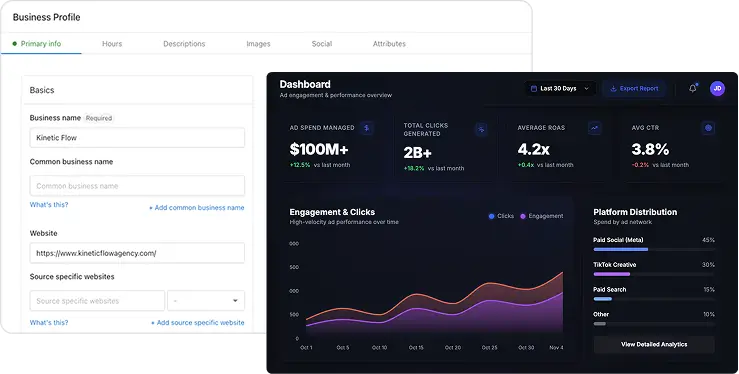
Every lead lands in the CRM automatically
Jon’s core service is gluing disconnected systems together. Vibe skips the glue. Every form on a Vibe-built page flows straight into the CRM, where AI employees can pick up the lead, follow up, and book the job. You’re not building an app next to the client’s business. You’re building it into the client’s business.
White-label builds you actually own
Vibe supports white-labeling, so the sites, apps, and dashboards you deliver carry your client’s brand (or yours), and every project exports as portable React and TypeScript. Full code access, no lock-in. You can manage a separate project for every client from one account, which is precisely the “systems, not chaos” structure Jon says separates a scalable AI practice from an accidental dev shop.
Proof it holds up in production
Vendasta tested Vibe on itself first, building its internal support platform on Vibe in days and retiring a Zendesk subscription that cost more than $100,000 a year. Partners moved just as fast: one agency co-founder built a working proposal generator for a client during a video shoot, before the drones landed.

The 10 Best Vibe Coding Tools for Entrepreneurs and Agencies in 2026
Every tool below can turn a prompt into working software. They differ on who they’re built for, what they connect to, and what happens after the demo.
1. Vendasta Vibe
Vendasta Vibe is the only vibe coding platform on this list built for agencies serving local businesses. Instead of opening to a blank page, it opens with the client’s business already loaded: brand assets, business knowledge base, CRM forms, analytics, backend database, hosting, and version history are pre-wired through its Connectors panel. Builds publish instantly to secure domains with hosting handled, leads flow directly into the CRM where AI employees can act on them, projects are white-label ready, and every app exports as portable React and TypeScript with full source access. It’s free to try in beta with 250 daily credits, with add-on credits for scale.
Best for: Agencies and local business partners who want vibe-coded apps that ship already connected to their clients’ brand, CRM, and AI workforce.
2. Lovable
Lovable is the breakout star of prompt-to-app builders, generating polished full-stack web apps with genuinely strong design out of the box. GitHub sync gives you code ownership, and Supabase powers the backend. It’s a superb generalist, though every project starts from zero business context, so client work means re-teaching it who the business is each time.
Best for: Non-technical founders shipping a standalone MVP fast.
3. Bolt.new
Bolt.new is the speed king for prototypes, with a full development environment in the browser and the fastest prompt-to-running-app time among web builders. The generated code is scaffold-quality by design, so most teams validate ideas in Bolt and rebuild for production elsewhere.
Best for: Rapid demos, hackathons, and “let me show you what I mean” moments.
4. Replit
Replit bundles a cloud IDE, an autonomous agent, databases, and hosting into one browser tab, and most of its users never write code at all. The trade-off is platform lock-in: your database, auth, and hosting live on Replit’s infrastructure, which gets complicated when a client relationship (or a migration) demands portability.
Best for: Solo builders and internal tools that will live their whole life on one platform.
5. Cursor
Cursor is the AI-native code editor that professional developers reach for, with deep codebase context and precise multi-file edits. It assumes you can read and steer code, which makes it powerful for technical teams and frustrating for everyone else.
Best for: Developers who want AI acceleration without giving up control of the codebase.
6. Claude Code
Claude Code is a terminal-first agent that handles long, complex, multi-file engineering tasks with impressive autonomy. Like Cursor, it rewards professional developer knowledge, and it’s a common second stop for hardening apps that started life in a web builder.
Best for: Technical teams doing serious refactors and production hardening.
7. v0 by Vercel
v0 generates beautiful React frontends from prompts and slots natively into the Vercel ecosystem. It’s frontend-only, with no databases, auth, or business logic, so plan on pairing it with a backend or a developer.
Best for: UI and landing-page generation for React teams.
8. Base44
Base44 offers one of the most guided, beginner-friendly paths from prompt to working app, with deployment included and predictable pricing. It’s a strong on-ramp, though agencies managing many client projects will outgrow its single-app orientation.
Best for: First-time builders who want the gentlest learning curve.
9. Devin Desktop (formerly Windsurf)
Devin Desktop is an agentic IDE built for large, existing codebases, now under the Cognition umbrella after its 2026 rebrand. It shines when the job is navigating and modifying big repositories rather than starting fresh.
Best for: Teams working across large legacy codebases.
10. GitHub Copilot
GitHub Copilot remains the most affordable AI pair programmer and has closed much of the gap with newer rivals. It’s an assistant rather than an app generator: it accelerates coding you’re already doing instead of building complete applications from a description.
Best for: Developers who live in VS Code and want inline AI assistance at the lowest price.
The Window Is Open (It Won’t Stay This Empty)
Jon Cheney’s argument, stripped to one sentence: the distance between an idea and a paying customer has collapsed from 18 months and $3.2 million to one weekend and $400, and almost nobody has noticed yet. “Stop assuming that other people know more about AI than they actually do,” he told us. “If you’re listening to this right now, you’re already in the top 5 percent.”
For agency owners, the assignment is uncomfortable in its simplicity. You already have the trust. You already know the pain points. The only question is whether you show up to next week’s client call with a slide deck or with a working prototype wearing their logo.
Jon’s parting advice applies double to you: “Just go do it. Pick up the tools. They’re right there in front of you. The playing field has never been more even.”
Pick one client. Build one thing. Send one link. And if you want your builds to start with the client’s business already wired in, book a demo with Vendasta today.
Vibe Coding for Entrepreneurs FAQs
1. What is vibe coding for entrepreneurs?
Vibe coding for entrepreneurs is building working software by describing it in plain language to an AI platform instead of writing code or hiring developers. The AI generates, connects, and deploys the application while the entrepreneur directs it conversationally. It compresses the journey from idea to working product from months to hours and puts custom software within reach of non-technical founders and agency owners.
2. Can you really start a business with vibe coding and no technical skills?
Yes. Jon Cheney built his entire company, GenAIPI, in one weekend for about $400 without writing a single line of code, and landed a $15,000 contract five days after starting. The pattern that works is building a simple version fast, then selling it immediately through your network rather than waiting for ads to convert.
3. How much does it cost to launch a vibe-coded business?
Far less than most people expect. Jon Cheney’s total launch cost was roughly $400, with about $140 going to vibe coding credits and the rest to an LLC, domain, logo, and banking setup. Compare that to the $105,000 dev shop quote he received for a simpler app, or the $3.2 million he once spent building comparable software the traditional way.
4. What is a fractional Chief AI Officer?
A fractional Chief AI Officer is an outside expert who embeds with a company part-time to lead AI strategy, training, and implementation. Jon Cheney pioneered the model at $10,000 to $25,000 per month, averaging $17,000 per client. The role covers auditing systems, prioritizing high-ROI automation projects, building tools, and training staff, giving companies executive AI leadership at a fraction of a full-time hire.
5. What kinds of businesses buy vibe-coded solutions?
Successful companies without a CTO buy fastest: law firms, dental offices, staffing agencies, pool companies, and main street blue-collar businesses like HVAC companies and paint shops. These owners see AI everywhere, know they’re missing out, and have no one internally to lead. One vibe-coded build for a 5,000-employee staffing firm cut hotline staffing from three people to one and saved about $100,000 a year.
6. How should agencies price vibe coding services?
Price for delivery at scale, not for what feels winnable today. Jon Cheney sets a $10,000 monthly floor because a $2,000 retainer leaves no room for payroll, marketing, and accounting once you have 30 clients instead of 3. Anchor pricing to the value delivered, lead with a working prototype instead of a proposal, and structure the engagement as recurring revenue rather than one-off builds.
7. What is the biggest mistake agencies make with vibe coding?
Becoming an accidental dev shop. Software generates endless feature requests, and agencies that take on unlimited technical maintenance drown in scope. Jon Cheney’s alternative: help clients see the solution, build it with them, then teach them to maintain it themselves with your team as the safety net. Capability and systems are the product, not code and tickets.
8. What makes Vendasta Vibe different from other vibe coding tools?
Vendasta Vibe starts with the business already loaded instead of a blank page. Each client’s brand, business knowledge base, CRM forms, analytics, database, and hosting are pre-wired before the first prompt, and every lead captured by a Vibe-built app flows directly into the CRM where AI employees can follow up. Projects are white-label ready and export as portable React and TypeScript, so agencies keep full ownership.
9. How does Vendasta help agencies turn vibe coding into recurring revenue?
Vendasta pairs Vibe-built apps with the platform agencies already use to run client programs: CRM, AI employees, reputation, campaigns, and automated reporting. That means a vibe-coded dashboard or portal becomes part of an ongoing managed service rather than a one-time deliverable, supporting the retainer model that took Jon Cheney to $1 million solo. Agencies manage every client project from one account.
10. Is vibe-coded software reliable enough for client work?
It depends on governance. Gartner projects that ungoverned citizen-developer builds will drive a 2,500% increase in software defects by 2028, which is exactly why clients need an accountable partner rather than a prompt. Agencies that review builds, control data connections, and use platforms with production infrastructure, like Vendasta Vibe’s built-in hosting, CRM integration, and version history, deliver the speed of vibe coding without the fragility.