About Us
 Careers
 Leadership
 Board
Board Newsroom
Your clients want custom tools. Landing pages built for a specific campaign. Dashboards that show their actual data. Proposal generators. Lead capture apps. Booking flows.
But every time you need one, you’re stuck. Waiting on a developer. Paying a freelancer. Delivering something generic that barely fits.
While you spend days chasing down a simple build, competitors are launching custom tools in hours — with no developers on staff.
Vibe coding is how they’re doing it. And the results are hard to argue with: one agency generated $57,000 in campaign revenue from a $2,800 ad spend. Another sold 72 products in a single month from a landing page built in an afternoon. A third built a working proposal generator live on a client’s rooftop, before the video shoot wrapped.
This guide covers vibe coding for agencies: what vibe coding is, how agencies are using it, what real results look like, and how to get started.
Turn a plain-English prompt into a live, branded client app
TL;DR
- Vibe coding lets agencies build custom apps without developers. Describe what you need in plain English, and the AI builder generates production-ready software connected to your business data.
- The results are real. Agencies using vibe coding report dramatic time savings, stronger client outcomes, and new revenue they couldn’t have generated before.
- The right tool matters. Most vibe coding tools start with a blank page. The best ones for agencies start with your business data already loaded.
What Is Vibe Coding?
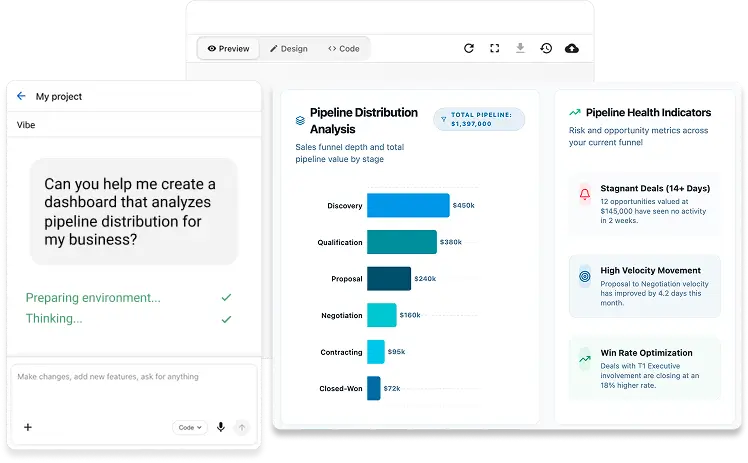
Vibe coding is the practice of building software by describing what you want in plain language, then letting AI generate it. Instead of writing code, you have a conversation.
The term was coined by Andrej Karpathy, co-founder of OpenAI, in early 2025. By 2026, it has gone from a viral concept to a mainstream development methodology — Google Trends indicates searches for the term have spiked by more than 2,400% since January 2025, and Collins Dictionary named it Word of the Year.
For agencies, vibe coding means something specific: the ability to build custom client tools, internal apps, and campaign infrastructure without hiring a developer or waiting weeks for delivery.
Why Vibe Coding Is Taking Over Agency Workflows in 2026
The frustration has been building for years. Agencies are technically capable, but the tools they rely on weren’t built for them.
A Vendasta 2026 survey, The Vibe Coding Revolution, 97 agencies and business owners found:
- 41% of agency respondents spend 10 or more hours per client asset, even with technical skills
- 35% say their platforms don’t connect to each other
- 35% say their tools don’t connect to their actual client data
- 33% say software is too rigid to customize for individual client needs
The underlying problem is simple: off-the-shelf software is built for the average business, which means it fits nobody perfectly.
Vibe coding addresses all three complaints at once. It’s fast, it’s customizable to each client, and, with the right platform, it’s connected to your existing data from the moment you start.
The Scale of Adoption
Industry adoption reflects the shift. 92% of US developers now use AI coding tools daily, according to 2026 data. But vibe coding’s bigger story is what it’s unlocking for non-developers: marketers, account managers, and agency owners who can now build what they need without a technical co-founder or a development retainer.
What Agencies Are Actually Building With Vibe Coding
The most common misconception about vibe coding is that it’s only useful for simple landing pages. The reality in 2026 is much broader.
Agencies are using AI app builders to create:
- Campaign-specific landing pages with lead capture connected directly to their CRM
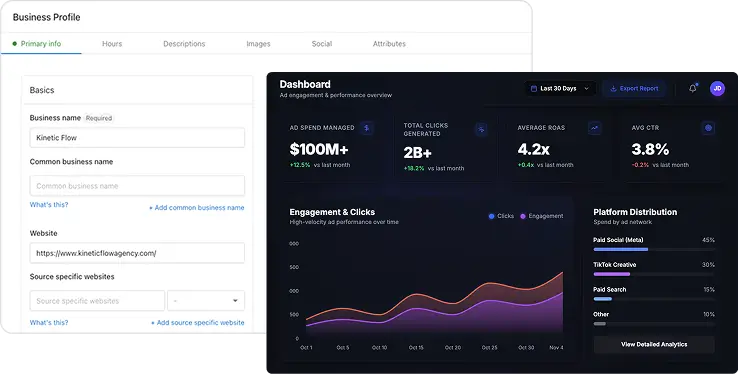
- Client performance dashboards pulling live data from multiple platforms in one view
- Proposal and quote generators that save hours of manual document work per week
- Booking flows with scheduling tools embedded and confirmation emails automated
- Reporting tools that show clients exactly what they need to see, without exporting spreadsheets
- Trade show apps with business card scanning and automatic CRM routing
Each of these would have previously required a developer, a budget, and days or weeks of back-and-forth. With vibe coding, agencies are building them in hours.
Vibe Coding for Agencies: 3 Real Examples With Real Revenue
The strongest case for vibe coding isn’t theoretical. Here’s what agencies are actually achieving with Vendasta Vibe.
These three Vendasta AI Certified Partners were early adopters of Vendasta Vibe. They aren’t tech companies or enterprise giants — they’re agencies just like yours, doing things that weren’t possible before.
Howell Studios AI Marketing: 72 Trailers Sold in One Month
Matt Dakin, COO at Howell Studios AI Marketing, came to Vibe with high expectations. What he found changed how his agency works at every level.
His first major test: a cargo trailer manufacturer needed a targeted landing page to drive conversions from a paid ad campaign. Dakin built the page in Vibe, complete with a product catalog, specs, pricing, and a quote request flow. The client sold 72 trailers in a single month.
Dakin also started using Vibe to produce AI strategy documents for clients, a service that previously took days or weeks. He built a custom AI Employee that pulls from CRM records, brand positioning, and SEO gaps, then outputs a full client strategy. He pastes that into Vibe, which renders it as a polished one-pager in about 30 minutes, a key tool for winning over clients in that critical first 90 days.
For a trade show campaign, he built a landing page with integrated CRM forms and scheduling tools, generating 14 bookings from a single event. His team is now building a business card scanner app that automatically extracts contact details and routes leads directly into the Vendasta CRM.
“You can think big, you can dream big, you can drop it in there, and it just gets to work.” — Matt Dakin, Howell Studios AI Marketing
Mitchell Media: $57,000 in Cookie Sales From a $2,800 Ad Spend
Chris Geer, Senior Sales Consultant at Mitchell Media, had been watching AI tools evolve for years. When he got access to Vibe, he immediately started building things his clients had been asking for.
His first build: an email reporting dashboard that took about 30 minutes of actual work. His client’s reaction was immediate. “This is exactly what I needed. I love it.” A follow-up meeting was booked the same day.
A standout example is the Girl Scouts cookie campaign. Geer built a matching engine that identified 1,215 likely cookie buyers from first-party data, a process that had taken hours manually the year before, then built a live dashboard showing the client they’d generated $57,000 in cookie sales from a $2,800 ad spend. The results were compelling enough that the Girl Scouts booked a larger fall campaign on the spot.
In a separate engagement, he built a full campaign package for a realtor webinar, including a landing page, HTML email, and social posts, in a single afternoon. Before Vibe, that would have taken days and multiple people.
“We would have had no way of doing this at all without Vendasta Vibe.” — Chris Geer, Mitchell Media
Black Feather Digital: A Proposal Generator Built Live on a Rooftop
Brett Prieskorn, co-founder and CEO at Black Feather Digital, thinks in products, not deliverables. Since getting access to Vendasta Vibe, he’s been building them faster than most agencies schedule discovery calls.
Built live, on-site: Brett was on the roof of a client’s home during a video shoot when the client mentioned he spent one to four hours every evening writing proposals. Brett opened Vibe on his phone while they were talking. By the time the shoot wrapped, the proposal generator existed. That same task now takes the client 30 minutes.
That’s become something of a pattern. A branded quiz called the Human vs. AI Sales Gauntlet, the kind of interactive lead capture tool that would have taken days in WordPress, came together on a friend’s patio while he was dogsitting.
For Brett, Vibe isn’t a faster way to do the same work. It’s a way to build things that wouldn’t have existed otherwise — created on a rooftop, on a patio, on a phone.
“This would have taken forever before. I would have had to do it in WordPress.” — Brett Prieskorn, Black Feather Digital
Introducing Vendasta Vibe: The AI App Builder Built for Agencies
The three agencies above all used the same tool: Vendasta Vibe. And what separates Vibe from every other AI builder on the market is where it starts.
Most AI app builders open to a blank page. You configure the brand, upload the assets, wire up the integrations, and spend an hour on setup before you’ve built anything. Vendasta Vibe works differently. It pulls your client’s business profile, logo, services, and data automatically — so your first draft already looks and feels like their business.
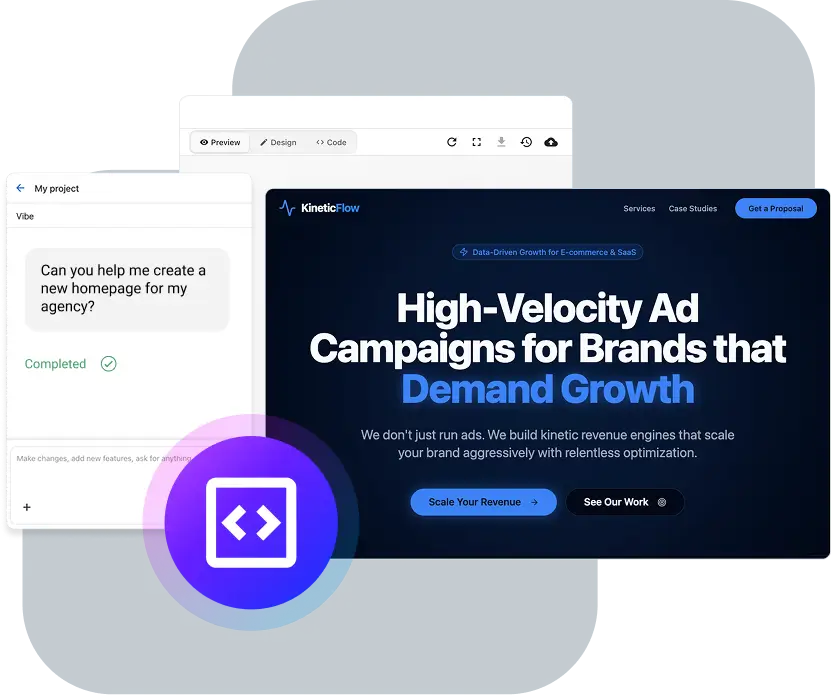
From there, you build by describing what you need in plain English. “Build a website for my plumbing services.” “Create a quote estimator for a roofing company with a lead capture form connected to my CRM.” “Show me how this business is performing by pulling in reviews, Google visibility, and social growth.” Vibe builds it and publishes it to a live, secure domain in minutes.
What Vendasta Vibe includes:
- Chat-based development: Describe what you need and watch it get built, no code required
- Business profile pre-loaded: Every project starts with your client’s brand and data already in place
- Native CRM integration: Every form submission routes directly to your CRM the moment it happens
- Instant publishing: Production-ready apps go live on secure domains with built-in hosting
- Multi-client management: Manage separate projects for every client from a single Vendasta account
- White-label delivery: Every app you build carries your client’s brand, not the tool’s
- Full code ownership: Complete source code and file tree access, with version history and one-click restore
- Point-and-click visual editor: Refine layout and copy without touching a prompt
Vibe isn’t a standalone tool you bolt onto your workflow. It runs as part of the Vendasta platform, so leads, sign-ons, analytics, and your AI workforce all connect automatically as your client’s business grows.
What to Look for in a Vibe Coding Tool for Agencies
Not all vibe coding tools are built for agency work. Most are designed for solo developers building prototypes. Before choosing a platform, evaluate it against five criteria that matter specifically to agencies.
1. Does It Start With Your Business Data?
Most AI builders start with a blank page and make you configure everything from scratch. The best tools for agencies pull your business profile, client data, and brand details automatically, so your first draft is already relevant and branded.
2. Does It Connect to Your CRM?
A landing page that doesn’t route leads into your CRM is a dead end. Look for builders where form submissions, bookings, and sign-ups flow directly into your existing stack without manual wiring.
3. Can You Manage Multiple Clients From One Account?
Agencies serve multiple clients simultaneously. The right platform lets you create and manage separate projects for each client, with their own domains and branding, all from one login.
4. Is It Production-Ready, Not Just Demo-Ready?
There’s a significant gap between a tool that looks good in a demo and one that runs your client’s business reliably. Look for built-in hosting, automated error recovery, and apps that stay functional without constant manual maintenance.
5. Does It Support White-Labeling?
The apps you deliver to clients should carry their brand, not the tool’s. White-label capability is essential for agencies that want to position custom software as part of their own service offering.
Vibe Coding Tools for Agencies: How the Major Platforms Compare
| Feature | Vendasta Vibe | Lovable | Bolt.new | GoHighLevel AI Studio |
|---|---|---|---|---|
| Business profile pre-loaded | Yes | No | No | No |
| Native CRM integration | Yes | No | No | Partial |
| Multi-client management | Yes | No | No | Yes |
| Production-ready apps | Yes | Prototypes | MVPs | Funnels only |
| White-label and reselling | Yes | No | No | Yes |
| Full code ownership | Yes | Yes | Yes | No |
Vendasta Vibe is built specifically for agencies managing multiple clients on a shared platform. Unlike general-purpose builders that start from scratch, Vibe pulls from your Vendasta business profile automatically, so every project begins with your client’s brand, services, and data already in place.
How to Get Started With Vibe Coding at Your Agency
If you’ve never shipped an app through a conversational prompt, the process is more straightforward than it sounds. Here’s a practical starting point.
Step 1: Start With a Real Client Problem
Pick something specific: a landing page for an upcoming campaign, a lead capture form, a client-facing dashboard. Don’t start with a complex internal tool. Start with something that would take your team a day or two to build the traditional way.
Step 2: Write a Detailed Prompt
Describe the goal, the audience, the key elements, and any integrations you need. The more specific you are, the better the first draft. Example: “Build a landing page for a roofing company that calculates a quote based on square footage and materials, with a lead capture form that routes to our CRM.”
Step 3: Review, Then Refine
Your first output won’t be final. Use the visual editor or follow-up prompts to adjust layout, copy, and functionality. Think of it as briefing a junior designer who’s very fast and very literal.
Step 4: Connect Your Data
Link the app to your CRM, your client’s business profile, or any relevant data source before publishing. This is where the tool earns its keep: not the build itself, but what happens after someone fills out a form.
Step 5: Publish and Track
Deploy to a live domain and monitor results. With the right platform, you can restore previous versions, track changes, and iterate without starting from scratch.
The Business Case for Vibe Coding at Scale
The math changes quickly when you start applying vibe coding across your client base.
If a typical client deliverable takes your team eight hours and you’re billing at $100 per hour, that’s $800 in internal cost per build. A vibe-coded equivalent takes two hours. The same deliverable costs $200 to produce.
Do that across 20 clients per month and you’ve freed up 120 hours of capacity — roughly three full weeks of work — without adding a single hire.
That’s the real argument for vibe coding for agencies: not just speed, but margin. And with 71% of agencies already planning to adopt AI app builders in 2026, the agencies that move first build a capability gap their competitors can’t close quickly.
The Bottom Line
Vibe coding for agencies isn’t a future trend. It’s what the fastest-growing agencies are doing right now to deliver more, bill smarter, and compete against teams twice their size.
The agencies in this guide aren’t outliers. They’re early movers. And the gap between agencies that have adopted vibe coding and those that haven’t is only going to grow.
Vendasta Vibe is an AI app builder built specifically for agencies. It starts with your business data already loaded, connects every build to your CRM, and supports multi-client management and white-labeling from day one.
Get a free demo of Vendasta Vibe.
Vibe Coding for Agencies FAQs
1. What is vibe coding for agencies?
Vibe coding for agencies is the practice of using AI-powered tools to build custom client software, landing pages, apps, and dashboards through plain-language descriptions rather than traditional code. It enables agencies to deliver custom digital tools without a development team, dramatically reducing build time and cost.
2. Do I need technical skills to use vibe coding tools?
No. The best vibe coding tools are designed for non-technical users. You describe what you need in everyday language, and the AI generates a working app. Tools like Vendasta Vibe also include a code editor for those who want more granular control, but it’s entirely optional.
3. How is vibe coding different from using a website builder like Wix or Squarespace?
Website builders give you templates and drag-and-drop components. Vibe coding generates custom apps from a description, connected to your real business data. The output is more flexible, more personalized, and starts from your actual business context rather than a generic template.
4. Can vibe-coded apps connect to my client’s CRM?
Yes, with the right platform. Vendasta Vibe connects directly to the Vendasta CRM, so every form submission, booking, or sign-up flows into your client’s contact records automatically. No manual exports, no data silos, no third-party connectors required.
5. How long does it take to build an app with vibe coding?
Most agencies report building functional first drafts in 15 to 60 minutes. More complex tools with multiple integrations take a few hours. This compares to days or weeks for traditional development, making vibe coding particularly valuable for time-sensitive campaign work.
6. What kinds of tools can agencies build with vibe coding?
Agencies are building landing pages, client performance dashboards, lead capture forms, quote and proposal generators, booking flows, trade show apps, reporting tools, and internal operations trackers. Essentially, anything that would typically require a developer can now be described and built conversationally.
7. Is vibe coding secure enough for client-facing apps?
Security depends on the platform. Look for built-in hosting with HTTPS, role-based access controls, and full code ownership. Vendasta Vibe runs on a trusted platform with automated error recovery, audit trails, and the ability to restore any previous version at any time.
8. How does Vendasta Vibe differ from other vibe coding tools like Lovable or Bolt.new?
Most vibe coding tools start with a blank page. Vendasta Vibe starts with your business profile already loaded, pulling your client’s brand, services, and data automatically. It also integrates natively with the Vendasta platform for multi-client management, CRM connectivity, and white-label delivery — features that general-purpose builders don’t support.
9. Can I resell vibe-coded apps to my clients?
Yes. Vendasta Vibe supports white-labeling, so the apps you build carry your client’s brand, not the tool’s. You can manage all projects from a single Vendasta account and deliver each client a branded experience on their own domain, positioning custom software as part of your agency’s own offering.
10. How do I get started with vibe coding for my agency?
The fastest way to start is to pick one real client problem and build a solution for it. Sign up for Vendasta Vibe, write a specific prompt describing the tool you need, review and refine the output, connect your CRM, and publish. Most agencies have their first client-ready app live within a few hours of signing up.