About Us
 Careers
 Leadership
 Board
Board Newsroom
How to sell AI agents becomes concrete in Isabella Bedoya’s account of building a $1.2 million AI business from organic LinkedIn content, with no paid ads, cold outreach, or sales team.
Sell one agent that fixes one expensive problem for one type of local business. Price it on the revenue it recovers, then put a $47 offer in front of the high-ticket build so the client’s first dollar comes easy. That is how agencies sell AI employees to local businesses: pick a single niche, solve one costly problem, and make the entry point low enough that saying yes is simple. The model keeps acquisition lean and conversion high by anchoring value to dollars recovered rather than hours delivered.
That system is what Isabella Bedoya, founder of Izzy GPT, laid out for Vendasta co-founder Jeff Tomlin on episode 817 of the Conquer Local Podcast, “She Made $1.2M Selling AI Agents (EXACT 4-Step Framework).” The four-step framework below comes from that interview. The pricing and unit economics that follow show how to operationalize it, with contract guidance for controlling risk.
The sections that follow give you an operator’s procedure covering niche and use-case selection, packaging, pricing with real dollar ranges, unit economics, sales channels, the pitch, contracts and liability, and the maintenance work clients evaluate when deciding whether to renew.
Automate every step of the customer journey with AI employees
TL;DR
- Isabella Bedoya’s four-step system works without sales calls: She built a $1.2 million AI business with LinkedIn content, lead magnets, a $47 boot camp, and AI agent builds priced from about $8,000 to $20,000, with no paid ads, cold outreach, or sales team.
- Inbound beat the phone: Bedoya says 200 sales calls produced $40,000 while her boot camp system brought in $150,000, and her LinkedIn lead magnets sold $180,000 of AI agents in six weeks.
- AI Receptionist handles fulfillment: Vendasta’s AI Receptionist answers calls 24/7, qualifies leads, books appointments, and logs every action, and agencies can sell it under their own brand.
What Selling AI Agents Actually Means (Versus Automation and Chatbots)
An AI agent you can sell completes a defined job end to end: it answers the 10 p.m. call, qualifies the caller, books the appointment against a real calendar, and logs the result. Automation moves data between two systems on a fixed trigger. A chatbot waits for a prompt and returns text. Local business owners pay for the first option because it replaces a task that already costs them money.
Moneypenny’s survey found that 62% of small and medium businesses (SMBs) miss calls during peak hours. In Vida’s survey, 42% of SMBs estimated they lose more than $500 a month to missed customer calls, and 97% of the owners already using an AI voice agent reported higher revenue.
Slow lead response is the second pain. Vendasta’s case data shows that Neighborly had roughly 30% of its leads go uncontacted before 35,700 AI-handled conversations produced 3,400 conversions and a 372% year-over-year increase in leads converted to revenue. Blue River Digital’s auction house client sourced a $20,000–$30,000 commission from a single lead that arrived at 11 p.m. and that AI matched with the business.
Vendasta packages its AI Workforce as AI Employees rather than agents and names them by the job, including AI Receptionist, AI Reputation Specialist, AI Sales Assistant, and AI Social Media Manager. The naming is the pitch. A dentist buys a phone that gets answered at 6:45 p.m. after the front desk has gone home.
The Three AI Agents Bedoya Says Local Businesses Buy
Bedoya named three agent types that local businesses are paying for right now. Each one plugs a leak the business already feels.
- Speed-to-lead agent: The agent contacts a prospect the moment they fill out a form, before the lead goes cold. For an agency that already runs a client’s ads, it is a natural upsell because the traffic already exists.
- AI receptionist: The agent answers inbound calls, handles common questions, and captures leads around the clock. Bedoya’s advice is to start with a minimum viable agent that automates the three to five questions the business hears most, which shortens setup and gets the client to a first win faster.
- After-hours agent: Plumbers, HVAC technicians, and landscapers lose jobs when nobody answers on a Saturday night. The agent captures the lead and either books the job or routes the caller to an on-call technician.
What Separates a $3K Agency From a $50K Agency
Bedoya argues that the gap between an agency billing $3,000 a month and one billing $50,000 is the system, not team size or ad budget. Three components make up that system: a high-ticket offer priced on the value it delivers, an inbound lead generation engine, and a sales process that qualifies and converts without the owner running every call.
Productizing is what makes the high-ticket price possible. In her words: “The biggest gold rush is when you productize your AI agents and your AI employees. Instead of just being another $2,000-a-month agency, now you’re actually charging $10,000 a month, $20,000 a month.”
How to Sell AI Agents: Isabella Bedoya’s Four-Step Framework
Bedoya described a four-step system to Tomlin. She attracts buyers with LinkedIn content, converts them with lead magnets and an email sequence, sells a $47 boot camp, and closes the high-ticket agent offer from a landing page instead of a sales call.
She credits the system with building a $1.2 million AI business. The figure is her own account rather than an audited number, and her business includes done-for-you services, boot camps, and education offers. The thread running through all four steps is counterintuitive: the more she gave away for free, the more people paid her.
Step 1: Attract Buyers With Content
Bedoya chose LinkedIn because that is where business owners spend time, while Instagram and TikTok mostly attract consumers. After a few years on Instagram with about 2,000 followers, she went all in on LinkedIn in 2023 and grew to more than 47,000 followers by posting daily, reaching more than 8 million impressions and earning four Forbes features. Organic posting was her acquisition channel. She used no paid ads, cold outreach, or sales team.
Her posting mix follows a 60-30-10 formula. Sixty percent is pure value, including how-to posts, frameworks, process breakdowns, and educational deep dives. Thirty percent is story and lessons from running the business. Ten percent is results and proof, meaning client wins and case studies.
Her second rule, the 1-1-1-1 formula, governs what every post is about: one problem, one solution, one ideal client, and one offer. She recommends holding that focus until the business reaches its first $1 million in revenue before expanding into other offers.
She also keeps links out of the body of her posts. Instead, she asks readers to comment and puts the offer inside the post itself, such as a QR code on the second page of a carousel, which keeps LinkedIn from throttling the post.
For an agency owner, that means picking a vertical before posting a word. If you have decided to sell an AI receptionist to plumbers, the 60% value content covers missed emergency calls in plumbing. The 30% shares what you learned during deployment, while the 10% presents the booked-jobs report from a real plumber.
Step 2: Convert Attention With Lead Magnets and a 7-Email Sequence
Lead magnets turn followers into a list you own. Bedoya says a series of AI agent lead magnets, promoted only through organic LinkedIn content, sold about $180,000 of AI agents in six weeks.
The best lead magnets are specific enough that the reader thinks, “How did you do that? Can you do it for me?” Four formats work well for AI agencies:
- Calculators: A missed-call revenue calculator lets the prospect enter their average ticket and call volume, so the math makes the case.
- Case studies: If you have no client results yet, analyze how a business in your niche could use a specific agent. The analysis itself builds credibility.
- Quizzes: A readiness quiz for an AI receptionist gives the respondent a score and gives you qualification data.
- Process snippets: Share one piece of a working system, such as the follow-up emails that booked appointments for a client.
Add one question to the opt-in form beyond name and email: “What is your number one challenge with [topic] right now?” The answers become your marketing language, so when prospects write “I keep missing calls on weekends,” your next post uses those exact words.
Bedoya also recommends hosting the lead magnet as a webpage rather than a PDF. Time on page shows who actually engaged, and you can send a different follow-up sequence to the readers who spent real time with it.
Every opt-in then enters a seven-email sequence:
- Deliver the resource and get the reader to open it.
- Build rapport by introducing yourself and your story.
- Name the pain point in the reader’s own words from the opt-in question.
- Begin the conversion by introducing your solution conceptually.
- Make the direct offer, with a clear call to action for the boot camp or core offer.
- Share social proof, such as a client result that mirrors the reader’s situation.
- Send a last call that closes the loop on the offer.
Step 3: Sell the $47 Boot Camp
The boot camp replaces the discovery call. Bedoya runs it as a live, three-day virtual event, one hour per day, at $47, about once a month. Each day teaches something useful that connects to the core offer, and the high-ticket offer comes on day three.
As Bedoya told Tomlin, “We could just do a boot camp once a month… and then upsell them to our high-ticket offer without having to get on all these calls.” She reports that 200 sales calls generated $40,000, while the boot camp system brought in $150,000, roughly four times as much.
Her argument for the $47 price is simple: getting the first dollar out of a client is always the hardest. She says winning the second dollar is about 90% easier because a boot camp attendee has already handed over a card. When the high-ticket offer appears on day three, the buyer is an existing customer being upsold. From there, her upsell ladder runs from the $47 boot camp all the way up to $20,000-a-month partnerships.
Step 4: Close the High-Ticket Offer With Buyer Enablement
Bedoya has sold AI agent builds from about $8,000 to $20,000, and her $8,000 build sold straight off her website without sales calls. The work a sales call would do moves to the landing page, which has to answer every question a serious buyer asks before committing. It explains what problem the agent solves, how it works step by step, what results similar businesses have seen, whether the buyer can try the agent first, what happens after signing, and what it costs. She adds a trained AI chatbot to the page to answer buyer questions and qualify them at scale, and she keeps each page to one niche and one outcome.
When a prospect still wants a call, she replies by email first to find out what they want to cover, and she caps any call at 15 minutes. At that stage, the call confirms logistics rather than overcoming objections. At the top of her ladder are growth partnerships at $10,000–$20,000 a month plus revenue share. These are year-long engagements, capped at about 10 clients so fulfillment quality holds.
Her pricing is value-based: she prices on what the agent is worth to the business, not the technology behind it. The rest of this article shows how to reproduce that offer with your own pricing, stack, and contracts.
Pick One Agent and One Niche Buyers Already Pay For
Start with one of Bedoya’s three agents in a vertical that already loses money on the phone. In Vida’s survey, inbound sales inquiries and lead capture was the top application among SMB voice-agent users at 31%. FAQ answering accounted for 20%, while support escalation accounted for 7%. The survey also found that 22% of SMBs were using a voice agent and another 31% planned to invest within 12 to 24 months. That is a use case with proven demand and a short path to a visible result, and it maps directly to lead capture.

Jobber’s report found 52% of blue-collar business owners now use AI in daily operations, with HVAC, plumbing, and roofing leading. The American Medical Association’s (AMA) report found that 81% of physicians now use AI professionally, roughly double the share reported three years earlier. The National Association of Residential Property Managers (NARPM) and Buildium report found 58% of property management companies use AI, up from 20% the prior year, yet only 8% have fully automated a single workflow.
Here is how three verticals map to a single sellable agent:
| Vertical | Agent to lead with | Workflow the agent replaces | Demand signal |
|---|---|---|---|
| Home services | After-hours agent or AI receptionist | After-hours call answering, emergency job booking | Jobber: 52% of owners use AI daily |
| Clinics and dental | AI receptionist | Appointment scheduling, reminders, insurance FAQs | AMA: 81% of physicians use AI professionally |
| Property management | Speed-to-lead agent | Leasing inquiry response, maintenance intake | NARPM/Buildium: 58% use AI, 8% fully automated |
Agencies benefit twice from specialization. Vendasta’s retention research found vertical-specialized providers retain clients 34% better after three years, and Social Ordeals attributed $47,698 in monthly revenue and 57 new clients in one month to AI intake for a nine-location veterinary group. One vertical also means one set of integrations, such as Jobber or ServiceTitan for home services and Dentrix for dental, instead of a new build every time.
Regulated verticals carry a compliance cost you price in up front. A clinic deployment that touches patient information requires a Business Associate Agreement under the Health Insurance Portability and Accountability Act (HIPAA), and Vapi’s pricing page lists its HIPAA add-on at $2,000 a month. Property management agents fall under Fair Housing rules, and outbound AI voice calls require prior express consent under the Telephone Consumer Protection Act (TCPA). Pick home services first if you want the shortest path to a signed contract.
Package It as a Productized Offer
A productized AI agent offer has fixed deliverables, a fixed scope, a fixed price, and a defined delivery timeline. That structure is part of what let Bedoya sell an $8,000 agent build from a landing page instead of a sales call. Custom scoping invites a discovery-and-proposal cycle; a product invites a checkout.
The deliverables list should fit on one page:
- Scope document: You define the channels covered (phone, web chat, SMS), the hours of operation, and what the agent may never do, such as quoting a refund.
- Knowledge setup: The agent learns from the business’s website, service list, price sheet, and FAQs, so answers are specific to that business.
- Integrations: Calendar and customer relationship management (CRM) connections put bookings where the staff already work.
- Escalation rules: Named triggers hand a conversation to a human, and the contract states how fast that happens.
- Reporting: A weekly or monthly log records calls answered, leads qualified, and appointments booked.
- Tuning: You make a defined number of prompt and rule changes each month.
The following delivery models compete for the same client, and each trades margin against control:
| Model | How it works | Strength | Tradeoff |
|---|---|---|---|
| Productized service | Fixed scope, setup fee plus retainer, repeatable build | Sells without custom proposals; fulfillment repeats | Clients with unusual workflows fall outside scope |
| Custom agency build | Scoped per client, priced on hours or value | Highest ticket; Bedoya’s $10,000–$20,000/month growth partnerships | Capped by your team’s hours; she limits these to about 10 |
| Self-serve SaaS resale | Client pays a subscription and configures it | Lowest fulfillment cost | Lowest price point and the client can churn in a click |
The productized model is the one that scales without a hire per client. Keep the custom tier for the 10 accounts that justify it, and refuse the rest.
What to Charge: Pricing Models With Real Numbers
Charge a setup fee plus a monthly retainer. Model the gross margin before quoting, and treat Bedoya’s $8,000–$20,000 agent builds as a value-pricing reference rather than a universal benchmark.
The Promethean Research report found the $175–$199 and $200–$249 hourly rate brackets together account for 68% of agencies. AI-related services have climbed from 10% to 17% of agency revenue.
At those rates, a $10,000 build priced against 50 hours of senior time works out to $200 an hour, inside the agency brackets.
Here is how planning ranges break out by model:
| Pricing model | Range | Where it fits |
|---|---|---|
| Setup fee | $750–$1,200 basic inbound; $1,200–$2,000 with CRM/calendar; $2,000–$3,500 multi-flow | Every deal; covers build hours |
| Monthly retainer | $299–$499 solo contractor; $499–$799 local business with 3–10 staff; $799–$1,200 mid-size | Ongoing tuning, monitoring, reporting |
| Tiered subscription (white-label) | $150/month basic resale; $499–$999/month productized | Reselling a platform under your brand |
| Usage-based | $0.75–$1.00 per minute on top of a retainer | Enterprise or high-volume voice |
| Pay-per-outcome | $150–$600 per booked meeting | Outbound lead generation |
| Revenue share | $10K–$20K/month plus a percentage of revenue | Growth partnerships with a capped roster (Bedoya’s model) |
Tiered pricing by vertical is a useful planning check. As illustrative planning assumptions rather than market data, you might use $400 a month for a solo contractor and $650 for real estate or roofing. Legal, healthcare, or multi-location clients may support a $1,000 tier.
Price the outcome, then check the margin. A plumber who estimates losing more than $500 a month to missed calls covers a $650 retainer with one recaptured $600 job. A clinic that fills its after-hours appointment requests may support a $1,000 tier once the price also covers its compliance costs. Bedoya’s $8,000–$20,000 price points become defensible when the recovered revenue and engagement scope support them.
The Unit Economics of an AI Agent
A voice agent for a local business at 1,000 call minutes a month runs about $142 in variable cost on a mid-range stack, against a $650 retainer. Each input below is the vendor’s published rate.
Here is the monthly stack, using Vapi with no Success Package, Twilio inbound, Deepgram Nova-3 for speech-to-text, GPT-5.6 Terra, and ElevenLabs Flash/Turbo for text-to-speech:
| Line item | Rate | Monthly cost at 1,000 minutes |
|---|---|---|
| Vapi platform fee | $0.05/min | $50.00 |
| Twilio inbound local | $0.0085/min | $8.50 |
| Twilio local number | $1.15/month | $1.15 |
| Deepgram Nova-3 speech-to-text | $0.0048/min | $4.80 |
| GPT-5.6 Terra input (250 tokens/min) | $2.00 per 1M tokens | $0.50 |
| GPT-5.6 Terra output (167 tokens/min) | $12.00 per 1M tokens | $2.00 |
| ElevenLabs Flash/Turbo text-to-speech (1,500 chars/min) | $0.05 per 1,000 chars | $75.00 |
| Total variable cost | ~$141.95 |
Text-to-speech is more than half the bill. Swapping ElevenLabs Flash for Deepgram Aura-2 at $0.030 per 1,000 characters brings text-to-speech cost down to about $45 a month; Aura-1 at $0.015 brings it down to about $22.50. The model layer is the smallest line; telephony comes in under $10.
The monthly margin on one client looks like this, assuming one hour of support at a $100 loaded internal cost:
| Item | Amount |
|---|---|
| Retainer (professional tier) | $650 |
| Variable stack | −$142 |
| Support hour | −$100 |
| Monthly gross profit | $408 (63%) |
That worked example produces a 63% gross margin before overhead. A $1,500 setup fee against a 10-hour build covers the labor at $150 an hour, and every month after the first carries less implementation labor.
Real token usage will run higher than the illustrative assumption; Vapi’s own calculator shows OpenAI costs of $0.0077–$0.0452 a minute at this volume, so model the pessimistic end before you quote. At 12 clients on that tier, you have $7,800 in monthly recurring revenue and roughly $4,900 in gross profit.
Vapi’s Core plan adds $29 a month if you need more than four concurrent calls. The HIPAA add-on is $2,000 a month, so a healthcare deployment must price that compliance cost separately or allocate it across enough accounts to preserve margin. An unmonitored loop can wreck the month: ZenML’s analysis of production deployments records one team’s weekly cost climbing from $127 to $47,000 in four weeks because of an undetected infinite conversation loop.
Where to Find Buyers
Bedoya sold direct off her own LinkedIn audience, so no platform took a cut of her revenue.
Each channel prices your margin differently:
| Channel | Effort | Margin | Platform economics |
|---|---|---|---|
| Direct (LinkedIn content, referrals) | High up front; compounding after | Full retainer | No fees; Bedoya’s model |
| White-label resale | Low; platform handles the build | The spread between wholesale cost and the retail price you set | Platform sets wholesale; you set retail |
| Fiverr | Low to list; race to the bottom on price | Seller keeps 80% | Fiverr takes a 20% seller commission; buyers pay a 5.5% fee plus $3.50 on orders under $200 |
| Upwork | Medium; proposals per job | Freelancer pays 0%–15% | Upwork charges a variable freelancer fee by client demand; clients pay a $0.99–$14.99 initiation fee plus 3%–5% on Basic or 8%–10% on Business Plus |
| Product marketplaces (resell a prebuilt agent) | Low; no build | Retail price minus wholesale | You set retail; platform sets wholesale and owns the catalog |
Freelance marketplaces make a weak long-term channel. Fees come off the top, buyers compare listings on price, and most projects end at delivery instead of turning into a retainer.
Use Fiverr and Upwork to build a portfolio if you have none, then move to direct sales. A $650-a-month retainer sold directly to a roofer produces recurring revenue without losing 20% from the top, while a one-time marketplace build ends after delivery.
The Pitch: Discovery, ROI Framing and Objections
Bedoya’s funnel is built to make discovery calls unnecessary, but many agencies will still run short calls while their inbound engine builds. A 15-minute call needs one number from the prospect: what a missed call or a slow follow-up costs them. That number is the basis for your return on investment (ROI) math, and everything else is confirmation.
Six Discovery Questions to Ask
Ask these questions in order and write down the answers:
- How many calls come in on a typical day, and how many go to voicemail after hours or during jobs?
- What is an average job or first appointment worth?
- Who follows up on web leads today, and how long does it take?
- Which calendar and CRM does the team live in?
- What does the agent need to never do (quote prices, promise refunds, give medical or legal advice)?
- Who reviews the weekly report, and what result would make this a clear win in 90 days?
If 10 calls a week go unanswered and one in five would have booked a $600 job, the business is leaving roughly $1,200 a week on the table, or about $62,000 a year.
Elite Web Professionals’ deployment of AI Receptionist for Choice Signature Luxury Car Rental handled 1,017 calls and qualified 778 leads at a 76% conversion rate over four months. Separately, iMedia Audiences built an estimated $200,000 monthly appointment pipeline from 80 bookings averaging $2,500. Show the client’s numbers beside results like these and the $650 retainer looks small.
How to Handle the Four Most Common Objections
These come up in nearly every call. Answer each in one or two sentences.
“Callers will know it’s a robot.”
Tell them it identifies itself. At 9 p.m., the caller’s alternative is voicemail. The Vida survey found 97% of owners using a voice agent reported higher revenue.
“What if it says something wrong?”
The scope document lists what it will never do; escalation rules send anything uncertain to a human, and the platform logs every conversation for the owner to review. The contract section below covers the liability piece.
“We already have an answering service.”
Ask what it costs per month and whether it books directly into the calendar. Most services take a message; the agent books the job.
“It’s too expensive.”
Return to the number from question two and price the offer against the revenue the agent recovers. Bedoya uses value-based pricing, pricing the offer against what it’s worth to the business rather than the technology behind it, which is how five-figure price points stay defensible.
Build or Buy: No-Code Tools Versus Custom Frameworks
Build on a no-code platform when the deal is under $5,000 to set up and the client has no IT team. Reach for a code-first framework only when the deal is large enough to fund an engineer and the vertical demands custom logic or data control. Buy prebuilt when the job is a receptionist, reputation, or follow-up workflow and you’d rather sell AI than maintain it. That rule covers nearly every local-business deal an agency will see.
Here is how the build and buy options compare on published pricing, limitations, and fit:
| Tool | Type | Published price | Meaningful limitation | Best fit |
|---|---|---|---|---|
| Vendasta | Prebuilt AI Employees, white-label | Starter plan $99/mo; spend-offset subscriptions | Prebuilt roles cover receptionist, reputation, social, and CRM work; custom logic runs through Custom AI Employees | Agencies that want to sell AI under their own brand without maintaining a stack |
| n8n | No-code workflow and agent builder | Starter 20€/mo, Pro 50€/mo (annual); self-hosted Community Edition free | Cloud plans are execution-bound; self-hosting shifts ops work to you | Integration-heavy builds with SaaS tools the client already runs |
| Make | No-code automation | Core $9–$12/mo, Pro $21/mo, Teams $38/mo | Credit-based billing gets unpredictable at volume | Lightweight automations alongside an agent |
| MindStudio | No-code agent builder | Free (1 agent, 1,000 runs); Individual $20/mo | Free tier limited to 1 agent and 1,000 runs | Fast prototypes where you want direct API rates with no markup |
| Voiceflow | Conversational agent builder | Free, Pro, Business, Enterprise; Business at $150/mo | Credits burn per interaction and white-label requires Business | Chat-first agents needing branded deployment |
| Vapi | Voice agent platform | $0.05/min platform fee; Core $29/mo | Telephony and model costs bill separately on top of $0.05/min | Voice receptionists at local-business volumes |
| LangChain / LangSmith | Code-first framework and observability | Developer $0; Plus $39/seat/mo | Self-hosting requires Enterprise; you own every breaking change | Stateful multi-agent builds with a retained engineer |
| CrewAI | Code-first multi-agent framework | Basic free (50 executions/mo); Enterprise custom | Free tier capped at 50 executions a month | MIT-licensed teams that need portability |
Each option earns its place in a different kind of deal:
- Vendasta: Prebuilt AI Employees answer calls, book appointments, follow up with leads, request and respond to reviews, publish content, and keep the CRM updated, with no build required. Most deploy in under 30 minutes from the business’s website and records. Vendasta maintains the underlying stack and logs every action, and agencies sell the AI Employees under their own brand.
- n8n: Its 1,000+ connectors and AI Agent node handle tool-calling and memory, which fits lead qualification and CRM enrichment where most of the job is moving records between systems the client already pays for. The self-hosted Community Edition costs nothing, but you take on hosting, upgrades, monitoring, and security.
- Make: It fits the lightweight automations that sit beside an agent rather than the agent itself. Model the client’s expected volume before you quote, because credit-based billing gets harder to predict as usage climbs.
- MindStudio: It is the fastest way to prototype an agent build, with direct application programming interface (API) rates and no markup. That makes it a practical place to prove a concept before you commit a client to a production stack.
- Voiceflow: It suits chat-first agents you deploy under your own brand, with phone delivery through Twilio. Credits deduct for each interaction, so a high-traffic client changes the math.
- Vapi: It is the voice layer for receptionist builds, but the $0.05-a-minute platform fee is one line of a bill that also includes telephony, speech-to-text, the model, and text-to-speech, as the cost table above shows. More than four concurrent calls puts you on the $29 Core plan.
- LangChain and CrewAI: Both fit engineering teams that need code-level control. ZenML’s guidance points to LangGraph for complex, stateful reasoning and to n8n for rapid integration with the SaaS tools a business already runs, and CrewAI’s MIT license keeps the stack portable.
Maintenance and Lock-In Decide the Real Cost
Maintenance is where build options diverge. Managed connectors reduce the work caused by authentication and schema changes, though you still need to test workflows after vendors update them. On LangChain or CrewAI, you own every breaking change, which fits a $25,000 build with a retained engineer but can consume the margin on a $650-a-month roofer.
Lock-in runs the other way. Cloud-only no-code platforms hold your workflows, while self-hosted n8n or an MIT-licensed CrewAI stack can move anywhere.
If you’d rather own neither tradeoff, prebuilt AI Employees shift the maintenance to the platform, as the Vendasta section below covers.
Contracts, SLAs and Liability When the Agent Gets It Wrong
The business that deploys the agent bears the customer-facing liability when it errs, and your contract has to say who stands behind that business. The Federal Trade Commission’s (FTC) position is blunt: “you can’t just blame a third-party developer of the technology.”
A British Columbia tribunal reached the same result in Moffatt v. Air Canada, holding the airline responsible for its chatbot’s misinformation and rejecting the argument that the bot was a separate entity. The ABA’s case analysis explains the ruling.
- Promise what you control: Infrastructure providers commit to 99.5%–99.99% uptime, but most provider contracts make service credits the sole remedy and exclude the client’s lost revenue. Mirror that structure downstream. Write the service-level agreement (SLA) around response time to incidents, using an acknowledgment target rather than a resolution guarantee, and around human escalation: which situations route to a person and within how many minutes.
- Accuracy needs a caveat: The OpenAI business terms make the customer “solely responsible for all use of the Outputs,” and Anthropic’s commercial terms require customers to tell users that factual assertions should be checked. Pass that language through to your client, and pair it with the capability list from your scope document. Mayer Brown’s analysis recommends defining what the agent can do (book an appointment) and cannot do (issue a refund, accept liability), with mandatory human-approval triggers.
- Cap your liability: The dominant structure across provider contracts is a cap equal to fees paid in the prior 12 months, with carve-outs for gross negligence and confidentiality breaches. Published agency templates go tighter, capping claims from AI-generated content at six months of fees. Expect sophisticated clients to ask for a separate hallucination super-cap of 3–5x annual fees; decide your answer before the call.
- Data ownership: OpenAI, Anthropic, and Microsoft all assign output ownership to the customer. OpenAI does not train on business customer content without explicit agreement, and Anthropic’s commercial terms prohibit training on customer content. Your contract should state that the client owns its prompts, knowledge base, conversation logs, and connected records. It should also prohibit using client data to train anything for another client. Where the client can run its own API account (bring-your-own-key), configure the account in the client’s name so providers bill usage directly to the client and contract-end handoff stays clean.
Keep a record of which AI tools produced which deliverables; one published agency clause holds those records for three years.
And call your errors-and-omissions carrier: Ropes & Gray’s analysis warns that coverage for AI services under existing technology E&O policies “is not assured.” Many pre-2024 policies also exclude automated decision-making. Ask for an AI-explicit endorsement before you sign the first client.
After the Sale: Maintenance, Churn and Referrals
Vendors can break agents through model updates and integration changes, and those changes arrive on the vendor’s schedule. The following vendor-side events account for most of the breakage.
- Model deprecation: OpenAI’s deprecation policy gives generally available models at least six months’ notice and preview models as little as two weeks. OpenAI announced the Assistants API retirement in August 2025 and shut the API down in August 2026.
- Model retirement: Anthropic retired Claude Sonnet 4 and Claude Opus 4 from its API on June 15, 2026, after announcing the change in April. Any integration still calling those model IDs now returns errors until someone migrates it.
- Silent upgrades: Azure can automatically upgrade a deployment to a different model, which changes prompt behavior with no error to catch.
- Integration schema changes: Authentication updates and revised data structures can stop connected workflows until the agency tests and updates them.
Pricing a Maintenance Retainer
Budget real hours for this. Cleanlab’s survey of engineering leaders with live production agents found 70% of regulated enterprises rebuilt their agent stack every three months or faster. One provider estimate, uncorroborated elsewhere, puts ongoing agent work at 20–40 hours a month. For a single-purpose receptionist, start your own planning baseline at two to four hours a month for monitoring, prompt revision, integration checks, and regression testing. Then adjust once your logs say otherwise. Price the retainer to cover the bad month.
Clients churn when they cannot see the work. Marketing agencies broadly run about 1.6% monthly churn according to Focus Digital’s analysis, roughly 18% a year, and an agent nobody reports on will churn faster than that.
The counter is a report the owner reads. Vendasta’s retention research found clients who receive regular proof-of-performance reports retain 38% better, and that 62% of clients not upsold within three months churn within two years. The monthly report also drives upsells. Calls answered can lead to review requests, and each added product deepens the client relationship.
The same second-dollar logic applies after the sale. A client paying $650 a month for a receptionist that books 20 jobs has already seen the core offer’s value. Adding a review-response agent at the $299–$499 solo tier becomes a straightforward account expansion. Ask that client for two referrals in the same vertical, with the booked-jobs report attached, and your 10% proof content writes itself.
How Vendasta Helps You Sell AI Agents Without Building Them
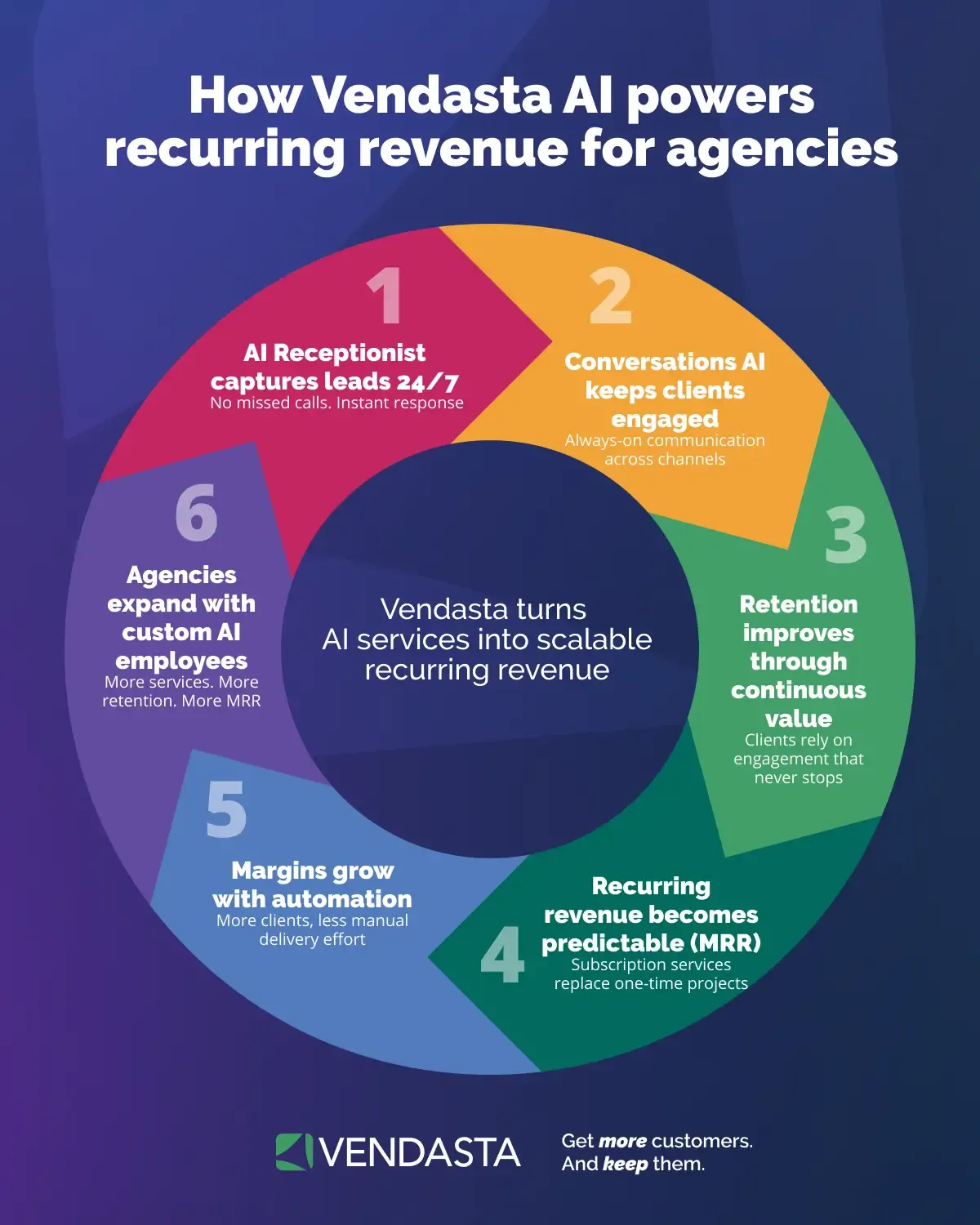
The build-your-own path above requires you to assemble telephony, speech models, a language model, a text-to-speech layer, integrations, monitoring, and contracts for every client. Your team must then keep all of it current as vendors deprecate models underneath you. Vendasta, an AI customer acquisition and engagement platform, packages those roles as AI Employees you sell under your own brand.
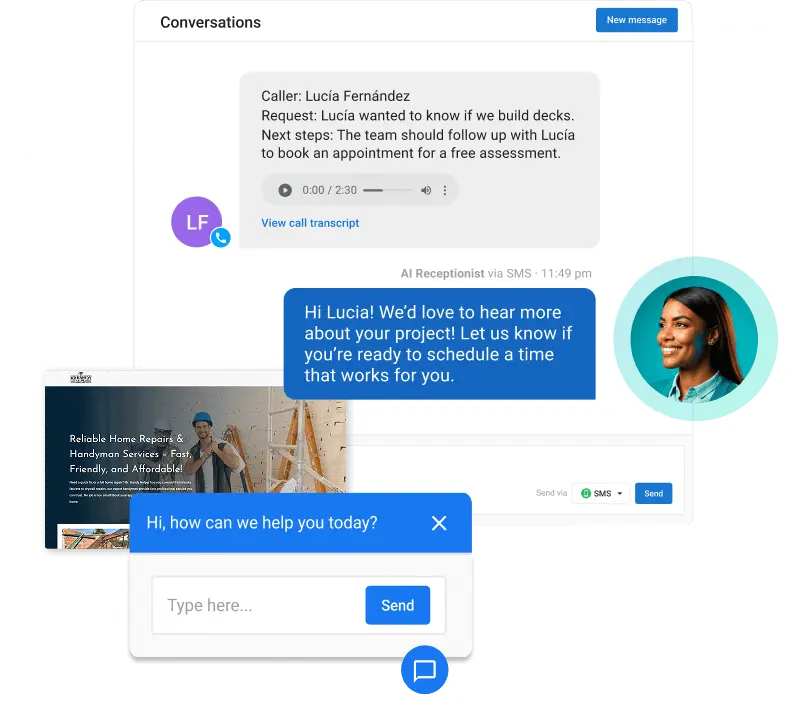
AI Receptionist answers calls, web chats, texts, and messages 24/7. It captures and qualifies leads before booking appointments against the business’s real calendar. AI Reputation Specialist responds to reviews and sends review requests; AI Social Media Manager and AI Blogger publish content; AI Sales Assistant keeps the CRM updated.
Most AI Employees deploy in under 30 minutes after learning from the business’s website, profile, and uploaded knowledge. Vendasta logs every action, which provides the proof-of-performance report that retention research rewards. Agencies can build Custom AI Employees without code by using uploaded documents and defined rules, while Custom Capabilities connect external systems through APIs.
Your team can deploy AI Employees across client accounts in each business’s brand context, set retail prices, and manage orders, subscriptions, invoices, and payments in one commerce layer. Pricing uses a spend-offset subscription. The Starter plan is $99 a month, and each dollar of qualifying product spend credits a dollar against the subscription, so the platform fee falls to $0 once product spend meets the minimum. Wholesale discounts reach up to 80% off retail depending on tier and volume, and you keep the spread between wholesale and the retail price you set.
Agencies should bundle from day one because deeper product adoption improves retention. Vendasta’s retention research, based on 200,000 client relationships, found two-year retention rises from 30% with one product to 80% with four. Xcite Group generated $745,000 in gross market revenue, retained 100% of its AI clients, and lifted lead-to-appointment conversion from 50% to 70%. For a deeper look at how those agencies structured the offer, read the AI Employees guide.
For the receptionist, reputation, and follow-up workflows local businesses buy first, prebuilt roles get you to a signed contract and a logged result faster than a stack you maintain yourself. When a client needs custom logic, Custom AI Employees and Custom Capabilities extend those roles without code. Only fully bespoke multi-agent systems call for a code-first framework.
The Real Path to Selling AI Agents Profitably
Isabella Bedoya’s interview explains how to sell AI agents through one problem, one solution, one ideal client, and one offer. Her order matters: LinkedIn content, lead magnets and a seven-email sequence, a $47 boot camp, then an $8,000-plus agent build sold from a landing page, all inside one vertical.
Her self-reported comparison, $40,000 from 200 sales calls versus $150,000 from the boot camp system, shows the value of earning a client’s first dollar before asking for five figures, and her $180,000 in six weeks from LinkedIn lead magnets shows what giving value away can return.
The economics work at agency scale when you productize the offer, charge a setup fee plus a $299–$1,200 retainer, track variable costs near the worked example’s $142 a month, and cap your liability in writing. Retention depends on a report the owner reads and a second product within 90 days.
You can build the stack yourself or sell prebuilt AI Employees such as AI Receptionist under your brand, with wholesale pricing and every action logged.
To see how Vendasta can address this workflow in your business, book a Vendasta demo.
How to Sell AI Agents FAQs
1. Is selling AI agents profitable?
Yes, when you sell a retainer rather than relying only on a one-time build and you control support costs. In the worked example, a $650 retainer against roughly $142 in variable costs and one $100 support hour produces $408 in monthly gross profit, or about 63%. Bedoya reports building a $1.2 million AI business on a mix of agent builds, boot camps, and partnerships.
2. How much should you charge for an AI agent?
Charge a setup fee of $750–$3,500 depending on integrations, plus a monthly retainer of $299–$1,200 scaled to the client’s size. Regulated or multi-location clients may require higher pricing to cover compliance and support. At the high end, Bedoya has sold AI agent builds for $8,000 to $20,000, priced on the value the agent delivers.
3. How do you make money selling AI agents?
Four revenue streams can stack: a setup fee for the build, a monthly retainer for monitoring and tuning, usage charges, and add-on agents for the same client. Bedoya also sells growth partnerships at $10,000–$20,000 a month plus revenue share, capped at about 10 clients. Direct selling keeps the full margin; Fiverr takes 20% and Upwork up to 15%.
4. Can you make $1,000 a day selling AI agents?
That is roughly $30,000 a month, which means about 46 clients at a $650 retainer, three $10,000 agent builds a month, or a mix of the two. Bedoya’s business spans done-for-you agent builds, boot camps, education offers, and growth partnerships. Your result depends on sales volume, delivery capacity, gross margin, and churn.
5. What AI agent use cases do local businesses pay for?
Bedoya names three: speed-to-lead agents, AI receptionists, and after-hours agents. In Vida’s survey of SMB voice-agent users, 31% used the agent for inbound sales inquiries and lead capture, 20% for answering FAQs, and 7% for support escalation. Appointment booking, review responses, and follow-up are other workflows home services businesses, clinics, and property managers buy early.
6. Can you sell AI agents without coding?
Yes. n8n, Make, MindStudio, and Voiceflow build agents through visual editors, with n8n’s self-hosted edition free and MindStudio’s Individual plan at $20 a month. Vendasta’s AI Employees go further: most prebuilt roles deploy in under 30 minutes from the business’s website and records, while uploaded documents, defined rules, and Custom Capabilities support no-code custom roles.
7. How do you get your first AI agent client with no portfolio?
Follow Bedoya’s sequence: post about one problem for one ideal client, offer a free lead magnet with a seven-email follow-up, then sell a $47 boot camp that earns the first dollar before the build. If you have no client results, publish an analysis of how a business in your niche could use a specific agent. Deploy your own agent on your own phone line as the demo.
8. Who is liable when an AI agent gives wrong information?
The business deploying the agent carries the customer-facing liability. The FTC has said you cannot blame the third-party developer, and a tribunal held Air Canada responsible for its chatbot’s misinformation. Your contract should cap your exposure at six to 12 months of fees, list prohibited actions, define approval controls, and require human escalation for uncertain cases.
9. What is the best niche for selling AI agents?
Home services is the shortest path to a signed contract: Jobber found 52% of blue-collar owners use AI daily, missed emergency calls are expensive, and no HIPAA agreement is required. Clinics and property management show strong adoption but add HIPAA and Fair Housing obligations. Vendasta’s retention research found vertical-specialized providers retain clients 34% better after three years.
10. How much does it cost to run an AI agent each month?
About $142 in variable cost at 1,000 voice minutes on a Vapi, Twilio, Deepgram, GPT-5.6 Terra, and ElevenLabs stack, with text-to-speech accounting for $75. Switching to Deepgram Aura-2 cuts that layer to about $45. Add $29 for Vapi’s Core plan if you need more concurrency and $2,000 a month for its HIPAA add-on.