
“I can control exactly what AI says about my business.”
When Steve Toth, founder of Notebook Agency and AI Notebook, said this, we stopped in our tracks. Most companies still believe their brand lives on their website or inside Google’s search results. But in 2025, that is no longer where buyers begin.
That’s why AI search optimization has become impossible to ignore.
For decades, you were told that winning meant ranking. Rank on page one. Rank in snippets. And rank in voice search.
But while you were tracking keywords and building backlinks, something bigger shifted. ChatGPT, Gemini, and Claude quietly became the first stop in the buyer journey. These models are already recommending products, shortlisting vendors, and shaping narratives long before anyone reaches your website.
Here is the unsettling truth that most teams have yet to realize: the version of your brand that lives inside these LLMs may not match the one you have worked hard to build.
Last week, we sat down with Steve Toth, an advisor to more than 20,000 marketers and increased FreshBooks’ traffic by 5x in under a year, to explore how businesses can reclaim their narrative within AI systems and become the brand LLMs confidently recommend rather than casually mention.
In this blog, we break down Steve Toth’s full framework for AI search optimization, including how to audit what LLMs already believe about your brand, how to correct narrative gaps, and how to publish the structured evidence models rely on to recommend you with confidence.
Automate every step of the customer journey with AI employees
What Is AI Search Optimization?
AI search optimization is the process of making your company’s information clear, consistent, and easily retrievable by large language models. Its goal is simple: ensure that when an LLM searches for facts about your business, it finds accurate, up-to-date details rather than scattered or outdated fragments.
Unlike traditional SEO, which centers on rankings and keywords, AI search optimization focuses on the underlying evidence LLMs rely on. This includes structured product information, pricing clarity, review signals, third-party references, and the consistency of your brand story across the public web.
At its core, AI search optimization is about providing models with a single, reliable version of the truth so they can accurately represent your brand in high-intent conversations.
The Buyer’s Journey Now Happens Inside ChatGPT
Here’s the shift that changes everything: Buyers are qualifying themselves inside LLMs before they ever visit your website or reach your sales team. A buyer today doesn’t just ask, “What’s the best project management tool?” They say:
“I need a project management tool for 30 people, my budget is $20 per seat, I need time tracking and Gantt charts, and I want strong user reviews. What do you recommend?”
The AI filters options, compares features, weighs sentiment, and gives a shortlist.
This shift is exactly why AI search optimization matters. If LLMs are doing the comparison work for buyers, your brand is only visible when the model can retrieve precise, current information.
As Steve Toth puts it:
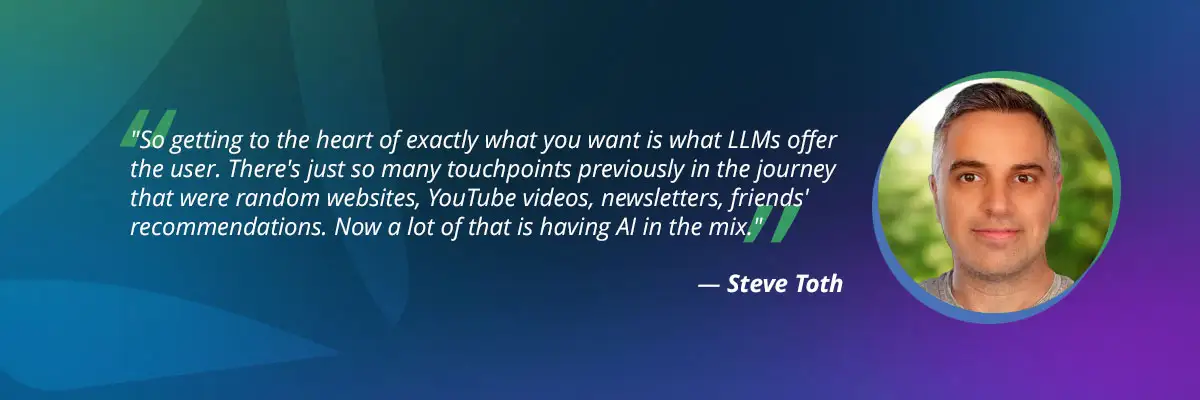
But here’s what most companies haven’t realized: If your information isn’t available for the LLM to cite when answering these specific constraints, you’re invisible during the most critical part of the buyer journey. The buyer has already made up their mind by the time they call your sales team. They’ve already ruled you in or out based on what ChatGPT told them.
The Uncomfortable Truth: LLMs Could be Lying About Your Brand
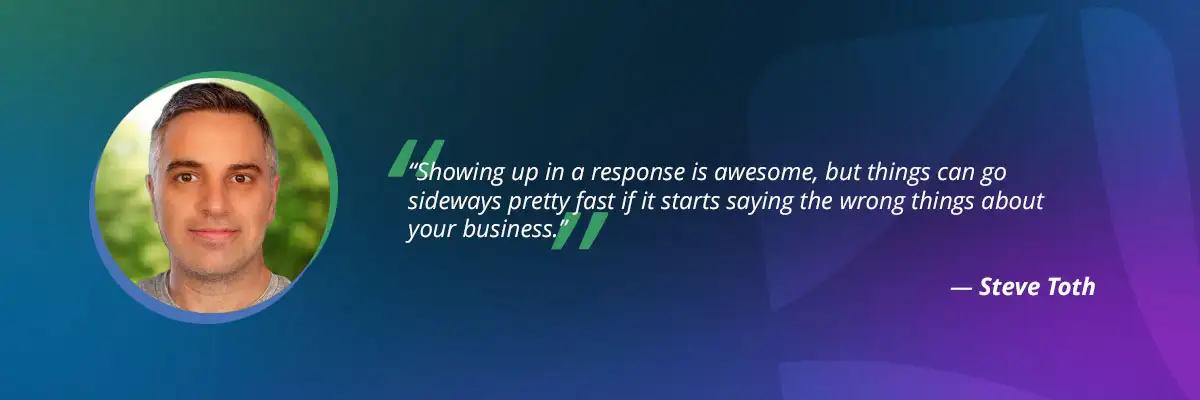
You’ve spent years building your brand. You’ve invested in SEO, PR, and thought leadership, maybe even followed advice on appearing in AI search results, but the unfortunate truth is that LLMs may not see you the way you see yourself.
When someone asks a question about your company, the LLM searches for relevant information on the web to try to answer that question. The problem is that not all the information on the web is correct.
This creates a perfect storm.
Across the web, you may still have fragments of an old story living in places like:
- Blog posts written years ago
- Case studies that no longer match your product
- YouTube videos featuring outdated messaging
- Reddit conversations from customers referencing past issues
- Wikipedia pages that are out of date
- Third-party listings with mismatched details
The LLM doesn’t know which version of “you” is current. It doesn’t understand that you’ve evolved, improved, or changed your positioning. It just synthesizes whatever it finds and presents it with the same confidence it would use for a question about basic facts.
The result? Your AI profile is a Frankenstein’s monster of outdated information, misrepresentations, and incomplete data.
So, you may be just casually mentioned by AI; AI names your company as one option among many, possibly with incorrect details, rather than being confidently recommended, when the AI knows everything about you.
How to Set Your Narrative Right With AI Search Optimization
Steve Toth’s Framework is a carefully designed AI search optimization system for closing the gap between what your company actually is and what AI believes you are.
Step 1: Run a Reverse Interrogation Audit

The first step is uncomfortable but essential. You need to see your business through an AI’s eyes. The Reverse Interrogation Audit gives you a clear picture of your AI Truth Gap, the distance between what you are and what LLMs believe you are.
Open ChatGPT, Gemini, Claude, and Perplexity. In each one, ask:
- “What do you know about [Your Company]?”
- “What’s the pricing for [Your Product]?”
- “Who’s a good fit for [Your Product]?”
- “What integrations does [Your Company] support?”
- “What are the main features of [Your Product]?”
- “Do you have any case studies for [Your Product] in the [Your Industry] space?”
- “What’s included in [Your Company]’s support?”
Document exactly what each LLM says. Then, for each answer, ask the follow-up: “What sources did you use for that answer?” This reveals exactly which websites, documents, and information sources the LLMs are using to build their understanding of your company.
You’ll typically find one of four situations:
- Accurate and Current: The LLM has your information right. Congratulations.
- Outdated: The LLM is citing old blog posts, old case studies, or old positioning from your website.
- Missing: The LLM has no information on this topic at all. This is a gap you need to fill.
- Wrong: The LLM is confidently stating something that’s completely incorrect. This is urgent.
Step 2: Detect the Deal Breakers
The second step is to research relevant questions your customers ask LLMs, and really uncover the prompts and queries that drive AI-generated answers in your category. Not all questions matter equally. Some are deal-breakers that determine whether you’re even in the conversation.
Which is why Steve Toth has launched his Custom Agent, Dealbreaker Detector.

For instance, for a Saas company, some deal-breaker questions would revolve around:
- Budget constraints
- Team size fit
- Integration requirements
- Implementation time
- Support model
- Compliance and certifications
This is where you can uncover significant gaps by asking the LLMs the same questions and documenting their responses. The LLM might have information on some deal breakers but be completely silent on others. This is your roadmap. Once you create content that answers each of these qualifying questions, your content becomes more likely to be retrieved and cited.
Step 3: Publish an “LLM Info” Page
Here’s where it gets tactical. Steve Toth’s team discovered something surprising that sits at the center of AI search optimization: LLMs can directly cite content, instead of relying too heavily on third-party websites, if you make it easy for them to find and parse.
At Notebook Agency, they implemented what Toth calls the “LLM Info” page, essentially a markdown file on your website that serves as a data source for LLMs to cite.
This file should contain:
- Company Overview: Mission, founding story, current positioning (not outdated positioning)
- Service/Product List: Complete with pricing, not vague descriptions
- Ideal Customer Profile: Specific description of who benefits most from your offering
- Key Differentiators: What makes you different, with specific examples
- Integration Capabilities: Complete list of systems you integrate with
- Team Structure: Size, key personnel, expertise areas
- Compliance and Certifications: Security measures, protocols, and certifications
- Support Offerings: Response times, availability, channels, inclusions
- Case Studies: 3-5 detailed examples with metrics and industry/company size
- Geographic Availability: Where you operate, where you don’t
- Customer Testimonials and Reviews: Real quotes from real customers
- Proven Outcomes: Specific statistics about what customers achieve
When someone asks ChatGPT, “What do you know about [Your Company]?”, the LLM will often cite this page directly, providing the user with accurate information about your company.
How to Craft Content That Wins in AI Search
The old SEO playbook is dead. Creating content for LLMs requires a completely different approach than creating content for Google’s search algorithm.
Step 1: Hyper-Specific Content That Wins in AI Search
After interrogating thousands of buyer conversations, Steve Toth discovered that LLMs have a native strength in comparison. When someone asks an LLM for a recommendation, the LLM almost always wants to provide comparisons.
Hyper-specific comparison content that positions company A versus company B for a particular use case can be a really powerful way to teach the LLM about everything you do and how you uniquely serve your clients.
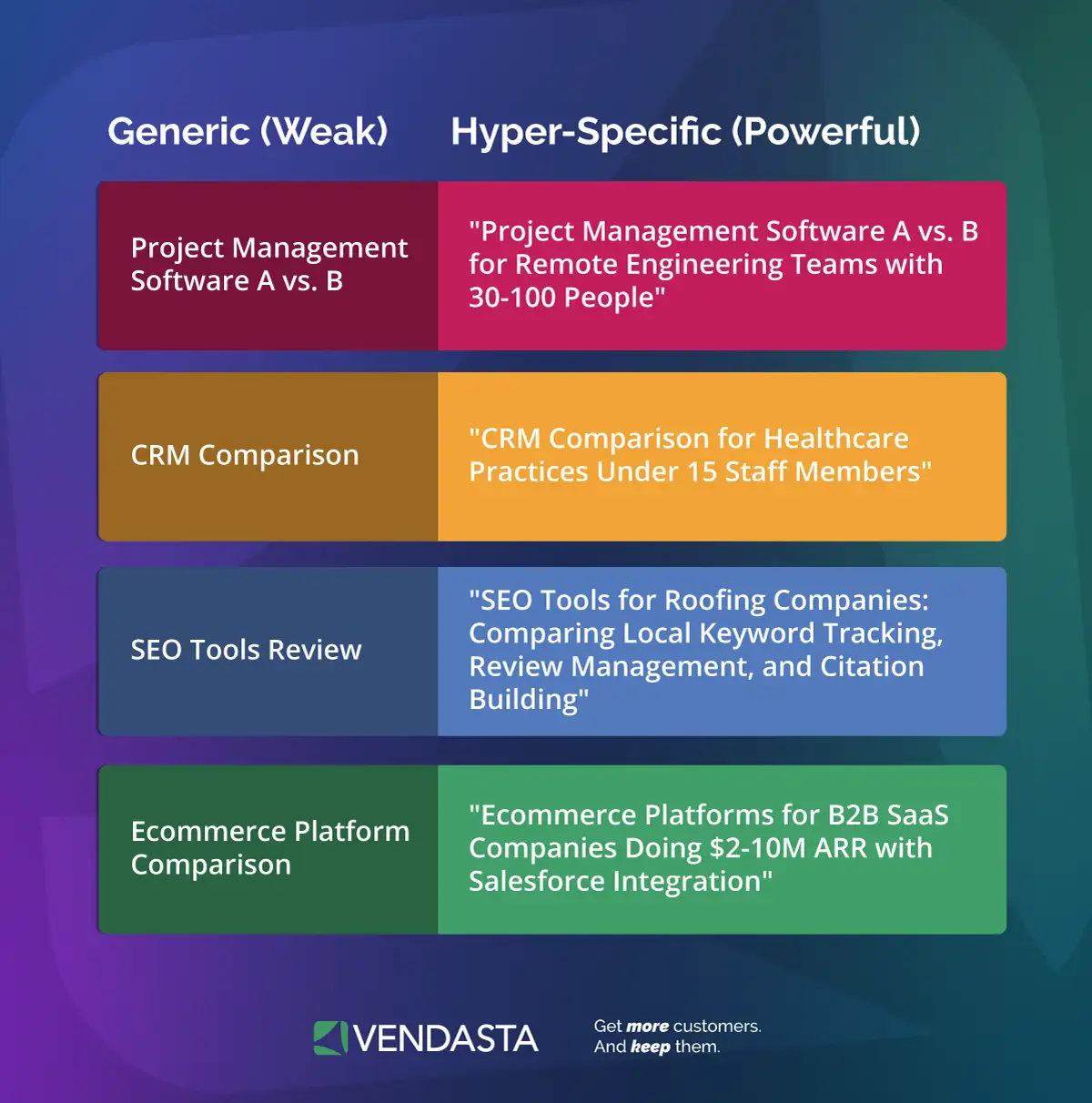
This type of content is a goldmine for LLMs because when a buyer tells ChatGPT their specific constraints, the LLM generates fan-out queries or internal hidden queries to find relevant information. If your hyper-specific comparison content matches these hidden queries, you get retrieved.
Step 2: The Off-Page Signals That Shape AI
Most businesses focus entirely on owned content: your website, your blog, your case studies. But LLMs don’t live in a vacuum. They’re trained on all public information about your company. This means Reddit complaints, review site ratings, YouTube videos, podcast transcripts, LinkedIn posts, and media mentions all influence how LLMs understand your brand.
Reddit: The Silent Influencer
Reddit is where brutally honest conversations about companies happen, and LLMs pay attention. You will find that old threads can outlive your fixes. Someone complained that your product was weaker, you improved it, yet the stale narrative still shapes buyer decisions.
That is the trap.
AI keeps seeing those signals and carries them forward. You need to watch the social chatter around your brand, know what still ranks in those conversations, and address the gaps before that old story becomes the only story. The solution isn’t to delete comments or spam threads with links. It’s to engage authentically and transparently.
Here’s the Reddit engagement strategy for businesses to fix the old brand chatter:
- Search for your company, products, and competitors on Reddit
- Document threads where there are complaints or outdated information
- Respond transparently, explaining what you’ve changed
- Provide evidence (case studies, testimonials, documentation)
- Use clear, declarative language that LLMs can easily extract and cite
- Don’t just link back to your website; provide actual information in the Reddit response
Reviews: Your Distributed Truth
Beyond Reddit, reviews on Google Business Profile, Trustpilot, G2, and industry-specific review sites are critical signals that LLMs consider, as they reflect the great work you’re doing to improve your customers’ experience.
This isn’t just about reputation management. It’s a key part of AI search optimization because when an LLM searches for information about your company’s support quality, customer success, or value delivered, it needs current, positive evidence.
The Brand Narrative Cleanup
Many companies struggle with AI representation because they haven’t cleaned up their old narratives. Even after they have pivoted, the LLMs still reflect their old narrative. Audit your web presence, and uncover old case studies, outdated product descriptions, old company videos, old LinkedIn posts, and even archived versions of your website.
For each piece of content, ask, “Does this reflect who we are today?” If not, try to either update it to reflect current positioning or delete it and set up a redirect to the current content.
Not to mention, in addition to deleting old narratives, ensure that your current offering is described consistently across your website homepage and service pages, LinkedIn company page, YouTube channel description, “LLM Info” page, social media bios, email signatures, and speaking bios.
This “cleanup” signals to LLMs that you’ve moved on from your old positioning. It removes the conflicting information that causes LLMs to be confused about what you actually do.
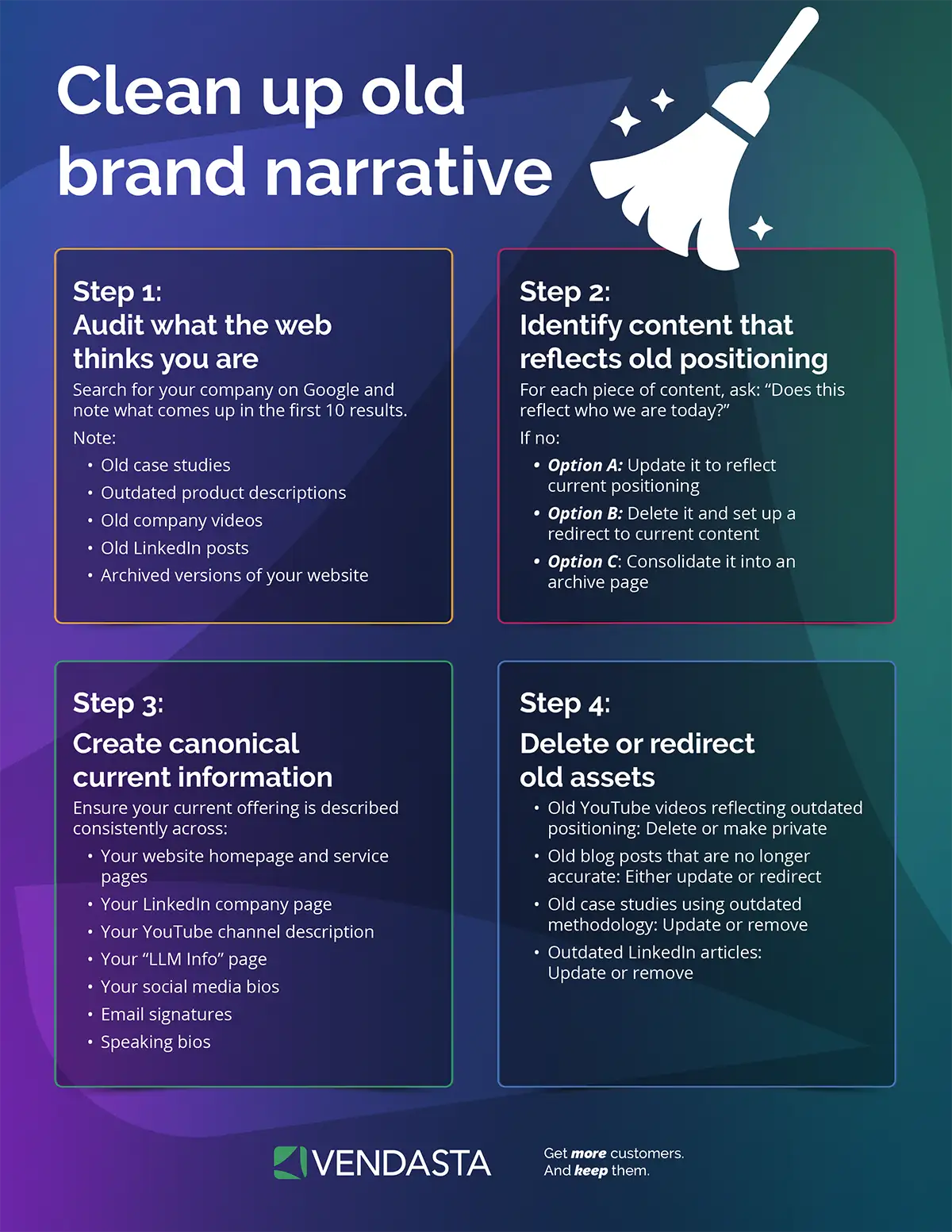
Here’s how to clean up your old brand narrative:
- Audit what the web thinks you are: Search for your company on Google and note what comes up in the first 10 results (old case studies, outdated product descriptions, old company videos, old LinkedIn posts, and archived versions of your website).
- Identify content that reflects old positioning: For each piece of content, ask: “Does this reflect who we are today?” If the answer is no, either update it to reflect current positioning, delete it and set up a redirect, or consolidate it into an archive page.
- Create canonical current information: Ensure your current offering is described consistently across your homepage, service pages, LinkedIn company page, YouTube channel description, “LLM Info” page, social media bios, and speaking bios.
- Delete or redirect old assets: Update or remove old blog posts that are no longer accurate, case studies that use outdated methodology, LinkedIn articles that are outdated, and old YouTube videos that reflect outdated positioning.
Building AI Authority Through Brand Presence
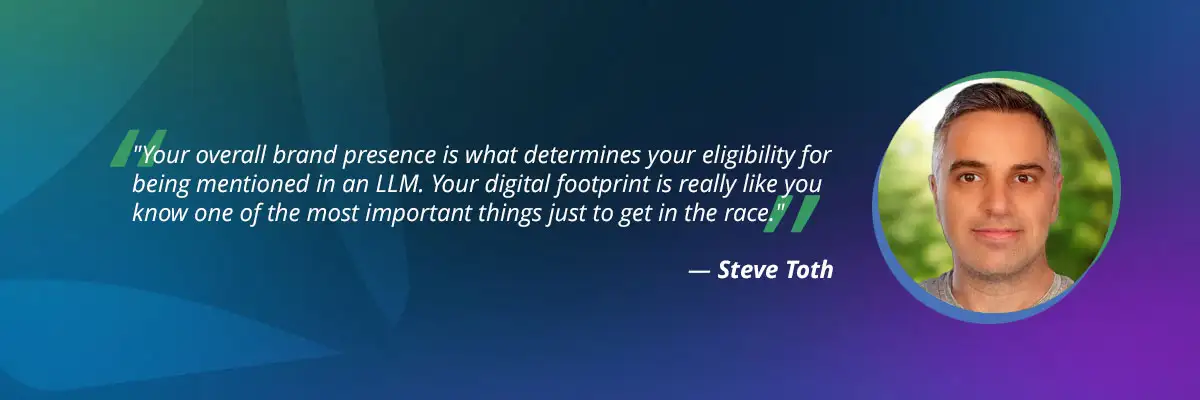
Brand-building strategy is your AI SEO strategy. You can’t win in AI search if the AI doesn’t know you exist. That means consistent public visibility, such as:
- Posting YouTube videos to demonstrate expertise and answer deal-breaker questions
- Appearing on relevant industry podcasts to establish your narrative
- Actively gathering reviews on Google Business, Trustpilot, and G2
- Earning media mentions by posting thought leadership in relevant publications
- Regular posts about your expertise and approach on LinkedIn
- Peaking engagement like webinars, conferences, and events
Brands that actively show up in public are the ones LLMs learn about—and the ones that get recommended.
The 22x Conversion Advantage
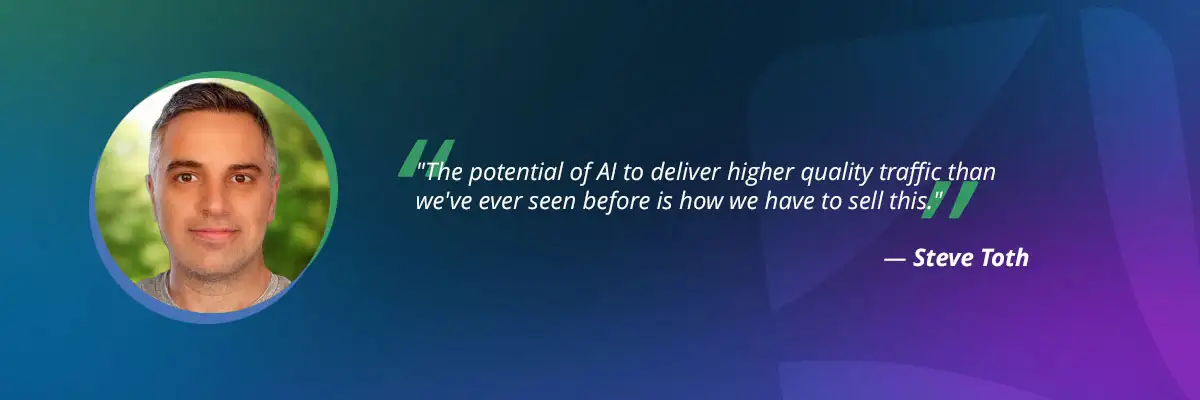
Here’s the part that changes the math completely. Ahrefs released a study where they said that only 0.5% of their traffic is coming from LLMs, but it accounts for 12% of their signups, and those signups are converting at 22x higher than Google traffic. Think about that. LLM referrals might be small in volume, but massive in value.
Why? Because the buyer has already pre-qualified themselves through the AI conversation. They know what they want. They know what you offer. They’ve already matched the fit.
For agencies, this changes the metric. The goal isn’t traffic volume. It’s traffic precision.
Beyond SEO: This Is Brand Strategy
Toth challenges the entire framing of AI SEO:
“Should we be thinking about it in terms of SEO versus brand presence? Does this become a new focus for your branding versus you thinking about this as an SEO initiative?”
This isn’t keyword work; it’s reputation work. It’s narrative control. Traditional SEO is about ranking. AI representation is about trust.
Your mission isn’t to climb Google results. It’s to make sure that when a buyer asks ChatGPT, “What’s the best solution for my situation?” the AI confidently recommends you. The winners in this new era won’t be the loudest. They’ll be the most accurate. They’ll audit what AI thinks. They’ll fix the gaps. They’ll align truth with representation.
Because the buyer journey doesn’t start with Google anymore. It starts with ChatGPT. And if AI doesn’t understand who you really are, you’ve already lost the sale.
Winners are accurately represented in AI systems.
Everyone else is fighting for visibility on Google.
Vendasta-Powered Truth: Build the Evidence LLMs Trust
Every recommendation an LLM makes is based on the evidence it can find. Clean, consistent, verifiable information serves as the foundation for accurate AI representation. This is where Vendasta strengthens Steve Toth’s framework.
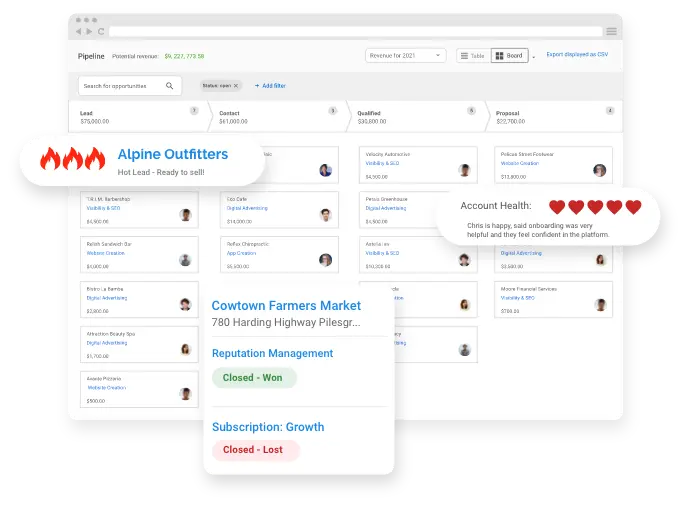
Vendasta unifies the operational truth of your business—your CRM data, conversations, reviews, case outcomes, and customer activity—into a single shared workspace for your team and your clients. When your information is consistent across every customer touchpoint, the signals LLMs rely on become clearer and more trustworthy.
Turn Everyday Interactions Into Structured Proof
AI Employees and Conversations AI capture the details that matter for AI search optimization: implementation timelines, pricing expectations, customer goals, support outcomes, and qualitative feedback.
These interactions create a continuous stream of structured evidence that can be transformed into case studies, review snippets, comparison content, and LLM-friendly facts for your “Hey AI, learn about me” page.
Instead of manually collecting proof after the fact, Vendasta helps you gather it as you work.
Orchestrate Your Public Truth at Scale
LLMs learn from everything: reviews, social content, support interactions, podcasts, and historical chatter. Vendasta’s Reputation Management and Social Marketing tools give partners the ability to guide that narrative consistently by:
- Collecting fresh, high-quality reviews
- Responding transparently to customer feedback
- Distributing expertise-driven content across channels
- Keeping public-facing information aligned with current positioning
Nothing happens in isolation. The more consistent your signals are, the more confidently AI can recommend your brand.
Human Oversight, AI Efficiency
The goal is not to let AI take over your narrative but to let AI handle the heavy lifting while your team shapes the message. Vendasta supports an 80/20 model: AI captures the data and executes routine tasks, and humans guide the story that LLMs ultimately learn.
The outcome is a brand that is not only visible to AI systems but accurately represented, which is the new competitive advantage.
AI Search Optimization FAQs
1. How do I make sure ChatGPT, Gemini, or Claude understands my business correctly?
Start by asking each model what it knows about your company, your pricing, your customers, and your product details. Compare the answers to your current messaging. Correct anything outdated across your website, reviews, and public profiles. AI search optimization works best when every signal matches.
2. What is the fastest way to correct wrong information that LLMs repeat?
Trace the misinformation back to its source. Old pages, mismatched details, or stale reviews often cause it. Update or remove the inaccurate content and replace it with clean, structured facts. Once the truth is consistent, LLMs adapt quickly.
3. Why is an “LLM Info” page vital for AI search optimization?
LLMs rely on simple, structured facts. An LLM Info page gives them one place to find your pricing, features, integrations, ICP, and outcomes. When that page stays updated, models cite your verified information rather than scattered fragments.
4. How do reviews influence AI recommendations?
Reviews give LLMs a sense of quality, reliability, and recent performance. Fresh customer feedback shows that your product delivers results today, not years ago. Replying to outdated or negative reviews with current facts helps reset the model’s understanding.
5. Why do Reddit threads affect AI search optimization?
Reddit conversations often surface candid experiences that LLMs consider. If older threads describe issues you have already fixed, the model may still use them. Add a clear, factual reply with what changed so the model can account for your improvements.
6. Why might LLMs recommend competitors instead of my product?
Competitors often publish more specific, evidence-based information. LLMs favor brands that state their ICP, use cases, features, and results clearly. Improving your AI search optimization strategy by adding detailed content helps the model see where you fit best.
7. How long does it take for AI systems to reflect updated information?
Early shifts appear within a few weeks. Larger corrections take one to three months, depending on how many public pages reference the older details. LLMs adjust faster when your updates are consistent and reinforced across multiple sources.
8. How does Vendasta support AI search optimization?
Vendasta centralizes CRM data, conversations, outcomes, and reviews so your brand presents a single version of the truth. This unified record gives you the structured evidence LLMs rely on during recommendation queries, which helps improve AI visibility.
9. Does off-page activity matter for AI search optimization?
Yes. LLMs interpret signals from podcasts, social posts, interviews, review platforms, and industry forums. Consistent public visibility helps models build an accurate representation of your expertise. Thought leadership and recent customer results play a strong role.
10. What content should I publish to improve AI search optimization?
Start with precise, factual content that answers real buyer questions. Add case results, integration details, pricing clarity, and comparison articles. Vendasta’s platform helps you capture these insights and turn them into structured proof that LLMs can cite.