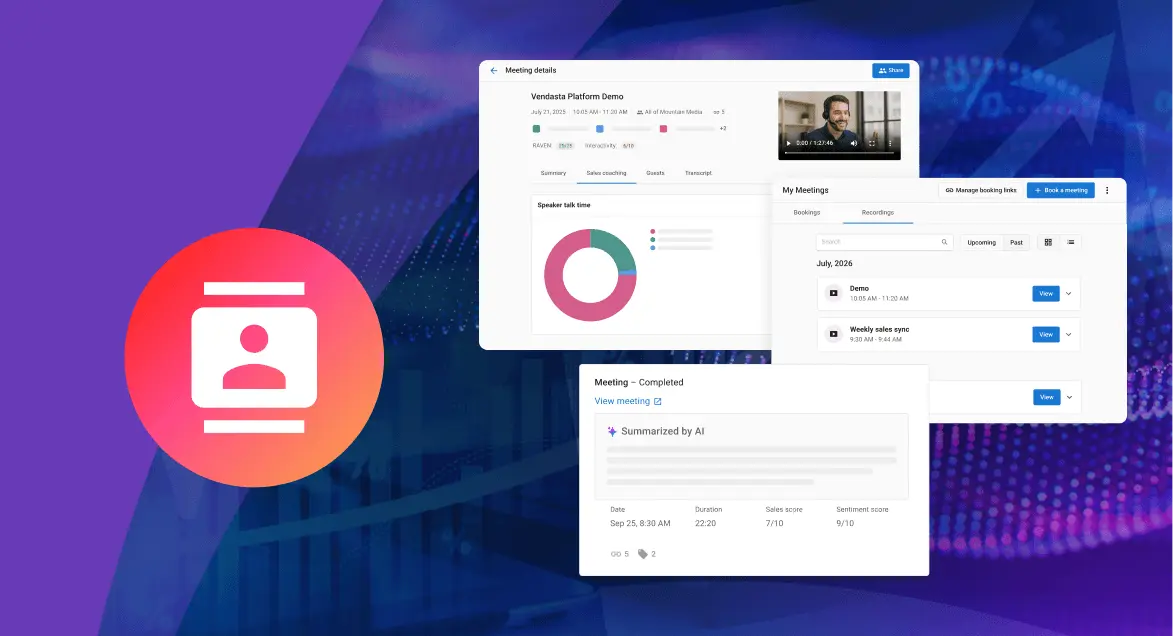
Most SMB sales teams are drowning in manual administrative work that never actually results in a closed deal.
According to our 2026 State of AI-Driven Sales Execution report, there is a massive execution gap between having data and taking action. While many teams spend hours recording meetings, 74% still struggle to turn those conversations into consistent, personalized follow-ups.
This gap is the primary reason many lean sales teams fail to hit their revenue targets. Vendasta’s new AI-native CRM is built specifically to bridge this divide by turning conversations into immediate action without manual effort.
Sell smarter and scale faster with AI-powered CRM
TL;DR
- The Execution Gap: 90% of teams record calls, but 74% fail to turn that data into actual follow-up.
- The AI Native Shift: Moving from a “System of Record” to a “System of Action” that automates updates and next steps.
- The Solution: Vendasta CRM AI unifies meeting intelligence and AI assistants to kill manual data entry and surface hidden revenue.
Why Traditional CRMs Create an Execution Gap
Traditional CRMs were designed to be Systems of Record, static databases that require constant manual feeding to remain up to date. For the modern small-to-medium business, this model has reached a point of diminishing returns.
Instead of empowering sellers, these legacy systems often burden them with hours of administrative data entry, taking time away from actual selling.
The result is a widening gap between having a lead and taking the action required to close it. Our research shows that inconsistent follow-up is the absolute top hurdle preventing teams from reaching their revenue targets.
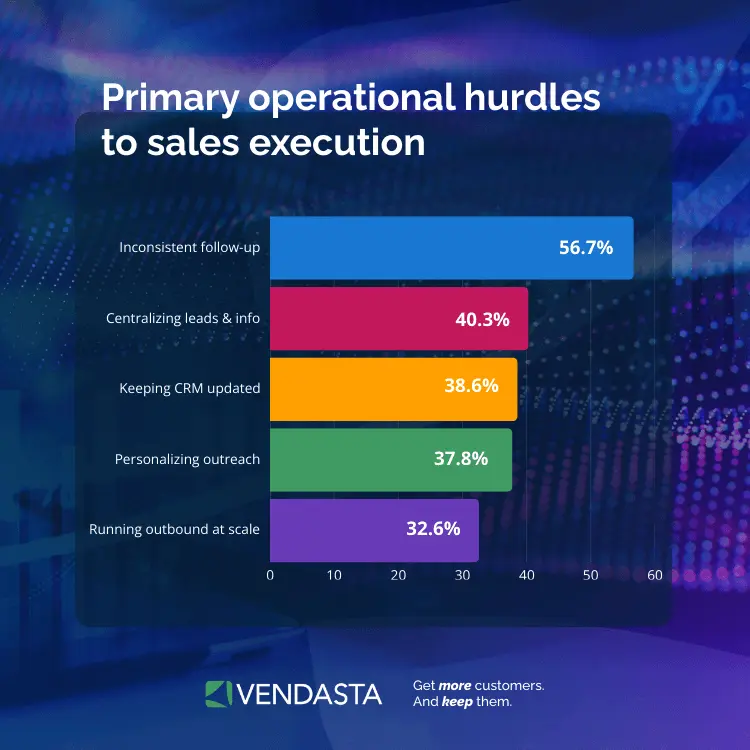
This inconsistency is a direct result of the limits of human effort.
Even though 90% of teams now record their conversations, critical context like buyer objections often remains trapped in transcripts that are never read.
Without a system that automatically triggers the next step, meeting analysis remains a passive archive rather than a driver of sales growth.
What is an AI-Native CRM?
An AI-native CRM is a sales platform where artificial intelligence is the foundational component that drives every process. Unlike legacy software, the architecture, data management, and operational flows are all designed with AI at the center from day one.
It doesn’t just store information; it interprets context and organizes it into usable intelligence for your team.
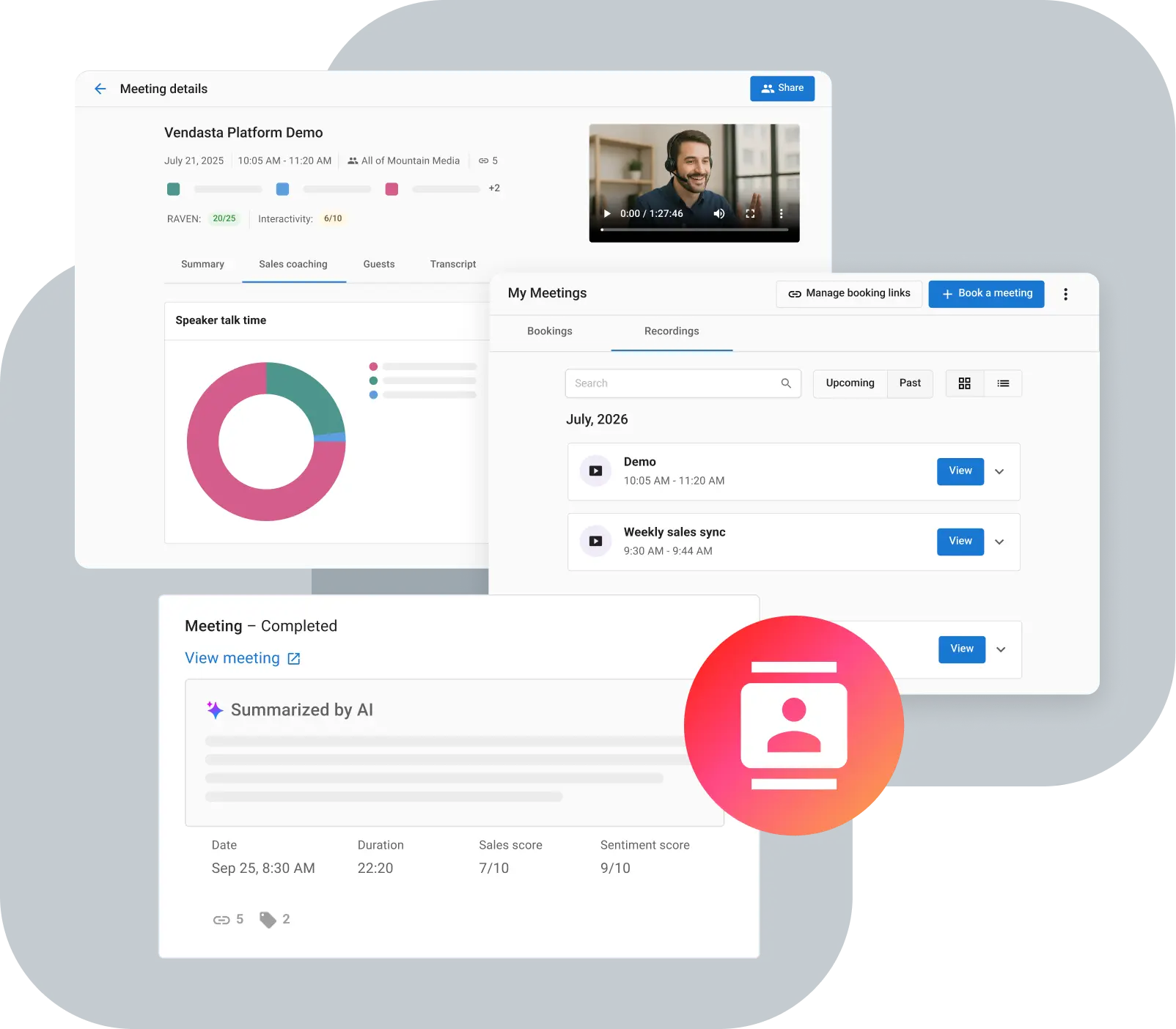
In an AI-native environment, the CRM acts as an active participant in your sales cycle.
It treats every customer interaction as a data input for automated workflows. This shift transforms the CRM from a passive filing cabinet into a proactive system that helps you execute sales.
By automating administrative burdens, an AI-native platform allows teams to focus on building trust and closing deals. It understands the entire customer journey and proactively suggests the best next steps to move a prospect forward.
This ensures that no opportunity falls through the cracks, regardless of your current lead volume.
AI-Native CRM vs. AI-Enabled CRM: Why Architecture Matters
The difference between an AI-native CRM and an AI-enabled CRM lies in their intentions and structures. AI-enabled tools are traditional systems that have added AI features as an afterthought or an upsell tier.
While these tools might summarize a call or draft an email, they often require manual triggers and complex integrations to work.
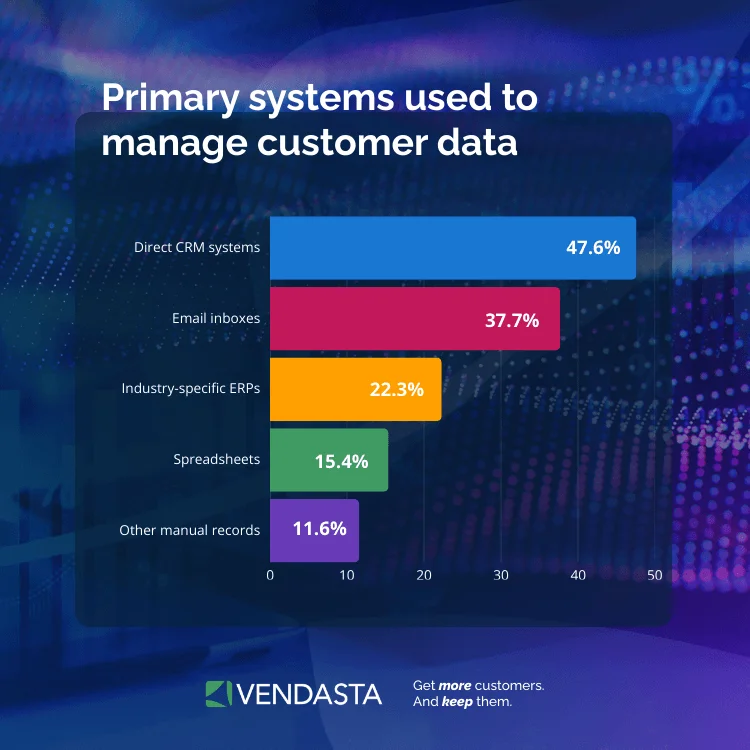
This execution burden is the primary reason why 68% of sales data remains scattered across personal inboxes and spreadsheets. As shown in the data below, most organizations still operate without a true system of record because legacy tools feel too inflexible.
An AI-native system is built for contextual autonomy. It does not require a human to prompt it for every task, as it already understands your business rules and sales methodology.
Sales leaders are increasingly realizing that AI that only explains a problem does not solve it. Moving to a native architecture is the only way to ensure your AI can see and coordinate across the full outreach motion.
Introducing Vendasta’s CRM AI
Vendasta CRM AI is a smarter, self-updating sales engine designed specifically for lean teams that need to grow without adding resources.
We have combined our powerful CRM with built-in AI employees that automate the manual tasks, stalling your revenue growth. This tool knows your business and helps you execute your sales strategy.
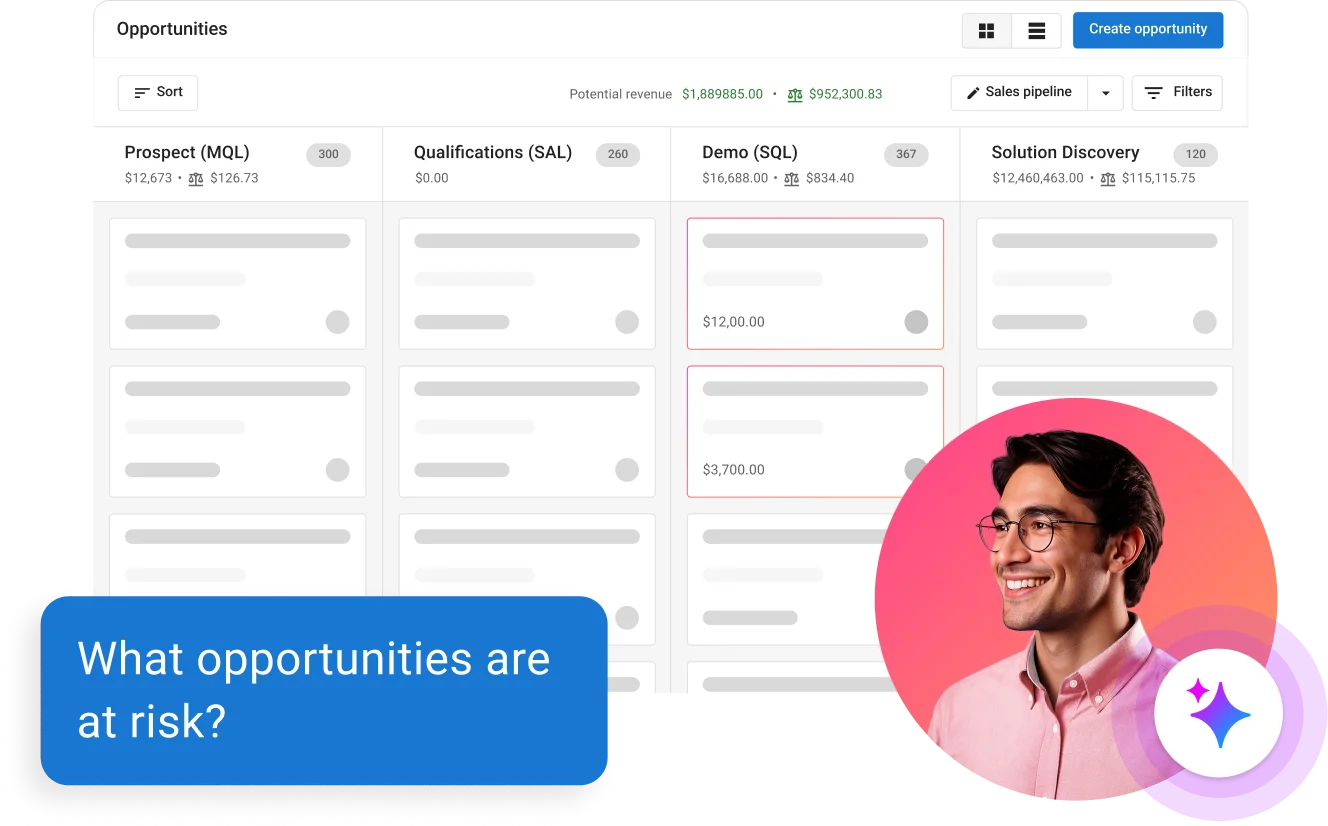
What makes Vendasta truly unique is how the AI Sales Assistant leverages your business’s proprietary data to act as a digital teammate. It proactively researches prospects and updates CRM records based on your actual activities.
This ensures the CRM stays accurate without sales reps needing to spend time on manual data entry.
Vendasta AI CRM also features Conversation Intelligence that goes far beyond basic transcription. It automatically extracts action items and scores conversations based on professional sales methodologies like BANT and MEDDPICC.
This turns every customer meeting into a documentation asset that helps teams follow up with confidence.
The data is clear: Sales leaders are pragmatic and results-oriented, prioritizing lead generation and deal velocity above all else.
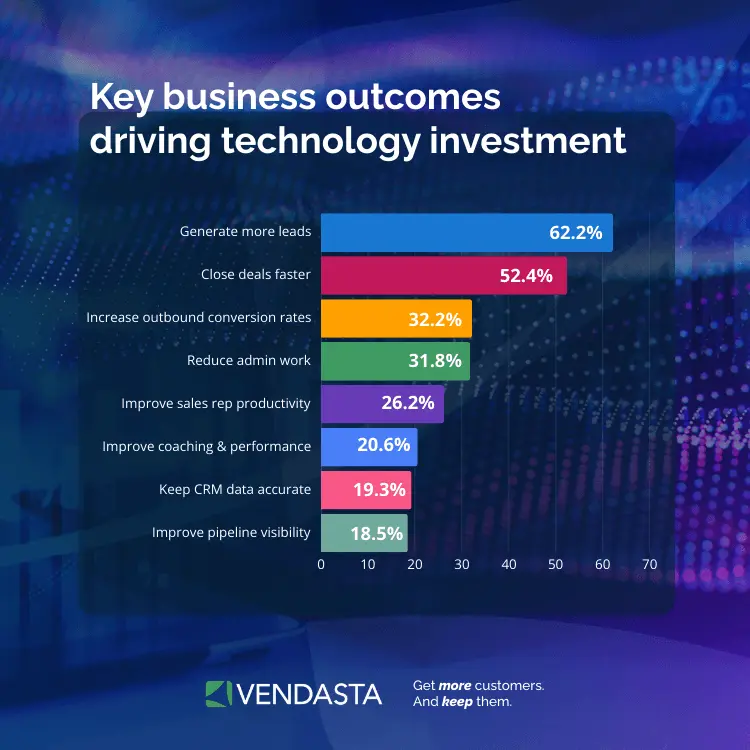
Vendasta CRM AI aligns perfectly with these priorities by reducing the friction between a rep’s effort and a closed contract.
How an AI Native CRM Drives Scalable Growth
The primary benefit of an AI-native CRM is the ability to scale revenue without scaling headcount. By removing the limits of human effort, you can handle a higher volume of leads with a lean sales team.
This is essential for SMBs that want to grow efficiently in a competitive landscape while keeping operations simple.
As activity scales, manual execution becomes harder to manage, leading to what we call the “scaling wall.” Many teams find that their follow-up begins to depend on individual memory, causing personalization to break down.
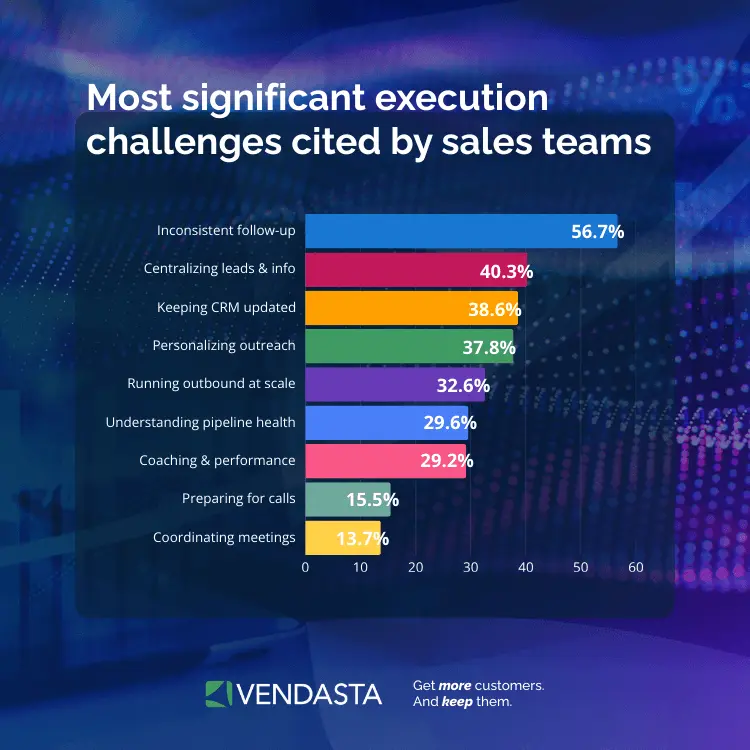
An AI-native platform eliminates these blind spots that typically kill deals.
With a unified view of all customer interactions, teams gain total visibility into pipeline health. This allows you to respond to risks and opportunities in real time rather than finding out about them weeks later during a review.
Deep Dive: The 2026 State of AI-Driven Sales Execution
If you want to understand the structural failures of the modern sales stack, our new report provides the definitive roadmap for change.
Sales technology has reached a point of diminishing returns, and our research shows that 68% of sales data is still living outside the CRM. This report breaks down why 74% of teams are still struggling with follow-up despite having more “visibility” tools than ever before.
Inside the 2026 State of AI-Driven Sales Execution, you will discover the rise of “Contextual Autonomy” and how AI agents are beginning to manage the end-to-end deal lifecycle.
We use data from over 200 professionals to show how leading teams are shifting from “knowing more” to “doing more”. You will learn how to identify the “scaling wall” where manual effort and human memory begin to kill your revenue.
Conclusion: Orchestrating Success with an AI-Native CRM
The data is clear: sales success is no longer about who has more data, but who executes most consistently.
By moving past the traditional System of Record and embracing an AI-native CRM, you remove human effort as the bottleneck for growth. This allows small teams to deliver a sophisticated customer experience that was previously only possible for massive enterprises.
Vendasta CRM AI is designed to be your unified system of action, handling everything from lead capture to final meeting analysis.
We are committed to democratizing these advanced tools so you and your clients can compete and thrive in an AI-driven economy. Stop fighting against your software and start using a platform that works as hard as you do.
Ready to see how an AI native CRM can transform your sales engine? Schedule a demo of Vendasta CRM AI today and learn how to close the execution gap for good.
AI-Native CRM FAQs
1. What is an AI-native CRM?
An AI-native CRM is a sales platform built with artificial intelligence as its core architecture from the ground up. Unlike traditional systems, it is designed to automate work, interpret context, and proactively assist sales teams rather than just acting as a static database.
2. How does an AI-native CRM solve the execution gap?
It solves the gap by turning passive data, like meeting recordings, into immediate actions and CRM updates. Vendasta CRM AI bridges this divide by extracting action items and populating records automatically, ensuring no follow-up is missed due to human error.
3. Do I still need to enter data manually with Vendasta CRM AI?
No, the goal of Vendasta’s AI native architecture is to eliminate manual data entry. Our AI Sales Assistant automatically updates contact, company, and opportunity records based on your sales activities and meetings, keeping your data accurate without the extra effort.
4. What is the difference between AI-native and AI-enabled?
AI-enabled CRMs are legacy systems that add AI features as external modules or plugins. AI-native CRMs, like Vendasta, have intelligence embedded at the platform level, allowing for deeper context, better reliability, and more powerful autonomous actions.
5. Can an AI-native CRM help me coach my sales team?
Yes, Vendasta CRM AI includes automated Sales Coaching that scores every call based on methodologies like BANT and MEDDPICC. It highlights coachable moments and trends across teams to improve performance without the need to manually review every call.
6. Will an AI-native CRM replace my sales reps?
No, AI is designed for empowerment rather than replacement. By handling administrative tasks and research, Vendasta CRM AI allows sales reps to focus on high-value activities like building relationships, building trust, and closing complex deals.
7. How does Vendasta’s CRM AI handle privacy?
Privacy is built into our platform’s core, giving you full control over who can view meeting recordings and transcripts. You can adjust visibility settings at any time, ensuring sensitive customer conversations remain protected while still supporting team collaboration.
8. Does this CRM integrate with my existing meeting tools?
Yes, Vendasta CRM AI natively supports recording and analysis for major platforms like Google Meet and Microsoft Teams. It captures your virtual meetings directly and stores all generated insights and summaries within your central system of record.
9. Can I ask natural language questions about my sales data?
Absolutely. Vendasta features a natural-language chat interface that allows you to ask questions like “Which deals are at risk?” This eliminates the need to run manual reports, giving you instant answers based on your CRM and meeting data.
10. How quickly can I see results from an AI-native CRM?
Many teams see immediate improvements in follow-up speed and data accuracy because the automation starts working after the very first meeting. Vendasta is designed for instant deployment, helping you win more customers with less manual oversight from day one.