About Us
 Careers
 Leadership
 Board
 Newsroom

AI agency profit margins now run inversely to headcount, and federal labor data shows it. An analysis of Bureau of Labor Statistics census data counted 21,312 US advertising agency establishments in early 2019 and 39,801 in early 2026, while total employment barely moved, from 203,434 to 200,876. That is nearly twice as many agencies with roughly half the people in each one: about 9.5 employees per shop in 2019, about five in 2026.
The money followed the shrinkage. In Promethean Research’s 2026 State of Digital Services, a survey of 119 agency owners and managers, the average agency posted a 13% after-tax net margin in 2025, while agencies that reduced the services they sell grew 13% and posted 30% net margins. Most agency owners read numbers like that and still reach for a job posting the moment work piles up. It is the reflex the whole industry was built on: more clients, more hours, more people. Today it is the fastest way to compress your margin.
That is why we sat down with Sandy Lee on the Conquer Local podcast. Nine months before the conversation, she was a political science graduate doing sales and marketing for funeral home companies, and she had never written a line of code. She landed a $3,000 monthly retainer on Upwork with no SEO experience, raised it to $5,500 on results, hired six people to help deliver the work, watched every one of them fail, and replaced the entire attempt with seven AI agents that cost her about $200 a month.
In this guide, Sandy shows you how to build an agent roster that does the work of a four-person production team, how to win the client before you have the skill, how to price AI work so the margin stays yours, and what it takes to sell AI services to local business clients without giving that margin back.
Replace busy work with AI employees that take action
TL;DR
- The number of US ad agency establishments nearly doubled between 2019 and 2026 while total employment stayed flat, and Promethean Research found that agencies that reduced their service mix posted 30% net margins. Headcount stopped being the growth lever and became the margin tax.
- Sandy Lee priced out her agent roster against real salaries and landed at $7,000 to $8,000 of monthly labor replaced for roughly $230 in subscriptions and API calls. Six human hires had already failed at the same job.
- Vendasta partners run the same play with less assembly required. The agency LeadWorks cut content production time by 90%, from 90 to 120 minutes per piece down to 5 to 10 minutes, with a Custom AI Employee, and turned content into one of its highest-margin services.
What Are AI Agency Profit Margins?
AI agency profit margins are what an agency keeps after it delivers client work with AI systems instead of billable human hours. The cost base shifts from salaries, contractors and management overhead to software subscriptions and API usage, which means margin stops rising and falling with your staffing decisions.
The practical difference shows up in four places:
- Cost of delivery. A production role costs thousands a month. An agent that does the same narrow job costs tens of dollars.
- Capacity. Human capacity grows in lumpy, expensive steps. Agent capacity grows the moment you write another prompt.
- Consistency. Your best person has good weeks and bad ones. A well-configured agent produces the same output on a Tuesday in December as it did in March.
- Pricing power. When delivery cost collapses but client results improve, the gap between what you charge and what you spend is yours to keep, as long as you price on outcomes rather than hours.
That last point is where most agencies give the win away. A 2026 Forrester and 4A’s study found that 61% of US marketing agencies still classify AI as a “cost of business,” with limited direct monetization, and only 31% plan to monetize agentic AI within the next 24 months. If you still bill by the hour, every efficiency you find is a discount you hand to the client.
The Math Behind AI Agency Profit Margins: Six Hires Versus Seven Agents
Sandy did not set out to build an argument about margin. She set out to stop drowning. The retainer was growing, the work was piling up, and she did what every agency owner does at that moment. She hired.
“I hired six people, and none of them worked out, and now it’s seven AI agents that I have. And honestly, it costs me about two hundred bucks a month, and I’m not even an engineer.”
Sandy Lee, Founder of Sandy Lee Automations
The part worth sitting with is that she priced the comparison honestly. She did not compare her agent stack to nothing. She compared it to what the same work costs when people do it, using the rates she was quoted and the rates she paid.
| Job | What it covers | Human cost per month | What runs it now |
|---|---|---|---|
| Social media manager | Channel strategy, posting cadence, competitor watch | $2,000 to $4,000 | Channel analyst agent |
| Video editor | Cuts, captions, thumbnails, final assembly | $2,000 to $3,000 (quoted $100 to $3,000 per video) | Editing agent on a $100 plan |
| Researcher | Trend monitoring, topic sourcing, outlier spotting | Bundled into the $1,500 to $3,000 band | Trend Scout agent |
| Script writer | Hooks, structure, full scripts to camera | $1,500 to $3,000 | Script writer agent |
| Total | $7,000 to $8,000 | About $230 |
The $230 breaks down as two $100 model subscriptions plus $20 to $30 in API calls. Her own soundbite rounds it to “seven to eight thousand dollars of work for less than two hundred bucks,” which is the subscription line only. Either number tells the same story: the delivery cost of content production fell by more than 95%, and it fell for a person with no engineering background.
The time math moved with it. Sandy has been making content since 2018, back when a two-minute video meant six to eight hours in Premiere Pro, captions typed by hand.
| 2018, manual | Now | |
|---|---|---|
| Editing one short video | 6 to 8 hours | Under 30 minutes for a 33-minute recording |
| End-to-end production | 24 to 48 hours per video | About one hour a day |
| Production headcount | Her, plus a human editor | Zero |
| Monthly cost of production | $7,000 to $8,000 equivalent | About $230 |
Her human editor quit two weeks before this interview. Under the old model, that is a crisis, a job posting and six weeks of lost output. Under the new one, it was a Tuesday. The agents kept publishing.
Why the Hiring Attempt Failed Before the Agents Succeeded
This is the part of the story agencies skip when they tell it. Sandy did not go straight to AI because she was visionary. She went to AI because hiring had already failed.
She brought on six people from different countries through Upwork, project by project. The work was AI SEO, which in that window was new enough that almost nobody had done it.
“Nobody knew how to do the work,” she said, “because AI SEO back then was really new.”
Each of them partially finished what they started. The whole experiment cost her $700 to $800 and left her with nothing usable and less time than she started with.
That failure is more ordinary than it sounds. Hiring for a capability that did not exist eighteen months ago means you are training, not recruiting, and training is a cost you absorb before you see a single deliverable. Agencies run the same experiment constantly with AI specialists, automation leads and content strategists, and most of them arrive at a version of Sandy’s answer.
The Rebuild Took Five Days
With the hires written off, Sandy rebuilt the delivery system herself using an AI coding assistant and a friend who knew SEO.
“With Claude’s help with AI, I was able to build a whole system fairly quickly,” she said. “With the six people that I hired, it was not going anywhere. But with Claude Code, I pretty much built the whole system within, I would say, five to six days.”
Five to six days of building replaced a hiring experiment that had produced nothing usable. That gap is the real argument for AI agency profit margins: how quickly a capability becomes yours matters more than what each seat costs.
Why She Owns the System Instead of Renting the People
The durable part is ownership. A contractor who learns your process takes it with them when they leave. An agent that encodes your process stays, gets edited and gets better.
“I realized I cannot have somebody hold my income basket.”
Agency owners usually hear that as a line about clients. Sandy means it about delivery too. Every person between you and the work is a point where the work can stop.
The Seven-Agent Content Staff, Agent by Agent
Sandy does not describe what she built as a workflow. She describes it as a staff, and the distinction matters. A workflow is a sequence you trigger. A staff is a set of roles with standing jobs, each one narrow enough to be good at it.
That framing also changes her own job. Instead of doing the writing, editing and design herself, she reviews and directs the output of each role, the same way a creative director runs a production team.
“I’m not a writer. I’m not an editor. I’m not a designer. I just manage them. I’m more of a director managing them.”
1. The Channel Analyst
This agent studies two things at once: what competitors and adjacent creators are publishing, and how the operator actually sounds. The second job is the one most agencies forget to assign. Without a voice model, every downstream output reads like a template.
It enforces what Sandy calls the eighty-twenty rule. 80% of what you publish should cover topics already proven to work in your market, delivered in your own voice. 20% can be whatever you want to say. “If you’re coming up with your own topic, you don’t know if that’s proven or not,” she said. The 80% earns the audience. The 20% builds the brand.
2. The Trend Scout
This is the agent that decides what gets made, which makes it the highest-leverage role in the roster. Everything downstream is execution. The Trend Scout, wired into the YouTube API, watches two signals.
Outlier score. If a channel normally does a thousand views per video and one video does ten thousand, that video carries a 10x outlier score. The score is relative to that channel’s own baseline, which is what makes it useful. A 6.6x outlier on a small channel tells you the topic worked, not that the creator is famous.
Views per hour. This is the signal almost everyone skips. A video pulling 7,700 views per hour is alive right now. A video with a great lifetime outlier score and almost no current velocity is a dead topic wearing a good costume. Sandy’s rule is to work from what people are watching right now, because if barely anybody is watching the older videos you reference, the topic is probably dead.
For an agency, this is the difference between a content calendar built in a planning meeting and one built from live demand. Your client’s competitors are publishing against last quarter’s assumptions. You can publish against this week’s.
3. The Script Writer
The script writer agent takes a topic from the Trend Scout, pulls the voice profile from the channel analyst, and drafts to a seven-step hook structure Sandy reverse-engineered from videos that outperformed. The opening moves are a pattern interrupt, then a mirror of what the viewer is actually feeling, then an exposed gap, then the curiosity that gap creates, then proof of authority, then the promise of what they finish the video holding.
That structure is the packaging. Sandy is blunt about how much it matters, and she noticed the same discipline in how the Conquer Local team records its intros and outros separately. Treat packaging as part of the work itself, with its own time and its own standards.
4. The Thumbnail Generator
Same topic, same voice profile, visual output. Sandy added a second model specifically because she preferred its thumbnail and editing style, which is a detail worth copying. You are not obligated to run your whole stack on one vendor. Assign each role to whatever does that job best.
5. The Editor
The editing agent cut a 33-minute recording in under 30 minutes. For context, in 2018 a two-minute video took her six to eight hours. This is the agent that took over from the human editor who walked out, and the handover cost nothing.
6. The Teleprompter
Unglamorous and load-bearing. The script lands in a teleprompter inside the same app, ready to read, which removes the copy-paste-reformat tax that quietly eats an hour out of every recording day.
7. The Packager
The last role pulls everything into one place: content ideas, today’s script, the thumbnail and the competitor reference. One surface, one morning review, one decision. Sandy originally shipped this as a daily email and killed it. “Getting an email doesn’t really help because I get so many other spam emails every single day too. It’s just buried.” The output moved into an app her community now uses.
That is the detail agencies should steal. The output of an agent roster has to land somewhere a human will actually look, or the whole system quietly stops working.
Vendasta partners hit the same wall and solve it the same way. AI Employees learn each business from its own data and log every action inside Business App, the client-facing portal the client already opens. That is how the agency LeadWorks took content production from 90 to 120 minutes per piece down to 5 to 10 minutes, with client revisions now rare.

How She Won the Retainer Before She Had the Skill
None of the margin math matters without a client paying for it. Sandy’s acquisition story is the most copyable part of this episode, because she had no portfolio, no case studies and no SEO background when she won a $3,000 monthly retainer.
What she did have was a clear read on where the competition was thin and a pitch format that showed understanding instead of claiming experience. Both are repeatable for any agency adding an AI service it has not sold before.
“Did I have any SEO experience when I applied? No, none. I applied for seven jobs, and that’s it. Just seven. And honestly, I had no idea what the backlink was.”
The Positioning Move: Search Without the AI
Everybody looking for AI work searches for AI work. Sandy watched what that did to her own hiring.
“As soon as I put something AI, my gosh, I got like fifty applications within two minutes.”
So she searched the other way.
“Instead of searching AI something, something, something, you should probably search just without AI in that keyword and see which of the companies align with your values.”
The job she won said SEO in the title and AI in the description. The businesses that want AI but do not yet have the vocabulary for it are sitting in the unglamorous categories, and almost nobody is competing for them. She also ran the same searches in Korean and Spanish, because she speaks both, which is the same principle applied to a second unfair advantage.
For an agency, the translation is direct. Stop pitching “AI automation” into a market saturated with it. Go find the HVAC franchise searching for “answering service” and the law firm searching for “intake.” The demand is identical. The competition is not. That is also the quiet logic behind how to find clients for digital marketing in a crowded category: you win on where you look, not on how loudly you pitch.
The Close: A Two-Minute Loom
“The secret is the Loom videos. That’s the secret.”
Sandy tested length and landed on two to three minutes. Seven minutes loses people. The structure she used on cold applications has three parts:
- Open on their website, not your credentials. The first ten seconds prove this is not a template.
- Share your screen and show the workflow you would build. You are not proving you have done it. You are proving you understand the shape of the problem.
- Map their stated problems to specific fixes, one by one, from their own job description.
She was careful about the line she would not cross. “I never said I’ve done it because I haven’t. I didn’t want to lie. But I can say, I’m confident in this. This is fixable with this.”
That is a usable sales posture for any agency selling a capability it is still building. Confidence about the solution, honesty about the track record. It took two weeks to close, and the client paid $3,000 a month.
If you are pitching AI services and your proof is thin, the Snapshot Report does a version of the same job at scale. It scans a prospect’s online presence across more than 70 directories and 30 review sites and puts their actual gaps on screen before you have claimed anything about yourself.

From $3,000 to $5,500: How to Price AI Services for Clients
The raise is the part most agency owners will recognize as the thing they never do. Sandy delivered for a few months, saw what the work was actually producing, and went back for more.
The client was an education business. The work was automating blog production as the engine of their SEO program. After a two- to three-month build-up period, Sandy reported that the client’s target keyword reached the top three in search results.
She asked for $6,500. They settled at $5,500. The retainer grew 83% with no increase in her delivery cost, because the delivery cost was an API bill.
Price on the Client’s Return, Not Your Effort
“I think the value comes from how much ROI you can bring to the company. That is the first thing that you want to measure.”
This is why she chose lead generation work over time-saving work in the first place, and her reasoning applies to any agency choosing what to productize.
“When it comes to AI agency or AI business, there are two different things you can do. You can either save people’s time, which is eventually leading to money, or you can directly tell them that they can earn money. And I went with the earn-money route.”
Sandy Lee, Founder of Sandy Lee Automations
Time saved is a soft number a client has to be talked into. Revenue generated is a hard one they can feel. If you are deciding which AI service to build first, build the one with a number attached to it on the client’s side of the ledger.
Underpricing Reads as Low Quality
The second half of her pricing answer is about what your number signals.
“If you’re undercharging yourself, then chances are the company that are about to hire you, they probably think the quality sucks, or they’re probably not really getting their expectations pretty high. So it is both ROI and also your confidence.”
A cheap price does not read as a bargain to a serious buyer. It reads as a risk. It also sets up a relationship where neither side is fully committed, which is a worse problem than a lost deal. Agencies raising prices on AI-delivered work are not being opportunistic. They are pricing the outcome, and an AI agency pricing strategy built on outcomes is the only model that holds up once clients learn what AI delivery actually costs.
Topic Before Format: What Agencies Get Backwards Selling Content
Midway through the episode, Sandy was handed a role play that most agency owners will find uncomfortably familiar. The prospect is a three-million-dollar roofing company. One guy posts sometimes. He has no idea what he is doing. Sell me.
Her answer did not start with a package. It started with a correction.
“They’re confused between choosing the right format versus picking the right niche and picking the right ICP. A lot of times, people are just thinking about what kind of format can I use? Is that talking head, or is that podcast, or should I dance in front of a camera? That’s all format. But before you solidify what format you should be using, you should be really studying what you should talk about, which is the topic. And that’s what a lot of people miss.”
Most social media proposals a local business receives are format proposals. Twelve posts, four reels, two carousels. None of them answer the only question that determines whether the work produces revenue: who is this for, and what do they already want to watch?
Views Are the Wrong Metric for a Local Business
Sandy is unusually blunt about the standard agency pitch here.
“A lot of social media experts would say, you need to get lots of views. You just need to go out there and get lots of views. Which is not incorrect. However, it is not one of the best ways to sell something. We’re not trying to be Kim Kardashian. We’re business owners.”
She has the receipts on the other side of that. She was getting inbound consulting requests at around 400 subscribers, from people who found her on LinkedIn. Sponsorship money needed ten thousand. Client work did not.
“If you have a solid offer, if you have a solid ICP, even with the minimum following you have, you can still generate money off of that content.”
This reframes what you sell. Sell the roofer a small number of the right people instead of reach, and prove it with booked jobs rather than impressions. That is a harder promise to make and a much easier one to keep, and it changes the reporting conversation completely.
What the Client Actually Buys
The architecture Sandy is proud of is the last thing she leads with when she pitches. In her experience, most business owners care far less about what you build than about the result it produces. It all comes back to return on investment. Nobody is buying your seven agents, so do not build a deck about them. Build a report about what they produced.
The Trap Hiding Inside the AI Agency Model
Sandy calls the AI agency a really good business model that can make a lot of money, especially right now. Her warning is that the window is limited. AI agents can do a lot of work, and clients can drop you at any time unless they sign long-term, which in a lot of cases they don’t. So getting started is profitable, but building a brand is what matters.
The thing that makes AI delivery so profitable (that a narrow job can be automated by someone who learns it in a week) is the same thing that makes it fragile. Low barrier to entry on your side is low barrier to entry on everyone’s side. Your client will eventually be pitched the same automation by someone charging less, or will build it themselves with a coding assistant and a weekend.
Sandy’s answer was to stop taking client work and build a brand and a product instead. For an agency, the answer is structurally similar but does not require abandoning your book.
Three Ways Agencies Make the Margin Durable
Own the system, not the task. An automation a client can replicate is a commodity. An operating system across their marketing, sales and customer communication is much harder to replace. The client who can rebuild your blog automation cannot rebuild the connective tissue underneath it.
Sell the recurring thing, not the project. The agencies compounding right now sell subscriptions, not builds. That is the whole premise of recurring revenue for agencies, and depth is what makes it stick: Vendasta’s study of 200,000 client records found that one product retains 30% of clients at two years, while four products retain 80%.
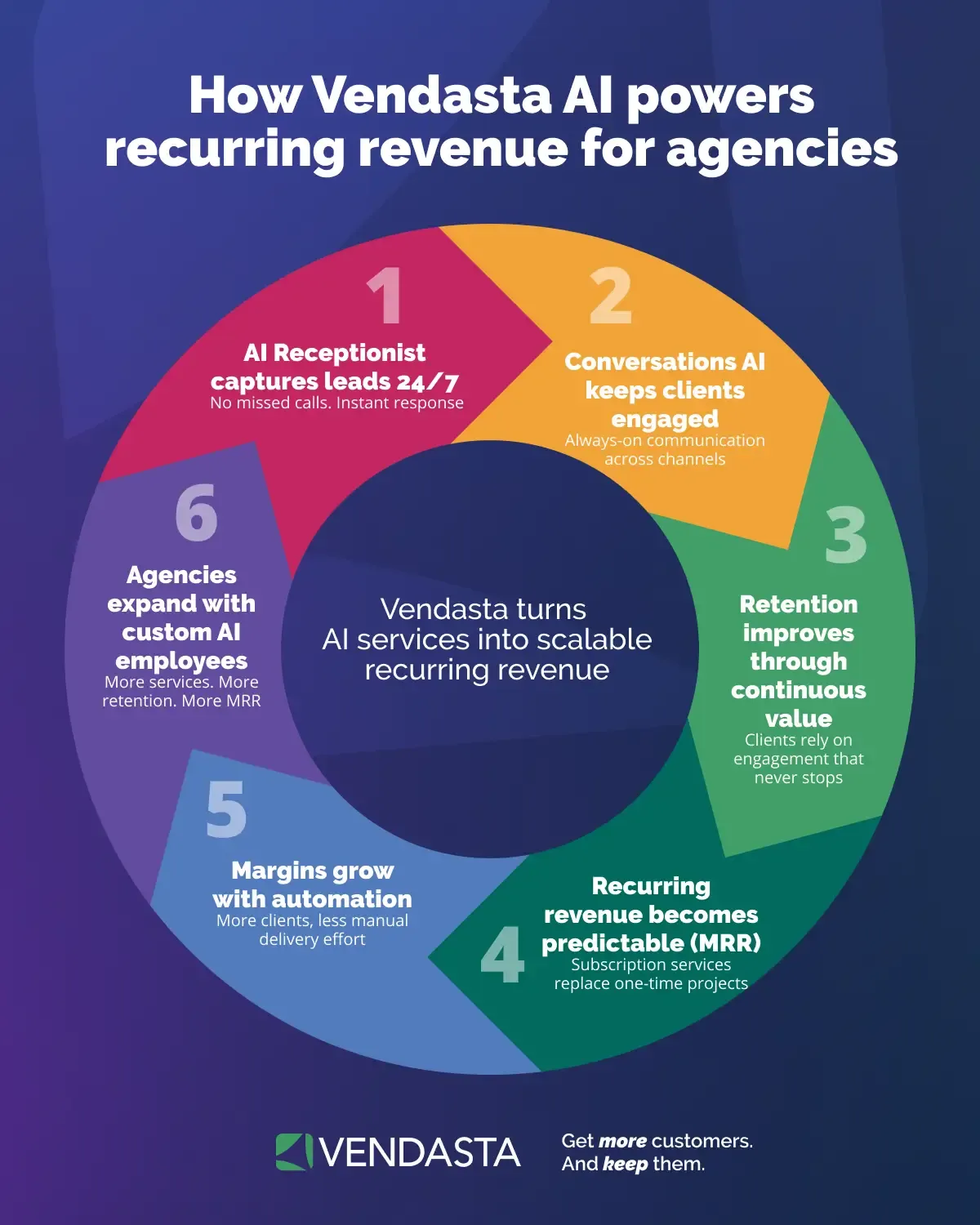
Be the brand they come to. Sandy got consulting requests at 400 subscribers because she published consistently in public. Agencies get the same effect from the same behavior, and it costs nothing but the discipline to keep showing up.
The margin from AI is real. The moat around it has to be built separately.
AI Agency Profit Margins Made Durable With Vendasta
Sandy built her roster herself, from scratch, over sleepless nights, for one business: her own. That is the right call when the business is a personal brand. It is a much harder call when you are running delivery for forty local clients who each want the system pointed at their own data, their own brand voice and their own phone line.
For a midsize agency, that is where growth turns into a trap: more clients mean more hires, and more hires mean thinner margins. Vendasta is an AI customer acquisition and engagement platform for local businesses and the partners who serve them, and it breaks that equation. AI Employees become the fulfillment layer, so you grow monthly recurring revenue without growing your team.
Hire the Roster Instead of Building It
Sandy spent five days building and several months learning before that. The Vendasta AI Workforce ships the roles already built. An AI Receptionist answers calls, web chats, and texts around the clock, qualifies leads, and books appointments. An AI Reputation Specialist responds to reviews. An AI Social Media Manager and an AI Blogger handle the content work Sandy’s roster was built for: researching what customers search for, writing and publishing articles, and turning each one into a week of social posts.
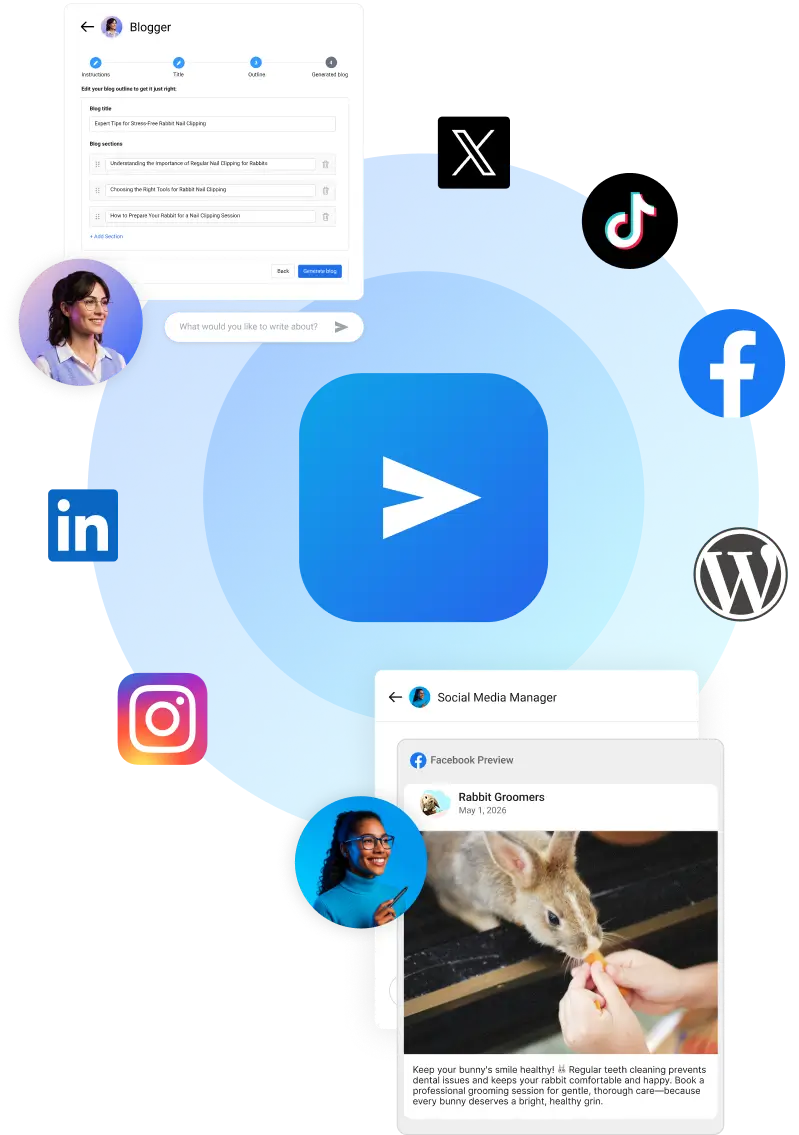
Most AI Employees deploy in under 30 minutes, which is the difference between deploying to one client and deploying to fifty. And because over a decade of local business data plus each business’s own records sit underneath them, these AI Employees start with context rather than a blank prompt.
Point the Same System at Every Client
The reason Sandy’s stack works is that it knows her voice and her market. The reason most agency automations fail at client number three is that they do not transfer.
Vendasta’s AI Employees run across thousands of partner and business accounts at once, each one operating in the right brand context and working from that business’s own website, business profile, and uploaded knowledge. They complete end-to-end workflows instead of waiting for prompts, and you deploy them across your whole client portfolio from Partner Center, under your own brand. You build the play once and deploy it everywhere.
Build the Agent Your Niche Actually Needs
Some roles will not exist off the shelf, which is where Custom AI Employees come in. You upload documents, define rules and connect external systems without code. That is how LeadWorks built Penn, an AI content employee trained on client knowledge bases that cut content production from 90 to 120 minutes per piece down to 5 to 10 minutes.

“Penn is actually one of my most profitable employees, and he’s an AI worker,” said Scott Regan, founder and CEO of LeadWorks. Blue River Digital took the same approach with a proposal-building AI Employee that cut proposal turnaround from days to under two minutes, and partners use the same builder for roles like the AI Inside Salesperson, which qualifies inbound inquiries and books meetings.
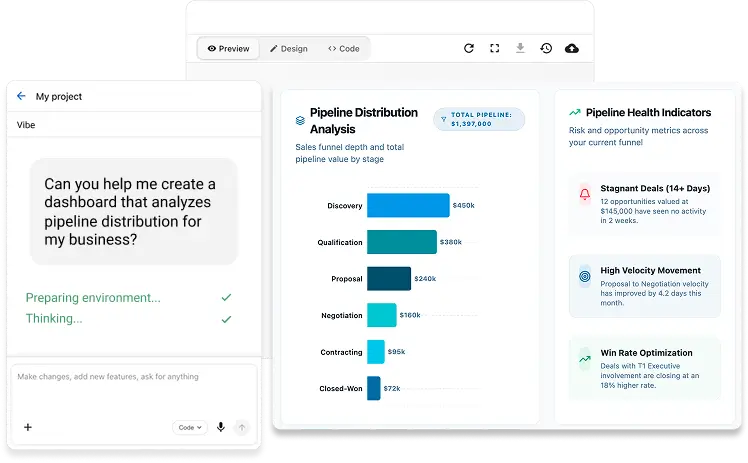
If what your niche needs is a small tool rather than an AI Employee, Vendasta Vibe, now in beta, lets you describe it in plain language and ship it without an engineering hire, the same way Sandy turned her internal dashboard into something two hundred people now use.
Before you start, our guide to vibe coding for agencies walks through where that approach holds up and where it does not.
Prove the ROI You Just Charged For
Sandy raised her retainer 83% because she could point at a result. Most agencies cannot, because the proof lives in six dashboards nobody opens.
The Executive Report compiles performance across channels automatically and delivers it under your brand, and Business App logs every AI action so the work stays visible between reporting cycles. That matters for margin as much as for sales: in Vendasta’s churn study, clients receiving regular proof-of-performance reports retain 38% better. It also makes a raise conversation easy instead of awkward.
Resell What You Proved
Once a play works, you can package AI Employees, brand them and sell them as your own service, buying at wholesale and setting your own retail price. Agencies have built real businesses on exactly this motion. Blackfeather Digital reached $1 million in first-year revenue with a team of three and kept 100% of its clients through that first year.
You can see how other partners packaged and sold their AI Employees in our AI Employee success stories.
Conclusion: The Hiring Reflex Is the Expensive Part
Sandy Lee has a full-time job, three kids under eight, and a content operation that would have cost eight thousand dollars a month to staff in 2018. She is not an engineer. Nine months ago she had never written a line of code, and she had no idea what a backlink was when she applied for the job that paid her first retainer.
Her story says less about being exceptional than about how cheap execution has become, and how few agencies have updated their business model to match.
The agencies posting the best margins right now are not the ones with the most people. The BLS census shows nearly twice as many US ad agencies as in 2019 with roughly half the staff in each, and the margin data shows that agencies that narrowed what they sell are keeping more of what they earn. Headcount stopped being the growth lever. It became the thing that eats the growth.
The real question is whether you will own that system or rent it from the next contractor who learns it faster than you do. Sandy picked ownership. “You’re not hiring a full team anymore,” she said. “You’re just building one system, multiple different AI agents.”
If you want that system working across your whole client book instead of one account at a time, book a demo with Vendasta today and see what the Vendasta AI Workforce looks like deployed across forty local businesses at once.
AI Agency Profit Margins FAQs
1. What are AI agency profit margins?
AI agency profit margins are what your agency keeps after delivering client work with AI systems rather than billable human hours. Cost shifts from salaries and contractors to subscriptions and API usage, so margin stops tracking headcount. The gain only holds if you price on client outcomes instead of hours, because hourly billing passes every efficiency straight to the client.
2. How much can AI actually cut agency delivery costs?
Sandy Lee priced her content agent roster against the salaries the same roles command and landed at $7,000 to $8,000 of monthly labor replaced for roughly $230 in subscriptions and API calls. The reduction is largest in production work: writing, editing, research and scheduling. Strategy, client relationships and judgment do not compress the same way, and should not.
3. Why do agencies struggle to hire for AI delivery roles?
The capability is too new for a hiring market to exist around it. Sandy hired six people before building the system herself, and none delivered usable work because the specialty barely existed yet. You end up paying to train rather than to recruit, absorbing the cost before a single deliverable lands. Building the system is usually faster.
4. What is the eighty-twenty rule for content, and does it work for clients?
Sandy’s eighty-twenty rule says 80% of what you publish should cover topics already proven to perform in your market, delivered in your own voice, while 20% can be whatever you want to say. The proven majority earns the audience. The remainder builds distinctiveness. It works for client accounts because it anchors the calendar to demand instead of opinion.
5. What is an outlier score and why does it matter for content planning?
An outlier score compares a single piece of content to its own channel’s baseline. A channel averaging a thousand views with one video at ten thousand has a 10x outlier. Pair it with views per hour, which shows whether people are watching right now, and you can tell a live topic from one that performed well a year ago and is now dead.
6. How should agencies price AI services for clients?
Price on the client’s return, not your effort. Sandy moved a retainer from $3,000 to $5,500 after demonstrating results, with no increase in her delivery cost. She also warns that underpricing signals low quality to serious buyers. Vendasta partners who sell AI Employees as outcome-based services, rather than hourly automation projects, protect the margin the automation created.
7. Is building an AI agency a sustainable business model?
It is profitable now and fragile over time. Sandy’s own warning is that clients drop AI service providers easily because the barrier to replicating a single automation is low. Durability comes from owning the operating system rather than individual tasks, selling recurring services instead of projects, and building a brand clients come to rather than one they shop against.
8. How does Vendasta help agencies improve AI agency profit margins?
Vendasta gives agencies a prebuilt AI Workforce instead of a build project. Most AI Employees deploy in under 30 minutes, each one works from that business’s own data, and you can package and resell them under your own brand at wholesale pricing. You get the delivery cost advantage without the months of assembly Sandy went through.
9. Can an agency deploy AI Employees across many clients at once?
Yes, and that is the problem Vendasta is built for. Configuring one agent for your own business is straightforward. Configuring it for forty businesses with different brand voices, phone lines and data is where most agency programs stall. Vendasta’s AI Employees are set up per client from that client’s own data and deployed across the whole portfolio from Partner Center.
10. What should an agency automate first?
Start where the work is repetitive, high volume and tied to revenue the client can feel. Missed calls, slow follow-up, review responses and content production are the usual four. An AI Receptionist is a natural first service because missed-call revenue is obvious to the business owner, which makes it one of the easiest services to sell and to prove.