About Us
 Careers
 Leadership
 Board
Board Newsroom
“No one ever left a message before. Of course they didn’t.”
For fifteen years, Klint Rudolph never answered his own phone at The Xcite Group. Calls were forwarded to partners who were always in client meetings, and the voicemail box was always empty. He assumed nobody called a marketing agency at night.
Then he switched on an AI voice receptionist, mostly out of indifference, and found a transcript of a stranger asking detailed questions about Xcite’s web design process at eight in the evening. The empty voicemail box was never proof nobody called. It was proof nobody waited.
“If Xcite’s missing phone calls at night, what real businesses are?”
That question reorganized his entire company. Fifteen years selling local businesses traffic, and he’d never sold them a way to answer it. Neither has your agency — which is why AI employees for agencies stopped being a service line this year and became the entire business model at Xcite.
The urgency is real: your clients already found this without you. The Upwork Research Institute surveyed 195 SMB leaders in Q1 2026 and found customer service is now the top function for AI agent pilots, at 40%, ahead of scheduling and admin at 38% and analytics at 37%. Asked where they learn about AI agents, those leaders named vendors at 53% and peer networks at 52% — not their marketing agency. Meanwhile, Forrester found the share of B2B marketers expecting to increase agency budgets fell 13 percentage points year over year, with digital marketing dropping hardest, from 51% down to 31%. Repriced on the old work, routed around on the new work.
Klint worked that out roughly two years before his competitors. He is a founding partner at The Xcite Group and a Vendasta partner since 2013. He rebuilt the operating model around a roster of eleven named AI employees, gave up running four departments to do it, then sold the same system into a book of close to 200 SMB clients. Their case study with Vendasta paints the picture: $745K in gross marketplace revenue, a 20% lift in conversions, and 100% retention among clients using Vendasta AI products.
In this guide, Klint shows you how to encode one person’s expertise into an agent the whole team can query, how to configure a receptionist that qualifies and books instead of deflecting, and how to run a demo that closes a client in five minutes without a pitch.
Automate every step of the customer journey with AI employees
TL;DR
- The Xcite Group serves nearly 200 SMB clients with a shrinking headcount and has not lost a single AI client it did not want to lose. Two of roughly 50 AI clients left, one sold the business, and one closed the doors. Vendasta’s case study puts the agency at $745K gross marketplace revenue, a 20% conversion lift, and retention up from 70% to 100% on AI products.
- Selling AI stopped being a pitch and became a demo. Klint spins up a trained chat agent on a prospect’s own website content, sends the link with one line, and lets it do the talking. “You’d be shocked at how easy it is. I showed them the demo once. I asked them one question. Five minutes later, they’re a client.”
- Depth beats adoption. Deloitte found only 34% of organizations are deeply transforming with AI while 37% stay at the surface. Xcite is in the first group because the AI runs the forms, the phones, the CRM, the reviews, and the campaigns, not a widget bolted to the corner of a page.
What Are AI Employees for Agencies?
AI employees for agencies are role-based digital workers that own a defined job inside an agency or an SMB client account, such as answering the phone, qualifying inbound leads, responding to reviews, drafting social content, or assembling proposals. Unlike a chatbot, an AI employee runs on the business’s own data, follows a written playbook, takes action in connected systems, and logs everything to a shared record.

For agencies specifically, they cover two jobs at once:
- Internal capacity. Work that used to bottleneck on a founder or a specialist gets encoded once and made available to the whole team.
- Sellable service. The same architecture gets cloned into client accounts as a recurring line item that plugs into fulfillment instead of adding to it.
Klint draws the line hard. “It’s not a chatbot. It’s a new employee that has been trained on everything I know about your business, your website, the rivers that you operate on if you’re an outdoor client, the kind of haircuts that you like to do, whatever.”
“It’s not a chatbot. It’s a new employee that has been trained on everything I know about your business.”
— Klint Rudolph, Founding Partner, The Xcite Group
Rule One: Write the Manifesto Before You Write the Prompt
Most agencies start with a tool. Xcite started with a document.
Klint’s team was already using ChatGPT, Claude, and Manus in the shadows. People were nervous. If an agent could do a job, was the job going away? So before Xcite scaled anything, the partners wrote an internal AI philosophy and said it out loud.
“Our core philosophy will always be people first, always. AI does the grinding, humans provide the spark.”
That line does more work than it looks like. It gave the team permission to automate without feeling like they were writing their own severance letter, and it gave client-facing staff a sentence they could repeat in a sales call. It also gave the agency a filter for scope. As Klint puts it, when a client asks whether the AI can do something, “Well, yeah, it can do anything basically. But should it?”
Teach the Golden Prompt Formula on Day One
Xcite paired the philosophy with a single training standard everyone learns: RCO. Role, context, outcome.
- Role: tell the agent what job it holds.
- Context: give it the messy real inputs, the constraints, the history, the ugly edge cases.
- Outcome: define what a win looks like before it starts.
It is deliberately simple, and that is the point. Once a 12-person agency shares one vocabulary for talking to AI, the ideas stop coming from the top.
Then let the team bring you the use cases
Once the manifesto landed and RCO was taught, Klint stopped being the only person inventing agents.
A paid search optimizer came to him with a problem. Xcite was running a campaign for its own AI services, traffic was thin, and visitors were not reading the long-form landing page. Her ask: could a separate agent live on that page and walk people through an ROI estimate?
That agent is Gage. He introduces himself as a workforce ROI strategist, asks what kind of business you run, how many calls you miss a week, how many come in after hours, and what an average customer is worth, then returns an estimate of what an AI workforce would recover. Klint took Vendasta’s static AI impact calculator and made it conversational.
“I just stole that form and made Gage do it, and do it in real time in a conversation.”
The strategic point is not the calculator. It is that an optimizer, not the innovation partner, thought of it. That only happens after you tell people the rules.
Rule Two: Turn Tacit Knowledge Into an Agent Before You Turn It Into a Hire
Klint ran programmatic at Xcite. He also ran SEO, analytics, and video production. Programmatic was the worst of it, because the expertise had nowhere to live except his head.
Account managers sent him 12 to 15 programmatic requests a week through Trello. Each one meant a meeting, then research across roughly 50 products with different minimums, ad sizes, and requirements, then a proposal. It took him two days to even open the ticket. Clients waited a week for an answer they had usually stopped caring about.
So he built Klaygent.
Klint took his own knowledge plus every training doc Xcite had, compiled it into a large structured JSON file, and gave it to a custom AI employee. Now an AM types the client type and the goal, and Klaygent returns the eligible products, the minimums, the CPMs, the ad specs, the lead times, the measurement plan, and the next steps. Ask again, and it writes the proposal.

The time it gave back: 10 hours in a good week, closer to 20 in a bad one.
| The old model | The Xcite model |
| 12 to 15 programmatic requests routed to one partner per week | Any AM queries Klaygent directly |
| Two-day queue before the request is opened | Answer in under a minute |
| A week to get a recommendation back to the client | Same-day proposal, copy and paste ready |
| Expertise lives in one person’s head | Expertise lives in a knowledge source the whole team reads |
| 10 to 20 partner hours a week consumed | Those hours redirected to innovation and client strategy |
Klint frames the underlying problem better than most operators do. “Most companies don’t even know how their work gets done. Processes live in silos. Expertise walks out the door during turnover. And the how behind decisions rarely makes it into any system of record.”
That is the real starting point for AI employees for agencies. Not “what can we automate.” Ask instead: what does exactly one person here know, and what happens to us the day they resign?
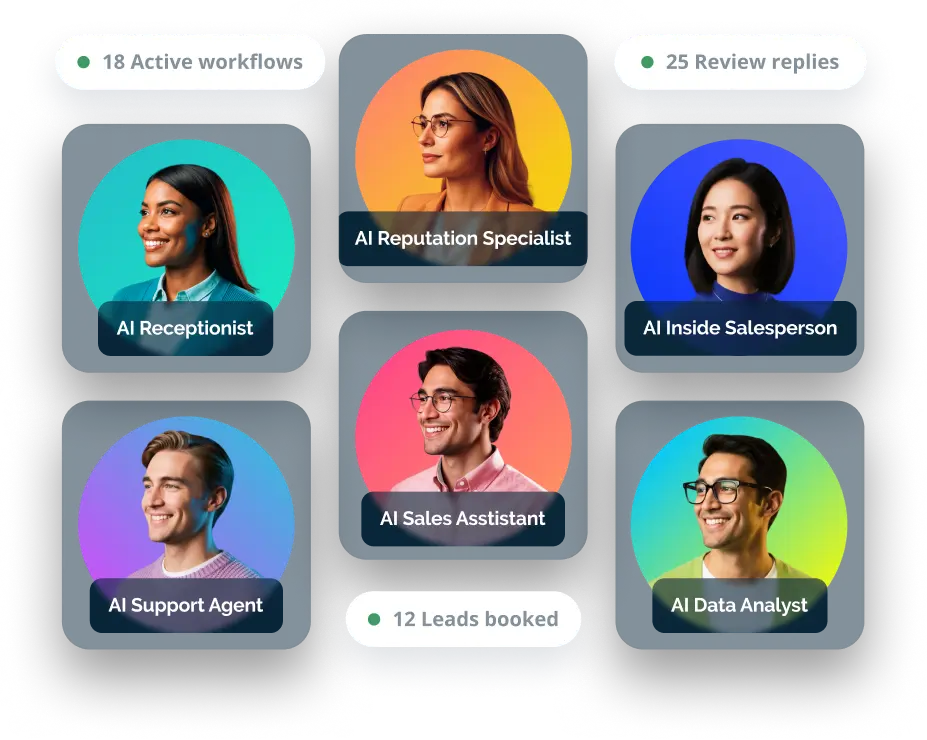
The Roster Klint Runs Today
| AI employee | What it does at Xcite | Vendasta product |
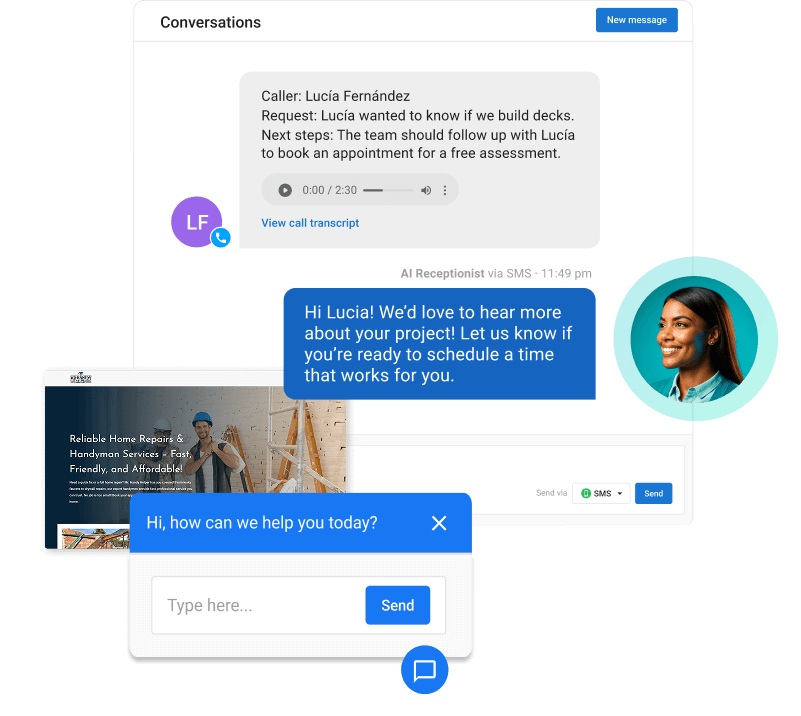
| Sophia (chat) | Greets web visitors, answers service questions, captures leads, continues over SMS, email, Facebook, Instagram, and WhatsApp | AI Receptionist |
| Sophia (voice) | Answers every inbound call 24/7 with the same knowledge base, qualifies, books, and blocks vendor spam | Conversations AI |
| Social media manager | Drafts and schedules on-brand posts, tailored per platform, sent to Klint for approval | Social AI |
| Blogger | Runs scheduled research, drafts long-form content, revises through chat | AI Employees |
| Sophia (reputation) | Writes review responses in the agency’s tone, including negative ones, and answers questions about review trends | AI Reputation Specialist |
| AI sales assistant | Joins every meeting, takes notes, produces follow-ups, syncs to the CRM | AI Sales Assistant |
| Search expert | Answers questions about local rankings and on-site AEO and SEO issues, with live context on current positions | Local SEO |
| Grizz | Custom internal data analyst | Custom AI Employees |
| Klaygent | Programmatic specialist for the AM team | Custom AI Employees |
| Gage | ROI estimator embedded on a specific campaign landing page | Custom AI Employees |
| HR specialist | Answers employee questions on holidays, 401(k), parental leave, and policy | Custom AI Employees |
He also keeps seven or eight Vendasta Vibe projects running at any time. As he describes his own screen, “I have a million custom agents.”
Rule Three: Build One Great Agent, Then Clone It
Here is the part that makes 200 client accounts possible without 200 build cycles. Klint does not architect a new agent per client. He built one very good receptionist (Sophia) and treats it as a base image.
The Anatomy of Sophia
Persona first. Before capabilities, Klint gives the agent an identity. For one hotel client, he researched the property, found a resident dog that guests kept mentioning in reviews and photos, named the agent after the dog, commissioned a cartoon likeness, and fed it that personality. Small move, disproportionate trust.
Ground truth and hard constraints. Sophia runs on an explicit list of things she will never do: no guaranteed pricing estimates, no invented capabilities or integrations, no claiming AI replaces staff, no robotic or repetitive phrasing, no long explanations unless asked. Those constraints are the difference between an agent you can put in front of a client and one you have to babysit.
An intent ladder, not a script. Klint merged the out-of-the-box AI sales assistant prompt with his own qualification logic, so Sophia reads intent and changes behavior:
| Reader signal | What Sophia does |
| High intent, wants help now | Move fast, capture, push to demo or booking |
| Mid intent, exploring | Educate and qualify |
| Low intent, browsing | Engage, delay the capture ask |
| Skeptical or doubtful | Validate the concern, then differentiate |
| Urgent, has an immediate plan | Capture fast and escalate |
Knowledge sources stay lean. For Xcite, Sophia reads one thing: the business profile and the website, which after fifteen years is a deep archive of service pages and blogs. Klint’s view is that “Sophia knows way more about what Xcite does than I could train someone who would be an administrative assistant to answer our phones.”
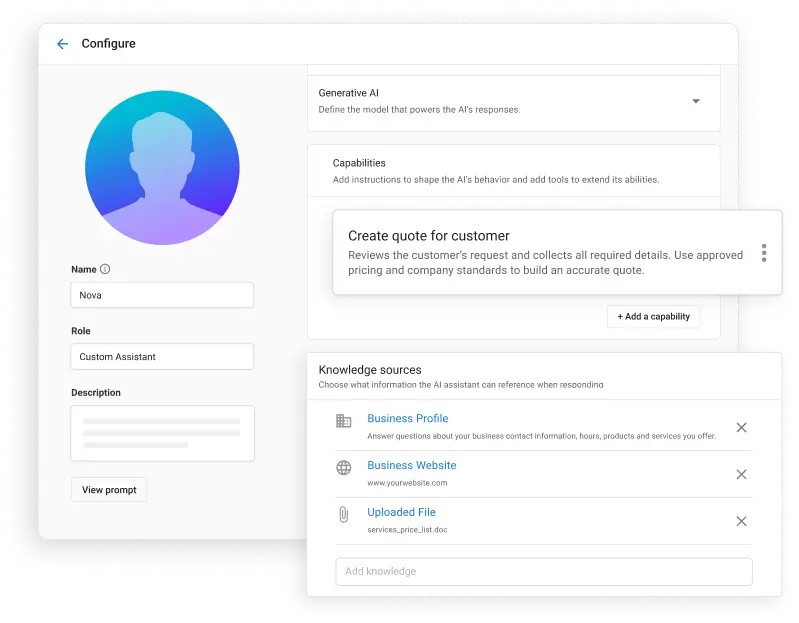
The power is in the automations, not the chat window. Every field on every Xcite form is a custom field that writes to the CRM. When a form comes in, the automation calls the AI employee to read the actual submission and reply to what the person wrote, not with a template. Checked PPC and typed that they are trying to lower cost per click? The reply names the problem back to them and offers either a conversation or a booking.
How He Clones it Across a Book of Business
The scaling loop is unglamorous and repeatable:
- Start from the proven Sophia base prompt. Never from scratch.
- Drop the base prompt plus the client’s URL into an LLM and ask it to research the business and adapt the prompt for that vertical.
- Paste the adapted prompt into the client’s agent.
- Test it, then break it.
- Chat with the agent directly and ask, what else are you missing in your prompt, and how can I help you do your job better.
- Adjust the persona, name, avatar, and tone. Strip the nurture logic for clients whose businesses are not sales-led.
“The base prompt I’m not creating from scratch. I inject the personality of that business, the name of the agent, the picture, what tone of voice they have.”
— Klint Rudolph
What That Buys You: “The Harmony Story”
On January 4, a woman named Harmony filled out Xcite’s contact form. She worked for an MSP, needed help with a Google Ads account, and wanted to sync the ad launch with a billboard campaign.
Klint is blunt about what would have happened in the old model. “Every one of them would have looked at it and said, we don’t do billboards.” The form would have died in an inbox.
Instead, Sophia texted and emailed her immediately, then kept going. Over three and a half weeks, they exchanged emails. Harmony sent her target market. Then her ICPs. Then the actual billboard design and her latest Google Ads data.
Sophia confirmed the targeting plan back to her, naming the Madison, Wisconsin focus, the emphasis on construction, and the secondary sectors from her own worksheet. When the intent signals stacked up high enough, Sophia asked for the meeting and put it on the calendar.
Xcite signed the retainer. Harmony’s words at the meeting: your sales team is incredible.
“And I said, well, that’s our AI. And she’s like, OK. Well, I need Google Ads help, but I want whatever all that is.”
Three and a half weeks of unglamorous follow-up is exactly the work a human rep abandons. Vendasta partners see the same pattern in the numbers: leads contacted within five minutes are 21 times more likely to qualify than leads contacted at 30 minutes, and 79% of marketing leads never convert, with lack of nurture as the primary cause. Speed and persistence are not personality traits. They are configuration.
Rule Four: Stop Selling AI in Layers
Most agencies sell AI the way they sell everything else. Good, better, best. A chat add-on. Voice as an upgrade. Reviews as a Phase 2.
Klint refuses. His approach plays out like an AI sales pitch framework for agencies in practice: every client who onboards at Xcite gets the whole system.
The baseline he still calls Step Rep, a name from his earliest Vendasta contract, now covers listings management, listing sync, Reputation AI, Social AI, Conversations AI Pro, and Campaigns Pro. Voice is included whether the client turns it on this month or in six months.
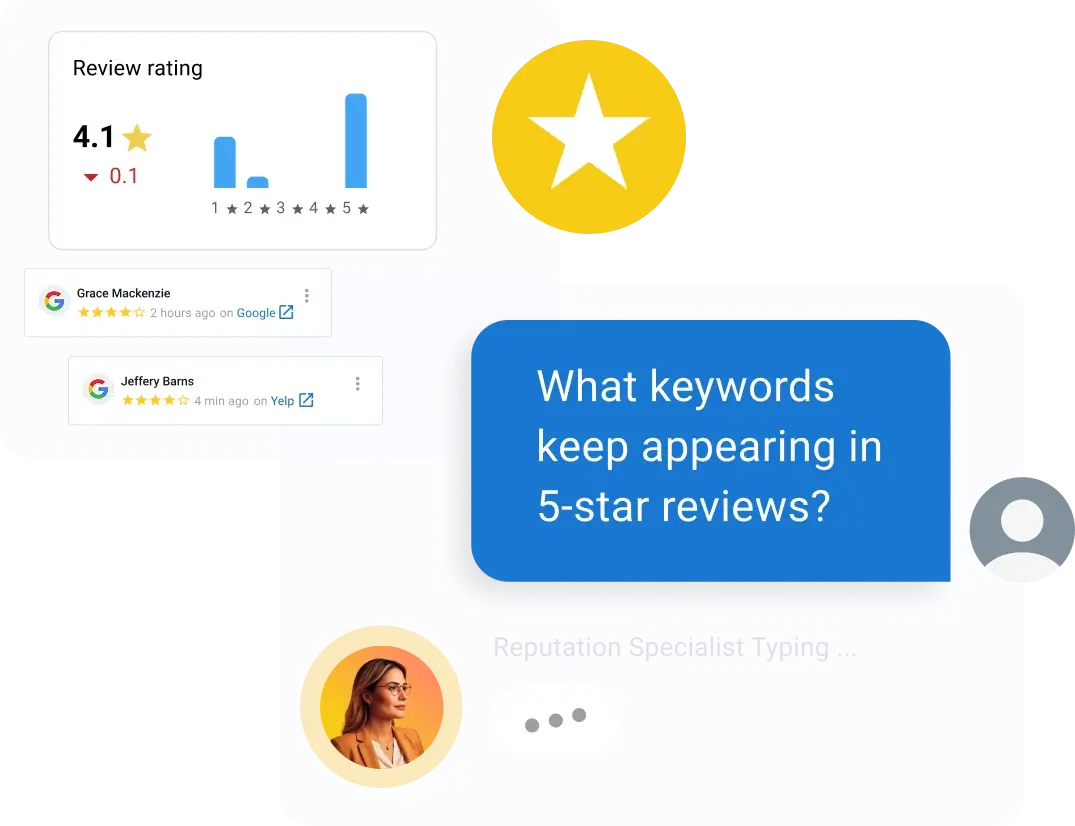
“I don’t sell this in layers. I don’t sell it in packages. You’re getting all of it, period.”
Three things make that work.
1. He sells the outcome, not the SKU list.
“You’re getting a full local SEO, listings management, citation building, and reputation management platform all in one. You can run email campaigns out of it. And you’re getting this AI workforce to use when you see fit, when you’re comfortable. I’m going to teach you how to use it.”
2. He prices it as a replacement, not an addition.
When a prospect is already spending $300 a month across scattered tools, the pitch is to consolidate. Klint’s positioning is explicit: he is cheaper than GoHighLevel, and the bundle absorbs software the client is already paying for. Normal markup still applies. This is not the $10K retainer sitting on top of a $40K ad budget, and it is not supposed to be.
3. He does not fight the incumbent CRM.
When a client says they already have Salesforce, Klint agrees and moves on. Xcite’s CRM still runs underneath to give the agents context, and everything the AI workforce does pushes into Salesforce or HubSpot. The client keeps their system of record. The agency keeps the data layer that makes the agents good.
That last one is the quiet reason this compounds. Klint’s answer for why the platform beats a stack of general-purpose LLMs is contextualization.
“These things have free reign on the internet. If you don’t know how to train it, if you don’t give it proper guardrails, and if it doesn’t have proper context to your business, there’s so many things you can’t do.”
For clients who have been on the platform for years, the listings, reviews, contacts, and campaign history are already there. For a new client, he builds that context from day one in one system instead of stitching Gravity Forms to Constant Contact to a spreadsheet of warm leads.
Handling the objections that do come up
Klint hears fewer objections than most, because he leads with a working demo rather than a promise. The ones he does hear cluster in two places.
- “I love the chat, but do not send follow-up texts.” His answer is a question. It is the same agent, the same guardrails, the same brand voice, just a different channel. Are you actually uncomfortable, or are you not sure it is the same thing? Usually it is the second one.
- “I do not want it posting content for me.” He agrees instantly. Keep human approval on. Then he reframes the math: you just produce a month of drafts in five minutes, editing takes less time than writing, and every edit teaches the agent your voice.
Onboarding runs three calls, and by the end of the third, the voice agent is trained, and the phone number is live, and the client’s job is to stress test it. Call it. Have your spouse call it. Have someone try to break it. Turn it on when you are ready.
“You have to treat every AI deployment like onboarding a real person. Don’t just toss it the workflow. You have to give it the playbook.”
— Klint Rudolph
Rule Five: Let the Demo Do the Selling
This is the section to steal.
The free chat agent is the entire sales motion. Klint’s advice, delivered as the single takeaway he most wants agency owners to act on: you can enable Local SEO Standard for free and spin up a chat agent on a client’s My Listings page. It costs you nothing and requires no product activation before a signature.
The sequence:
- Train the agent on the prospect’s own website. Base prompt in, URL in, adapted prompt out, ten minutes of testing.
- Deploy it and send one line. “Hey, I built this for you. It’s already trained on your website and your business.”
- Set the expectation before they click. Tell them it may get something wrong, and tell them why. It has read their whole site, including the parts they forgot about.
- Let the misses become value. This is the move most people miss. When a prospect comes back and says the agent quoted pricing from a 2015 blog post, that is not a failure. That is a website audit they did not know they needed. “Now it becomes the AI helped them uncover a problem they didn’t know they had. Not that the AI isn’t working.”
- Ask one operational question. What is your team’s playbook today for a new lead, and what is your playbook for existing clients? The gaps sell the rest.
The results speak in the numbers Klint quotes without hesitation. One client wanted chat only, no voice, no review responses. Setup took about an hour. It went live that night.
“Took me about an hour to set up this AI agent. And by the next morning it had booked a $1,400 job.”
The client’s response was to turn on the phones and the reviews.
“You’d be shocked at how easy it is. I showed them the demo once. I asked them one question. Five minutes later, they’re a client.”
The Pipeline Behind the Demo is Education, Not Outbound
Xcite has no outbound sales team. Klint’s number one lead source is speaking and podcasting, where he never mentions Xcite.
He has presented at the America Outdoor Conference for years. Last year he co-presented on how AI could improve the outdoor guest experience across pre-trip, on-trip, and post-trip, tool agnostic, no product pitch. A high-end Canadian fishing lodge came up afterward with a problem no vendor had solved: guests arriving from around the world, and no way to hire enough translators for Chinese and Russian speakers.
Klint told them chat and voice could handle it. They did not believe him. He asked for an hour and spun it up at his booth. The lodge owner’s wife, a Russian speaker, told him it was the best Russian translation she had seen.
Then came the question that pays the bills. So what else do you do?
They were unhappy with their current PPC agency. Xcite now runs their search and their social.
“They literally came for the chat. But the conversation and the trust are already built. So when I say, of course, I can do Google Ads, they’re like, oh, I don’t have to sell myself on that.”
Why Xcite’s AI Clients Do Not Leave
Retention is where this stops being a story about tools.
Xcite historically ran 75 to 80% retention, which is healthy for the agency world and still meant a monthly fight to justify the invoice. Among the roughly 50 clients running the AI system, two have left. One sold the business. One closed the doors. Zero left because of the work.
Klint’s read on why is worth sitting with, because it has nothing to do with AI being impressive.
“When this is your forms, when this is what answers your phones at night, when this is your CRM, when this is your email campaigns, when this is the thing that responds to all of your reviews, it is a business operating system that is far harder to separate and go rebuild somewhere else.”
The switching cost is not a contract term. It is the operational dependency you built together on purpose. And the defense burden drops with it. “I still have to defend our marketing. I don’t have to defend this much because they’re getting, from the technical piece, every lead that comes in. Everyone’s getting notification that says new phone call from The Xcite Group, new lead from The Xcite Group.”
The client sees the agency’s name on every recovered opportunity, every day, without a report.
That distinction matters more in 2026 than it did in 2023. Forrester’s data shows buyers getting more selective about what they pay agencies to execute. Execution is what gets repriced. Infrastructure is what gets renewed. If you want the deeper version of this argument, our breakdown of recurring revenue for agencies covers the model math.
“My clients don’t leave. They came for one capability and they stayed for everything.”
— Klint Rudolph
What This Did to Xcite Itself?
The internal numbers are as interesting as the client ones.
Headcount went down, not up. Xcite lost two account managers to other opportunities and has not backfilled either seat while serving close to 200 clients — the AI account management model in practice. Klint is honest that this was not a strategy. “It’s gone down, but not on purpose. We’re trying to get more efficient so that I don’t have to in the short term. Long term, the way that I want to grow, we’re going to have to staff up.”
A partner’s job description changed. Klint spends roughly 75% of his time building, breaking, and learning inside the AI workforce. He used to run four departments. “To stay ahead, that means I have to devote the bulk of my time breaking things, learning things, getting your team to fix things I’ve broken.”
Nobody measures that with a normal KPI. “It’s not measurable by typical KPIs. It’s measurable in results. It’s measurable in far downstream effects of teams bursting at the seams and now all of a sudden being like, oh, I have more time to do the things I’m good at.”
The revenue followed. $745K in gross marketplace revenue, conversions up 20%, manual workload down 60%, and lead-to-appointment conversion up from 50% to 70%, per Vendasta’s case study.
There is one more thing Klint said that has nothing to do with margin and probably matters most. Twenty-five years into digital advertising, he had gone quiet. “I wasn’t not engaged, but I was pretty kind of complacent and almost bored. There’s only so many times I can talk about pay-per-click.” The last two years brought the passion back, because the work went back to visibly helping small businesses instead of defending a channel report.
How Vendasta Turns AI Employees Into Agency Infrastructure
Klint’s system works because every agent shares one brain. The client’s listings, reviews, contacts, conversations, campaign history, and rankings all live in the same place, so a new AI employee arrives already knowing the business instead of starting from a blank prompt. That is the gap between an agency running eleven agents across 200 accounts and an agency running eleven disconnected subscriptions.
Vendasta is an AI customer acquisition and engagement platform built for SMBs and the partners who support them, combining a business’s unique data with AI and automation so agencies stop stitching disjointed systems together.
Deploy AI Employees in Minutes, Not Sprints
Klint spins up a client-ready chat agent in about an hour and a full voice receptionist inside a three-call onboarding. Vendasta’s AI Workforce ships chat and voice receptionists that are ready for a business in minutes, which is the practical advantage that lets one partner serve hundreds of accounts. Your team configures and tests before anything touches a live customer.
Give Every Agent the Client’s Own Data
The reason Sophia outperforms a general-purpose model on a client’s website is context. Vendasta’s AI Employees run on a business’s own data, and 17 or more years of local business data means agents spin up faster than anywhere else. They are not glorified IVRs. They suggest optimizations, predict customer behavior, and take action across CRM AI, Conversations AI, reputation, listings, and campaigns.
Build the Agents That Only Your Agency Could Build
Klaygent, Grizz, Gage, and the HR specialist are not products. They are Klint’s proprietary knowledge, encoded. Custom AI Employees let you turn the expertise that currently lives in one person’s head into something your whole team can query, and something a competitor cannot copy. Pair that with Vendasta Vibe when the idea needs an interface, not just a conversation.
Sell it Under Your Own Brand, On Your Own Terms
Xcite’s clients experience Xcite, not a vendor. Vendasta’s rebrandable platform and white-label Marketplace let you package acquisition, engagement, and operations as one recurring offer with your name on every notification. Klint’s agency is also a Vendasta AI Certified Partner, which is how he keeps a seat at the table on what ships next. You can become AI certified too.

Conclusion: The Agencies That Survive Sell Infrastructure, Not Hours
The uncomfortable read on the 2026 data is that buyers are not abandoning agencies. They are abandoning execution. Forrester found nearly half of B2B marketers expect flat agency spend, with the sharpest pullback in the digital services agencies have sold for two decades. Deloitte found that most organizations are decorating their existing processes with AI rather than rebuilding them. Both groups are describing the same failure to change shape.
Klint changed shape. He gave up running four departments to become the person who breaks things. He gave away his most valuable personal expertise to a JSON file so his team could stop waiting on him. He stopped selling packages. He stopped pitching entirely and started sending demos. And he ended up embedded so deeply in his clients’ daily operations that leaving would mean rebuilding their business, not just switching agencies.
“We had to be early. And if you’re not, you’re going to find by this time next year, you might not be around, or your competitors might not be around. The landscape is changing.”
You do not need a two-year head start to begin. You need one client, one afternoon, one trained chat agent, and the discipline to send it with a single sentence instead of a deck.
Ready to build the same system inside your agency? Book a demo with Vendasta today and see what a full AI workforce looks like running under your brand.
AI Employees for Agencies FAQs
1. What are AI employees for agencies?
AI employees for agencies are role-based digital workers that own a specific job inside an agency or a client account, such as answering calls, qualifying leads, responding to reviews, or drafting content. They run on the business’s own data, follow written guardrails, take action inside connected systems, and log every interaction to a shared CRM record rather than sitting in an isolated chat window.
2. How is an AI employee different from a chatbot?
A chatbot answers questions from a script and hands off a form. An AI employee holds a defined role, reads real business context, follows an intent framework, and completes work such as booking appointments, sending follow-ups, and updating the CRM. Klint Rudolph’s version at The Xcite Group nurtured one inbound lead over three and a half weeks before booking the meeting that closed a retainer.
3. How many AI employees does an agency actually need?
Start with one. Klint recommends deploying a single trained chat agent before anything else, because it costs nothing to spin up and demonstrates value immediately. Once that agent proves out, voice, reputation, social, and custom internal agents follow naturally. The Xcite Group now runs eleven, but it took two years and started with one.
4. What is the RCO prompt formula?
RCO stands for role, context, and outcome. Klint teaches it as the baseline standard for everyone at Xcite. Tell the agent what job it holds, give it the real and messy context of the business, then define what a successful result looks like before it starts. It is deliberately simple so every department can build without waiting on a specialist.
5. How do agencies scale AI employees across hundreds of clients?
Do not build from scratch each time. Klint uses one proven base prompt, feeds it plus the client’s URL into an LLM to research the vertical and adapt the wording, pastes the result into the client’s agent, then tests, refines, and swaps in the persona, name, avatar, and tone. Vendasta gives every agent shared access to that client’s existing data, which removes most of the setup work.
6. How do you sell AI employees to a local business without a pitch?
Build the demo first. Train a chat agent on the prospect’s own website, deploy it free on their listings page, send the link with one line, and set the expectation that it may surface outdated content from their site. Then ask what their team does today with a new lead. Klint closed one client five minutes after a single demo and one question.
7. Do AI employees replace agency staff?
No, and Xcite’s philosophy says so explicitly. AI does the grinding, humans provide the spark. The repetitive follow-up, review responses, after-hours calls, and proposal research move to agents so account teams spend their time on strategy, creative judgment, and client relationships. Xcite’s headcount changed through attrition, not replacement, and the partners plan to hire again as they scale.
8. How does Vendasta help agencies deploy AI employees?
Vendasta gives partners chat and voice receptionists ready for a business in minutes, plus reputation, social, sales, and custom AI employees that all run on the client’s own data inside one rebrandable platform. Because listings, reviews, CRM records, and campaign history already live there, agents arrive with context instead of a blank prompt, which is what makes deployment across hundreds of accounts realistic.
9. Why do Vendasta AI clients have such high retention?
Because the platform becomes the client’s operating system, not an add-on. When forms, phones, CRM, email campaigns, and review responses all run through it, switching means rebuilding operations rather than swapping vendors. The Xcite Group moved from 70% retention to 100% among clients using Vendasta AI products, with the only departures coming from a sale and a closure.
10. Why should an agency choose Vendasta to build an AI workforce?
Vendasta is a unified end-to-end platform for acquisition, engagement, and operations, backed by 17 or more years of local business data that lets AI employees spin up faster than anywhere else. Partners get the tools to implement AI, be the trusted expert, and monetize that expertise under their own brand, rather than assembling and maintaining a stack of disconnected point tools.