About Us
 Careers
 Leadership
 Board
Board Newsroom
AI agents for marketing agencies are ending the equation where every new client requires a new hire. But most agency owners do not realize they are trapped in that equation until the signs are impossible to ignore: margins shrinking despite growing revenue, a fulfillment team running at capacity, and a pipeline they are quietly afraid to close because they do not know how they would actually deliver the work.
Here is what makes it worse. While you are managing that pressure internally, a growing number of competitors have already figured out the exit. They are adding AI-powered service lines, winning clients you should be winning, and scaling without adding a single person to payroll. They are not working harder. They have changed the underlying model.
The agencies that crack this do it by letting AI handle the execution layer: content, lead response, follow-ups, reviews, and campaigns, all running autonomously, around the clock, without overtime pay, onboarding time, or benefits packages. The work gets done. The team stays the same size. The margin finally moves in the right direction.
This guide covers everything you need to know to make that shift: what AI agents actually are, how they work inside an agency, which platforms are worth using, and exactly how to implement them so your growth stops being limited by how many people you can afford to hire.
Automate every step of the customer journey with AI employees
TL;DR
- The hiring trap is real: AI agents for marketing agencies can now handle fulfillment tasks autonomously and at scale, which matters because the average agency runs on 10–15% net profit margins and every new hire directly eats into that window.
- The market is moving fast: 79% of organizations already report some level of agentic AI adoption, and the agentic AI market is projected to grow from $7.29 billion in 2025 to over $93 billion by 2032.
- Agencies that act now win: Platforms like Vendasta give agencies a complete AI workforce, including receptionist, voice, web chat, and review generation, that can be resold as a new service line with zero additional fulfillment effort.
What Are AI Agents for Marketing Agencies?
AI agents for marketing agencies are autonomous software systems that can plan, execute, and optimize multi-step marketing tasks with minimal human oversight. Unlike a chatbot or a basic automation rule, an AI agent perceives its environment, reasons through options, makes decisions, and takes action, then learns from the outcome to perform better next time.
Think of traditional marketing automation as a vending machine: you press a button, and it delivers a preset output. An AI agent is more like a skilled employee: you give it a goal, and it figures out how to get there, adapts when things change, and reports back when it’s done.
For marketing agencies specifically, AI agents can:
- Respond to leads instantly via web chat, voice, or SMS, 24 hours a day
- Generate and publish content across channels on a scheduled cadence
- Follow up with prospects automatically until a conversion is reached
- Monitor and respond to online reviews without manual intervention
- Optimize ad campaigns in real time based on performance data
- Qualify inbound leads and route them to the right team member
The key distinction is autonomy. AI agents don’t wait to be told what to do step by step. They work toward a goal and handle the complexity of getting there on their own.
AI Agents vs. Traditional Marketing Automation: What’s the Difference?
This question comes up constantly, and for good reason: the two are often confused. The difference is significant, and for agencies trying to scale, it matters enormously.
| Feature | Traditional Automation | AI Agents |
|---|---|---|
| Decision-making | Rule-based (“if X, then Y”) | Reasoning-based (adaptive, context-aware) |
| Task handling | Single-step, linear | Multi-step, dynamic |
| Personalization | Template-driven | Learns and tailors in real time |
| Response to new data | Requires manual update | Adapts automatically |
| Human oversight needed | High | Low to minimal |
| Campaign optimization | Static | Ongoing, autonomous |
| Communication | Scripted | Conversational and contextual |
| Learning over time | No | Yes |
Traditional automation is powerful for predictable, repetitive tasks. Sending a welcome email when someone signs up, for instance. But it breaks down when complexity increases: when a lead asks a follow-up question, when a campaign isn’t performing, or when a client needs something outside the script.
AI agents handle the messy, dynamic, real-world complexity that automation can’t. That’s what makes them transformative for agencies.
What Is an AI Digital Marketing Agency?
An AI digital marketing agency is an agency that uses artificial intelligence — particularly AI agents — to deliver marketing services at scale, with less manual labor and higher consistency than traditional agency models. Rather than growing headcount in proportion to clients, an AI digital marketing agency uses autonomous AI systems to handle the execution layer of service delivery.
What distinguishes an AI digital marketing agency from a traditional one:
A traditional digital marketing agency delivers results through human labor: account managers handle client communication, specialists execute campaigns, and coordinators manage fulfillment. Growth requires hiring. Capacity is a function of team size.
An AI digital marketing agency replaces the execution layer — repetitive, high-volume tasks like lead response, review management, content scheduling, and follow-up sequences — with AI agents that operate autonomously. Human team members focus on strategy, relationships, and oversight. Growth is no longer constrained by headcount.
Core services an AI digital marketing agency typically offers:
- 24/7 AI-powered lead capture and qualification via web chat, voice, and SMS
- Automated reputation management, including review generation and response
- AI-driven content creation and social publishing
- Intelligent campaign optimization with autonomous budget reallocation
- AI sales assistants for lead nurturing and appointment booking
Why this model is winning: An AI digital marketing agency can serve significantly more clients at the same margin because the marginal cost of adding a new client is a software license, not a salary. This creates a structural cost advantage that human-labor agencies cannot close by working harder.
Platforms like Vendasta make it possible for any agency to operate as an AI digital marketing agency. The AI Workforce can be white-labeled, deployed across every client, and packaged as a premium service offering — without building proprietary technology or adding internal specialists.
The Real Cost of the Hiring Trap
Here’s the math most agency owners know but rarely say out loud:
The average marketing agency operates on 10–15% net profit margins. Every staffing decision directly impacts that narrow window. One wrong hire, or one hire made too early before the client revenue fully materializes, can eliminate an entire quarter of profits.
The pattern looks like this: you win a handful of new clients. Great. Now you need someone to fulfill the work. You hire. Revenue grows. Margins stay flat or shrink. The cycle repeats, and you find yourself running faster just to stay in the same place.
Each new hire requires significant client volume increases before profitability resumes. During growth periods between hires, agencies either turn away opportunities or risk service quality from overextended staff. Neither is a good option.
This is the fulfillment bottleneck: the moment your capacity to deliver becomes the ceiling on your growth. And it’s where most agencies get stuck.
The good news? AI agents are specifically designed to break this ceiling. They extend your capacity without extending your payroll. They don’t need onboarding time, benefits, or performance reviews. They work nights, weekends, and holidays without complaint. And they can handle the kinds of high-volume, communication-heavy tasks that typically demand the most staff time.
What Can AI Agents Actually Do for Your Agency?
Let’s get specific. Here’s a breakdown of the core tasks AI agents can handle for marketing agencies right now, not in some theoretical future, but today.
Lead Response and Customer Communication
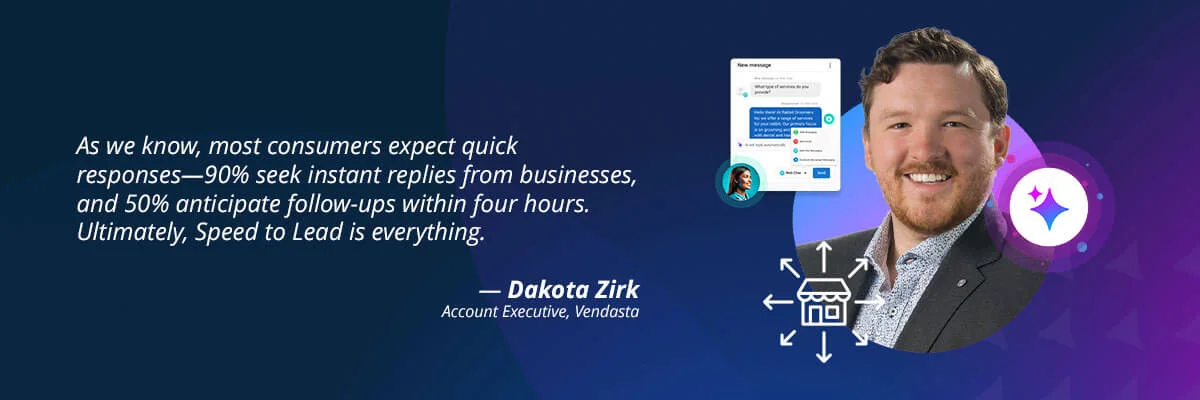
Speed-to-lead is one of the most critical factors in conversion. Studies consistently show that responding to a new lead within five minutes makes you 100 times more likely to connect than if you wait 30 minutes. Most agencies can’t staff for that kind of instant response, especially after hours.
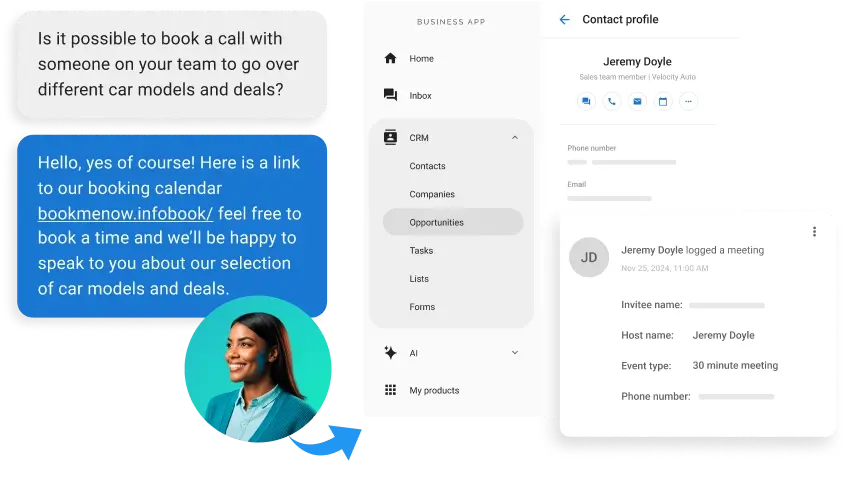
AI agents, like an AI Receptionist, can solve this completely:
- Engage new leads the moment they land on a client’s website
- Answer common questions conversationally, in real time
- Qualify the lead using custom criteria
- Book appointments directly into the calendar
- Send follow-up messages via SMS or email until a response is received
This alone can be a significant service differentiator. Offering your clients 24/7 AI-powered lead response, with no added headcount on your side, is something most competing agencies simply can’t match.
Content Creation and Social Publishing
Content is one of the most time-consuming deliverables for any agency. AI agents can generate, schedule, and publish content across multiple channels autonomously, including blog posts, social media updates, and email newsletters, while maintaining brand voice consistency.
This doesn’t mean removing humans from the creative process. It means the heavy lifting of drafting, formatting, and distributing is handled by AI, freeing your team to focus on strategy, client relationships, and quality review.
Review Generation and Reputation Management
Online reviews are essential for any local SMB. Getting them consistently, however, requires follow-up, something most business owners don’t have time for. AI agents like an AI Reputation Specialist can:
- Send automated review request messages to customers after a transaction
- Respond to reviews (positive and negative) on behalf of the business
- Monitor review platforms for new activity
- Flag urgent issues for human follow-up
Offering this as part of a client package is low-effort for your agency and high-value for your clients.
Campaign Optimization
AI agents can monitor ad campaign performance in real time, tracking impressions, click-through rates, conversions, and cost, and make autonomous adjustments to bids, targeting, and budget allocation. If Google Ads are converting at half the cost of another platform, the agent shifts spend accordingly without waiting for a human to review the report.
This kind of proactive optimization was previously the exclusive domain of expensive media buyers. AI agents democratize it.
Appointment Booking and Scheduling
For service-based SMBs, which make up the core client base for most agencies, appointment booking is mission-critical. AI voice agents can handle inbound calls, answer questions, and book appointments directly, with no hold times and no dropped leads.
Lead Nurturing and Follow-Up Sequences
Most leads don’t convert on the first touch. AI agents can manage multi-step follow-up sequences across email, SMS, and chat, personalizing each message based on the lead’s behavior and stage in the funnel, until the lead converts or opts out.
How AI Agents Work: A Step-by-Step Breakdown
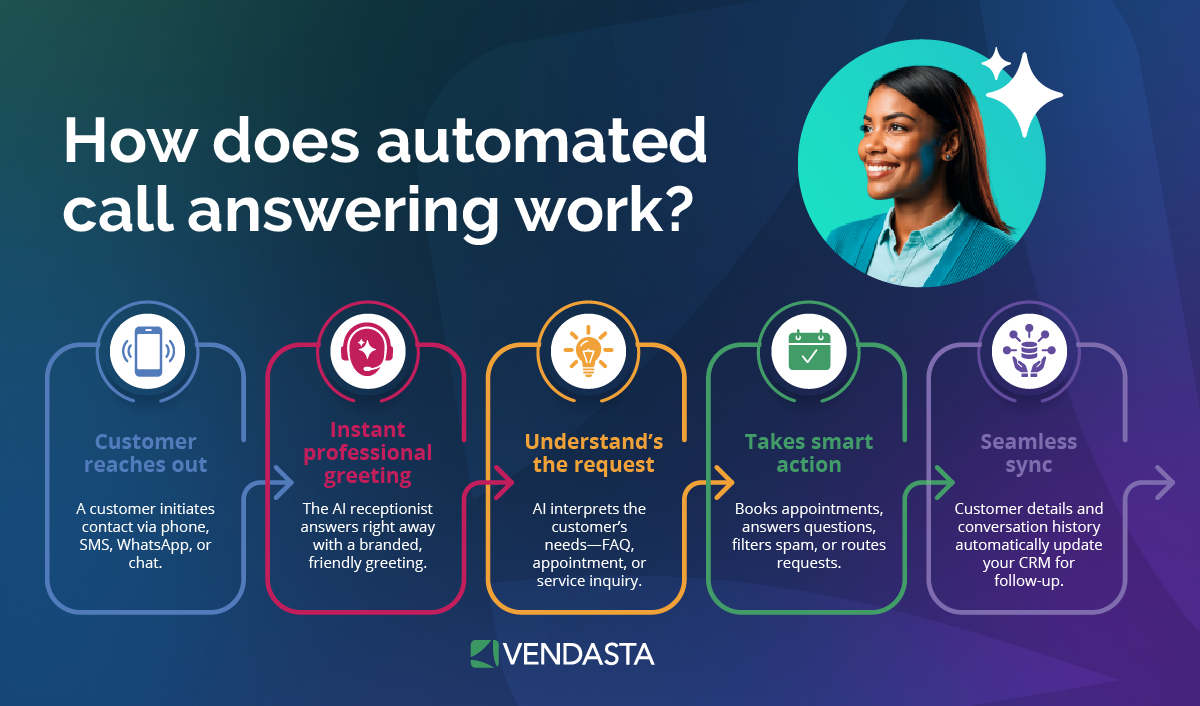
Understanding how to use AI agents for a marketing agency starts with grasping the mechanics of their autonomy. Unlike traditional software that simply follows a list of instructions, AI agents for marketing agencies operate through a sophisticated cognitive cycle. This allows them to function as a true digital workforce rather than just another tool in your stack.
Step 1: Perceive
The agent begins by constantly monitoring its environment for specific triggers. This isn’t limited to a single data source; an AI receptionist can see a new lead form submission, an AI call agent for marketing agencies can hear a customer, and an AI SEO agent for marketing agencies can detect a drop in rankings.
Because they perceive data in real-time, they eliminate the latency that usually occurs when a human staff member has to manually check dashboards or email inboxes.
Step 2: Reason
Once the agent perceives a trigger, it thinks. Using Large Language Models (LLMs) and your client’s unique business data, the agent evaluates the context. It asks: Is this a high-priority lead? What was our last interaction with this customer? What is the goal of this campaign? This reasoning phase ensures that the output isn’t a generic one-size-fits-all response, but a calculated decision based on the specific needs of the SMB.
Step 3: Act
After determining the best course of action, the agent executes the task autonomously. This might involve an AI call agent for marketing agencies handling a complex appointment booking over the phone or an AI SEO agent for marketing agencies updating meta tags and local citations. Because these actions happen in seconds, your agency provides a level of responsiveness that would normally require a massive, 24/7 fulfillment team.
Step 4: Learn
The final step is what makes the technology truly agentic. The agent tracks the outcome of its actions: did the customer book the call? Did the SEO change improve rankings? It uses this data to refine its reasoning for the next interaction. This closed feedback loop means the system gets smarter the more it runs, ensuring that your agency’s fulfillment quality actually improves as you scale.
This closed feedback loop (perceive, reason, act, learn) is what separates AI agents from static automation tools. The system gets smarter the more it runs, which means the value compounds over time.
For multi-step tasks, AI agents can coordinate with other agents. One agent might handle inbound web chat, another manages follow-up SMS, and a third generates and sends a review request after the appointment is complete. These multi-agent systems have been shown to outperform single-agent approaches by 90.2% on complex tasks.
The Business Case: What the Numbers Say
The data on AI agent adoption and ROI is now compelling enough to share with skeptical clients and partners alike.
- The agentic AI market is projected to grow from $7.29 billion in 2025 to over $93 billion by 2032, representing a compound annual growth rate of more than 40% (MarketsandMarkets)
- 79% of organizations already report some level of agentic AI adoption (McKinsey)
- Companies using AI agents report up to 37% cost savings in marketing operations (McKinsey)
- Businesses implementing AI-driven predictive models see up to a 20% revenue increase (McKinsey)
- Human-AI collaborative teams demonstrate 60% greater productivity than human-only teams, with 23% more time spent on creative work and 60% less on editing (DemandGenReport)
- 62% of companies anticipate 100% or greater ROI from AI agent deployments (PagerDuty)
- Early tests show that AI-personalized outreach leads to up to 7x better conversion from lead to opportunity (LandBase)
- AI-sourced traffic increased 527% from January to May 2025, signaling a major shift in how buyers find and evaluate vendors (UrbanElement)
For agencies, the implications are direct. You can handle more clients without more staff. You can offer AI-powered services as a premium line item. And you can differentiate from competitors who are still running entirely on human labor.
What Do Agencies and Users Say About AI Agents?
Agencies that have implemented AI agents consistently report the same outcomes: faster lead response, higher review volume, and more capacity without additional hires. Here’s what the data and direct feedback show.
From the research: McKinsey research projects that organizations implementing agentic workflows in marketing can expect 10–30% revenue growth from hyperpersonalized campaigns, with agentic systems accelerating campaign creation and execution by ten to fifteen times. On outbound conversion, early tests of agentic AI achieved a 7x higher conversion rate versus standard, non-personalized outbound campaigns.
What agency owners report in practice
- Leads contacted within seconds of form submission, versus the industry norm of hours, consistently convert at a higher rate across nearly every vertical.
- Review generation campaigns running on automation generate 3–5x more monthly reviews than manual request processes, according to agencies using platforms like Vendasta.
- Fulfillment teams report reclaiming 10–15 hours per week per client when lead response, follow-up, and review management are handed to AI agents.
Common concerns addressed by early adopters
- “Clients will know it’s AI” — Modern conversational AI agents are indistinguishable from human responses in routine interactions. Most clients only notice the speed.
- “Setup takes too long” — Agencies report initial deployment on platforms like Vendasta taking hours, not weeks, once a standard configuration template is established.
- “The AI gives wrong answers” — Agents configured with specific business data (hours, services, FAQs) produce accurate, on-brand responses. The quality of the output reflects the quality of the setup.
The consistent theme across reviews: agencies that act early build a compounding advantage. Every month of AI-powered lead response and reputation management generates client results that justify premium pricing and reduce churn.
Real Agencies, Real Results: AI Agents in Action
The data on AI agents is compelling. What makes it real is seeing exactly how agencies deployed them, and what happened. The following are documented outcomes from Vendasta partners already running on AI Employees.
An agency booked a high-value client on a Sunday without lifting a finger
When The Xcite Group deployed their AI Receptionist on their own agency website, the first result came within the opening weekend. A Washington-based plumbing company reached out on a Sunday afternoon while the team was completely off-duty. The AI employee, named Sophia, qualified the lead, answered every question, and booked a Thursday meeting on the calendar without a single minute of human involvement. When the prospect showed up for the call, they called Sophia “amazing” and “knowledgeable” — and immediately asked how they could get the same thing for their business.
“Shortly after launching AI Receptionist, I got a notification — ‘You have a meeting scheduled.’ I hadn’t lifted a finger. Sophia had qualified the lead and booked the appointment. I did nothing. It was wonderful.” — Michael Klabon, Partner at The Xcite Group
→ How an agency used its AI receptionist to secure a high-value client on a Sunday
A BBQ pitmaster tripled his annual revenue while working a full-time job
The owner of a BBQ catering business is also a working realtor. He had no time to handle after-hours catering inquiries or manage the complex back-and-forth that weddings and large events require. His agency, Howell Studios, deployed an AI Receptionist trained specifically on his catering menu, event minimums, and booking requirements. By year-end, he had tripled his annual catering revenue. His only required action: sending a Stripe payment link after the AI has already closed the job.
“The AI receptionist handles everything from menu questions to event vetting based on the owner’s specific requirements. It’s teeing up guaranteed catering jobs in the background while the client focuses on other commitments.” — Matt Dakin, COO at Howell Studios
→ How a national BBQ champion tripled annual revenue using an AI catering specialist
A car rental company captured 778 qualified leads in four months
Elite Web Professionals configured an AI Receptionist for Choice Signature Luxury Car Rental in Atlanta to automatically take any call a human agent didn’t answer within 20 seconds. The AI triaged rideshare vs. luxury inquiries, educated callers on licensing requirements for Uber Black, and captured names, numbers, and intent before logging everything to the CRM. Result: 778 qualified leads in four months, a 76% conversion rate, and complete visibility into a missed-call gap the client never knew existed.
“The AI Voice Receptionist has been a game changer. It gave us visibility into missed calls we never knew about. Now we know who’s calling, what they need, and we can follow up.” — Christopher Williams, President of Elite Web Professionals
→ How a car rental company captured 700+ qualified leads in 4 months using AI voice
An AI matched a real estate prospect at 11 PM and generated a $30,000 commission
Blue River Digital deployed an AI Receptionist on an auction house’s site with deep knowledge of property listings. At 11 PM, a prospect asked about a home with a pond. The AI identified a match, and when the prospect expressed interest in more land, it suggested an alternative property weeks out from auction. The prospect followed the link, purchased the property, and the commission came in at an estimated $20,000 to $30,000.
“That property probably made him somewhere between 20 and 30 grand… it absolutely works. Once we could show our clients, ‘this is how it works,’ it paid for everything.” — Nick Prentice, VP of Growth at Blue River Digital
→ How an auction house secured a $30,000 commission using 24/7 AI inventory matching
A marketing agency reclaimed 10 hours of leadership time every week
Blue River Digital operates nine departments, making manual quoting a constant bottleneck. A Custom AI Employee, trained on full price lists, markups, and service packages, now generates complete, accurate quotes in seconds. Forgotten line items like setup fees are included automatically every time. The time savings translate directly to capacity: leadership now runs two additional sales meetings per day, adding 10 more high-value conversations per week with the same team size.
“By automating that workflow, I saved enough time to meet with two additional people every day — that’s 10 more intentional meetings every week.” — Nick Prentice, VP of Growth at Blue River Digital
→ How an agency reclaimed 10 hours of leadership time per week using an AI pricing assistant
A nine-location vet clinic turned after-hours silence into $47,000 per month
Social Ordeals deployed a centralized AI Receptionist across a nine-clinic veterinary network. The AI was trained to route after-hours inquiries to the appropriate emergency hospital, capture contact details, and answer service questions while staff was home. In October 2024, the system generated $42,963 from 101 clients — 57 of them brand new. By November 2025, the monthly figure had grown to $47,698.
“I call it an ‘extra net.’ You’re not losing that 10:00 PM web surfer anymore. All of a sudden, the AI is capturing their intent, and they are halfway to becoming a client without you ever lifting a finger.” — Chris Montgomery, CEO of Social Ordeals
→ How a 9-location vet clinic captured $47,000 in monthly revenue using centralized AI intake
A construction company tripled its sales close rate using AI pipeline coaching
The Xcite Group implemented a Custom AI Employee to analyze 100% of a construction company’s inbound calls, surfacing exactly where sales conversations were breaking down. The AI identified outdated website pricing, confusing service descriptions, and moments where reps weren’t asking for the sale. With that visibility, the agency coached the client’s team using real data, and the close rate jumped from 15% to 50%.
“We use AI to surface exactly what’s happening on the front lines by listening to the calls and identifying why leads aren’t closing. It’s transformed our clients into active participants in their own success.” — Michael Klabon, Partner at The Xcite Group
→ How a construction company tripled their sales close rate using AI pipeline coaching
These are not projections or pilot studies. They are documented outcomes from agencies already running Vendasta’s AI Workforce across their client base. The full library is available here: AI Employee Success Story Library.
Top AI Agents and Platforms for Marketing Agencies in 2026
Not every AI agent platform is built for agency use. Many are designed for individual businesses and lack the white-labeling, multi-client management, and reseller infrastructure that agencies need. Here are the platforms worth knowing about:
1. Vendasta
Vendasta is purpose-built for digital marketing agencies and the SMBs they serve. Unlike point solutions that handle a single function, Vendasta offers a complete AI Workforce that agencies can deploy across their entire client base and resell under their own brand.

Vendasta’s AI Workforce includes specialized AI Employees, each built to handle a distinct area of client acquisition, engagement, and retention:
- AI Receptionist: Provides fast, helpful responses through phone, chat, text, and connected sites — answering questions, promoting products and services, booking appointments, and handling support issues, all hands-off and available 24/7.
- AI Reputation Specialist: Helps businesses stand out and win more customers by delivering personalized review responses, posting on behalf of the business, and sending review requests that encourage positive feedback while handling negative comments with care.
- AI Sales Assistant: Automatically updates contact records after every meeting and identifies the next best steps to unlock revenue, so your team can focus on selling while AI handles the busy work.
- AI Support Agent: Resolves customer questions via SMS and chat using the HEARD framework, providing warm, human-like assistance and capturing details for your team when escalations are needed.
- AI Social Media Manager: Drafts, schedules, and posts content for websites, blogs, and social media platforms to drive awareness and engagement across every channel.
- AI Search Specialist: Analyzes keywords and suggests improvements to increase online visibility and drive more traffic from search engines and ads.
What sets Vendasta apart for agencies is the platform model. Every AI service is bundled into a single, integrated platform that agencies can white-label and resell. There’s no need to stitch together five different tools or manage five different vendor relationships. Agencies get one infrastructure layer that handles acquisition, engagement, and retention for every client, automatically.
For agency owners facing the hiring trap, Vendasta’s AI Employees represent a genuine alternative: a new AI-powered service line that requires zero fulfillment effort on the agency side, with recurring revenue potential built in.
2. Salesforce Agentforce
Salesforce’s Agentforce is a deeply integrated AI agent layer built on top of its existing CRM and marketing cloud. Best suited for agencies with enterprise clients already in the Salesforce ecosystem, Agentforce can execute campaign tasks, manage customer service interactions, and run lead-nurturing sequences using CRM data.
3. HubSpot Breeze AI
HubSpot’s Breeze AI Agents, launched in late 2025, include a Prospecting Agent for research and outreach, a Content Agent for generating emails and landing pages from CRM data, and a Customer Agent for support and engagement. A strong choice for agencies already running clients on HubSpot.
4. Jasper
Jasper is a leading AI content creation platform with strong brand voice controls. Its Campaigns feature allows agencies to generate full content suites, including blogs, social, email, and ad copy, from a single brief. Best used alongside a broader AI stack rather than as a standalone solution.
5. Gumloop
Gumloop is a no-code AI agent builder that allows agencies to design custom workflows connecting AI reasoning with real-world actions. Good for technically inclined teams who want to build proprietary processes for specific client types.
6. Zapier AI Agents
Zapier‘s expansion into AI agents extends its 3,000+ integration ecosystem with autonomous workflow capabilities. Strong for agencies that already rely on Zapier for client automation and want to add intelligent decision-making to existing workflows.
Are There Free AI Tools for Marketing Agencies?
Yes, several free AI tools for marketing are available, though the most capable options for agency-scale work require paid plans. Here’s what agencies should know:
Free tools with genuine utility:
- ChatGPT (free tier) handles content drafting, research summarization, and client communication templates at no cost, though it lacks the autonomy and workflow integration of true AI agents.
- Google Gemini (free tier) is useful for research tasks, document summarization, and ideation within Google Workspace environments.
- Meta AI is accessible for social-context ideation, particularly for agencies managing Facebook and Instagram campaigns.
- Canva AI (free tier) generates social graphics and basic copy, useful for visual content workflows.
The limitation of free-tier tools for agencies: Free tools are designed for individual use, not for multi-client deployment, white-labeling, or autonomous operation. They require human input at every step, meaning they reduce individual effort but don’t eliminate the fulfillment bottleneck that limits agency growth.
Where to draw the line: If your goal is drafting faster, free tools work. If your goal is scaling client delivery without scaling headcount — with AI that acts autonomously, responds to leads 24/7, and generates reviews without prompting — a purpose-built platform like Vendasta is the right investment. The ROI gap between free tools and agentic platforms widens significantly as client volume grows.
How to Implement AI Agents in Your Agency: A Step-by-Step Guide
Rolling out AI agents doesn’t have to be disruptive. Here’s a practical approach for agencies moving from zero to operational:
Step 1: Audit Your Current Fulfillment Bottlenecks
List the five most time-consuming tasks your team handles repeatedly for clients. Focus especially on tasks that are high-volume, low-complexity, and require fast response times. These are the best early candidates for AI agent deployment.
Step 2: Start with One Use Case
Don’t try to automate everything at once. Pick one high-impact use case; AI-powered lead response is a strong starting point, and deploy it for a pilot group of clients. Measure the impact on response time, lead conversion, and team hours saved.
Step 3: Choose a Platform Built for Agencies
Look for a platform that supports multi-client management, white-labeling, and reselling. A platform like Vendasta allows you to manage AI deployments across your entire client base from one interface and package those services as part of a premium offering.
Step 4: Set Up Your AI Agents
Configure each agent with the relevant business information: hours, services, FAQs, booking links, and tone guidelines. Most platforms make this straightforward. The quality of the setup directly impacts the quality of the agent’s output.
Step 5: Test Before Launch
Run through likely customer scenarios yourself before going live. Test edge cases: unusual questions, difficult conversations, after-hours interactions. Adjust prompts and configurations based on what you find.
Step 6: Package and Resell
Once the deployment is working for existing clients, productize it. Create a named service tier (e.g., “AI-Powered Client Growth Package”) with defined deliverables, a monthly retainer price, and clear value metrics. This becomes a new recurring revenue stream that scales without new hires.
Step 7: Expand Across Your Client Base
Use the learnings from your pilot to standardize deployment across additional clients. With a platform like Vendasta, this process is replicable. The same configuration framework applies to every new client you onboard.
Step 8: Monitor, Optimize, Report
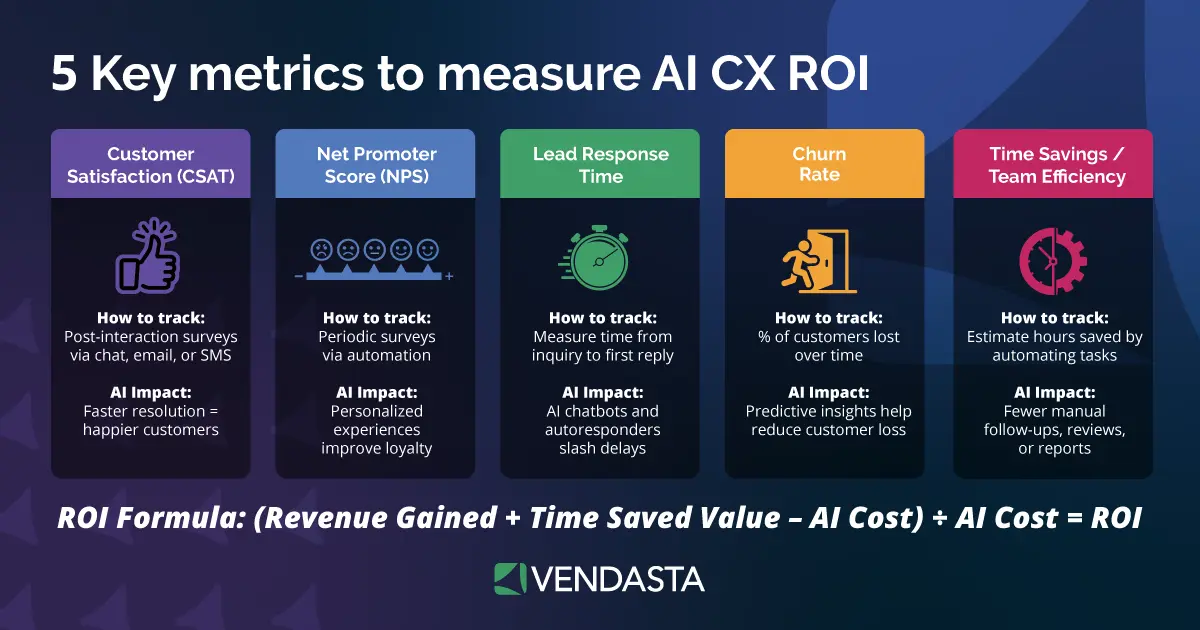
Set up regular reporting on key metrics: leads responded to, appointments booked, reviews generated, and response time averages. Share these reports with clients as proof of value. This data also informs ongoing improvements to your AI configurations.
Why Most Agency AI Agent Deployments Fail (And How to Avoid the Same Mistakes)
The implementation guide above gives you the right steps. This section gives you the honest picture of where agencies go wrong, because the failure modes are consistent and avoidable once you know what to look for.
Deploying before the data is ready
AI agents are only as accurate as the information they have access to. An agent configured without complete business data, including services, pricing, hours, FAQs, and escalation rules, produces generic or incorrect responses that erode client trust fast. The fix is straightforward: spend more time on the knowledge setup than on the persona setup. The voice and name matter far less than what the agent actually knows.
Automating a broken process
If your lead follow-up process is inconsistent when humans do it, an AI agent will make that inconsistency faster and more frequent. Agents accelerate what already works. They do not fix what is fundamentally broken. Before deploying, document the process you want the agent to follow and confirm it works before handing it to AI.
Trying to automate everything at once
Agencies that launch five AI agents across five use cases simultaneously have no clean way to diagnose what is working and what is not. One underperforming agent contaminates the results of the others. Start with one use case, prove the result, then expand. This is not just a best practice. It is the difference between a deployment that builds internal confidence and one that gets quietly turned off after three weeks.
Skipping the test phase
Real customer conversations are messier than demo scenarios. Callers ask off-script questions, use unusual phrasing, and occasionally say things the agent was not configured to handle. Running test calls across realistic edge cases before going live is the step most agencies skip when they are eager to launch. It is also the step that most often determines whether the first month of client results is a success or a scramble.
Measuring the wrong things
If the only metric tracked is call volume answered, the deeper value of AI agents stays invisible. Track lead-to-appointment conversion rates before and after deployment. Track response time averages. Track review volume per month per client. These are the numbers that make the ROI conversation with clients clear and the renewal conversation straightforward.
Starting with insight-only agents that make recommendations without taking autonomous actions, then graduating to semi-autonomous after 90 days of validated performance, is the pattern that produces the most durable results for agencies scaling AI deployments. Trust is built incrementally, and that applies both to client confidence in the AI and to your team’s confidence in configuring it
What a Day at Your Agency Looks Like With AI Agents
To make this concrete, here’s what a typical day might look like for an agency that has deployed Vendasta’s AI Workforce across its client base.
7:00 AM — Overnight, the AI Receptionist handled after-hours calls and web inquiries across three client accounts, answering questions, qualifying leads, and booking eight consultations. No staff involvement required.
8:30 AM — The AI Reputation Specialist automatically sent review requests to yesterday’s appointment completions. Three new five-star reviews were posted before the team’s first meeting.
10:00 AM — The AI Social Media Manager published this week’s posts across all active client accounts, drawing from pre-approved content calendars across every platform.
12:00 PM — A lead from three days ago who hadn’t responded gets a follow-up SMS from the AI Inside Salesperson. They reply, get qualified through a structured discovery conversation, and book a call for the next morning.
3:00 PM — The AI Data Analyst surfaces a performance briefing flagging two underperforming ad sets, with a clear budget reallocation recommendation ready for the team to action.
5:00 PM — The team wraps up. The AI agents keep working.
This isn’t a hypothetical. This is what an agency running on Vendasta’s AI Employees can experience today, across every client, every day, with a team that doesn’t grow every time the client roster does.
What to Look for in an AI Agent Platform for Your Agency
Not all AI agent platforms are created equal. When evaluating options, here’s what to prioritize:
- Multi-Client Management: The platform should allow you to manage AI deployments across all your clients from a single dashboard. Logging into 30 different tools for 30 different clients is not scalable.
- White-Label Capability: If you’re reselling AI services, you need to present them under your brand, not the platform vendor’s. Look for platforms that support full white-labeling of client-facing interfaces.
- Reseller / Revenue Model: The best platforms for agencies include a commercial model that allows you to profit from reselling. Understand the margin structure before committing.
- Integration Depth: AI agents are only as useful as the tools they connect to. Ensure the platform integrates with the CRMs, scheduling tools, and communication channels your clients actually use.
- Ease of Setup and Replication: If it takes weeks to configure each client, the economics don’t work. Look for platforms that make deployment fast, templated, and repeatable across clients.
- Quality of the AI: Test the conversational quality of the AI agents yourself. Are the responses natural? Do they handle edge cases well? Does the AI stay on-brand? This matters enormously for client satisfaction.
- Reporting and Analytics: You need data to prove value to clients. Ensure the platform provides clear, client-ready reporting on the metrics that matter.
Conclusion: The Future of Agentic AI in Marketing
Agentic AI is not a distant trend. It is reshaping marketing operations right now, and the pace of change is accelerating.
For marketing agencies, the implications are both an opportunity and a warning. The agencies that adopt AI agent infrastructure now will be able to serve more clients, offer more advanced services, and operate at margins that human-labor-dependent competitors simply cannot match.
The agencies that wait will find themselves undercut on price, outcompeted on capability, and struggling to explain why they can’t offer what AI-first agencies are already delivering.
The shift from “agency as a team of people” to “agency as an AI-powered platform” is already underway. The agencies thriving in this environment aren’t replacing their teams. They’re multiplying what those teams can do by pairing human strategy and creativity with AI execution and scale.
The hiring trap has an exit. AI agents are it.
Don’t let fulfillment bottlenecks cap your growth. See how Vendasta’s white-label AI Workforce can handle the heavy lifting of lead engagement, reputation management, and content creation for your clients. Book your Vendasta demo today.
AI Agents for Marketing Agency FAQs
1. What is an AI agent for a marketing agency?
An AI agent for a marketing agency is an autonomous software system that executes multi-step marketing tasks, including lead response, appointment booking, review generation, and content publishing, with minimal human oversight. Unlike basic automation tools, AI agents adapt to new information and improve over time. Vendasta offers AI Employees built specifically for agency deployment.
2. How are AI agents different from marketing automation tools?
Traditional automation follows rigid “if-then” rules and requires human setup for every scenario. AI agents are reasoning-based: they perceive context, make decisions, and adapt autonomously. Where automation handles simple, linear tasks, AI agents manage complex multi-step workflows, like full lead nurturing sequences or a 24/7 receptionist that handles any inbound question.
3. Do AI agents replace human marketers at agencies?
No. AI agents handle repetitive, high-volume tasks (lead response, follow-ups, review requests, content publishing) that don’t require strategic judgment. This frees human marketers to focus on strategy, creative direction, and client relationships. Research shows human-AI collaborative teams are 60% more productive than human-only teams.
4. What tasks can AI agents handle for marketing agency clients?
AI agents can handle 24/7 lead response via chat, voice, and SMS; appointment booking; automated review generation; social media publishing; ad campaign optimization; and multi-step nurturing sequences. Platforms like Vendasta bundle all of these capabilities into a single AI workforce that agencies can deploy across their entire client base.
5. How much does it cost to implement AI agents for a marketing agency?
Costs vary by platform, number of clients, and scope of services. Vendasta is structured as a reseller platform, allowing agencies to set their own pricing and margins on AI services. Given that AI agents reduce fulfillment labor costs by up to 37%, the ROI tends to materialize quickly.
6. Can marketing agencies resell AI agent services to their clients?
Yes, and it’s one of the most significant revenue opportunities available right now. Platforms like Vendasta are built for agency reselling, with white-label capabilities and multi-client management. Packaging AI Employees as a premium service tier creates a compelling recurring revenue stream with zero additional fulfillment effort on the agency side.
7. How do AI agents help agencies grow without hiring?
AI agents eliminate the “one new client, one new hire” trap by handling fulfillment autonomously. When lead response, appointment booking, review management, and content publishing run on AI, agencies can onboard more clients without adding headcount. This directly improves margins and makes growth sustainable. Vendasta’s AI Employees are built specifically for this.
8. What is agentic AI, and how does it apply to marketing?
Agentic AI refers to systems that act autonomously toward a goal, making decisions and adapting without step-by-step human direction. In marketing, it manages entire workflows, from identifying a lead and initiating contact to nurturing touchpoints, booking appointments, and requesting reviews, with no human involvement required at each step.
9. How long does it take to implement AI agents at a marketing agency?
With the right platform, initial deployment can happen in hours, not weeks. The process involves providing business information, setting up integrations, and testing conversational flows. Vendasta is designed for fast, template-based replication, making it straightforward to scale AI agent deployments across an entire client base once the first setup is refined.
10. Will clients notice they’re talking to an AI agent?
Many users can’t tell the difference when the interaction is smooth and helpful. Modern AI agents are conversational, contextually aware, and fast-responding. Transparency best practices recommend disclosing AI involvement where appropriate, but quality matters most. An AI agent responding in seconds consistently outperforms a human responding hours later.