
Reputation management for small businesses has shifted from a marketing task to an operational necessity. Most businesses know reputation matters. But knowing it matters and managing it effectively are two very different things.
While reviews directly influence trust, local search visibility, and conversions, many small businesses still rely on manual monitoring, scattered platforms, and reactive workflows. As review volume grows and AI-driven search reshapes discovery, that gap between importance and execution is becoming a real growth risk.
Our 2026 State of Reputation Management report reveals exactly where small businesses stand today, and why AI-driven execution is quickly becoming the difference between visibility and vulnerability.
TL;DR
- 74.5% of SMBs say reputation management is critically important, yet most still rely on fragmented tools.
- 62.6% depend on native review platforms, increasing the risk of missed reviews and delayed responses.
- Buyers want AI-powered automation with control, especially for faster responses and earlier issue detection.
Why Reputation Management For Small Businesses Is Now Mission-Critical
Online reviews are no longer just social proof.
They influence:
- Local search rankings
- Conversion rates
- Brand perception
- AI-driven search visibility
- Customer retention
According to the 2026 State of Reputation Management report, 74.5% of SMBs say online reputation management is critically important to their business today.

This confirms what most operators already feel: reputation is no longer optional. It is foundational to growth.
And yet, most small businesses still struggle to manage it consistently.
The 2026 Reputation Reality: Small Businesses Are Managing Reviews Manually
One of the most important findings in the report is this:
62.6% of SMBs rely primarily on native review platforms.
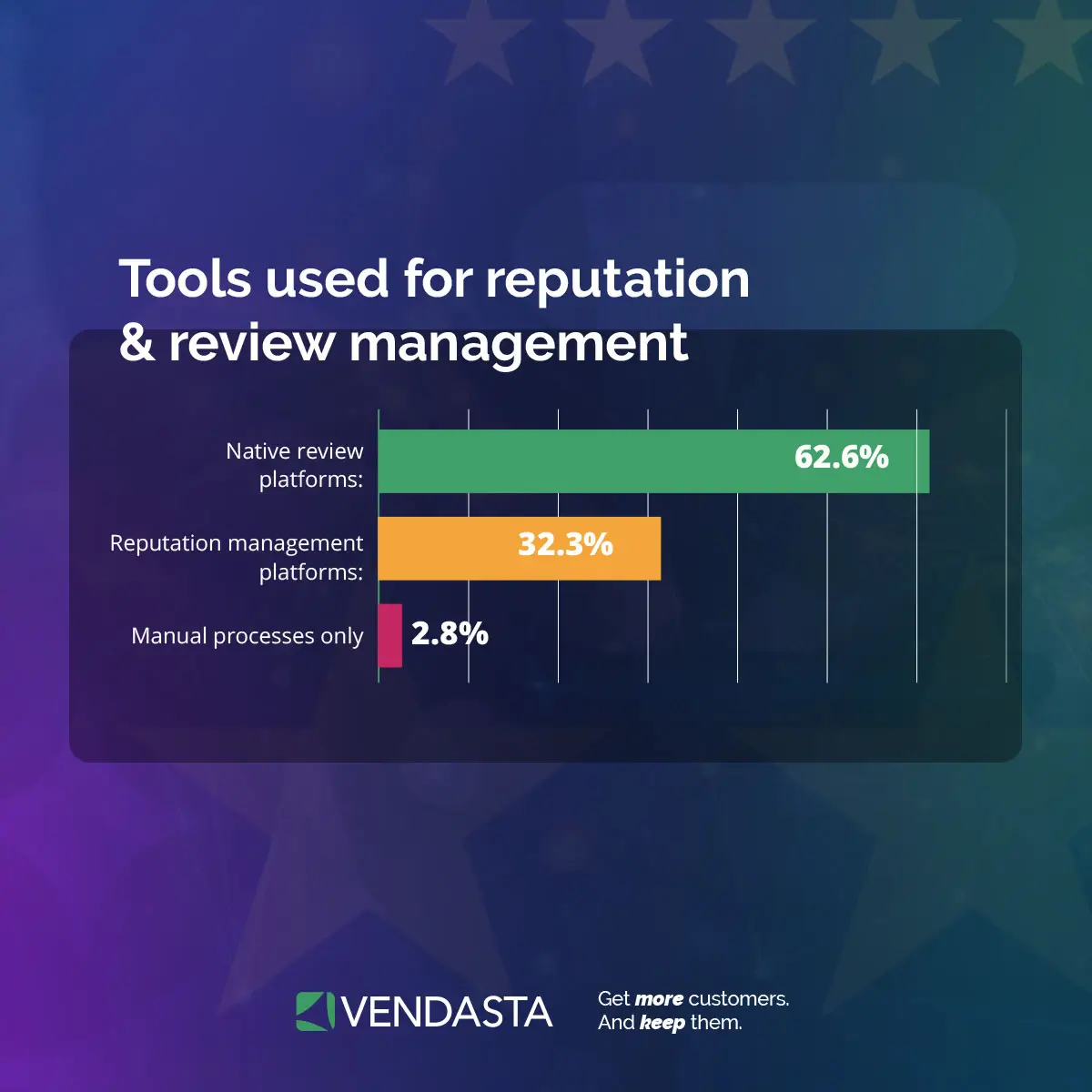
That means most businesses are:
- Logging into Google separately
- Checking Facebook independently
- Monitoring platforms manually
- Responding one-by-one without centralized oversight
Why This Is Risky
Native platforms were not built for:
- Cross-channel monitoring
- Sentiment analysis
- Multi-location consistency
- Scalable workflows
- Proactive issue detection
When reviews arrive across platforms, outside business hours, and across languages or locations, manual oversight breaks down.
The result:
- Missed reviews
- Delayed responses
- Inconsistent tone
- Eroding trust
For agencies and partners managing dozens of SMB clients, that fragmentation multiplies.
What Makes Reputation Management Different for Small Businesses vs. Enterprises?
Reputation management is not one-size-fits-all.
Enterprises typically have:
- Dedicated marketing teams
- Centralized brand governance
- Crisis communication protocols
- Budget for multiple specialized tools
- Staff assigned solely to monitoring and response
Small businesses operate in a completely different reality.
Most SMBs rely on:
- Owners or general managers to respond to reviews
- Limited staff juggling service delivery and customer communication
- Native platform logins instead of centralized systems
- Manual workflows with little automation
The difference isn’t intent; it’s capacity. For an enterprise brand, reputation is one department among many. For a small business, reputation management competes with payroll, hiring, service delivery, and day-to-day operations.
That creates three structural challenges:
- Time Constraints: Reviews arrive continuously. Small teams cannot monitor platforms 24/7, which increases the risk of delayed responses and missed feedback.
- Tool Fragmentation: Enterprises can afford complex tech stacks. Small businesses often rely on free, disconnected platforms that were never designed for cross-channel oversight.
- Inconsistent Execution: Without centralized systems or automation, response tone, speed, and follow-up vary depending on who is available.
As AI-driven search surfaces give review signals greater prominence in discovery experiences, these structural gaps become growth constraints.
Reputation management for small businesses must be:
- Automated, but controlled
- Centralized, but simple
- Intelligent, but accessible
- Scalable, without adding headcount
This is where modern reputation platforms change the equation.
Instead of layering more dashboards onto already stretched teams, the right system consolidates monitoring, automates execution through AI review responses, and surfaces risk before it becomes public damage.
Small Business Reputation Management Statistics
If you’re evaluating your approach, these numbers matter.
1. Automation Is Welcome With Guardrails
56.2% of buyers are comfortable with automated review responses if brand voice and control are protected.
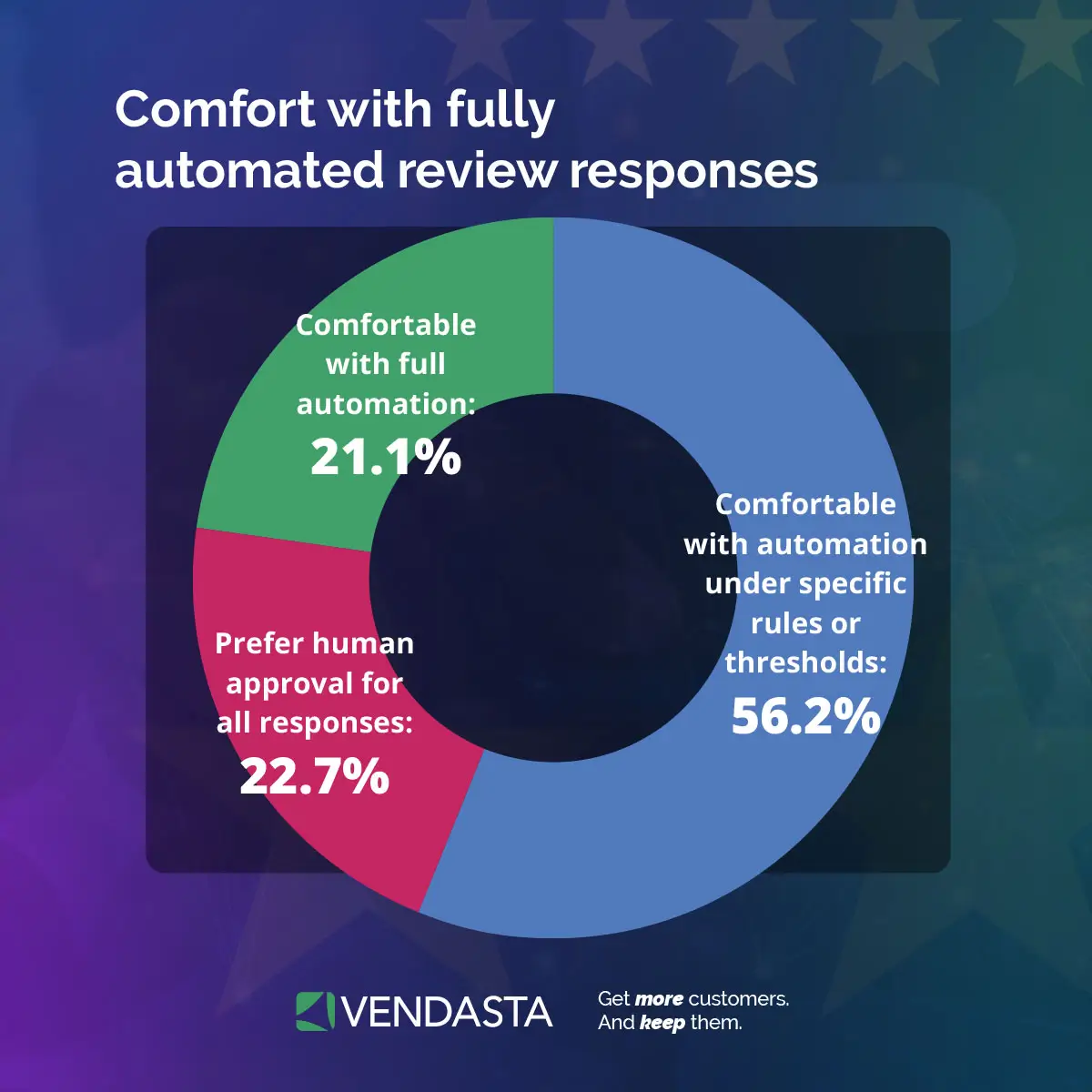
Only 21.1% are comfortable with full automation without oversight.
This tells us something critical: Small businesses want speed and consistency, but not at the expense of trust.
2. Growth Outcomes Matter More Than Crisis Management
When asked what matters most, respondents prioritized:
- Increasing positive reviews (27.2%)
- Improving local SEO & findability (25.4%)
- Generating more conversions from reviews (16.2%)
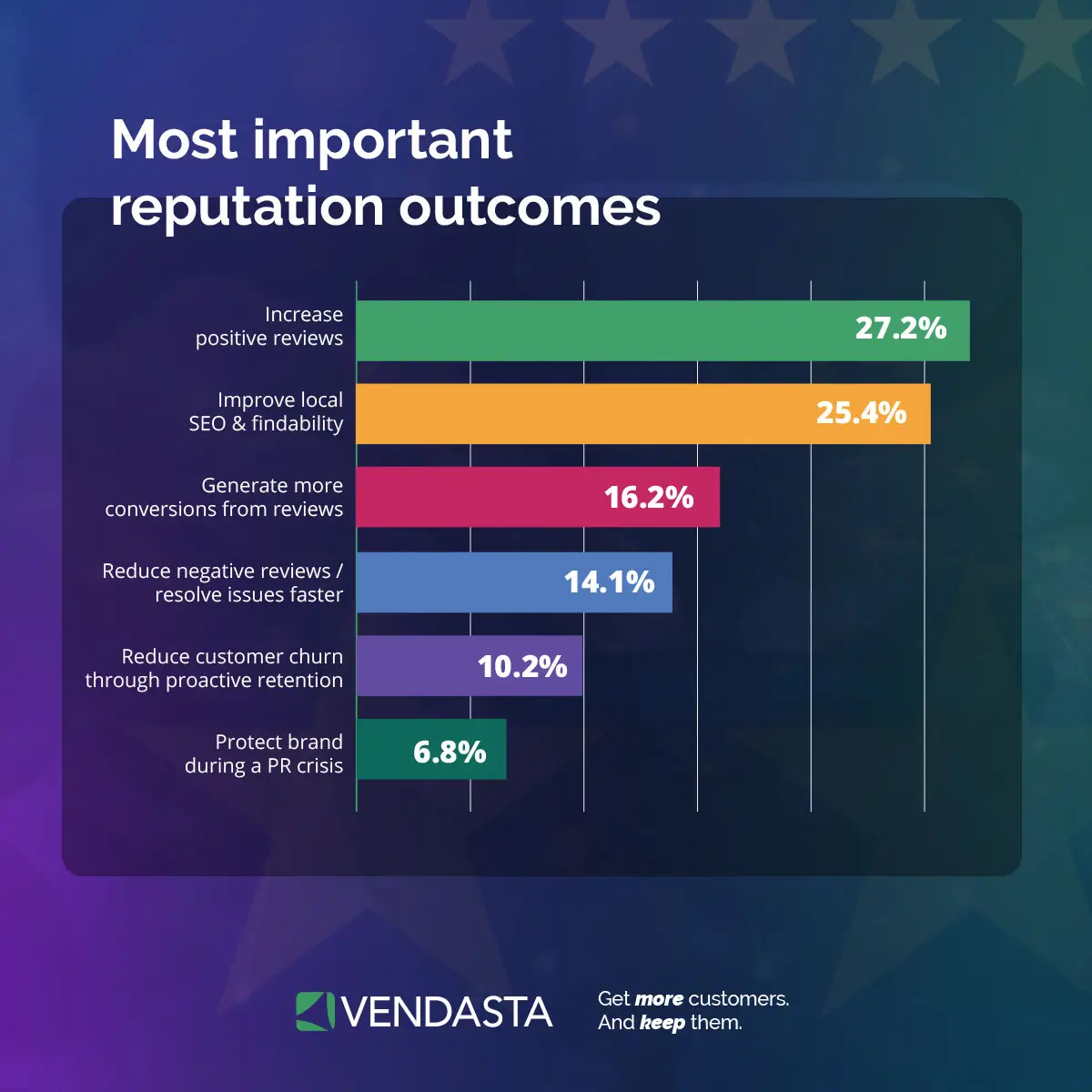
Notice what ranks lowest: PR crisis protection.
That’s a major shift.
Reputation management is no longer just damage control. It’s a growth engine.
3. Speed And Protection Drive Value
When buyers evaluated which capabilities matter most:
- Automated review responses (26.8%)
- Centralized monitoring (22.4%)
- Sentiment analysis & trend detection (18.9%)
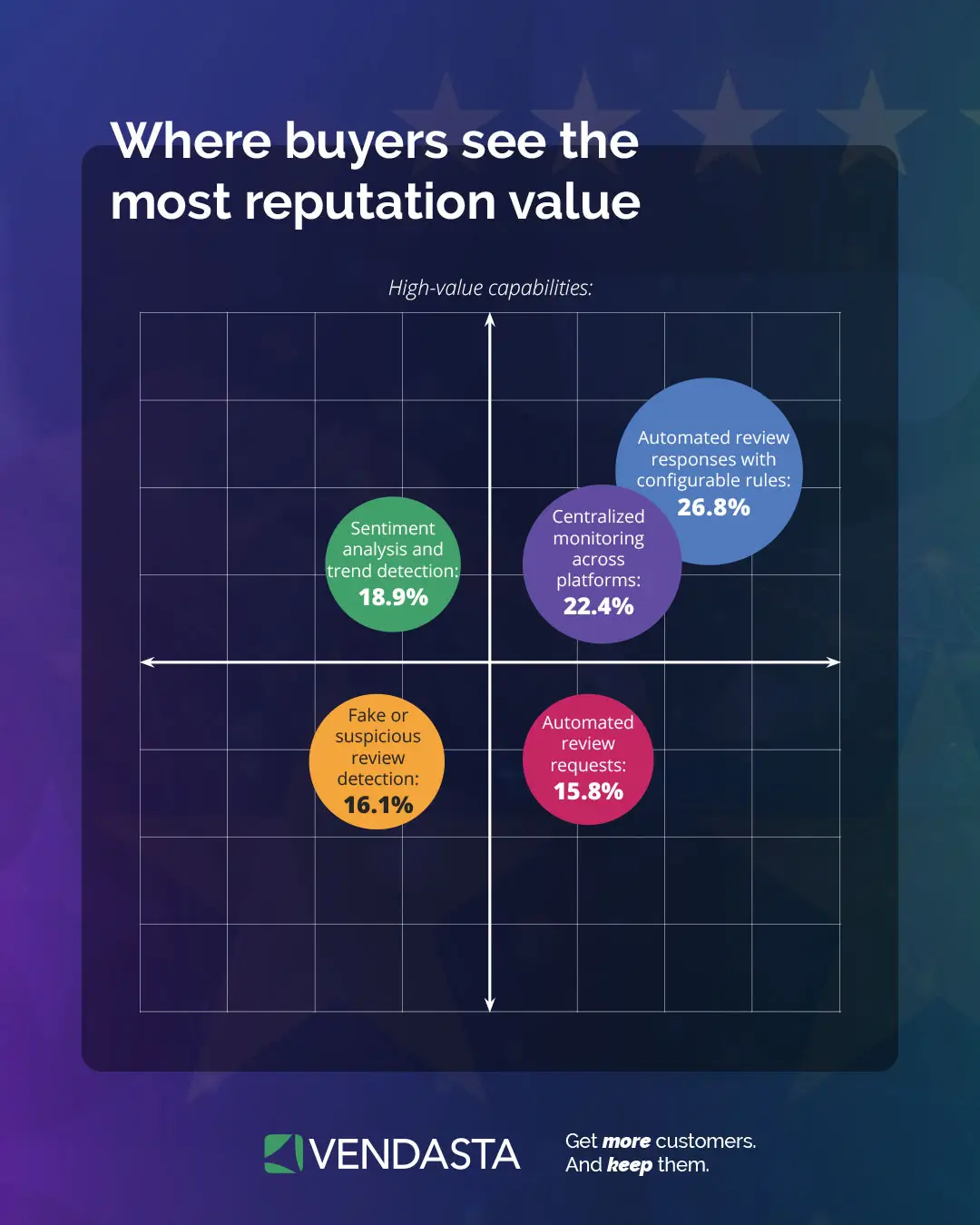
Standalone analytics ranked lower.
In other words, insight without execution is no longer enough.
What Small Businesses Actually Want From AI In Reputation Management
The report shows two dominant priorities:
- Faster, more consistent responses without hiring more staff
- Earlier visibility into issues before they impact trust
That’s important.
SMBs aren’t asking for more dashboards.
They want:
- Execution handled automatically
- Risk surfaced early
- Actionable guidance
- Brand-safe automation
This is where traditional reputation tools fall short. Many offer reporting. Few offer proactive execution.
The Shift From Monitoring To Prevention
The strongest forward-looking signal in the report:
54.1% of buyers want earlier issue detection.
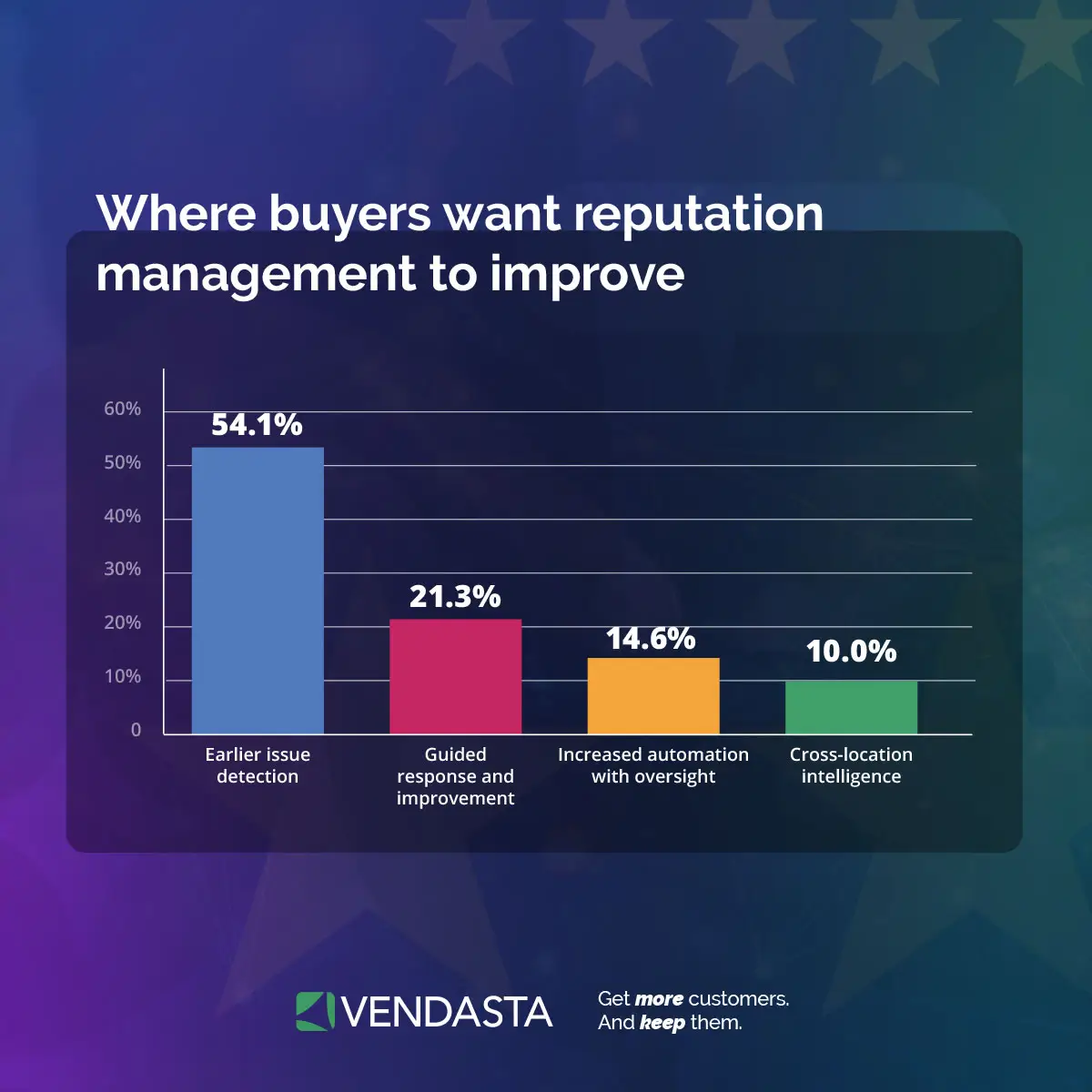
This marks a shift from reactive monitoring to proactive prevention.
Reputation issues rarely begin as public crises. They start as patterns:
- Recurring complaints
- Declining sentiment
- Slower response times
- Service breakdowns across locations
Small businesses need systems that surface those patterns early.
That requires AI.
Why Reputation Management Is Now An Execution Problem
The conclusion of the 2026 report is clear:
Reputation management has outgrown manual oversight.
Reviews arrive:
- Continuously
- Across platforms
- Outside business hours
- Across locations
Manual processes introduce delays and inconsistency, even for teams that care deeply.
The gap is no longer awareness; it’s execution.
Small businesses that treat reputation like an operational system, not a side task, will outperform those that don’t.
How Vendasta Helps Small Businesses Scale Reputation Management Safely
This is exactly the problem Vendasta’s Reputation AI and AI Reputation Specialist are built to solve.

1. Centralized Review Management
Instead of juggling native platforms, businesses can:
- Monitor all reviews in one dashboard
- Track sentiment shifts
- Identify patterns
- Manage multi-location accounts seamlessly
No more channel sprawl.
2. AI Reputation Specialist: Built-In Execution
Vendasta’s AI Reputation Specialist functions as an AI reputation management agent designed specifically for small businesses that need automation without losing brand control.
It doesn’t just suggest responses; it executes intelligently while keeping safeguards in place.
It can:
- Auto-post configurable, personalized replies on Google and Facebook
- Match the language of each review
- Follow brand-safe tone guidelines
- Escalate based on rating thresholds
- Surface insights through AI chat
This directly aligns with what 56.2% of buyers want: automation with control.
3. Automated Review Requests And NPS
To grow reviews consistently, Reputation AI:
- Sends automated email and SMS review requests
- Integrates with QuickBooks, PetExec, Jobber, and more
- Collects NPS data after jobs or transactions
- Identifies promoters and early detractors
This connects reputation directly to:
- Customer acquisition
- Retention
- Operational improvement
4. AI Chat Insights That Drive Action
Instead of digging through reports, teams can:
- Ask the AI Reputation Specialist questions about review trends
- Identify negative sentiment clusters
- Spot emerging risks
- Get recommended next steps
This turns reputation from passive monitoring into proactive management.
Reputation Management For Small Businesses In 2026 And Beyond
The data is clear:
- Reputation influences discovery before customers ever visit your site
- Buyers expect fast responses
- Automation is accepted, but only with control
- Prevention is becoming more important than reaction
Small businesses that rely solely on manual processes will struggle to keep pace.
Those that implement AI-driven execution frameworks will:
- Respond faster
- Protect brand voice
- Surface issues early
- Improve local visibility
- Convert more customers
Download The 2026 State Of Reputation Management Report
This article only scratches the surface.
The full report includes:
- Complete survey findings
- Industry breakdowns
- Detailed AI adoption insights
- Deeper analysis of reputation as a growth channel
If reputation management is part of your growth strategy, this report is your implementation guide.
Download the 2026 State of Reputation Management Report
The Bottom Line: From Monitoring to Mastery
The 2026 data confirms that the era of “checking reviews” is over. For small businesses, reputation has transitioned from a marketing luxury to the operating system for growth.
You no longer need to be convinced that reputation matters; you need a way to execute it without burning out your team.
The gap between visibility and vulnerability is now defined by speed and scale. By moving away from fragmented manual workflows and adopting AI-driven execution, you aren’t just managing feedback—you’re building a 24/7 growth engine.
Ready to close the execution gap? See how AI reputation management can modernize your entire review process and protect your brand voice at scale.
Request a demo of Vendasta Reputation AI today.
Reputation Management For Small Businesses FAQs
1. What is reputation management for small businesses?
Reputation management for small businesses is the process of monitoring, responding to, and improving online reviews across platforms like Google and Facebook. It impacts trust, local search visibility, and conversions. Platforms like Vendasta centralize reviews and automate responses to improve consistency and growth.
2. Why is reputation management important for small businesses?
Online reviews directly influence purchasing decisions, search rankings, and brand perception. A strong reputation increases visibility and conversion rates, while slow or inconsistent responses can erode trust. Effective reputation management helps small businesses attract new customers and retain existing ones.
3. How does AI improve reputation management for small businesses?
AI improves reputation management by automating review responses, identifying sentiment trends, and detecting risks early. Tools like Vendasta’s AI Reputation Specialist deliver brand-safe replies and surface actionable insights, helping businesses respond faster while maintaining oversight and control.
4. Do small businesses really need reputation management software?
Yes. Managing reviews manually across multiple platforms increases the risk of missed feedback and delayed responses. Reputation management software centralizes monitoring, automates workflows, and provides insights that improve efficiency. Vendasta enables businesses to scale reputation efforts without increasing headcount.
5. How do online reviews affect local SEO?
Online reviews influence local search rankings, click-through rates, and overall trust signals. Search engines consider review quantity, quality, and response activity. Consistent review generation and timely engagement can improve visibility in local search and AI-driven discovery experiences.
6. What is the best way to respond to negative reviews?
The best approach is timely, professional, and solution-oriented. Acknowledge the issue, apologize if appropriate, and offer to resolve it offline. AI-powered tools like Vendasta’s AI Reputation Specialist help generate thoughtful, reputation-safe responses while escalating sensitive cases when needed.
7. How can small businesses get more positive reviews?
Automated review requests sent via email or SMS after a service interaction significantly increase review volume. Integrations with tools like QuickBooks or Jobber streamline the process. Vendasta’s Reputation AI automates review requests and ensures consistent follow-up.
8. What are the biggest challenges in reputation management for small businesses?
Common challenges include managing multiple review platforms, inconsistent response times, limited staff capacity, and a lack of early issue detection. As review volume grows, manual processes become unreliable. Centralized, AI-supported systems help maintain consistency and protect brand trust.
9. Can reputation management help reduce customer churn?
Yes. Negative reviews often reflect service issues before customers leave permanently. By analyzing sentiment patterns and NPS data, businesses can identify problems early and improve operations. Proactive reputation management strengthens loyalty and long-term retention.
10. How do I choose the right reputation management platform for my business?
Look for centralized monitoring, automated review requests, configurable response rules, sentiment analysis, and AI-powered insights. The right platform should protect brand voice while improving speed and consistency. Vendasta offers an integrated solution that scales with small business growth.