
So it’s time for that first sales call. After chasing a prospective customer for weeks, you finally have an appointment. Depending upon how that lead has come into your funnel, there are different discovery call tactics you need to adopt.
“While discovery is a tactic that we spend a lot of time teaching young sales reps, I believe that even some of our veteran sales reps could be reminded of it again. Sometimes when we have been doing this for a long time, there’s a tendency to skip over very important considerations for building rapport and trust,” says George Leith, chief customer officer at Vendasta.
Let’s start from the beginning. What is a discovery call and what are the sure-shot tactics to ace it?
A discovery call is the first conversation between a salesperson and customer. It’s an opportunity to get to know each other and understand a prospect’s business better. A salesperson is looking to determine whether or not they can provide a needed value or benefit. A discovery call — over phone or face to face — will dictate the trajectory of a buyer-seller relationship. It could either be a deal-maker or deal-breaker. It can torpedo an opportunity if you are in a hurry or make even small but critical mistakes. However, it could also help seal the deal if you do the right things.
In this podcast, Leith underlines the four stages to ace a discovery call.
Automate the entire customer journey from first touch to repeat business
Adopt the Mindset of a Student
The first and foremost thing required for a successful discovery call is adopting the mindset of a student. “When I talk about being a student, it means being inquisitive, eager to learn. You are not pontificating. Being a student also means asking questions,” Leith says.
What’s important is to keep this attitude throughout the relationship with a prospective customer. Discovery at the beginning shows whether there is a fit and dictates the way forward. However, more often than not, sales professionals think of a discovery call as a static stage, and can’t wait to get down to making their pitch. Not having that discovery mindset means missing out on upsell and cross-sell opportunities.
“Some of the biggest customers that I deal with today became large customers well into our relationship. They started out with us for a certain reason. We built rapport with the client first and proved that we were able to deliver the products or services (they needed). Then, because we had that constant mindset of being a student and (willingness to) understanding the needs of the customer, we were able to layer in much larger purchases, subscriptions or products because we kept that mindset of always looking for new opportunities.”
Also, it is pertinent to keep in mind that the buyer’s journey dictates the use of a discovery strategy to understand the reasons why a buyer has come to you. They may be dealing with active or latent problems, looking to develop a solution to a particular problem, or simply evaluating new strategies. It is important to keep in mind that they may have considered alternative options, and are stacking you up against competitors.
For this reason, it’s important for sales professionals to be well researched. You don’t want to be asking questions during the call where answers could have been found with a simple Google search. This is where the mindset of a student becomes crucial. Diligent pre-call research gives you insight into your prospective client’s business and the role and responsibilities of the individual you would be calling from that company. This prepares you for situational questions, and moving into further exploration.
Vendasta Academy: Courses for everything about selling digital solutions to local businesses
Two Kinds of Pain: How to Deal with Them
Now that you have done research you should have an idea whether the prospect has active or latent pain. Active pain usually identifies itself in the inbound customer journey, explains Leith. “If they have active pain, they would go online and do a bunch of research to find you. In the case of active pain, it’s the customer who reaches out to you. It’s inbound.”
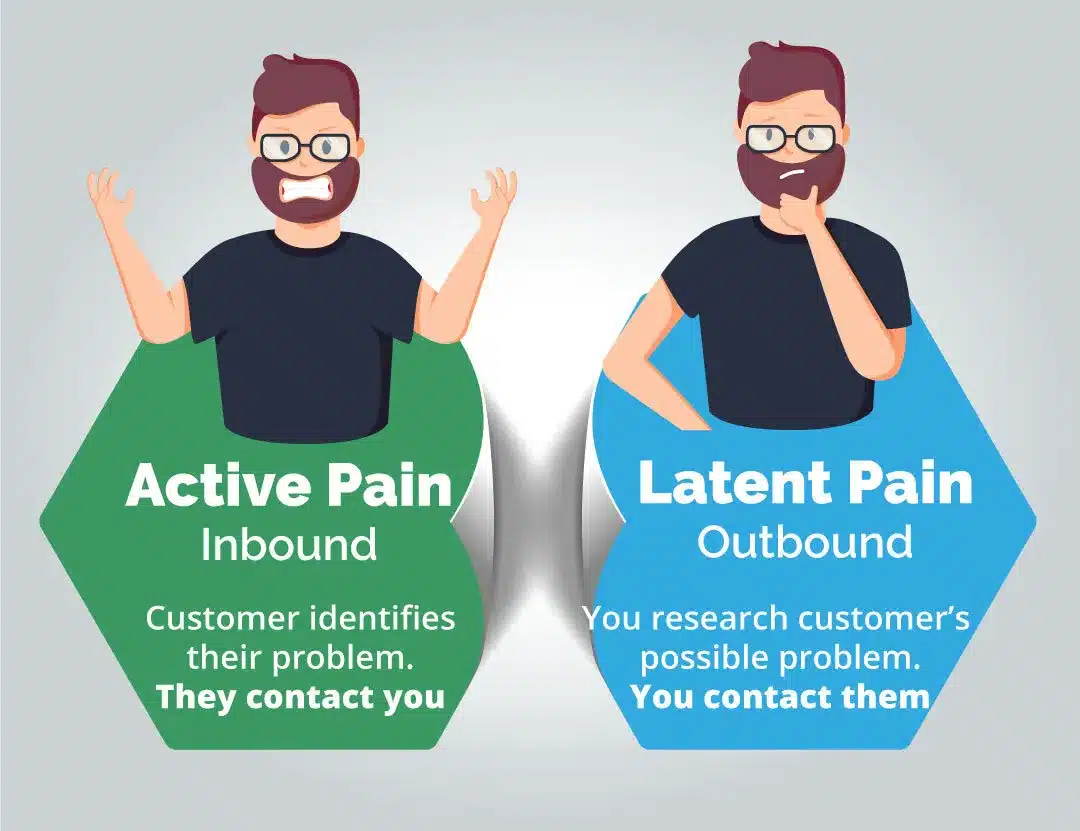
In the case of an inbound lead, the buyer states his active pain upfront. Your job is to understand that problem and explain how you can solve it. So be patient, and listen.
Jeb Blount, CEO of Sales Gravy and bestselling author of Fanatical Prospecting and Sales EQ, explains, “In sales, we always think about closing, and that it’s the sexy part of being in sales. The truth is that the sexy part of sales is discovery. It is the part where you are listening to your prospects. When you sit down with that C-Suite and you need to turn your mouth off and your ears on.”
On the other hand, latent pain can be identified as outbound, where you reach out and show a client that you actually understand their pain point. In this case, it’s important to understand the persona of the customer – the very person you are going to interact with. Different personas have different types of pain. For instance, the head of marketing deals with different problems than the sales or IT head of a company. The trick is to present your track record of solving all of those issues.
For an outbound lead, you need to earn the right to help a prospect with their pain. Here again the trick is to be patient – ask simple questions and allow the customer to speak.
“It starts with emotional self-awareness, because that which you’re not aware of, you cannot change and you’re bound to repeat. Emotional self-awareness leads to emotion management, which leads to the execution of asking consistently good questions,” says Colleen Stanley, president of Salesleadership Inc and author of the book Emotional Intelligence For Sales Success.
Anita Nielsen, the author of the sales enablement book Beat the Bots and founder of LDK Advisory, says it’s a mistake to pitch your product any sooner than 45 minutes if you are in an early meeting with a prospect. “Sales is high pressure and salespeople are taught to “get to the ink,” so they end up rushing the discovery process — and that’s a mistake. You’re leaving a lot of valuable information behind that you could have turned into additional sales opportunities,” she adds.
Set the Boundaries and Stages
It’s important to set boundaries for the relationship with the customer. For instance, if the prospective client wants you to wait for a long time at a scheduled appointment or reschedules it multiple times, you have the right to be firm. “Show them that your time is as valuable as theirs. That’s a really important piece. Nobody likes desperation, especially when you’re on a discovery call. You don’t want to look like ‘Oh God, I really need this deal to hit my quota.’ It’s just not going to work,” Leith says.
Next, set the stages for that relationship. Don’t try to rush in things at one go, and don’t walk away from it either because you don’t want to look too desperate. Work out an upfront contract with the new lead. An upfront contract at the early part of the conversation sets the stage for a successful interrogation of whether or not this thing’s going to work.
Leith lays out a dummy script that a sales professional may want to use once he has the prospect on the line and going through the discovery. “I want to take 45 minutes of your time. And by the end of the call, we’re going to figure out if there’s a need for us to move forward. We may just part ways, or decide that we want to move to the next step. This means further discussion of how we can have a great relationship. I don’t want to put my reputation on the line if there’s not a proper fit.” Of course, you need to customize it as per your requirement, but you get the idea.
Hook the Customer, Get Them Talking
The easiest way to get a customer talking is to tell a story that triggers a prospect’s “hot button” — a story articulating how you solved the problem of somebody who looks exactly like the prospect. And, if you don’t have that story, find one inside your organization and use it until you have your own.
“It’s a really important piece and this is where you set the hook,” Leith says.
The other trick is to sharpen your questions so that you get the specific answers you are looking for during the call. Ask the right leading questions and then start to dig deeper. And don’t forget to ask simple follow up questions. Every salesperson knows that the key to effective discovery is to ask simple follow-up questions, but they often skip that during the call.
Stanley suggests writing down good curiosity questions during the pre-call research phase, which will help you resist the urge to present your product too soon. “If you have a prospect saying all the right things, you might skip over all of these great questions you need to ask and start product dumping. Or if they’re a challenging prospect, you might get nervous and move to a product dump rather than asking effective redirect questions,” she says.
Leith lists out simple questions:
- Can you help me understand what you meant by that?
- Can we dig into that a little bit deeper?
- Can you walk me through what a customer experiences when they walk into your business?
- Can you tell me about some of the biggest challenges that you’re having in your marketing?
If they said something and you didn’t quite understand it, it’s okay to ask them to repeat that or ask more questions. Remember, you are a student at the discovery stage?
Close It Right, Don’t Burn Your Leads
If you have done all the right things so far, chances are there is a possibility for a working relationship. Now, how to go from here?
“Validate the buyer. You want to set the next steps and expectations. This is all a part of that contract piece where you say ‘as we move down the funnel…’ or ‘here’s how I’ve found that it works best. And I need to have another call next week with that person that you brought up earlier that’s responsible for this’,” Leith says.
Then talk about what the second call might look like. You need to specify what time frame you are looking at; how long could it be; who you would like to bring from your team and expect your prospect to bring from his or her end; if you would want to give a product demo and hence need screen-sharing. Give as much detail as possible. The bottomline is, prepare the prospect well for Stage 2.
There may still be times when you just couldn’t dig deep enough into your discovery on one call, but you believe it’s still a good prospect. Leith assures that’s just fine. “It’s okay to say to the prospect, ‘You said some very interesting things. I’ve taken really good notes. I want to go back to my team and do some research to come back to see if we’re going to be able to move to the next stage where we can propose a solution to this challenge that you’re having’,” he says.
Great conversations are key to successful discovery calls. So, treat the call more like a conversation instead of an interrogation or a product pitch.
And lastly, it’s okay to be nervous. But if you prepare well, you can reduce much of the anxiety. And it starts with following these tactics George Leith lays down.
For more on how to be an effective sales professional, you can log into Conquer Local podcasts and listen to the master sales series.