About Us
 Careers
 Leadership
 Board
Board Newsroom
Your clients already bought AI. That is the part most agencies have not caught up to. The U.S. Chamber of Commerce found that 58% of small businesses now use generative AI, up from 40% the year before and more than double the 2023 rate. The Chamber calls it the fastest technology uptake it has tracked since social media.
Now the uncomfortable half. MIT’s Project NANDA studied 300 public deployments and found that 95% of generative AI pilots produce no measurable impact on the P&L. Not a small return. No return. The researchers blamed the gap between the tool and the workflow, not the models.
So here is the market you are actually walking into when you figure out how to sell AI services. Nearly every local business owner in your city has a ChatGPT tab open. Almost none of them have turned it into money. They are not waiting for you to explain what AI is. They are waiting for someone to tell them where it goes in their business.
That is exactly why we sat down with Corey Ganim, co-founder of Return My Time and host of the Build With AI podcast. Corey sells AI services to local businesses for a living, charges $999 for a 45-minute call, and turns roughly half of those calls into retainers worth thousands more. His first AI agent cost $30 a month to run and produced about $11,000 a month for the client.
In this guide, Corey shows you the seven-point inspection he runs on any local business, the exact four-phase assessment he sells for $999, the six offers that sit above it on the ladder, and the reason the AI agent everyone wants to build should be the last thing you sell, not the first.
Drive customer acquisition and engagement with AI employees
TL;DR
- The assessment is the product; the agent is the upsell. Corey charges $999 for a paid AI assessment that takes about two hours of work, and roughly half of those buyers come back for retainers between $1,200 and $1,800 a month. Four prospects said yes in a single week while he raised the price on each one.
- Selling AI is easy right now because almost nobody is getting a return. MIT found that 95% of generative AI pilots deliver no measurable P&L impact. Your client bought the tools already. What they are missing is the diagnosis, the sequence, and someone to sit beside them while they build.
- Speed to lead is the fastest revenue story you can tell. A $30-a-month agent generated roughly $11,000 in additional monthly revenue for one wedding venue operator. Vendasta partners run the same play without building it. One partner’s AI Receptionist closed a $30,000 real estate commission from an 11:00 PM conversation, and another booked a plumbing company on a Sunday with nobody at the office.
What Does It Mean to Sell AI Services in 2026?
Selling AI services means getting paid to diagnose where a business loses time and revenue, fix the process behind it, and then hand the repeatable parts to software. It is consulting, process design, and implementation sold as one ladder, usually starting with a small paid assessment and climbing toward a monthly retainer.
It is not selling software licenses. It is not building a chatbot and calling it a transformation.
A working AI services offer usually covers:
- A paid assessment that uncovers bottlenecks and prescribes specific tools
- Process redesign, often with no AI involved at all
- A knowledge system that gives AI accurate context about the business
- Automated workflows and agents built on top of that context
- An ongoing retainer where you implement alongside the owner
As Corey puts it, the sequencing is what makes the money.
“What’s great about the paid assessment is you’re basically getting paid to figure out what you can sell them next.”
— Corey Ganim, Return My Time
The $30 Agent That Made a Client $11,000 a Month
Corey’s first AI agent was, in his words, clunky. He built it on Make.com for a wedding venue operator running three or four venues, and it cost about $30 a month to run.
The client had one salesperson, Christina, who spent her days running in-person venue tours. Those tours closed at 40% on an average package price of $11,000. Meanwhile, about 20 inquiries a week landed in a web form she could not get to. She replied 6 hours later, 12 hours later, sometimes a full day later.
So they trained an agent on everything the business sold. The FAQs. The venues. The alcohol packages. Then they pointed it at the form.
The replies went out in under five minutes, and they were not autoresponders. “It was an actual personalized: Hey, thanks so much for reaching out. I understand you’re interested in our Abbey venue. Here’s what those packages look like. You know, you asked specifically about how many people it can fit. We can fit 150 people there. Would you like to schedule a tour with Christina?”
The math did the rest.
| Input | Number |
|---|---|
| Average deal size | $11,000 |
| Close rate on in-person tours | 40% |
| Inbound web inquiries per week | About 20 |
| Response time before the agent | 6 to 24 hours |
| Response time after the agent | Under 5 minutes |
| Extra tours needed to justify everything | 2 per month |
| Monthly cost to run the agent | $30 |
Two extra tours a month at a 40% close rate translates to roughly $11,000 in additional monthly revenue. They booked more than two. For the client, Corey says, it was a no-brainer.
Why a Few Hours Feels Harmless and Costs a Fortune
Two studies sit behind the speed-to-lead argument. The MIT and InsideSales.com Lead Response Management study found that contacting a web lead within five minutes instead of 30 makes you 21 times more likely to qualify it. Harvard Business Review‘s audit of 2,241 U.S. companies found the average first response time was 42 hours, and that 23% of companies never responded at all.
Corey’s version is blunter, and it is the one your prospect will understand.
“Your competitors are probably taking twenty-four to forty-eight hours on average to respond to new leads. If you can simply respond quicker than them, you are going to make more money, period, full stop.”
He also hands you a demo you can run this afternoon. Google a landscaper or a painter in your town. Fill out their web form. Start a timer. “I guarantee you, I bet every dollar I have, it’s at least twenty-four hours. And by then you’ve moved on to the next one. You probably booked the one that responded to you first.”
That timer is your entire pitch. The word-for-word version comes later in this post.
Why the AI Agent Should Be the Last Thing You Sell
Here is where most agencies get it backward. The agent is the exciting part, so it becomes the opener. Corey sells it last, on purpose. “The agent is only as effective as the data that it has access to.” And almost no business has that data in usable shape.
“Most companies, I would even go as far as to say ninety-nine percent of companies, do not have an organized context layer that their agents can operate from.”
What they have instead is a Google Drive or a Dropbox. Pricing from two years ago. Client records from six months ago. Two versions of the same service description that contradict each other. Then the owner points an AI tool at the whole folder and says, “Here is everything you need.”
The agent inherits the mess and confidently repeats it.
So the work happens in this order. Assess the business. Organize the context into one accurate source that stays updated. Then put agents on top of it. Do that and, in Corey’s estimate, the agent is a hundred times more effective on day one because it already knows the company instead of starting from scratch.
This is what separates an AI services business from a demo shop. Anyone can wire up a chatbot. Getting paid to fix the knowledge underneath it is a service with no ceiling.
AOA: Audit, Optimize, Automate
Corey runs every engagement through a three-step framework he calls AOA. Audit, optimize, automate. It exists because of one very expensive mistake.
“If you jump straight to the automate step, a lot of times you’re just automating, or you’re handing to AI, a broken process.”
Audit. Understand how the process runs today, by hand, step by step. Not how it should run. How it actually runs.
Optimize. Cut the fat. “A lot of times a process is nineteen steps, for example, when it only needs to be ten.” Fix that before you touch a tool.
Automate. Only now do you hand it off, usually by turning the cleaned-up process into an AI skill that runs on a schedule.
Sell the audit and the optimization as paid work. Corey does. “We’ve sold packages where we’re not even adding AI. We’re not even automating anything. We’re literally just fixing a broken process.” Owners pay for that, because the pain is real whether or not a model is involved.
The Three Levers: The Only Reason to Deploy AI
Before the inspection, Corey applies a filter. Every AI decision has to pull one of three levers.
- Effectiveness. Will this help the business make more money?
- Efficiency. Will it save time?
- Quality. Will it improve the product or service?
“If an AI implementation or solution doesn’t pull one of those three levers, then it’s not worth exploring, period, because it’s not going to add any value to the business.”
Use it on your own prospect calls. It kills the shiny object conversation in about ten seconds, and it makes you sound like an operator instead of a vendor.
The Seven-Point Inspection You Run on Any Local Business
This is the diagnostic engine behind the assessment. Corey walked through it using a local HVAC company, and it maps onto a plumber, a dentist, a law firm, or a landscaper with almost no changes.
| Spot | What you ask | What a bad answer means |
|---|---|---|
| Inbox | How long does a lead sit before we send a reply? | More than 30 minutes and the business is bleeding revenue |
| Calendar | Are we booking client meetings by manual back and forth? Are internal meetings running longer than necessary? | A scheduling tool fixes half of it, and it does not even need AI |
| Quoting | How long does a quote take to turn around, and who has to approve it? | There is an approval bottleneck sitting between the customer and the sale |
| Follow up | Are we doing any follow-up at all? | Corey: people would be shocked how many local service businesses do none |
| Knowledge | Where does company context live? Drive, Dropbox, or employees’ heads? | This is the context layer problem, and it is the biggest paid project on the list |
| Reporting | Can the owner see yesterday’s numbers on a dashboard? | The owner is running blind and does not know it |
| Repeat work | What gets done daily, weekly, or monthly the same way by a human? | Every one of these is a candidate to become an AI skill |
Seven questions. Forty-five minutes. That is the whole discovery instrument, and it works because local business owners have never been asked any of it before.
The $999 Assessment: The Easiest First Yes in AI Services
Corey’s entry offer is an AI tools assessment priced at $999. The pitch is built around a feeling every owner already has.
They know they should be using AI. They know competitors are. They feel behind. And they are working 50 or 60 hours a week, so the last thing they have time for is learning it.
So the offer is simple. For $999, sit down for 45 minutes, surface the main bottlenecks, then prescribe three to seven off-the-shelf AI tools that buy back five to ten hours a week. And if the assessment cannot find at least five hours a week in savings, the client gets every dollar back.
In the owner’s mind, that is risk-free. Worst case, they learn something. Best case, they get ten hours a week back.
One-Word Change That Raises Your Close Rate
Corey refuses to call it an audit.
“I’m sure, as you probably know, when people hear audit, they’re like, oh, nobody wants to be audited. But people don’t mind being assessed. So I just try to discipline myself to use that language.”
Free advice worth more than most sales training. Change the noun.
The Four Phases of Delivery
Total delivery time is around two hours.
Phase 1. The discovery call. Forty-five minutes with the owner, with an AI note-taker on the call so you get the transcript. The questions are the seven spots plus three openers: what is costing you time, where does work tend to pile up, and what have you tried to automate in the past and failed?
Phase 2. The analysis. Feed the transcript into Claude and ask it to do two jobs. Identify the main pain points the owner named, then find specific off-the-shelf tools that fix each one.
Phase 3. The report. Drop the findings into a template and fill it with client-specific detail. Corey built his in Claude Design.
Phase 4. The review call. Thirty minutes on Zoom, screen shared, walking the report line by line. You mentioned email was eating your mornings; here is the tool. You mentioned quotes take four days; here is the tool.
Then the close, which is one sentence: do you want my help implementing these things?
Notice what is not in this offer. You are not building anything. You are not writing code. “We’re just telling them the gaps that they have and then prescribing tools to fill them.” That is why a non-technical agency owner can sell it next week, and why it works as a front end for the agency automation work you already do.
“Right now I’m charging nine hundred ninety-nine dollars for a forty-five-minute call. And about half of those people want to come back and pay me thousands of dollars more.”
— Corey Ganim, Return My Time
The Upsell Ladder: Six Things to Sell After the Assessment
The assessment hands you a map of the business. Now you sell against it. Corey’s ladder runs from cheap and simple to deep and expensive, and any rung can be the right one depending on what the report found. From here, how you sell AI services is just picking the right rung.
| Rung | What you sell | Sell it when |
|---|---|---|
| 1. Process redesign | Fixing the manual process itself, no AI involved. Cutting a nineteen-step process down to ten | The workflow is the problem, and automation would just make the mess faster |
| 2. Simple automation build | A no-code build in Zapier or Make for a one- to three-step workflow | Same input, same output, every time. AI would be overkill |
| 3. Knowledge system | A custom assistant trained on the business’s own documents | The same questions get asked hundreds of times by customers or staff |
| 4. Custom workflow | Turning a process into an AI skill that runs on a schedule | The work repeats on a rhythm and follows rules a human currently holds in their head |
| 5. Full implementation | Any combination of the above, packaged. Corey prices these from $5,000 to $10,000 and up | The report surfaced several connected problems |
| 6. AI concierge retainer | Done with you consulting, monthly | The owner wants to build capability in-house, not just buy an outcome |
Rung three has the best story attached. Corey has a client who brokers business sales. Every time he lists a company, he gets four to five hundred emails from interested buyers, nearly all asking the same questions. So they built a custom GPT trained on the listing’s marketing package. Now he hands out a link instead of his email address, and buyers get answers without waiting on him.
One afternoon of work. A permanent change to how the man spends his week.
The AI Concierge: How Corey Prices Time at $1,000 an Hour
Selling AI services at scale eventually means productizing your own time, not just the client’s process. Corey kept getting asked for one-on-one consulting calls, and he kept turning them down.
“I really don’t like trading my time for money.”
He also knew an hour of advice does not change anyone’s business. So he set a benchmark and worked backward from it: what would it take to be worth $1,000 an hour? The answer was a productized retainer he calls the AI concierge.
The client gets three things:
- Two 45-minute strategy calls a month. Not advice calls. Screen-shared working sessions where the owner’s manual workflows get turned into AI skills, together. Corey calls it done with you consulting.
- Unlimited access between calls via Voxer, a voice messaging app, so questions get answered without booking anything.
- A client hub in Notion, updated after every call with the recording, the summary, the key takeaways, and a running inventory of everything built so far.
Four Yeses in One Week, at a Higher Price Each Time
Corey had four sales calls land in the same week and pitched the concierge offer on all of them.
First prospect, $1,200 a month. Immediate yes, no hesitation. “So I was like, dang, I probably should have charged more.” Second, $1,500. Immediate yes. Third, $1,500 again. Yes. Fourth, $1,800. Yes.
Four for four while raising the price 50%. Two lessons fell out of it. He had not found the ceiling, and the market for done-with-you help is far bigger than he expected.
If you are building recurring revenue for agencies, sit with that. Not the price. The fact that nobody flinched.
The Notion Hub Is a Renewal Mechanism
Here is the part most agencies miss about retainers. Clients do not churn because the work was bad. They churn because they forgot what they got.
The Notion Hub fixes that. Every call adds a recording, a summary, and a list of what was built. When renewal comes around, the client is not reconstructing value from memory. They are scrolling an inventory of it.
They Hit the 90-Day Goal in 60 Days and Stay Anyway
At kickoff, Corey has clients fill in a form with one important question: what does success look like 90 days from now? Usually the answer is a specific outcome, like automating onboarding or automating a production workflow.
Four out of five of his clients hit that 90-day goal in under 60 days. So why does nobody cancel?
“Every single time, without fail, as we start getting into this engagement, as we start getting into the weeds, we’re always finding more work to do. Once you start building skills with clients, it’s like their brain sees the light and they start to identify all these other use cases.”
Hitting the goal early does not end the engagement. It proves the engagement works, and it surfaces the next ten things worth building. That form is also your roadmap for the renewal conversation, because it captured more processes than you will ever finish in a quarter.
How to Get Your First AI Services Client With No Audience and No Budget
Two paths. One gets you a client this week. One builds a pipeline that pays for years.
Path One: Knock on Ten Doors
Find ten local service businesses in your city. Walk in. Ask for the owner. Offer a free fifteen-minute mini assessment, then upsell the paid one.
“If you have ten conversations, you’re going to land one to three paid clients from that.”
Corey mentioned this offhand on another podcast and assumed nobody would act on it. Two weeks later, a listener sent him a DM. He had walked into 30 local businesses, booked five follow-up meetings, and closed two of them into clients. Days before our recording, another listener reported walking into a financial planner’s office, asking for the owner, taking him out for coffee, and selling the assessment on the spot.
“Very few people go one for one. Don’t expect that to always be the case.” The point still holds. “I feel like door knocking is a lost art in twenty twenty six. Most people are afraid to do that.”
Small piece of Vendasta trivia for anyone who thinks this is new: one of the first lead generation websites we ever built was nomoredoorknocking.com. The tools changed. The doors did not go anywhere.
Path Two: Host a Monthly AI Meetup
Slower build, much better asset. Corey runs one in Charlotte called AI for Business, aimed at non-technical owners. Ninety minutes of networking, a twenty-minute talk on using AI as a business owner, contact details collected at the door.
Fifteen people might show up to the first one, and none of them buy. Run it monthly, and by month five or seven you have a room of local owners who know you, plus referrals. “It basically just positions me, and can position you, as the go-to AI person in your city or town.”
That is a durable answer to how to find clients for digital marketing, and it costs almost nothing but consistency.
The Word-for-Word Speed-to-Lead Pitch
Corey was asked to sell a speed-to-lead agent to a plumber, cold, on the spot. Here is what he said.
First, do the homework. Find the plumber’s website, fill out the form as a customer, and time the response. Then go see them in person if you can.
“Hey, look, I reached out to you guys last week posing as a customer because I wanted to see what your sales process looked like. And it took about twenty-eight hours for me to get a response from you guys. So I’m assuming that’s probably how long it’s taking you to get back to the average customer, which is probably causing you guys to lose business versus being able to respond to them in minutes, right? So how about we have a conversation around what it would look like to set up an AI agent that could respond to inbound leads around the clock, even on the weekends, even when you’re asleep, in a way that’s personalized and leads them towards a sales motion, not just a generic AI chatbot. Would that be something that you’re interested in discussing?”
Then widen it to the phone. Most after-hours calls to a plumber hit voicemail, and plenty of callers hang up without leaving one. A voice agent captures that number. Even if the caller does not book, the business now has contact details for a future campaign, which is the whole premise behind AI lead generation for local businesses.
Proof It Works: A Real Speed-to-Lead Win
The pitch works in both directions, by the way. Vendasta’s long-standing partner, The Xcite Group, deployed a Vendasta AI Receptionist on their own agency website and named her Sophia. The first weekend after launch, on a Sunday afternoon with the team off duty, a plumbing company in Washington started a conversation with her. Sophia vetted the inquiry, answered the questions, and booked a meeting for the following Thursday.
“Shortly after launching AI Receptionist, I got a notification. You have a meeting scheduled. I hadn’t lifted a finger. Sophia had qualified the lead and booked the appointment. I did nothing. It was wonderful.”
— Michael Klabon, Partner at The Xcite Group
The prospect asked during the meeting whether Sophia was AI, then called her knowledgeable. If you are going to sell speed to lead, run it on yourself first. The story sells better when it is yours. More partner results live in the AI Employee success stories library.
You Do Not Need to Be an Expert. You Need to Be One Chapter Ahead
The most common objection Corey hears is not about price. It is about permission. I am not technical. I only started learning this last year. Why would anyone hire me?
His answer is a scene from Catch Me If You Can, where the con artist teaches a college psychology course for a semester without a psychology degree. When asked how, the character says he figured out he didn’t need to be an expert. He just needed to be one chapter ahead of his students.
“The same thing applies here. You don’t need to be an expert to sell AI services or to host an AI in-person meetup. You just need to be one step ahead of the people that are your clients. And the bar is still so low. We’re still so early. Most people don’t know anything about AI. So if you’re listening to this podcast, chances are you know more than ninety-five percent of people.”
He is also unbothered about giving the entire playbook away, which tells you what he thinks about the size of the opportunity.
“Even if everybody watching this implemented everything I said, there would still be unlimited opportunity. We’re still so early, and this is still such a massive blue ocean.”
— Corey Ganim, Return My Time
How to Sell AI Services at Scale with Vendasta
Corey’s ladder works because every rung is sold before it is built. The strain shows up later, when you have fifteen clients, each with their own context layer, their own agents, and their own monthly proof to produce. That is the point where agencies either hire or stall.
Vendasta is an AI customer acquisition and engagement platform built for local businesses and the partners who support them. It gives you the delivery layer underneath the offers you just learned how to sell, so the ladder scales past the founder.
Diagnose faster, and put a number on the gap
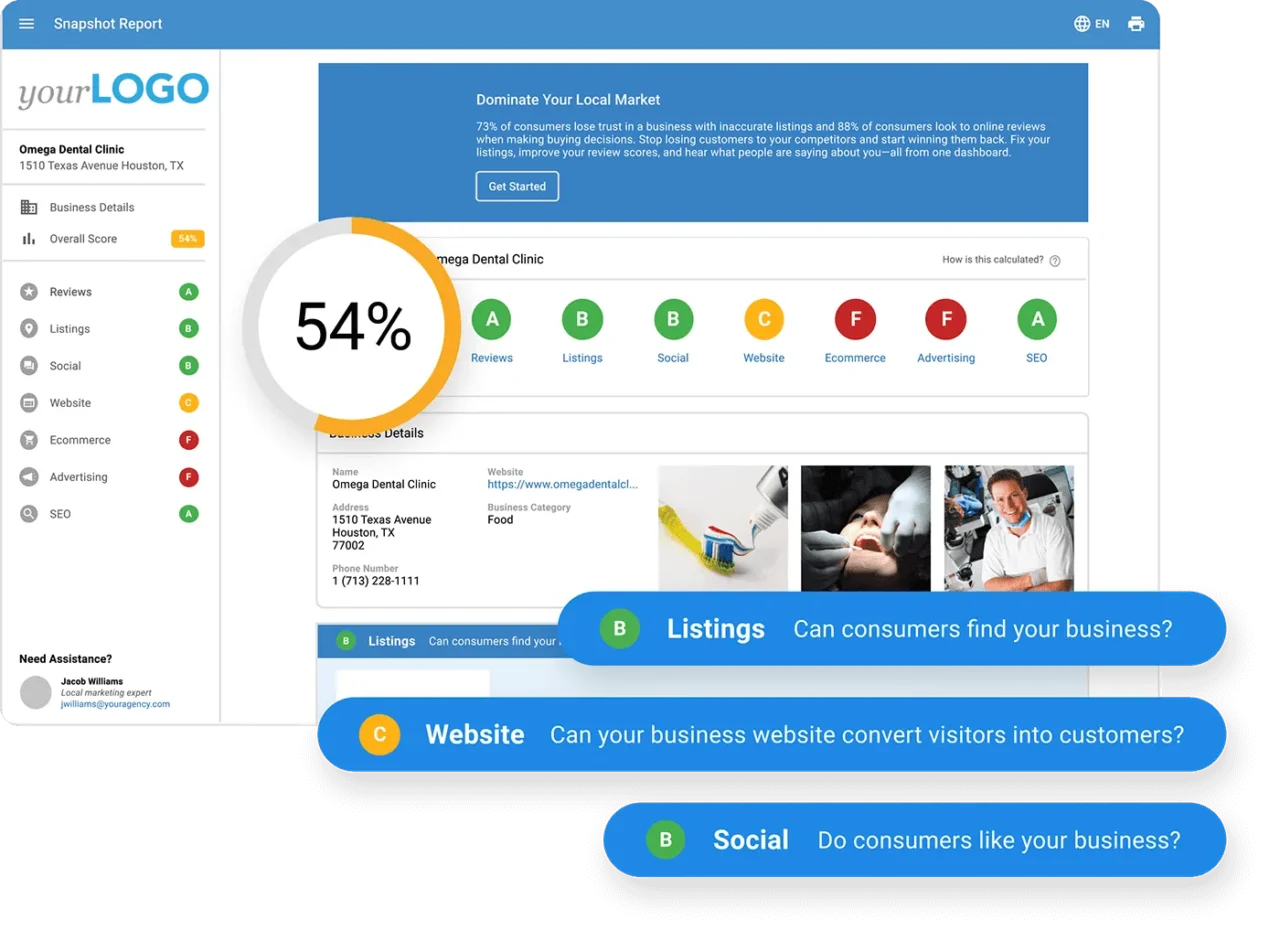
The assessment is your foot in the door, and it lives or dies on how specific the findings are. The Snapshot Report pulls a local business’s live marketing performance, listing accuracy, review profile, and search visibility into one automated needs assessment you can walk through on the review call. It does not replace the seven-point inspection. It gives you the evidence half of it, generated before you sit down, so your 45 minutes go to the operational questions only a human can ask.
Sell the Speed-to-Lead Agent Without Building It
The wedding venue result came from a response that arrived in under five minutes and actually knew the business. That is exactly what an AI Receptionist does out of the box, answering calls, chats, and texts around the clock, capturing the lead, and pushing it into the CRM instead of a voicemail box nobody checks. The AI Inside Salesperson picks up from there and runs the follow-up your client has never once done consistently.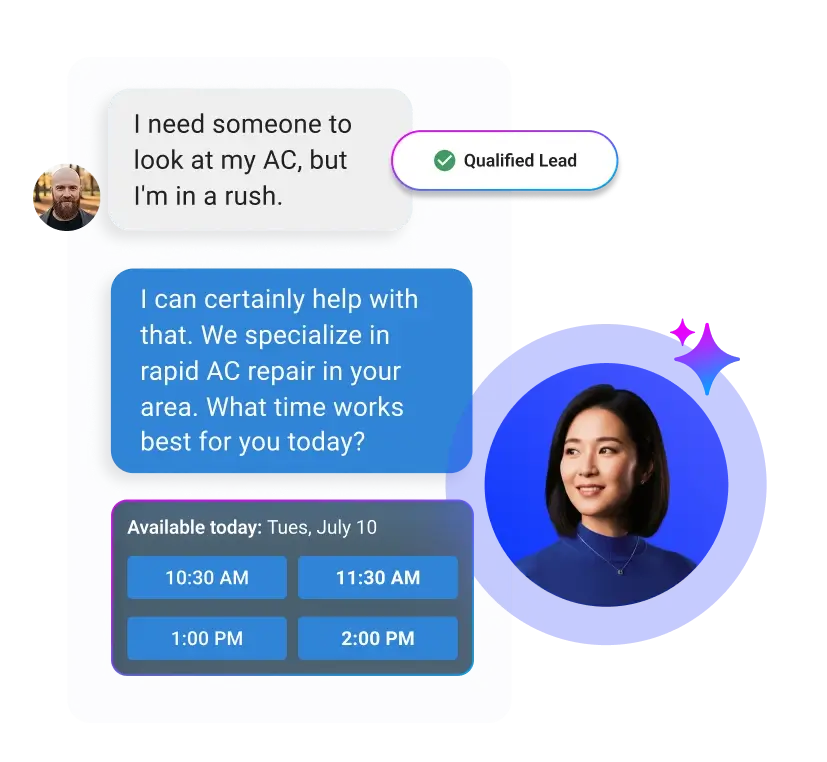
Blue River Digital ran Corey’s exact play for a real estate auction house, without building anything. They trained an AI Receptionist on the client’s property inventory so it could answer detailed questions about land features instead of collecting a name and a number. At 11:00 PM, with no human staff online, a prospect asked about a home with a pond. The AI found a match, then suggested a larger property coming to auction in a few weeks when the lead mentioned wanting more land. The prospect followed the link and bought it.
“That property probably made him somewhere between 20 and 30 grand. It absolutely works. When I shared that with my team, they finally understood it’s not just fluff.”
— Nick Prentice, VP of Growth and Development at Blue River Digital
Same shape as the wedding venue, same after-hours window, no Make.com build and no maintenance. The partner noted the agent could be switched on in about 45 seconds. Chat and voice receptionists going live for a business in minutes rather than sprints is a real advantage over competitors like GoHighLevel when you are deploying across a book of clients, and one partner’s clients saw a 372% increase in lead-to-revenue conversion after putting Conversations AI on their inbound.
Solve the Context Layer Problem Once
Corey’s 99% statistic is the real bottleneck in this business. Agents fail because the data behind them is scattered and contradictory.
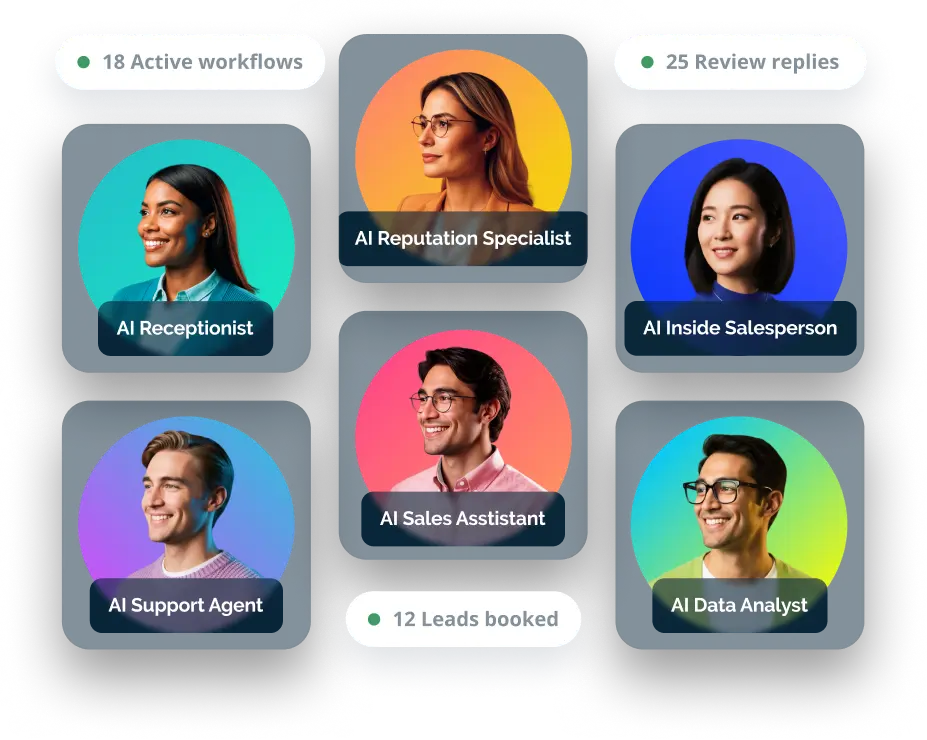
Vendasta’s AI employees run on a business’s own data: the customer records, conversations, services, and performance history already flowing through the platform. They are not glorified IVRs. They suggest optimizations, predict customer behavior, and take action. Seventeen-plus years of local business data means you can spin them up faster than building context from an empty folder, and the context stays current because it updates as the business operates.
Keep the Renewal Mechanism Running by Itself
Corey’s Notion hub works because the client sees the proof without asking. The executive report does that automatically, compiling what the AI employees did, what moved, and what it was worth, in the client’s own branded portal. Then the white-label Marketplace lets you package your assessment, your implementation tiers, and your retainer as products under your own brand with your own margin, instead of rebuilding an offer for every new client.
The Window Is Open, and It Is Wider Than It Looks
The gap Corey built a business inside is not a technology gap. Your prospects have the tools. The gap is that nobody has sat down with them and said, here is where it goes, here is what it is worth, and here is the order we do it in.
That job pays $999 for a first conversation and $1,800 a month after that, and the only qualification anyone checked was whether he understood it better than the person across the table.
So pick ten businesses. Fill out their web forms. Time the responses. You will have ten pitches by Friday.
That’s the whole playbook for how to sell AI services right now — the tools are already in your prospect’s hands.
When you are ready to deliver what you sell without hiring a team, book a demo with Vendasta today and see how partners package AI employees, assessments, and reporting into recurring revenue.
How to Sell AI Services FAQs
1. What does it mean to sell AI services?
Selling AI services means charging to diagnose where a business loses time or revenue, redesign the process behind it, and then automate the repeatable parts. Most successful offers start with a small paid assessment and climb toward a monthly retainer. You are selling judgment and implementation, not software licenses.
2. How do I price an AI services offer?
Start with a paid assessment in the $500 to $1,000 range, then price implementation by outcome, not hours. Corey Ganim charges $999 for a 45-minute assessment and $1,200 to $1,800 a month for his AI concierge retainer. He raised the retainer price four times in one week without losing a deal, which suggests most agencies underprice this work.
3. Do I need to be technical to sell AI services?
No. Corey’s assessment offer prescribes off-the-shelf tools rather than building anything, so the skill required is diagnosis, not engineering. His rule is that you only need to be one chapter ahead of your clients. Vendasta helps here by giving partners AI employees that deploy without development work.
4. What is the AOA framework?
AOA stands for audit, optimize, automate. Audit the process as it runs today, optimize it by cutting unnecessary steps, then automate what remains. The framework exists because skipping to automation usually means handing AI a broken process, which locks the inefficiency in place and makes it harder to fix later.
5. Why should the AI agent be the last thing I sell?
Because an agent is only as good as the data it can reach, and most businesses keep contradictory information scattered across drives and inboxes. Organize that context layer first, and the agent performs dramatically better from day one. Selling the agent first usually produces a disappointing result and a client who blames AI.
6. What is a speed-to-lead agent and why does it sell so well?
A speed-to-lead agent replies to inbound inquiries within minutes with personalized, accurate information and pushes the prospect toward booking. It sells because the revenue math is obvious. Research from MIT and InsideSales found that replying within five minutes rather than 30 makes a business 21 times more likely to qualify the lead.
7. How do I get my first AI services client?
Walk into ten local service businesses and offer a free fifteen-minute mini assessment, then upsell the paid one. Corey reports that ten conversations typically produce one to three paid clients. For a longer-term pipeline, host a monthly AI meetup for non-technical owners in your city and collect contact details at the door.
8. How does Vendasta help agencies sell AI services?
Vendasta gives agencies the delivery layer behind the offer. The Snapshot Report provides evidence for your assessment, AI employees like the AI Receptionist and AI Inside Salesperson handle lead capture and follow-up, and the white-label Marketplace lets you package it all under your own brand with your own pricing.
9. Can I resell AI employees under my own brand?
Yes. Vendasta is a rebrandable platform, so agencies sell AI employees, reporting, and marketing services as their own products. That matters for margin, because you keep the client relationship and pricing power instead of referring the work to a vendor your client can find on their own.
10. Why should agencies choose Vendasta to scale an AI services business?
Vendasta combines chat and voice AI employees that go live in minutes, backed by 17-plus years of local business data, and a unified platform for acquisition, engagement, and operations. Partners get automated client reporting and a branded portal, which means the proof of value that drives renewals arrives without anyone assembling it by hand.