About Us
 Careers
 Leadership
 Board
Board Newsroom
AI lead generation for local businesses produced a 39.2% lead conversion rate for early adopters of Vendasta’s AI Workforce.
It uses purpose-built AI to handle every inbound call and digital inquiry in seconds through qualification and appointment booking, then updates your CRM, so no lead slips through while you’re busy running your business.
AI lead generation for local businesses looks like this in practice: Vendasta’s AI Receptionist handled 1,017 inbound calls for a car rental business and qualified 778 of them — around the clock, without missing a lead.
This blog covers how AI lead generation for local businesses handles intake and qualification, plus speed-to-lead evidence, available tools, setup, compliance, and channel-partner delivery.
Capture, qualify, and convert leads 24/7 without lifting a finger
TL;DR
- AI lead generation for local businesses converts nearly 4 in 10 leads: Vendasta’s AI Workforce produced a 39.2% lead conversion rate for early adopters, handling qualification and appointment booking for every inbound call or digital inquiry around the clock.
- Five-minute callbacks beat 30-minute ones by 100x: The MIT and InsideSales.com study found contact odds fall 100 times between a five-minute and a 30-minute callback, so a lead left unanswered while staff works a job is often lost.
- AI Receptionist qualified 778 of 1,017 calls: Deployed for a car rental business, it answered calls and digital messages 24/7, qualified against the service list, booked appointments, and logged every action to the CRM.
What Is AI Lead Generation for Local Businesses
AI lead generation for local businesses is software that captures and qualifies prospects, then follows up using the business’s own data: the website, Google Business Profile, service list, price sheet, calendar, and CRM history.
Data sourcing feeds the AI service details and coverage areas, including operating hours, and scoring ranks each inquiry by urgency and fit. The appropriate outreach or booking link then goes out through automated lead capture the moment a trigger hits, and the output of AI customer acquisition is a booked appointment with a logged record.
A four-person HVAC company has nobody free to answer the phone mid-install, yet it pays for the ad click either way while the caller taps the next listing. The Federal Reserve Small Business Credit Survey found 46% of small employer firms already use AI, and 31% of those users report higher sales.
At that adoption level, using AI to answer inquiries is a normal operating decision. The competitor down the road may already be doing it.
How to Generate Leads Without AI Tools
Manual lead generation still works for a local business, and it rests on visibility, reputation, referrals, and a named person responsible for fast callbacks.
- Keep the Google Business Profile complete with current hours, services, and photos updated regularly
- Ask every finished customer for a review before the invoice is closed
- Make a written referral ask to existing customers and adjacent trades — a plumber trading leads with an electrician, for example
- Run local paid search or service ads tied to a tracked phone number so every call source is measurable
- Build a callback rota that assigns one named person to return every missed call and web form within five minutes, including evenings
The tradeoff is straightforward. A Harvard Business Review audit found that 23% of companies never responded to a web lead at all. The MIT and InsideSales.com Lead Response Management Study found that contact odds fall 100 times between a five-minute and a 30-minute callback. Both findings hold whether the intake is manual or automated.
Manual methods set the baseline every local business needs. AI lead generation for local businesses is what holds that five-minute standard on nights, weekends, and busy afternoons without adding headcount.
How AI Lead Generation for Local Businesses Captures and Qualifies Leads Automatically
AI lead generation for local businesses captures every lead the moment it arrives on any channel. It asks what a trained front-desk person would ask and passes only ready prospects to a human.
An AI chatbot for lead capture that only collects contact details stops short of that, because the qualifying happens in the conversation, and Vendasta’s AI Employees run it from the business’s own knowledge base.
AI Chatbots and 24/7 Lead Capture
Vendasta’s AI Receptionist answers from the service list and books the slot on the live calendar. In the Choice Signature Luxury Car Rental deployment, the AI took any call staff did not answer within 20 seconds.
Conversations AI extends AI Receptionist across phone, web chat, SMS, WhatsApp, email, Facebook Messenger, and Instagram. It brings every thread into one inbox and logs it to the CRM. AI receptionist for small business covers deployment by vertical.

MarTech reported that only 15% of consumers had experienced a smooth transfer from an AI to a human agent. AI Receptionist logs every action, so whoever picks up the thread sees the questions asked and the slot booked.
Predictive Lead Scoring and Qualification
AI lead scoring is the step where AI lead generation for local businesses ranks each inquiry by urgency and service fit, estimating revenue value before a salesperson ever sees it. The score applies service availability and coverage rules, then factors in job margin to ensure every lead is weighted against real operating context.
At 11 p.m., the AI flags a burst pipe as an emergency and texts the on-call technician, while a bathroom remodel quote gets the next open Tuesday. Xcite Group increased lead-to-appointment conversion from 50% to 70%.
The Choice AI separated luxury and ride-share rentals from daily rentals. It also asked ride-share callers about a chauffeur’s license before a human spent time on the call.
Automated Follow-Up and Speed to Lead in AI Lead Generation for Local Businesses
An MIT study found that the odds of reaching a lead drop 100 times when the callback comes at 30 minutes instead of five, while qualification odds drop 21 times. The study measured contact and qualification, not closed sales.
A Harvard Business Review audit of 2,241 U.S. companies found 23% never responded to a web lead at all. After-hours and weekend inquiries can remain untouched until staff return.
Behavior-triggered sequences close that gap without staff: Vendasta’s Campaigns Pro runs the email and SMS steps from CRM segments, and Conversations AI adds missed-call text-back, the mechanism behind an AI phone answering service. AI lead nurturing covers sequence design.
AI appointment booking writes the slot to the real calendar and confirms by text, the last automated step in customer journey automation.

CRM Integration and Enriched Lead Data
AI lead generation for local businesses creates a CRM record for every AI conversation, filling in the caller’s name and need, along with the source and booked time.
AI Sales Assistant, part of Vendasta CRM AI, extracts outcomes from calls and meetings and updates contact and company records, plus the opportunity, and each logged action makes an AI employee auditable. Vendasta prices CRM AI per organization with unlimited seats, so your whole team works the pipeline without a per-user bill.
Vendasta integrates with Jobber, ServiceTitan, Housecall Pro, and QuickBooks, so booked jobs flow to the system you already run. Per-seat alternatives appear in the roundup of best CRM platforms with AI.
AI Lead Generation for Local Businesses: Conversion and ROI Benchmarks
Neighborly, the home services franchise network, posted a 372% year-over-year increase in leads converted to revenue with Vendasta’s AI running conversations.
The AI handled 35,700 conversations in one quarter and turned 3,400 into conversions; previous workflows had left roughly 30% uncontacted. Vendasta’s conversational AI guide breaks down the funnel.
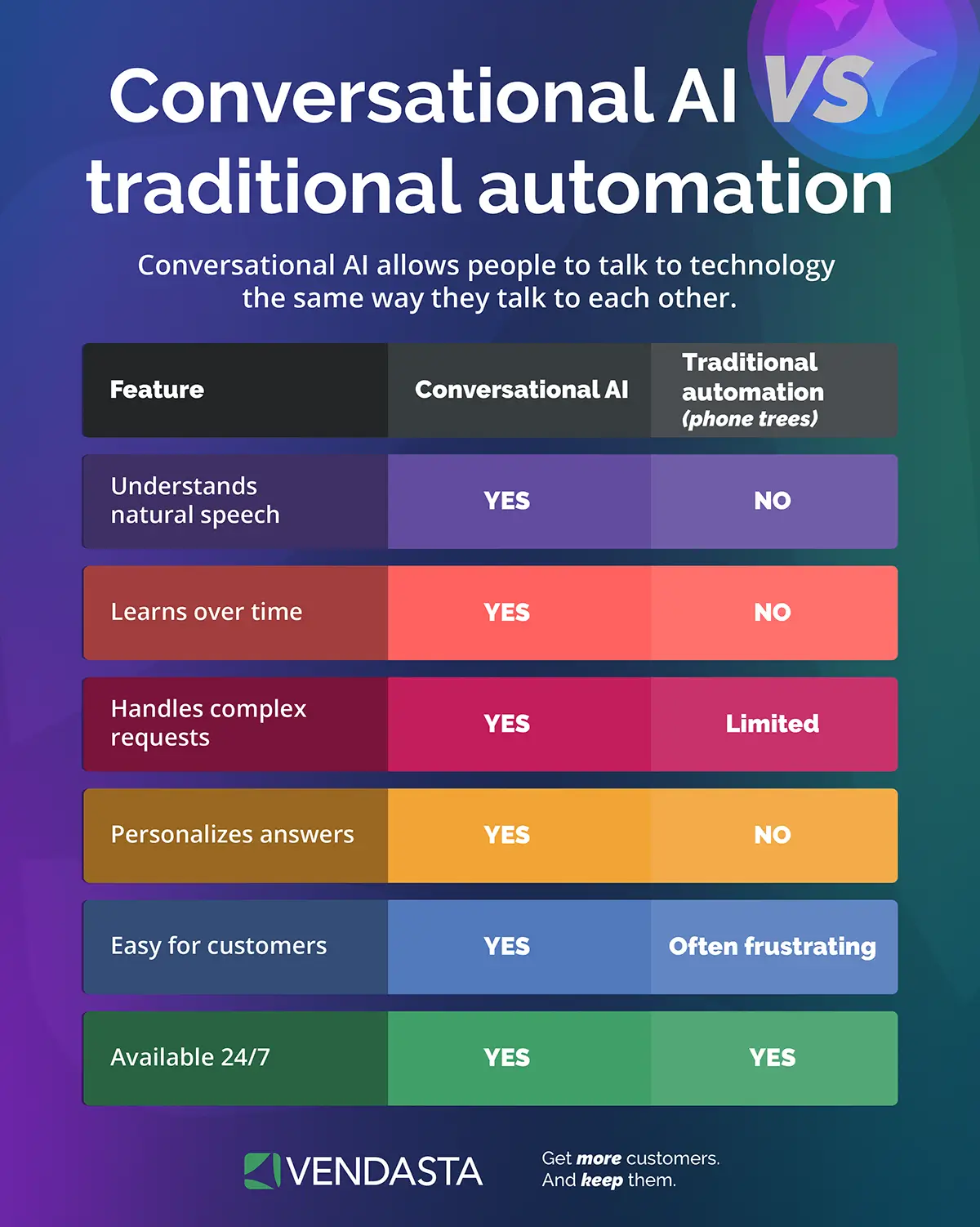
The AI Receptionist that Elite Web Professionals deployed for Choice Signature Luxury Car Rental converted 76% of captured leads over four months, across 1,017 handled calls. The AI Receptionist case study has the deployment details. Across early AI Workforce adopters, Vendasta reports a 39.2% lead conversion rate.
WordStream analyzed 13,474 U.S. campaigns and reported median costs per lead of $90.92 for home improvement, $72.97 for dentists, and $131.63 for attorneys. At a $90.92 median cost per lead, an unanswered home-improvement call puts paid media spend at risk.
Top AI Lead Generation Tools for Local Businesses
Five platforms cover AI lead generation for local businesses, and the differences that matter most aren’t just price — they’re contract terms, hidden renewal fees, and how much of the customer journey each one actually covers, from the missed call to the review that comes after.
| Tool | Best for | Key strength | Limitation | Pricing | Verdict |
|---|---|---|---|---|---|
| Vendasta | Local businesses and the partners serving them | AI Receptionist answers and qualifies calls, chats, texts, and social messages 24/7 | Built as a full customer acquisition and engagement platform rather than a single-purpose call answering tool | $99/month starter; Spend-offset subscriptions; 14-day free trial | Built for local businesses that want customers acquired and kept, without hiring more staff |
| Podium | Local businesses | AI Employee handles calendar booking | 12-month auto-renewing contracts that are hard to exit (Trustpilot 4.0/5); BBB complaints cite unclear terms | Contact sales; ~$399–$999/month | Strong inbox, but locks you into annual terms at a steeper real cost |
| Birdeye | Brands buying per location | Front Desk Agent handles voice, chat, text, and email | No built-in CRM to track deals; Automatic 8% “Innovation Fee” is added at every renewal (Trustpilot 3.5/5) | Contact sales; ~$299–$449/month per location | Best fit for multi-location brands that need CX tools, not a sales pipeline |
| GoHighLevel | Agencies building their own funnels | Visual branding available starting at the $297/mo Unlimited plan | No native local SEO or done-for-you fulfillment | $97–$497/month plus usage-based SMS, email, and AI fees | A strong pick if you’re the one building the funnel, not if you just want leads answered |
| HubSpot | Existing HubSpot CRM users | Customer Agent now $0.50 per resolved conversation | No native missed-call text-back; Professional adds $3,000 onboarding | Starter $7/seat (annual); Professional $1,300/month | Strong fit for an in-house marketing team, less built for day-to-day local visibility |
Remember to check the contract and renewal terms, confirm the vendor publishes its AI fee, and make sure it covers every channel your customers actually use (phone, text, chat, and social) from that first call through the follow-up and the review after.
Step by Step: Setting Up AI Lead Generation for Local Businesses Without a Tech Team
A working AI intake system takes five phases:
- Select the tool: Match the platform to the channels your leads arrive on: phone, web form, Google Business Profile messages, Instagram. Choose the solution that covers your mix so no inquiry slips through.
- Set up capture: Connect the phone number, install web chat, link the calendar, and upload the service list, price sheet, coverage map, and FAQs. Most Vendasta AI Employees deploy in under 30 minutes.
- Define qualification rules: Write the five questions a receptionist asks and the disqualifiers (outside service area, service not offered), then define the emergency triggers.
- Build the nurture sequences: Set the missed-call text-back and the form-follow-up text, then add a two-touch email for stalled quotes under the consent rules below.
- Convert and measure: Route booked appointments into the CRM and review logged actions weekly. Track answer rate and response time alongside lead-to-appointment rate.

Phase five is where AI lead generation for local businesses becomes measurable: a weekly 10-minute review shows whether intake is booking work.
Logged actions and answer rate provide numbers to compare with cost per lead. Response time adds another operating measure. An AI marketing strategy built on that data gets sharper every month.
Real Results: AI Lead Generation in Action
Statistics tell you what’s possible. Real businesses show you what actually happens. Here’s how AI lead generation played out for local businesses across the verticals that benefit most.
Real estate: A $30,000 commission from an 11 PM chat
An auction house’s AI receptionist was fielding a late-night inquiry about a property with a pond when the prospect mentioned wanting more land. Instead of a dead end, the AI matched them to a different property coming up for auction. The lead followed through and purchased, generating a commission between $20,000 and $30,000 that would have gone to voicemail on any other system.
→ Read how an auction house secured a $30,000 real estate commission with 24/7 AI
Home services: AI becomes the top-booking agent on the team
A home services company was missing roughly 30% of inbound calls to voicemail. After routing unanswered calls to an AI voice receptionist, the AI now books more appointments than any human on the team, simply by never missing a call, a break, or an after-hours ring.
→ Read how a home services company recovered 30% of missed leads with AI
Veterinary care: $47,000 a month from after-hours pet owners
A nine-location vet group was losing late-night searchers, the 9 or 10 PM pet owner looking for emergency care, to whichever competitor answered first. A centralized AI receptionist now triages those inquiries across the network, driving $47,698 in monthly revenue and dozens of new clients who found care exactly when they needed it.
→ Read how a 9-location vet clinic captured $47K in monthly AI-driven revenue
Hospitality: $25,000 in bookings during the slowest month of the year
A whitewater rafting company in Colorado deployed an AI receptionist to handle questions about water conditions and trip safety during its off-season. The AI directly generated $9,500 in bookings and helped staff close another $15,000, a combined $25,000 lift, roughly 10% of that month’s total revenue, during the period the business could least afford to lose leads.
→ Read how a rafting company generated $25K in off-season AI bookings
Food services: Tripling annual revenue on the side
A BBQ pitmaster running his catering business around a full-time job had no Google presence and no time to manage after-hours inquiries. An AI receptionist trained on his menu and event minimums started vetting brides, grooms, and event planners while he worked his day job. By year end, he’d tripled his annual revenue and is now aiming to triple it again.
→ Read how a BBQ catering business tripled revenue with an AI receptionist
Retail: 30% more Shopify sales with zero added staff
An online retailer’s Shopify store was a passive catalog: good products, no one to answer questions. An AI shopping assistant trained on the full inventory started making recommendations, adding items to cart, and guiding shoppers to checkout around the clock. Shopify sales increased 30% with no additional headcount.
→ Read how an online retailer grew Shopify sales 30% with an AI shopping assistant
How Channel Partners Deliver AI Lead Generation for Local Businesses
If you are a channel partner serving local businesses, the same intake stack ships under your brand.
Wholesale discounts reach up to 80% off retail depending on tier and volume, and the spend-offset subscription credits a dollar of product spend against a dollar of platform fee, starting with the $99-per-month Starter plan.
Partner Center handles deployment and billing, then reports across every client account from one console. Channel partners can then bill clients monthly for AI intake, creating a recurring revenue stream.
Vendasta’s retention research, based on 200,000 client relationships, found two-year retention rises from 30% with one product to 80% with four. Pair AI intake with Reputation AI and a website, and the client has three reasons to stay.
Real-world proof: The Xcite Group posted $745,000 in gross market revenue with 100% retention among its AI clients, and Blackfeather Digital reached $1 million in first-year revenue with a three-person team. Channel partners supporting local businesses can replicate these results by joining the Vendasta partner program, where they buy at wholesale and access the tools needed to scale.
Data Privacy and Compliance for AI Lead Generation for Local Businesses
AI intake can support compliance when teams configure messaging rules before the first message: consent, opt-out handling, quiet hours, and applicable privacy disclosures.
- Consent: Telemarketing calls using an artificial or prerecorded voice require prior express written consent under the standard the FCC reinstated on August 29, 2025 (Federal Register notice); automated marketing texts may also require it depending on the technology and use. FCC order 24-17 places AI-generated voices under the artificial-voice rules.
- Revocation: Honor any reasonable opt-out within 10 business days, and treat STOP and similar keywords as valid.
- Quiet hours: No solicitations before 8 a.m. or after 9 p.m. at the recipient’s local time, per 47 CFR § 64.1200.
- California: If your business crosses the CCPA thresholds, disclose what you collect at the point of collection and honor deletion requests within 45 days.
In the EU, GDPR consent cannot come from a pre-ticked box. Do not deploy nonessential chatbot cookies until the user explicitly requests the chatbot and supplies any required consent.
Why AI Lead Generation Is Becoming Essential for Local Businesses
AI lead generation for local businesses closes a measurable response gap. The U.S. Chamber of Commerce small business report found that 58% of small and medium businesses (SMBs) were using generative AI in 2025, up from 40% the year before. Results come from answering inquiries immediately, qualifying prospects against the business’s rules, booking on the live calendar, and recording outcomes in the CRM.

For local business owners, the path to measuring results is straightforward: compare your current answer rate and response time against your baseline, track lead-to-appointment conversion week over week, review logged actions to spot drop-off points, and compare booked revenue against your cost per lead. Pair those numbers with retention economics, because each relevant AI capability can deepen loyalty with your existing customers and reduce churn.
Every missed call is a job that goes to whoever answers next. AI lead generation for local businesses closes that gap without adding headcount, so the leads you’re already paying for turn into booked work instead of voicemail. To see how AI Receptionist and Vendasta CRM AI would handle intake for your own business, book a demo with Vendasta today!
AI Lead Generation for Local Businesses FAQs
1. How does AI lead generation work for local businesses?
AI lead generation for local businesses answers calls and digital inquiries in seconds, asks qualifying questions from the service list, books the appointment, and logs the record in the CRM. Follow-up fires on triggers like a missed call. An AI chatbot for your website is the simplest start. The business’s service data, coverage rules, pricing, and calendar keep each response specific.
2. What are the best AI lead generation tools for local businesses?
For local businesses, Vendasta’s AI Receptionist answers calls, chats, and texts from your service list and logs every action. GoHighLevel suits owners who want to build their own funnels and accept a learning curve. Podium and Birdeye both quote privately, Birdeye per location. HubSpot fits business-to-business pipelines rather than field-service intake. Compare channel coverage and implementation requirements before choosing. Then assess ownership complexity and verified pricing.
3. How much does AI lead generation cost for a local business?
Vendasta partners deliver AI Receptionist through spend-offset subscriptions starting with the $99-per-month Starter plan, with wholesale discounts up to 80% off retail. GoHighLevel’s AI Employee add-on runs $50–$97 per sub-account monthly, and Podium and Birdeye both require a quote. Before signing, ask your provider for the monthly total and contract length. Confirm the AI usage fee separately.
4. What ROI can local businesses expect from AI lead generation?
Results vary, but named examples include Neighborly’s 372% year-over-year increase in leads converted to revenue and a 76% conversion rate on AI-captured leads at Choice Signature Luxury Car Rental over four months. Model ROI from your own answer rate and cost per lead, then track booked appointments and revenue against the software cost. Vendasta reported these results; they do not guarantee future performance.
5. How do I set up AI lead generation without a tech team?
Five phases: choose a platform covering every channel leads arrive on, connect the phone and digital intake channels, link the calendar, upload the service list and FAQs, write the qualification rules and emergency triggers, then build follow-up sequences. Most Vendasta AI Employees deploy in under 30 minutes. Review logged actions weekly after launch.
6. What is AI lead scoring and how does it help local businesses?
AI lead scoring ranks each inquiry before a person sees it, using the business’s own rules for service line and coverage zip code, then factoring in job margin and the urgency the caller states. Emergencies page a human immediately, while lower-urgency requests get the next open slot. That routing protects staff time without leaving routine inquiries unanswered.
7. Why does speed to lead matter for local businesses?
The MIT and InsideSales.com study found the odds of contacting a lead drop 100 times between a five-minute and a 30-minute response. AI voice agents and text-back automation make an immediate automated response the default on nights and weekends, without staffing the phone. The study measured contact and qualification rather than closed sales.
8. How can agencies and other partners resell AI lead generation to local businesses?
Channel partners can package AI Receptionist and follow-up sequences as one white-label service. They can bundle reporting into a wholesale package and set their own retail price. Deploy across client accounts from Partner Center. Four products lift two-year retention to 80% from 30%, per Vendasta’s retention research.
9. Is AI lead generation compliant with TCPA and privacy laws?
AI lead generation for local businesses can support TCPA and privacy compliance when the business configures it correctly and documents consent. It must also honor opt-outs and account for applicable federal and state rules. Telemarketing calls using an artificial or prerecorded voice require prior express written consent, while automated marketing texts may also require it depending on the technology and use. CCPA-covered businesses must disclose collection at capture.
10. Can AI lead generation and reputation management run together?
Yes. Each feeds the other. AI Reputation Specialist sends review requests after jobs, helping your business improve its Google reviews, while AI Receptionist converts the calls those reviews generate. You see review activity and booked leads in one place, so you can tell exactly which reviews are producing calls.
This article was originally published in June 2026 and was updated in September 2026 to include the latest information and insights.