Your customers are watching AI-native platforms steal deals they used to win. Your sales team keeps losing to competitors with built-in AI features. And every quarter, the same conversation plays out in your planning session: “When do we ship AI?”
The answer keeps getting pushed. Your engineering team is stretched. Adding a full-scale conversational AI build to the roadmap means something else gets cut again. Meanwhile, SMB SaaS companies churn between 3% and 5% of customers every month. Feature gaps accelerate that number fast.
The good news is that you don’t have to build conversational AI from scratch. The best platforms today let software vendors embed production-ready AI in weeks, ship it to thousands of SMB customers, and start monetizing immediately without pulling a single engineer off the core product.
Conversational AI agents for businesses are AI-powered systems that simulate human-like dialogue across phone, SMS, web chat, and messaging platforms to automate lead capture, appointment booking, customer support, and follow-up 24 hours a day, without adding headcount.
If you’re a software company serving SMBs, your customers are already asking for this. And if your platform can’t deliver it, a competitor’s platform will.
This guide covers everything you need to know: what conversational AI agents are, how they work, what makes a great platform, and how to deploy them in a way that actually drives revenue and reduces churn.
Launch AI-powered capabilities without building them in-house
TL;DR
- The market is growing fast: The global conversational AI market was valued at $11.58 billion in 2024 and is projected to hit $41.39 billion by 2030 — a 23.7% CAGR. Software vendors who don’t embed AI now risk being left behind.
- Speed wins deals: Leads contacted within one minute convert at 391% higher rates. Conversational AI agents respond instantly, 24/7, eliminating the gaps that cost businesses customers.
- Build vs. buy is a false choice: Embedding white-label AI through a platform like Vendasta lets ISVs ship AI capabilities in weeks without touching the core roadmap or taking on new technical debt.
What Are Conversational AI Agents for Businesses?
A conversational AI agent is an AI-powered system that can hold natural, goal-oriented conversations with customers or prospects across text, voice, or messaging channels. Unlike basic chatbots that follow rigid decision trees, modern AI agents use natural language processing (NLP), machine learning, and large language models (LLMs) to understand context, handle complex questions, and take meaningful action.
In a business context, that action might be qualifying a lead, booking an appointment, answering a support question, requesting a review, or updating a CRM record, all without a human in the loop.
The key distinction between an AI agent and a simple chatbot comes down to autonomy and outcome. A chatbot answers questions. An AI agent gets things done.
How Do Conversational AI Agents Actually Work?
Conversational AI agents combine several underlying technologies to simulate human-like dialogue and take intelligent action:
- Natural Language Processing (NLP): Interprets what the customer says or types — even when it’s messy, abbreviated, or context-dependent.
- Natural Language Understanding (NLU): Identifies the intent behind a message and determines the appropriate response or action.
- Machine Learning: Improves over time by learning from real interactions, making the agent more accurate and helpful with each conversation.
- Large Language Models (LLMs): Power the generative side of the agent, allowing it to craft natural, contextually appropriate responses — not just pull from a pre-written script.
- Integrations and APIs: Connect the agent to your CRM, calendar, knowledge base, and other systems so it can actually take action, not just talk about it.
When all of these components work together well, the result is an AI agent that feels like a knowledgeable, always-available team member — one that knows your customer’s history, understands your business’s services, and can execute tasks end to end.
Why Businesses Are Deploying Conversational AI Agents Right Now
The global conversational AI market was valued at $11.58 billion in 2024 and is projected to reach $41.39 billion by 2030, growing at a compound annual growth rate of 23.7%. That growth isn’t driven by hype — it’s driven by measurable outcomes businesses are seeing in the field.
Here’s why companies aren’t waiting:
1. Response Speed Determines Who Wins the Customer
Speed is the baseline expectation. Research consistently shows that leads contacted within one minute convert at 391% higher rates. Despite this, the average business takes more than 42 hours to respond to an inquiry.
Over 50% of people hire the first business to respond to their request, even if that business charges more. Conversational AI agents respond instantly, any time of day, capturing interest at its peak before it fades.
2. Customers Expect 24/7 Availability
Your SMB customers’ end users don’t follow a 9-to-5 schedule. Neither do their questions. AI agents handle incoming leads, support requests, and appointment bookings around the clock, ensuring no opportunity slips through at 11 PM on a Friday.
3. AI Drives Measurable Conversion Improvements
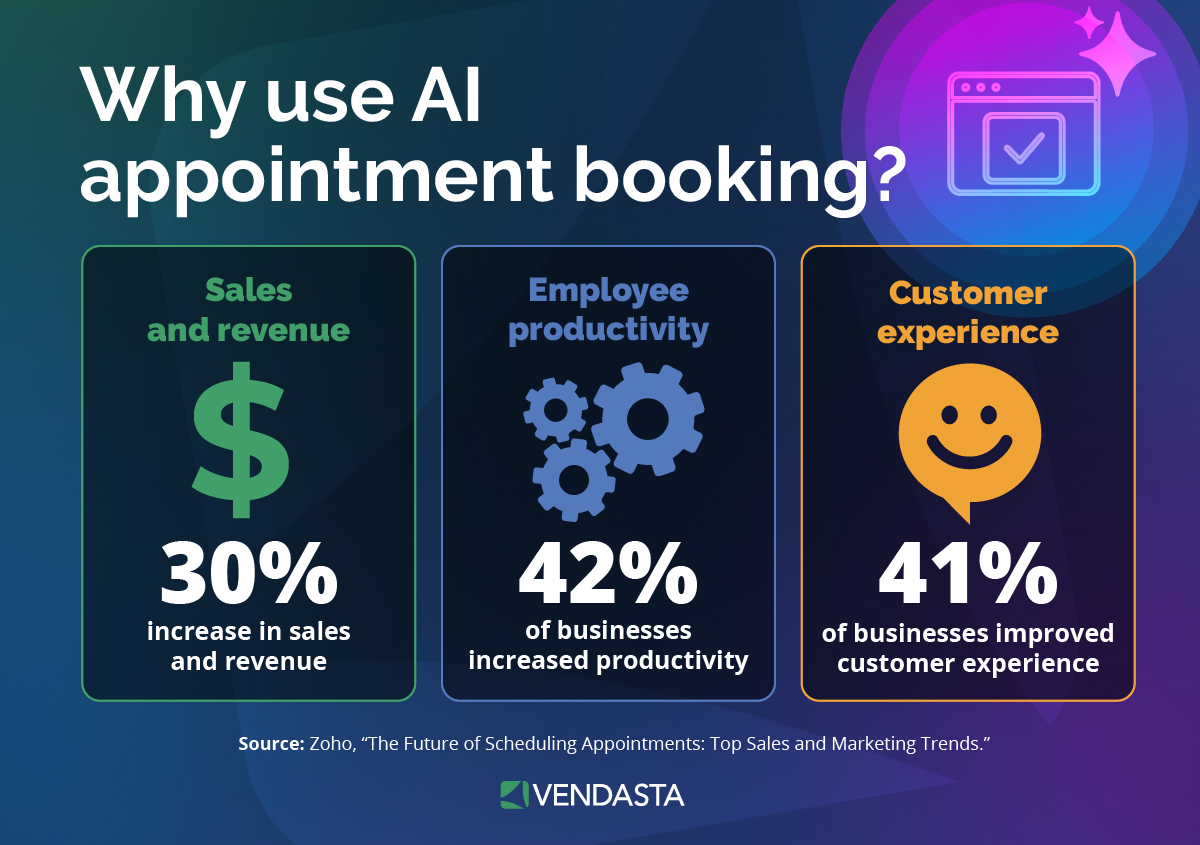
Businesses using AI chatbots and virtual agents have seen conversion rates increase by 23% compared to those without, while resolving customer issues 18% faster. Companies that deploy AI in their sales workflows report 83% revenue growth versus 66% for companies without AI — a meaningful competitive gap.
4. The Cost of Inaction Is Growing
As AI-native competitors multiply, the feature gap becomes a selling point for your customers’ buyers. Every quarter without AI is a quarter your sales team defends the same objection: “Your competitor already has this.”
For software vendors serving SMBs, this is the core business risk. Customers don’t announce they’re evaluating alternatives; they just churn.
Types of Conversational AI Agents Businesses Use
Not all conversational AI agents serve the same purpose. The most effective deployments assign agents to specific roles across the customer lifecycle — each one purpose-built to handle a distinct job rather than trying to do everything at once.
Inbound Communication Agent
Handles incoming inquiries across phone, SMS, web chat, and connected sites. Available 24/7, an inbound AI agent greets leads, answers questions about services and pricing, and routes conversations to the right team member when needed. Works across both voice and chat channels.
Lead Qualification and Sales Agent
Engages inbound prospects in real-time conversations, qualifies them based on predefined criteria, and books meetings all without requiring a human sales rep to be available. Syncs with your CRM so qualified leads are never lost.
Customer Support Agent
Resolves common support questions instantly, reducing ticket volume and freeing your human team to focus on complex issues. Pulls from your knowledge base to deliver accurate, consistent answers at scale.
Reputation and Review Management Agent
Automates review generation by sending personalized review requests to customers at the right moment, responds to reviews on behalf of the business, and surfaces actionable insights from customer feedback. Effective AI reputation management is often the difference between winning and losing a new customer for SMBs in home services, healthcare, and professional services.
Data and Insights Agent
Surfaces insights from customer interactions, sales performance, and engagement trends, giving business owners and their teams the context they need to make smarter decisions without digging through dashboards manually.
Each of these agent types works best when connected to the same underlying data and operating across a unified platform. Siloed agents create siloed experiences, and customers notice.
Key Capabilities to Look For in a Conversational AI Platform
Choosing the right platform is where most software vendors either accelerate their roadmap or create a support burden they didn’t plan for. Here’s what actually matters:
Omnichannel Coverage
Your customers’ end users communicate across phone, SMS, WhatsApp, web chat, and email. An AI platform that only covers one or two of these channels creates gaps. Look for native support across all major communication channels in a single unified inbox.
Context-Aware Conversations
The best AI agents understand the full context of a conversation and remember past interactions. An agent that asks a repeat customer for their name every time isn’t intelligent; it’s frustrating.
Deep Integration Capabilities
An AI agent that can’t connect to your CRM, scheduling tool, or customer database is just a very sophisticated FAQ page. Prioritize platforms that integrate via standard REST APIs and webhooks, and that can act on data.
Governed Workflows and Human Override
Especially when deploying AI across thousands of SMB customers, you need to define what the agent can do autonomously and what requires human approval. AI workflow automation at this scale requires strong platforms that give you granular control over permissions, actions, and escalation logic — so you can deploy confidently without worrying about what the AI might do unsupervised.
Auto-Learning from Business Context
The best AI agents don’t require manual configuration for every customer. They ingest data from existing sources — Google Business Profiles, websites, your platform — and automatically learn each business’s services, pricing, and policies. No setup required per customer means you can deploy to hundreds of SMBs without an army of onboarding specialists.
White-Label and Branding Options
If you’re an ISV embedding AI into your platform, the AI should look and feel like your product — not someone else’s. White-label AI means your customers see your brand, you control the experience, and the underlying infrastructure is someone else’s problem.
Analytics and Reporting
Deploying AI without tracking its performance is flying blind. Look for built-in analytics that surface conversation metrics, resolution rates, lead conversion data, and channel performance — giving you and your customers a clear picture of ROI.
Best Conversational AI Platforms for Businesses in 2026
The market for AI conversational tools has expanded significantly. Below is a comparison of leading platforms evaluated on features, use case fit, and deployment approach, particularly relevant for software vendors and the best AI agent platforms businesses serving SMBs should consider.
| Platform | Best For | Key Strength | ISV/White-Label |
|---|---|---|---|
| Vendasta Conversations AI | ISVs embedding AI for SMB customers | Full AI Workforce suite (receptionist, sales, support, reputation) + white-label deployment across thousands of SMBs | Yes — fully white-label |
| Salesforce Agentforce | Enterprise CRM users | Deep CRM integration and native Salesforce ecosystem | Limited |
| Retell AI | Voice-first AI for contact centers | High-quality voice agents, strong telephony stack | Partial |
| Cognigy | Global enterprise contact centers | Mature contact center AI with multi-language support | No |
| Intercom Fin | SaaS customer support teams | Strong resolution rates for product support interactions | No |
| Bland AI | Dev-heavy teams needing voice AI | Low-latency voice agents, 18+ languages, production-ready | Partial |
For software vendors focused on SMB markets, home services, healthcare, and professional services, the requirements are different from enterprise contact center tooling. You need AI that deploys at scale, learns automatically from each customer’s business context, and can be embedded under your own brand. That’s a narrower list.
How Vendasta’s AI Workforce Powers Conversational AI for SMBs at Scale
Vendasta’s Conversations AI is the intelligent engine behind a full AI Workforce, a suite of specialized AI Employees that handle customer acquisition, engagement, and retention across every major communication channel.

What separates Vendasta’s approach from standalone conversational AI tools is the combination of breadth, depth, and deployment speed, particularly for software vendors that need to ship AI to thousands of SMB customers without rebuilding their infrastructure.
Built for Production, Not Demos
Vendasta’s AI Employees are designed to work out of the box. They automatically ingest data from sources like Google Business Profiles, existing websites, and your platform, so each SMB customer gets an AI agent that understands their specific services, pricing, and policies from day one. No manual setup per customer. No prompt engineering required.
This matters enormously at scale. When you’re deploying AI across hundreds or thousands of SMB accounts, per-customer configuration is not a viable model. Auto-learning eliminates that bottleneck entirely.
A 372% Increase in Lead-to-Revenue Conversion
Vendasta’s Conversations AI has driven a 372% increase in lead-to-revenue conversion for businesses using the platform. That’s the result of AI agents that respond instantly, qualify intelligently, and follow up automatically across the full customer journey.
The Full AI Workforce
Vendasta’s platform includes four specialized AI Employees, each built on professional frameworks for their specific role:
- AI Receptionist: Available 24/7 via phone, chat, SMS, and connected sites. Captures leads, answers customer questions, and delivers a consistent experience that converts in both chat and voice formats.
- AI Inside Salesperson: Qualifies prospects, books appointments, and syncs with your CRM, so your human sales team spends time closing deals, not chasing cold leads.
- AI Support Agent: Handles common support inquiries instantly, reducing ticket load and improving customer satisfaction without adding headcount.
- AI Reputation Specialist: Sends personalized review requests, responds to reviews on behalf of the business, and surfaces feedback trends, helping SMBs grow and manage their online reputation automatically.
Fits Your Existing Stack Without Forcing Architecture Changes
Vendasta integrates into your existing infrastructure using standard REST APIs, webhooks, and enterprise authentication. Whether you’re running an industry-standard stack or proprietary middleware, Vendasta acts as a normalization layer, handling orchestration and automation while your core systems stay the source of truth.
For CTOs and VPs of Engineering, this is the detail that matters most. A clean integration that doesn’t create a new support burden is the difference between a champion and a blocker in the buying process.
Ship AI in Weeks, Not Quarters
The core value proposition for ISVs is speed to market. Vendasta’s white-label platform lets software vendors go from “let’s offer this” to “customers are paying for it” in a matter of days, not a quarter of engineering work. Vendasta handles feature improvements, infrastructure maintenance, and keeping the product competitive. Your engineering team stays focused on what differentiates your core platform.
Monetization is handled too. Vendasta’s ordering system manages provisioning, activation, and lifecycle management, connecting to your existing billing system via API. You can package new features, adjust pricing, or create bundles without dumping work on your dev team.
How to Deploy Conversational AI Agents: A Step-by-Step Guide
Whether you’re a software vendor embedding AI into your platform or a business deploying it directly, the deployment process follows a similar structure.
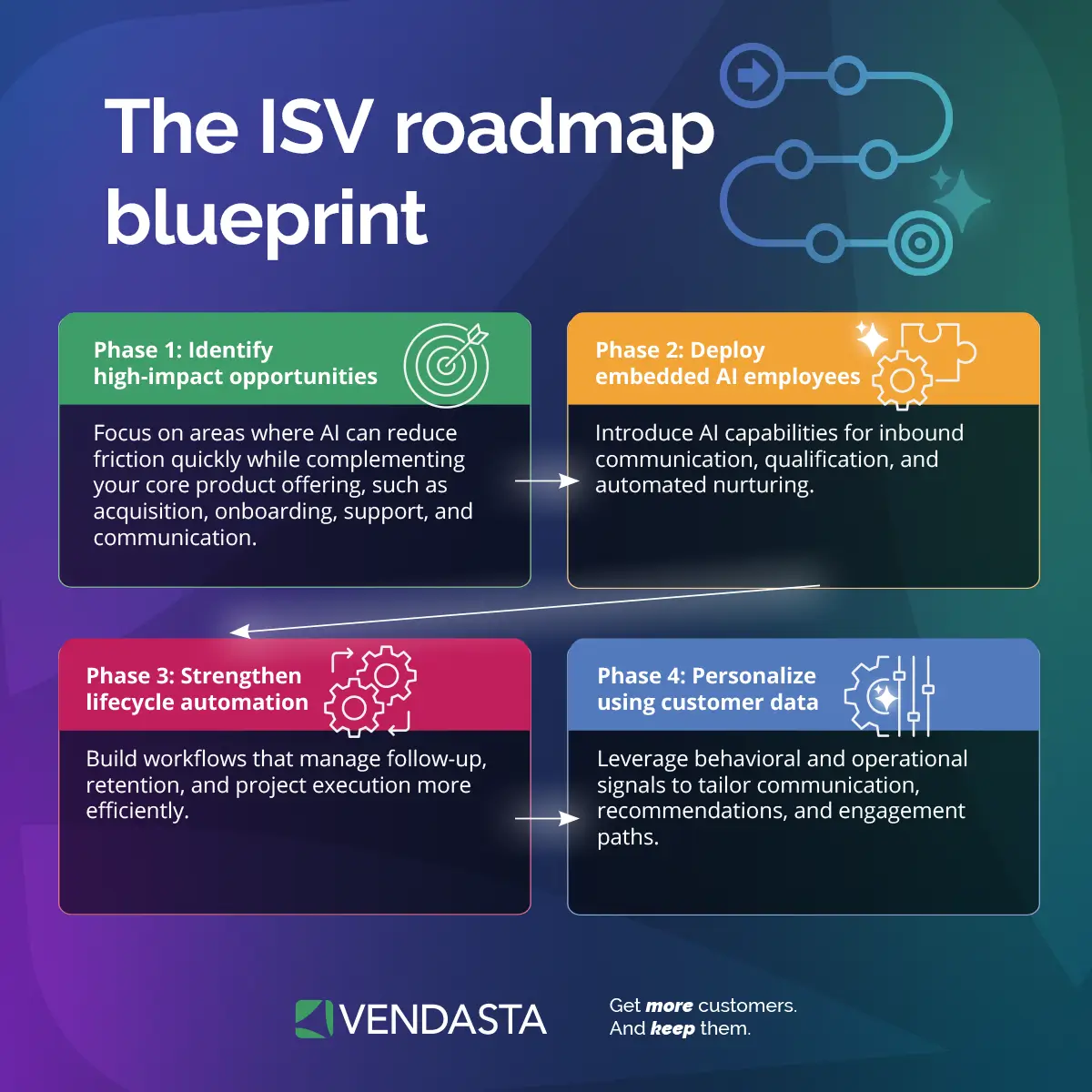
Here’s a practical framework:
Step 1: Define the Use Cases and Agent Roles
Before picking a platform, map the specific jobs you need AI to handle. Lead qualification? Appointment booking? After-hours support? Each use case requires a different agent configuration, and getting this right before deployment prevents costly rebuilds later.
For ISVs, the best starting point is usually the use cases your existing customers ask about most — the ones your sales team hears on calls. Those pain points represent immediate upsell opportunities once you have AI to offer.
Step 2: Choose a Platform That Matches Your Deployment Scale
If you’re serving hundreds or thousands of SMB customers, you need a platform built for multi-tenant deployment. Look for auto-learning (agents that configure themselves from business data), governed workflows you can manage at scale, and a white-label layer that keeps your brand front and center.
Step 3: Connect Your Data and Integrations
An AI agent is only as useful as the data it can access and the actions it can take. Connect your CRM, calendar tool, knowledge base, and any business-specific data sources before you go live. Establish clear rules for what the agent can do autonomously versus what requires human review.
Step 4: Define Escalation Logic
Even the best AI agents encounter situations that require a human. Set up clear escalation paths for when the agent should transfer to a human, how that handoff happens, and what context gets passed along. A seamless escalation experience is often more important to customer satisfaction than the AI’s performance in straightforward interactions.
Step 5: Set Up Tracking and Baseline Metrics
Establish your baseline before launch: average response time, lead conversion rate, support ticket volume, and review count. These numbers give you the before/after data you need to prove ROI both to your own organization and to the SMB customers you’re serving.
Step 6: Launch, Monitor, and Iterate
Start with a defined channel or use case rather than deploying everything at once. Monitor conversation quality in the first few weeks, identify where the agent performs well and where it struggles, and iterate from there. The best AI deployments improve continuously.
Conversational AI Agents vs. Traditional Chatbots: What’s the Difference?
This is one of the most common questions from businesses evaluating AI tools, and it matters because the gap in capability is significant.
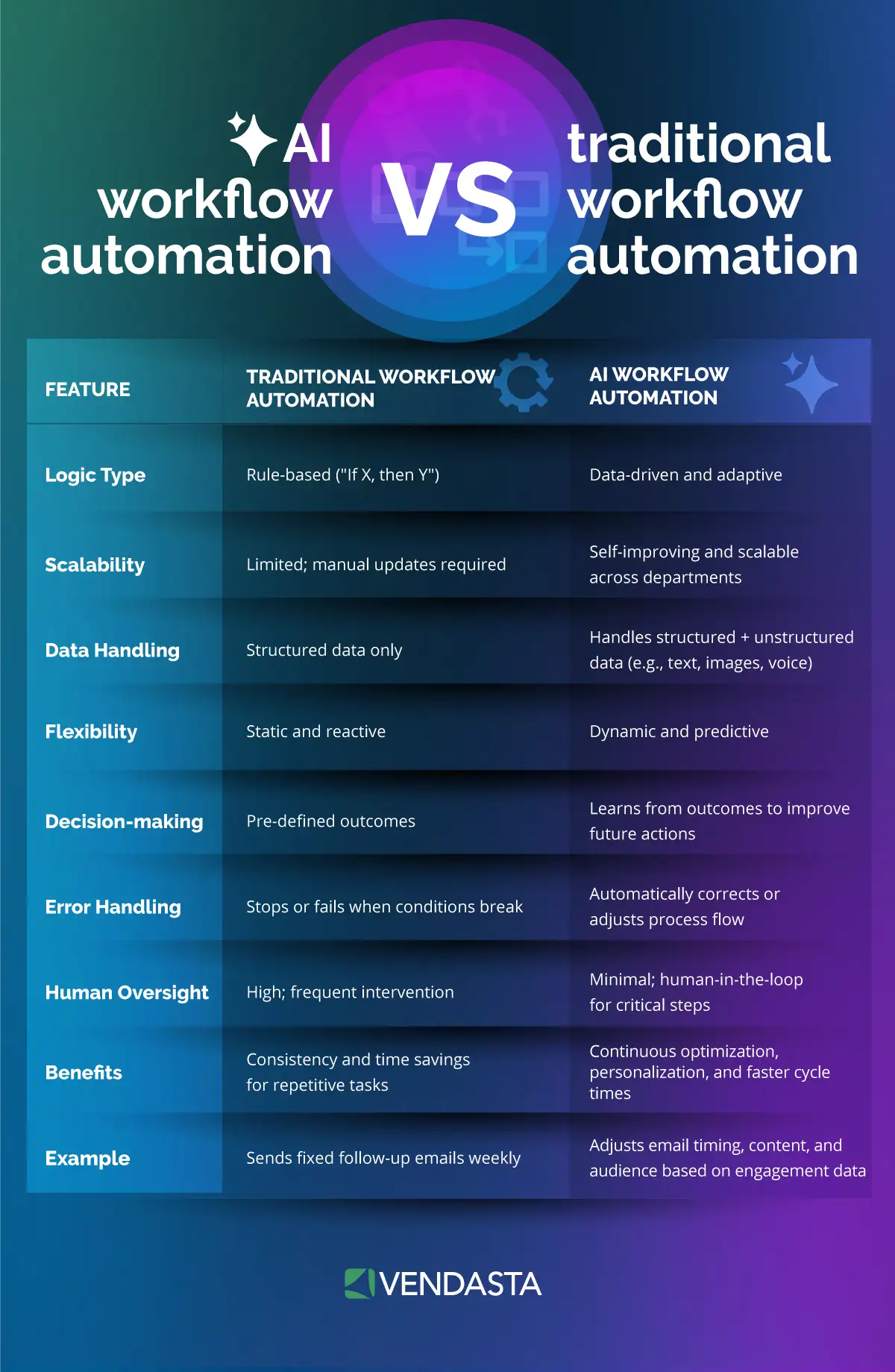
| Traditional Chatbot | Conversational AI Agent | |
|---|---|---|
| Conversation Logic | Rule-based decision trees | NLP + LLM — understands intent, not just keywords |
| Context Memory | Usually none across sessions | Maintains context across multi-turn conversations |
| Actions It Can Take | Displays information, routes to human | Books appointments, updates CRM, sends follow-ups |
| Setup Complexity | Requires manual scripting of every path | Learns from business data automatically |
| Channels Supported | Typically, web chat only | Phone, SMS, WhatsApp, web chat, and more |
| Handles Unexpected Input | Falls back to “I don’t understand” | Interprets intent and responds naturally |
| Customer Experience | Transactional, often frustrating | Natural, helpful, goal-oriented |
The practical implication: a rule-based chatbot can handle a narrow set of FAQs. A conversational AI agent can handle the full customer journey — from first inquiry to booked appointment to post-service review request across every channel your customers use.
Real-World Use Cases: How Businesses Are Using Conversational AI Agents
The most valuable way to understand conversational AI is to see how it maps to actual business workflows.
Home Services: Never Miss a Lead Again
A plumbing company receives inquiries at all hours, many of them urgent. An AI receptionist for small business answers every inbound call and chat, captures the lead’s contact details and service need, and books an appointment directly in the calendar. When the human team arrives the next morning, the schedule is already full.
Before AI, that 10 PM call went to voicemail. The customer called a competitor at 10:01 PM.
Healthcare: Appointment Booking at Scale
A multi-location medical clinic deploys an AI agent to handle appointment requests, insurance questions, and follow-up reminders across SMS and web chat. Staff time spent on phone scheduling drops significantly. Patient satisfaction scores improve because questions are answered instantly rather than during business hours only.
Professional Services: Qualifying Leads Before They Hit Your CRM
A bookkeeping firm embeds an AI chatbot on their website. When a prospect visits the pricing page, the agent initiates a conversation, asks qualifying questions about business size and current software, and routes high-fit leads to a sales rep with the conversation summary already attached. Sales reps stop spending time on prospects who would never convert.
Software Vendors: Turning AI Into an Upsell
An ISV serving the home services industry embeds white-label AI agents into their platform. They launch an AI Receptionist module as an add-on, price it at $150 per customer per month, and roll it out to their customer base. Within the first quarter, hundreds of customers activate the feature, adding meaningful ARR without a single new engineering sprint.
Common Mistakes to Avoid When Deploying Conversational AI Agents
Most failed AI deployments aren’t failures of technology; they’re failures of implementation. Here are the patterns to avoid:
- Deploying without defining success metrics. If you don’t have a baseline and a clear definition of what good looks like, you can’t prove (or improve) ROI.
- Treating AI as a one-time setup. Conversational AI improves with oversight and iteration. Teams that deploy and walk away miss most of the value.
- Choosing a platform that doesn’t scale with your customer base. A tool that works for one customer but requires manual configuration for each additional one becomes a bottleneck, not an asset.
- Skipping the escalation design. An AI that can’t gracefully hand off to a human when needed creates frustrating dead ends — and frustrated customers.
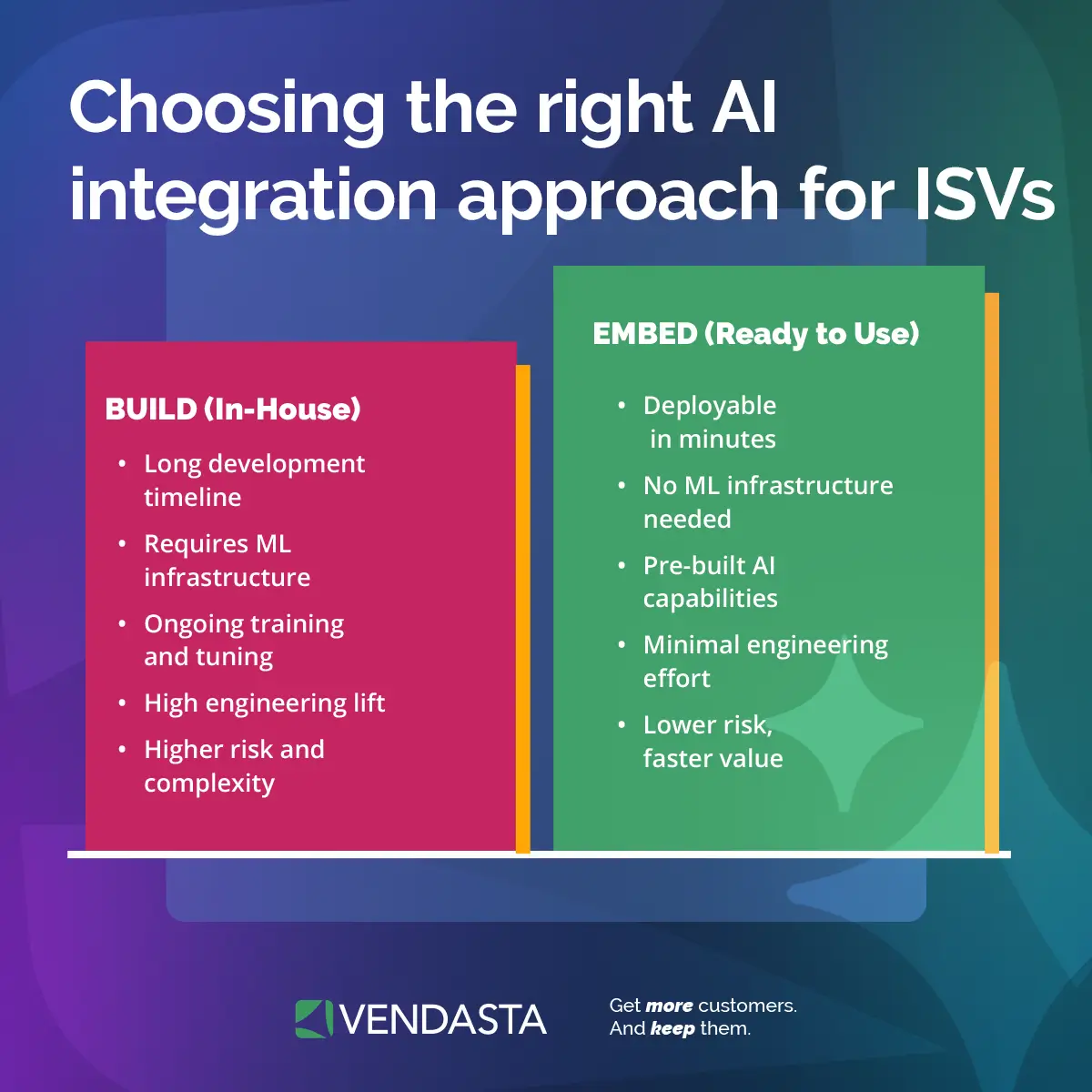
- Building from scratch when embedding is an option. For software vendors especially, the build-vs-buy calculation almost always favors embedding. The time cost of building multi-tenant AI infrastructure from scratch and maintaining it competitively is rarely justified when production-ready platforms exist.
The Build vs. Buy Question: What Software Vendors Need to Know
For product leaders at software companies, this is the most consequential decision in the AI conversation. Build your own conversational AI, or embed a proven platform?
The instinct to build is understandable. You want control. You want it to feel native. You don’t want a third-party dependency in a core part of your product.
But the math rarely works out in favor of building, especially when you account for the full cost.
What Building Actually Costs
- Months of engineering time scoped, resourced, and delivered
- Multi-tenant infrastructure designed and maintained
- LLM model selection, fine-tuning, and ongoing prompt management
- Channel integrations: phone, SMS, WhatsApp, web chat, built and maintained separately
- Security, compliance, and data governance layers
- Ongoing updates as AI capabilities and customer expectations evolve
That’s 12–18 months of work at minimum, and ongoing maintenance after launch. For a company with a stretched engineering team, that cost is rarely the right trade-off.
What Embedding Gets You
- Production-ready AI in weeks, not quarters
- White-label branding so it looks like your product
- All infrastructure, updates, and maintenance are handled by the vendor
- Immediate upsell revenue from your existing customer base
- The engineering team focused on what actually differentiates your core platform
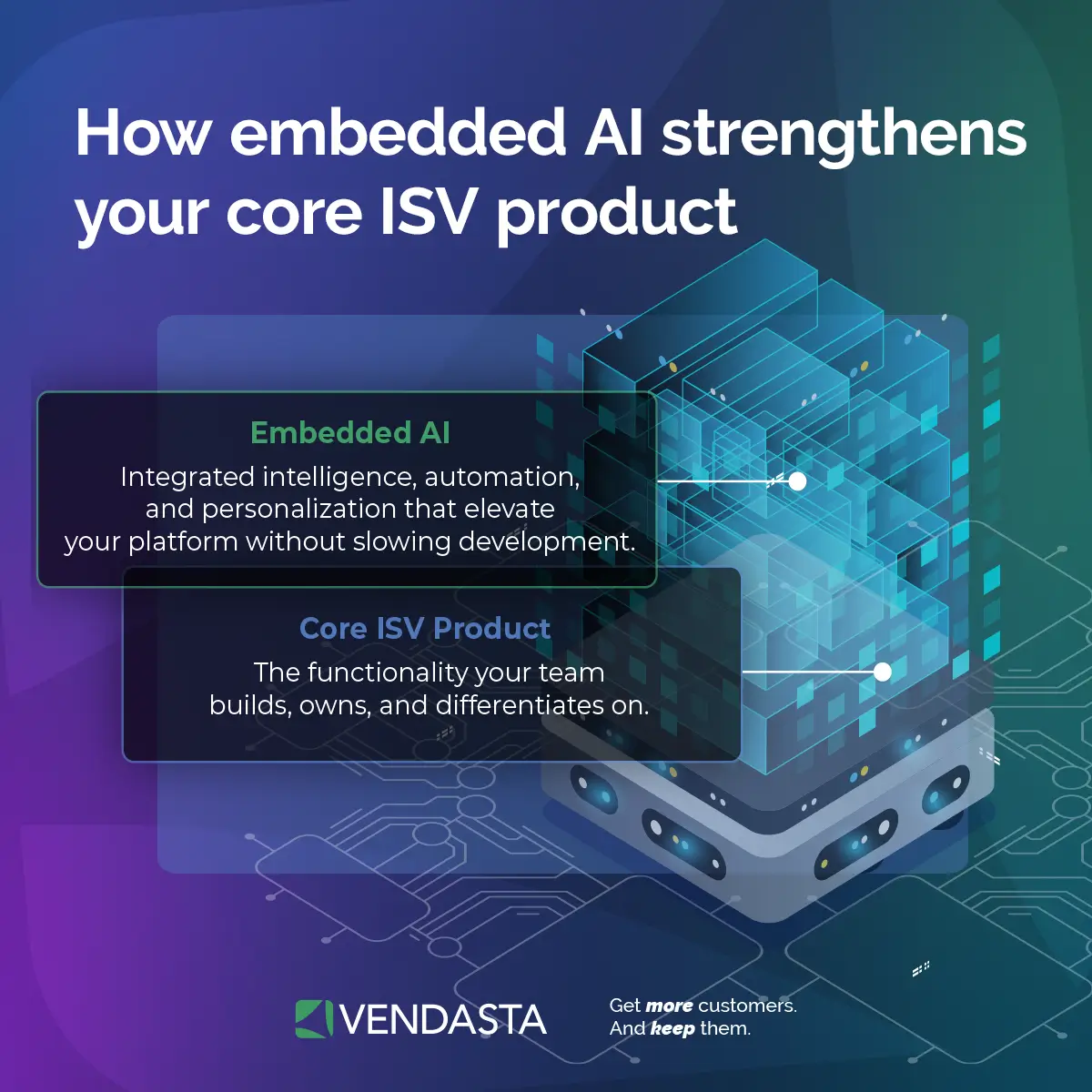
The best embedding partnerships don’t force you to change your architecture. They add a capability layer on top of what you already have — clean, well-documented, and easy to support.
Vendasta is built specifically for this model. Its AI integration for SaaS vendors uses standard REST APIs, enterprise authentication, and a white-label layer so ISVs can go deep without disrupting existing workflows. Vendasta handles the feature improvements and keeps the AI competitive. Your team ships the product that wins deals, AI included.
How to Measure ROI from Conversational AI Agents
Deploying AI is an investment. Here’s how to measure whether it’s paying off:
Lead Metrics
- Lead capture rate (percentage of inquiries that become identified leads)
- Speed to first response (before and after AI deployment)
- Lead-to-appointment conversion rate
- Percentage of after-hours leads captured
Revenue Metrics
- ARPU (average revenue per user) change after adding AI features
- New revenue from AI add-on activations
- Upsell close rate when AI is part of the offer
Retention Metrics
- Customer churn rate changes after AI deployment
- Feature adoption rate among existing customers
- Net Promoter Score or customer satisfaction change
Operational Metrics
- Support ticket volume handled by AI vs. human agents
- Average resolution time
- Hours saved by the human team per week
For ISVs, the most important metric is often the simplest: how many customers activated the AI feature, and what did it do to your ARPU? A $150/month add-on activated by 30% of your customer base is a meaningful ARR impact, and it becomes the clearest case for expanding the AI offering further.
The Future of Conversational AI for Businesses
Conversational AI is evolving quickly, and the trajectory points toward agents that don’t just respond — they act proactively, predict customer needs, and coordinate across entire business workflows with minimal human intervention.
A few developments worth watching:
- Agentic AI: Gartner predicts that 33% of enterprise software applications will include agentic AI by 2028 — agents that can initiate multi-step workflows autonomously, not just respond to prompts.
- Voice-first expansion: AI voice agents are becoming standard in customer service and sales. As latency drops and natural language understanding improves, voice AI will become the default channel for inbound calls in SMB markets.
- Deeper personalization: As AI agents accumulate more customer data, their ability to personalize interactions in real time improves. The next generation of conversational AI will feel less like talking to an assistant and more like talking to someone who genuinely knows your business.
- Unified AI workforces: The shift away from point solutions toward integrated AI platforms where agents share context, coordinate actions, and operate as a connected workforce — will become the standard expectation for businesses of all sizes.
For software vendors, the companies that embed and ship AI now will have a compounding advantage. Each quarter of AI deployment is a quarter of learning, improvement, and customer data — a gap that late movers will find increasingly difficult to close.
Conclusion
The question for software companies serving SMBs is no longer whether to offer conversational AI — it’s how quickly you can get it in front of your customers. Every quarter without AI is a quarter where competitors close deals you should have won, and where customers who don’t see a reason to stay start looking for one to leave.
The build-vs-buy debate is largely settled for most ISVs: embedding a proven, white-label AI platform is faster, cheaper, and less risky than building multi-tenant conversational AI infrastructure from scratch. The AI market is growing at 23.7% annually, customer expectations are accelerating in parallel, and the window to lead rather than catch up is narrowing.
The good news is that the path forward is clear. Define the use cases your customers need most, choose a platform built for your deployment scale, and ship AI in weeks — not quarters. Your engineering team stays focused on your core product. Your sales team gets a compelling new offer. And your customers get the AI features they’ve been asking for.
Vendasta’s AI Workforce gives software vendors exactly that: a production-ready, white-label suite of conversational AI agents that deploys across thousands of SMB customers with no manual setup, no infrastructure rebuild, and no roadmap bloat. From AI receptionists to reputation specialists to CRM-connected sales assistants, it’s the fastest path from “AI is on our roadmap” to “AI is in our product — and generating revenue.”
Book a demo with Vendasta today!
Conversational AI Agents for Businesses FAQs
1. What are conversational AI agents for businesses?
Conversational AI agents for businesses are AI-powered systems that hold natural, goal-oriented dialogues with customers across channels like phone, SMS, web chat, and WhatsApp. Unlike basic chatbots, they understand context, handle complex questions, and take actions, like booking appointments, qualifying leads, and updating CRM records, without human intervention.
2. How do conversational AI agents differ from regular chatbots?
Traditional chatbots follow rigid, pre-scripted decision trees and typically handle only simple FAQs. Conversational AI agents use natural language processing and machine learning to understand intent, maintain context across multi-turn conversations, and complete real tasks, making them significantly more capable and useful for business operations.
3. What business problems do conversational AI agents solve?
They solve response time gaps, after-hours lead loss, support team overload, and manual sales follow-up. Businesses using AI agents capture more leads, book more appointments, reduce support costs, and improve customer satisfaction — all without adding headcount or stretching their existing teams.
4. How does Vendasta’s Conversations AI help businesses deploy AI agents?
Vendasta’s Conversations AI powers a full suite of specialized AI employees, including an AI Receptionist, AI Inside Salesperson, AI Support Agent, and AI Reputation Specialist. It deploys across phone, SMS, WhatsApp, and web chat, automatically learns each SMB’s business context, and connects to existing CRM and scheduling systems through standard APIs.
5. How long does it take to deploy a conversational AI agent for my business?
With a platform like Vendasta, deployment can happen in weeks rather than months. The AI automatically learns from your business data, including your website, Google Business Profile, and existing systems, so there’s no lengthy manual setup. For software vendors embedding AI for their customers, the timeline from integration to revenue is similarly compressed.
6. Can conversational AI agents handle voice calls, or just text?
Modern conversational AI platforms support both. Vendasta’s AI Receptionist, for example, is available in both AI chat and AI voice formats, handling inbound phone calls as naturally as text-based web chat. Voice AI is one of the fastest-growing segments in the market as natural language models become more accurate and responsive in real-time audio.
7. Is conversational AI a good fit for SMBs in home services, healthcare, and professional services?
Yes, these are among the highest-impact industries for conversational AI deployment. In home services, AI captures after-hours leads. In healthcare, it handles appointment booking and follow-up. In professional services, it qualifies leads before they reach your sales team. Vendasta’s AI Workforce is purpose-built for these SMB verticals.
8. What should software vendors (ISVs) look for in a conversational AI platform to embed in their product?
ISVs should prioritize white-label branding, multi-tenant deployment at scale, standard API integration, auto-learning from customer data, and a vendor that handles ongoing maintenance. Platforms like Vendasta are specifically designed for ISV embedding, letting software vendors to ship AI in weeks without pulling engineering resources off their core roadmap.
9. How do I measure the ROI of conversational AI agents?
Key metrics include lead capture rate, speed to first response, lead-to-appointment conversion, support ticket deflection rate, and ARPU changes after AI feature activation. For software vendors, the clearest ROI signal is usually how many existing customers activate the AI add-on and what it does to average revenue per user over 90 days.
10. Is it better to build conversational AI in-house or use an existing platform?
For most software vendors, embedding an existing platform is the faster and more cost-effective path. Building multi-tenant conversational AI from scratch requires 12–18 months of engineering work minimum, plus ongoing maintenance. Vendasta’s white-label platform lets ISVs ship production-ready AI in weeks, with Vendasta handling all infrastructure updates and feature improvements going forward.