About Us
 Careers
 Leadership
 Board
 Newsroom

The best AI tools for agencies add delivery capacity without adding hires. We scored eight tools on seven weighted criteria, including multi-client support, white-label options, and cost. Three led: HubSpot for client customer relationship management (CRM) and automation (Marketing Hub Professional from $800 a month), Vendasta for selling AI services to local business clients under your own brand (no subscription, with monthly minimums from $99), and Zapier for low-cost app connections (free for 100 tasks a month).
For a midsize agency, growth usually means another fulfillment hire for every new batch of clients, and margins thin as the team grows. AI breaks that pattern only when the tool fits how agencies work: separate client accounts, branded deliverables, and pricing that doesn’t climb faster than the client list. If your plan is to sell AI services to local business clients under your own brand, resale economics matter as much as features, which is why this comparison weighs multi-client support and margin above feature counts.
Disclosure: Vendasta, an AI customer acquisition and engagement platform, is our product. We scored it on the same criteria as every other tool, and the full scoring, pricing table, and alternatives follow.
Turn hours of work into minutes with AI-powered workflows
TL;DR
- Match the tool to what your agency sells: Vendasta leads for selling AI services under your own brand, HubSpot for client CRM and automation, and Zapier for low-cost app connections.
- Pricing models matter more than list prices: Per-client and per-domain fees grow with your client list. Vendasta has no subscription: partners commit to a monthly minimum that starts at $99, and from the second month every $1 of qualifying product spend counts toward it.
- More services per client raise retention: Vendasta’s research across 200,000 client relationships found two-year retention is 30% with one product, rises by roughly 20 percentage points with a second, and reaches 80% with four.
How We Evaluated
We scored every tool on the same seven weighted criteria. Each one targets a problem that stalls agencies once they pass 30 or 40 clients:
- Multi-client support (20%): Separate client accounts, permissions, and credentials, plus portfolio views that support client management at scale.
- White-label options (15%): Whether clients see your brand or the vendor’s in logins, reports, emails, and domains.
- AI transparency (15%): Whether the vendor documents what the AI does, logs its actions, and supports human approval.
- Integrations (15%): CRM, calendar, ad platform, and reporting connections that remove manual handoffs.
- Channel coverage (10%): Phone, chat, SMS, email, social, search, and AI answer engines.
- Data readiness (10%): How much clean, consented client data the tool needs before its output is usable.
- Cost (15%): Starting price, how the bill scales with client count, and room for resale margin.
We built each score from vendor documentation, official pricing pages, and partner program terms. We then checked every tool against four common agency jobs: monthly reporting, review responses, after-hours lead capture, and content in several client voices. Prices come from each vendor’s own pricing pages and help documentation as checked in November 2026, and promotional tiers change often.
The table below shows which tools led the criteria that separated our top picks:
| Criterion | Led by | Why it led |
|---|---|---|
| Multi-client support | Vendasta | Partner Center deploys AI Employees across the client portfolio |
| White-label options | Vendasta | Each client gets a white-label Business App login |
| Integrations and CRM depth | HubSpot | CRM, Agent Hub custom agents, and predictive lead scoring on Enterprise |
| Cost (entry) | Zapier | Free plan with 100 tasks a month |
Most agency management software scores well on two or three criteria and poorly on multi-client support. If your client list is growing, give that criterion the heaviest weight in your own review.
Best AI Tools for Agencies at a Glance
The table compares the eight scored tools by agency job. Prices are starting figures from each vendor’s official pricing pages, and billing periods differ by vendor:
| Tool | Agency Job | Best For | Price | Verdict |
|---|---|---|---|---|
| HubSpot | CRM and marketing automation | Agencies running client CRM, email, and nurture programs | Marketing Hub Starter from $7/seat/mo (new-customer pricing); Professional from $800/mo plus $3,000 onboarding | Best for client CRM and automation; no white-label edition |
| Vendasta | AI services resold under your brand | Agencies selling AI services to local business clients | No subscription; monthly minimums from $99, and qualifying product spend counts toward them | Best for branded AI resale; built for local business clients |
| Zapier | Automation between client tools | Small teams connecting apps on a budget | Free (100 tasks/mo); Professional from $19.99/mo | Best budget pick; shared task pool strains across many clients |
| Jasper | Multi-brand content | Teams writing in several client voices | Pro $59/seat/mo billed yearly | Good brand voice controls; Pro caps brand voices at two |
| Semrush AI Visibility Toolkit | AI search visibility | Search engine optimization (SEO) agencies adding AI answer tracking | $99/mo per domain, billed annually | White-label reports through a $20/mo add-on |
| Peec AI | AI search visibility across a portfolio | Agencies tracking many client brands | Agency plans from $245/mo (3 client projects) | Clearest multi-client AI visibility pricing |
| AgencyAnalytics | Client reporting | Agencies reporting monthly to dozens of clients | $20 per client/mo, billed annually | Per-client pricing scales predictably |
| GoHighLevel | Lead handling with AI chat and voice | Agencies rebilling AI usage to local clients | Unlimited platform $297/mo; AI Employee Unlimited $97/mo per sub-account | Flexible AI usage rebilling on Unlimited and higher plans |
Read the Price column next to the Agency Job column. Per-client and per-domain prices grow with your book, while flat platform fees spread across it.
Our Top Picks
HubSpot, Vendasta, and Zapier lead three different agency jobs: client CRM and automation, branded AI resale, and low-cost app connections.
Forrester’s press release on US marketing agencies says nine in 10 use generative AI and half use agentic AI for marketing execution. The same release says 61% still classify AI as a cost of business, so the picks below favor tools that save delivery hours or produce revenue you can bill.
Best for Client CRM and Marketing Automation: HubSpot
HubSpot suits agencies that run CRM, email, and lead nurture programs for clients and want a large partner program behind them. If you are comparing CRM for agencies, it sets the reference point for depth.
- What the AI does: Breeze Assistant works across HubSpot, and Agent Hub lets teams build custom agents. AI usage draws on HubSpot Credits at $0.010 per credit, and Breeze Customer Agent, available on Professional and Enterprise, bills $0.50 per resolved conversation.
- Scoring: HubSpot’s predictive lead scoring comes with Marketing Hub Enterprise, while Professional includes basic lead scoring.
- Ideal agency size: Agencies with dedicated CRM or automation specialists and clients that can carry a four-figure monthly software bill.
- Starting price: Marketing Hub Professional starts at $800 a month with three core seats, 2,000 marketing contacts, and a required $3,000 onboarding fee. Enterprise starts at $3,600 a month plus $7,000 onboarding.
- Pros: Partners earn 20% of net revenue on qualified transactions, and a free Partner Seat gives staff access to all features in a client’s account.
- Cons: HubSpot doesn’t offer a white-label edition, so clients work in HubSpot-branded software. Partners must also reach gold tier within 24 months to keep partner benefits, including revenue share.
HubSpot earns its pick on CRM depth and partner economics. Agencies that need clients to see only their own brand should look at the next pick.
Best for Selling AI Services to Clients Under Your Brand: Vendasta
The Vendasta AI Workforce suits agencies that want to sell AI services to local business clients as their own branded offering instead of referring work out. Disclosure: Vendasta is our product. For agencies, the case is growing monthly recurring revenue (MRR) without adding headcount, because AI Employees handle fulfillment work that would otherwise need a new hire.
- What the AI does: Vendasta’s AI Employees complete end-to-end workflows using each business’s own data. The AI Receptionist answers calls, web chats, and texts 24/7, captures and qualifies leads, and books appointments, while the AI Reputation Specialist responds to Google and Facebook reviews under rules you set, such as rating thresholds and approval workflows.

- More roles: The AI Social Media Manager publishes platform-adapted posts, and the AI Blogger writes SEO-optimized articles. In the Premium edition of Vendasta SEO AI, the AI Search Specialist reports monthly on whether ChatGPT, Gemini, and Perplexity recommend the business and which competitors appear instead.
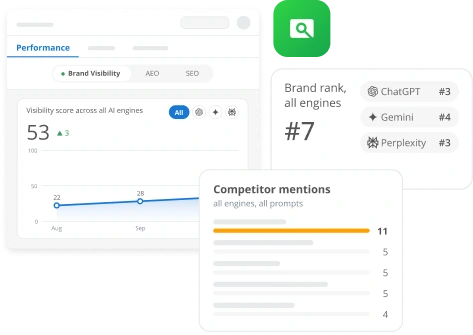
- How agencies run it: Agencies use Partner Center to deploy AI Employees across the client portfolio and handle client orders, billing, invoices, and reporting, and account templates keep multi-location setups consistent. Each client logs into a white-label Business App that brings the CRM, unified inbox, and AI Employee management into one login.
- Pricing: There’s no subscription. Partners pick a plan with a monthly minimum, starting at $99 on Starter with no contract. The first month’s minimum is paid up front, and from the second month, every $1 of qualifying product spend counts toward it; if spend falls short, partners pay only the difference. Partners buy at wholesale and set their own retail prices, and the pricing page lists current plan minimums.
- Proof: Vendasta platform data shows early AI Workforce adopters saw a 39.2% lead conversion rate. Vendasta’s retention research found two-year retention is 30% with one product, rises by roughly 20 percentage points with a second, and reaches 80% with four.
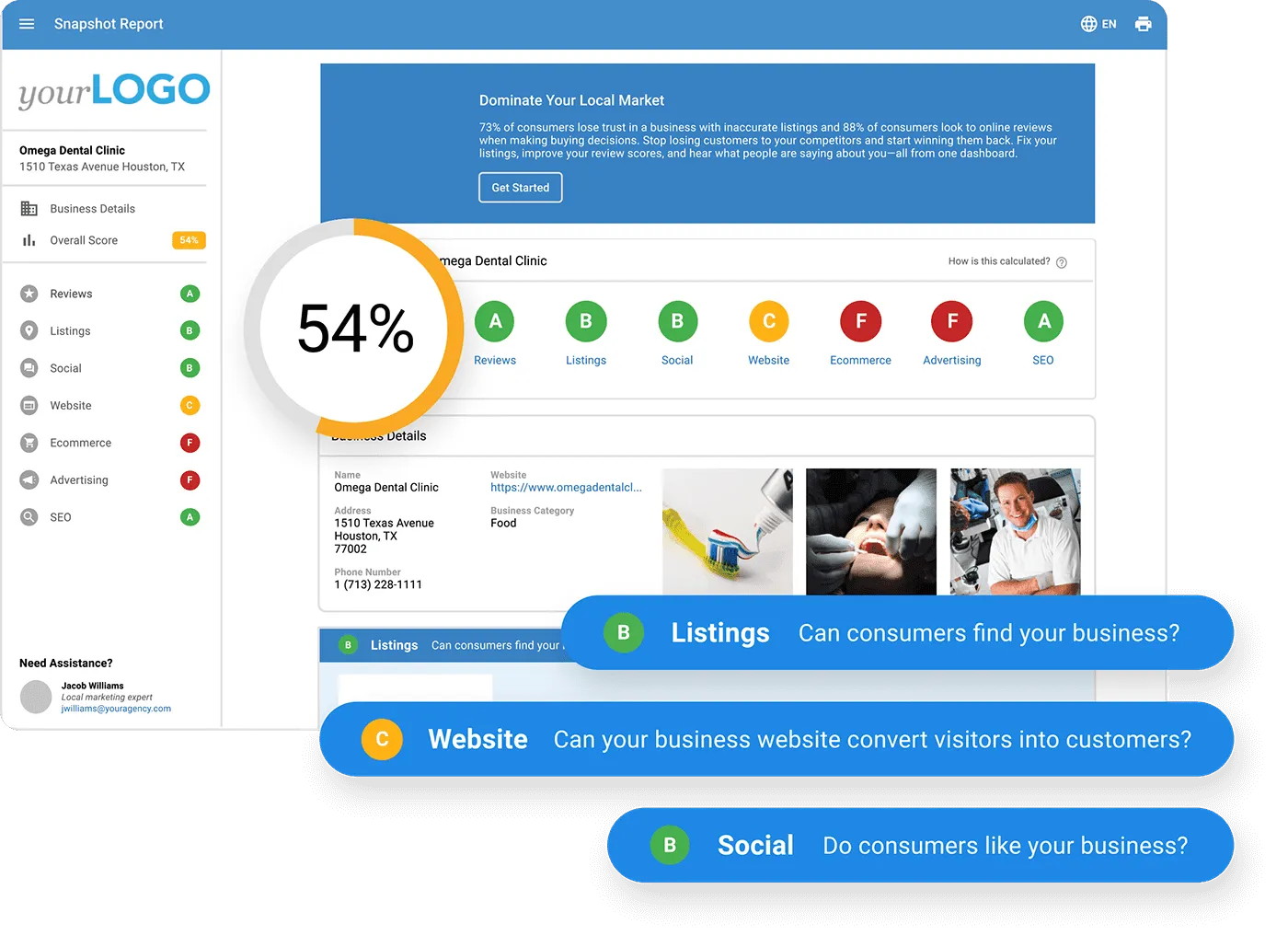
- Pros: The Snapshot Report scans a prospect’s online presence across 70+ directories and 30+ review sites and produces a brandable report for sales conversations. Integrations cover HubSpot, Zapier, Jobber, ServiceTitan, QuickBooks, and Google Business Profile, plus Model Context Protocol (MCP) support.
- Cons: The platform is built for local business clients, not enterprise B2B accounts. Plan minimums apply even in light-spend months.
For agencies whose margin depends on reselling services, the Vendasta AI Workforce scored highest on white-label options and multi-client support.
Best Budget Option: Zapier
Zapier suits smaller agencies that need to connect client apps cheaply and run internal operations. It ranks among the most familiar task automation tools, and its free tier lowers the cost of testing.
- What the AI does: Copilot is available on every plan, including Free. AI by Zapier steps cost 1x, 3x, or 5x tasks per run depending on model tier, plus the same rate for each tool call, and Agents is a separate add-on measured in activities.
- Ideal agency size: Teams of up to 25 people automating internal work or a modest number of client workflows.
- Starting price: The free plan includes 100 tasks a month for one user. Professional starts at $19.99 a month for 750 tasks, and Team starts at $69 a month for 2,000 tasks and up to 25 users.
- Pros: Tables, Forms, and MCP access are included on every plan, and triggers plus built-in steps like Filter and Formatter don’t count as tasks.
- Cons: Zaps, AI steps, and code draw from one shared task allocation. Pay-per-task overage costs 1.25x your plan’s base task rate and caps at three times the plan limit. Zapier’s White Label program is in limited access and built for embedding automation in software products, not agency resale.
Zapier works best as plumbing for agency automation, with task budgets monitored per client before overage charges arrive.
Other Options We Considered
The tools below cover narrower agency jobs and scored well within them. None led our overall scoring, but each solves a specific delivery problem better than a general platform does, so most agencies end up running one or two of them alongside a core platform.
Read each category against the services you already sell. An SEO-led agency will get more from an AI visibility tracker than from a content tool, while an agency that reports monthly to dozens of clients will feel per-client reporting fees first. Pricing models vary widely here, from per-seat to per-domain to per-data-source, so model the cost at your current client count and again at double it.
For tools aimed at in-house marketing teams rather than agencies, see our guide to AI marketing tools for marketers.
Content Production Across Client Brands
Jasper Pro costs $59 per seat a month billed yearly ($69 monthly), includes two Brand Voices, and lets agencies create separate projects for each client. ChatGPT Business costs $20 per user a month billed annually ($25 monthly) with a two-seat minimum, but the OpenAI pages we reviewed did not list a brand voice feature.
Agencies often run several of these side by side. Digiday’s reporting on agency AI bills says Dept’s AI toolkit spans Claude, ChatGPT, and Google to account for varying client preferences.
If social content is the bottleneck, compare these against tools built to manage multiple social media accounts.
SEO and AI Search Visibility
Peec AI offers the clearest agency pricing in this category. Its agency pricing page lists Essential at $245 a month for three live client projects, Growth at $495 for 10, and Scale at $795 for 25, all with unlimited team and client users. Semrush’s pricing page lists its AI Visibility Toolkit at $99 a month per domain, billed annually, and Otterly’s published pricing lists Standard at $189 a month with unlimited workspaces.
Ahrefs’ published pages list Brand Radar at $199 a month per AI index or $699 for all platforms. Search Engine Land’s measurement framework notes these tools report very different counts for the same brand on the same day, so treat them as trend lines rather than absolute counts.
For local search work, SEO AI combines listings sync, local rank tracking on a map grid, and the AI Search Specialist, which checks whether ChatGPT, Gemini, and Perplexity recommend a client over its competitors and drafts website fixes and content for approval. Those website changes run end to end on Vendasta-hosted WordPress sites.
Client Reporting
Reporting tools are priced in three different ways. AgencyAnalytics charges $20 per client a month billed annually, including a white-labeled client portal and AI summaries. Swydo starts at $69 a month ($62 billed annually) with 10 data sources included and charges per data source after that, while DashThis starts at $44 a month billed yearly for three dashboards, with basic AI Insights included.
For agencies selling several services, Vendasta’s Executive Report rolls activity across services into one client view.
Choose the model that tracks how you report digital marketing performance to clients. Per-client pricing suits large client lists with few accounts each, and per-source pricing suits smaller lists with many ad accounts.
Lead Handling and Reputation
GoHighLevel’s AI Employee Unlimited plan costs $97 a month per sub-account, and its pricing FAQ says agencies on the Unlimited and $497 plans can rebill AI usage to clients, often with a markup. Retell charges $0.07 to $0.31 per voice minute on its pay-as-you-go plan, with voice infrastructure, language model, and telephony costs that vary by setup.
On Vendasta, the AI Receptionist handles AI web chat, texts, and calls from one inbox, which keeps after-hours lead capture moving.
For reviews, compare reputation management software with an AI Reputation Specialist against other AI review tools on how much of the reply workflow they automate.
Review response automation works only when review and reputation monitoring covers every source a client cares about.
Automation and Engagement Platforms
These platforms suit agencies that need deeper or cheaper automation than a task-based model allows:
- Make: Make’s comparison page lists Core at $9 a month and Team at $29, both starting at 10,000 credits a month.
- n8n: Starter costs $20 a month billed annually for 2,500 executions. Each workflow run counts as one execution regardless of step count, and the self-hosted Community Edition is free.
Vendasta’s automations cover no-code workflows across the customer journey inside the platform.
How to Choose
Pick the tool that matches what your agency already sells, then confirm data, consent, and review steps before any rollout.
Most failed rollouts trace back to one of two mistakes: buying a tool for a service the agency doesn’t sell yet, or switching on automation before client data and consent are in order. Both are cheaper to prevent than to fix after a client notices.
The four checks below cover agency type, AI versus rule-based automation, data and privacy, and a 30-day pilot. Work through them in order, since each one narrows the shortlist for the next.
Match Tools to Your Agency Type
Your core specialty decides where AI saves the most hours:
- SEO-led agencies: Start with an AI visibility tracker such as Peec AI or Semrush, then add review and listings automation that feeds the same rankings.
- Web-led agencies: Pair AI-driven web design tools with lead capture, since a site that converts after hours is easier to retain.
- Paid media-led agencies: Prioritize lead handling and reporting, because missed calls waste the ad spend you manage across marketing channels.
Write the tool choice into your marketing strategies for each client tier so staff know which accounts get which automation.
Pair it with a plan for how to get more clients so new capacity turns into new revenue.
Decide Where AI Beats Rule-Based Automation
MarTech’s use-case guide describes rules-based automation as fixed if/then workflows that run the same steps whenever conditions are met.
AI agents interpret context and choose the next step, which helps with lead qualification and review replies but adds risk; Vendasta calls its purpose-built roles AI Employees.
The failure rate is high. A Gartner press release predicts over 40% of agentic AI projects will be canceled by the end of 2027 because of escalating costs, unclear business value, or inadequate risk controls. The same release advises using agents where decisions are needed, automation for routine workflows, and assistants for simple retrieval.
Start with marketing AI use cases where the decision is narrow and the output is easy to check, and judge any AI software on whether it logs every action.
Check Data, Consent, and Human Review
Clean CRM records come first. Gartner’s guidance for sellers recommends fixing CRM hygiene and keeping manager review of AI outputs until trust is established. It found 66% of sales leaders report low trust in AI-generated insights within their organizations, which is why one messy client CRM can sink a pilot.
Consent rules apply to AI calls and texts. The Federal Communications Commission’s (FCC) declaratory ruling confirms AI-generated voices count as artificial voices under the Telephone Consumer Protection Act (TCPA), so calls need prior express consent unless an emergency purpose or exemption applies.
In California, the California Privacy Protection Agency’s (CPPA) announcement says businesses that use automated decision-making technology to make significant decisions must comply with the new rules beginning January 1, 2027.
In the European Union (EU), the European Commission’s FAQ says that from 2 August 2026, providers must design chatbots so people are informed they are interacting with AI, unless that is obvious.
In Canada, Canada’s Anti-Spam Legislation (CASL) requires express or implied consent before businesses send commercial electronic messages such as marketing texts and emails.
Build these checks into client communication templates, and map each client’s data flows with an AI integration plan before launch.
Run a 30-Day Pilot
A pilot needs a baseline and a decision rule. In Moore Kingston Smith’s survey, 48% of respondents said AI lets agencies take on more work without increasing headcount, and the same survey links AI to client pricing pressure. Prove the capacity gain before clients ask for the discount:
- Pick one job, such as lead handling or review responses, and three to five clients.
- Record the prior 30 days: speed to lead, missed calls, cost per lead, booked appointments, hours spent per client, and content output.
- Fix CRM fields, confirm consent lists, and assign one human reviewer.
- Run the tool for 30 days with approval on client-facing output.
- Compare against the baseline, then scale, adjust, or stop.
MarketingProfs’ pilot guidance says to write out the production threshold before the next stakeholder review: the specific conditions under which a pilot becomes a workflow, backed by evidence from people who would use it without hand-holding and a named person with the authority to make the call.
To see how the Vendasta AI Workforce can take over review replies, lead capture, and content across your client portfolio under your agency’s brand, book a Vendasta demo.
Best AI Tools for Agencies FAQs
1. How can an agency add new services without hiring specialists?
Put AI on repeatable delivery work such as review responses, after-hours lead capture, social posting, and monthly reporting, and keep people on strategy and client judgment calls. In Moore Kingston Smith’s survey, 48% of respondents said AI lets agencies take on more work without increasing headcount. Start with one service and measure the hours it saves.
2. Will my clients see the vendor’s brand on AI tools?
That depends on the vendor. HubSpot doesn’t offer a white-label edition, so clients work in HubSpot-branded software, and Zapier’s White Label program is in limited access and built for software products. Vendasta, Semrush (through its Pro Report add-on), and AgencyAnalytics offer white-label or branded client views, but branding depth differs across logins, reports, emails, and domains, so check each one separately.
3. What do AI tools for agencies cost, and where is the margin?
Costs run from Zapier’s free plan to HubSpot Marketing Hub Enterprise at $3,600 a month before its $7,000 onboarding fee. Margin comes from tools you resell: Vendasta partners buy at wholesale and set their own prices. Vendasta’s pricing page lists current plan minimums.
4. Can one platform replace a stack of six to eight tools?
One platform can cover CRM, lead handling, reviews, listings, social, and reporting for local business clients, which removes separate contracts and billing. Specialized needs may still call for a dedicated tool, such as an AI visibility tracker for SEO-led work. Map each current tool to a client deliverable before you cancel anything.
5. How do AI agents differ from traditional marketing automation?
Traditional automation runs fixed if/then rules and repeats the same steps every time. AI agents interpret context and choose the next action, which suits lead qualification and review replies; Vendasta calls its purpose-built roles AI Employees. Gartner advises using agents where decisions are needed and automation for routine workflows, and it predicts over 40% of agentic AI projects will be canceled by the end of 2027 over cost, unclear value, or weak risk controls.
6. Do these AI tools integrate with the CRM my agency already uses?
Most do, with varying depth; Zapier connects apps, though its task billing can raise costs as client workflows multiply. Vendasta integrates with HubSpot, Zapier, Jobber, ServiceTitan, QuickBooks Online, and Google Business Profile, and supports Model Context Protocol (MCP). Check whether AI actions write back to the CRM automatically or need a manual export, since that decides reporting effort.
7. What client data should be in place before deploying AI?
Clean CRM records, consented contact lists, working call and form tracking, and one unified data source per client. Gartner recommends fixing CRM hygiene and grounding AI in high-quality data, and it found 66% of sales leaders report low trust in AI-generated insights. Keep human review on outputs until results hold steady.
8. What privacy and consent rules apply to AI calls and texts?
The FCC requires prior express consent for AI-voice calls, subject to emergency purposes or exemptions. California’s automated decision-making rules cover significant decisions from January 1, 2027, and EU AI Act chatbot disclosure obligations apply from 2 August 2026. Canada’s CASL requires express or implied consent for commercial texts and emails.
9. Does bundling more AI services improve client retention?
Vendasta’s retention research, based on 200,000 client relationships, found two-year retention is 30% with one product, rises by roughly 20 percentage points with a second, and reaches 80% with four. For agencies, each added service that a client uses daily makes the relationship harder to replace, which protects monthly recurring revenue.
10. How should an agency run a 30-day AI pilot?
Choose one job and three to five clients, then record a 30-day baseline for speed to lead, missed calls, cost per lead, booked appointments, hours per client, and content output. Run the tool with human approval, compare the results, and decide using a threshold you wrote down before the pilot started.