About Us
 Careers
 Leadership
 Board
Board Newsroom
Lead generation for marketing agencies has never been more competitive — or more consequential. If your agency is still relying on cold calls, referral luck, and manual outreach to fill your pipeline, you’re already falling behind.
Meanwhile, competitors are deploying AI-powered systems, automated nurture sequences, and scalable inbound strategies that generate qualified prospects around the clock.
The hard truth? Most agencies are brilliant at generating leads for their clients but struggle to build a reliable pipeline for themselves. Every new client win requires more hiring, more fulfillment effort, and thinner margins. Something has to give.
The solution is a modern, scalable lead generation system built specifically for how agencies grow, combining inbound content, outbound automation, account-based marketing, and AI-powered tools that do the heavy lifting without adding headcount.
This guide breaks down exactly how to generate leads for a digital marketing agency in 2026, from strategy to execution.
Find, nurture, and convert prospects that are ready to buy
TL;DR
- Manual outreach doesn’t scale. Agencies relying on referrals and cold outreach face eroding margins as every new client demands more staff. A systematic lead generation engine fixes this.
- The best agencies combine inbound and outbound. Content marketing, SEO, LinkedIn ABM, lead magnets, and paid ads work together to fill your pipeline predictably.
- AI is the multiplier. Vendasta gives agencies AI employees that automate lead capture, follow-up, and client communication, letting you scale revenue without scaling headcount.
Why Lead Generation for Digital Marketing Agencies Is a Unique Challenge
It sounds ironic: agencies that drive lead generation for dozens of clients often find it the hardest to grow their own business.
The reason is structural. When you are focused on client delivery, business development falls to the bottom of the to-do list. And when you do pursue leads, every new client adds operational complexity, which means another hire, another onboarding, and slimmer margins.
Nearly half of B2B professionals say generating enough leads to meet sales targets is a real challenge. For agencies specifically, the pressure is doubled because growth itself becomes a cost center.
Using marketing automation software can increase qualified leads by as much as 451%. That stat alone makes the case for moving beyond purely manual outreach.
The agencies winning in 2026 are those that treat their own business as a client and build repeatable, automated systems to attract, qualify, and convert prospects at scale.
What Is a Lead Generation System for a Marketing Agency?
A lead generation system is not a single tactic. It is the combination of your positioning, content, outreach, nurture sequences, and conversion tools working together in a repeatable process.

For a digital marketing agency, an effective system typically includes:
- A clearly defined niche and ideal client profile (ICP)
- An inbound content engine (SEO, blog, lead magnets)
- Outbound prospecting (cold email, LinkedIn, ABM)
- Paid acquisition (Google Ads, LinkedIn Ads, Meta Ads)
- A CRM and automation layer to track and nurture leads
- AI-powered tools that handle follow-up, scheduling, and communication
When these elements work together, AI lead generation becomes predictable rather than reactive.
Step 1: Define Your Ideal Client Profile and Niche
The fastest way to improve lead quality is to get specific about who you serve.
Agencies that say “we do everything for everyone” attract no one. Agencies that say “we help multi-location healthcare practices grow review volume and patient acquisition” attract the exact right prospects.
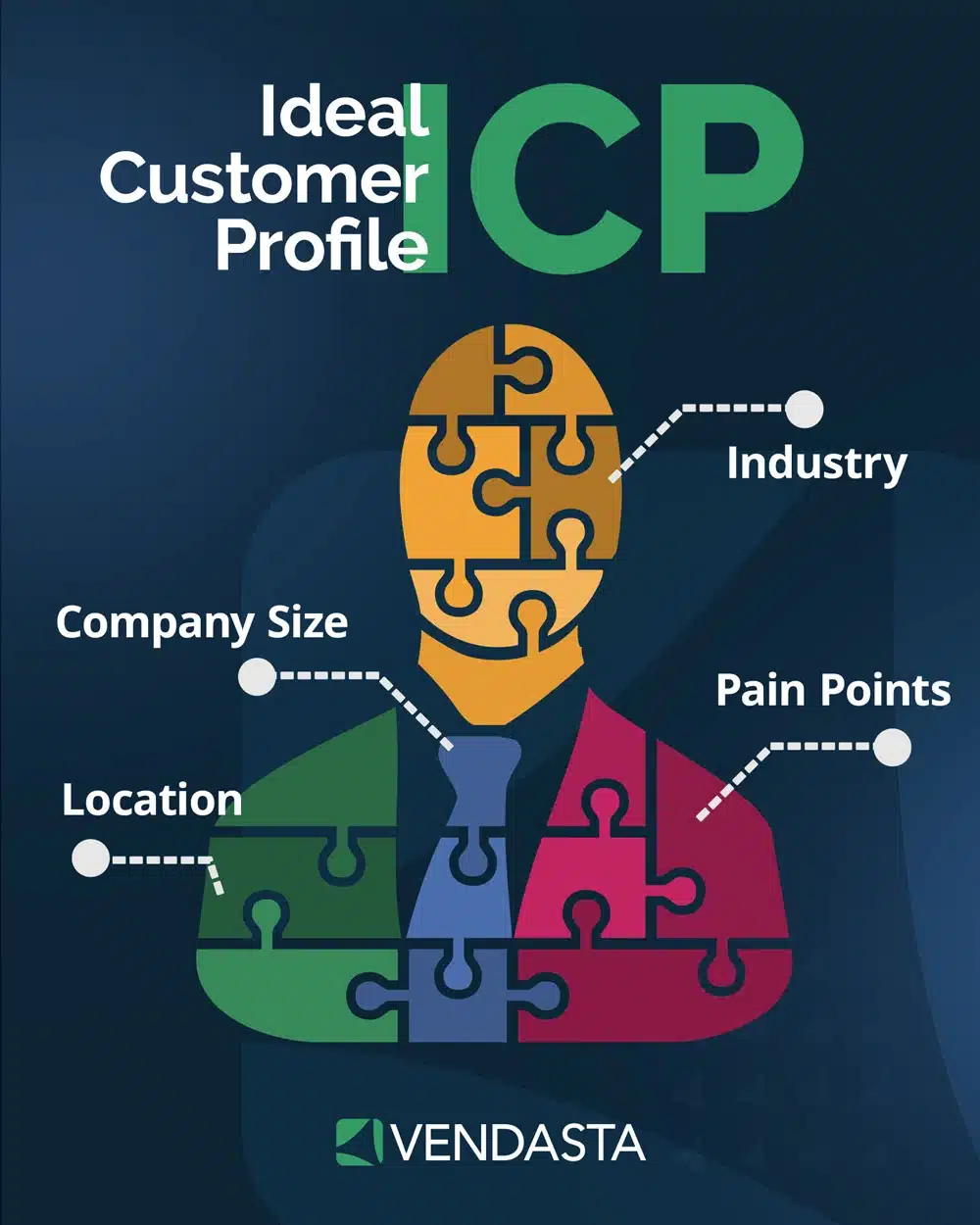
Your ICP should include:
- Industry and sub-vertical
- Company size and revenue
- Geography
- Business model (local SMB, franchise, ecommerce, etc.)
- Specific pain points and goals
Equally important: build buyer personas for the actual decision-makers you’re trying to reach. For most agencies serving SMBs, that is the owner, CEO, or founder, someone who is problem-aware, budget-conscious, and deeply skeptical of agency promises they have heard before.
Nine in ten decision-makers are more receptive to agencies that consistently produce high-quality, insight-rich content. That means your positioning and content need to speak directly to your ICP’s real concerns, not generic marketing platitudes.
Pro tip: Add a “Who we’re NOT a fit for” section to your website or proposal process. It filters out bad-fit prospects early and signals confidence to serious buyers.
Step 2: Build an Inbound Engine With Content Marketing
Content marketing is the most durable and cost-effective long-term lead generation strategy for digital agencies. It builds trust before the first conversation, attracts pre-qualified prospects, and compounds in value over time.
78% of B2B marketers said they achieved their goal of generating leads through content marketing.
What Type of Content Works Best?
The highest-performing content for agencies typically includes:
- Case studies with specific results: Before/after metrics, named clients (when permitted), and a clear narrative about the problem solved
- Long-form SEO blog posts: Targeting high-intent keywords your ideal clients are searching (e.g., “how to get more Google reviews for my restaurant”)
- Thought leadership articles: Positioning your agency’s perspective on trends, strategy, or industry challenges
- Lead magnets: Downloadable guides, checklists, templates, or calculators that attract prospects in exchange for contact information
- Video content: Walkthroughs, explainers, and testimonials that humanize your brand and build credibility fast
SEO as a Lead Generation Channel
Leads from organic search conversions result in 14.6% close rates, significantly higher than most outbound channels. That makes SEO one of the highest-ROI investments for long-term agency growth.
Focus your SEO strategy on:
- Service pages optimized for transactional keywords (e.g., “social media marketing agency for restaurants”)
- Blog content targeting informational and bottom-of-funnel queries
- Local SEO if you serve a specific geographic market
- Long-tail keyword targeting, which captures high-intent searchers closer to a buying decision
Long-tail keywords typically yield higher conversion rates because they align closely with user intent. For agencies, this means writing for specific niches and specific problems rather than trying to rank for broad, competitive terms.

What Is the 3-3-3 Rule in Marketing?
The 3-3-3 rule in marketing is a messaging framework that focuses strategy around three core elements: three key messages about your brand or services, delivered through three primary marketing channels, to three stages of the buyer’s journey. Its purpose is to reduce complexity, improve brand recall, and increase campaign effectiveness through disciplined focus and structured repetition.
The framework works because it aligns with how audiences actually process information. People encounter thousands of marketing messages daily and have limited attention spans. By organizing messaging into three focused pillars and repeating them strategically across three touchpoints, you reduce cognitive overload and strengthen brand positioning without increasing budget or complexity.
The three components break down as follows:
- Three core messages: Identify the three strongest differentiators of your agency or the three most compelling benefits you deliver. Every piece of content, every pitch, and every ad should reinforce these three pillars consistently — not a different claim every month.
- Three primary channels: Rather than spreading thin across every platform, the 3-3-3 rule directs you to identify and dominate three channels where your ideal clients are most active. For most agencies targeting SMBs, this typically means a combination of owned media (blog, email), earned media (SEO, reviews), and paid media (LinkedIn Ads, Google Ads).
- Three stages of the buyer’s journey: Awareness (attracting the right audience), consideration (capturing interest and building trust), and conversion (turning qualified prospects into paying clients). Your messaging and content should be intentionally mapped to each stage rather than using the same approach throughout.
How the 3-3-3 rule applies to lead generation for agencies:
For a marketing agency building its own lead generation system, the 3-3-3 rule provides a useful constraint that forces strategic focus. Instead of trying to publish on every platform or communicate every service you offer, it asks: what are the three things we want every prospect to know about us, where are the three places they spend time online, and how do we meet them at each stage of their decision process?
Applied practically, an agency might build its lead generation system around three messages (results-focused, niche expertise, AI-powered delivery), three channels (LinkedIn, SEO blog, email nurture), and three buyer stages (educational content for awareness, case studies for consideration, free audits for conversion). That structure is more likely to create a consistent, memorable impression than a scattered approach across ten channels with ten different messages.
Step 3: Create High-Converting Lead Magnets
A lead magnet is a free, high-value resource you offer in exchange for contact information. It is one of the most effective ways to turn anonymous website visitors into identifiable prospects you can nurture.
The best lead magnets for agencies are highly specific and immediately actionable.
| Lead Magnet Type | Example for an Agency | Why It Converts |
| Checklist | “12-Point Local SEO Audit for Restaurants” | Fast to consume, shows expertise |
| Ebook | “The Agency Owner’s Guide to Scaling Without Hiring” | Speaks to a core pain point |
| Template | “Client Reporting Template That Takes 20 Minutes” | High practical value |
| Webinar | “How to Sell AI Marketing Services to SMBs” | Builds authority and relationship |
| Free Audit | “Free 15-Minute Website Conversion Audit” | Creates a direct sales conversation |
| Calculator | “What Is Your Client Churn Costing You?” | Personalized, data-driven insight |
The specificity of your lead magnet matters more than the format. “Facebook Ads Checklist for Local Gyms” will outperform “Digital Marketing Checklist” every time because it speaks to a defined audience with a defined need.
Important: Keep your opt-in form short. Name, email, and one qualifying question is enough. Every additional field reduces conversion rates.
Step 4: Master Account-Based Marketing (ABM) for Agency Growth
Account-based marketing flips the traditional lead generation funnel. Instead of casting a wide net and hoping qualified prospects find you, ABM identifies specific high-value target accounts and builds tailored outreach designed for them.
For agencies, ABM is particularly powerful because your sales cycle is relationship-driven and your ideal clients are often a concentrated, identifiable group.
According to Gartner, ABM provides a 28% increase in overall account engagement and a 25% rise in the marketing-qualified lead to sales-accepted lead conversion rates.
How to Run ABM as an Agency
Step 1: Build your target account list
Use LinkedIn Sales Navigator, Apollo, or similar tools to identify companies that match your ICP. Filter by industry, size, geography, and signals like recent funding, hiring activity, or new leadership.
Step 2: Research each account deeply
Review their current marketing presence: their website, reviews, social media, and online visibility. Identify the gaps your agency can fill.
Step 3: Personalize your outreach
Generic pitches get deleted. Reference something specific about their business: a gap in their Google review response strategy, a slow-loading landing page, or an opportunity in a channel they are not using.
Step 4: Use multi-channel sequences
Combine LinkedIn connection requests, personalized emails, and retargeting ads to stay visible across touchpoints.
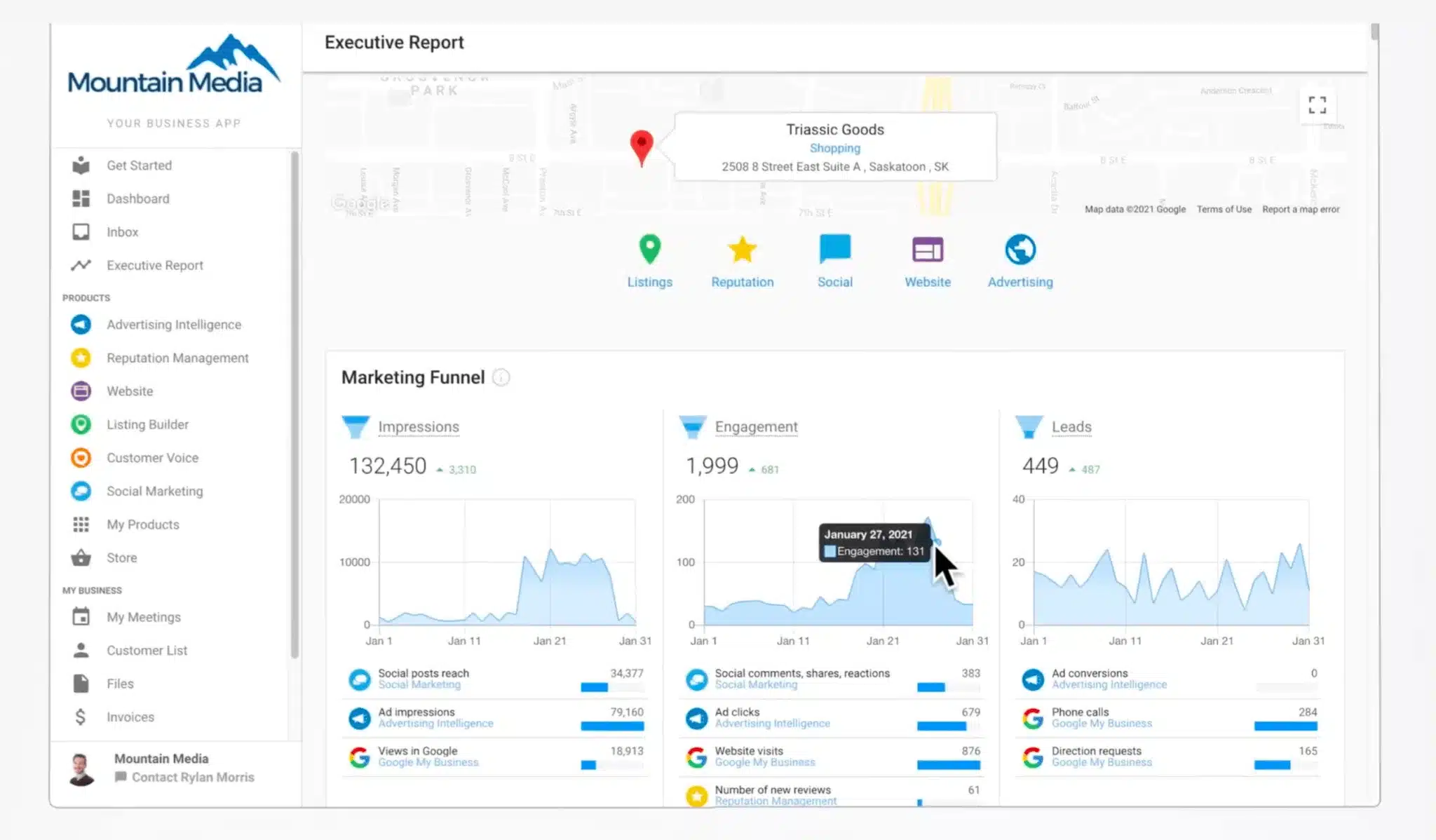
Step 5: Track engagement
Use your CRM to monitor which accounts are opening emails, visiting your site, and engaging with your content. Prioritize follow-up based on intent signals.
75% of decision-makers say a single piece of compelling thought leadership prompted them to research a service they weren’t previously considering. Combine ABM outreach with strong content, and you warm up accounts before the first direct conversation.
Step 5: Use Paid Advertising to Accelerate Pipeline
Organic strategies build long-term momentum. Paid advertising accelerates it.
For lead generation for digital marketing agencies, the most effective paid channels are:
Google Ads
Google Ads captures people who are already actively searching for agency services. These are high-intent users who have identified a need and are evaluating solutions.
Focus your Google Ads strategy on:
- Transactional keywords (“digital marketing agency for [niche]”)
- Problem-aware keywords (“how to get more leads for my restaurant”)
- Competitor comparison terms
Use lead form extensions to reduce friction and capture contact information directly within the search result.
LinkedIn Ads
LinkedIn is the premier B2B platform for agency lead generation. 89% of B2B marketers use LinkedIn for lead generation efforts, and its targeting capabilities, by job title, company size, industry, and seniority, make it ideal for reaching agency decision-makers.
LinkedIn Lead Gen Forms are particularly effective because users can submit their information without leaving the platform, reducing drop-off.
90% of B2B marketers using LinkedIn Lead Gen Forms lowered their cost per lead by reducing friction.
Meta Ads (Facebook and Instagram)
Meta’s advertising platform is powerful for creating demand among audiences who may not be actively searching but fit your ICP. Use Facebook and Instagram to:
- Promote lead magnets and webinars
- Retarget website visitors with case studies or testimonials
- Build lookalike audiences based on your best existing clients
Facebook and Instagram are tied as top social platforms for marketing ROI at approximately 29% each.
Retargeting as a Conversion Multiplier
Most website visitors do not convert on their first visit. Dynamic retargeting ads re-engage people who have already shown interest, keeping your agency top of mind as they move through their buying journey.
Retargeting works best when the ads are sequenced: start with a case study or credibility piece, then follow up with a direct offer or free consultation.
Step 6: Build a Lead Nurture System That Converts
Getting a lead into your database is just the beginning. Most prospects are not ready to buy immediately, and without a structured nurture process, those leads go cold.

73% of B2B buyers say good thought leadership makes them willing to pay a premium to work with a firm. That premium starts being earned in the nurture phase, through consistent, relevant communication that builds trust over time.
Email Nurture Sequences
Email remains one of the highest-performing nurture channels. Nearly three-quarters of B2B buyers say email is their preferred way of hearing from sellers.
A strong agency nurture sequence typically follows this structure:
- Day 0: Welcome email with the promised lead magnet and a brief introduction to your agency
- Day 2: Value email sharing a relevant case study or insight specific to their industry
- Day 5: Educational email addressing a common pain point with practical advice
- Day 10: Social proof email featuring a client testimonial or results breakdown
- Day 14: Soft offer inviting them to book a free consultation or audit
Segment your list by industry, service interest, or company size so that the content stays relevant. Segmented email campaigns drive 30% more opens and 50% higher click rates than non-targeted batches.
Lead Scoring
Not all leads are equal. Lead scoring assigns values to prospect behaviors (opening emails, visiting pricing pages, downloading resources) so your sales team focuses effort on the highest-intent prospects first.
A basic lead scoring model might look like this:
| Behavior | Points |
| Downloads a lead magnet | +10 |
| Opens 3+ emails | +5 |
| Visits pricing page | +15 |
| Books a discovery call | +25 |
| Visits homepage only, no engagement | +2 |
Leads above a defined threshold get flagged for direct outreach. Everyone else stays in the automated nurture flow.
Step 7: Leverage Cold Email and LinkedIn Outreach
Inbound takes time to build. Cold outbound provides a faster path to the pipeline when executed correctly.
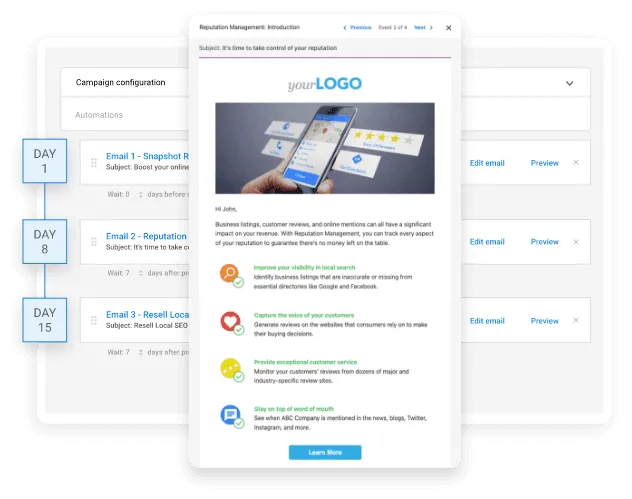
Cold email in 2026 works best as a highly personalized, research-driven process, not spray-and-pray blasting.
Cold Email Best Practices
- Build targeted lists based on your ICP using tools like Apollo, Hunter, or LinkedIn Sales Navigator
- Keep emails short: three to five sentences, one clear ask
- Reference something specific about the recipient’s business
- Use low-pressure CTAs (“Worth a quick look?” or “Open to a 15-minute call?”)
- Send a follow-up sequence of two to three emails over two weeks
- Protect deliverability by warming up your domain and maintaining proper SPF, DKIM, and DMARC records
LinkedIn Outreach
LinkedIn outreach works particularly well for agency business development because it happens in a professional context where decision-makers are already receptive.
Best practices for LinkedIn outreach:
- Connect with a personalized note referencing something specific about their profile or company
- Share valuable content (your articles, case studies) before making any pitch
- Use voice or video messages to stand out in a text-heavy environment
- Move high-interest conversations to email or a discovery call
Combine cold email and LinkedIn into a coordinated sequence where each touchpoint references the others. This multi-channel approach significantly increases response rates compared to single-channel outreach.
Step 8: Build and Optimize Your Lead Generation Funnel
All of these tactics need to connect into a unified funnel with clear stages, conversion metrics, and optimization loops.
Here is a straightforward lead generation funnel framework for agencies:
Stage 1: Awareness
Goal: Attract the right people to your brand.
Channels: SEO blog content, social media, YouTube, podcast appearances, LinkedIn thought leadership, paid ads
Metric: Traffic, impressions, reach
Stage 2: Consideration
Goal: Capture interest and contact information.
Channels: Lead magnets, webinars, free audits, newsletter sign-ups, gated content
Metric: Lead volume, cost per lead, opt-in rate
Stage 3: Evaluation
Goal: Nurture leads toward a buying decision.
Channels: Email sequences, retargeting ads, case studies, testimonials, direct outreach
Metric: Email engagement rate, MQL rate, booking rate
Stage 4: Conversion
Goal: Convert qualified leads into paying clients.
Channels: Discovery calls, proposals, free audits
Metric: Lead-to-client conversion rate, sales cycle length, average deal value
Stage 5: Retention and Referral
Goal: Retain clients and generate referrals.
Channels: Onboarding experience, monthly reporting, proactive communication, referral incentives
Metric: Client retention rate, NPS score, referral volume
Here’s an infographic illustrating the calculation of client retention rate.

Build dashboards to track these metrics by stage. Identify where leads are dropping off and test improvements at each bottleneck.
Step 9: Use Referral Marketing to Compound Growth
Referral marketing is one of the highest-ROI lead sources available to agencies because trust is already pre-established.
Referred customers have a higher lifetime value of around 16%, and 37% higher retention.
To build a systematic referral program:
- Ask satisfied clients directly and make it easy (“Do you know anyone who could benefit from what we’ve done for you?”)
- Create a formal referral structure with clear incentives (service credits, cash rewards, or co-marketing opportunities)
- Make the referral ask part of your standard client review process, not a one-off conversation
- Ask partners, vendors, and complementary service providers (accountants, web developers, consultants) to refer clients to you
The key distinction between hoping for referrals and generating them systematically is the process. Make it repeatable, and referrals become a predictable pipeline source.
How AI Is Transforming Lead Generation for Digital Marketing Agencies
Artificial intelligence is not a future trend for agency lead generation. It is a present-day competitive advantage for agencies that adopt it early.

85% of marketing leaders believe generative AI will substantially transform their content creation. But the opportunity goes far beyond content. AI is reshaping how agencies capture, qualify, nurture, and convert leads.
AI for Lead Capture and 24/7 Availability
One of the most impactful applications of AI for agencies is automated lead capture. An AI receptionist or chat agent on your website can engage visitors in real time, qualify them with pre-set questions, and schedule discovery calls, all without human involvement.
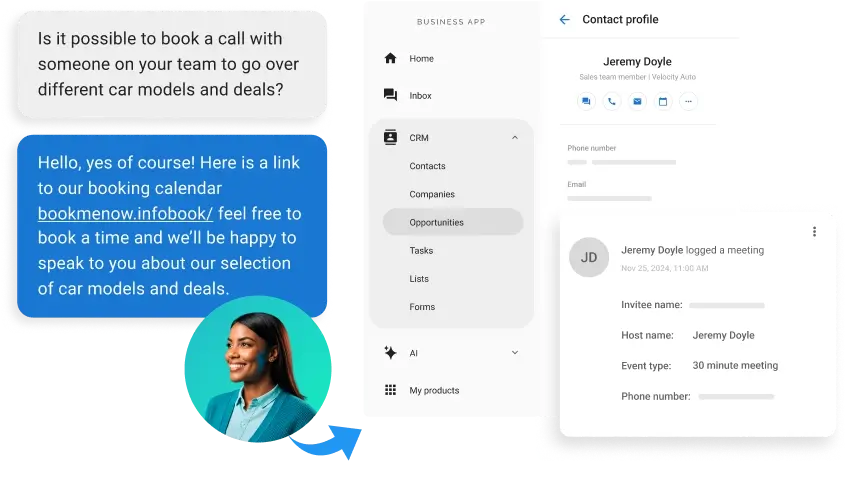
This matters because most website visitors arrive outside business hours. Without an AI system to capture and respond to those visitors, you are leaving a pipeline on the table every single night.
AI for Follow-Up and Nurture
Speed to lead is one of the most important factors in lead conversion. Studies show that leads contacted within five minutes of submitting a form are dramatically more likely to convert than those contacted hours later. AI-powered follow-up sequences ensure that no lead waits, regardless of when they submit or what time zone they are in.
AI for Qualification
AI can analyze lead behavior, responses, and demographic data to score and prioritize prospects automatically. This means your sales team spends time on the leads most likely to close, rather than manually sorting through every inquiry.
Can ChatGPT Do Lead Generation?
ChatGPT can support several parts of the lead generation process, but it cannot run lead generation autonomously. It is a research and writing tool, not an end-to-end lead generation system. Understanding what it does well — and where it falls short — helps agencies use it strategically without over-relying on it.
What ChatGPT does well for lead generation:
- Account research and personalization: ChatGPT can analyze a prospect’s website, LinkedIn profile, or recent content and generate personalized outreach angles at scale. Lead generation research identifies account research, outreach personalization, and qualification frameworks as the three areas where ChatGPT delivers genuine value in the sales process.
- Content creation for inbound: ChatGPT dramatically accelerates content production — blog outlines, email sequences, lead magnet drafts, LinkedIn posts, and ad copy. 93% of marketers now use AI to generate content faster, reducing the time cost of inbound lead generation significantly.
- Cold email and LinkedIn drafting: ChatGPT can generate hundreds of personalized outreach variations in the time it takes to write a handful manually, improving the volume and quality of outbound sequences when given specific prospect context.
- Lead qualification frameworks: It can help build scoring criteria, draft qualification questions for discovery calls, and analyze prospect responses to surface intent signals.
Where ChatGPT falls short for agency lead generation:
- It cannot find or verify contact data. ChatGPT hallucinates contact information and cannot reliably source real email addresses or phone numbers. Agencies using it for prospecting still need a verified data tool (Apollo, Hunter, LinkedIn Sales Navigator) for actual contact lists.
- It cannot act autonomously. ChatGPT is a prompt-response tool. It does not monitor your pipeline, follow up with leads automatically, respond to inbound inquiries at 2am, or update your CRM. Every output requires a human to prompt it, review it, and act on it.
- It does not integrate with your systems. ChatGPT has no native connection to your CRM, email platform, calendar, or lead capture tools. Workflows built around it require manual data transfer or separate automation layers.
ChatGPT vs. purpose-built AI lead generation tools:
The key distinction is between AI that assists and AI that acts. ChatGPT assists — it produces content and research when prompted. Purpose-built AI lead generation tools act — they engage website visitors in real time, qualify leads automatically, book appointments without human involvement, and follow up across SMS, chat, and email without waiting for a prompt.
For agencies building a scalable lead generation system, ChatGPT is a useful productivity layer for content and research tasks. But it cannot replace an always-on lead capture and follow-up system. Vendasta’s AI Receptionist and Conversations AI, for example, engage leads the moment they arrive — across phone, SMS, WhatsApp, and web chat — qualify them, and book discovery calls automatically, 24 hours a day. That is the difference between a writing assistant and an autonomous lead generation engine.
The most effective agency lead generation stacks in 2026 use both: ChatGPT for content production and outreach personalization, and purpose-built AI agents for real-time lead capture, follow-up, and conversion.
How Vendasta Helps Agencies Scale Lead Generation Without Adding Headcount
For agencies looking to operationalize everything above, Vendasta’s AI-powered platform provides the infrastructure to make it work at scale.
Vendasta is an AI customer acquisition and engagement platform built for SMBs and the agency partners who support them. For agencies, it delivers two compounding benefits: a platform to generate leads for your own business and a product suite to deliver AI-powered marketing services to your clients, creating a new recurring revenue stream without new fulfillment effort.
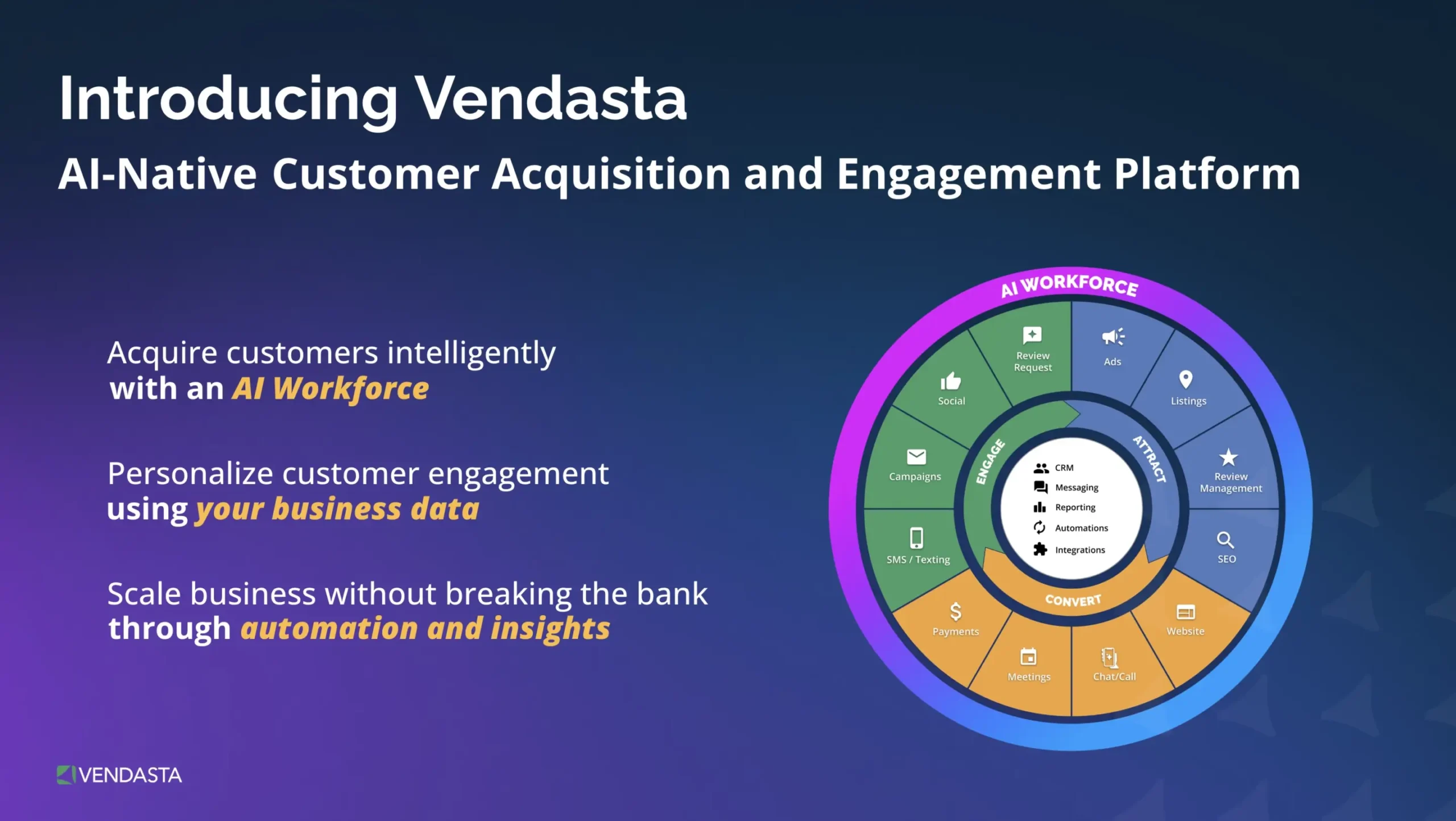
Vendasta Conversations AI
Vendasta Conversations AI is the intelligent engine powering a specialized AI workforce. Connecting across phone, SMS, WhatsApp, and web chat, it deploys AI employees that execute specific roles from first contact to final booking.

Key AI employees powered by Conversations AI include:
- AI Receptionist: Available 24/7 to capture leads, answer questions, and provide an excellent customer experience through chat and voice
- AI Inside Salesperson: Engages and qualifies prospects automatically across multiple channels
- AI Support Agent: Handles client questions and requests without human intervention

Vendasta’s data shows that Conversations AI drives a 372% increase in lead-to-revenue conversion. That is not a marginal improvement. That is a structural advantage for agencies willing to deploy it.
Vendasta CRM AI
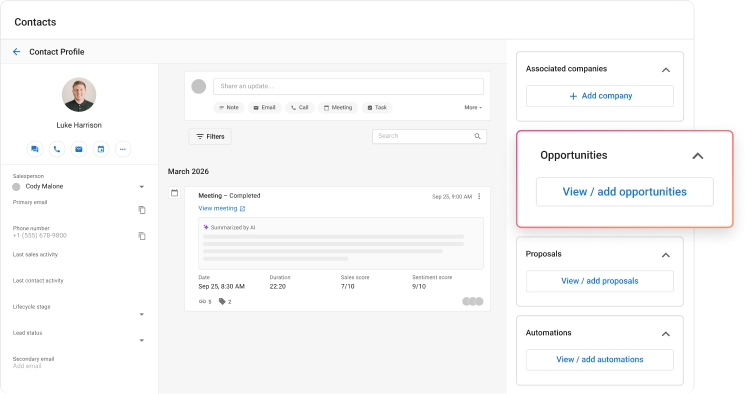
Vendasta CRM AI is a self-updating sales solution that captures sales conversations, automates data entry, and surfaces the insights your team needs to close deals. Its AI Sales Assistant automatically extracts meeting outcomes, updates records, and identifies upsell opportunities so your team focuses on selling, not administrative work.
Vendasta Reputation AI
Vendasta Reputation AI helps agencies build and manage online reputation at scale.
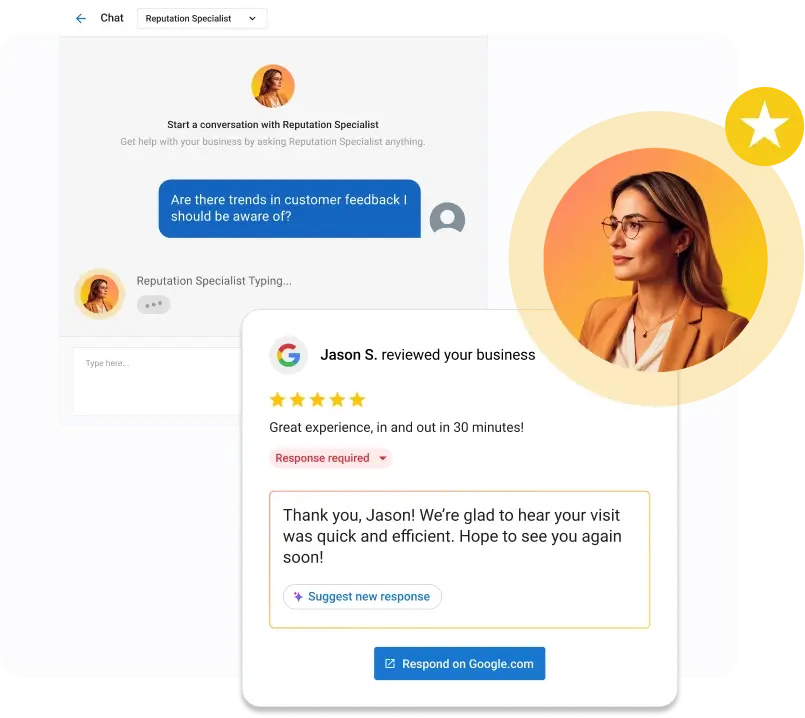
The AI Reputation Specialist automates review requests, generates personalized review responses, and surfaces insights that guide better client decisions, making reputation management a hands-free service line agencies can deliver and bill for.
The Bigger Picture: A New Revenue Stream
Beyond running your own lead generation more efficiently, Vendasta gives agencies the ability to resell AI-powered marketing products to their SMB clients. This turns traditional service fees into recurring revenue and creates a differentiated offer that competitors without AI infrastructure cannot match.
For agencies where every new client currently requires a new hire, Vendasta’s AI workforce model is the architecture that breaks that cycle.

Lead Generation Metrics Every Agency Should Track
You cannot improve what you do not measure. These are the essential metrics for managing a healthy agency lead generation system.
| Metric | What It Measures | Benchmark to Target |
| Monthly leads generated | Total pipeline volume | Depends on deal size and close rate |
| Cost per lead (CPL) | Efficiency of acquisition spend | Varies by channel; know your number |
| Lead-to-MQL rate | Quality of incoming leads | 20-30% is a healthy target |
| MQL-to-opportunity rate | Effectiveness of qualification | 40-60% for well-targeted outreach |
| Opportunity-to-close rate | Sales process effectiveness | 25-35% for agency services |
| Average deal value | Revenue per client | Track and look to grow over time |
| Customer acquisition cost (CAC) | Total cost to win one client | Should be less than 1/3 of first-year revenue |
| Client lifetime value (LTV) | Long-term revenue per client | LTV:CAC ratio of 3:1 or higher is healthy |
| Time to first conversion | Speed of your sales cycle | Shorter is better; track by channel |
Review these metrics monthly. When numbers deviate from expectations, diagnose by funnel stage to find the specific bottleneck.
Common Lead Generation Mistakes Agencies Make
Even agencies with strong capabilities make systematic errors in their own business development. Here are the most common ones to avoid.
- Targeting everyone: Without a defined ICP, your message resonates with no one. Specificity drives conversion.
- Neglecting their own marketing: Agencies that produce content only for clients and nothing for themselves have no SEO authority, no thought leadership, and no inbound pipeline. Treat your own business as a client.
- Relying entirely on referrals: Referrals are great, but they are not predictable. Build systematic lead generation that runs parallel to your referral network.
- Slow lead follow-up: There is no quicker way to lose a warm lead than slow follow-up. Automate your initial response so that every lead is acknowledged within minutes.
- No nurture system: Most leads are not ready to buy immediately. Without a nurture sequence, the majority of your leads go cold and never convert.
- Measuring the wrong things: Tracking impressions and traffic without tying them to pipeline and revenue leads to vanity metrics that do not reflect business health.
- Underinvesting in content: Agencies that do not invest in their own content miss the most scalable, durable, and cost-effective long-term lead channel available.
Build a Scalable Lead Engine for Sustainable Growth
Scaling your agency’s lead generation comes down to systems, not effort. When you combine clear positioning, consistent inbound strategies, targeted outbound, and automation, your pipeline becomes predictable instead of reactive. The real shift happens when AI takes over lead capture, follow-up, and qualification, helping you convert faster without adding headcount.
Agencies that invest in structured, AI-supported systems are seeing stronger pipelines, better margins, and shorter sales cycles. Instead of chasing leads, you build a process that brings the right prospects to you and moves them forward efficiently.
If you’re ready to move beyond manual outreach and create a system that scales with your growth, schedule a demo with Vendasta today and see how it can transform your lead generation.
Lead Generation for Digital Marketing Agencies: FAQs
1. What is lead generation for a marketing agency?
Lead generation for a marketing agency is the process of attracting and converting businesses that need marketing services into qualified prospects. It includes strategies like SEO, content marketing, paid ads, cold outreach, referrals, and AI-powered automation. The goal is a predictable pipeline of new clients without relying on luck or reactive outreach.
2. How do digital marketing agencies generate leads for themselves?
Agencies generate leads through a combination of inbound strategies (SEO content, lead magnets, webinars) and outbound tactics (cold email, LinkedIn ABM, paid ads). The most effective agencies combine both into a structured funnel with automated nurture sequences and CRM tracking. Platforms like Vendasta add AI automation that runs 24/7 lead capture and follow-up at scale.
3. What is the best lead generation strategy for a digital marketing agency?
There is no single best strategy. The most effective approach combines niche positioning, consistent content marketing, LinkedIn outreach, and paid acquisition backed by automation. Vendasta’s AI workforce platform helps agencies add AI-powered lead capture and client communication to this mix, compressing the sales cycle and increasing conversion rates significantly.
4. How do I generate leads for a digital marketing agency with a small team?
Automation is your best friend with a small team. Focus on high-ROI channels like SEO and email nurture, and use AI tools to handle lead capture, follow-up, and qualification automatically. Vendasta’s AI Receptionist and Conversations AI are specifically designed to give small agencies enterprise-level responsiveness without enterprise-level headcount.
5. How long does it take to see results from lead generation efforts?
It depends on the channel. Paid ads can generate leads within days. Cold outbound typically shows results within two to four weeks. Content marketing and SEO take three to six months to build meaningful momentum. Building all three channels in parallel gives you both short-term pipeline and long-term compounding growth.
6. What role does content marketing play in lead generation for digital marketing agencies?
Content marketing is the foundation of sustainable long-term lead generation. It establishes thought leadership, builds trust before the first sales conversation, improves organic search rankings, and attracts pre-qualified prospects who are already looking for what you offer. Research shows that 76% of B2B marketers achieve their lead generation goals through content marketing.
7. How do I qualify leads for my marketing agency?
Qualify leads using a combination of lead scoring (tracking engagement behaviors), qualification questions during initial contact or on opt-in forms, and structured discovery call frameworks. AI-powered tools like Vendasta’s AI Inside Salesperson can pre-qualify leads automatically before your sales team spends time on them.
8. Should a marketing agency buy leads or generate them organically?
Building organic and outbound lead generation systems delivers higher-quality leads, better cost efficiency, and stronger client fit over time. Buying leads can be a short-term tactic but typically results in lower conversion rates, potential compliance risks, and leads that are sold to multiple competitors simultaneously. Invest in building your own pipeline.
9. How does AI improve lead generation for digital marketing agencies?
AI improves lead generation by automating the time-sensitive and repetitive parts of the process: immediate lead response, qualification, follow-up sequences, appointment scheduling, and CRM data entry. Vendasta’s AI Workforce powers 24/7 lead engagement across phone, SMS, chat, and WhatsApp, driving a 372% increase in lead-to-revenue conversion for agencies that deploy it.
10. What metrics should a digital marketing agency track for lead generation?
The most important metrics to track are cost per lead, lead-to-MQL conversion rate, opportunity-to-close rate, average deal value, customer acquisition cost, and client lifetime value. Track these by channel so you know exactly where your best leads come from and where to invest more. A well-configured CRM like Vendasta CRM AI surfaces these insights automatically without manual reporting work.