The debate regarding AI agent vs chatbot is no longer just a technical comparison. It represents a strategic choice between a system that simply responds to messages and one that completes meaningful work.
While a chatbot is built for conversation, it remains a reactive tool. It handles FAQs and guides users through scripted flows, but it is typically limited to responding to prompts within a single session.
By contrast, an AI agent is built for outcomes. Rather than just talking, these systems leverage persistent memory and integrate with tools like CRM systems to execute autonomous workflows across multiple channels.
The fundamental difference between an AI agent vs chatbot lies in this shift from conversation to execution. Understanding the distinction between agentic AI and traditional bots is critical as adoption accelerates across service and sales.
This guide breaks down the architecture, use cases, and ROI to help you determine which solution your business truly needs.
Capture leads and book appointments 24/7 with AI voice and messaging
TL;DR
- AI agent vs chatbot comes down to execution: chatbots handle conversations, while AI agents handle workflows.
- Agentic AI platforms execute multi-step tasks across CRM, messaging, and sales systems.
- Solutions like Vendasta’s AI-powered platform bridge this gap by combining conversational interfaces with the autonomy required to drive scalable business outcomes.
What Is a Chatbot?
A chatbot is a conversational interface that simulates dialogue using rules or AI-generated responses. As part of a broader conversational AI platform, it is designed to respond to user inputs through predefined flows or natural language processing.
There are two main types of chatbots. Rule-based chatbots follow scripted decision trees and respond based on keywords or selected options. Generative AI chatbots use large language models to create more flexible answers, but they still function within conversation boundaries rather than autonomous workflows.
Chatbots are built with conversation-focused architecture. They prioritize answering questions, guiding users, or collecting structured information instead of completing complex, multi-step tasks. Their context is typically session-limited, meaning they do not retain persistent memory across interactions.
Because of this structure, workflow execution remains restricted. When comparing an AI agent vs AI chatbot, chatbots remain conversation-first systems rather than outcome-driven operators.
When Chatbots Make Sense
Chatbots are effective when the goal is structured interaction and quick response. They work well for FAQ automation, allowing businesses to handle repetitive questions without increasing support headcount. Industry research from Gartner indicates that chatbots are becoming a primary service channel for handling routine inquiries across organizations.
They are also practical for AI appointment booking and website lead capture. In lower-complexity SMB environments, chatbots can collect contact details, qualify basic inquiries, and route conversations efficiently. Businesses looking to improve structured inquiry handling can explore strategies like automated lead capture to support early-stage engagement.
Chatbots are particularly useful for basic customer service deflection. They reduce support ticket volume and provide instant answers, improving responsiveness without requiring deeper system integration or autonomous execution.
What Is an AI Agent?
An AI agent is an autonomous, goal-driven system that can reason, access tools, integrate with software, and execute multi-step workflows without constant prompting. Unlike conversational tools, it is built to complete tasks rather than just respond to messages. The distinction between an AI agent and a chatbot becomes clear when execution is considered.
An AI agent operates with persistent memory, allowing it to retain context beyond a single session. It can access APIs, connect with external tools, and integrate directly with CRM systems to update records in real time. These systems function through decision-making loops, where they evaluate inputs, choose actions, and refine outcomes.
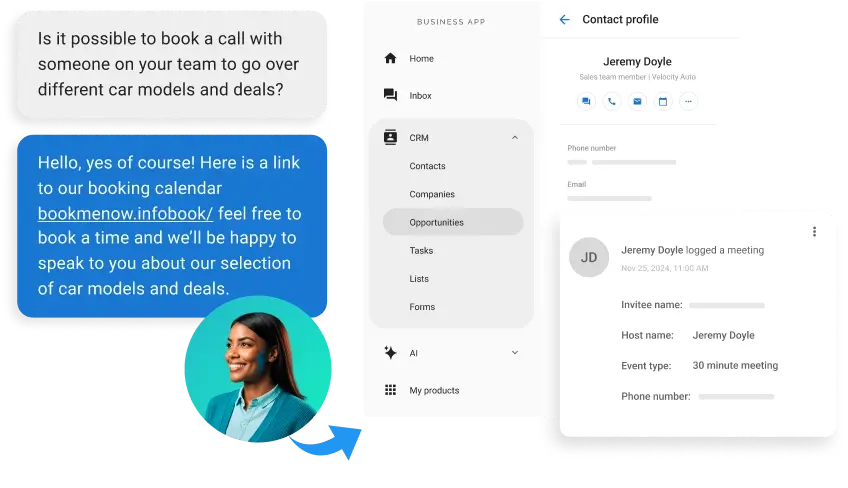
Most importantly, AI agents are proactive. They can initiate follow-ups, trigger workflows, renewals, and move opportunities forward without waiting for another prompt. This is where agentic AI vs chatbot becomes clear at the point of autonomy.
What “Agentic” Actually Means
Agentic AI refers to AI solutions capable of planning, acting, evaluating results, and iterating toward a defined objective. These systems do not simply generate responses. They assess context, determine next steps, and execute actions aligned with a goal.
This is the architectural shift seen in agentic AI platforms vs traditional chatbot builders. Chatbots respond. Agentic systems pursue goals. That difference defines the leap from conversation to execution.

AI Agent vs Chatbot: Side-by-Side Comparison
To clearly understand AI agent vs chatbot, you need to compare architecture, autonomy, and business impact side by side. Both may use artificial intelligence, but their core purpose and execution depth are fundamentally different.
The distinction becomes clearer when evaluated across operational capabilities.
| Feature | Chatbot | AI Agent |
| Primary Role | Conversational | Goal-driven |
| Core Purpose | Answer questions | Complete tasks |
| Autonomy | Reactive | Autonomous |
| Memory | Session-based | Persistent |
| Context Retention | Limited to conversation | Cross-session and system-wide |
| CRM Integration | Limited or manual | Native and automated |
| API Access | Minimal | Built-in |
| Multi-Step Workflows | Rare | Core capability |
| Tool Usage | Respond-only | Can call tools and execute actions |
| Proactivity | No | Yes |
| Decision-Making | Script-based | Dynamic reasoning loops |
| Scalability | Conversation scaling | Workflow scaling |
| Human Dependency | Requires escalation | Reduces manual intervention |
| Business Impact | Support efficiency | Revenue & lifecycle growth |
The difference between an AI agent vs chatbot is not intelligence; it’s execution.
Agentic AI Platforms vs Traditional Chatbot Builders
The shift from chatbot builders to agentic platforms represents a structural evolution. Traditional chatbot builders focus on designing conversation flows, optimizing scripts, and improving response accuracy. Their primary goal is to enhance the quality of dialogue within predefined boundaries.
Agentic AI platforms operate differently. They orchestrate workflows across systems, integrate with CRMs and operational tools, and trigger automation without constant prompting. Instead of refining conversation paths, they drive measurable outcomes.

When comparing agentic AI platforms vs traditional chatbot builders, the real distinction lies in scope. Chatbot builders optimize conversations. Agentic platforms optimize business processes.
When Should Your Business Use a Chatbot?
Chatbots make sense when workflow complexity is low, and the primary need is structured interaction. If your goal is to answer FAQs, collect basic information, or guide users through predefined options, a chatbot can deliver quick value. In these cases, deep system integration is not critical.
Chatbots are also suitable when CRM synchronization is not essential to the interaction. If conversations do not need to trigger multi-step workflows or update backend systems automatically, a chatbot is often sufficient. This keeps implementation lighter and faster.
Budget constraints are another practical factor. Chatbots typically require less integration work and can be deployed quickly. When speed of deployment matters more than operational depth, conversation-focused tools are the pragmatic choice.
When Do You Need an AI Agent Instead?
You need an AI agent when response speed directly affects revenue. Research from Harvard Business Review shows that companies responding to leads within an hour are significantly more likely to qualify them compared to delayed follow-ups. If missed or slow responses cost deals, automation must extend beyond conversation.
An AI agent becomes essential when follow-ups are manual, inconsistent, or dependent on team availability. Persistent memory and CRM synchronization ensure that every interaction progresses automatically rather than resetting after each conversation. This is where agentic AI vs chatbot becomes a revenue decision, not just a technical one.
You also need agentic systems when managing multiple SMB clients or operating across channels. Lifecycle automation, appointment scheduling, CRM updates, and proactive engagement require orchestration.
Solutions like AI receptionists demonstrate how conversational engagement can extend into automated execution, ensuring inquiries move from initial contact to confirmed action without manual intervention.

AI Agent vs Chatbot for Businesses Serving SMBs
For businesses serving SMBs, the choice between an AI agent vs chatbot directly impacts scalability. Marketing service providers handling multiple clients need consistent lead routing, automated reporting, and structured retention workflows. A conversation-only tool often cannot support cross-client workflow orchestration.
Franchisors and multi-location brands require centralized visibility with localized personalization. Maintaining brand consistency while allowing location-specific engagement demands deeper system integration. Agentic systems help synchronize data, messaging, and follow-up across distributed operations.
MSPs and SaaS vendors benefit from onboarding automation, renewal reminders, and ticket routing. These tasks require persistent context and backend system access, not just scripted dialogue.
An AI workforce can extend beyond chat to operational execution, enabling scalable automation across client environments.

Cost & ROI: AI Agent vs AI Chatbot
Chatbots are typically cheaper upfront. They require lighter integration, minimal backend connectivity, and can be deployed quickly. For businesses seeking basic inquiry automation, the initial investment is lower and easier to justify.
AI agents, by contrast, cost more to implement because they integrate with CRM systems, APIs, and operational tools. They require configuration for workflows, decision logic, and system orchestration. However, implementation cost does not reflect long-term return.
AI agents reduce manual labor by automating qualification, follow-ups, routing, and updates. McKinsey reports that organizations adopting AI for workflow automation see measurable productivity gains across business functions. When repetitive tasks are automated, teams can focus on revenue-generating activities rather than administrative work.
AI agents also increase lead conversion by delivering faster responses and consistent engagement. Harvard Business Review research shows that rapid lead follow-up dramatically improves qualification rates. Automated systems eliminate delays that typically reduce conversion probability.

Finally, AI agents improve customer lifetime value by enabling lifecycle automation. Persistent engagement, renewal reminders, and proactive communication strengthen retention. The real decision in AI agent vs chatbot should be framed around long-term ROI, not just sticker price.
Moving Beyond Conversations: Vendasta’s Unified AI Platform
Moving beyond conversation requires infrastructure, not just chat interfaces. Vendasta’s platform brings together AI Employees, CRM-native automation, and cross-channel engagement within a single ecosystem. This alignment allows marketing, sales, and operational workflows to function as one coordinated system.
AI Employees operate with outcome-driven logic rather than scripted responses. They connect directly to CRM data, enabling real-time updates, workflow triggers, and structured follow-ups. This creates a unified layer where engagement and execution work together rather than separately.
The platform also supports white-label deployment and multi-client scalability. Businesses serving SMBs can deploy AI solutions under their own brand while maintaining centralized oversight. Resources like AI communication tools illustrate how conversational engagement integrates with automation to support full customer lifecycle management.

The Future: Will AI Agents Replace Chatbots?
AI agents are not replacing chatbots overnight. The market is moving toward hybrid systems that combine conversational interfaces with autonomous execution. Intelligent virtual agents are emerging as layered systems that respond, reason, and act within the same environment.
CRM-native AI ecosystems are quickly becoming the standard for businesses that depend on structured data and lifecycle engagement. As expectations for speed and personalization rise, conversation alone is no longer enough.
Chatbots will not disappear. They will become components within broader agentic platforms where conversation is the entry point, and execution drives value. The competitive advantage will belong to businesses that connect dialogue with action.
Vendasta’s AI Employees are built around this evolution. They combine conversational engagement with CRM-native automation, enabling businesses serving SMBs to move from simple responses to structured execution.
If your business is ready to move beyond conversations and into measurable growth, schedule a demo to see how Vendasta’s AI-powered platform can turn engagement into real operational work.
AI Agent vs Chatbot FAQs
1. What is the main difference between an AI agent and a chatbot?
The main difference is autonomy. A chatbot responds to user inputs within predefined or session-based conversations. An AI agent can reason, access tools, update systems, and execute multi-step workflows independently. In short, chatbots talk. AI agents act.
2. Is agentic AI better than a chatbot for lead generation?
Agentic AI is often better when lead response speed and follow-up consistency impact revenue. Chatbots can capture information, but AI agents can qualify leads, update CRM records, schedule appointments, and trigger nurture sequences automatically. That deeper automation typically improves conversion rates and ROI.
3. What are agentic AI platforms vs traditional chatbot builders?
Traditional chatbot builders focus on designing conversation flows and scripted responses. Agentic AI platforms integrate with CRM systems, APIs, and operational tools to execute workflows. The architectural difference lies in execution depth, not conversational ability.
4. Can an AI chatbot become an AI agent?
In some cases, yes. If a chatbot is enhanced with tool access, persistent memory, and workflow orchestration, it can evolve into a more agentic system. However, this requires backend integration and automation logic beyond conversational scripting.
5. Do businesses serving SMBs need AI agents?
Workflow complexity determines the answer. Businesses managing multiple clients, synchronizing CRM data, and relying on consistent follow-up benefit significantly from AI agents. These systems scale engagement, automate lifecycle communication, and reduce manual workload. Platforms like Vendasta help operationalize this automation across marketing, sales, and customer retention workflows.
6. How does AI agent vs AI chatbot affect ROI?
The ROI difference comes from automation depth. Chatbots reduce support load, while AI agents reduce manual sales tasks, improve response times, and automate retention workflows. Over time, workflow automation has a greater impact on revenue and customer lifetime value.
7. Are chatbots becoming obsolete?
No, chatbots are not obsolete. They remain effective for structured conversations and basic inquiry handling. However, they are increasingly integrated into broader agentic systems where conversation is just the first step in a larger automation process.
8. How do AI agents integrate with CRM systems?
AI agents connect through APIs to read and update CRM data in real time. They can create records, modify fields, trigger workflows, and log interactions automatically. Vendasta’s AI Employees operate within a CRM-native environment, ensuring conversations translate directly into operational actions.
9. Is agentic AI expensive to implement?
Agentic AI may cost more upfront due to system integration and workflow configuration. However, long-term value often outweighs initial expense through labor savings, faster lead qualification, and improved retention. The decision should focus on lifetime value, not initial deployment cost.
10. How can my business deploy an AI agent?
Start by defining your automation goals and identifying required integrations. Choose a platform that combines conversational engagement with workflow execution. Vendasta’s AI-powered ecosystem enables businesses serving SMBs to deploy AI agents that connect marketing, sales, and operations within one unified system.