About Us
 Careers
 Leadership
 Board
Board Newsroom
If you tuned into this year’s Super Bowl, you were one of 127 million people. And if you tuned in for the halftime show, you were one of 135 million viewers.
Now… some of us watch for the game (go team with which I have an affinity for the city!). Some for the halftime show. And a suspicious number of us watched like it’s a marketer’s national holiday: for the commercials.
I knew the date of the Super Bowl only so I could start searching “Super Bowl commercials 2026” at the beginning of the week, though a more purist part of me likes to wait for the actual game to see the ads. Alas, now I have kids, so I watch when I can. Not to mention a Canadian broadcast that cuts a bunch of the best Super Bowl commercials.
This year was fun. The best Super Bowl commercials 2026 leaned hard into absurdity, nostalgia, and AI anxiety. Standouts include DoorDash’s self-aware trolling with 50 Cent, Anthropic’s sharp little warning shot about ads creeping into AI, and Amazon’s thriller-parody where Chris Hemsworth spirals over his Alexa.
While big brands spent millions on celebrities like George Clooney and Scarlett Johansson, the real shift was in how ads were made — with AI taking center stage in concepts and production, the same shift powering Vendasta’s AI Employees.
Obviously, every marketer has a dream to produce a Super Bowl commercial. Or maybe I’m projecting my desires onto my profession, but I suspect most of us are jealous of the big budgets, gargantuan audience, and a chance to flex our creative prowess (see you in Cannes 💭).
So yes, before we get to it, I have a confession: we wrote a Super Bowl commercial too. We just didn’t pay the $8M cover charge. Watch it!
Replace busy work with AI employees that take action
The Multimillion-Dollar Spot vs. Our $200 AI Ad
We wrote a Super Bowl 2026 commercial. We produced it. We aren’t airing it. Why? Because a 30-second spot costs multimillions of dollars. Brands are dropping GDP-sized budgets to get 50 Cent to mock his own beefs or put Elijah Wood in a forest.
We spent $200 in Higgsfield AI credits. We built it with three people in five days using only AI. No shoot. No craft services. Just strategy and compute.
The Contrast:
| Super Bowl Commercial | Our AI Commercial | |
|---|---|---|
| Media + Production Cost | $8M+ media buy + millions in production | $200 in AI credits |
| Timeline | Months of planning | 5 days |
| Team | External agency + large crew | 3 people |
| Production | Full shoot, locations, talent, logistics | No shoot, no crew, all AI |
| Primary Goal | Awareness | Awareness + booked meetings |
We’re publishing a “How We Made It” deep dive soon, because the most interesting part wasn’t the ad… it was what we learned making it (and the friends we made along the way).
AI didn’t magically do the thinking for us. It still needed taste, direction, and a tight plan. We’ll share the exact workflow (script to launch), plus the few surprises that changed how we’ll build fast creative from here on out. So you can ship high-velocity assets for your customers without a bloated crew, timeline, or budget.
AI Progress: 2025 → 2026
AI is no longer a garnish. It’s the main dish. And the tools are officially broadcast-ready — which is both exciting and a little terrifying, depending on how much you enjoy living in the future.
2025: AI Was the Shiny Object
- AI showed up as a wink. A reference. A novelty.
- When it was used, it often lived in safer places: static assets, minor edits, basic generative visuals.
- The subtext was: “Look! We used AI!” not “This story only works because of the AI tools we were able to use.”
2026: AI is the Plot and the Producer
- We’re watching brands turn AI anxiety into the narrative engine (Amazon is the cleanest example).
- We’re also watching brands use AI more openly in production—Svedka basically raised their hand and said, “Yes, we did it with AI,” and then dared the internet to argue with them.
- And B2B brands are getting braver: “cloning” concepts, workforce multiplication, efficiency-as-entertainment (Ramp nailed this).
The List: Super Bowl Commercials 2026
As always, Super Bowl commercials are less about “ads” and more about emotion on demand. In 2026, brands leaned hardest on a familiar trio: humor, nostalgia, and fear — especially the modern flavour of fear: AI anxiety dressed up as entertainment.
There was absolutely no shortage of celebrity (because nothing says “trust us” like a famous person doing something unhinged in 30 seconds), but the best spots didn’t rely on star power alone — they used it as a delivery vehicle for a clear idea.
We also saw more surreal, meme-ready weirdness than usual, plus a growing push toward campaigns that live beyond game day through personalization, interactivity, and shareable cutdowns. Translation: the commercials weren’t just trying to win Sunday night — they were built to win the week/month/year.
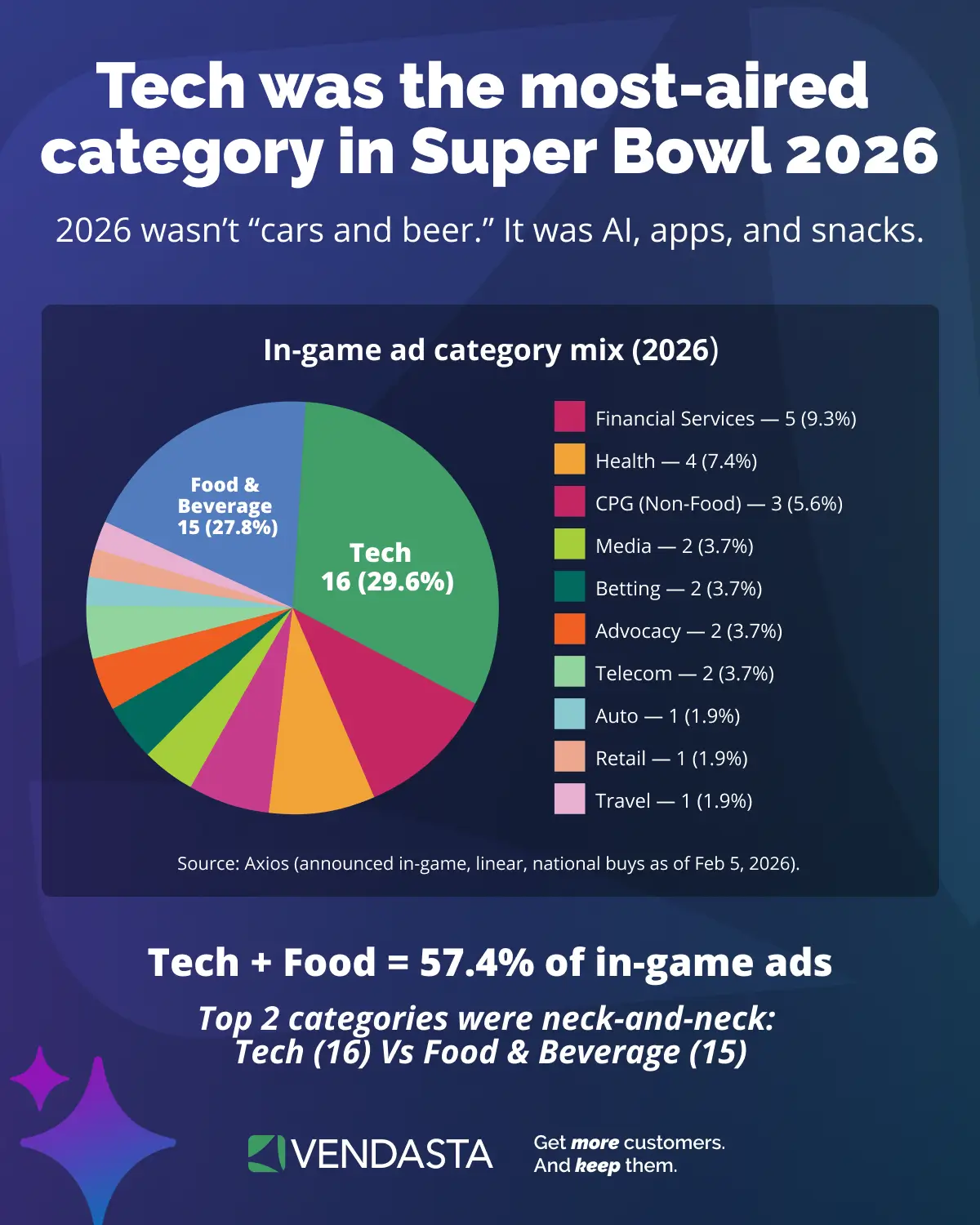
One quick nerdy note before we get back to the fun stuff: even the in-game ad mix tells a story. Based on announced, in-game, linear, national buys as of Feb. 5, tech was the most-aired category at Super Bowl 2026 (16 spots), just edging out food & beverage (15). Together, those two categories made up 57% of the in-game lineup, which basically means Super Bowl LX was powered by AI, apps, and snacks.
Best Super Bowl Commercials 2026
Anthropic (Claude) — “Ads Are Coming to AI. But Not to Claude.”
Anthropic showed up to the Super Bowl like the kid in the back of the class who’s quiet until they’re not. The whole bit is basically: “AI chatbots are about to get ruined by ads… but Claude won’t.” It’s cheeky, a little smug, and it made me laugh. As well as slightly nervous about where this category is headed. Had me feeling like an episode of Black Mirror…
They took a huge swing at OpenAI’s announcement that ads will be coming to ChatGPT. Sam Altman slapped back on X with a 400+ word rebuttal, going so far as to call Claude an authoritarian company. It makes me think of when Michael Ginsberg said, “I feel bad for you,” to Don Draper in Mad Men, and he said, “I don’t think about you at all.” OpenAI quickly “leaked” a Super Bowl 2026 commercial (that didn’t air). Anyway, I’m here for the drama,
Why it works
- It’s a clear enemy without needing to name names: ad-supported AI.
- The premise is instantly relatable: nothing kills trust like a helpful tool suddenly trying to sell you something.
- It turns a boring product claim (“no ads”) into an emotional promise: “you can relax here.”
- It’s positioned like a values statement, not a feature—which is why it lands.
AI angle
- The AI angle isn’t “we used AI to make this.” The AI angle is the message: AI is becoming the interface to everything, and whoever controls that interface controls the incentives.
- Personal take: this is smart brand positioning, but it’s also a bold swing. If you’re going to claim “we’re the ethical alternative,” you better live it, because the internet will keep receipts.
Steal this for your funnel
- Trust as a feature: Pick one line you can own (privacy, speed, transparency, “no nonsense”) forever and build your retention messaging around it.
- Objection-first positioning: Say the thing people are worried about out loud, then show how you prevent it.
Amazon — “Alexa+” (Chris Hemsworth & Elsa Pataky)
Hemsworth basically stars in a mini thriller where AI might be out to get him… until it turns into “AI makes your life easier.” It’s funny because the fear is real.
Why it works
- It names the anxiety instead of pretending it doesn’t exist.
- It dramatizes everyday utility (the best kind of demo).
- The twist reframes AI as helpful, not creepy.
AI angle
- The whole narrative is AI anxiety → trust (very 2026).
- Personal take: this is the playbook — don’t deny fear. Acknowledge it. Then show control.
Steal this for your funnel
- Objection handling: Put the scary objection in the headline, then disarm it.
- Reverse it: As we did with our Super Bowl commercial — show the non-AI normal as the weird/annoying part.
DoorDash — “Beef 101” (50 Cent)
50 Cent weaponizes his own history of public beefs to sell delivery. I laughed. Then I laughed again because it’s also a pretty smart brand move.
Why it works
- Self-awareness makes the celebrity casting feel earned, not rented.
- Fast visual gags = high rewatch potential.
- The brand promise (“we deliver everything”) is baked into the joke.
AI angle
- Unverified / my suspicion: This kind of gag-heavy prop universe is exactly where gen tools speed up iteration (mockups, alt products, rapid comp tests). But I’m not calling it fact. This is something that is easy to do without AI, so not a good example of “the possible.”
Steal this for your funnel
- Reputation Management: Turn negative reviews or public perception into a brand asset. Own the narrative to increase retention.
Blog - Lead response speed: “We deliver everything” works because it’s instantaneous. Your follow-up should feel the same.
Ramp — “Multiply What’s Possible” (Brian Baumgartner)
Ramp clones Brian Baumgartner to multiply capacity. It’s a literal metaphor… and it’s exactly why it works. I’m a sucker for “make the idea visual,” and that’s something that’s become way easier for people without huge production budgets with AI.
Why it works
- “Force multiplication” is hard to explain. This makes it obvious in three seconds.
- Nostalgia casting without relying on nostalgia alone.
- Tight message: less busywork, more output.
AI angle
- Not “AI-made,” but AI-coded conceptually: workforce multiplication, capacity on demand.
- My take: this is where B2B should live — sell the after world, not the feature list.
Steal this for your funnel
- Operational leverage: Sell “time back” and “more capacity,” not tooling. The way we position our AI Receptionist.
Funniest Super Bowl Commercials 2026
TurboTax — “The Expert” (Adrien Brody)
Brody goes full dramatic actor, and TurboTax tells him to calm down. It’s self-parody as persuasion.
Why it works
- One repeatable line carries the whole spot.
- Humor + clarity: taxes are pain, expert help is relief.
- Timing is perfect (tax season = urgency).
AI angle
- No verified AI production claims.
Steal this for your funnel
- Lead response speed: Build follow-up scripts that are consistent and immediate.
- Sales enablement: Give your reps one line they can actually use.
Pringles — “Build a Boyfriend” (Sabrina Carpenter)
Sabrina builds the “perfect man” out of Pringles. It’s ridiculous. It’s catchy. It’s also painfully shareable. I don’t love this Super Bowl commercial, but I know it lands with the audience it’s intended for.
Why it works
- Pop culture casting at the right moment, with an audience that actually posts, remixes, and replays (gen Z baby).
- Visual comedy that lands on mute, which is the whole game now.
- Brand assets do the work: the pop, the can, Mr. P energy, the “Once you pop…” truth baked into the plot.
- Nostalgia without feeling dated: classic slogan equity, Gen Z execution.
- It’s not a one-off. It’s a platform moment designed for second-screen behaviour and social cutdowns.
AI angle
- Not an AI production story, from sources I can find.
- My take: it does rhyme with the “build your perfect AI partner” discourse, without being (fully) cringe about it.
Steal this for your funnel
- Packaging your offer: Let prospects “build” a package (choice increases commitment).
- Lifecycle marketing: Turn customization into a retention lever (clients stay when it feels made for them).
Pepsi — “The Choice” (Coca-Cola Polar Bear)
Pepsi did the boldest kind of Super Bowl trolling: they “borrowed” Coke’s polar bear, ran him through a blind taste test, and sent him into a full existential spiral when he picks Pepsi. It’s petty in the most entertaining way. I respect the audacity.
Why it works
- Instant recognition: you see the polar bear, and you immediately understand the Coke vs. Pepsi context.
- The story is simple and visual: taste test → identity crisis → break free. No one’s confused.
- It turns a product claim (“tastes better”) into a narrative, not a line at the end.
- It’s designed for replay and sharing because the whole premise is a single, meme-able twist.
AI angle
- No verified “made with AI” claims (and it doesn’t need it). This is classic concept + execution.
Steal this for your funnel
- Positioning: Pick a clear “enemy” and dramatize the escape.
- Conversion: Build a “choice” moment — quiz, assessment, comparison, interactive demo — so the prospect feels like they decided.
- Retention: Make your promise emotional, not technical (“you can relax, we’ve got it” beats “AI-powered workflow automation” every day).
Hellmann’s — “Meal Diamond” (Andy Samberg)
A deli-cryptid musical number about mayo… which sounds like a sentence generated by a sleep-deprived copywriter (compliment). I loved the commitment. Not my favourite commercial, but well done.
Why it works
- Takes a boring product and gives it lore.
- A catchy, recognizable musical structure sticks in your brain.
- It’s weird in a way that feels intentional, not random.
AI angle
- Unverified / my take: The concept has “LLM brainstorming at full temperature” energy. Not proof, just vibes.
Steal this for your funnel
- Pattern interrupt: Stop sending “checking in” emails. Send something with personality to wake up dead leads.
- Retention: Give your customers a story they can repeat to other people.
Weirdest Super Bowl Commercials 2026
Svedka — “Shake Your Bots Off” (AI-led production)
This ad got dragged online. The criticism is warranted… and also, it’s kind of the point: you can’t ignore it. Svedka brings back the Fembot, adds Brobot, and makes them dance. It’s loud. It’s shiny. It’s intentionally polarizing. And that’s why it worked as a Super Bowl moment. Note that they turned the comments off on YouTube, which always tells you something.
Why it works
- It’s a headline as much as it’s a commercial (“Did ya hear, a fully AI-generated Super Bowl commercial?!”). I know the team working on this is more excited to share the how-it’s-made content than the actual commercial.
- “First primarily AI-generated Super Bowl ad” is built into PR, whether people love it or hate it.
- It taps into the cultural tension: people are curious and annoyed at the same time.
- It creates a second-screen storyline: debate, quotes, reactions, stitched takes.
- It’s not a one-off stunt. It tees up a bigger campaign and more placements beyond the game.
AI angle
- Svedka calls it the first primarily AI-generated Super Bowl commercial.
- Silverside AI used AI to train the robots on a dance that came from a TikTok open call.
- The team used AI to move faster than traditional production and keep iterating late into the process.
- My take: AI can accelerate production. What it can’t replace is taste. This spot makes that conversation unavoidable, which is exactly why it spread.
Steal this for your funnel
- Creative iteration: Use AI to generate options fast, then edit with taste, like your pipeline depends on it.
- Brand trust: Be transparent about where AI is used. People sniff out vague “AI-washed” claims instantly. Use it and claim it, and know where it doesn’t fit.
- PR engineering: “First ever” plus a clear proof point equals coverage, even if the comments section is a dumpster fire.
- Speed-to-market: Keep revising closer to launch, then ship more cutdowns while attention is still hot.
Skittles — “Deliver the Rainbow” (Elijah Wood)
Elijah Wood as a woodland fairy producing Skittles is… unsettling. When I picture the copywriters who make Skittles Super Bowl commercials, I imagine they are asking themselves how they can outweird last year. They always do. It’s never my vibe, but it’s always memorable.
Why it works
- Discomfort is a memory hack.
- It’s visually loud in a sea of “polished.”
- It creates an experience, not just an ad.
AI angle
- No verified AI production claim in the sources, which is strange, since why not at this point?
Steal this for your funnel
- Offline-to-online: Create a real-world trigger (event, direct mail, stunt) that forces a response and drives booked meetings.
Most Talked-About Super Bowl Commercials 2026
Uber Eats — “Build Your Own Super Bowl Commercial / Is Football Selling Food?”
Uber Eats turned its Super Bowl spot into a choose-your-own-adventure inside the app. Over 1,000 versions. And yes, it wants you to order food while you play. Before the game even starts, Uber Eats runs an interactive “build your own commercial” experience in-app. You choose scenes. You choose celebrity cameos. You basically direct the ad yourself. The result: 1,000+ possible outcomes. And a very convenient “add fries to cart” moment.
The spots they previewed lean into the same “what is football really selling?” bit, with Bradley Cooper and Matthew McConaughey leading the existential snack debate. Then they stacked cameos: Parker Posey, Addison Rae, Tramell Tillman, and more. It’s celebrity roulette. With a checkout button.
Why it works
- It starts early, which is the whole SEO game for Super Bowl commercials 2026.
- It makes the viewer do the work, which increases attention and recall.
- It turns one media buy into infinite variations and endless social clips.
- It’s built for the second screen, because the second screen is the first screen now.
- The app is the channel and the conversion point, not just the logo at the end.
AI angle
- Not positioned as an AI-made ad.
- It does borrow the “infinite combinations” feeling people associate with AI.
- My take: interactive personalization is the gateway drug. Once brands see the lift, AI-powered versions are next.
Steal this for your funnel
- Interactive lead capture: Let prospects “build” their plan, then gate the results with email.
- Personalization at scale: One core story, many variations, targeted by segment.
- Conversion path: Don’t send people to “learn more.” Put the action in the experience.
- Retargeting fuel: Every choice becomes a signal you can use for follow-up. Hellllooooo data.
Liquid I.V. — “Take a Look” (Singing Toilets / Urinals)
Liquid I.V. made its Super Bowl debut by turning a bathroom PSA into a full musical number. Singing toilets. Singing urinals. Phil Collins. It’s… a lot. The backlash was predictable, and also kind of the point: you cannot ignore this one (even if you want to).
Why it works
- It’s a pattern interrupt so aggressive that your brain can’t scroll past it.
- The insight is real (and weirdly useful): hydration = check your pee color.
- The song choice does instant heavy lifting: recognizable, dramatic, meme-ready.
- It’s built for reaction content: “gross” and “hilarious” both travel fast.
- Whether you loved it or hated it, you remembered the brand. Mission accomplished.
AI angle
- No verified “made with AI” production claims that I’ve seen.
- My take: this is a reminder that AI isn’t the only way to go viral — one committed creative decision will still beat a thousand “safe” spots.
Steal this for your funnel
- Education disguised as entertainment: Teach one practical thing in a way people actually remember.
- Polarizing isn’t always bad: If your category is bland, a little “ew” can create a lot of talk — just make sure the insight earns it.
Best B2B / SaaS Super Bowl Commercials 2026
Salesforce / Slack — “MrBeast manages chaos”
B2B trying to entertain is always risky. This one works because the story is ops chaos, and the product belongs there. Is it peak MrBeast? Not really. But that’s the trade when you pair a viral creator with enterprise software. You don’t get fireworks, you get fewer fires.
Why it works
- “Show, don’t tell” for coordination value.
- Big personality gives the ad momentum.
- Clear positioning: keep teams aligned under pressure.
AI angle
- No verified AI production claim. Again — why?
- My take: the AI angle is implied: modern ops = automation + orchestration.
Steal this for your funnel
- Delivery + retention: Your client experience should feel coordinated across sales, service, and support.
- Complete the experience: Connect your funnel + inbox + CRM, so leads don’t fall through cracks.
A Few More Super Bowl Favorites of 2026
There were SO many. And I surely haven’t seen them all. Here are a few others that caught my eye, and some that I liked even more than in the lists above.
- Lay’s “Last Harvest” had me crying. Maybe it’s because I’m from the prairies, but a dad handing down the farm to his daughter is a tear-jerker. If I had to choose Pringles or Lay’s based on these spots alone, I’d go Lay’s.
- Hims and Hers played on our distaste of the wealthy to get diagnostic testing.
- Base 44, I just Built an App. I love the allure of vibe coding, so I was intrigued.
- Bud Light — old pros at the Super Bowl commercial game — went with a comedic wedding scene. Meh.
- Michelob made me smile with a spot by Joseph Kosinski, director of the Oscar best picture nominees “Top Gun: Maverick” and “F1.” The spot felt like a film, with Kurt Russell delivering a how-to-ski montage.
- Google knows how to pull on the heartstrings, simply, and they do it with their New Home spot.
- Xfinity pulled in a Jurassic Park trailer.
- Kellogg’s Raisin Bran had William Shatner lean into his aging by doing a “William Shat” spot where he talks about 💩. Weird, gross, memorable, and clever. If the story isn’t protein, it’s fibre.
- Instacart’s “For Papa” nailed the nostalgia and awkward comedy.
- Doesn’t everyone love a Pepsi vs Coke moment? Pepsi’s ad used Coca-Cola’s iconic bears for some easy laughs.
- Squarespace’s “Unavailable” commercial with Emma Stone.
- Dove is always an emotional pull, this one especially for female athletes.
- If you make me cry, you make the list. Not that that’s difficult, but Redfin did it with a stretch on mortgages.
- This year, Jesus took out a Super Bowl commercial. Kind of. Run by “He gets us”, this commercial nailed the feeling of chasing more.
- Fanatics spot with Kendall Jenner.
- Wix’s spot about creating with harmony.
- Ring went with an old school looking Super Bowl commercial, but effectively showed a use case I have never heard about — using the Ring camera to find lost pets. I was intrigued by the novelty and the idea, not the production.
- Yes Bueno is obviously a crowd favourite, hitting nearly 25 million views before kickoff.
- Is it even America if there’s not a bunch of weight-loss drugs advertised? Ro did a simple spot with Serena Williams, earning them instant credibility (Serena uses it?! She’s an athlete, that means surely I could use it).
- Oakley Meta was cinematic, but the story came up short. Or maybe I just don’t see the need to “post that on Instagram” right from my sunglasses.
- T-mobile is obviously targeting us elder millennials by pulling in the Backstreet Boys to tell us why…something about cellphone plans. It made me feel a little weird, but I noticed it.
- Novartis, another pharma company, went with a “relax your tight-end” play on checking for prostate cancer. You mix word play and a bum joke, and I’ll give you a mention.
- Blue Square Alliance Against Hate used sticky notes to show a bullying scene from a high school. Easy to get on board with the message, but it feels like a ’90s after-school special.
- YouTube TV had a few fun puns.
- Who doesn’t love the Budweiser Clydesdales?
- Boehringer Ingelheim put on an action movie trailer to encourage urine tests for kidney damage. The pharmaceuticals always have me sighing, “Ah, America.”
- Every car commercial feels like a car commercial. Toyota aired two cute-but-not-memorable concepts: Superhero Belt and Where Dreams Began.
- Wegovy with a meh spot, though we all knew they’d be in the game.
- Manscaped sang a hairballad that ends with balls. This has to be their target demographic.
- Grubhub will eat the fees.
Patterns We Saw in Super Bowl Commercials 2026
- AI as the villain (or the anxiety): Fear is the hook, trust is the payoff.
- Force multiplication: Clones, doubles, “more output with less effort.”
- Nostalgia 2.0: Familiar faces in modern contexts.
- Creator-led casting: Pop culture accelerates recall.
- Hybrid activations: Ads that spill into real life.
- Aggressive specificity: Brands taking shots (playfully) instead of playing safe.
- TikTok pacing: Fast cuts, visual overload, instant punchlines.
You just watched a parade of multi-million-dollar ideas trying to win 30 seconds of your attention. If you’re anything like me, you’re already filing away the best ones for your next campaign.
But here’s the punchline: You don’t need an $8M media buy to make something that moves people and drives action. We proved it.
We made our own Super Bowl-style spot for $200 in AI credits, and we built it for the only metric that matters after the laughs fade: booked meetings and faster lead response. If you haven’t watched it yet, go do that now — then steal the parts that work and put them to work in your funnel.
Watch “Put AI to Work,” and if you want help turning attention into pipeline, get a demo of Vendasta’s AI Workforce.