About Us
 Careers
 Leadership
 Board
Board Newsroom
Most SaaS and ISV teams know AI is no longer optional. Customers expect smarter software, competitors are shipping AI features faster, and leadership wants a clear plan for monetization and differentiation.
The problem is that AI often feels like a roadmap disruptor. Building in-house models drains engineering resources. Bolting on AI features creates technical debt. And chasing trends without a strategy leads to expensive experiments that never ship or never drive adoption.
. One that prioritizes customer outcomes, protects roadmap velocity, and turns AI into a revenue driver instead of a distraction — for many ISVs that means embedding proven capabilities like Vendasta’s team of AI Employees rather than building from scratch. This article breaks down how modern ISVs are integrating AI strategically, what to avoid, and how embedded AI is changing the game.
Launch AI-powered capabilities without building them in-house
TL;DR
- AI integration works best when it focuses on outcomes, not features, especially across acquisition, engagement, and retention
- Most ISVs should embed AI instead of building it, reducing engineering lift while accelerating time to value
- Vendasta enables ISVs to launch AI-powered capabilities quickly, without fragmenting their tech stack or roadmap
What Is AI Integration for SaaS?
AI integration for SaaS refers to embedding artificial intelligence capabilities directly into a software platform to automate workflows, improve decision-making, and drive measurable customer outcomes.
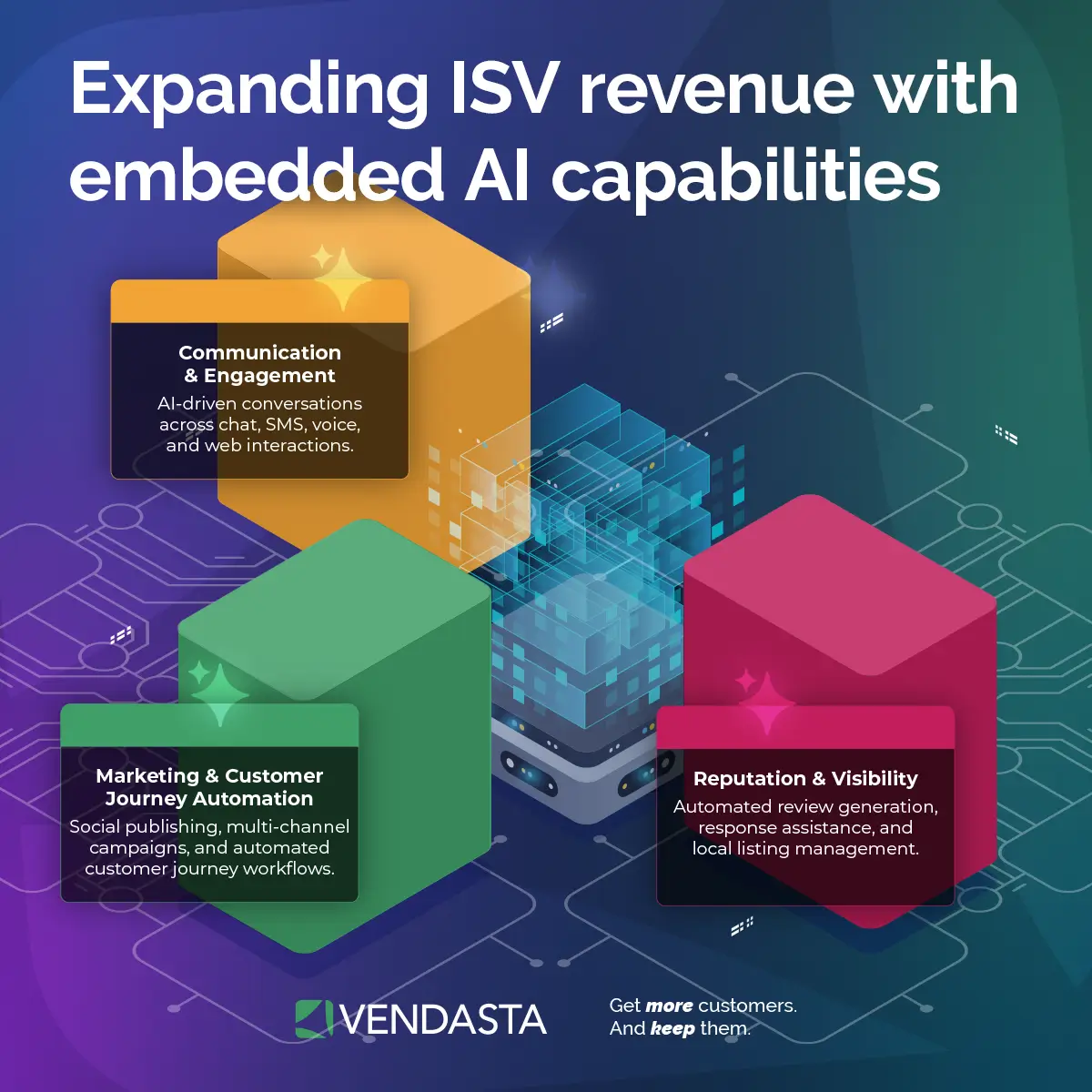
For ISVs, this is not about adding AI for novelty; it’s about enabling customers to:
- Acquire more users or leads
- Onboard faster
- Stay engaged longer
- Receive support without friction
- See clear ROI from the software they pay for
Modern SaaS buyers are no longer satisfied with efficiency alone. According to recent McKinsey research, a significant subset of software leaders expect AI to drive over 20% additional revenue growth, with a notable portion anticipating even higher gains.
That shift is driving ISVs to rethink how AI solutions fit into their product strategy.
Why AI Integration Has Become a Priority for ISVs
The ISV growth equation has changed.
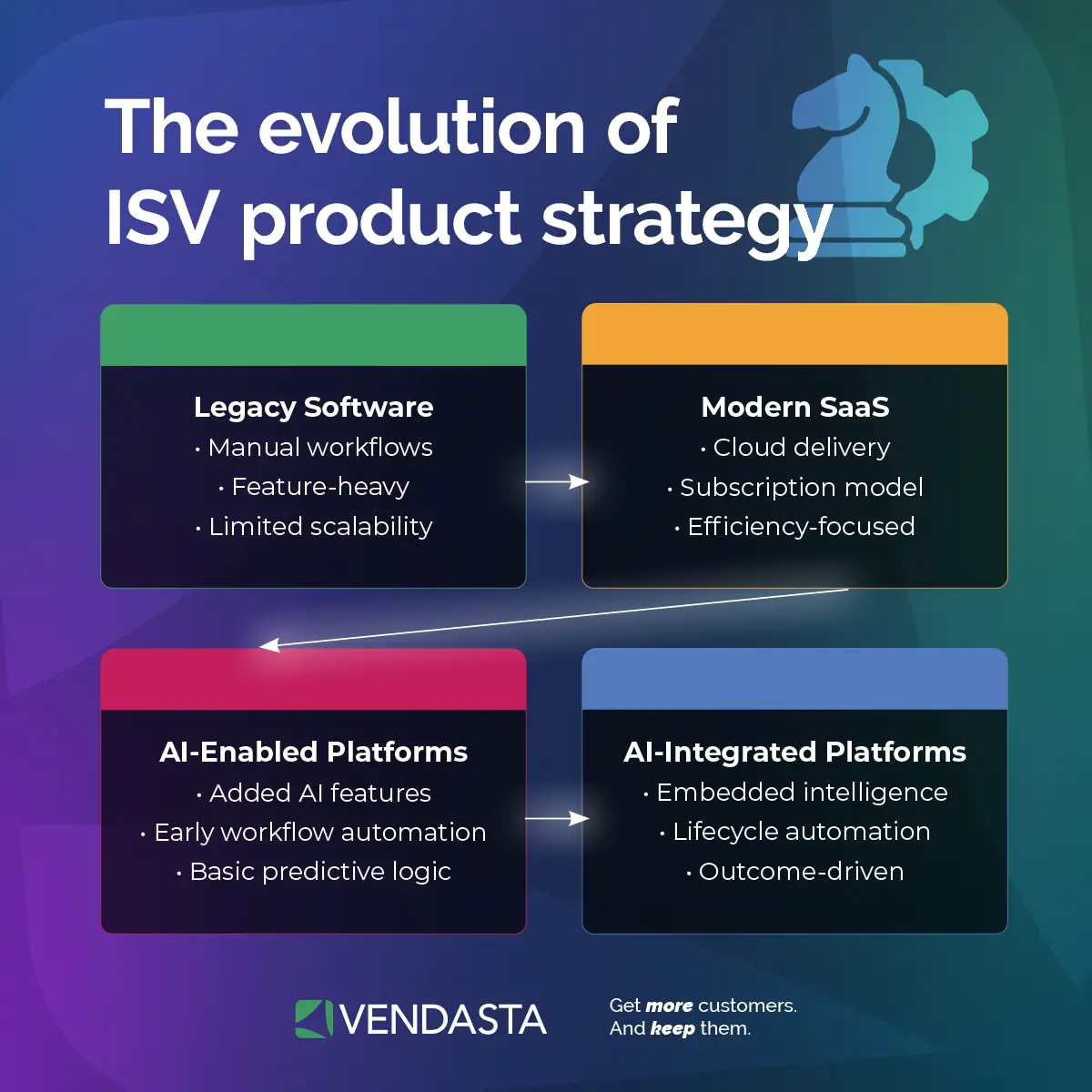
Historically, SaaS growth depended on feature depth, pricing, and distribution. Today, buyers evaluate software based on how well it contributes to business outcomes across the full customer lifecycle.
Rising Expectations in the SaaS Market
Customers increasingly expect their software to:
- Anticipate needs instead of reacting to them
- Automate repetitive tasks
- Provide real-time insights
- Support acquisition, engagement, and retention
- Integrate seamlessly with existing workflows
Gartner reports that by 2026, more than 80% of independent software vendors will embed AI capabilities into their applications, up from less than 20% just a few years ago. ISVs that delay risk becoming feature-complete but outcome-poor.
The Core Challenge: Integrating AI Without Breaking the Roadmap
For most ISVs, the biggest barrier to AI adoption isn’t vision—it’s execution.
Common Roadmap Pressures ISVs Face
- Fully committed engineering backlogs
- Limited machine learning expertise
- Infrastructure and governance concerns
- Pressure to show short-term ROI
- Fear of slowing core product innovation
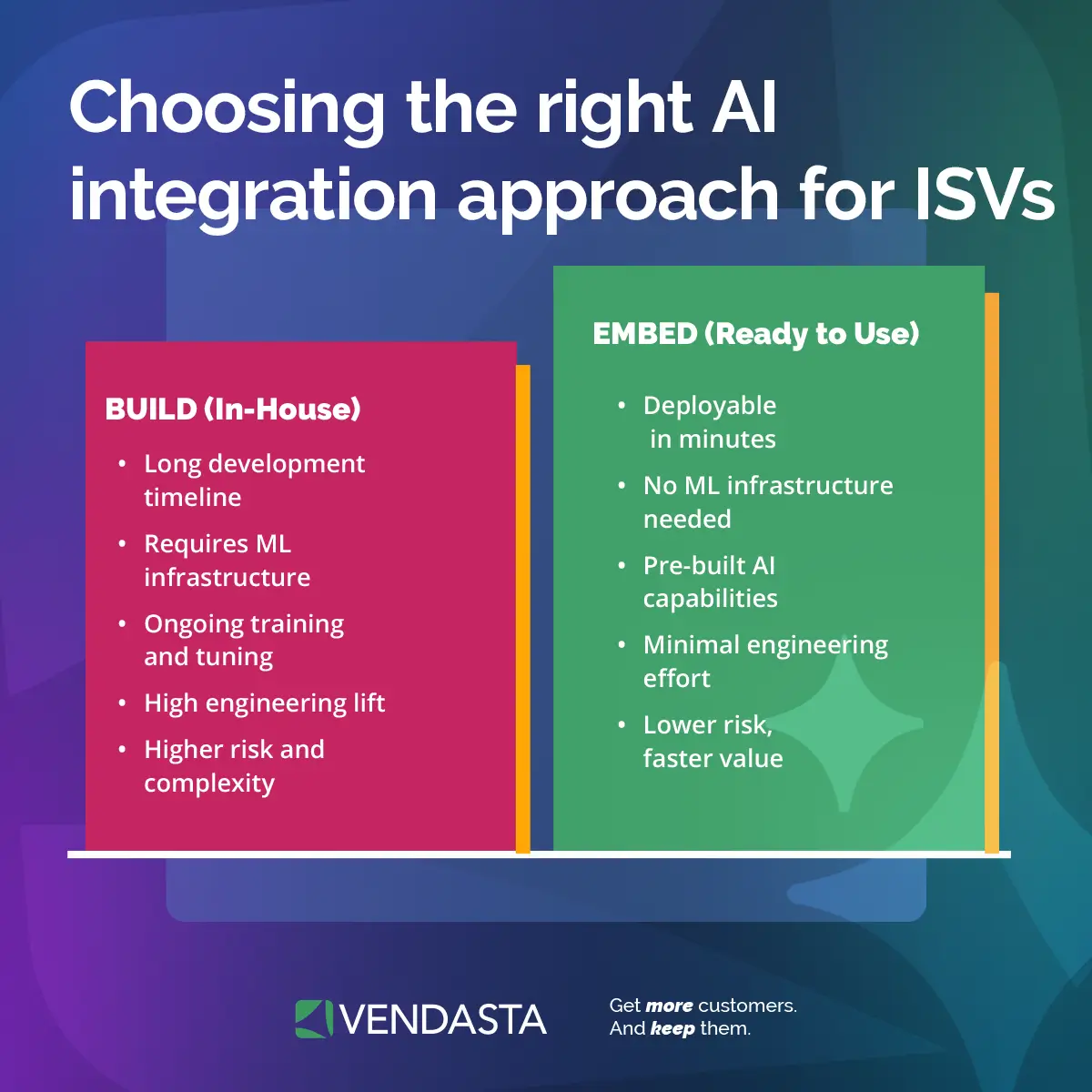
Building AI in-house often means long timelines, high risk, and ongoing maintenance. That trade-off rarely makes sense for capabilities that support rather than define your core differentiation.
Build vs Embed: How ISVs Should Think About AI Integration
One of the most important decisions in AI integration for SaaS is whether to build AI internally or embed it from a partner.
When Building AI Makes Sense
Build in-house when the AI capability:
- Is central to your long-term differentiation
- Relies on proprietary data that competitors cannot access
- Requires deep customization unique to your product
When Embedding AI Is the Smarter Choice
Embed AI when the capability:
- Supports customer acquisition, engagement, or operations
- Is not a core differentiator
- Would require significant infrastructure and ongoing tuning
- Needs to evolve quickly as AI technology advances
For most ISVs, the majority of AI use cases fall into the second category.
Where Embedded AI Delivers the Fastest Value for SaaS Platforms
Embedded AI allows ISVs to launch intelligent experiences without rebuilding their product from the ground up.
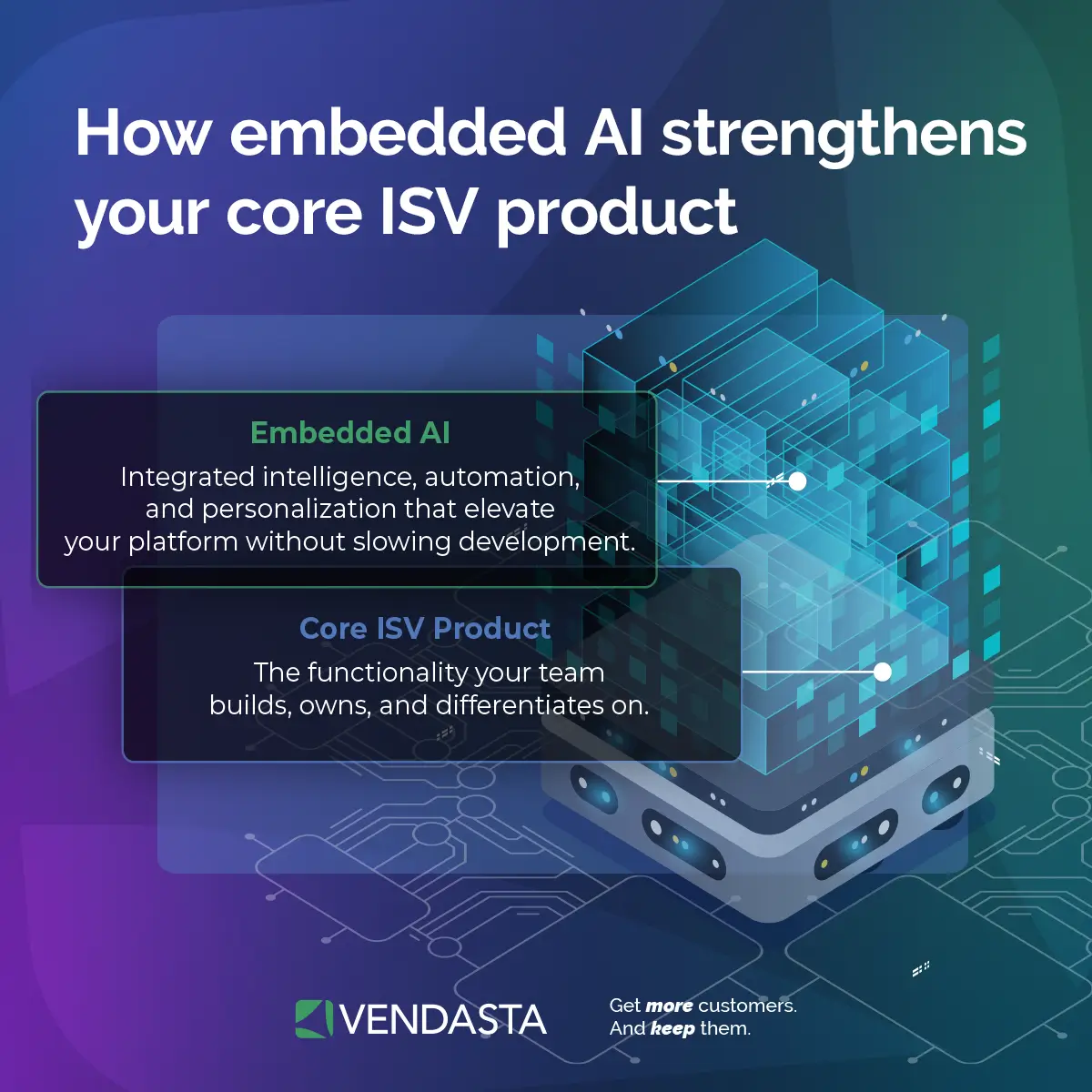
High-Impact Embedded AI Use Cases
Customer acquisition
- AI chat and voice assistants that respond instantly to inbound inquiries
- Automated lead qualification and routing
- Consistent follow-up across channels
Onboarding and engagement
- Guided onboarding workflows
- Proactive prompts that encourage feature adoption
- AI-driven recommendations based on usage behavior
Retention and expansion
- Signals that identify disengaged users
- Automated nurture campaigns
- Upsell and cross-sell recommendations
Support and fulfillment
- AI-powered responses to common questions
- Workflow automation for repetitive tasks
- Scalable support without increasing headcount
These capabilities help ISVs deliver outcomes customers care about, which directly impacts retention and lifetime value.
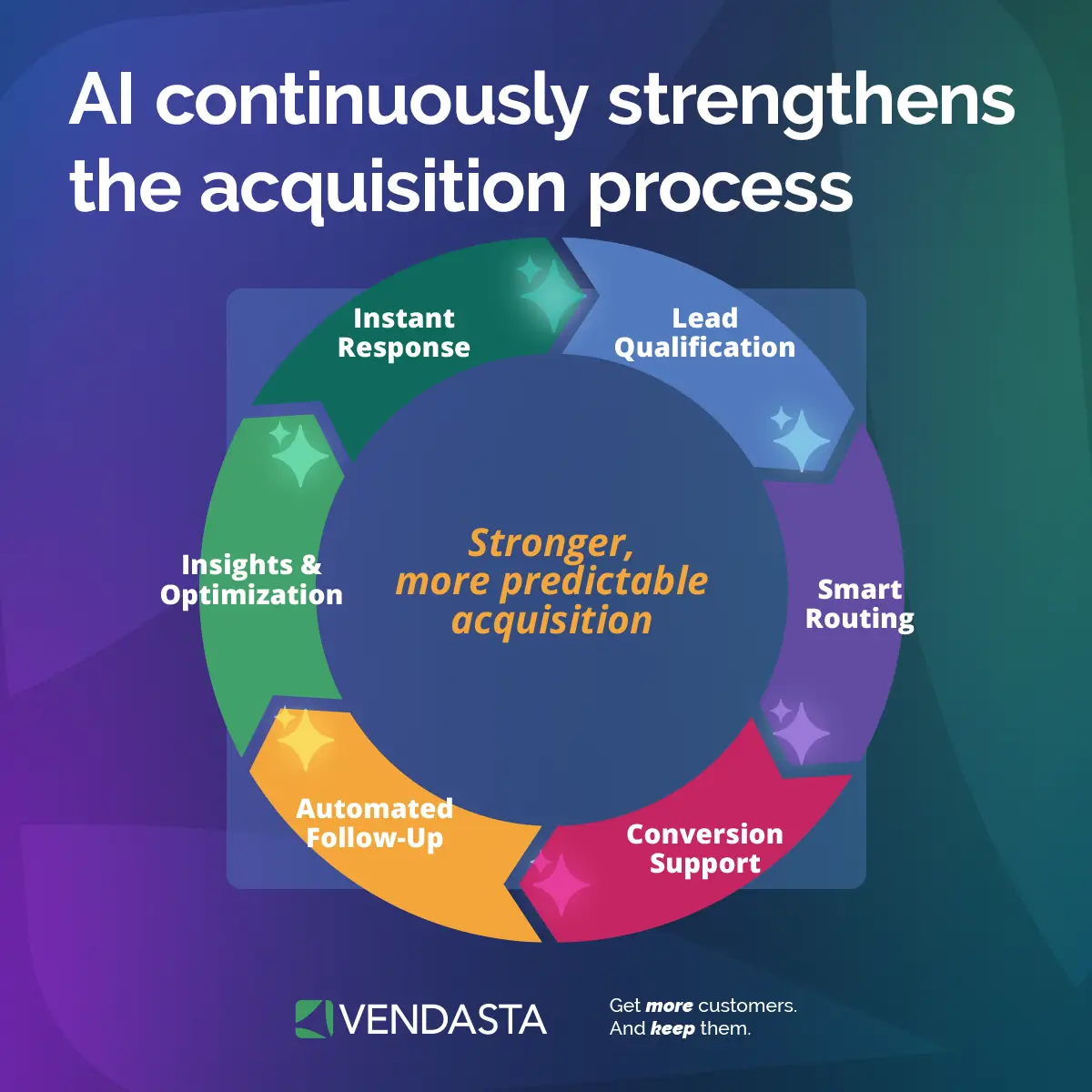
How AI Integration Drives Revenue for ISVs
AI is not just a product enhancement. It is a revenue strategy. That’s why it is a must-have on the product roadmap in 2026.
ISVs that integrate AI effectively unlock new monetization paths, including:
- Premium AI-enabled tiers
- Expansion revenue through embedded services
- Higher retention through improved customer outcomes
- Reduced churn from better onboarding and support
According to Bain & Company, increasing customer retention by just 5% can increase profits by 25% to 95%. AI-driven engagement and lifecycle intelligence make that improvement achievable at scale.
How Vendasta Supports AI Integration for SaaS
Vendasta was built to help partners deliver smarter customer experiences without complexity or fragmentation.
For ISVs, Vendasta provides a platform of AI employees, automation tools, and customer engagement capabilities that can be embedded directly into your product.
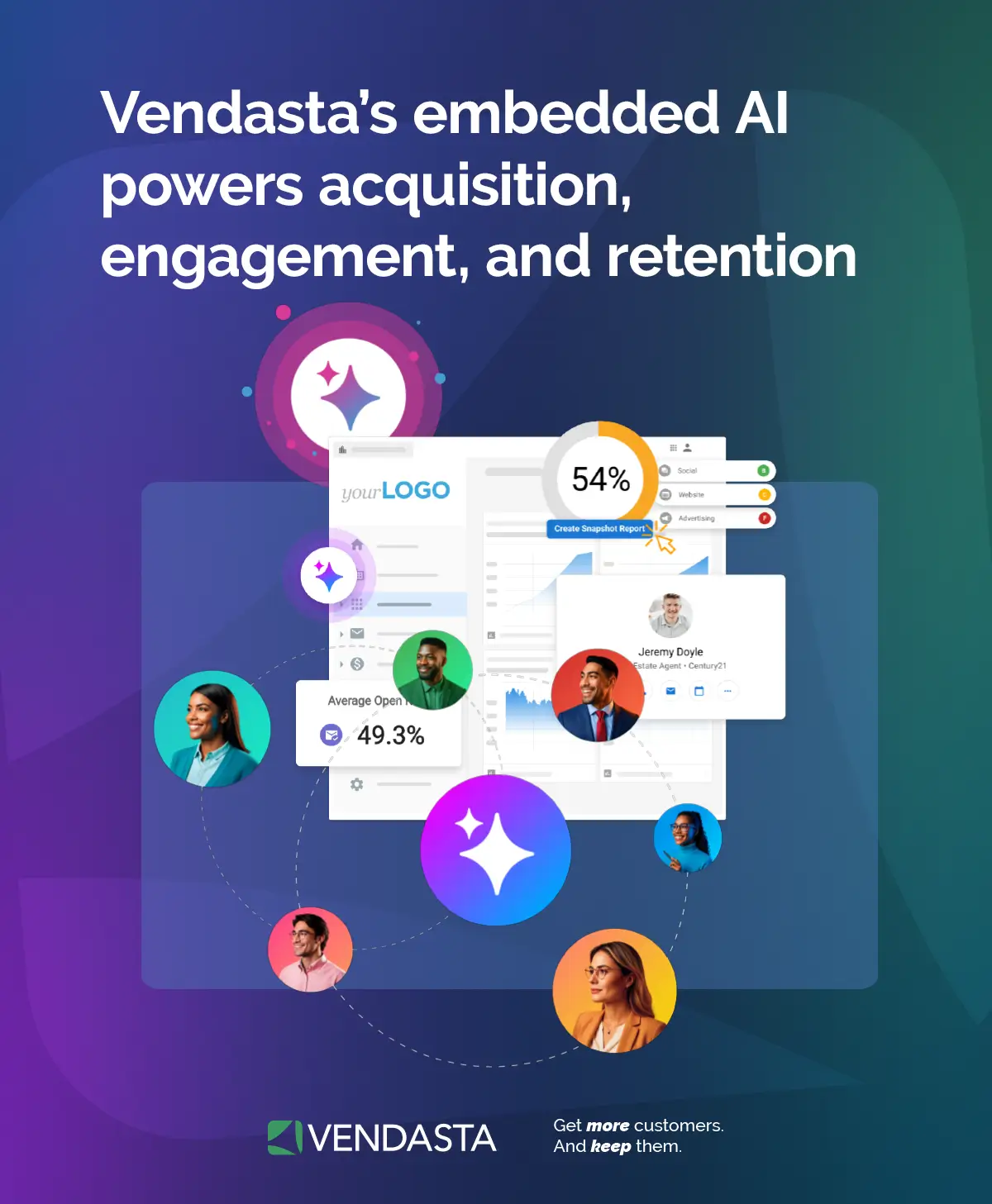
What Makes Vendasta Different for ISVs
- AI chat, SMS, and voice capabilities deployable in minutes
- Pre-built AI workflows for acquisition, engagement, and retention
- No machine learning infrastructure required
- Continuous improvements without engineering overhead
- A single, unified platform instead of disconnected tools
- White-label and rebrandable for seamless customer experiences
Vendasta helps ISVs democratize advanced technology for their customers while maintaining roadmap focus and development velocity.
A Practical Framework for AI Integration in SaaS
Successful AI integration follows a phased approach.
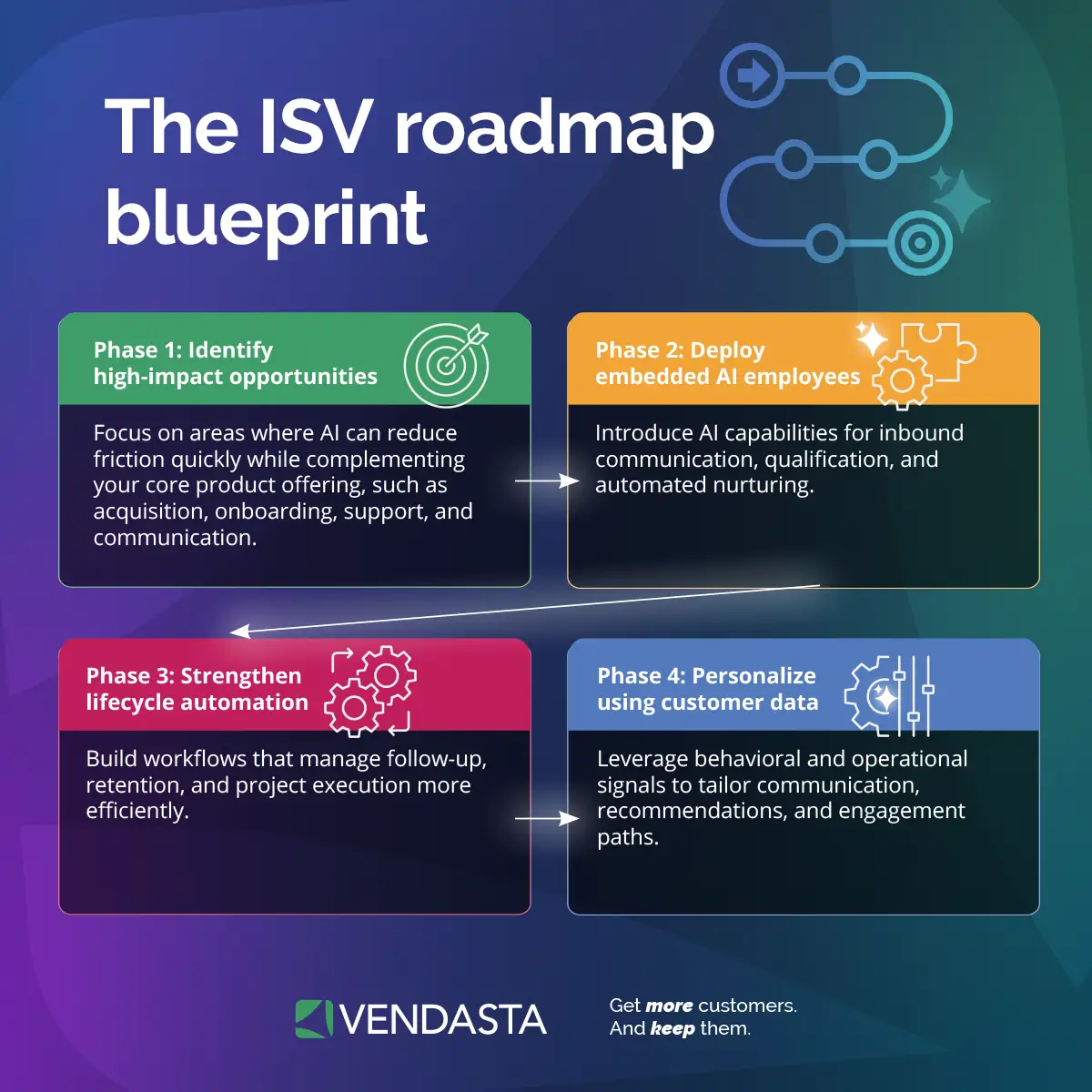
A Simple AI Roadmap for ISVs
- Identify high-impact opportunities: Focus on areas where AI reduces friction quickly, such as communication, onboarding, and support.
- Deploy embedded AI capabilities: Introduce AI employees that handle inbound interactions and automate follow-up.
- Strengthen lifecycle automation: Build workflows that support retention, expansion, and fulfillment.
- Personalize using customer data: Use behavioral signals to tailor experiences and recommendations.
This approach allows ISVs to capture value early while building toward more advanced intelligence over time.
Why Most ISVs Are Moving Away From Building Everything In-House
AI technology is evolving too quickly for most teams to maintain internally.
Embedding AI allows ISVs to:
- Move faster
- Reduce risk
- Stay current with ongoing advancements
- Focus internal teams on core differentiation
Rather than becoming AI infrastructure companies, ISVs can become outcome-driven platforms that deliver real value to customers.
Want the Full Framework?
This article covers the high-level strategy behind AI integration for SaaS. The full playbook goes deeper.
Vendasta’s ebook The AI Integration Playbook for Software Product Roadmaps breaks down:
- Real-world ISV challenges
- Build vs embed decision models
- Go-to-market strategies for AI-powered products
- Practical frameworks you can apply immediately
Ready to integrate AI into your SaaS platform with confidence?
Get The AI Integration Playbook and learn how ISVs are using embedded AI to grow faster, retain more customers, and protect their product roadmap.
Conclusion: AI Integration for SaaS Is a Strategic Advantage
AI integration for SaaS is no longer about experimenting with new features or keeping pace with competitors. For ISVs, it has become a strategic decision that shapes product relevance, customer outcomes, and long-term growth.
The most successful ISVs are not trying to build everything themselves. They are focusing internal teams on what truly differentiates their platform, while embedding AI where it delivers the most impact across acquisition, onboarding, engagement, retention, and support. This approach protects roadmap velocity, reduces risk, and accelerates time to value for customers.
Vendasta makes this strategy achievable. By offering rebrandable AI employees, automation, and customer engagement capabilities within a single, unified platform, Vendasta helps ISVs deliver smarter, more complete experiences without the cost and complexity of fragmented systems.
If you are evaluating AI integration for your SaaS platform, the opportunity is clear. The question is not whether to adopt AI, but how to do it with purpose and precision.
To go deeper, Vendasta’s AI Integration Playbook provides practical frameworks, real-world use cases, and decision models designed specifically for ISVs. It is your guide to integrating AI confidently while keeping your product roadmap focused and your growth strategy strong.
Request a demo of Vendasta to see firsthand how embedded AI can strengthen your platform, accelerate growth, and simplify AI integration for SaaS.
AI Integration for SaaS FAQs
1. What is AI integration for SaaS?
AI integration for SaaS is the process of embedding artificial intelligence into a software platform to automate workflows, improve decision-making, and deliver better customer outcomes. For ISVs, this often includes AI for acquisition, onboarding, engagement, support, and retention rather than standalone AI features.
2. How does AI integration help SaaS companies grow?
AI integration helps SaaS companies grow by improving customer acquisition, accelerating onboarding, increasing engagement, and reducing churn. When AI supports the full customer lifecycle, ISVs can unlock expansion revenue and higher lifetime value without adding operational or engineering overhead.
3. Do SaaS companies need to build AI in-house?
Most SaaS companies do not need to build AI in-house. Building requires machine learning expertise, infrastructure, and ongoing maintenance. Many ISVs choose to embed AI instead, using platforms like Vendasta to launch proven AI capabilities quickly while keeping their core product roadmap focused.
4. What are the biggest challenges with AI integration for SaaS?
The biggest challenges include limited engineering capacity, long development timelines, unclear ROI, and fear of disrupting the product roadmap. ISVs often struggle when AI is treated as a side project instead of being integrated strategically around customer outcomes and lifecycle value.
5. What types of AI features are most valuable for SaaS platforms?
The most valuable AI features for SaaS platforms focus on outcomes, not novelty. These include AI chat and voice assistants, automated onboarding, intelligent follow-up, lifecycle insights, and support automation. These capabilities directly impact acquisition, retention, and scalability for ISVs.
6. How does embedded AI differ from built-in AI?
Embedded AI allows SaaS companies to integrate pre-built AI capabilities without developing models or infrastructure internally. Built-in AI is developed in-house and maintained by internal teams. Embedded solutions, such as those offered by Vendasta, reduce risk and accelerate time to value.
7. How can Vendasta support AI integration for SaaS?
Vendasta supports AI integration for SaaS by providing rebrandable AI employees, automation tools, and customer engagement capabilities that ISVs can embed into their platforms. This allows partners to deliver AI-powered acquisition, engagement, and retention without fragmenting their tech stack.
8. Is AI integration for SaaS only for large software companies?
AI integration is not limited to large SaaS companies. Platforms like Vendasta democratize AI by making advanced capabilities accessible, affordable, and easy to deploy for ISVs of all sizes, without the need for specialized machine learning teams or large upfront investments.
9. How long does it take to integrate AI into a SaaS product?
The timeline depends on the approach. Building AI in-house can take months or longer. Embedding AI through a platform like Vendasta can take days or weeks, allowing ISVs to launch AI-powered features quickly while maintaining product momentum.
10. What is the first step in AI integration for SaaS?
The first step is identifying high-impact use cases where AI can reduce friction quickly, such as customer communication, onboarding, or support. From there, ISVs should evaluate whether to build, embed, or partner, with many choosing embedded solutions for faster results.