About Us
 Careers
 Leadership
 Board
Board Newsroom
AI customer engagement is already reshaping how small businesses operate; nearly half of small-employer firms use AI today, according to the Federal Reserve’s 2026 Report on Employer Firms, yet McKinsey found 95% of organizations are still piloting customer-experience AI rather than running it at scale.
AI customer engagement uses machine learning to adjust every interaction based on live data, from the first ad a prospect sees through the renewal conversation years later, instead of running the same fixed sequence for everyone regardless of what they do. That gap between adoption and maturity is where agencies earn their margin: clients have bought the tools but haven’t yet connected them into a system that adapts to customer behavior in real time.
This article covers the definition, lifecycle stages, maturity stages, governance, implementation steps, measurement, and the business case agencies need to close that gap for their client accounts.
Acquire and serve 10x more clients with AI-powered software
TL;DR
- AI customer engagement starts free for agencies: Vendasta’s spend-offset model waives the platform subscription entirely once an agency hits its monthly product-spend minimum, giving agencies a $0-software entry point to deploy AI customer engagement across client accounts.
- 46% of small firms use AI, maturity lags: The Federal Reserve’s 2026 Report on Employer Firms found 46% of small employer firms use AI, yet most remain in the Reactive stage of Vendasta’s four-stage path (Reactive → Behavioral → Predictive → Autonomous).
- Vendasta AI Employees close the execution gap: EMARKETER found 99% of agencies say personalization lifts client revenues, yet only 1 in 5 organizations have fully implemented it.
What Is AI Customer Engagement?
AI customer engagement is the use of artificial intelligence, including machine learning and natural language processing, to manage and improve customer interactions across every channel and lifecycle stage.
Customer engagement AI and artificial intelligence customer engagement name the same thing. So does AI for customer engagement: software that reads customer data and can determine the next best interaction. In many cases, it can also execute that interaction without a human in the loop.
Adoption is already mainstream in customer service. Capterra’s Customer Service Technology Survey found 53% of U.S. businesses already use AI-enhanced customer service software; among those users, 61% report increased productivity and 58% report increased customer satisfaction. For small and medium businesses (SMBs), the appeal is capacity: AI answers at midnight, and Gartner puts median cost per contact at $1.84 for self-service against $13.50 for assisted channels.
AI Customer Engagement vs Traditional Marketing Automation
Traditional marketing automation enables businesses to execute pre-built sequences; AI customer engagement decides what to do next based on live data. The 15 differences below show where each approach earns its keep:
| # | Dimension | Traditional Marketing Automation | AI Customer Engagement |
|---|---|---|---|
| 1 | Trigger logic | Static if/then rules | Behavioral signals interpreted in real time |
| 2 | Personalization | Merge tags (name, company) | Content and offer tailored per individual, with individualized timing |
| 3 | Data used | Form fills and list segments | CRM, conversations, purchase history, reviews, web behavior |
| 4 | Channel handling | One channel per workflow | Unified across chat, voice, SMS, email, social |
| 5 | Learning | None; rules stay fixed until edited | Product teams can configure systems to improve from interaction data |
| 6 | Timing | Scheduled sends | Send-time optimized per contact |
| 7 | Content creation | Human-written templates | AI creates brand-trained copy and imagery |
| 8 | Lead scoring | Point-based, manually weighted | Predictive, model-driven |
| 9 | Conversation ability | None; one-way messages | Two-way dialogue that answers questions |
| 10 | Escalation | Not applicable | Hands off to humans with full context |
| 11 | Scaling | Linear; more workflows, more admin | Multi-account deployment without added headcount |
| 12 | Reporting | Opens and clicks, plus sends | Resolution and sentiment metrics, plus revenue attribution |
| 13 | Optimization | Manual A/B tests | Continuous, automated testing |
| 14 | Journey coverage | Mostly acquisition | Full lifecycle, awareness through advocacy |
| 15 | Maintenance | Constant rule upkeep | Some systems can update models or recommendations as new data becomes available |
Automation provides the delivery rail, while AI determines what travels on it.
Predictive vs Generative vs Agentic AI in Customer Engagement
These three terms describe three different jobs, not three brand names for the same thing.
| Type | What It Does | Customer Engagement Example | Data It Needs |
|---|---|---|---|
| Predictive AI | Scores what is likely to happen next | Flags a client’s customer whose booking frequency dropped as a churn risk | Several quarters of clean CRM and transaction history |
| Generative AI | Produces new text, replies, and creative | Drafts the review response, the campaign email, and the social post in the business’s voice | The business’s own knowledge base, services, and brand voice |
| Agentic AI | Executes multi-step workflows and decides sequencing | Answers the 9 p.m. call, qualifies the lead, books the appointment, and follows up | Connected systems such as calendar, CRM, and inbox, plus defined guardrails |
The distinction matters commercially for an agency because each capability arrives with its own prerequisites. Predictive models need history a new client may not yet have, which means they deliver less value at onboarding and more value at renewal. Generative output needs review workflows in place before it goes live, because it can be confidently wrong — producing polished copy that contains an incorrect price, a discontinued service, or an off-brand claim.
Agentic workflows carry the highest upside and the highest trust threshold. They need permissions scoped correctly and logged activity that a business owner can audit before anyone is comfortable letting them confirm a booking or send a payment follow-up on the company’s behalf.
Most local businesses buy these capabilities in that order — predictive first as their data matures, generative next as content demands grow, and agentic last as trust and system integrations catch up.
The Evolution of Customer Engagement
Customer engagement began with in-person and phone service. One-to-many email blasts then widened its reach before rule-based automation began segmenting lists and drip-feeding sequences. Each era widened reach but flattened relevance, and customer expectations kept rising anyway. Zendesk’s survey found 74% of consumers now expect 24/7 service specifically because AI exists, and 85% of CX leaders say customers will drop brands if first-contact resolution fails.
The current era inverts the old trade-off. AI lets a five-person local business respond with the immediacy and personalization that once required an enterprise contact center. Gartner predicted that by 2028, conversational third-party assistants in mobile devices will begin and resolve 70% of customer service journeys.
The Role of AI in Modern Customer Engagement
AI now sits at the center of engagement budgets. A Gartner survey of 199 service leaders found AI spending increased 38%, while overall service and support budgets grew 2%. In another Gartner survey of 321 service leaders, executive leadership pressured 91% of respondents to implement AI.
Customer expectations drive the pressure as much as executives do. McKinsey data shows 71% of consumers expect personalized interactions and 76% get frustrated when personalization doesn’t happen. AI closes that gap at scale: it reads first-party signals, predicts intent, generates the message, and logs the outcome.
For agencies, AI adoption across a client portfolio also changes the economics of service delivery, because one platform can run engagement for dozens of accounts without a proportional hiring curve.
What Happens If Businesses Don’t Adopt AI Customer Engagement?
Standing still directly costs businesses customer tolerance. That tolerance is shrinking fast. Genesys’s study of 5,811 consumers found 47% of consumers would switch after only two to three bad interactions, and 21% would switch after just one, a 24% increase from the prior year. When competitors answer in seconds around the clock, a next-business-day response can read as a bad interaction.
Researchers at BCG and MIT NANDA document a performance gap between AI leaders and laggards, with an important caveat. BCG’s study found AI-leading companies achieve 1.7× revenue growth and 1.6× EBIT margin versus peers. But MIT NANDA’s study of 300 public implementations found 95% of organizations getting zero return from generative AI, so the gap reflects execution quality as much as timing. Delay carries risk; sloppy adoption carries a different one.
For agencies, the same pressure arrives from the client side. The Gartner survey of 321 service leaders cited above already documents executive demand to implement AI, and local-business owners hear a version of it from their own customers every week. An agency without an engagement AI offer leaves that conversation, and the expansion revenue attached to it, to a competitor who has one.
The Benefits of AI Customer Engagement
AI customer engagement can improve personalization and increase operational efficiency. It can also help businesses anticipate customer behavior. Researchers report the strongest evidence when teams connect these capabilities to defined customer outcomes.
Improved Personalization and Customer Satisfaction
Customers report spending more when businesses tailor engagement to them. Twilio’s report found 75% of businesses say personalization boosts customer spending, with a 32% average increase per purchase, and 54% of consumers say they spend more when businesses tailor engagement.
McKinsey’s research estimates AI-powered engagement can lift customer satisfaction 15–20% and revenue 5–8% while cutting cost to serve 20–30%. McKinsey drew these figures from named consulting cases rather than controlled experiments, but they are consistent in direction with the survey data.
Increased Efficiency Through Automation of Routine Tasks
The strongest evidence here is peer-reviewed. Brynjolfsson, Li, and Raymond’s study found AI assistance increased issues resolved per hour by 14–15% on average, with a 34% improvement for novice workers. Businesses can expect savings in the same direction, given the self-service versus assisted-channel cost gap cited earlier. Automating routine questions and appointment booking moves volume from the expensive column to the cheap one. Automating repetitive sales processes also frees senior staff for judgment calls.
Enhanced Ability to Predict Customer Needs and Behaviors
Prediction is where AI does work no rulebook can. McKinsey documented an unnamed company where AI-driven targeting produced a 210% improvement in reaching at-risk customers and a 59% reduction in churn intention among high-value at-risk accounts. Instead of reacting to a cancellation email, the business intervened weeks earlier, when the customer’s behavior first signaled trouble.
How AI Customer Engagement Transforms the Entire Customer Journey
AI compounds across the lifecycle because each stage feeds data to the next.
1. Awareness
AI handles lead generation at the top of the funnel by optimizing ad targeting and keeping social media publishing consistent without a dedicated hire. An AI Social Media Manager learns brand voice and publishes platform-adapted posts across Google Business Profile, Facebook, Instagram, LinkedIn, and more, so a local business stays visible where prospects first look.
2. Consideration
Prospects comparing options get answers instantly instead of entering a queue. AI-driven lead nurturing sequences adapt to what each prospect reads and clicks, and conversational AI answers product questions on the spot. Randomized field experiments by Fang et al. found a pre-sale service chatbot lifted sales 16.3% and conversion rates 21.7%, the largest effect of any generative AI application they tested.
3. Conversion
An AI Receptionist answers calls and web chats around the clock. It also responds to texts. It can qualify a lead with the questions a human would ask and book the appointment against a live calendar. Faster responses can help local businesses capture time-sensitive demand: a homeowner who calls a plumber at 9 p.m. and reaches voicemail may call the next plumber, while an assistant that books Tuesday at 10 secures the appointment.
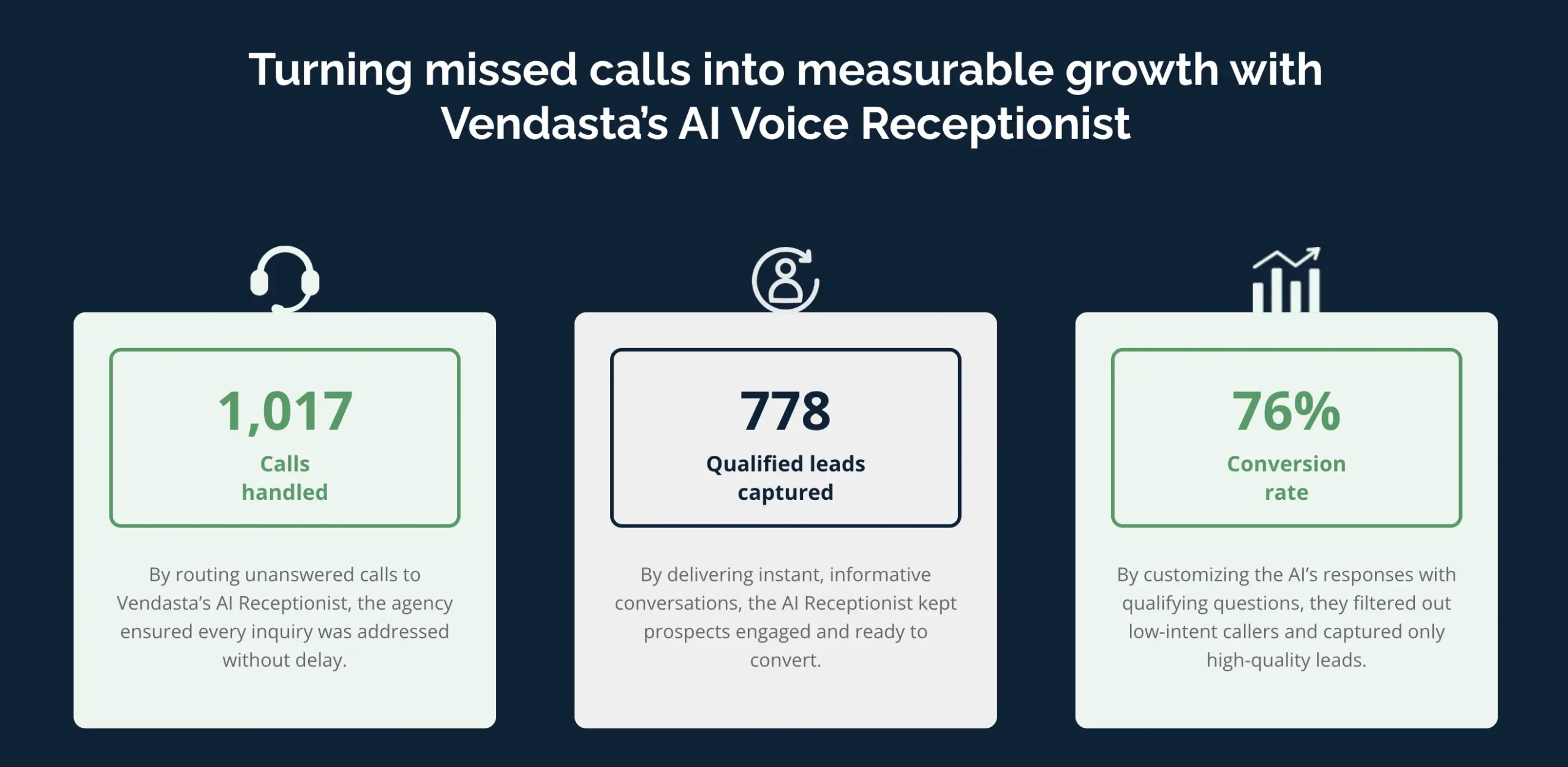
Vendasta’s partner results put numbers behind that claim. Elite Web Professionals deployed Vendasta’s AI Receptionist for Choice Signature Luxury Car Rental, where it handled 1,017 calls and qualified 778 leads, producing a 76% conversion rate over four months. For an agency, that means booked appointments and captured demand the client would otherwise have lost to voicemail.
4. Onboarding
New customers get welcome sequences and setup guidance without waiting on a human. The business can train AI on its own knowledge base to handle common first-week questions and escalate unusual ones with context attached.
5. Retention
AI keeps customers by responding before frustration compounds. It provides 24/7 answers and proactive follow-ups while identifying churn risk from behavioral signals. Given the Genesys finding that two or three bad interactions are enough to move a customer, answering at 11 p.m. can help retain customers. Falling booking frequency and a lapsed renewal date can prompt early intervention, as can an unresolved support thread.
6. Expansion & Upsell
AI spots expansion signals humans miss, such as usage patterns that indicate a customer has outgrown their current plan, and times renewal outreach to engagement peaks rather than calendar dates. Customers may respond differently depending on timing: an upgrade conversation opened in a week when the customer is logging in daily lands differently from the same offer sent on the contract anniversary.
7. Loyalty & Advocacy
AI turns satisfied customers into visible ones by requesting reviews when satisfaction peaks, right after a completed job or a resolved ticket, and responding to every review in the reviewer’s language. Coverage matters as much as volume, since the next prospect reading the profile sees how the business answers criticism in public.
Key AI Technologies Transforming Customer Engagement
Four AI categories are reshaping customer engagement:
- Conversational AI covers chat, voice, and SMS assistants that handle direct two-way interactions in real time.
- Predictive AI uses first-party behavioral data to score churn risk, purchase intent, and lifetime value before a customer acts.
- Generative AI produces campaign copy, personalized replies, and creative assets on demand.
- Agentic AI executes multi-step workflows end-to-end, capturing a lead, qualifying it, and booking the appointment without human handoffs.
Together, these four categories cover the customer lifecycle from first ad through renewal.
AI-Powered Chatbots and Virtual Assistants
AI-powered chatbots and virtual assistants handle two-way conversations across chat, voice, SMS, and social messaging.

Deploy them where consumers want them:
- Qualtrics XM Institute data shows 63% of consumers are comfortable using AI to check order status but only 39% for resolving billing issues.
- Gartner’s survey found 64% of customers would prefer companies not use AI in customer service at all, so design the human escalation path before you launch the bot.
Vendasta’s Conversations AI addresses this with a unified inbox where AI handles routine volume, and humans pick up flagged conversations with full history.
Agent Assist: Triage, Summarization, Smart Reply, and Sentiment
The highest-return AI in customer engagement often never talks to the customer at all. The agent-assist layer sits between full automation and unaided human work. Instead of replacing the agent, it handles the cognitive overhead that slows agents down — reading back through threads, deciding what to prioritize, drafting replies from scratch, and writing up notes after the call ends.
That overhead is where time and quality both leak, and it is where AI can close the gap without introducing the customer-facing risk that makes full automation a harder sell.
- Intelligent triage routes and prioritizes inbound messages by topic and urgency, so the billing dispute does not sit behind an hours-of-operation question while the customer’s frustration compounds.
- Summarization writes the case summary and after-call notes automatically, so the next agent or manager does not have to re-read the entire thread to get up to speed.
- Smart reply drafts the response the human edits and sends, drawing on the business’s own knowledge base — the agent still owns the message, but the blank page problem disappears.
- Sentiment analysis scores tone across conversations and reviews in real time, so a frustrated customer surfaces before they post publicly and the window to recover the relationship stays open.
The evidence for this layer is unusually strong. Brynjolfsson, Li, and Raymond’s peer-reviewed study of 5,179 customer-support agents across 3 million chats found AI assistance increased issues resolved per hour by 14–15% on average, meaning a small client team can handle more volume without adding headcount. The gain was 34% for novice workers, which matters for agencies whose clients often rely on newer or part-time staff, and manager escalation requests fell by nearly 25%, freeing senior people for higher-value work.
Metrigy’s study of 697 companies found average handle time dropped 29.5% with agent assist, and after-call work fell from 16.2 to 10.4 minutes; time that was previously invisible overhead now returned to productive capacity. Together, these numbers make the business case straightforward: agent assist raises the ceiling on what a small client team can handle without changing headcount, and it is the least risky AI deployment available because a human still signs off on every customer-facing word.
Predictive Analytics for Customer Insights
Predictive models use first-party behavioral data to score churn risk and purchase intent. They can also estimate lifetime value. McKinsey estimated that AI could reduce a global payments processor’s merchant attrition by up to 20% per year by flagging at-risk merchants early enough to intervene.
For a local business, the same logic applies at a smaller scale: the customer who stopped booking monthly appointments three weeks ago is a save opportunity today and a lost account next quarter.
Personalized Marketing Automation
AI-powered marketing automation layers machine-driven decisions onto the delivery infrastructure agencies already run: what message to send and which channel and time to use for each contact. Agencies have a strong commercial reason to build this competency.
StackAdapt reports 99% of agencies say digital personalization directly increases client revenues, yet only one in five organizations have fully implemented personalization across channels. The gap between belief and execution is the service opportunity.
Generative AI for Campaign and Creative Production
The production workload behind AI customer engagement is concrete and repetitive: campaign email and SMS copy, ad variants, landing-page text, social posts adapted per platform, review replies written in the reviewer’s language, and blog articles built around the questions customers actually ask. These are the assets that have to exist before any delivery or personalization layer can do its job, and they accumulate fast across a multi-client portfolio.
What separates specific output from generic output is the training context the model draws on. A generic prompt-based tool has no knowledge of the business, so it produces copy the business has to rewrite before it can use it. A model trained on the business’s own website, service list, pricing, policies, and past conversations produces copy that is already on-brand and factually grounded.
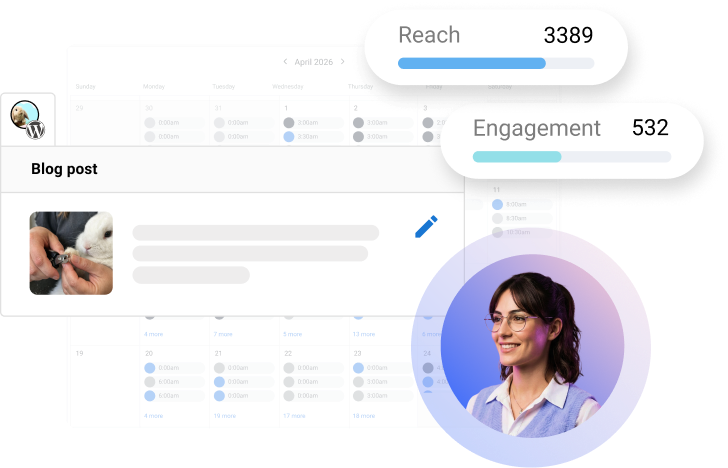
Vendasta AI Social Media Manager learns brand voice and visuals and publishes platform-adapted content on schedule. Vendasta AI Blogger researches the questions customers are actually asking, produces one SEO-optimized article per week, publishes it to WordPress, and can pass it directly to AI Social Media Manager for social distribution — closing the loop between content creation and audience reach without a manual handoff.
The honest tradeoff is that generative output scales volume, not judgment. Approval workflows matter, and Social AI supports both approval workflows and full autopilot depending on edition, with every action logged for proof of performance. The agency economics shift accordingly: LeadWorks reduced content production time by 90%, which illustrates the broader shift — the production line that once required a copywriter per client becomes one review pass across a portfolio.
What Are the Best AI Tools for Customer Engagement?
No single platform wins every category — the right choice depends on how well a tool fits the business’s operating context and the agency’s delivery model. Four criteria run throughout this section: whether the tool trains on the business’s own data, which channels it covers, whether every action is logged for reporting, and whether it can be deployed white-label across many client accounts.
| Platform | Intended User | Distinguishing Strength | Meaningful Limitation | Best For |
|---|---|---|---|---|
| Zendesk AI | Mid-market and enterprise support teams | Mature ticketing and AI resolution workflows | Priced and scoped around support desks rather than local-business acquisition | Organizations that need proven, structured support-desk automation at scale |
| Salesforce Einstein and Agentforce | Enterprise service organizations | Deep CRM-native agentic workflows | Implementation and administration overhead that outpaces a local business | Large enterprises with dedicated Salesforce administrators and complex service operations |
| HubSpot | Marketing and sales teams | Unified marketing and service records with broad integrations | AI service depth trails dedicated service platforms | Teams that prioritize marketing-to-service continuity over deep conversational AI |
| Intercom | Product-led and digital-first businesses | Conversation-first AI resolution with outcome-based pricing | Less suited to phone-heavy local service work | SaaS and digital products where chat is the primary support channel |
| Google Contact Center AI | Contact centers with engineering resources | Strong voice and speech models | Requires developer build-out rather than out-of-the-box deployment | Organizations with in-house engineering capacity and high-volume voice operations |
| Vendasta | Local businesses and the partners serving them | AI Employees that complete workflows using the business’s own data with every action logged, can be deployed white-label across client accounts | The AI Search Specialist is currently in open beta | Agencies and partners managing AI-powered engagement across a portfolio of local business clients |
Vendasta is purpose-built for the local business context and the agencies that serve it, which means the platform’s AI Employees are designed to operate within the data, brand voice, and workflow constraints that define a service business rather than a digital-first enterprise.
Every action an AI Employee takes is logged, giving agency partners the reporting layer they need to demonstrate value and retain clients. The spend-offset subscription model, with plans starting at $99 per month, is structured so that the efficiency gains AI delivers can absorb the cost of the platform itself, making the business case straightforward to present.
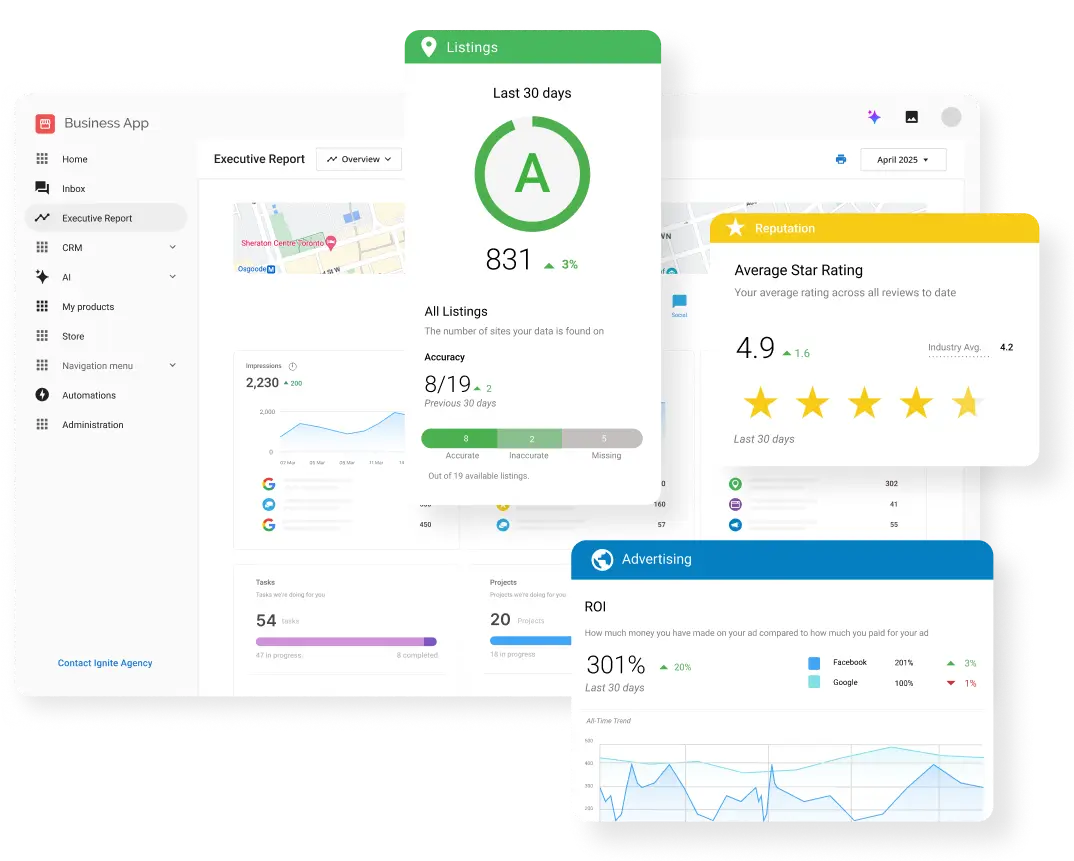
Multi-tenant deployment keeps each client’s brand context intact across the account base, so an agency managing dozens of local businesses can maintain consistent, on-brand AI engagement for each one without rebuilding configurations from scratch.
Why First-Party Data Is the Engine Behind AI Customer Engagement
Every AI capability above runs on the business’s own data: CRM records, conversation history, purchase behavior, and reviews. The old urgency argument for first-party data, Google’s third-party cookie deadline, is dead; Google announced in April 2025 that it would maintain its current approach to cookie choice in Chrome. The argument that replaced it is reach: 34.9% of US browsers already block third-party cookies by default, and IAB’s State of Data found 71% of brands and publishers, along with agencies, were currently growing or planning to grow first-party datasets, nearly double the rate of two years prior.
Data quality is the bottleneck. Salesforce’s 2026 State of Marketing research found only 27% of SMB marketers are completely satisfied with their ability to unify customer data, and calls messy data “the number one blocker stopping SMBs from getting real value out of AI.” The infrastructure is mostly in place already: the vendor-commissioned Salesforce Small Business Trends Report found 92% of SMB marketing teams use CRM technology, so the work is consolidating conversations and transactions, along with reviews, into that system of record before pointing AI at it. Train AI on a specific business’s data so it answers like that business; without that data, its answers remain generic.
The Risks of AI Customer Engagement: Hallucinations, Tone, and Privacy Law
AI customer engagement earns its place in an agency’s toolkit: faster response times, more volume handled without added headcount, availability that no human team can match. But like any new operating layer, it comes with failure modes. The good news is that they’re documented, specific, and largely preventable.
Hallucinated Answers Create Real Liability
In Moffatt v. Air Canada, an Air Canada chatbot ruling established that a chatbot told a grieving customer he could apply retroactively for a bereavement fare — a policy that did not exist. The BC Civil Resolution Tribunal held the airline responsible and ordered it to pay $812.02 in damages, rejecting Air Canada’s argument that the chatbot was a separate legal entity.
That case is not an outlier. A 2025 HalluDetect benchmark paper on consumer-grievance chatbots found hallucinations in 46.67% to 63.33% of tested chats depending on architecture — meaning nearly half to nearly two-thirds of conversations produced at least one fabricated claim.
The control is straightforward: restrict the AI strictly to the business’s own knowledge base of services, pricing, policies, and hours, and require automatic escalation to a human agent for any question that falls outside it. An AI that says “I don’t have that information — let me connect you with someone who does” creates far less liability than one that invents a confident answer.
Wrong Tone Damages the Brand Faster Than Slow Replies
A BBC news report on the DPD chatbot incident documented how a UK parcel firm disabled its support chatbot after it swore at a customer and criticized its own employer in a public exchange. Separately, New York City’s MyCity business chatbot was reported to be giving businesses incorrect legal guidance — advice that, if followed, could have exposed those businesses to real penalties.
Both cases share the same root cause: the AI was not constrained to a defined brand voice or a defined set of topics. Without those guardrails, a general-purpose language model will fill gaps with whatever output its training makes probable, regardless of whether that output is accurate, appropriate, or on-brand.
The control is to train the AI on the business’s own content to establish brand voice, define explicitly which topics it will and will not handle, and review logged conversation output during the first month of deployment. Problems surface quickly when someone is actually reading the transcripts.
GDPR, CCPA, and AI Transparency Are Now Compliance Obligations
The rules are catching up to the technology. In the EU, Article 50 of the AI Act has required chatbots to disclose they’re AI since 2 August 2026. GDPR Article 22 separately gives consumers the right not to be subject to decisions based solely on automated processing. In California, CPPA regulations on automated decision-making took effect January 1, 2026, with full compliance due by January 1, 2027.
For agencies, the practical takeaway is simple: when you deploy AI on a client’s behalf, you configure the disclosure, and that obligation follows each client’s customers into whatever jurisdiction they’re in. The control is to add a visible AI disclosure at the first interaction and maintain a jurisdiction checklist for where each client’s customers actually are.
None of this is a reason to avoid AI. It’s a reason to deploy it with the same care you’d apply to any client-facing system.
The 4 Stages of AI Customer Engagement Maturity
Businesses can adopt engagement AI in a sequence. Vendasta’s four-stage maturity framework tracks it: Reactive → Behavioral → Predictive → Autonomous. Knowing which stage a client is in tells you what to sell next.
Stage 1: Reactive Automation
AI responds when triggered and does nothing otherwise. A chatbot answers FAQs, and missed calls get a text back. Review requests also fire after a transaction. Setup is fast, risk is low, and the payoff is capturing demand that previously leaked through after-hours calls or weekend web chats while AI answers reviews.
Stage 2: Behavioral Personalization
AI starts adapting to individual behavior. Email content varies by past engagement, while chat responses draw on the customer’s history. Send times also optimize per contact. The prerequisite is unified first-party data; this is the stage where fragmented tech stacks stall.
Stage 3: Predictive Engagement
AI acts before the customer does. Churn models flag at-risk accounts, while lead scoring prioritizes the pipeline. Next-best-action recommendations guide both automated and human outreach. This stage requires enough historical data to train reliable models, typically several quarters of clean CRM records.
Stage 4: Autonomous Optimization
AI executes end-to-end workflows and improves them without human direction: capturing a lead, qualifying it, booking the appointment, following up, requesting the review, and adjusting its own approach based on outcomes. Humans set goals and guardrails and review the logs. Gartner predicts agentic AI will autonomously resolve 80% of common customer service issues by 2029, reducing operational costs by 30%, which describes Stage 4 operating at scale.
Where Most SMBs Stand Today
Vendasta interprets adoption and maturity data as evidence that many local businesses remain in the early stages. Adoption figures vary widely by definition: the Federal Reserve’s Report found 46% of small employer firms currently use AI, while the SBA Office of Advocacy, using a narrower definition, measured 8.8% among small firms as of September 2025.
Maturity lags adoption everywhere; McKinsey’s State of AI found only 1% of company executives describe their gen AI rollouts as mature, and its customer-experience research found 95% of organizations still in pilot phase. For agencies, this distribution points to broad room for local-business clients to advance.
How to Implement AI Customer Engagement
Implementation succeeds or fails on sequencing. The Federal Reserve’s 2026 barrier data shows why: among firms planning to use AI, 54% cite finding or adapting tools to meet business needs as a barrier. Firms also cite implementation or training time (37%) and data security and privacy concerns (32%). Cost follows at 29%.
Step 1: Evaluate Your Current Customer Engagement Strategy
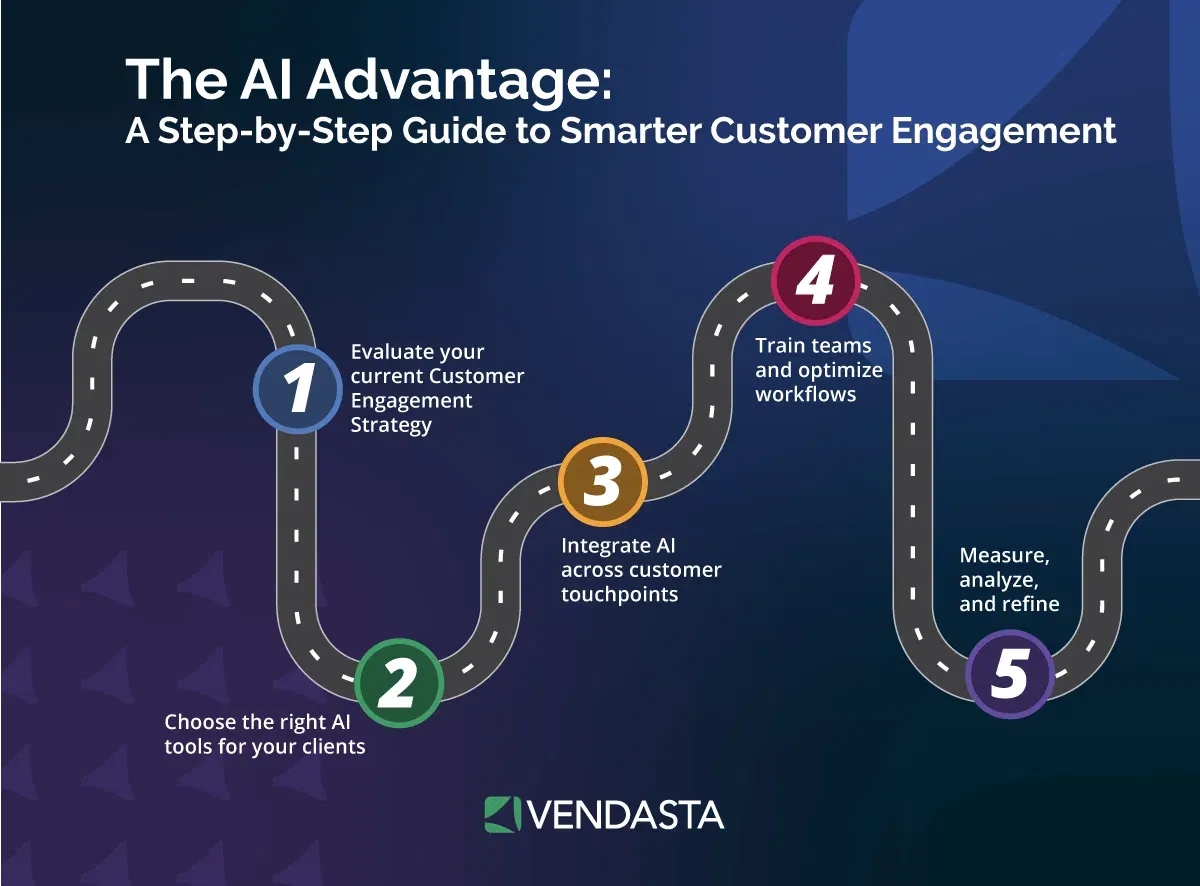
Map every touchpoint where customers contact the business and measure current performance, including response times and after-hours coverage. Review response rates and follow-up consistency as well. The gaps you find, such as calls ringing out at 6 p.m. or leads waiting two days for a reply, become the AI deployment priorities. Audit the data foundation at the same time, since AI personalization is only as good as the CRM feeding it.
Step 2: Choose the Right AI Tools for Your Clients
Match tools to the gaps from Step 1 rather than buying a category. Evaluate AI software on four criteria: does it train on the business’s own data, does it cover the channels customers use, does it log every action for reporting, and, for agencies, does it deploy white-labeled across many client accounts. Compare AI marketing tools on the same basis. For portfolio-scale use, assess how a point solution will integrate with the agency’s other channels and client accounts.
Step 3: Integrate AI Across Customer Touchpoints
Prioritize the channel with the largest measured leakage, then expand. Chatbots integrated with the CRM can use customer records, while calendar and knowledge-base connections can support appointment booking and business-specific answers. Configure each channel to write to a shared inbox and customer record so the AI and human team can work from the same history.
Step 4: Train Teams and Optimize Workflows
Teams need to know when to trust the AI and when to take over. Among AI-adopting small businesses, 88% want more training and support to implement AI successfully (Goldman Sachs), so include training time as a line item. Define escalation rules explicitly: identify topics AI never handles and specify what context transfers with a handoff. Assign someone to review AI output during the first month.
Step 5: Measure, Analyze, and Refine
Review AI performance weekly at launch, then monthly. Conversation intelligence tools surface what customers ask and where AI answers fall short. They also reveal which handoffs frustrate people, turning anecdotes into a tuning backlog. Feed the findings back into the knowledge base and prompts; Stage 4 maturity is this loop running continuously.
How to Measure the Impact of AI on Customer Engagement
Measure against realistic benchmarks, because vendor decks and reality diverge. Independent syntheses put AI self-service deflection at a median of 22% (range 8–45%) per HappySupport.ai’s analysis, while Creative Genius found a median of 47% with a top quartile of 58–73%. Track these metrics from day one:
- Containment and deflection rate: Count the share of interactions AI resolves without a human, and judge it against the independent medians above rather than vendor claims.
- Response and resolution time: Track first-response time on every channel and time to full resolution, since customers feel these two most directly.
- Customer satisfaction by channel: Split CSAT between AI-handled and human-handled interactions, and watch what the score does when an issue goes unresolved.
- Conversion and booking rate: Count leads captured and qualified, then measure how many convert to appointments. Agency leaders can use these results to evaluate the revenue case.
- Retention and repeat purchase: You confirm everything upstream worked when repeat purchase rate climbs.
Set expectations by horizon. Gartner’s guidance says sales conversion improvements can show in 8–12 weeks and labor cost optimization within a fiscal quarter. Time-to-value metrics can take 6–12 months. BCG’s survey found a typical pattern of 3 months for implementation and 3 months for initial benefits.
The Business Case for AI Customer Engagement
Businesses can justify AI customer engagement through revenue growth and cost control. Customer lifetime value provides the longer-term payoff. Results depend on implementation quality and disciplined measurement.
1. Revenue Growth
The strongest causal evidence comes from randomized experiments: Fang et al.’s field experiments found generative AI applications produced sales lifts up to 16.3%, and McKinsey’s B2B work documented a global industrials case with 40% higher conversion rates from an AI-enabled growth engine. For agencies, the revenue lever is the same one their clients pull, applied across a portfolio: every account that captures more of the demand already reaching it becomes easier to keep and expand.
2. Cost Reduction
Gartner projects agentic AI resolving 80% of common service issues by 2029 will cut operational costs by 30%, and a Deloitte consulting case study documented a client reaching $0.45 average cost per call, down from $10. Calibrate against the sober numbers: Roland Berger’s study found average realized gains of 11.5% in process efficiency and 11.7% in operating cost reduction among AI-powered organizations, and Gartner warns GenAI cost per resolution will exceed $3 by 2030, above many offshore human agent costs. Cost savings are achievable and usually smaller than the pitch deck says.
3. Customer Lifetime Value Expansion
BCG found personalization leaders in retail grow revenue 10 percentage points faster than laggards, with returns on personalized offers 3× higher than mass promotions. BCG also cautions that 20–40% of active personalization programs deliver hardly any incremental lift without randomized holdout groups to verify it, so build measurement discipline into the program from the start. For agencies, the CLV math compounds twice: the client’s customers stay longer, and the client stays longer with the agency as engagement services embed deeper into their operations.
The Future of AI Customer Engagement: From Automation to Autonomous Growth
Gartner projects that agentic AI will autonomously resolve 80% of common service issues by 2029, cutting operational costs 30% — describing Stage 4 as an operating model rather than a feature. Two constraints shape how quickly that arrives: Gartner expects GenAI cost per resolution to exceed $3 by 2030, above many offshore human agent costs, so quality of resolution matters more than raw deflection volume.
McKinsey’s June 2025 finding that 95% of organizations are still piloting customer-experience AI confirms that execution, not strategy, is the bottleneck. The practical next move for agencies is narrow: pick one client, move them one stage up the framework this quarter, and put what the deployment produced in next month’s report.
To see how that process can operate across your client portfolio without adding headcount, book a Vendasta demo.
AI Customer Engagement FAQs
1. What is AI customer engagement in simple terms?
It’s software that uses artificial intelligence to handle customer interactions. It can answer questions and book appointments while sending personalized messages and flagging customers likely to leave. It works across channels such as chat, phone, text, email, and social, and it learns from each interaction when product teams design and configure it to do so.
2. How is AI customer engagement different from marketing automation?
Marketing automation executes rules a person wrote: if a contact fills a form, send email A. AI engagement can make decisions from data and hold two-way conversations while improving without anyone rewriting every workflow. Most businesses run both, with automation as the delivery layer and AI as the decision layer.
3. How does AI customer engagement improve customer retention?
It provides instant 24/7 responses that can prevent the bad interactions driving customers to switch. Predictive models can also flag at-risk customers early enough to intervene, while automated follow-up reduces reliance on a busy team’s memory. McKinsey documented one case where AI targeting cut churn intention 59% among high-value at-risk customers.
4. Is AI customer engagement suitable for small and medium-sized businesses?
Yes, and arguably more so than for enterprises, because it gives a small team enterprise-grade responsiveness. Nearly half of small employer firms already use AI in some form per the Federal Reserve’s 2026 survey, and a three-person shop with an AI receptionist can answer the 9 p.m. call as promptly as a 300-person one.
5. What data is required for AI customer engagement to work effectively?
First-party data includes CRM contact records, conversation history, purchase and appointment history, reviews, and the business’s own knowledge base (services, pricing, policies, hours). Unifying that data in one system matters more than the volume; fragmented data is the top blocker local businesses report.
6. How long does it take to see results from AI customer engagement?
Reactive deployments such as chatbots and missed-call text-back can show captured-lead results within weeks. Gartner’s guidance puts sales conversion improvements at 8–12 weeks and labor savings within a quarter; Forrester TEI interviewees reported implementation timelines from two weeks to six months depending on scope.
7. Can AI customer engagement replace human customer service teams?
AI works best as a complement to human customer service teams. Klarna scaled back its AI agent and resumed hiring human service workers in May 2025 after finding users preferred human interaction. The working model assigns routine volume to AI and routes complaints and other cases that need human judgment, including relationship work, to humans.
8. What are the key metrics to measure AI customer engagement success?
Track containment rate, which measures interactions AI resolves alone, along with first-response and resolution time. Also measure CSAT by handler type and lead-to-appointment conversion. Track retention as well. Benchmark deflection against independent medians in the 22–47% range instead of vendor claims.
9. How does AI customer engagement support multi-channel communication?
Depending on the platform and integrations, AI can support phone, web chat, SMS, email, WhatsApp, Facebook Messenger, and Instagram. Configure the platform to log interactions to a shared inbox and customer record so customers can move between supported channels with less repetition, and the business can follow one continuous conversation.
10. Can I use ChatGPT for customer service?
ChatGPT works well for drafting replies a human then reviews, but as a general-purpose assistant it has no knowledge of your hours, pricing, or policies, cannot book against a live calendar, and logs nothing for reporting. It also will not satisfy chatbot disclosure requirements on its own.
11. What is the 30% rule in AI?
There is no formal 30% rule. The phrase typically refers to Gartner’s projection that agentic AI will autonomously resolve 80% of common service issues by 2029, cutting operational costs by 30%. It is also used loosely for the share of work AI can absorb. Treat 30% as a cost-reduction estimate, not a fixed law.
12. What should businesses look for in an AI customer engagement platform?
Look for a platform whose team can train its AI on the business’s own data and that covers the channels its customers use. The platform should also provide activity logs and performance reporting. For agencies, add white-label multi-account deployment so every client sees the agency’s brand. Start with a needs assessment of current engagement gaps, then match the platform to those gaps.
This article was originally published in February 2026 and was updated in September 2026 to include the latest information and insights.