About Us
 Careers
 Leadership
 Board
Board Newsroom
Your franchise brand is strong. Your service is proven. But if customers in your locations can’t find you on Google, none of that matters. Most franchise networks spend heavily on national brand awareness while quietly bleeding leads at the local search level, where buying decisions actually happen.
Here’s the uncomfortable truth: 46% of all Google searches have local intent, according to HubSpot. For franchise businesses serving specific zip codes, neighborhoods, and cities, local search visibility isn’t a nice-to-have. It’s the difference between a fully booked calendar and a franchisee calling corporate to complain about slow leads.
The problem is that SEO for franchise websites isn’t like optimizing a single-location business. You’re managing dozens, hundreds, or even thousands of location pages, all competing in different markets, all needing consistent NAP data, localized content, and individual Google Business Profiles. Without a scalable system, the whole thing falls apart fast.
This guide covers everything: the strategy, the structure, the technical details, and the tools that make franchise-wide SEO manageable without burning out your corporate marketing team.
Streamline operations and ensure brand consistency for franchise success
TL;DR
- Local SEO is where franchise revenue is won or lost: 46% of Google searches have local intent, and franchises that don’t optimize each location individually lose leads to competitors who do.
- Consistency at scale is the core challenge: Managing NAP data, Google Business Profiles, location pages, and content across 20 to 500+ locations requires a centralized platform, not a manual process.
- AI-powered platforms change the game: Tools like Vendasta automate listing management, reputation monitoring, local content, and lead follow-up across every franchise location from a single dashboard.
What Is SEO for Franchise Websites?
Franchise website SEO is the practice of optimizing a franchise brand’s online presence so that both the corporate site and each individual franchise location rank well in search engines, particularly for local searches in their respective service areas.
It combines technical SEO, on-page content strategy, local SEO, and reputation management, all applied simultaneously across multiple locations under a single brand umbrella. The challenge is maintaining brand consistency while also allowing each location to rank for hyper-local terms like “lawn care service in Austin, TX” or “residential cleaning near me.” If you’re just getting started, our deeper guide to franchise SEO strategy covers the foundational principles in detail.
Franchise SEO vs. Traditional SEO: What’s Different?
Standard SEO focuses on one domain, one audience, and one set of keywords. Franchise SEO multiplies every variable by the number of your locations. Here’s how the two compare:
| Factor | Traditional SEO | Franchise SEO |
|---|---|---|
| Domain structure | Single domain | Parent domain + location subpages or subdomains |
| Keyword targeting | One set of target keywords | Location-modified keywords for every market |
| Content creation | Centralized | Localized per market, at scale |
| Google Business Profiles | One profile | One per location, all managed centrally |
| Duplicate content risk | Low | High without a deliberate content strategy |
| Reporting | Single dashboard | Network-wide visibility with per-location drill-down |
The scope is what makes franchise SEO both powerful and complex. Done right, a 50-location franchise can dominate local search in every market it operates. Done poorly, each location competes against itself, loses to local independents, and drains corporate marketing resources without generating measurable ROI.
Why Franchise Local SEO Strategy Is the Foundation of Network-Wide Growth
Before diving into tactics, it’s worth understanding why local SEO is disproportionately important for franchise businesses compared to other marketing channels.
According to Google, 76% of people who conduct a local search on their smartphone visit a business within 24 hours, and 28% of those searches result in a purchase. For home services franchises, this behavior maps almost perfectly to how customers find and book services.
A customer searching “HVAC repair near me” or “residential cleaning in [city]” is not browsing. They’re ready to act. If your franchisee doesn’t appear in the local 3-pack or top organic results for that search, a competitor takes the job.
The Hidden Cost of Poor Local SEO Across Your Network
Consider a franchise network with 50 locations, each handling 200 monthly leads. Industry data suggests that roughly 30% of captured leads never get properly followed up on, and many more are lost at the top of the funnel before even submitting a form or making a call.
When you layer poor local search visibility on top of that, the numbers compound quickly. Corporate may be pouring budget into paid ads and brand campaigns while franchisees quietly bleed revenue from search because their location pages are generic, their Google Business Profiles are incomplete, or their NAP data is inconsistent across the web. Franchise marketing automation is increasingly how leading networks close this gap at scale.
A franchisee revenue problem is always, at some level, a lead generation problem. And a lead generation problem in 2025 is always, in part, a local SEO problem.
How to Structure Your Franchise Website for SEO Success
The architecture of your franchise website has a bigger impact on local search performance than most franchise marketers realize. The wrong structure creates duplicate content penalties, confused crawlers, and location pages that never rank.
Choose the Right URL Structure
There are three primary approaches for franchise site architecture. Each has tradeoffs:
- Subdirectories (recommended):
yourbrand.com/locations/austin-tx/— consolidates domain authority and is easiest for corporate to manage. Google tends to favor this structure for franchise SEO. - Subdomains:
austin.yourbrand.com— can work, but Google may treat subdomains as separate sites, splitting authority. Use this approach only if location-level customization demands it. - Separate domains:
yourbrand-austin.com— creates significant management overhead, dilutes brand authority, and makes centralized SEO reporting difficult. Generally avoid for franchise networks.
For most franchise brands in home services, the subdirectory model is the clear winner. It keeps domain authority centralized, makes it easier to manage technical SEO at scale, and keeps the corporate team in control of the brand experience.
Build Unique, Optimized Location Pages
This is where many franchise websites fail. Generic, copy-pasted location pages with only the city name swapped out are a recipe for thin content penalties and poor rankings.
Every location page needs to be a genuinely useful resource for someone in that market. Here’s what each page should include:
- A unique title tag and meta description that include the city and primary service (e.g., “Lawn Care in Austin, TX | [Brand Name]”)
- A unique H1 that includes the location and primary keyword
- Locally relevant content: mention of neighborhoods served, local landmarks, regional climate considerations, or community involvement
- Embedded Google Map for the location
- Local phone number (not a toll-free corporate number)
- Location-specific reviews or testimonials
- Structured data markup (LocalBusiness schema)
- Clear calls to action, including click-to-call and booking links
If you have 100 locations, creating 100 truly unique pages sounds daunting. This is exactly where AI content tools become essential for franchise marketers. More on that shortly.
Create a Clear Location Finder
A well-built location finder helps both users and search engines. Include a search-by-zip-code or city feature that surfaces the nearest franchisee, linking to their dedicated location page. Make sure the location finder is crawlable and not buried behind JavaScript that search bots can’t index.
Your sitemap should include every location page with proper hreflang tags if you operate in both the US and Canada, and your internal linking structure should allow crawlers to reach every location page in three clicks or fewer from the homepage.
Google Business Profile Optimization for Franchise Locations
Your Google Business Profile (GBP) is arguably the single most important local SEO asset for each franchise location. It determines whether you appear in the local 3-pack, how customers find your phone number, and how your reviews are presented to searchers.
According to Backlinko, businesses with complete GBP listings are 70% more likely to attract location visits from potential customers. For a franchise with 50 locations, every incomplete profile is a missed revenue opportunity.
Franchise GBP Best Practices
- Claim and verify every location: Unverified listings are invisible in local pack results. Corporate should manage the verification process centrally to ensure nothing falls through.
- Use consistent NAP data: Name, address, and phone number must be identical across GBP, your website, and every directory listing. Even minor inconsistencies (St. vs. Street, Suite vs. Ste.) can hurt rankings.
- Select the right primary and secondary categories: Be precise. “Lawn Care Service” ranks differently than “Landscaping Company.” Review competitor GBP categories to ensure you’re not leaving category authority on the table.
- Add location-specific photos regularly: GBP profiles with photos receive 42% more requests for directions and 35% more website clicks, per Google’s own data. Have each franchisee submit real job photos monthly.
- Respond to every review: Review responses signal engagement to Google and influence conversion rates for potential customers reading them. This is nearly impossible to do manually across a large network without automation.
- Post regular GBP updates: Google Posts (offers, events, updates) keep your profile fresh and can improve visibility for competitive searches.
- Enable messaging and booking: If your franchise offers appointment scheduling, enabling direct booking through GBP can meaningfully increase conversion rates from local search.
Managing GBP Across 50+ Locations Without Losing Your Mind
Manually managing GBP for a large network is not realistic. Corporate teams working location by location quickly find themselves overwhelmed. The solution is a centralized platform that lets you push updates, manage reviews, and track performance across every profile from a single dashboard.
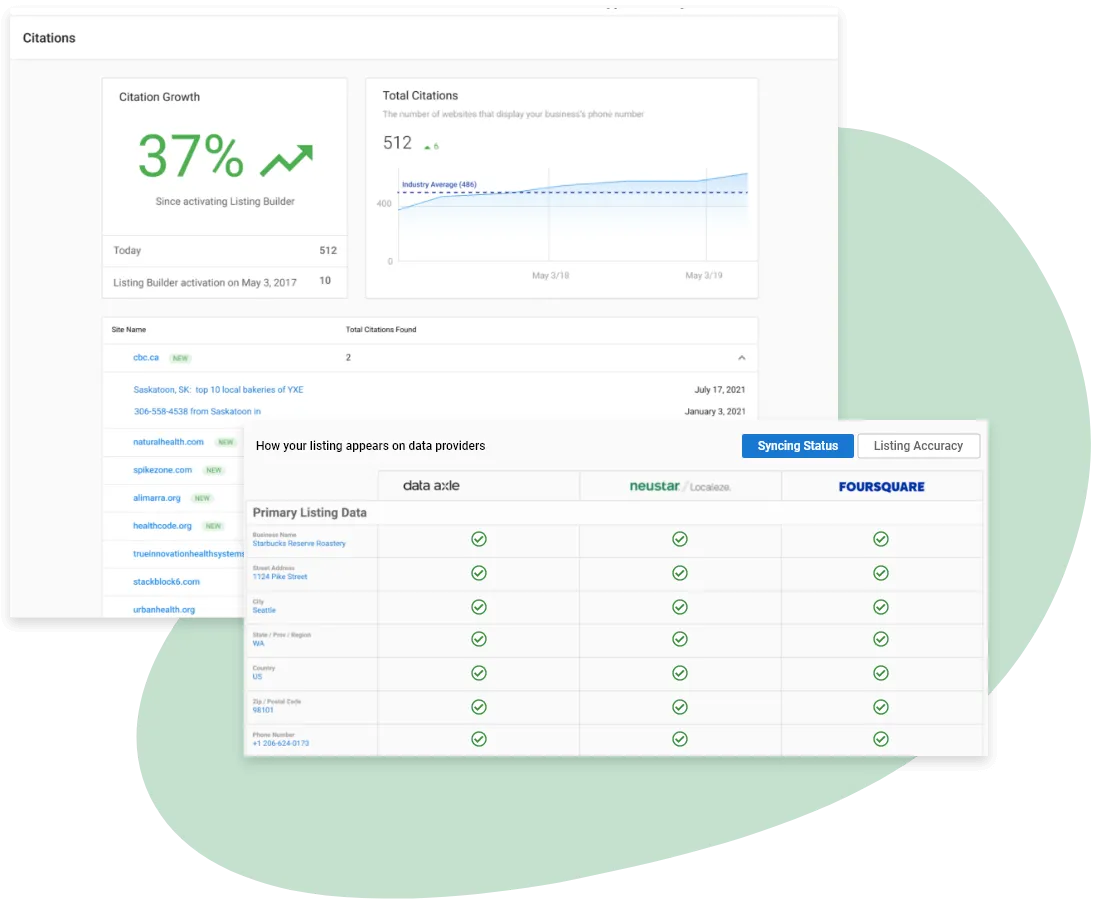
Vendasta’s Local SEO tools include Listing Sync, which syncs your business information to Google Business Profile, Facebook, Bing, and other directories simultaneously. When a phone number changes at a location or a new franchise opens, one update pushes to every platform instantly. No more chasing inaccurate listings across the web.
Keyword Strategy for Franchise SEO: How to Rank in Every Market
Keyword research for franchise networks isn’t a one-time exercise. Every market has different competition levels, different search volumes, and different customer vocabulary. A scalable keyword strategy accounts for all of this.
Start with a Core Keyword Framework
Build your keyword strategy in layers:
- Brand keywords: Your brand name + location modifiers (e.g., “[Brand] Austin”). These are often already ranking and should be protected.
- Service + location keywords: The core of your local SEO strategy. “[Service] in [City]” or “[Service] near [Neighborhood].” These drive direct booking intent.
- Problem-based keywords: “Why is my lawn turning brown in Texas summer” or “how to find a reliable house cleaner.” These attract top-of-funnel traffic and build topical authority.
- Competitor keywords: Targeting branded terms from local competitors can help franchisees steal market share in specific cities.
Localize Your Keyword Research for Each Market
Tools like Ahrefs and Google Keyword Planner allow you to filter search volume by location. Use this to identify high-opportunity keywords in each franchisee’s market before building their location page content.
A keyword that drives 1,000 monthly searches nationally might have very different local volumes. In some markets, you may find less competitive long-tail terms with high conversion rates that are far easier to rank for than the generic head terms.
Watch for Keyword Cannibalization
If you have multiple locations serving overlapping geographic areas, two location pages can end up competing for the same keyword. This splits your ranking signals and reduces the performance of both pages. Use geographic specificity (city vs. neighborhood) to create clear content boundaries between locations, and use Google Search Console to monitor which pages Google is indexing for specific queries.
Technical SEO for Franchise Websites: The Foundation That Makes Everything Work
Content and listings are visible. Technical SEO is invisible, but without it, everything else underperforms. Franchise websites face specific technical challenges that single-location businesses simply don’t encounter.
Duplicate Content: The Biggest Technical Risk for Franchises
When location pages share the same body copy with only the city name changed, Google sees it as thin, duplicate content. Pages may be deindexed, or the wrong page may rank for local searches.
Prevention strategies include:
- Writing genuinely unique introductory and closing paragraphs for each location page
- Adding location-specific content blocks (local team bios, local testimonials, local project highlights)
- Using canonical tags strategically if template-based content is unavoidable
- Auditing your site regularly with tools like SEMrush Site Audit to catch duplicate content issues before they affect rankings
Schema Markup for Franchise Locations
Structured data (schema markup) helps Google understand exactly what each page is about and can unlock rich results in search. For franchise websites, the most important schema types are:
- LocalBusiness schema: Add this to every location page, with the location-specific name, address, phone number, hours, and service area.
- Organization schema: Add this to your corporate homepage to establish brand identity.
- Review schema: When embedding testimonials or review data on location pages, mark them up properly to potentially surface star ratings in search results.
- Service schema: Define each service offered at a location, which supports visibility in Google’s service-related rich results.
Use Google’s Rich Results Test to validate your markup after implementation. Errors in the schema can actively hurt your visibility, so testing before publishing is non-negotiable.
Page Speed and Core Web Vitals
Google uses Core Web Vitals as a ranking factor, and franchise websites, often built on shared templates, can struggle here. Large header images, unoptimized scripts, and heavy page builders all slow load times at scale.
Run every location page template through Google PageSpeed Insights and address the top issues. Because your location pages share a template, fixing performance issues once benefits every location simultaneously, making this one of the highest-ROI technical SEO improvements a franchise can make.
Mobile Optimization
More than 60% of local searches happen on mobile devices. If your location pages aren’t fast, readable, and easy to navigate on a phone, you’re losing customers before they even see your content. Click-to-call buttons, visible contact forms, and fast-loading images are table stakes for franchise local SEO.
NAP Consistency and Citation Building for Franchise Networks
NAP stands for Name, Address, and Phone number. It’s the foundation of local SEO credibility. Every time your franchise location’s NAP appears online, Google treats it as a signal confirming that business exists at that location. Consistent signals build trust. Inconsistent signals create doubt, and Google responds by ranking your locations lower.
Why NAP Consistency Is Especially Hard for Franchises
Franchise networks accumulate listing data across hundreds of directories, data aggregators, and review platforms over time. When a location changes its phone number, moves to a new address, or rebrands, those updates need to propagate everywhere. Manually updating dozens of directories per location, multiplied across 50 or 100 locations, is practically impossible without automation.
The major data aggregators like Foursquare and Neustar/Localeze feed business data to hundreds of downstream sites. Getting your information right at the aggregator level ensures it flows accurately across the web.
Building Citations That Move the Rankings Needle
Not all citations are equal. Focus your franchise citation strategy on:
- Core directories: Google Business Profile, Apple Maps, Bing Places, Yelp, Facebook
- Industry-specific directories: Angi, HomeAdvisor, and Thumbtack for home services; Houzz for landscaping and painting
- Chamber of commerce listings: Local chamber memberships and their online directories are strong local trust signals
- Local news and neighborhood sites: Sponsorships, community events, and press coverage generate high-authority local citations that are very hard for competitors to replicate
Vendasta’s Listing Sync keeps NAP data synchronized across all major directories and platforms automatically. For a franchise CMO managing 50+ locations, this means no more spreadsheet tracking, no more manually hunting down outdated listings, and no more franchisees ranking lower than they should because their address is wrong on Bing.
Content Strategy for SEO on Multiple Franchise Websites
Content is what converts search traffic into booked jobs. It’s also where many franchise networks fall behind, because producing high-quality, locally relevant content at scale is genuinely difficult without the right tools and systems.
The Three Tiers of Franchise Content
Think of your content strategy in three tiers, each serving a different SEO purpose:
- Tier 1: Corporate content hub. In-depth guides, industry reports, and thought leadership that build domain authority for your parent domain. This content ranks for competitive informational keywords and builds the topical authority that benefits every location.
- Tier 2: Location-level service pages. Optimized pages for each service in each market. These pages rank for high-intent local queries like “lawn aeration service in Denver, CO.”
- Tier 3: Hyperlocal content. Blog posts, case studies, and guides tied to specific locations or neighborhoods. “The Best Time to Aerate a Lawn in Denver” outperforms generic content because it’s exactly what a Denver homeowner would search for.
How to Create Localized Content Without Writing 500 Blog Posts
AI content tools have dramatically reduced the cost of creating localized content at scale. Rather than writing each piece from scratch, franchise marketing teams can use AI to generate location-specific variations of service pages and blog posts, which human editors then review and refine. Pairing this approach with a broader digital marketing strategy ensures your content investments support both local visibility and overall brand growth.
The key is ensuring the output is genuinely useful and locally specific, not just generic content with a city name inserted. Google’s Helpful Content guidelines penalize content that exists primarily to rank rather than to genuinely assist the reader.
Vendasta’s AI-powered platform helps franchise marketers create, schedule, and publish content across locations without managing each one individually. Corporate sets the brand standards. AI handles execution at the franchisee level, consistently and on time.

The Role of Video in Franchise Local SEO
Video content is increasingly influential in local search. Before-and-after videos of completed jobs, team introduction videos, and customer testimonial clips can appear directly in Google search results and strengthen trust signals on location pages. Encourage franchisees to collect short video testimonials from satisfied customers. Even a 30-second clip reviewed on a smartphone can meaningfully improve conversion rates on a location page.
Reputation Management as a Local SEO Multiplier
Reviews are not separate from SEO. They’re a core ranking factor for local search. Google’s local algorithm uses review quantity, recency, and sentiment as explicit signals when determining which businesses appear in the local 3-pack. A deliberate approach to AI reputation management is one of the fastest ways to improve local pack visibility across your network.
According to BrightLocal, 98% of consumers read online reviews for local businesses, and businesses with more than 4.0 stars receive disproportionately more clicks than those with lower ratings. For a franchise network, a handful of locations with weak review profiles can drag down the entire brand’s local search performance.
Building a Scalable Review Strategy for Franchise Networks
The fundamentals are straightforward:
- Ask every customer for a review immediately after service, via SMS or email
- Make the review request frictionless: one link, directly to Google
- Respond to every review, positive and negative, within 24 hours
- Flag and escalate negative reviews to the franchisee and corporate for service recovery
- Track review volume and average rating per location to identify underperformers
Crafting thoughtful, personalized AI review responses at scale is one of the clearest signals to Google that your locations are actively managed and customer-focused. The challenge is doing all of this across 50 or 100 locations without a corporate team member managing each one, which is a genuinely unsolvable problem without automation.
Vendasta’s Reputation AI automates review requests after each job, monitors incoming reviews across platforms, and uses AI to draft personalized responses that match your brand voice. The AI Reputation Specialist can handle review management for every location simultaneously, ensuring no negative review goes unaddressed and no positive customer goes without a thank-you.
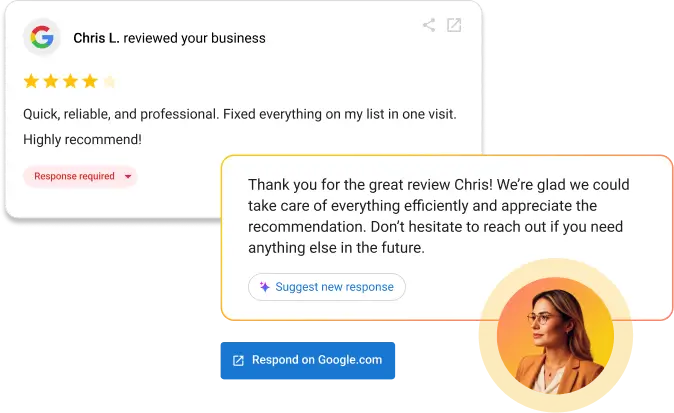
Corporate gets a network-wide reputation dashboard to monitor performance and flag issues before they become brand risks.
For franchises looking to build review volume quickly, the guide to improving Google reviews covers practical tactics that work at both the individual location and network level.
Link Building for Franchise SEO: Earning Authority at Scale
Backlinks remain one of Google’s strongest ranking signals. For franchise websites, link building needs to happen at two levels: national links to the parent domain and local links to individual location pages.
National-Level Link Building
National links build the overall domain authority that flows through to every location page. Strategies include:
- Digital PR: Data-driven studies, surveys, and newsworthy content that earns coverage in national trade publications and business media
- Guest content on industry blogs and publications (home services, franchising, small business)
- Partnerships with franchise associations and industry groups like the International Franchise Association
- Sponsorships of national events or industry conferences with link-back agreements
Local-Level Link Building Per Location
Local links pointing to individual location pages are among the most powerful ranking signals for local search. Sources to prioritize include:
- Local chamber of commerce membership (almost always includes a link)
- Sponsorships of local sports teams, schools, or community events
- Local news stories: a grand opening, a community project, or a charitable initiative
- Partnerships with complementary local businesses (a landscaping franchise linking with a local nursery, for example)
- Neighborhood and community websites like Nextdoor business profiles
Encourage franchisees to actively seek local link opportunities as part of their community involvement. Corporate can support this with a playbook and templates, while tracking local link acquisition alongside other SEO metrics in a centralized dashboard.
The Leaky Funnel Problem: Capturing and Converting Local SEO Traffic
Here’s where franchise SEO becomes a business operations issue, not just a marketing one. You can rank your franchise locations at the top of local search results, drive hundreds of qualified leads per month, and still fail to grow franchisee revenue if the leads aren’t being captured and followed up on effectively.
The numbers are sobering. Research consistently shows that roughly 30% of inbound leads are never properly followed up on across service businesses. For franchises, the problem is compounded by the fact that many franchisees are owner-operators juggling service delivery, team management, and customer communication simultaneously.
Leads that come in after hours go to voicemail and never call back. Web inquiries submitted on a Tuesday morning don’t get a response until Wednesday afternoon. The lead goes cold, books with a competitor, and your SEO investment generates zero revenue.
How AI Bridges the Gap Between Traffic and Revenue
This is the piece that most SEO guides skip: ranking is only half the battle. Converting the traffic your SEO generates is equally important, and it requires systems, not just strategy. Automated lead capture closes the window between a prospect finding your location page and actually booking a job.
Vendasta’s AI Employees are built specifically to solve this problem for franchise networks. The AI Receptionist captures and responds to leads 24/7, across web chat, phone, and SMS. When a homeowner submits a lawn care request at 9 PM on a Friday, the AI Receptionist responds immediately, qualifies the lead, answers questions, and books the appointment, without a human ever having to be involved.
For corporate franchise marketers, this means that the leads your SEO strategy generates are actually being captured and converted at the location level, consistently, without managing each franchisee individually. You set the standard once. The AI deploys it everywhere.
The AI Inside Salesperson then handles follow-up with leads that don’t convert immediately. MOFU and BOFU leads that requested a quote but didn’t book receive AI-powered lead nurturing sequences via SMS and email, dramatically improving the percentage of leads that eventually convert to booked jobs.
SEO Reporting for Franchise Networks: Measuring What Matters
Franchise SEO is an ongoing process. Without clear reporting, it’s impossible to know which locations need attention, which strategies are working, and how to prioritize your team’s time.
Key Metrics to Track at the Network Level
- Organic traffic per location: Are individual location pages driving increasing search traffic month over month?
- Local 3-pack appearances: How often does each location appear in the local pack for their target keywords?
- Keyword rankings by location: Track the top 5–10 target keywords per location and monitor position changes
- GBP performance: Impressions, direction requests, website clicks, and calls from each Google Business Profile
- Review velocity and average rating: Monitor per location to catch reputation issues early
- Conversion rate from organic traffic: What percentage of location page visitors submit a form, call, or book an appointment?
- Lead-to-booking rate: How many of the leads generated by SEO actually result in booked jobs?
Connecting SEO Performance to Revenue
The most important number for a franchise CMO is not keyword rankings. It’s revenue per location attributable to local SEO efforts. Connecting your SEO metrics to your CRM and booking system makes this possible, and it’s the data that justifies continued SEO investment to franchisees and to corporate leadership.
Vendasta’s platform provides a unified reporting dashboard that lets corporate marketing teams monitor SEO performance, lead generation, and customer engagement across every location in a single view. You can drill down into underperforming franchisees, identify the gap (is it traffic, conversion, or follow-up?), and take targeted action rather than applying blanket changes across the network.
Top SEO Tools for Franchise Websites in 2026
Managing SEO for multiple franchise websites requires a stack of tools that work together, not a collection of point solutions that each require separate logins, separate billing, and separate reporting. Here’s what a well-equipped franchise marketing team should have:
| Tool Category | Purpose | Recommended Options |
|---|---|---|
| All-in-one franchise platform | Listings, reputation, local SEO, AI lead response, CRM | Vendasta, Yext |
| Keyword research | Identifying target keywords per market | Ahrefs, SEMrush, Google Keyword Planner |
| Technical SEO audit | Crawl errors, duplicate content, and page speed | Screaming Frog, SEMrush Site Audit |
| Rank tracking | Monitoring keyword positions by location | BrightLocal, SEMrush, Ahrefs |
| Local citation audit | Finding and fixing NAP inconsistencies | BrightLocal, Moz Local, Vendasta Listing Sync |
| Analytics | Traffic, conversions, and user behavior | Google Analytics 4, Google Search Console |
| AI content creation | Localized content at scale | Vendasta AI, Jasper, Surfer SEO |
The challenge with running a separate tool for each category is the cost, complexity, and data fragmentation. A franchise CMO overseeing 50 locations is not well served by managing eight different software subscriptions and trying to connect the data manually. Teams that embrace SEO automation with AI consistently outperform those still relying on manual workflows, across both execution speed and results quality.
Vendasta consolidates the most critical pieces of this stack into a single platform: listing management, local SEO, reputation management, AI-powered lead response, CRM, and network-wide reporting. For franchisors evaluating franchise management software, the difference between a patchwork of vendors and a unified platform becomes clear quickly, both in cost and in results.
How to Build and Execute a Franchise Local SEO Strategy That Scales
Strategy without execution is noise. Here’s a practical framework for building a franchise SEO program that corporate can manage and franchisees will benefit from, whether you’re starting from scratch or fixing an underperforming existing program.
Phase 1: Audit and Baseline (Weeks 1 to 4)
- Conduct a full technical SEO audit of the parent domain and all location pages
- Audit every GBP listing for completeness, accuracy, and category selection
- Run a NAP consistency check across major directories for each location
- Establish baseline keyword rankings for each location’s target market
- Audit review volume, average rating, and response rate per location
Phase 2: Foundation (Weeks 5 to 12)
- Fix critical technical issues: crawl errors, duplicate content, page speed problems
- Implement or update LocalBusiness schema on all location pages
- Correct NAP inconsistencies across all directories using a listing sync tool
- Optimize all GBP profiles with complete information, photos, and correct categories
- Rewrite any thin or duplicate location page content with unique, locally relevant copy
Phase 3: Content and Growth (Months 3 to 6)
- Launch Tier 2 and Tier 3 content programs for each location
- Begin local link-building outreach per market
- Implement automated review request workflows at each franchisee
- Launch an AI-powered lead response to capture and convert organic traffic 24/7
- Begin monthly reporting against established baselines
Phase 4: Optimize and Scale (Month 6 Onward)
- Identify top and bottom-performing locations and adjust resources accordingly
- Expand content programs to new keyword clusters based on ranking data
- Deepen local citation and link profiles in competitive markets
- Use review and reputation data to surface franchisee service quality issues
- Continuously A/B test CTAs, page layouts, and conversion elements on location pages
Conclusion
SEO for franchise websites is one of the most complex, highest-leverage investments a franchise brand can make. When done right, it creates a compounding revenue engine: each location ranks for the local searches that matter most, captures leads consistently, and builds a reputation that sustains growth long after any individual ad campaign ends.
The brands that win at franchise SEO are those that treat it as a system, not a one-time project. They build the right site architecture, keep NAP data consistent at scale, create genuinely useful location-level content, earn reviews and respond to them, and close the loop with lead capture and follow-up tools that ensure organic traffic actually turns into booked jobs.
That kind of scale requires more than a spreadsheet and a marketing intern. It requires a platform built for the unique realities of multi-location marketing, where the corporate sets the standard and every location executes consistently without constant supervision.
Vendasta was built for exactly that. From automated listing management and AI-powered reputation responses to 24/7 lead capture and a network-wide performance dashboard, it gives franchise marketing teams the infrastructure to drive results across their entire network without burning out their teams or their budgets.
If your franchise is ready to stop losing leads to poor local visibility and start building a local SEO program that scales, explore what Vendasta can do for your network.
Book a demo with Vendasta today!
SEO for Franchise Websites FAQs
1. What is SEO for franchise websites?
SEO for franchise websites is the practice of optimizing both the parent brand domain and individual location pages to rank in search engines, particularly for local searches. It combines technical SEO, local listing management, content strategy, and reputation management across multiple locations under one brand.
2. How is franchise SEO different from regular SEO?
Franchise SEO manages multiple locations simultaneously, each needing unique local content, individual Google Business Profiles, and location-specific keyword targeting. The biggest challenges include avoiding duplicate content, maintaining NAP consistency across all locations, and scaling content creation without losing quality.
3. What is the best URL structure for franchise websites?
Subdirectories (e.g., yourbrand.com/locations/city-name/) are generally the best URL structure for franchise websites. This approach consolidates domain authority into one parent domain, is easier for corporate teams to manage centrally, and tends to perform best in Google’s local search results.
4. How do I manage Google Business Profiles for multiple franchise locations?
Managing GBP at scale requires a centralized platform that allows you to update listings, respond to reviews, and track performance across all locations from one dashboard. Tools like Vendasta’s Listing Sync push updates to Google Business Profile and other directories simultaneously, reducing manual work across large franchise networks.
5. Does duplicate content hurt franchise websites?
Yes. If location pages share identical body copy with only the city name changed, Google may treat them as thin or duplicate content and reduce their rankings. Each location page should include unique introductions, locally relevant content, local testimonials, and location-specific details to avoid this penalty.
6. What is NAP consistency, and why does it matter for franchise SEO?
NAP stands for Name, Address, and Phone number. Consistent NAP data across your website, Google Business Profile, and all online directories tells Google your business information is accurate and trustworthy. Inconsistencies can suppress local rankings, particularly in competitive markets where small trust signals make a measurable difference.
7. How many reviews does a franchise location need to rank in the local 3-pack?
There’s no exact number, but review quantity, recency, and average rating all factor into local pack rankings. BrightLocal research shows the average business in the local 3-pack has more than 47 reviews, with ratings above 4.0. Consistent review generation and fast response times help every location compete effectively in local search.
8. How can AI help with franchise SEO and local marketing?
AI tools can automate many of the most time-consuming aspects of franchise SEO: generating localized content at scale, managing review requests and responses, syncing listing data across directories, and capturing and following up with leads 24/7. Vendasta’s AI Employees handle these tasks across every location simultaneously, without requiring corporate oversight for each one.
9. What schema markup should franchise websites use?
Franchise websites should implement LocalBusiness schema on every location page, Organization schema on the corporate homepage, and Service schema for each service offered. Review schema can unlock star ratings in search results. Use Google’s Rich Results Test to validate your markup after implementation and catch any errors before they impact visibility.
10. How long does it take for franchise SEO to show results?
Most franchise SEO programs see measurable improvements in local rankings and organic traffic within three to six months of implementation, with more significant results building over six to twelve months. Technical fixes and GBP optimizations tend to deliver the fastest wins, while content and link building compound over time to build lasting authority in each market.