About Us
 Careers
 Leadership
 Board
Board Newsroom
Reputation management services are now a routine expense for many local businesses: 74.5% of small businesses call online reputation management critically important in Vendasta’s 2026 State of Reputation Management report.
Reputation management services are paid, ongoing agency work or reputation management software that monitors, builds, and repairs what appears about a business online: Google and Yelp ratings, branded search results, social mentions, and news coverage.
For a roofing company or a heating, ventilation, and air conditioning (HVAC) contractor, that means the 4.2-star rating a homeowner checks before calling, the review request nobody sent after Tuesday’s job, and the one-star complaint that sat unanswered while you were on a ladder.
The decision turns on included work, cost, removal limits, Google and Federal Trade Commission (FTC) rules, delivery model, and realistic results at six and 12 months.
Respond to every review faster, smarter, and on brand with AI
TL;DR
- Reputation management services cover seven deliverables: Audit, monitoring, review generation, review response, suppression, crisis communications, and reporting. Local programs focus on the first four; suppression and crisis work are separate, pricier engagements.
- One Yelp star lifts independent restaurant revenue 5–9%: Harvard Business School’s study of Seattle restaurants found the 5–9% effect was driven by independents; chains showed close to zero.
- An AI Employee can answer reviews under your rules: Vendasta Reputation AI monitors 100+ review sources, and the AI Reputation Specialist replies to Google and Facebook reviews under rules you set. Reputation AI also sends automated review requests after every job.
What Reputation Management Services Include
A reputation management service manages the public record of your business in the places a customer decides whether to call: review platforms, the first page of Google for your business name, social channels, and any news or forum mention. The strategic job is to keep that record accurate, current, and favorable enough to convert, and to contain damage when it is not. Providers package the types of reputation management work into a standard set of deliverables:
- Audit: The provider inventories every review profile, rating, branded search result, and listing error, then sets a baseline for star rating, review count, and the number of negative results on page one.
- Monitoring: The provider’s software checks review sites and search results for new mentions, so a one-star review surfaces the day it posts instead of the day a customer mentions it.
- Review generation: Text and email requests go to customers after each job, timed and tracked to raise volume and recency.
- Review response: Every review gets a reply inside a set window, with a separate protocol for complaints and disputes.
- Suppression: The provider builds new positive content, such as profiles, site pages, and press, to outrank negative results for your business name.
- Crisis communications: A review-bombing spike, a lawsuit, or a viral complaint gets a holding statement, a response plan, and platform reporting.
- Reporting: Monthly reports show rating, volume, response time, and search-position changes against the audit baseline.
The mix differs by provider. Local review-management programs concentrate on the first four items; suppression and crisis work are separate, pricier engagements. Ask which items your tier includes and which get billed by the hour, because that split explains most of the cost spread.
Review Monitoring and Review Generation
Monitoring and generation cover two recurring jobs:
- Monitoring: One inbox collects reviews from Google, Yelp, Trustpilot, and Facebook.
- Generation: Every customer receives a text or email request after the job.
Checking those platforms one at a time makes it more likely that a review sits unanswered for days while you’re on a job.
Sterling Sky’s ranking research describes a dental client that had been pulling in 60 or more reviews a month, paused for 18 days, and watched rankings that “fell off a cliff.” That is one client observation rather than a controlled test. Whitespark’s 2026 local search survey, which reflects expert opinion, places a sustained influx of reviews over time at #14 for Local Pack rankings.
In a typical automated setup, a closed job or paid invoice can prompt a text or email with a direct link to your Google profile, and a reminder follows if the customer doesn’t act. You don’t need an office manager chasing reviews at month-end.
Reputation AI handles the monitoring side across 100+ sources and analyzes sentiment. The AI Reputation Specialist, one of the AI Employees in Vendasta’s AI Workforce, replies to Google and Facebook reviews in the reviewer’s language under rules you configure, such as rating thresholds, delays, and approval steps, and suggests replies for other review sources.
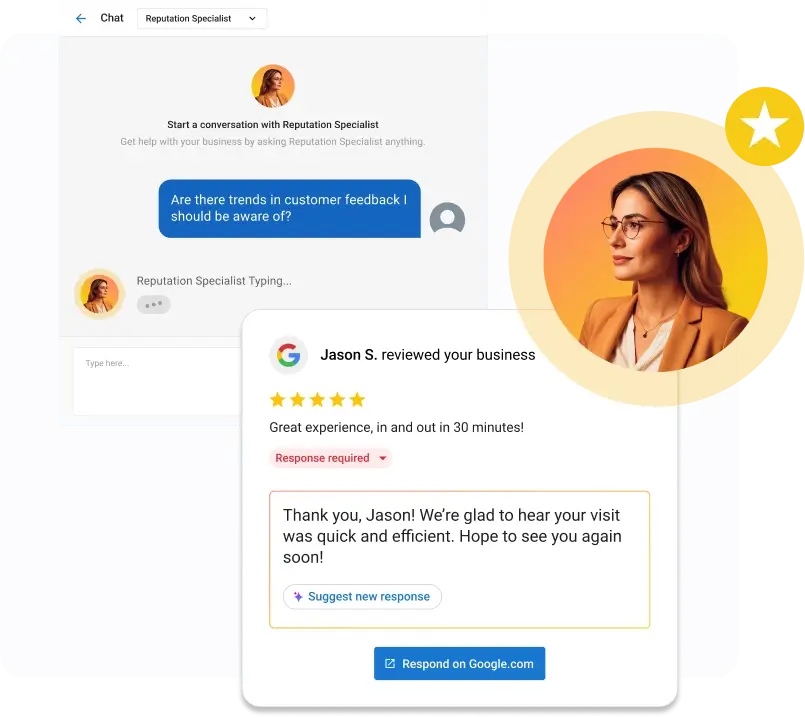
Reputation AI also sends review requests and net promoter score (NPS) surveys by email and SMS. It integrates with Jobber and QuickBooks Online, so a real transaction can trigger the request.
Handling and Responding to Negative Reviews
A negative review protocol has four steps:
- Reply within a week.
- Move the dispute to a phone call.
- Never tie a refund to a changed rating.
- Report extortion or policy violations instead of arguing in public.
Search Engine Land’s response guidance recommends replying to every review, with a thank-you for positive ones and an apology plus an offer to make things right for negative ones. BrightLocal’s 2026 Local Consumer Review Survey corroborates the expectation: 89% of consumers expect business owners to respond to reviews, and 81% expect to hear back within a week.
The revenue logic is damage control. Every homeowner who checks your profile may read an unanswered one-star review about a missed appointment as confirmation of a problem. With a two-sentence reply and a phone number, the same homeowner may instead see a business that fixes mistakes.
Academic evidence from hotels is mixed on what responses do to later reviews: Proserpio and Zervas found responding hotels gained about 0.12 stars, while Chevalier, Dover, and Mayzlin found that management responses disproportionately stimulated new negative reviews. That split is one more reason to keep replies short, factual, and offline-directed rather than argumentative.
The FTC’s Consumer Review Rule bars unfounded legal threats or intimidation aimed at getting a review removed, and the FTC’s rule Q&A says paying consumers to change or remove truthful negative reviews may violate the FTC Act. If a sudden run of one-star reviews arrives with a payment demand, Google’s extortion guidance says to report it promptly and not to pay or engage with the people behind it.
Templates speed the routine replies. A one-star reply to a missed appointment can be this short:
We’re sorry we missed your appointment on Tuesday. That’s on us. Please call our office and ask for our service manager so we can get you rescheduled at a time that works.
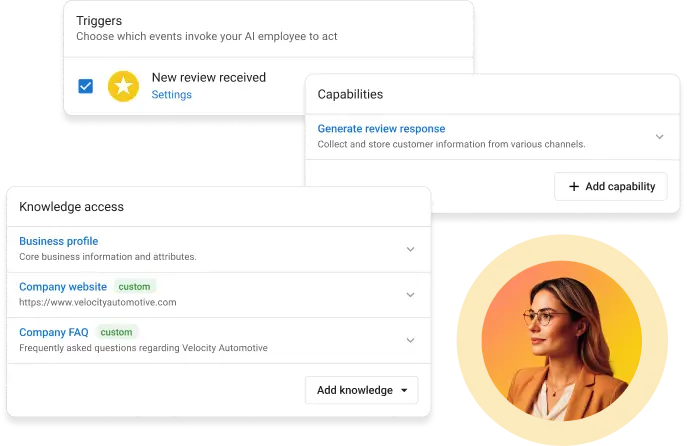
The AI Reputation Specialist works under configurable rules: you set them, it drafts or sends replies in the reviewer’s language, and every action is logged. Many owners start with approval on every reply, then let the AI Employee publish positive-review replies on its own once they trust the drafts. Set up review-response automation once, and every new review gets a reply inside your response window.
Negative Content Suppression and Removal
Removal and de-indexing are different outcomes. Suppression is a third, and the price and timeline differ sharply for each.
Search Engine Journal’s removal guide, a sponsored post from removal provider Erase, draws the line: removal means the source page is gone, de-indexing means the page exists, but Google no longer returns it, and suppression means the page stays indexed and gets pushed below the visible results. The guide calls suppression “the weakest of the three against AI surfaces.”
Suppression: Outranking the Negative Result
Suppression builds new assets, including your site, social profiles, directory listings, and press, on domains with authority equal to or greater than the negative source. Search Engine Land’s removal strategies piece, sponsored by Erase.com, estimates that suppression “usually takes two to six months to reshape a Page 1 SERP” and requires ongoing maintenance, with rankings often rebounding once the work stops.
High-authority negatives take longer. Reputation X’s suppression guide puts weaker negatives at 3–6 months and major news domains at 6–12 months or more, and adds 2–3 months when the negative sits on a domain with authority above 70, when your business name is common, or when fewer than three credible third-party assets exist.
AI answers add another wrinkle: Search Engine Journal’s removal guide notes that a claim can keep appearing in AI Overviews and assistant answers even after its page is removed and de-indexed, so a clean page one needs ongoing upkeep.
De-Indexing and Legal Takedown
Google’s own tools cover narrow cases: personal information such as home addresses and phone numbers through Results about you, and pages whose content has already changed or disappeared through the Refresh Outdated Content tool.
For defamation, Google’s legal help center says it is not in a good position to judge whether claims are true, so it takes a court ruling in the requester’s favor into account, and an approved request restricts access only in the country where the content is considered defamatory. The page stays live on the original site either way.
A Digital Millennium Copyright Act (DMCA) notice must be signed by the copyright owner or someone authorized to act for it, and Section 512(f) of the Copyright Act makes anyone who knowingly misrepresents infringement liable for damages, a risk for anyone filing over a review they don’t own.
Any provider promising guaranteed removal should be asked, in writing, which of the three outcomes it means and by what mechanism.
What Reputation Firms Cannot Remove
Google generally won’t delist court and government records, legitimate news articles, or honest negative reviews. The source owner makes the takedown decision, whether that owner is a court, publisher, or site operator. A third-party firm cannot make that decision for them. Four categories usually stay up, or come down only at the owner’s or publisher’s request:
- Court and government records: Google’s right-to-be-forgotten guidance for European requests treats continued government publication as a strong indication that the public interest still exists, and the American Bar Association notes that news reports and online information can remain after a record is sealed or expunged.
- News articles: Google takes journalists’ public-interest judgments into account, and Search Engine Journal’s removal guide notes that Google will not de-index a legitimate news article on request. For defamation, Google considers a court ruling that the article is defamatory and restricts access only in that ruling’s country. Newsroom “fresh start” programs at outlets such as The Boston Globe and Cleveland.com exist, but editors review each request and decline many.
- Honest reviews: The Consumer Review Fairness Act protects a customer’s ability to share an honest opinion. The FTC’s guidance on the Act says a business can still remove reviews from its own site that contain confidential information; are libelous, harassing, abusive, obscene, or sexually explicit; are unrelated to its products or services; or are clearly false or misleading. The FTC adds that an opinion you disagree with is unlikely to qualify.
- Wayback Machine captures: The Internet Archive’s removal help page lets site owners email info@archive.org to request exclusion of their own site, with no guaranteed outcome. Other removal requests can go to the same address with an explanation, but the page makes no specific provision for requests from reputation firms.
Review platforms vary. Search Engine Journal’s removal dataset, which Erase sponsored, found a median of 18 days to removal for successful outcomes and 19 days for Google reviews, while Yelp, Trustpilot, Indeed, Better Business Bureau (BBB), and Glassdoor reviews rarely came down. Those figures describe how long a successful removal took, not how likely removal was.
When the content cannot come down, suppression is the remaining route, typically 3–6 months for weaker negatives. Ask any suppression proposal to name the target URLs, the assets it will build, and the page-one positions it will report against your audit baseline.
Why Online Reputation Drives Conversion and Local Rankings
Searchers use reviews to decide whether to call a local service business. Google also uses review signals when deciding whether that business appears in the Google Map Pack. Google’s local ranking guidance states that “More reviews and positive ratings can help your business’s local ranking” and lists review count as an input to prominence.
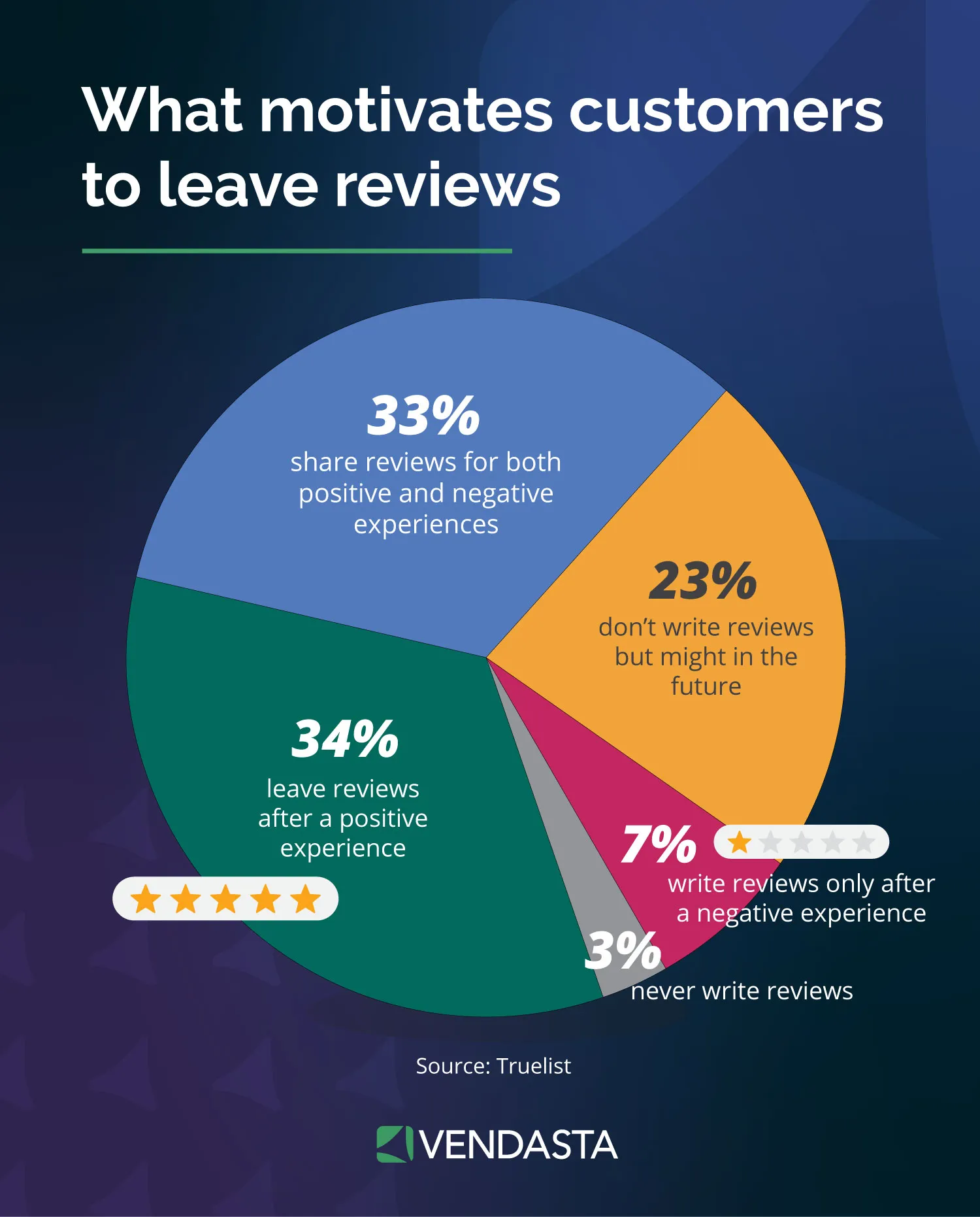
BrightLocal’s 2026 survey found that 97% of consumers read reviews for local businesses, 47% won’t use a business with fewer than 20 reviews, and 74% look for reviews written in the last three months. The 20-review buyer threshold and the 90-day recency window are the two measures a home-services company should track weekly.
Harvard Business School researchers measured the conversion side in revenue terms: the 5–9% lift per Yelp star held for independent businesses, while chains showed an effect close to zero. The study covered Seattle restaurants, so applying it to an independent plumber or electrician is an inference, but it remains one of the few published revenue measurements tied to star rating.
Review Signals in the Map Pack
Whitespark’s 2026 survey places high numerical Google ratings at #6 for Local Pack rankings, quantity of native Google reviews with text at #9, recency of reviews at #11, and a sustained influx of reviews over time at #14. The presence of owner responses to most reviews ranks #122, so owner replies matter mainly for what a reader decides, not for Local Pack position.
Volume moves you past the 20-review buyer threshold, while recency keeps your newest reviews inside the three-month window BrightLocal’s respondents say they look for. Rating keeps you above the line that matters most: 68% of BrightLocal’s respondents will only use a business with four or more stars.
Fred Astaire Dance Studios, one of Vendasta’s published case studies, averaged 50 reviews per store and grew search traffic 37%. Vendasta’s case study reports that the franchise also generated 2.5 times more net-new leads. A dance studio is not an HVAC company, but a home-services owner can track the same review volume and search traffic metrics, then connect them to leads.
What Reputation Management Services Cost
Local review management runs $300–$1,500 per client per month in agency self-reports, while enterprise programs run $5,000–$20,000 or more per month. Every figure below is published by a firm or marketplace that sells or lists these services, and sources disagree on enterprise floors, so treat the bands as orientation rather than quotes:
| Pricing model | Range | What it buys | Source |
|---|---|---|---|
| Local review management, per client | $300–$500/month; $500–$900/month; $900–$1,500/month | Software and reporting; managed responses; full program with escalation and benchmarking | ReviewJet’s pricing guide |
| Small business monthly cost | $800–$3,500/month | Local-business reputation program | DesignRush’s cost report |
| Enterprise program | $5,000–$20,000+/month | Multi-location management, sentiment analysis, dedicated teams, and crisis response | Onewrk’s cost guide |
| Crisis reserve | $10,000–$50,000+ | Funds set aside for active crisis management | Onewrk’s pricing breakdown |
| Hourly consulting | $100–$135/hour (small business); $400–$500/hour (crisis or enterprise) | Consulting billed by the hour | DesignRush’s cost report |
| Content removal | Flat rates, retainers, or per-submission fees, usually quoted case by case | One item removed, de-indexed, or updated, depending on contract definition | Erase’s removal cost guide |
Contract terms matter as much as the band. Erase, a removal provider, says most removal services charge upfront regardless of outcome and that charging only after a confirmed removal is not the norm. The Better Business Bureau’s scam guidance flags four warning signs: a 12-month lock-in, monthly reports that never mention leads, calls, or sales, a demand for a large upfront payment, and any promise to put you at the top of Google.
Software pricing works differently from a retainer for hours. Vendasta offers a 14-day free trial with no credit card required, so an owner can see what Reputation AI and the AI Reputation Specialist do before committing.
For agencies and other partners reselling to local businesses, Vendasta’s Starter plan requires $99 in monthly product spend, credited dollar-for-dollar against the platform subscription, and meeting that minimum can reduce the platform subscription to $0.
Agency, Software, or In-House: How to Choose
The choice turns on which deliverables you need. Software covers requests and monitoring, with rule-based responses available where supported. An agency covers suppression and crisis, while in-house work covers whatever your schedule allows.
The comparison below applies the same six criteria to each option. Birdeye and Podium publish no numeric prices on their official pricing pages, and Yext describes its pricing as custom.
| Option | Intended user | Primary strength | Limitation | Time cost (editorial estimate) | Break-even volume (editorial estimate) | Best-fit verdict |
|---|---|---|---|---|---|---|
| Agency retainer | Businesses with page-one negatives or several locations | Humans run suppression, crisis response, and escalation | $300–$1,500 per month (ReviewJet, per client) at the local tier; watch for 12-month lock-ins | Reviewing monthly reports | When the revenue at risk from negative results or multiple locations exceeds the retainer | Suppression and crisis work |
| Birdeye | Local businesses (200,000+ customers) and multi-location enterprises with “50 or 5,000 locations” | Monitors 200+ review sites; its Review Response Agent publishes 4- and 5-star replies on its own and holds 1- and 2-star reviews for staff | Quote-only pricing banded by location count, from 1–3 to 1,000+ | Setup plus approving held replies | Steady review flow across multiple locations | Multi-location operators willing to request a quote |
| Podium | Local businesses in auto, home services, aesthetics, and retail | Textable review invites and reminders in one inbox | Custom quote only; automated AI review responses start at the Pro tier | Setup plus managing the shared inbox | Businesses already texting customers | Local businesses already texting customers |
| Yext | Brands with hundreds or thousands of locations | Requests by email, SMS, QR code, bulk upload, and API; monitors Google, Facebook, Yelp, and 80+ industry sites | Custom pricing billed annually; no Yelp review generation; AI drafts replies for approval | Approving AI drafts | Enterprise location counts | Enterprise location counts |
| Vendasta | Local businesses and the partners serving them | Reputation AI monitors 100+ sources; AI Reputation Specialist responds under configurable rules; Vendasta’s platform integrates with Jobber, Housecall Pro, ServiceTitan, and QuickBooks | Review requests, NPS surveys, and full response automation require Reputation AI Premium | Setting response rules; most AI Employees deploy in under 30 minutes | When review requests and replies fall behind job volume | Owners who want responses and requests done without a hire |
| In-house | One-location businesses with low job volume | No software fee, and replies in your own voice | Requests and replies stop when the schedule fills | Ongoing owner or staff time | One location with low job volume | Workable at low job volume |
An agency retainer buys human judgment on suppression that no software product performs.
Compliance With Google Review Policy and FTC Rules
Google’s policy bars review gating and incentives outright. The FTC’s Consumer Review Rule separately bars fake reviews, sentiment-conditioned incentives, and undisclosed reviews from company insiders. Google’s penalties land on the business’s profile, and reputation firms a business hires are not immune from FTC liability.
Google Review Policy
Google’s Business Profile content policy bars merchants from attempting to “Discourage or prohibit negative reviews, or selectively solicit positive reviews from customers.” It also bars incentives such as payment, discounts, or free goods or services in exchange for posting a review or for revising or removing a negative one, and it bars asking staff to solicit a certain number of reviews or reviews with specific content, including content that identifies a staff member. Soliciting genuine reviews with no incentive and no attempt to influence the rating remains permitted.
Google Enforcement
Google enforces these rules at scale. Google’s Maps enforcement update reports that Google blocked or removed more than 292 million policy-violating reviews and placed posting restrictions on more than 782,000 accounts in 2025. Under its Business Profile restrictions for policy violations, Google can stop a profile from receiving new reviews for a set period.
It can also temporarily unpublish existing reviews while displaying a public warning that fake reviews were removed. In one repeat-violation notice reported by Search Engine Roundtable in July 2026, Google blocked new reviews and hid past ones for two months, double the earlier one-month restriction.
FTC Consumer Review Rule
The FTC’s Consumer Review Rule (16 CFR Part 465) prohibits:
- fake reviews, including AI-generated ones
- incentives conditioned on positive or negative sentiment
- undisclosed reviews from company insiders, such as employees and their relatives
- review suppression through unfounded legal threats or intimidation, or by misrepresenting that the reviews displayed represent most or all of the reviews submitted
Civil penalties run up to $53,088 per violation, and the FTC’s rule Q&A states that reputation management companies “are not immune from liability under the rule.”
The FTC and Illinois sued Premium Home Service (the FTC’s press release) over fabricated five-star reviews used to dilute legitimate one-star reviews. The complaint seeks civil penalties under the rule and $50,000 per deceptive act under Illinois law, which are requested figures rather than an award. In December 2025, the FTC also sent warning letters to 10 companies about possible violations of the rule.
The complaint request is simple: every customer gets asked after every job, nobody gets paid, and nobody gets screened. Reputation AI follows that pattern: it sends automated review requests to every customer by email and SMS and logs each one.
How to Evaluate Providers and What Results to Expect
Evaluate a provider on logged work and written compliance, using a before-and-after benchmark tied to your own baseline. Vendasta’s client churn study of 200,000 client records found that clients who receive regular proof-of-performance reports have a 38% higher retention rate.
Ask any provider for that kind of reporting: a timestamped log of requests and replies, plus a monthly report against the audit numbers. Six questions cover the rest:
- Compliance in writing: Will the provider confirm it never gates, incentivizes, screens, or writes reviews, and never files takedowns it has no standing to file?
- Logged actions: Can you see every request, reply, and content asset with a timestamp?
- No guarantees: Does the proposal avoid guaranteed removals, guaranteed positions, and fixed timelines?
- Exit terms: What is the contract length, and is there 30-day cancellation?
- Integration: Does it trigger requests from Jobber, Housecall Pro, or ServiceTitan so the ask goes out when the job closes?
- Approval control: Who signs off on replies to one- and two-star reviews?
A Worked Benchmark at Six and 12 Months
No independent source measures a local business at both six and 12 months, so the scenario below is illustrative:
| Metric | Starting point | 6 months (illustrative) | 12 months (illustrative) |
|---|---|---|---|
| Star rating | 4.6 | about 4.7 | 4.8 |
| Review volume | 165 | about 290 | 428 |
| Page-one negatives | 2 | 1 | 0–1 |
Start and 12-month figures follow Bell Plumbing’s vendor-reported results in betterbunch’s case study: 165 reviews at 4.6 stars to 428 at 4.8 in under a year. The 6-month values are interpolated.
Gao et al.’s study of TripAdvisor hotels found solicitation raised review ratings by 0.151 points and review volume by 34.3%, while organic review volume fell 15.5%, with no stated horizon. Per Reputation X, weaker negatives take 3–6 months to suppress and major news 6–12 months or more.
Bell Plumbing’s 4.8 sits well above the four-star minimum that 68% of BrightLocal’s respondents apply before choosing a business.
The Bottom Line on Reputation Management Services
Local businesses get returns from reputation management services when the work continues after the first month. That means a request after every job and a reply to every review within a week. The report should show rating and volume, then track page-one position against the audit baseline.
Compare providers on those outputs and on their written refusal to gate or incentivize reviews, because FTC civil penalties of up to $53,088 per violation reach the business as well as the firm. Reputation X estimates suppression at 3–6 months for weaker negatives and 6–12 months or more for major news. Google generally won’t delist court records, legitimate news, or honest reviews.
For the routine layer, Vendasta Reputation AI monitors 100+ sources and sends review requests after every job, and the AI Reputation Specialist responds under your rules. Agencies and other partners serving local businesses deploy the same AI Employees across client accounts, under their own brand, through Partner Center. To see how Vendasta can address this workflow in your business, book a Vendasta demo.
Reputation Management Services FAQs
1. How much do reputation management services cost?
Agency self-reports put local review management at $300–$1,500 per client per month and enterprise programs at $5,000–$20,000 or more per month. Content removal is usually quoted case by case, and most removal services bill upfront regardless of outcome. Vendasta offers a 14-day free trial with no credit card required, and partners on Vendasta’s Starter plan have $99 in monthly product spend credited dollar-for-dollar against the platform subscription.
2. What are the best reputation management companies for a local business?
Vendasta Reputation AI serves local businesses and the partners serving them, with the AI Reputation Specialist handling responses. Birdeye serves both local businesses and multi-location enterprises; Yext is built for brands with hundreds or thousands of locations, and Podium centers on text-based review invites. For page-one suppression or a crisis, hire an agency and read its contract terms first.
3. Can negative content be removed from Google?
Sometimes. Google removes personal information through Results about you, may restrict a page in one country after a court ruling on defamation, and takes down fake or policy-violating reviews when flagged. Honest reviews, news articles, and court records generally stay. When removal isn’t available, Reputation X estimates suppression at 3–6 months for weaker negatives, with ongoing work.
4. Should I hire an online reputation management agency or buy software?
Buy software for review requests after each job and for monitoring with rule-based responses, which Vendasta Reputation AI and the AI Reputation Specialist handle without a new hire. Hire an agency for negative results on page one. Several locations with different managers or a crisis needing a human spokesperson can also justify an agency.
5. Can I do reputation management myself?
Yes, and most local businesses start that way: claim your Google Business Profile, ask every customer for a review, reply within a week, and check Yelp and Facebook weekly. The failure point is consistency. Requests stop when the schedule fills, and checking each platform separately makes a missed review more likely.
6. How is online reputation management different from public relations (PR)?
PR builds relationships with the media and the public and earns coverage, including crisis communications. Online reputation management concentrates on what appears when someone searches your business: reviews, ratings, and branded search results. The two overlap, and professional bodies such as the Public Relations Society of America offer dedicated reputation management training. PR earns the coverage; reputation management manages the record that coverage joins.
7. How long does it take to push negative results off page one?
An Erase.com-sponsored piece in Search Engine Land puts suppression at two to six months to reshape page one, and Reputation X estimates 6–12 months or more for major news domains. Rankings for negative pages often rebound when the work stops, and claims from removed pages can keep surfacing in AI answers. Treat a guaranteed timeline as a red flag.
8. Is review gating allowed under Google and FTC rules?
No. Google’s policy bars discouraging negative reviews or selectively soliciting positive ones, and bars incentives for posting a review or for revising or removing a negative one. The FTC’s Consumer Review Rule bars sentiment-conditioned incentives and misrepresenting that displayed reviews represent most or all reviews submitted, with civil penalties up to $53,088 per violation. Ask every customer and offer nothing.
9. Is reputation management the same as search engine optimization (SEO)?
No. SEO raises visibility for the searches customers use to find a service, such as roof repair near me. Reputation management applies SEO to searches for your business name, so your site, profiles, and positive coverage hold the top positions. Google and customers use reviews in both contexts: Whitespark’s expert survey ranks rating, count, and recency among the top 15 Local Pack factors.
10. What is the difference between personal and business reputation management?
Personal programs deal with an individual’s name by removing addresses and phone numbers through Google’s Results about you and building a LinkedIn and bylined-content presence. They may also suppress old news. Business programs live in review and rating systems such as Google Business Profile and Yelp. Owners track star rating and review count, then monitor review recency before customers call.