About Us
 Careers
 Leadership
 Board
Board Newsroom
Everything agencies used to charge for is now a free feature somewhere. In 2026, 64% of U.S. small businesses choose a website builder over custom development, and AI-powered builders are the fastest-growing part of that market, on track to climb from roughly $3.2 billion this year to $17.4 billion by 2035. Your prospect can describe a website out loud and watch one appear. So the question is no longer how to sell websites: it is what you sell now that the website itself is nearly free.
Most agencies answer that wrong. They build faster and charge less, and end up competing with a $16 monthly subscription that ships in four minutes.
There is a better answer, and it starts with an uncomfortable admission: nobody ever wanted the website. They wanted what they assumed the website would do.
That is exactly why we sat down with Enmanuel Diaz, founder of iCreateYourSite.com, who sold over a 1000 websites to small businesses, but then stopped selling websites entirely and rebuilt his agency around selling systems. No build fees. No contracts. A close rate above 90% and churn under 2%.
In this guide, Enmanuel Diaz shows you how to run a discovery call that surfaces the revenue system a client will actually pay for, how to price it so clients stay for years instead of months, and how to put a dollar figure on your own work every month so the cancellation conversation never happens. He also explains why he walked away from $2,000 website projects and what replaced them.
Turn a plain-English prompt into a live, branded client app
TL;DR
- The build is commoditized. The system is not. Local service businesses lose 60% to 65% of clients after the first or second visit. Enmanuel sells the rebooking, capture, and follow-up systems that close those gaps, and charges monthly for them.
- Dropping the build fee took his close rate above 90%. No upfront cost, no contract, cancel anytime, and the client owns the files. Revenue dipped the first month after the switch. Churn now sits under 2%.
- Proof beats persuasion. One client’s dashboard calculates the revenue his website generated. It read roughly $1,100 nineteen days after launch against a $450 subscription. Vendasta gives agencies the same advantage with AI Employees and reporting clients can see for themselves.
What Does It Mean to Sell Systems Instead of Websites?
Selling a system means charging for the mechanism that produces revenue for the business, with the website as the container it ships in. Instead of quoting a one-time build, you find a specific gap in how the business captures or keeps customers, build the workflow that closes it, and charge monthly to run it.
In practice, a system is any of these:
- A rebooking flow that brings past customers back on a schedule
- A booking or quoting tool that converts interest before it cools
- Lead capture that routes into a CRM instead of an inbox
- Automated follow-up for the leads nobody called back
- Reporting that shows the owner what the site produced this month
The distinction matters commercially, not philosophically. A website is finished. A system has to be run, and anything that has to be run can be billed monthly. That is the entire difference between a project business and a recurring one, and it is why the question of how to sell websites has quietly become a question about what you attach to them.
Nobody Wakes Up Wanting a Website
Enmanuel started where most web designers start. He searched Google Maps for businesses with ugly websites or none at all, then called and emailed. The response was consistent, and it was not interest.
He tells a story about a high-end jewelry store whose website consisted of a single landing page with a logo. No products, no way to buy anything. He was standing in the store as a paying customer when he raised it. The store owner, as recounted by Enmanuel Diaz, asserted that “We don’t use the website. We don’t care about the website. Foot traffic is fine. Don’t talk to me about websites.”
At $2,000 a site, roughly one in ten prospects said yes.
“These business owners are more interested in getting solutions versus just getting a pretty website.”
— Enmanuel Diaz, founder, iCreateYourSite.com
That rejection stung, but it taught him something. He was not being turned down on price, design, or timing. He was being turned down on premise. As he puts it, “These business owners are more interested in getting solutions versus just getting a pretty website.”
Think about what actually happens in that conversation. You look at a website and see a system: search rankings, traffic, conversion paths, brand equity, a pipeline that fills itself. Four moves ahead, all of it obvious.
The owner looks at the same page and sees a business card. It has her name and her number on it. It has been there for six years. Nobody has ever complained about it. She is not being stubborn or short-sighted. She is doing sensible math on the information she has. Her phone rings, her calendar fills, and rent gets paid. Nothing in her week points to that website as the reason anything is or isn’t working. So when a stranger calls to say the thing she never thinks about needs $2,000 spent on it, the answer is no. It was always going to be no.
The Firearms Range That Proved the Point
The answer came from the least likely prospect on his list.
A firearms training company. Over 500 five-star reviews, a calendar booked solid, ranking number one on Google. The website was something the owner had thrown together himself in a free GoDaddy builder, and by every standard a designer cares about, it was rough.
By every standard the business cared about, it was fine. That is the part worth sitting with. The ugly site was winning.
Enmanuel could have pitched a redesign anyway. He has a name to put on his work, so making it look professional was going to happen regardless. But he asked a different question first, and it is the question this entire playbook rests on: what do you offer a business that is already winning?
He found the answer on the discovery call, not in the site audit. Somewhere in the conversation, the owner mentioned, almost in passing, that students would take a class, have a great time, and never come back. He was excellent at getting people through the door once. He had nothing that brought them back.
For firearms training, that gap is not just revenue. Safe handling is a perishable skill. Students are supposed to practice on a schedule, and his were not.
So Enmanuel built the loop. Every 30 or 60 days, depending on the class, past students get automatically re-invited to book again. The system tracks which level each student finished, so a level one graduate gets invited into level two rather than a generic “come back soon.”
Students who used to come once started coming four and five times. Level one, then two, three, four, then a shotgun class.
Look at what actually got sold there. The site was already number one. Traffic was not the problem, design was not the problem, and no redesign on earth would have moved that revenue. He sold the mechanism that turns one customer into five. And unlike a homepage, a mechanism has to be watched, tuned, and kept running, which is precisely why it can carry a monthly fee.
That was the light bulb moment, in his words. Everything after it is an execution detail.
How to Find the System a Client Will Pay For
Enmanuel’s discovery process comes down to three moves. None of them involve talking about design.
1. Find Where You Can Actually Create Value
Bigger clients are easier here because a business with existing traffic gives the system more surface area to work with. Look for anything that gets a customer to come back, book faster, or spend more.
One example from his book of business: a kitchen remodeling client whose site now lets homeowners upload a photo of their current kitchen and see an AI-edited version of the remodel. It gets people excited, and excited people reach out. That is not a design feature. That is a conversion mechanism attached to a design.
Sometimes the honest answer is that a small business just needs a clean placeholder site with occasional updates. That is fine. As Enmanuel points out, $250 a month still beats $2,000 for that client, and they will pay it for years knowing someone is watching the site. He includes business email setup and a branded signature so even his smallest accounts get more than a page.
2. Think Like the Customer, Not the Business Owner
This is the move most agencies skip, and it is where the good systems come from. Owners struggle to imagine being their own customer, so asking them what they need returns the same three answers every time.
Enmanuel uses his dog groomer as the example. His golden retriever needs a bath every three weeks. The groomer’s site is outdated and lacks a booking system, so he has to call. He forgets. By the time he remembers, it is five o’clock, and they are closed. He is a customer trying to spend money and failing.
Multiply that across every local service business in your pipeline. The revenue is already there. Nobody built the path to it.
3. Build It Before They Ask
The bridal boutique started as a routine maintenance client. Then she sent photos of her studio for a website update, and Enmanuel noticed a TV screen on the wall.
He asked about it. She explained that brides email a few dresses they like beforehand, and she opens the tabs and shows them on the TV before anyone tries anything on.
He did not pitch. He built.
When a bride books now, the boutique’s dashboard shows a start appointment button. Click it, and a splash screen appears on the studio TV, welcoming that bride by name in the boutique’s branding, with the studio’s Instagram handle. Brides photograph it and post it, which solves a marketing problem she could not solve any other way. A bride will post about cake tasting and flowers, but never about the dress. This gives her something she can share, and the boutique gets tagged in it.
Then the bride’s pre-favorited dresses appear, not in an ecommerce layout but as a clean gallery of large images and hover videos. No description blocks. No price tags.
That last detail is the commercial one. Taking price out of the browsing moment lets brides choose emotionally rather than defensively, and the average dress price sold increased. When two dresses are close in price, she picks the one she loves.
Behind it sits a booking view, notifications, a calendar, and a CRM organized by wedding date rather than by contact date, because wedding date is the field that actually drives her delivery schedule. It also replaced a generic WordPress booking plugin that had been breaking the site.
She never asked for any of it. She was almost nervous the first time he demoed it. Then a bride used it, loved it, and posted about it.
“A booking form is not a revolutionary piece of technology. I shouldn’t have to spend two or three days hand-coding a booking form.”
— Enmanuel Diaz
Software like this used to require months, a coding team, and UX and UI engineers. Enmanuel puts the old price at $50,000 to $100,000 or more, the kind of build only an enterprise could fund. He and his team shipped it in just under seven days.
She pays $250 a month. Given what wedding dresses cost, one extra sale covers the year.
Price the System, Not the Build
Once you are selling a system, the pricing model has to change with it. Enmanuel switched to subscriptions at the start of 2026. The first month, revenue went down. He kept going because conversions immediately moved the other way.
The arithmetic is not complicated. Ask a landscaper who charges $50 to $100 per yard for $2,000, and you are asking for 20 to 30 yards of work. Ask for $250 a month and the objection disappears.
The price is only half of it. The bigger unlock was fear removal. A $2,000 site carries a real risk for the buyer. They spend the money, the site looks nice, and nothing happens. No traffic, no ranking, no calls. A subscription tells them someone is there every month, making sure it works.
| One-time $2,000 build | $250 per month subscription | |
| Client’s first objection | “That is 20 landscaping jobs” | “That is one job a month” |
| Client’s fear | Pay once, get nothing | Cancel if it stops working |
| Agency revenue, year 1 | $2,000 | $3,000 |
| Agency revenue, 4 years | $2,000, if they never come back | $12,000 |
| Relationship after launch | Ends | Starts |
| Who fixes the broken site later | Nobody | You, every month |
That last row matters more than agency owners admit. Enmanuel used to hand clients a short tutorial on updating a phone number or swapping an image. Months later, he would check the site and find it destroyed. The client was too embarrassed to reach out or assumed a fix would be expensive. He could not even keep the work in his portfolio, because anyone clicking through would see a broken site and assume he built it that way.
No Build Fee, No Contract, Public Pricing
Enmanuel publishes his rates on his website, which he notes most agencies hate doing. No contracts. No commitment. Cancel anytime. And the client owns the site, so canceling means he sends the files rather than holding the work hostage.
He knows how this sounds to a room full of agency owners.
“The person who loves to walk will get further than the person who loves the destination.”
— Enmanuel Diaz
The risk is real, and he names it plainly. A client can take a custom build, pay for three months, change their mind, and walk with under $1,000 collected. He accepts the exposure because the numbers on the other side are better than those on the safe side.
| Metric | Result |
| Close rate | Over 90% |
| Churn | Under 2% |
| Typical subscription | $250 to $450 per month |
| Upfront build fee | $0 |
| Contract length | None |
| Lifetime value at $400 per month over 5 years | $24,000 |
His framing: “Our goal is not to sell you a $2,000 website and disappear.” A client paying $400 a month for four, five, or six years generates more than any one-time website sale ever would. The low risk is exactly why the close rate clears 90%.
He does flag the exception. If a prospect wants a genuinely complex application, a build fee may make sense. As for the small-business core of his book, it does not.
Make the Value a Number, Not a Feeling
A subscription only survives as long as the client can see what it is buying. Every month, quietly, they ask themselves whether this is still worth it. Most agencies answer that question with a traffic report, which is not an answer at all. Enmanuel’s answer sits in a mobile car detailing business, and it is the single most useful idea in this playbook.
Start with the site itself. Reviews, service pages, a mega menu, and a custom booking form that lets customers upload photos of their car, so the detailer knows before he arrives whether he is walking into a light clean or a disaster. Good work, but not the part that makes him stay.
The part that keeps him there is his analytics dashboard. He sells a service in person, so there is no ecommerce on the site and no revenue number to report. Enmanuel built a widget that estimates one anyway.
Here is the logic. Every service on the site lists a starting price. The booking form requires the customer to select which service they want. Someone who saw the price and filled out the form is a warm lead who already knows roughly what they are buying. So the system multiplies the minimum price of each booked service by the number of times it was booked, and produces an estimated value generated from the website.
Nineteen days after launch, that number read roughly $1,100. The site had already covered its $450 monthly subscription twice over. The dashboard also tracked 10 people who skipped the form and messaged him directly on WhatsApp, revenue that is real but uncounted.
“It’s not a mystery, the value that the website is bringing. It’s a clear numerical value with a money symbol in front of it.”
— Enmanuel Diaz
Or put it the way a CFO would: “Unless this number is less than what we’re charging them, they would have no reason to cancel whatsoever.”
Most agencies send a monthly report full of sessions, bounce rate, and keyword positions. None of those are money. Retention research keeps landing in the same place: a 5% lift in retention can raise profits by 25% to 95%, and the fastest way to earn that lift is to make the value obvious rather than inferred.
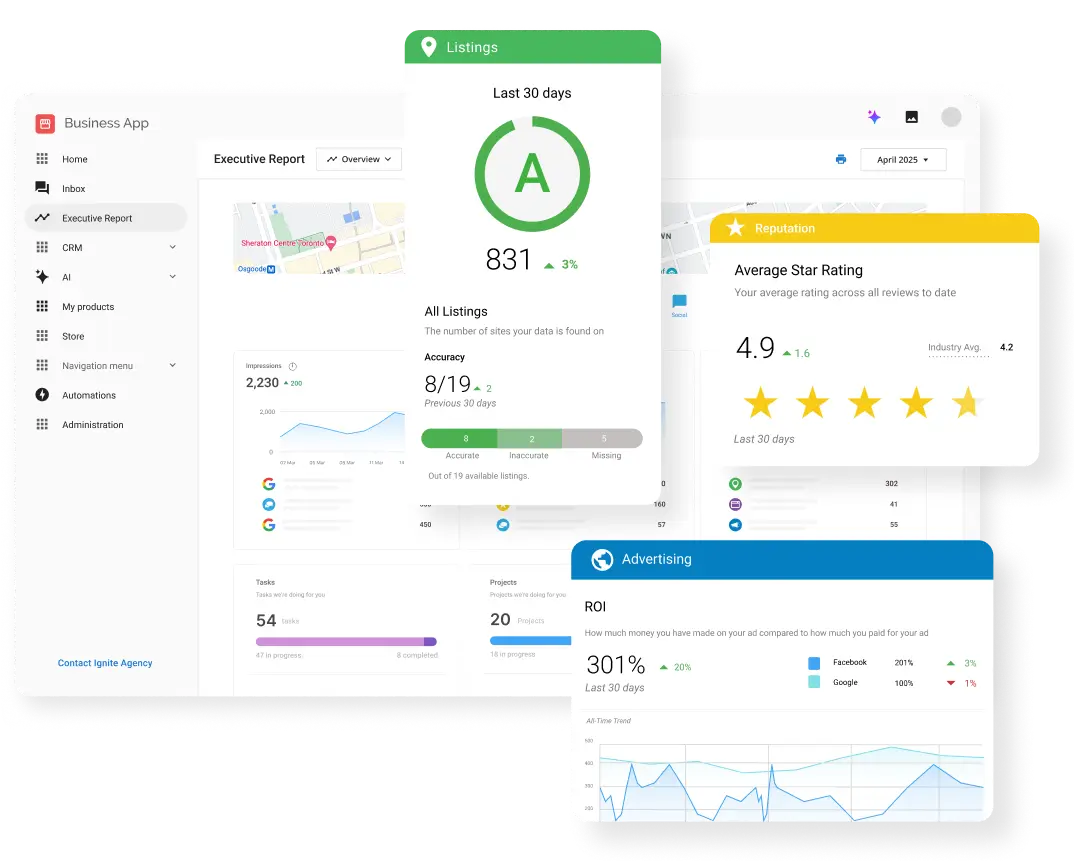
Platforms like Vendasta make this practical across a full client book. Rather than hand-building an analytics widget for each account, agencies can push performance data into a client-facing portal and schedule an executive report that ties activity to outcomes the owner recognizes.
Speed Is What Makes the Whole Model Work
Selling systems only work if you can ship them before the client loses interest. A first draft within five business days is enough for most clients to trust the direction, and Enmanuel finds he receives very few corrections. Builds that used to take months now take one to two weeks.
Getting there with general-purpose AI tools is possible but not free. During the episode, a live build ran close to 20 minutes across two sessions and still dropped the client’s logo, even with the file path spelled out in the prompt. Enmanuel estimates 200 to 300 prompts are needed to get a fully custom website right. The speed is real. So is the overhead.
That overhead stems from a single structural gap. General AI builders start from a blank page. They know nothing about the client’s brand, services, or customer records, so every build starts by re-teaching a machine the facts your platform already has.
How Vendasta Turns This Into a Repeatable Business
Enmanuel’s model works because value shows up every month. The hard part for most agencies is not agreeing with him. It is running this across 20, 50, or 200 clients without hiring a build team, an ops team, and a reporting team.
Vendasta is an AI customer acquisition and engagement platform built for SMBs and the partners who support them. It combines a business’s own data with AI and automation, enabling agencies to run acquisition, engagement, and operations from one rebrandable platform instead of stitching together separate tools.
Ship the Build in Minutes with Vendasta Vibe
Vendasta Vibe is an AI app builder that already knows the business. Describe what you need in plain language, and Vibe pulls the client’s brand, logo, services, and business details straight from their business profile, so the first draft already looks like their company. No manual data entry. No blank page.
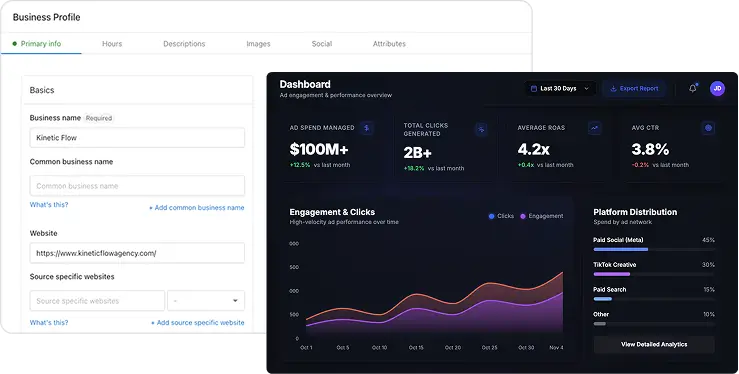
Builds publish to secure domains with hosting, fast pages, and automated error recovery included, so there are no deployment steps between a finished draft and a live site. Vibe also handles site cloning, image generation, a point-and-click visual editor, automated checkpoints, and full code export, which means your team keeps control of the output rather than renting it.
That is the difference between a tool that generates a page and a tool that ships a client deliverable in one sitting.
Turn Every Build Into a System
A page does not renew. A system does. Vibe apps wire directly into the platform your clients already run on, which is how a site stops being a brochure and starts being the thing Enmanuel charges for.
- Lead capture: every form submission lands in CRM AI the moment it happens, ready for follow-up
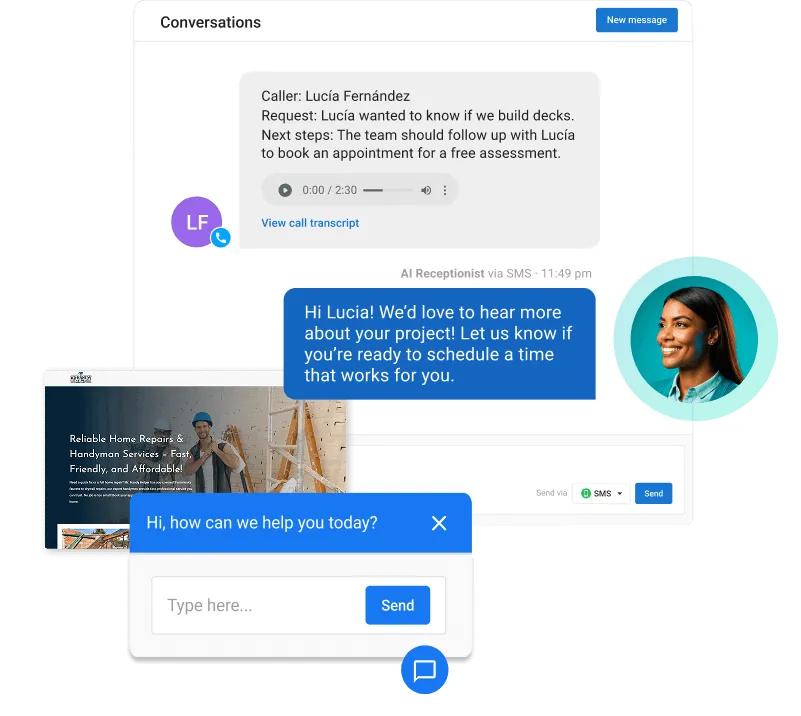
- AI Workforce: drop an AI Receptionist into any project with a widget code, so after-hours calls and chats get answered and captured
- Business analytics: surface real performance data inside the app for the right users
- Business knowledge base: connect the business profile so what you build reflects the business from day one
- External database: connect a Supabase database and build on the client’s own data
That is the bridal booking dashboard and the detailer’s value widget available as configuration instead of a custom engagement. Vendasta’s AI Employees run on a business’s own records plus 17 years of local business data, which is why they behave like staff rather than a scripted chatbot. Partners using Conversations AI have reported a 372% increase in lead-to-revenue conversion.
Put a Number in Front of the Client Every Month
The detailer stays because a dollar figure sits on his dashboard. Vendasta gives every client that view without a custom build behind it. The client-facing portal shows performance in one place, the executive report compiles it automatically on a schedule, and reviews, listings, campaigns, and conversations all report into the same record.
Your renewal conversation becomes a reading of the report instead of a defense of the invoice. For the deeper version of this, our guide to client reporting covers what belongs in it and what to cut.
Sell It Under Your Own Brand, Across Every Client
Vibe supports white-label reselling and multi-client management, so a system you prove once becomes a system you deploy everywhere. Pair it with the white-label Marketplace, and you can bundle services, launch recurring revenue products, and grow the book without rebuilding infrastructure for each account.
That is the scale layer this model needs. Enmanuel proved the offer with a handful of local businesses. A platform is what turns it into 200 of them. For more on this shift, see our breakdowns of vibe coding for agencies and recurring revenue for agencies.
Conclusion: The Thing You Are Best At Is the Thing They Value Least
That is the uncomfortable part of this episode. Design skill has not stopped mattering. It has stopped being the reason anyone signs.
What clients pay for monthly, for years, is a business that works better than it did before you showed up. More rebookings. Fewer missed calls. A number on a dashboard with a dollar sign in front of it. Build that, and pricing gets easy, contracts become unnecessary, and churn drops to a rounding error.
Enmanuel’s closing advice to agency owners was short. Do not be scared of the tools. Do not feel behind, because they change too fast for anyone to be caught up. And in his words, “Don’t just sell a pretty website, sell a solution.”
The agencies that make this shift in 2026 will not be the ones with the best portfolios. They will be the ones whose clients can see exactly what they are paying for. If you want to run this model without building the infrastructure yourself, book a demo with Vendasta today.
How to Sell Websites FAQs
1. What does it mean to sell systems instead of websites?
It means charging for the mechanism that produces revenue for the business, with the website as the container. Instead of quoting a one-time build, you find a gap in how the business captures or keeps customers, build the workflow that closes it, and charge monthly to run it. A website is finished. A system has to be maintained.
2. How do you sell websites to small businesses that say they do not need one?
Stop pitching the website. Most owners already see their site as a business card and will not fund a redesign. Ask what happens after a customer buys, whether anyone follows up, and what gets missed after hours. Sell the fix for that gap, then deliver the site as part of it.
3. How much should agencies charge for a website subscription?
Most small-business subscriptions range from $250 to $450 per month, depending on the systems included. Price against the value the system produces, not your build hours. A rebooking flow that recovers a few thousand dollars a month justifies more than a maintenance-only plan, and clients renew when that math stays visible.
4. Is it risky to sell websites with no contract and no build fee?
There is real exposure. A client can cancel after a few months and keep the site. In practice, agencies delivering measurable monthly value see very low churn, because canceling costs the client more than staying. Removing the contract also removes buyer fear, which dramatically lifts close rates.
5. How do you sell a system the client never asked for?
Run discovery from the customer’s point of view, not the owner’s. Owners struggle to imagine being their own customer, so ask what would stop a buyer from purchasing or purchasing again. Missed rebookings, no after-hours bookings, and confusing contact paths keep recurring. Build the fix, demo it, and the value explains itself.
6. What should a website subscription include beyond the site?
Include hosting, updates, and at least one system that produces revenue: booking, rebooking, quoting, lead capture, or automated follow-up. Add reporting that shows what the site generated. Small extras like business email setup and a branded signature raise perceived value on your smallest accounts at almost no cost.
7. Does using AI to build client sites produce low-quality work?
Only when nobody guides it. AI generates standard components like booking forms in minutes, freeing your team for the parts that require judgment. Quality comes from business insight, design direction, and review, not from the prompt. Payment processing and other sensitive functions should always run on hardened enterprise APIs.
8. How do you prove monthly value to a subscription client?
Report money, not metrics. Sessions and bounce rate do not renew anything. Estimate revenue influenced by the site using booked services, service pricing, and captured leads, then put that figure in front of the client every month. Vendasta automates this with client-facing dashboards and scheduled executive reports.
9. How does Vendasta Vibe help agencies deliver client systems faster?
Vendasta Vibe is an AI app builder that already knows the business. It pulls the brand, logo, services, and details from the business profile, so the first draft immediately matches the client. Builds publish to secure domains with hosting and error recovery included, and agencies keep full code ownership plus a visual editor for refinements.
10. Why should agencies choose Vendasta to scale this model?
Vendasta gives partners one rebrandable platform for building, capturing, engaging, and reporting, so a proven system can be deployed across every client instead of being rebuilt each time. AI Employees run on the business’s own data and 17 years of local business data. Multi-client management and white-label reselling make the model scalable rather than manual.