 About Us
 Careers
 Leadership
 Board
Board Newsroom
If you run a digital agency, MSP, or B2B sales team, you have likely hit a wall of client resistance when pitching modern tech. Phrases like “I hate AI chatbots,” “We prefer a human touch,” or “We tried software before, and nobody used it” have become standard pushback from small and medium-sized business (SMB) owners.
The problem usually is not the client’s willingness to invest. It is how the offer is framed. That gap is exactly what a repeatable AI sales pitch framework for agencies is built to close.
Most local business owners do not want to buy another software subscription, learn a new interface, or figure out prompt engineering. They buy outcomes: more qualified leads, faster response times, reduced administrative overhead, and plugged revenue leaks.
To scale an agency today and get customers, sales teams need to move away from technical feature dumps and adopt an outcome-first AI sales pitch framework instead.
Drive customer acquisition and engagement with AI employees
TL;DR
- SMB clients resist AI pitches that lead with features. They respond to pitches that lead with lost revenue.
- Reframe every AI employee as a revenue safeguard, not a software expense.
- Use a repeatable four-step framework: vertical alignment, a two-minute demo, an ROI calculation, and white-label leave-behinds.
- Demo AI Data Analyst using the Analyze, Interpret, Recommend model so prospects see judgment, not just automation.
- Show up with finished work on day one: a pre-built landing page, a trained chatbot, and a pre-audited visibility report.
Why Feature First AI Pitches Fall Flat With SMB Clients
When pitching an AI employee, whether it is an AI Voice Receptionist, AI Reputation Specialist, or AI Data Analyst, leading with tech specifications instantly creates cognitive fatigue. Instead, open by highlighting an immediate operational bottleneck or lost revenue opportunity within the prospect’s specific business model.
Consider how the conversation changes across different verticals when you reframe the entry point.
Pet Services and Emergency Vets
Feature pitch: “Our natural language AI bot handles after-hours booking on your site.”
Outcome pitch: “When pet parents face an urgent situation after hours, they do not leave voicemails. They hang up and call the next provider on Google. How many emergency appointments are you losing to the shop down the road simply because no one picked up the phone at 8 PM?”
Home Services and Contractors
Feature pitch: “This automated system tracks lead pipelines and sends instant SMS replies.”
Outcome pitch: “Your field technicians are on job sites all day, so incoming calls go straight to voicemail. By the time someone calls back at 5 PM, that homeowner has already hired another contractor. What is a single missed high-value estimate costing your bottom line?”
By linking AI directly to lost revenue, you reframe the conversation from an optional software expense to a necessary operational safeguard. This shift is the foundation every other part of the AI sales pitch framework builds on.
The 4 Step AI Sales Pitch Framework Agencies Can Repeat
To make your agency’s sales process repeatable across your entire team, structure your pitch using this four-step framework.
| Step | Action | Objective |
|---|---|---|
| 1. Vertical alignment | Match the prospect to industry-specific pain points | Open with a single discovery question focused on revenue leakage |
| 2. High-impact demo | Execute a concise, two-minute workflow demo | Demonstrate simple setup and clear logic without getting bogged down in tech |
| 3. Quantify inaction | Run an ROI and impact calculation | Show the direct monetary loss of changing nothing over six to twelve months |
| 4. Deliver white label assets | Hand off branded leave-behinds and one-pagers | Reinforce trust with clean collateral tailored to the prospect’s vertical |
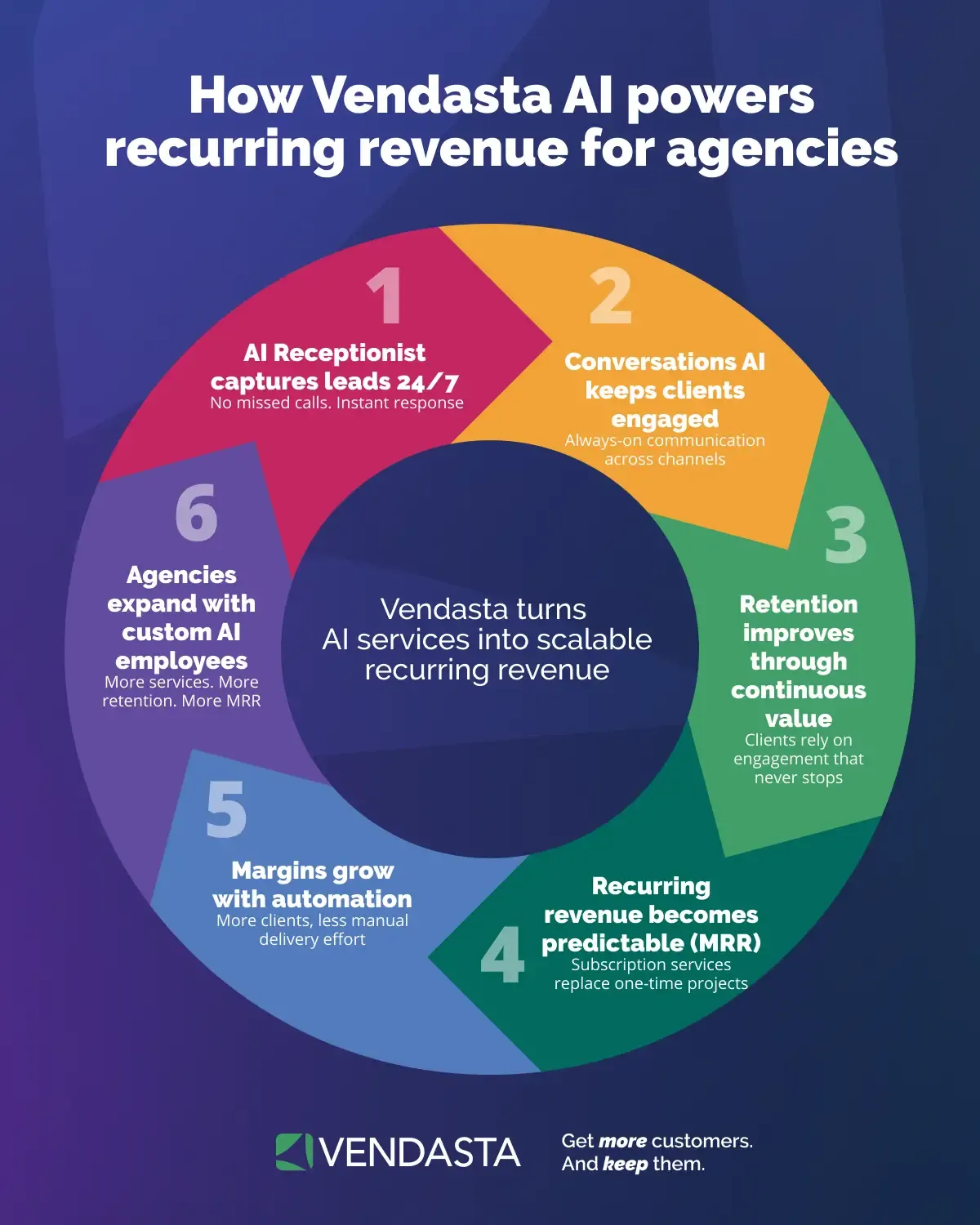
This is the sequence that turns a one-off pitch into a repeatable motion your whole sales team can run to build recurring revenue for agencies, regardless of vertical.
For scripts and objection responses your reps can use call by call, the AI Workforce sales playbook walks through each step in more depth.

See the Framework in Action
Watching a pitch land in real time makes the framework easier to copy than reading about it. This walkthrough from Vendasta’s training library shows how the steps above play out in a live conversation.
How to Demo an AI Employee in Under 2 Minutes
A common pitfall during sales demos is overcomplicating how the technology works behind the scenes. Clients want to see simplicity and reliability.
For example, when demonstrating an AI Data Analyst, avoid discussing language models or parameters. Instead, show how a structured reasoning framework turns raw business data into immediate action using the AIR model.
- Analyze: The AI reviews connected data sources, such as CRM records, recent Google reviews, or social engagement metrics.
- Interpret: It identifies underlying patterns or quiet accounts, for example, “3 key pipeline accounts have not been contacted in 30 days” or “negative review trends mention wait times.”
- Recommend: It concludes every interaction with a concrete, practical next step rather than a raw dump of numbers.
Showing this live in under two minutes proves to the prospect that an AI employee functions as an active assistant, not just an automated text box.
Move From Potential to Finished Work on Day One
A primary reason SMB clients abandon software purchases is setup friction. Expecting a busy business owner to log into an empty dashboard, upload documents, configure settings, and build their own system leads to high drop-off rates and stalled sales cycles.
Modern agency onboarding requires showing completed deliverables upfront:
- Pre-built landing pages: Instead of promising a website design, generate a custom, high-converting preview page using the prospect’s existing brand assets before the first demo call.
- Trained chatbots: Pre-train a web receptionist on the prospect’s public menu, pricing sheet, or FAQ page so they can interact with a working prototype live during the pitch.
- Pre-audited visibility reports: Scan 40-plus directory listings and review profiles in advance to show exact gaps in local search performance during the meeting.
When prospects log in and see finished work rather than a long setup checklist, the sales friction disappears. You are no longer selling potential. You are handing over an active operational asset.
Final Strategy: Stop Selling Tech, Start Selling Results
Selling software puts you in competition with every other subscription tool on the market. Selling tangible business outcomes puts you in a category of one.
An AI sales pitch framework for agencies works because it centers the conversation on what clients actually care about: the missed call recovered at 8 PM, the instant response that secures a new lead, and the administrative hours given back to their staff every week.
Ready to put this framework in front of your next prospect? Book a demo and see how quickly your team can turn a feature pitch into an outcome pitch.
Frequently Asked Questions
1. What is an AI sales pitch framework?
An AI sales pitch framework is a repeatable structure agencies use to sell AI employees to SMB clients. It replaces technical feature explanations with a sequence built around vertical-specific pain points, a short demo, an ROI calculation, and finished deliverables.
2. Why do outcome-based AI pitches convert better than feature-based pitches?
SMB owners rarely evaluate AI on its technical merits. They evaluate it on whether it recovers lost revenue, saves staff time, or removes a specific daily headache. Leading with outcomes matches how the buyer actually makes the decision.
3. How do I pitch AI employees to clients who are skeptical of AI?
Open with a revenue leakage question specific to their vertical rather than a product description. Skepticism usually softens once the conversation is about a concrete cost they already recognize, such as missed after-hours calls.
4. What is the AIR model for demoing an AI Data Analyst?
AIR stands for Analyze, Interpret, Recommend. The AI reviews connected data sources, identifies a pattern or gap, and closes with one specific next step, rather than presenting raw numbers for the prospect to interpret themselves.
5. How long should an AI employee demo take?
Aim for under two minutes. A short, focused workflow demo proves reliability and simplicity. Long demos that dive into configuration or model details tend to increase, not reduce, buyer hesitation.
6. What deliverables should I show a prospect before the first call?
A pre-built landing page using their brand assets, a chatbot pre-trained on their own menu or FAQ content, and a visibility audit of their existing directory listings all work well. Each shows finished work instead of a setup task list.
7. How do I handle the objection that they tried software before and no one used it?
Acknowledge the past experience, then point directly to the finished, pre-configured deliverable in front of them. The objection is usually about setup friction, and a working prototype removes the friction the objection is based on.
8. What does it mean to frame AI as a revenue safeguard?
It means positioning the AI employee as protection against revenue already being lost, such as missed calls or slow follow-up, rather than as an optional new expense competing with the rest of the software budget.
9. How many discovery questions should I ask before pitching?
One well-chosen, vertical-specific question about revenue leakage is often enough to open the conversation. The goal is to surface a pain point the prospect already feels, not to run a long discovery process before demonstrating value.
10. Can this framework work across different verticals?
Yes. The four-step structure stays the same. Only the vertical alignment step changes, since the revenue leakage question and demo example should match the prospect’s specific industry, such as pet services, home services, or another local vertical.
