About Us
 Careers
 Leadership
 Board
Board Newsroom
A 43-location equipment dealership was losing hours every week to one repetitive task: writing review responses for every location, one at a time. Their story is a good starting point for talking about marketing tools for small business owners actually need, because it shows what the right software should do: remove hours of manual work instead of adding another dashboard to check.
Vendasta’s AI Reputation Specialist changed how that team spent its week, and you can read the full 43-location success story later in this article.
Small businesses are expected to run SEO, social media, email, advertising, reviews, and customer communication with a fraction of the staff a large brand would use. Most don’t have a marketing department big enough to manage every channel by hand.
Adding a new app for every problem often creates tool sprawl instead of relief. Teams end up bouncing between logins, copying data by hand, and repeating the same task three different ways.
A recent report found that 54% of small businesses already use AI marketing tools, with another 27% planning to start this year, which puts AI adoption on track to pass 80% of small businesses by the end of 2026.
This guide breaks down what marketing tools for small business owners actually need, compares five of the best options side by side, walks through the 43-location AI success story in full, and ends with a practical framework for building a smarter marketing stack without adding tool sprawl.
Turn hours of work into minutes with AI-powered workflows
TL;DR
- Choose tools based on outcomes: the best marketing tools for small business should solve specific problems and fit into your existing workflows.
- Prioritize connected systems and automation: fewer disconnected tools can mean less manual work and easier management.
- Real-world proof matters: one 43-location business used AI to automate routine review responses and save several hours every week.
What Are Marketing Tools for Small Business?
Marketing tools for small business are software platforms and applications that help a company attract new customers, manage relationships, promote its brand, automate repetitive marketing tasks, and measure results. They range from single-purpose apps built for one job to all-in-one platforms that handle several channels at once.
Traditional marketing software helps a person complete a task faster. AI marketing tools for small business go further by executing an entire workflow with far less manual input.
What Can Small Business Marketing Tools Help You Do?
- Generate and manage leads
- Improve local and organic visibility
- Create and distribute content
- Manage social media
- Send email campaigns
- Collect and manage reviews
- Automate customer follow-up
- Analyze marketing performance
- Manage customer relationships
- Automate repetitive workflows
What Marketing Tools Does a Small Business Actually Need?
Most small businesses don’t need dozens of tools. They need a focused stack of marketing tools for small business that supports their biggest growth priorities.
Many teams start with a handful of free online marketing tools for small businesses, then add paid software once a clear bottleneck appears. The core categories worth having in place are below.
- CRM and customer management
- SEO and local SEO
- Social media
- Email marketing
- Reputation management
- Advertising
- Analytics
- Marketing automation
- AI-powered customer engagement
How Do You Know Which Marketing Tools You Need?
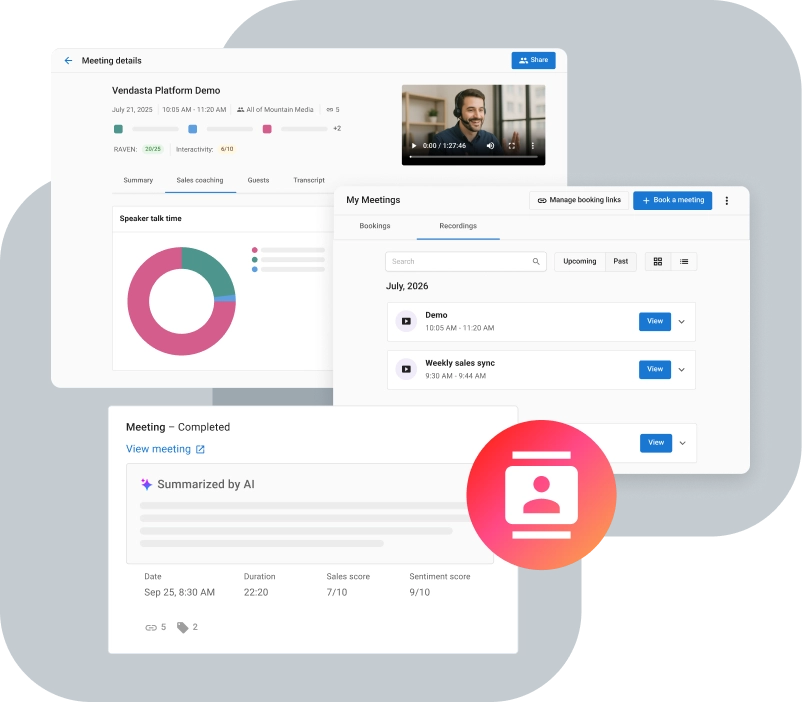
Start by identifying the biggest marketing bottleneck and which tasks eat up the most time. Then look at where leads or customers are being lost, and flag repetitive work that could be automated instead.
Time matters here more than most owners realize. LocaliQ’s 2026 Small Business Marketing Trends Report found that 60% of small businesses spend between 1 and 10 hours a week on marketing, and half have no employees dedicated to marketing at all. That leaves little room for tools that add complexity instead of removing it.
Choose software that integrates with your existing stack, and measure the business outcome after implementation rather than just usage.
5 Best Marketing Tools for Small Business Compared
Here are five marketing tools for small business owners, spanning one connected platform and four specialized tools, compared side by side.
| Tool | Best For | Key Capability | Best Fit |
| Vendasta | Connected Marketing And AI Automation | Marketing, customer engagement, automation, AI Employees | Businesses wanting a more unified marketing stack |
| Canva | Creating Marketing Content | Visual content and branded assets | Businesses creating their own marketing materials |
| Google Business Profile | Local Visibility | Search and Maps presence | Local businesses |
| Mailchimp | Email Marketing | Email campaigns and automation | Businesses building email relationships |
| Semrush | SEO And Competitive Research | Keyword and competitor research | Businesses focused on organic visibility |
1. Vendasta: Best for Connected Marketing and AI Automation
Vendasta is built to be one of the more complete marketing tools for small business owners, agencies, and franchises managing growth across customer acquisition, engagement, and retention. It covers customer acquisition, marketing software, reputation management, social media, advertising, CRM, automation, AI Employees, and centralized management from one login.
Why Use a Unified Marketing Platform?
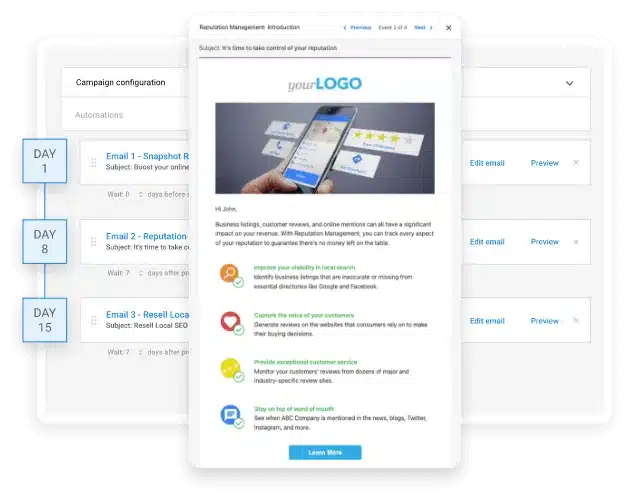
A connected platform pulls customer data, campaigns, and communication into one place instead of scattering them across five logins. That means less manual work, easier reporting, and marketing automation that can span multiple workflows at once instead of just one.
Adoption backs up the shift toward this approach. SBE Council’s 2026 Small Business Tech Use Survey found that 82% of small business employers have already invested in AI tools, with a median of five tools in use and more planned over the next twelve months.
What Are AI Employees?
Vendasta’s AI Employees take on recurring roles across marketing, sales, and customer engagement rather than completing a single one-off task. Instead of generating one piece of content or answering one question, an AI Employee can run an entire workflow from start to finish
2. Canva: Best for Creating Marketing Content
Canva is a design tool that helps small business owners produce their own visual content without hiring a designer for every asset. It covers social media graphics, ads, flyers, presentations, branded content, and templates.
Most small businesses use it to keep a consistent look across channels without adding production time to an already full week.
3. Google Business Profile: Best for Local Visibility
Google Business Profile controls how a business shows up in Google Search, Google Maps, and local search results. It covers business information, photos, customer reviews, and customer actions like calls, direction requests, and bookings.
This matters most for local small businesses, since most nearby customers check a business’s Google listing before ever visiting the website. Pairing it with local SEO and listings management helps keep that same information accurate across every other directory a customer might check.
4. Mailchimp: Best for Email Marketing
Mailchimp covers email newsletters, lead nurturing, customer communication, segmentation, automated campaigns, and performance tracking. It’s built for businesses that want a direct line to customers instead of relying only on social platforms.
Email marketing becomes especially valuable once a business has a growing list of past customers or leads worth staying in touch with. Vendasta’s own email marketing automation works the same way, pairing automated campaigns with the rest of a business’s marketing data.
5. Semrush: Best for SEO and Competitive Research
Semrush covers keyword research, competitor research, search visibility, content opportunities, and website audits. It helps a business see where it stands against competitors before committing to a content or SEO decision.
SEO tools like this turn guesswork into a plan, showing exactly which keywords and content gaps are worth pursuing. Vendasta’s own Snapshot Report offers a similar competitive lens, surfacing SEO, listings, and review gaps a business may not know it has.

What Are the Best AI Marketing Tools for Small Business?
The best AI marketing tools for small businesses automate repetitive work, help teams make faster decisions, and improve customer engagement without removing human oversight.
Adoption is already paying off for businesses using it well. BizIQ’s review of 2026 research found that 68% of businesses report better marketing ROI from strategic AI adoption, and 89% of SMB marketers now use AI for content marketing and SEO efforts.
What Can AI Marketing Tools Automate?
| Marketing Task | How AI Can Help |
| Content creation | Draft and repurpose content |
| Social media | Generate and manage content workflows |
| Reviews | Draft or automate responses |
| Lead management | Qualify and route leads |
| Customer support | Answer common questions |
| Email marketing | Personalize and automate communication |
| Analytics | Identify trends and summarize data |
| Reporting | Turn data into actionable insights |
AI Tools vs. AI Employees: What’s the Difference?
An AI tool helps complete a specific task, like drafting a caption or answering one customer question. An AI Employee handles a recurring role or workflow using a business’s own information and instructions.
Vendasta’s Custom AI Employees show this distinction in practice, since each one is built around a specific business role instead of a single task. That difference is exactly what lets one business automate an entire recurring workflow, which is where the next section picks up.

Real-World Results: How a 43-Location Business Used AI to Save Hours Every Week
A 43-location equipment dealership faced the exact problem most growing businesses hit eventually: too many locations, too few hours, and reviews piling up faster than one person could answer them. Its experience with Vendasta’s AI Reputation Specialist shows what happens when a marketing tool doesn’t just organize work, but actually takes repetitive work off a team’s plate.
The Challenge: Managing Reviews Across 43 Locations
One marketing team member was drafting and posting review responses for every location, one at a time, and response times varied depending on how busy the team was on any given day. Some customer feedback sat unanswered longer than the business wanted, simply because there weren’t enough hours in the day.
Writing a personalized, professional response for dozens of locations took real effort every week, with no reliable way to keep tone and quality consistent across the board.
The Solution: AI Handled Routine Reviews While Humans Stayed in Control
The dealership set clear rules and let AI handle what could be automated. Every five-star review across all 43 locations received an automatic response, while anything rated lower was routed to the marketing team for a personal reply.
The team could monitor everything from a single dashboard instead of checking each location separately. That kept a person in the loop exactly where judgment mattered most, without slowing down the reviews that didn’t need it.
The Results: Several Hours Saved Every Week
| Metric | Result |
| Locations managed | 43 |
| Average response window | 6 to 16 hours |
| Time saved | Several hours every week |
| Routine review responses | Automated |
| Human oversight | Maintained |
The dealership now maintains an average response window of 6 to 16 hours across all 43 locations, a number expected to keep dropping as automated replies handle a growing share of the volume. The team also reclaims something harder to put a number on: knowing every location gets a timely, professional response no matter how busy the week gets.
What This Success Story Teaches Us About Marketing Tools
Don’t judge software by its feature count. Judge it by how much meaningful work it actually removes from your team’s week.
Automation should make a team more efficient without taking away its judgment on the interactions that need it. This case study is proof that marketing tools for small business don’t need to be complicated to work, they need to remove real work.
Key takeaway: The value of a marketing tool isn’t how many features it has. It’s how much time, complexity, and repetitive work it removes.
How Do You Choose the Best Marketing Tools for Small Business?
Turn the decision about marketing tools for small business into a simple, repeatable process instead of a one-time guess.
Step 1: Define Your Marketing Goal
Get specific about what you’re actually trying to achieve, whether that’s more leads, more traffic, better local visibility, more reviews, stronger retention, or simply saved time. A clear goal makes it much easier to rule out tools that don’t move the needle.
Step 2: Identify Your Biggest Bottleneck
Ask what’s taking the most time right now and what’s still being done by hand. Look at where leads are being lost and which tasks repeat every day or week.
Step 3: Look for Automation Opportunities
Prioritize tasks that are repetitive, high-volume, predictable, time-consuming, and easy to measure. These are exactly the kinds of tasks other businesses have successfully handed off to AI, as shown across Vendasta’s own AI Employee success stories.
Step 4: Check Integrations and Scalability
Look for CRM integrations, website integrations, email integrations, social integrations, advertising integrations, analytics, and multi-location support. A tool that can’t grow with the business will need replacing sooner than expected.
Step 5: Measure ROI
Track time saved, leads generated, conversion rate, customer response time, reviews generated, and revenue influenced. If a tool can’t show impact on at least one of these, it’s worth questioning whether it earns its place in the stack.
Should a Small Business Use One Marketing Platform or Multiple Tools?
Both approaches to marketing tools for small business can work, but they come with different tradeoffs.
| Multiple Tools | Unified Platform |
| Specialized functionality | Broader functionality |
| More dashboards | Centralized management |
| More integrations to maintain | Fewer disconnected workflows |
| Potentially more vendors | Fewer systems to manage |
| Greater risk of data fragmentation | More connected customer data |
When Do Multiple Marketing Tools Make Sense?
Multiple tools make sense when a business needs highly specialized functionality, its existing tools already work well together, and the team has the resources to manage several systems.
When Does a Unified Marketing Platform Make More Sense?
A unified platform tends to fit small teams managing multiple channels, multiple locations, or multiple businesses. It also suits teams that want centralized customer information, automation across workflows, and less tool sprawl overall.
For businesses in that second group, a connected platform like Vendasta removes the need to stitch several marketing tools for small business owners together by hand.
What Marketing Tasks Should Small Businesses Automate First?
Not every task is worth automating right away. Start with the ones that repeat the most and require the least nuance.
Start With Repetitive, High-Volume Tasks
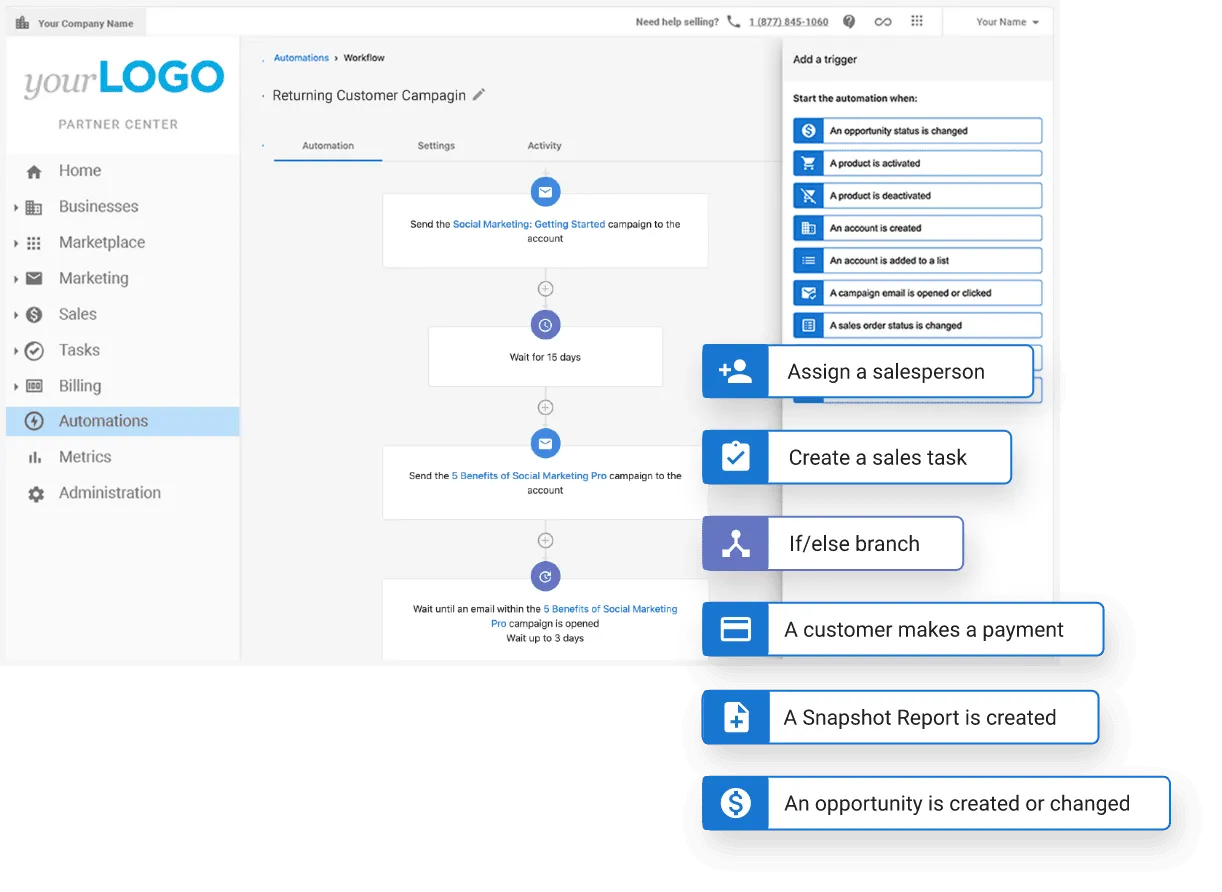
Review responses, review requests, social media scheduling, email follow-up, lead routing, appointment reminders, and reporting are usually the first candidates. Vendasta’s own workflow automation tools are built around exactly this kind of repeatable, high-volume work.
Automate Customer Engagement Next
Once the basics are running smoothly, extend automation to website questions, lead qualification, FAQs, appointment booking, and follow-up. These are still repetitive enough to automate, but customer-facing enough to monitor closely.
Keep Strategy and Sensitive Decisions Human-Led
Brand strategy, creative direction, complex customer complaints, campaign strategy, and high-value customer relationships should stay with a person. The 43-location dealership’s approach is proof that AI and human oversight work best together, not as a replacement for one another.
What Are the Biggest Mistakes Businesses Make When Choosing Marketing Tools?
Buying Too Many Tools
Tool sprawl happens gradually, one subscription at a time, until a team is paying for overlapping functionality across five different apps.
Choosing Features Instead of Outcomes
A tool’s feature count doesn’t necessarily translate into business value. The real question is always what problem it actually solves.
Ignoring Integrations
Disconnected systems create manual work, since someone still has to move information between them by hand. A single connected platform removes that step entirely.
Automating a Broken Process
Automation doesn’t fix a bad workflow, it scales it. Fixing the process first is what makes automation worth the investment.
Measuring Usage Instead of Results
Track leads, customers, revenue, time saved, conversion rate, and customer retention instead of just login counts. Usage numbers don’t tell you whether a tool is actually working.
How to Build a Smarter Small Business Marketing Stack
Bring the whole decision back to one simple filter for marketing tools for small business: does it remove real work, or does it just add another login to check?
A six-step framework keeps that filter consistent:
- Define one primary business goal.
- Identify the biggest workflow bottleneck.
- Choose tools that solve that bottleneck.
- Connect your customer data and workflows.
- Automate repetitive tasks with AI where appropriate.
- Measure results and remove tools that aren’t delivering value.
A smarter marketing stack isn’t necessarily a bigger one. It’s a stack that helps your business accomplish more with less manual work.
Conclusion: Choose Marketing Tools That Help Your Business Do More
The 43-location business didn’t need more manual processes. It needed a way to manage review volume at scale without losing the personal touch that mattered.
AI took over the routine work, while people kept control over the more nuanced customer interactions. That’s the broader lesson for anyone comparing marketing tools for small business: choose based on outcomes, automation, scalability, and ease of management, not feature count.
If your business is looking for more than individual marketing tools for small business, Vendasta brings customer acquisition, engagement, automation, and AI Employees together in one platform. Instead of adding another disconnected application to your stack, you can build workflows that help your team spend less time on repetitive work and more time growing the business.
Ready to see what AI-powered marketing can do for your business?
Book a demo with Vendasta to see how AI Employees and connected marketing workflows can help your team automate repetitive work, engage customers, and scale more efficiently.
Marketing Tools for Small Business FAQs
1. What are the best marketing tools for small business?
The best marketing tools for small business depend on your goals, but most companies need software for customer management, SEO, social media, email, reputation, analytics, and automation. Vendasta combines several of these capabilities into one platform, helping teams reduce disconnected workflows and automate recurring tasks.
2. What marketing tools does a small business need?
Most small businesses need tools for customer management, online visibility, communication, lead generation, reputation management, analytics, and automation. Vendasta brings several of these functions together while adding AI-powered workflows for recurring tasks.
3. What are the best AI marketing tools for small businesses?
The best AI marketing tools for small business automate repetitive work, improve customer engagement, and help teams make faster decisions. Vendasta extends these capabilities through AI Employees designed around recurring business workflows.
4. Are free marketing tools enough for a small business?
Free online marketing tools for small businesses can be enough when needs are simple, and paid software becomes more valuable as those needs grow. The key is choosing tools that deliver measurable value rather than simply adding more features.
5. How do I choose the best marketing tools for my small business?
Start by identifying your primary goal and biggest bottleneck, then evaluate each tool’s integrations, automation, and expected ROI. Vendasta suits businesses that want to manage several marketing functions through one connected, AI-powered platform.
6. Should a small business use one marketing platform or multiple tools?
Both approaches can work, but a unified platform reduces disconnected systems, manual data transfers, and extra dashboards. Vendasta is built for businesses that want marketing, customer engagement, automation, and AI capabilities connected in one place.
7. Can AI marketing tools replace a small business marketing team?
AI can automate repetitive tasks, but it shouldn’t replace strategy, creative direction, or important customer relationships. Vendasta’s AI Employees are designed to handle recurring workflows so people can focus on higher-value, judgment-driven work.
8. How much do marketing tools for small business cost?
Costs vary based on features, users, contacts, integrations, and automation needs, so it’s worth comparing total value rather than subscription price alone. You can see current plans on Vendasta’s pricing page rather than relying on a quoted number here.
9. What marketing tasks should a small business automate?
Start with repetitive, high-volume tasks like review requests, review responses, social scheduling, email follow-up, and reporting. Vendasta’s AI Employees can automate these recurring workflows while keeping people involved wherever judgment is needed.
10. Is Vendasta a marketing tool for small businesses?
Vendasta is a broader customer-acquisition and engagement platform rather than a single-purpose app. It brings marketing, customer management, automation, and AI Employees together to help a business manage more of the customer journey from one platform.