About Us
 Careers
 Leadership
 Board
 Newsroom

AI for restaurants matters at 7:15 on a Friday, when the line is out the door, and the phone at the host stand rings until the caller gives up and books the place down the street. That missed call is a lost table, and on a busy night it happens more than once.
AI for restaurants is software that handles specific jobs a local restaurant can put in place now. The most useful tools work like AI staff that answer calls, book tables, and reply to reviews, and they run on your own menu, hours, and booking data. Other uses send promotions, forecast prep and labor, keep listings current, and follow up with regulars. None of it involves kitchen robots.
This guide is for independent owners who want to know what each job changes on a shift, what it costs, how it fits a point-of-sale (POS) system, and whether it replaces anyone. It covers eight uses organized by job, followed by pricing, integration, privacy, and a rollout plan.
Attract, convert, and retain more customers with less manual work
TL;DR
- A quarter of operators report AI use: The National Restaurant Association reports that 26% of operators use AI-related tools, and marketing is the top area where operators say AI is having an impact.
- AI takes the jobs, staff keep guests: Only 6% of operators said technology investments permanently eliminated jobs. Book a Vendasta demo to map which jobs fit your shift.
- AI Receptionist answers when nobody can: Vendasta’s AI Receptionist handles calls 24/7, along with chats and texts. It answers from your menu and hours and books against your calendar.
What Makes a Practical Restaurant AI Use
Choose AI you can connect to the systems you already run and set up quickly, so you stop doing a task every service and leave hospitality with your staff. Use these four tests on any pitch:
- Fits your current stack: It reads from or writes to your POS or reservation book, with kitchen display system (KDS) connections where needed. Alternatively, it runs alongside them without double entry.
- Sets up fast: Most of Vendasta’s AI Employees deploy in under 30 minutes. They learn from your website and business profile, plus uploaded documents such as your menu.
- Fixes a daily pain: It takes over something that comes up every shift, like the 6 p.m. phone or the Monday review backlog.
- Backs up the team: It handles repeat work and passes anything unusual to a person.
Vendors often blur the distinction between automation and AI. Rule-based automation follows if-then steps a person wrote, such as “text a confirmation when a booking is made.” AI workflow automation goes further by letting the software decide the next step from the input it receives.

The EU AI Act draws the same line: its definition of an AI system does not cover systems based on rules defined solely by people to execute operations automatically.
With machine learning, developers train a software model on data to make predictions, such as next Friday’s covers. Artificial intelligence is the broader category. An AI system works out how to respond from the input it receives, so it can answer a parking question that nobody scripted word for word.
If a vendor calls a fixed text sequence “AI,” ask which part learns from your data.
Practical AI Uses for Restaurants at a Glance
Each use below is defined by the job it takes off your plate:
| Use case | What the owner stops doing by hand | What changes on the shift | Front or back of house |
|---|---|---|---|
| Answer the phone during a dinner rush | Running to the host stand mid-service, returning voicemails at close | Hosts stay with seated guests while callers get answers | Front |
| Take reservations and takeout orders | Writing bookings on paper, reading orders back over kitchen noise | Bookings land in the calendar and order requests arrive in writing | Front |
| Answer hours, parking and allergen questions | Repeating the same answers all night | Staff field only questions that need judgment | Front |
| Respond to reviews | Writing replies late on Sunday | Reviews get timely replies that sound like you | Front (online) |
| Fill slow nights with promotions | Building one-off texts and emails | Tuesday offers go out on schedule to the right guests | Front (marketing) |
| Forecast prep and staffing | Guessing par levels and shift counts | Prep and schedules follow expected demand | Back |
| Manage listings and menus | Updating hours site by site | Holiday hours match everywhere | Front (online) |
| Follow up with regulars | Remembering who hasn’t been in | Lapsed guests get a nudge automatically | Front (marketing) |
Answer the Phone During a Dinner Rush
AI Receptionist answers calls 24/7 using your own business knowledge, so the 7 p.m. caller gets an answer instead of endless ringing. It is one of the AI Employees in Vendasta’s AI Workforce, part of the customer acquisition and engagement platform that Vendasta offers local businesses.
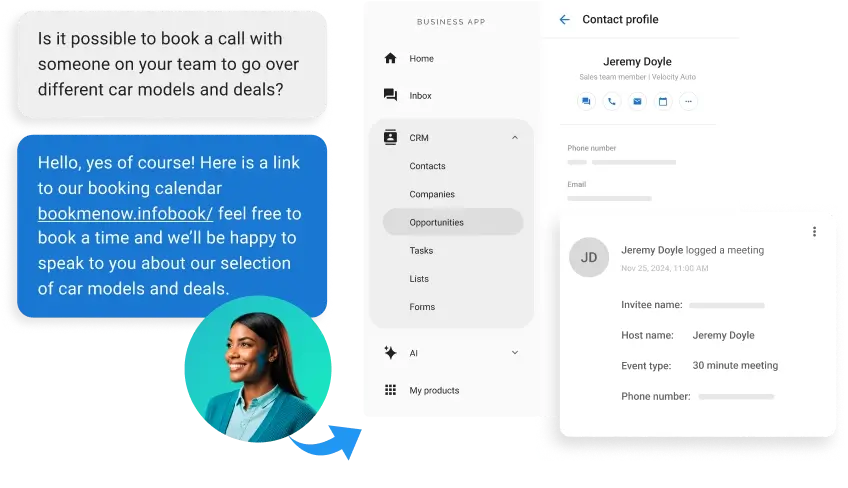
Voice answering and missed-call text-back are available in the U.S. and Canada through Conversations AI.
Rush hours are when the phone is busiest. AI phone vendor Maple analyzed more than 1.2 million restaurant calls and found that 68% arrive during lunch (11 a.m. to 2 p.m.) and dinner (5 to 9 p.m.), with the dinner window alone carrying 40% of daily volume.
Unanswered calls cost guests. In a Harris Poll conducted for AI phone vendor Hostie and covered in a Hospitality Technology report, 69% of U.S. adults said they would likely give up on a restaurant if nobody answered the phone.
Here is a worked example with assumptions you can swap for your own numbers. Picture a hypothetical bistro on a Friday dinner shift:
- Calls between 5 and 9 p.m.: 30
- Missed at one in three: 10 (merchants self-reported missing about 33% of peak-hour calls before using Maple)
- Reservation requests among missed calls, assuming half: 5
- Covers at three guests per table: 15
- Revenue at $40 per guest: $600 from one Friday
With AI Receptionist on the line, those 10 callers get answers. If a call still slips through, missed-call text-back texts the caller so the conversation continues. Every AI action is logged as proof of performance, so on Monday you can see exactly what happened Friday.
Vendasta’s first-party proof comes from outside restaurants. For Choice Signature Luxury Car Rental, a client of the agency Elite Web Professionals, AI Receptionist handled 1,017 calls and captured 778 qualified leads, with a 76% conversion rate over four months.
You stop sprinting to the host stand and returning voicemails at close. Your host stays at the door.
Take Reservations and Takeout Orders Without Staff
AI Receptionist books tables against your real calendar over voice and chat. It also captures takeout requests in writing, so nobody has to read a ticket back over the fryer.
Guests are open to this: in the same Harris Poll, 89% of Americans said they would be open to using an AI agent to interact with a restaurant, including 47% for making a reservation and 38% for placing a pickup or delivery order.
Where a booking lands depends on your systems. A connected calendar takes it directly.
Reservation platforms set their own rules. OpenTable, for example, has no public booking application programming interface (API), so voice AI tools must apply and be approved as integration partners before they can write to it.
For takeout, the conversation lands in writing in your inbox, so staff can enter the order or send the guest your online ordering link. Pushing orders straight into a POS needs an API connection your POS allows. Vendasta’s Custom AI Employees can use one through Custom Capabilities.

Here is one Saturday call from start to finish:
- At 6:40 p.m., a guest calls asking for a table for four at 7:30, plus two pizzas to go for a neighbor.
- AI Receptionist checks the connected calendar and offers 7:30 or 7:45. It books 7:45 when the guest picks it.
- It sends a text confirmation with the address and parking note.
- For the pizzas, the request is logged to the inbox, where staff enter it or send the online ordering link. Whether the AI sends that link itself depends on how you configure it.
- The conversation and booking are logged, and the host sees the reservation on the book.
The host who used to juggle that call stays with the tables already seated.
Handle the Same Questions About Hours, Parking and Allergens
Repeat questions make up a large share of restaurant calls, and AI answers them from the menu and business details you approve. In Maple’s call data, 22% of calls asked about hours or location, including directions. Another 15% asked about the menu.
Vendasta’s Conversations AI runs those answers across phone, web chat, text messaging (SMS), WhatsApp, email, Facebook Messenger, and Instagram. Every channel feeds one inbox, and every conversation is logged to the customer relationship management (CRM) system as proof of performance. A guest who texts “do you have parking?” at 4 p.m. gets the same answer as a caller at 8.
Write the allergen rule yourself. The AI should repeat only what your menu documentation states and send anything involving a serious allergy to a manager. That keeps liability-sensitive answers with a person while the AI handles “are you open Monday?” for the twentieth time.
Your front-of-house team stops reciting hours and the parking situation, and spends the shift on tables.
Respond to Reviews and Build Trust
Vendasta’s AI Reputation Specialist replies to Google and Facebook reviews in the reviewer’s language, following rules you set: rating thresholds, delays, and approval before posting. It suggests responses for 100+ other review sources and sends review requests. It runs inside Vendasta’s Reputation AI, which monitors reviews across 100+ sources and analyzes sentiment.

Full automation of review replies requires the Premium edition of Reputation AI, so check your edition before you switch approvals off.
Replies measurably helped hotels. A Marketing Science study of hotel reviews found that properties that began responding saw their ratings rise by an average of 0.12 stars and received 12% more reviews.
Guests expect a reply that sounds like a person. BrightLocal’s 2026 Local Consumer Review Survey found that 89% of consumers expect business owners to respond to reviews, and 50% are put off by generic or templated responses.
Review requests have to follow Google’s rules. Google’s Maps content policy bars merchants from discouraging negative reviews or trying to “selectively solicit positive reviews from customers.” It also bars offering payment or benefits such as discounts and free goods in exchange for reviews.
When Google finds violations, it can restrict a Business Profile from receiving new reviews for a set period and unpublish existing ones. It can also display a warning that fake reviews were removed.
The Federal Trade Commission’s (FTC) consumer review rule separately prohibits incentives conditioned on a review expressing a particular sentiment. So ask every guest the same way, never route unhappy guests away from Google, and never trade a free dessert for five stars.
You stop writing replies late on Sunday night.
Fill Slow Nights With Promotions
You can use automated email and SMS campaigns to fill a slow Tuesday, sending an offer to guests most likely to come in based on guest data you already hold. Marketing is the top area where operators say AI is affecting their restaurants: 19% of full-service and 15% of limited-service operators use AI-driven marketing tools, according to the National Restaurant Association.
Vendasta’s Campaigns Pro builds multistep email and SMS campaigns, drafts emails with AI, and segments contacts from the CRM. You can track engagement for each contact. A Tuesday flow might target guests who usually visit on weekends but haven’t come in this month.

Win-back flows show what this can do. In a case study from loyalty vendor Paytronix, an unnamed restaurant chain sent a weekly email offering a free entrée to loyalty members who hadn’t visited in 90 days. Between 12% and 13% of those dormant members came in and redeemed it, and 70% stayed active in the following months.
Texting has legal requirements:
- Autodialed marketing texts require the guest’s prior express written consent under Federal Communications Commission (FCC) rules.
- You must honor opt-out requests made by any reasonable means within 10 business days. The FCC adopted further opt-out changes in September 2026, so check the current requirements before you launch.
- Business texting from standard numbers needs application-to-person (A2P) 10-digit long code (10DLC) registration, and carriers block unregistered traffic.
- Marketing email needs an unsubscribe option and a valid physical postal address under the CAN-SPAM Act.
You stop building one-off blasts at midnight.
Forecast Prep, Inventory and Staffing
Demand forecasting sets prep pars and shift counts from your sales history, which addresses the two biggest lines on a restaurant profit and loss (P&L) statement. National Restaurant Association data for 2024 puts median food and non-alcohol beverage costs at 32.0% of sales for full-service and 32.4% for limited-service restaurants.
Labor is the other big line. Salaries and wages, including benefits, ran a median 36.5% of sales for full-service and 31.7% for limited-service restaurants in 2024, according to the association’s labor cost analysis.
Here is what forecasting looks like in practice:
- Prep pars: Chick-fil-A’s machine learning models forecast sales, transactions and ingredients down to 15-minute blocks for each restaurant. Operators use the forecasts for decisions such as how many cases of Waffle Fries to prep for the day.
- Waste: Restaurant Business reported that Bluemont Group, a 99-store Dunkin’ franchisee, cut doughnut waste 25% year over year after rolling out an AI counting and forecasting system built with PreciTaste. That waste had been costing about $3.1 million a year.
- Schedules: Toast reports that restaurants using its scheduling software averaged 41% fewer overtime hours than Toast restaurants not using it, based on its own customer data.
Among the restaurants using AI or automation in Fourth’s State of Restaurant Operations 2026 survey, sales forecasting was the top use case at 53%, followed by labor forecasting at 38%. That base is small: 32 of the 112 restaurant leaders surveyed.
None of the Vendasta AI Employees covered here forecast prep or build schedules; that job runs in your POS or other software for inventory and scheduling. With it, you stop setting pars and shift counts by gut feel on Sunday night.
Manage Online Listings and Menus
Keep your listings consistent so guests see the same hours and menu on Google as they do at your door. Google states that local results are mainly based on relevance, distance, and prominence, and that more reviews and positive ratings can help a business’s local ranking.
Accurate, complete listings also support your Google Business Profile ranking, since Google uses those details to judge relevance.
Vendasta’s Listing Sync Pro synchronizes and protects your listing details in real time across 50+ sites, and a premium U.S. tier covers 70+. Citation Builder submits your business data to the Data Axle, Neustar/Localeze, and Foursquare aggregator networks, reaching 300+ platforms. Both are add-ons to Vendasta’s Local SEO.
Change your holiday hours once, and the update flows out to every site Listing Sync Pro covers. Listings are one part of local SEO for restaurants, alongside reviews and your website.
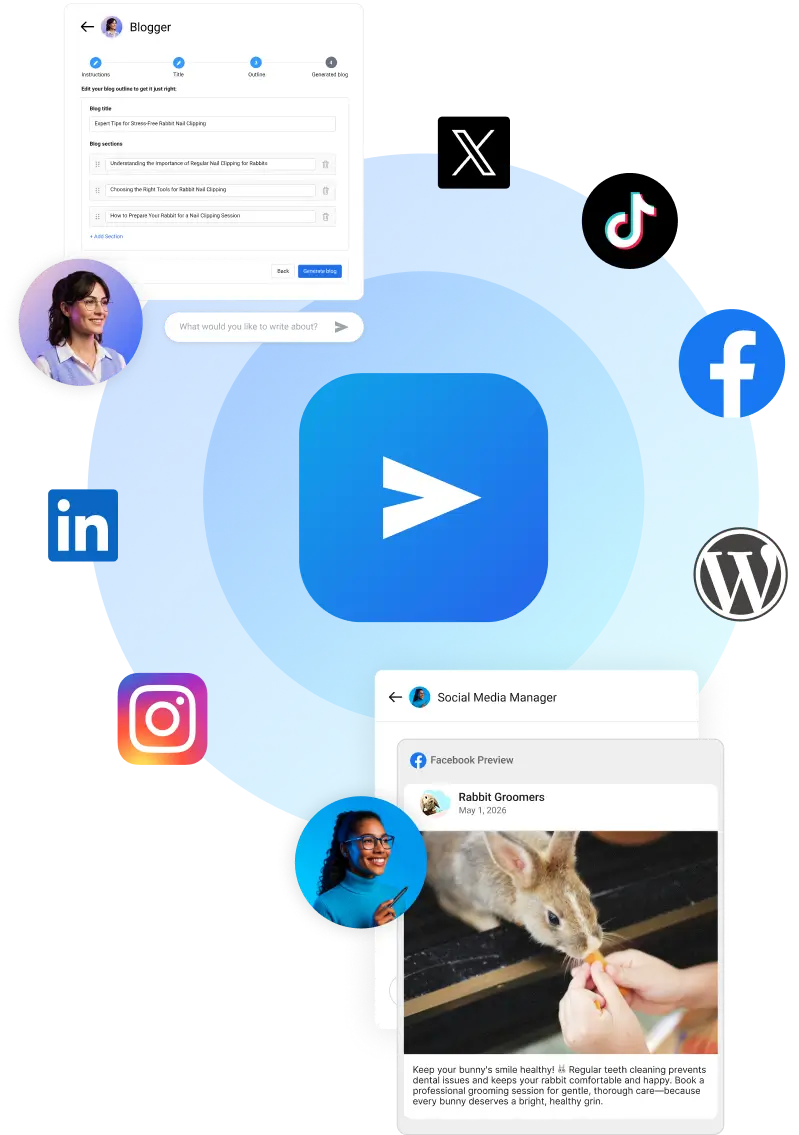
For visibility, AI Social Media Manager learns your brand voice and posts platform-adapted content to Google Business Profile. It also posts to other networks, including Facebook and Instagram. AI Blogger writes one FAQ-style article a week and passes it to AI Social Media Manager for social posts. Both are part of Vendasta’s Social AI.
You stop logging into each directory on Christmas Eve to post closing hours.
Follow Up With Regulars
You can use automated post-visit follow-up to encourage occasional guests to return without keeping a list by hand. Repeat visits are up for grabs: Circana found that loyalty members make 22% more restaurant visits than nonmembers, yet they still visit 20 chains a year, the same as everyone else.
You can encourage some of those repeat visits with a timed nudge. In a case study from ordering vendor Olo, First Watch sent an automated email 14 days after an online order, and recipients showed a 20% increase in spend over the next 30 days. The study does not report a control group.
Campaigns Pro can send a thank-you after a first visit and a nudge at day 14. You can add a win-back at day 60. Review requests sent after a visit follow the same Google rules covered above.
You stop trying to remember which regular hasn’t been in since spring.
Are Restaurants and Chains Like Chick-fil-A Using AI
About a quarter of restaurants use AI so far. The National Restaurant Association’s 2026 State of the Restaurant Industry report puts AI-related tool use at 26% of operators. Reservations and inquiries show the widest split by segment: 9% of full-service operators use AI there, compared with 1% of limited-service operators.
In Toast’s 2026 survey of restaurant decision-makers with 16 or fewer locations, 87% said they feel comfortable using AI. Guests are more divided on format. In the association’s consumer data, 62% of adults would order from a live person on a video screen, compared with 39% for an AI-generated persona.
Large chains report these results:
- Chick-fil-A: The company told QSR Magazine that it uses technology “to complement—not replace—the human connection,” and it runs the forecasting described above.
- Taco Bell: Voice AI takes drive-thru orders at more than 890 U.S. restaurants across 38 states. The chain says restaurants using it have seen higher employee retention because team members can focus on hospitality instead of order taking.
- Wendy’s: In its 2023 pilot, Wendy’s FreshAI handled an average of 86% of orders without a team member stepping in, according to the company.
- McDonald’s: The company ended its IBM drive-thru voice test in 2024 after the technology struggled with order accuracy. At its September 2026 Investor Day, it announced ArchIQ, an AI restaurant operating system whose Archy voice assistant takes drive-thru orders in English and Spanish at above 90% accuracy, per McDonald’s.
Operators mostly describe AI as support for staff. Only 6% said technology investments permanently eliminated jobs. In the association’s 2025 edition, 74% said technology would augment rather than replace human labor.
What Restaurant AI Costs and How It Fits Your POS
Owners usually decide whether to keep a tool after its first month by checking cost. A tool that books ten extra tables a week pays for itself quickly, while one that needs constant babysitting or double entry rarely does, no matter how low the sticker price.
Cost is only half the decision. The other half is whether the tool can read from and write to the systems you already run, and whether it handles guest calls and card data within the law. A cheap phone tool that can’t see your reservation book, or that records callers without notice, creates more work than it saves.
The subsections below cover what restaurant AI costs, how it connects to common POS and reservation systems, and which privacy and consent rules to check before you turn on voice AI.
What Restaurant AI Tools Cost
As of October 2026, restaurant AI phone tools that publish pricing ranged from about $150 a month to $599 a month per location, though vendors state billing periods and per-location terms differently, so the prices are not like-for-like. Others quote only on request. Reservation platforms such as OpenTable charge monthly subscriptions and can add $1 to $1.50 for each diner they send through their network.
The total cost of ownership depends on terms the headline price leaves out:
- Setup fees: Some vendors charge them. Others publish no amount.
- Call limits: Lower tiers can cap calls and charge overage fees.
- Contract length: Some plans require one-year terms that renew automatically.
- Per-order fees: Some ordering tools take a percentage of each order.
- Staff time: Count the hours someone spends loading the menu and policies, along with booking rules.
Vendasta pricing depends on the AI Employees and products you deploy. Most AI Employees set up in under 30 minutes, and a 14-day free trial with no credit card is available.
Expert setup and the AI Workforce Optimization Plan are optional add-ons if you want a team to configure and tune them. Request a Vendasta quote through a demo.
POS, Reservation and KDS Integration Checklist
Each POS and reservation system sets its own rules for third-party AI tools:
- Toast: Partner integrations require an application, an agreement, and certification. Toast has no dedicated reservation API, so your reservation system stays the source of truth.
- Square: Orders created through the Orders API appear on Square Point of Sale only after they are paid. Delivery fulfillment requires a partnership with Square.
- Clover: Orders created through its API show in the Orders and Register apps, but they don’t work with Clover Dining, so table assignments don’t carry over.
- SpotOn: It has no open API and integrates only with partners it selects. Its Orders API accepts only fully paid orders.
- OpenTable: Its APIs are available only to approved partners, who must apply, sign an agreement, and pass a review.
- Questions for every vendor: Does it write to your POS and KDS, or only read from them? Which system holds the reservation book? What happens to orders when the POS is offline?
Vendasta integrates with Shopify, QuickBooks Online, Zapier, Google products, and others, and it supports developer APIs and Model Context Protocol (MCP). Custom AI Employees connect external systems through APIs. None of those named integrations is a restaurant POS, so ask how yours would connect.
Privacy, Card Data and Caller Consent
Check caller consent and card-data handling before using voice AI:
- Recording consent: Federal law allows recording with one party’s consent. The Reporters Committee recording guide lists California, Delaware, Florida, Illinois, Maryland, Massachusetts, Michigan, Montana, Nevada, New Hampshire, Pennsylvania, and Washington as requiring consent from all parties. Washington accepts a recorded announcement at the start of the call.
- Maine: State law requires clear notice when an AI chatbot could lead a consumer to think they’re talking to a human.
- Utah: State law requires businesses using generative AI to disclose it when a consumer clearly asks.
- Outbound vs. inbound: In a 2024 proposed rule on AI-generated calls, the FCC noted that Telephone Consumer Protection Act (TCPA) requirements do not extend to technology used to answer inbound calls. Recording and disclosure laws still apply.
Card data: The PCI Security Standards Council says storing card verification codes in audio recordings after authorization violates the Payment Card Industry Data Security Standard (PCI DSS). Send a payment link by text instead of having guests read card numbers aloud.
Federal district courts in California have let wiretap claims against AI phone vendors move past early dismissal, including Taylor v. ConverseNow, a 2025 case over AI phone ordering, and Ambriz v. Google.
Which AI Uses Fit Your Restaurant
Start with the job that loses you the most covers this month. If reservations come in by phone, start with the phone. If takeout and hours questions tie up the line, put call and chat answering first, then listings. If you run several locations, consistent listings and one inbox across them belong early on the list.
- Run one AI Employee, usually the phone, for 30 days.
- Compare answered calls and bookings against the month before. Check reviews too.
- Add review replies, then promotions, once the first job runs cleanly.
- Leave forecasting to your POS and scheduling software.
Agencies and franchisors that serve restaurants can deploy the same AI Employees across every client or location from one place, under their own brand, with roll-up reporting on what the AI did.
Vendasta’s AI Receptionist and Vendasta’s AI Reputation Specialist cover the phone and review jobs, while Vendasta Campaigns Pro and Vendasta Listing Sync Pro handle promotions and listings.
To see how Vendasta can address this workflow in your business, book a Vendasta demo.
AI for Restaurants FAQs
1. How many restaurants use AI right now?
About a quarter of operators use AI-related tools, according to the National Restaurant Association’s 2026 State of the Restaurant Industry report, which put the figure at 26%. Marketing is the top area where operators say AI is having an impact. Toast’s 2026 survey of operators with 16 or fewer locations found 87% comfortable using AI.
2. Will AI replace my servers and hosts?
The evidence points to AI supporting staff. Only 6% of operators told the National Restaurant Association that technology investments permanently eliminated jobs, and in the 2025 edition, 74% said technology would augment rather than replace human labor. Chains using voice AI describe freeing crews for hospitality, as AI takes calls and repeat questions while people still run the dining room.
3. How do I measure return on investment (ROI) from restaurant AI?
Track a before-and-after month on the numbers the AI touches: answered calls, bookings from the phone, review count and response rate, and campaign redemptions. Every AI Employee action is logged as proof of performance, which gives you the record. Compare added covers and orders against the monthly cost, and keep forecasting results in your POS reports.
4. What should a restaurant automate first?
Start with the phone if calls go unanswered during service, since lunch and dinner rushes carry most call volume. Add review replies next, then promotions and follow-up. Run one job for 30 days, compare it with the prior month, and expand only once it runs cleanly.
5. How much does AI for restaurants cost?
Restaurant AI phone tools that publish pricing ranged from about $150 to $599 a month per location as of October 2026, though billing terms vary by vendor, and reservation platforms can add $1 to $1.50 per network cover. Check setup fees, call limits, per-order fees and contract length. Vendasta pricing depends on the AI Employees and products you choose, and you get a quote through a demo.
6. Does restaurant AI work with my POS?
It depends on the POS: Toast and SpotOn approve third-party integrations through partner programs, Square shows API orders only after payment, and Clover’s API orders don’t appear in Clover Dining. Vendasta offers standard integrations and developer APIs, while Custom AI Employees can connect external systems. Confirm the connection path for your system before signing with any vendor.
7. How is AI used in hospitality beyond the phone?
Restaurants use AI to reply to reviews, send promotions to segmented guest lists, keep hours and menus consistent across directories, follow up after visits, and forecast prep and labor. Chains go further: Chick-fil-A forecasts sales and ingredients in 15-minute blocks, and a 99-store Dunkin’ franchisee cut doughnut waste 25% year over year with AI counting and forecasting.
8. Does an AI phone answerer sound like a real person?
Many guests still prefer a person. A Harris Poll conducted for Hostie found 89% of Americans open to using an AI agent to interact with a restaurant, but the National Restaurant Association found 62% would order from a live person on video, compared with 39% from an AI persona. Open each call with a short notice and a handoff option, so guests who prefer a person can reach one.
9. Can AI ask guests for Google reviews?
Yes, as long as it asks every guest the same way. Google bars businesses from selectively soliciting positive reviews, discouraging negative ones, or offering discounts or free items for reviews. Violations can freeze new reviews and put a warning on your profile.
10. Is it legal to record calls answered by AI?
Usually, with notice: federal law allows recording with one party’s consent, but California, Delaware, Florida, Illinois, Pennsylvania, Washington, and other states require every party’s consent. Washington accepts a recorded announcement, and federal district courts in California have let wiretap claims against AI phone vendors move past early dismissal. Keep card verification codes out of recordings, and send a payment link instead of taking cards by voice.