About Us
 Careers
 Leadership
 Board
Board Newsroom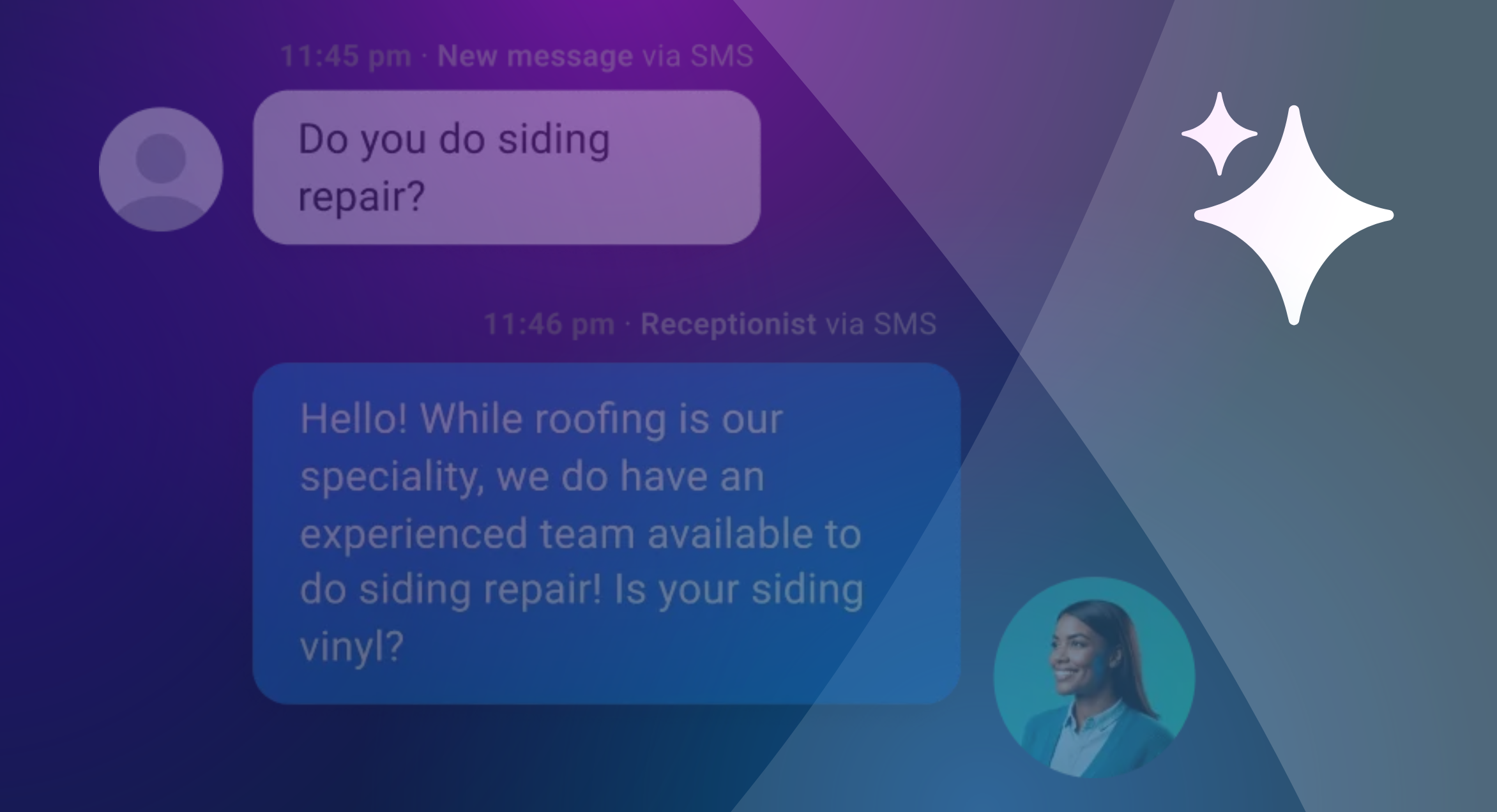
AI agents for small businesses exist because speed to lead wins the job, and most contractors don’t have it. According to CustomerFlows’ 2026 lead response study, a roofing lead qualifies 60% of the time when a contractor responds within five minutes, versus 15% at four hours, but the average contractor takes four to eight hours to respond.
AI agents for small businesses answer calls and messages around the clock. They qualify leads, book jobs, handle follow-up and review requests, and log every action in the CRM.
Most local businesses lose the lead before they know it existed. The phone rings during a job and goes to voicemail. By the time the owner calls back, the prospect has already booked with whoever answered first, which is rarely them.
Businesses waste more ad spend when they pay for leads but fail to answer them. Every dollar spent on search or social is effectively a subsidy for the competitor with faster coverage. A business’s response time affects whether paid traffic converts or prospects contact a competitor.
AI agents close that gap through practical customer-journey workflows. Compare the cost of AI coverage against human staffing, then match the agent to your biggest revenue leak.
Automate every step of the customer journey with AI employees
TL;DR
- Vendasta AI Workforce books leads: Vendasta’s AI Employees handle calls and book qualified leads across connected business tools.
- Speed to lead pays first: Responding within an hour makes you about 7x more likely to qualify a lead than responding an hour later, and 60x more likely than waiting a day, per Harvard Business Review’s 1.25-million-lead study.
- Human coverage costs six figures: Staffing a phone line around the clock runs $244,598–$352,220 a year, versus Vendasta’s $99/month Starter plan along with spend-offset subscriptions.
- Judge results at 90 days: Track lead handling and booked revenue against your baseline, not your P&L alone.
What Are AI Agents for Small Businesses?
An AI agent is software that pursues a goal on its own. AI agents for small businesses receive an input such as a missed call or a new lead and decide what steps are needed. They then execute those steps across your other tools. They can also respond to a fresh one-star review. Gartner defines AI agents as software that operates with partial or full autonomy, perceiving its environment and making decisions before taking action to reach a goal, whether that environment is digital or physical.
OpenAI draws the practical line in its agent-building guide: a system that only answers questions functions as an assistant. A system that connects to other tools and takes action based on user input qualifies as an agent. That distinction matters when you’re shopping, because vendors sell plenty of scripted widgets under the agent label.
Walk one missed call through the loop. After detecting the missed call, the agent identifies and qualifies the caller, then checks for an open slot and confirms the appointment. Your CRM supplies the customer record; your calendar supplies availability. Based on each result, it texts the caller a confirmation. If it can’t finish the booking, it escalates the call to you.
In practice, AI agents for small businesses handle the intake work a receptionist would otherwise manage. An AI employee on your phone line classifies “my furnace is dead, and it’s Saturday” as an emergency job and checks the calendar. It then books the visit. A script would have asked the caller to press two.
Do You Need an AI Agent for Your Business?
You need one if leads are reaching you faster than you can respond to them. Researchers conducting the cited surveys found that these conditions describe many local businesses:
- You miss calls while on jobs: CallRail’s analysis of 1.1 million leads found missed-call rates of 14% for home services businesses, rising to 32% in healthcare and 28% in legal — and most of those callers don’t leave a voicemail or call back.
- You pay for ads but respond in hours: Moneypenny’s survey of 2,000 U.S. consumers found 72% are likely to choose the business that responds first, and 41% expect a response within minutes.
- Your review profile has stalled: BrightLocal’s Local Consumer Review Survey found that nearly three-quarters of consumers consider only reviews posted in the last three months, and 42% are unlikely to use a business that ignores reviews entirely.
- Admin eats your evenings: Quoting and follow-ups compete with data entry after 8 p.m., or the work does not happen at all.
If two or more of those describe your week, an agent addresses a leak you can measure in dollars. If none do, use a free tier to test before you spend.
Types of AI Agents for Small Businesses
Vendors sell today’s agents in five categories. For many local businesses, the first two address the most immediate revenue leaks.
1. Task Automation Agents
Task automation agents watch for a trigger and execute a multi-step workflow. When a job closes in your field-service software, the agent sends the invoice. A separate follow-up updates the customer record before scheduling the review request. This is AI workflow automation applied to the admin work that currently happens at your kitchen table.
2. Conversational AI Agents
Vendors build conversational agents on conversational AI, so the agents can handle live customer contact across phone and digital messaging channels. They handle lead qualification by answering questions from your business’s own knowledge and screening the caller. They can then book appointments against a real calendar. For a local service business, conversational AI agents directly target the revenue line: each captured conversation preserves a lead that voicemail might lose.
3. Autonomous Research and Data Agents
Research agents gather and enrich information. They build prospect lists while monitoring competitors. They can also analyze review sentiment, then combine it with CRM data in a morning briefing. Most one-truck operations need this category later, if at all.
4. Orchestration Agents (Multi-Agent Systems)
Orchestration systems coordinate several agents on one goal. One agent handles research and writing; an execution agent sends the result. If you don’t have a technical hire, buy agents that vendors have already orchestrated inside a platform instead of assembling your own.
5. Customer Support and Ticket-Deflection Agents
Customer support and ticket-deflection agents resolve inbound support requests by drawing on a help center and knowledge base, closing the conversation before a human ever touches it. The key metric is deflection rate: the share of total conversations the agent handles end-to-end without escalation, which determines whether the category pays for itself.
How AI Agents Differ From Traditional Rule-Based Assistants
Forrester puts the difference bluntly: conversational systems with canned responses are not agentic. The technical gap shows up across five dimensions:
| Dimension | Rule-based assistant | Modern AI agent |
|---|---|---|
| Autonomy | Follows a predefined decision tree; breaks on unexpected input | Directs its own process to reach a goal |
| Reasoning | Pattern matching, no planning | Breaks goals into subtasks and adapts |
| Tool use | None, or scripted calls | Calls business systems such as calendars and CRMs as the task requires |
| Multi-step work | Single turn or rigid flow | Sustains execution across many steps |
| Memory | Session-only or none | Retains short- and long-term context |
Gartner warns buyers about “agent washing,” which it defines as rebranding existing products, including AI assistants and robotic process automation (RPA), without substantial agentic capabilities. Ask the vendor what the product does when a caller asks something outside the script. A scripted widget deflects; an agent works the problem.
Key Functions of Modern AI Agents
Across categories, the agents worth paying for perform a consistent set of jobs:
- Answer and qualify: Pick up calls and digital messages 24/7. Separate the $8,000 roof replacement from the tire-kicker.
- Book: Schedule appointments against your live calendar inside the same conversation.
- Follow up: Chase quotes and confirm appointments. They can also text back missed calls within minutes.
- Manage reputation: Request reviews after completed jobs and respond to new ones.
- Keep records: Update the CRM and log every interaction so nothing lives only in your head.
- Report: Show you what the agent handled and booked. An activity log also shows what it escalated so you can audit the work.
Key Benefits of AI Agents for Small Businesses
Operators can compare documented figures for coverage and response time. Cost-per-contact benchmarks provide a third basis for comparison.
1. AI Agents Answer After-Hours Calls and Turn Them Into Customers
Every call that rings outside staffed hours is a potential customer choosing between you and whoever picks up. BrightLocal’s study of 45,264 Google business listings found restaurants received 51% of calls after 5 p.m. and locksmiths received 42% of calls outside standard hours, meaning the majority of demand for those categories arrives precisely when most local businesses go dark. The caller books with whoever answers first.
Keeping the phone answered around the clock carries a real price tag for humans, but not for AI. A 24/7 line requires 4.2–5.4 full-time staff; at the BLS wage data mean customer-service wage of $46,590 plus a standard 1.25–1.4x loading for benefits and overhead, bare-minimum staffing costs $244,598 a year. AI receptionists can answer those calls at a fraction of the cost.
2. Faster Lead Response and Higher Conversion Rates
Harvard Business Review’s audit of 1.25 million leads across 42 companies found that responding within one hour made firms nearly 7x as likely to qualify a lead as waiting one additional hour, and 60x as likely as waiting 24 hours or more. Researchers have documented this qualification advantage for years, yet business response times have barely improved: Workato’s lead response audit of 114 business-to-business (B2B) companies found zero called a new lead within five minutes, with average phone response at 14 hours 29 minutes.
Faster operators can win leads while competitors delay their responses. An agent doing AI lead generation can acknowledge new inquiries automatically while your competitors’ quotes sit unopened. Answering first beats out-marketing the bigger contractor across town.
3. Significant Reduction in Operational Costs
Gartner’s cost-per-contact benchmark puts the median cost of a human-assisted customer contact at $13.50 and a self-service (AI) contact at $1.84, a 7x gap per interaction. Deloitte’s contact-center analysis documented one client whose cost per call fell from $10 to $0.45 with 95% containment. At current prices, owners can handle routine inquiries for a fraction of the cost of employee coverage — though Gartner expects that gap to narrow as GenAI costs rise past 2030.
4. Fewer Missed Steps in Routine Processes
An agent executes configured follow-up and data-entry steps consistently, and its answers are only as good as the business knowledge you load into it. Research across small and medium enterprises found AI-powered assistants handled 72% of routine inquiries and cut response times by 84%. Most of the repetitive workload can move off your team’s plate without sacrificing speed.
Consistent data entry and follow-up reduce repeat calls and missed tasks over time. McKinsey’s contact center research on a North American telecom case saw average handle time fall more than 25% and first-call resolution rise 10–20 percentage points after AI agent implementation. Fewer repeat calls means fewer irritated customers and fewer refund conversations.
5. Scalability Without Proportional Hiring Costs
CX Dive’s reporting in February 2026 found that a Gartner survey found only one in five customer-service leaders had cut headcount because of AI, while 55% held headcount stable while serving more customers. That’s your playbook: agents absorb growth so your next busy season doesn’t force another hire, which runs roughly $58,000–$65,000 once you load the BLS mean wage the way the figures above do.
Peer-reviewed research tracking 5,172 support agents found that generative AI assistance increased issues resolved per hour by 15% on average. That meaningful productivity lift compounds across every busy period. Your crew stays on billable work while the agent handles the volume in between.
6. Competitive Parity With Larger Enterprises
AI adoption among U.S. SMBs (under 250 employees) is climbing fast. The U.S. Chamber’s annual survey shows generative AI use at 23% in 2023 and 40% in 2024. It rose to 58% in 2025. Vendors now offer tools that once required an enterprise IT budget to local businesses through monthly plans.
Adoption of true agents, meaning the kind that take action rather than draft emails, is still early. Gartner’s 2026 Hype Cycle for Agentic AI found only 17% of organizations have deployed AI agents, with more than 60% expecting to within two years. A two-person HVAC shop that deploys this quarter answers like a national brand before its local competitors have finished a free trial.
AI Agents for Small Businesses: Matched to Your Use Case
Start from your biggest revenue leak, then pick the agent category that closes it. The most common revenue leaks map to these agent categories and starting points:
| Your biggest leak | Agent type | Where to start |
|---|---|---|
| Missed calls and after-hours inquiries | Conversational voice agent | Vendasta AI Receptionist; ElevenLabs |
| Slow lead follow-up | Conversational agent plus automation | Vendasta; HubSpot Breeze |
| Stagnant Google reviews | Reputation agent | Vendasta AI Reputation Specialist |
| Admin and data entry between tools | Task automation agent | Zapier Agents; Lindy; Vendasta AI Sales Assistant |
| Building prospect lists | Research and data agent | Clay |
| High support ticket volume | Support resolution agent | Intercom Fin; Vendasta AI Support Agent |
If your leak is the phone, prioritize voice. Every tool on this list can draft an email; far fewer can book a furnace repair at 11 p.m.
Best AI Agents for Small Businesses in 2026
We ranked the platforms by the factors an owner without an IT department feels most directly. Those factors are production speed and economics, including whether the agent touches revenue and what it costs at realistic volumes. We verified pricing against official vendor pages in August 2026:
| Platform | Best for | Starting price | Free tier / trial |
|---|---|---|---|
| Vendasta | Call and lead follow-up, reviews, and CRM in one platform | $99/mo (all-in-one solution) | 14-day trial, no credit card |
| Lindy | Personal task agents for email and scheduling | $29.99/user/mo | 7-day trial |
| Relevance AI | Building custom agent teams | $19/mo (annual) | 200 actions/mo free |
| HubSpot Breeze | Agents inside an existing HubSpot CRM | $10 per 1,000 credits | Breeze Assistant free with CRM |
| Zapier Agents (formerly Central) | Cross-app workflow automation | ~$33.33/mo (annual) | 400 activities/mo free |
| ElevenLabs | Voice agents by the minute | $6/mo Starter | 15 agent minutes/mo free |
| Clay | Lead data enrichment | $167/mo Launch | 100 credits/mo free |
| Sintra AI | Bundle of 12 role-based helpers | $97/mo (promos lower) | No free plan listed (14-day money-back) |
| CrewAI | Developer-built multi-agent systems | Free tier; Enterprise custom | 50 executions/mo free |
| Intercom Fin | Support ticket resolution | $0.99 per billable outcome + seat from $29 | 14-day trial |
Top 10 AI Agents for Small Businesses in 2026
Based on those criteria, revenue-facing agents come first. The rest automate internal admin.
1. Vendasta
Vendasta gives local businesses an all-in-one AI Workforce that captures more leads, responds faster, and keeps customers engaged around the clock. Instead of juggling separate tools, they get AI Employees that work together to turn missed opportunities into revenue.
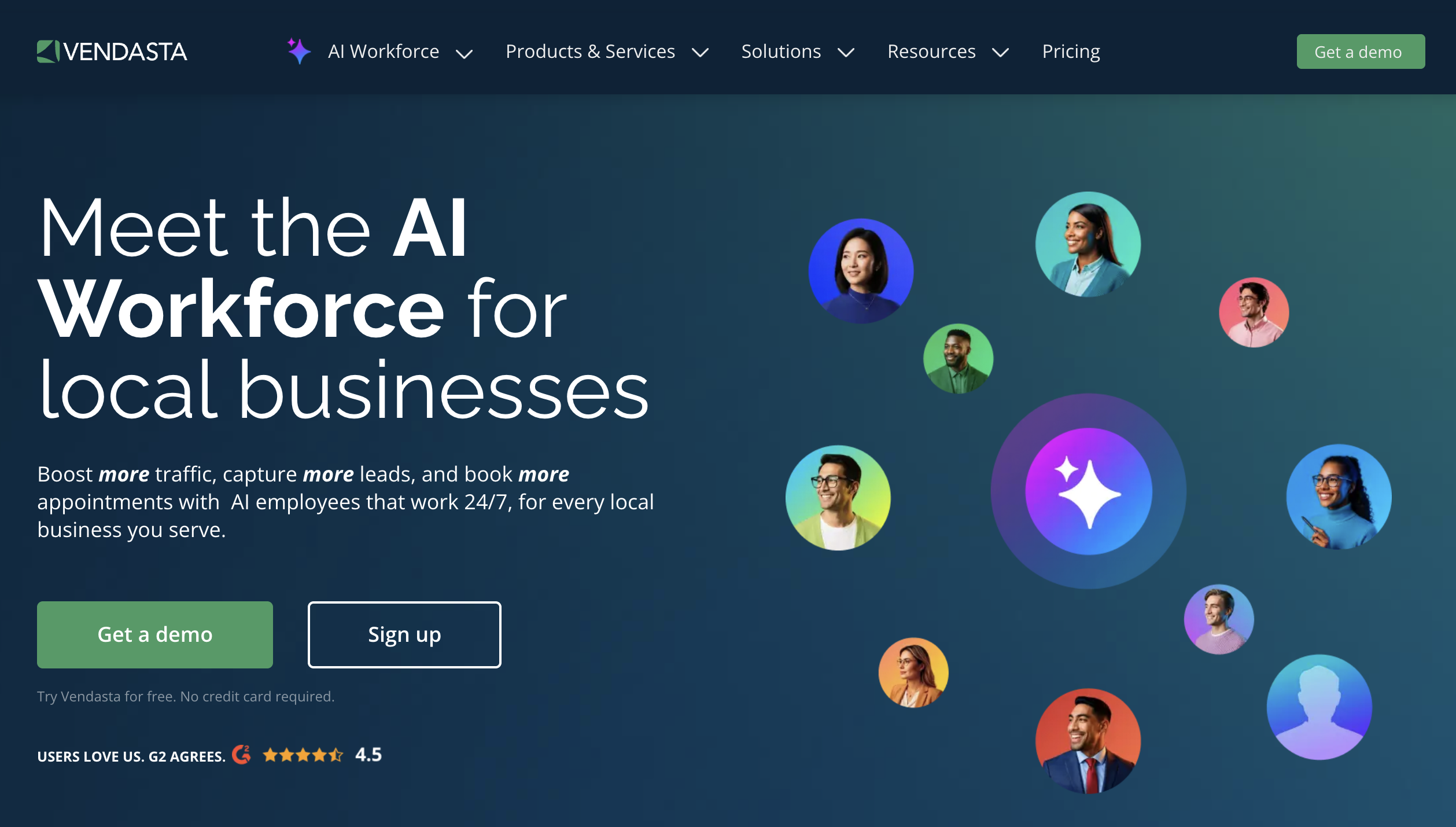
The AI Receptionist never misses a call or inquiry, even after hours — turning existing traffic into more booked business and stronger margins. Vendasta also covers reputation and sales: AI tools handle customer questions consistently, manage follow-up and review requests, and keep the business’s brand voice consistent across every interaction.
2. Lindy
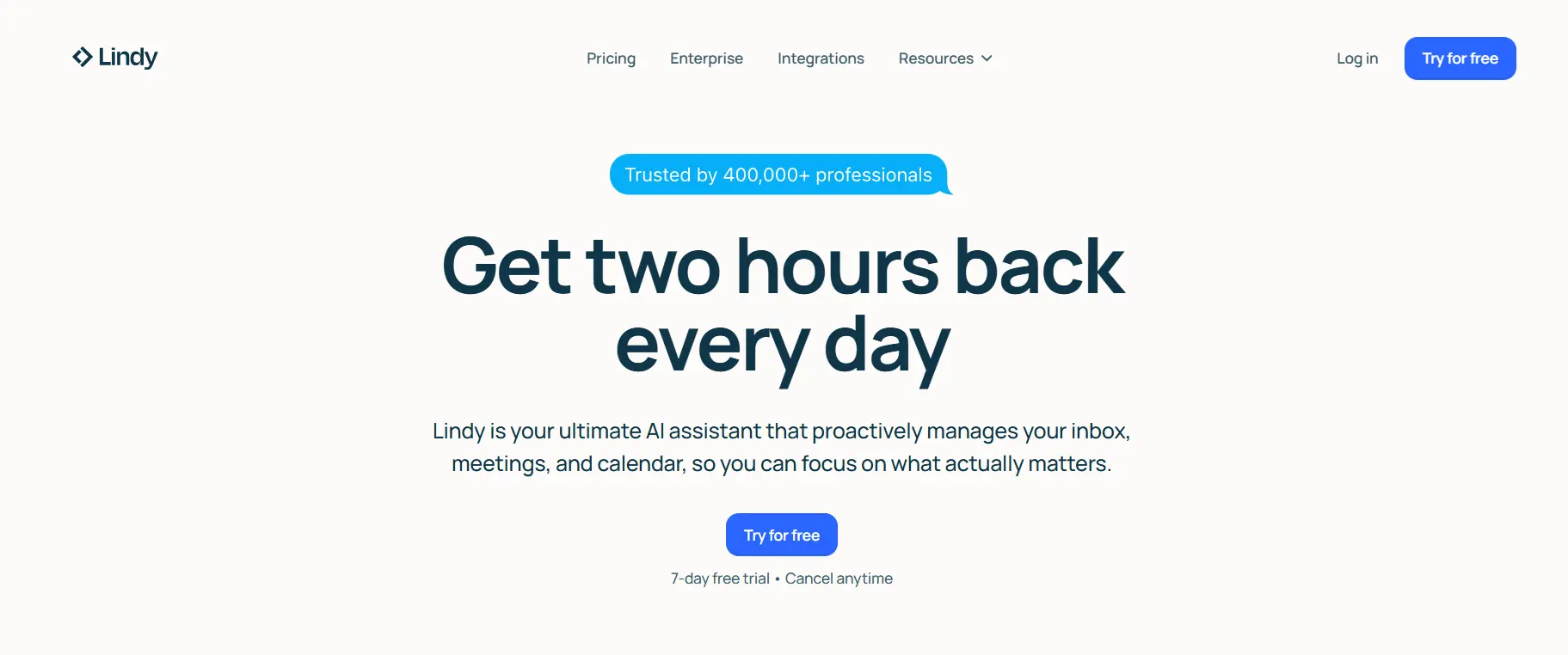
Lindy builds personal task agents for email triage and meeting scheduling. It also supports outreach through its model selection and more than 40 skills. Plans start at $29.99 per user per month with 3,000 credits; credits don’t roll over, and top-ups run $10 per 1,000. Lindy offers the seven-day trial only through Slack sign-up and bills direct sign-ups immediately.
3. Relevance AI
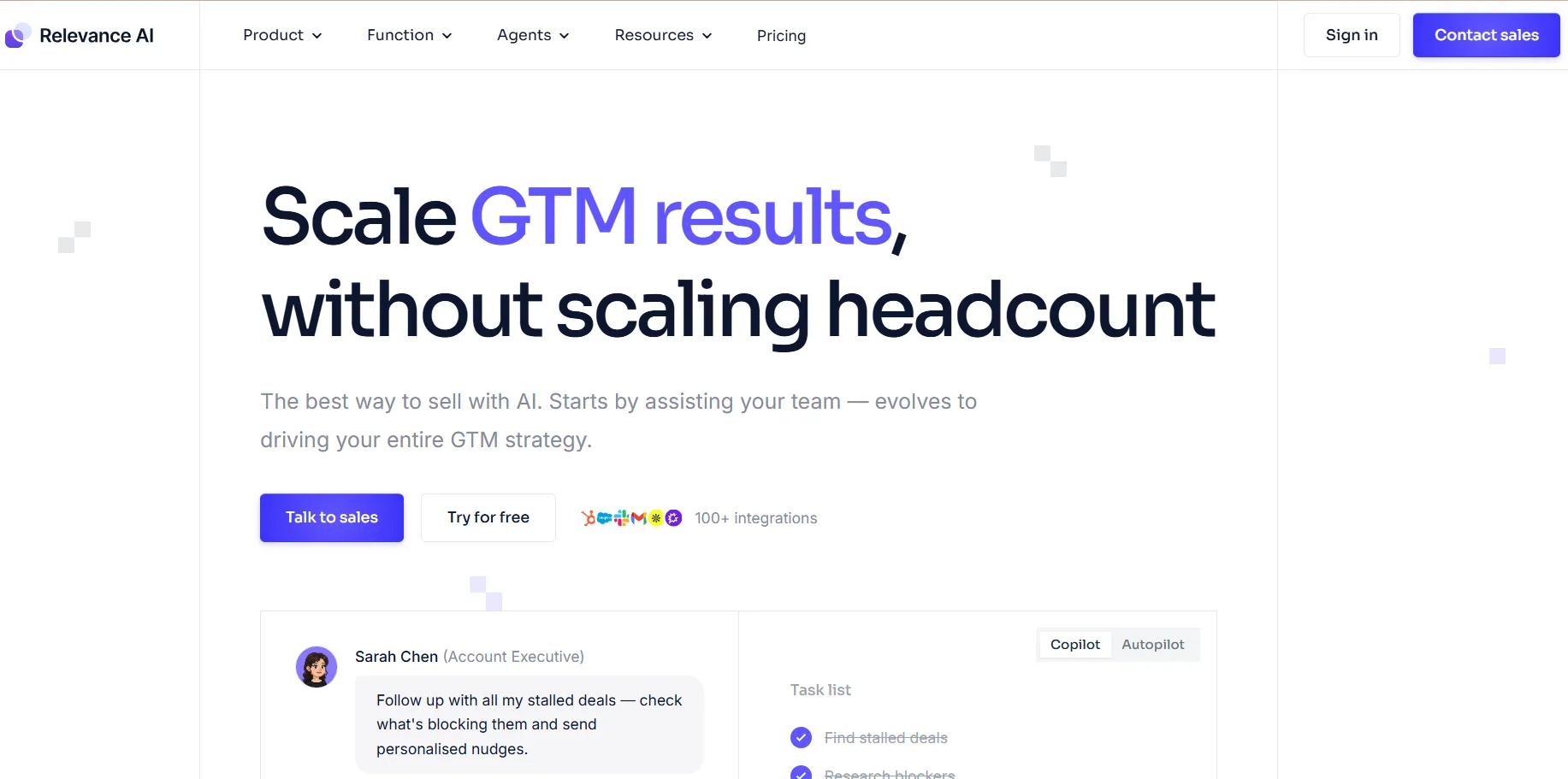
Relevance AI offers custom agent teams without enterprise pricing. Even the free plan includes unlimited agents and tools. It also includes SOC 2 and GDPR compliance. Pro costs $19/month billed annually ($29 monthly) with 2,500 actions; Team runs $234/month billed annually with 7,000. Free users get 200 actions a month but can’t buy more after they use them.
4. HubSpot Breeze
If you already run HubSpot, Breeze adds agents inside the CRM you have. The Customer Agent charges 50 HubSpot Credits per resolved conversation; at $0.010 per credit, that’s effectively $0.50 per resolution, below Intercom Fin’s published $0.99 outcome fee, but it requires a paid HubSpot seat plan. The free CRM includes the Breeze Assistant (60+ prompts) at no cost, while the actual agents sit behind paid tiers.

5. Zapier Central
Zapier renamed Central to Zapier Agents in January 2025 and is migrating the product to AI by Zapier, which reached general availability on July 15, 2026. It provides a direct way to automate work across the apps Zapier connects: the free tier includes 400 activities per month, and Pro runs about $33.33/month annually for 1,500. Use it for admin automation. Phone coverage requires a voice agent.
6. ElevenLabs
ElevenLabs bills conversational voice agents by the call minute: the $6/month Starter plan includes 75 minutes, additional minutes cost $0.080, and the free tier includes 15 minutes for testing. Voice quality is the draw. The trade-off is that you’re assembling calendar and CRM connections yourself rather than buying them pre-wired.

7. Clay
Clay is a research and enrichment agent for building outbound lead lists from dozens of data sources. Under pricing effective March 11, 2026, the Launch plan starts at $167/month with 2,500 data credits, Growth starts at $495, and a free tier includes 100 credits. It earns its price if outbound prospecting drives your revenue. Businesses that receive leads from ads and referrals need it less.
8. Sintra AI
Sintra bundles 12 role-based AI helpers across marketing and sales. The same subscription also covers support and other functions. Sintra X lists at $97/month with 250 credits, with promotional pricing as low as $15.60/month on a 12-month term, and single helpers at $39/month. It’s an inexpensive way to test several roles at once, with a 14-day money-back guarantee, though credit top-ups add up at $37.50 per 150 credits.
9. CrewAI
CrewAI is the framework developers use to build multi-agent systems: CrewAI licenses its open-source version under the MIT License and lets users self-host it for free with no execution cap, while the hosted Basic plan includes 50 workflow executions a month free. CrewAI sets custom Enterprise pricing. That tier includes SSO and PII redaction, with VPC deployment also available. Choose it only if you have or hire technical help.

10. Intercom Fin
Fin is the reference point for AI support pricing at $0.99 per billable outcome. An outcome includes a resolution or procedure handoff. Disqualification also counts. Fin charges $9.99 for a qualification and applies a maximum of one outcome per conversation. There is also a minimum monthly commitment. It requires an Intercom seat plan starting at $29 per seat monthly (annual billing) and offers a 14-day trial with no credit card. It fits businesses drowning in support tickets and is less relevant if your volume is inbound phone leads.

Challenges and Limitations of AI Agents for Small Businesses
The tools work, and they also fail in specific ways. Researchers and operators have documented each failure mode well enough to plan around it. None of these are reasons to skip AI agents; they’re the questions a good vendor should already have answers to, and the ones a bad vendor will dodge.
1. Hallucinations and Accuracy Gaps
Language models still state false things confidently. Vectara’s May 2026 hallucination leaderboard shows summarization hallucination rates ranging from 3.1% on the best models up to 15.1% on others.
To reduce the risk, configure agents to answer from your uploaded business knowledge and require approval before they promise quoted prices. Review transcripts weekly to catch errors, and during the first month, escalate any uncertain answers rather than letting them reach customers unchecked.
2. Data Privacy and Security Obligations
Several rules apply regardless of your size:
- HIPAA: Covers every healthcare provider that transmits health information electronically, and HHS explicitly treats an AI scheduling assistant on a patient portal as a business associate requiring a signed agreement.
- TCPA: The FCC has confirmed restrictions on artificial voices cover AI voice calls, so outbound marketing calls need prior express written consent.
- Illinois BIPA: Covers voiceprints with no revenue threshold.
- EU AI Act Article 50: If you serve EU customers, Article 50, applying from August 2, 2026, requires disclosing that a person is interacting with an AI system.
The FTC’s standard is the simplest to remember: “People should know if they’re communicating with a real person or a machine.” Ask any vendor you’re evaluating whether they handle consent and AI disclosure by default.
3. Over-Automation and Loss of Personal Touch
Zendesk’s 2025 CX Trends report found 63% of consumers are willing to switch to a competitor after one bad experience. An agent that traps an angry customer in a loop creates exactly that experience at scale. Configure clear escalation paths so complex or emotional conversations reach a human. Keep the agent’s job description narrow: capture and qualify, then have it book or escalate.
4. Integration Complexity With Existing Tools
The 2025 Reimagine Main Street survey of 947 local businesses found 84% of AI users struggle with tech tools that don’t work well together. A SAS/IDC study found only 10.4% of SMBs have AI acting across systems through orchestrated workflows. Before buying anything, confirm native integration with the field-service and accounting software you already run. An agent that can’t see your Jobber calendar can’t book a job.
5. Unpredictable Pricing at Scale
Credit and per-outcome pricing looks cheap until volume arrives. A $2.00 per-conversation fee at a 60% resolution rate works out to $3.33 per resolution delivered, per Drag’s AI support pricing analysis, and monthly credit resets make seasonal volume more expensive for businesses whose July demand looks nothing like January. Per-seat pricing compounds the problem for tools like Intercom Fin and HubSpot Breeze, since cost climbs with headcount on top of usage. Model your busy-month volume against the pricing table before you sign. Favor flat-rate plans if your call volume swings.
How to Choose the Best AI Agent for Your Business
A deployment that pays for itself starts with counting your leaks. Before you sign, test the setup time and available controls. Then confirm that the agent can use your data.
1. Identify Your High-Friction Workflows
Build your baseline from this week’s missed calls and the hours from inquiry to first response. Include unanswered reviews and the evening hours spent on admin. Deploy your first agent against the single biggest dollar leak, which for most service businesses is the unanswered phone. One workflow done well beats four done partially.
2. Prioritize Platform Unity Over Fragmented Tools
SBE Council’s 2026 survey found SMBs run a median of five AI tools, yet only 32% report AI touching more than a quarter of their operations. Five disconnected subscriptions create five separate login-and-billing flows. They also scatter a customer record across all five systems. The best AI agent platform for an owner-operator is one where the receptionist and review manager share data with the CRM.
3. Evaluate Time to Value (the Setup Test)
Ask every vendor one question: what happens in the first 30 minutes? Vendasta offers expert setup services, while custom-built agent pilots run EUR 10,000–40,000 per BrotCode’s March 2026 analysis, plus 15–20% of build cost in annual maintenance. If setup requires a developer, your payback clock starts months later than the sales deck implies.
4. Check for Human-in-the-Loop (HITL) Controls
OWASP’s LLM application guidance recommends requiring human approval for high-impact actions, and NIST’s generative AI profile calls for real-time monitoring that triggers human intervention. In practice, let the agent book estimate appointments autonomously. Route final quotes and refunds to you. Any vendor that can’t show you an approval workflow and an activity log hasn’t built for accountability.
5. Demand Unique Data Integration
A generic model gives generic answers; a caller asking whether you service their zip code on Saturdays needs your answer, not the internet’s. Choose an agent you can train on your own services and prices, service area, and live calendar. During a trial, test quality by calling your own agent and asking the questions your customers ask most.
No-Code and Template Routes to Building Your Own AI Agent
Starting from a vendor’s prebuilt template library cuts setup time because the vendor’s developers have already written the connection logic between your agent and common business tools. Zapier Agents ships templates on a free tier of 400 activities per month, Relevance AI’s free plan includes unlimited agents and tools with 200 actions per month, Lindy exposes more than 40 prebuilt skills, and HubSpot Breeze drops prebuilt agents inside a CRM you may already run.
The no-code configuration route removes the need for a developer entirely. Teams configure Vendasta Custom AI Employees with uploaded documents and defined rules. Custom Capabilities connect external systems through APIs. Most AI Employees deploy in under 30 minutes after learning from the business’s website and business profile. They also use connected records.
For teams that want full control, the code route is an option worth pricing honestly. CrewAI is MIT-licensed and self-hostable at no software cost, but custom agent builds run EUR 10,000 to 40,000 according to BrotCode’s analysis, plus 15% to 20% of the initial build cost each year in maintenance.
Pick the route whose templates already touch your calendar, CRM, and field-service software, because the connection work is what stretches a 30-minute setup into a quarter.
Are there free AI agents for small businesses?
Yes. Free tiers support testing and rarely provide enough capacity for production phone coverage. Zapier Agents includes 400 free activities a month, while Relevance AI gives 200 actions. CrewAI’s hosted tier allows 50 executions. HubSpot’s free CRM includes the Breeze Assistant, though its true agents require paid plans. Lindy offers a seven-day trial, Vendasta a 14-day trial with no credit card required, and Intercom Fin a 14-day one.
Volume is where the free tiers run out. ElevenLabs’ free tier includes 15 voice minutes a month, roughly five calls at three minutes each, and a busy local business can exhaust free automation allowances long before the week ends. A wider survey of AI tools for SMBs shows the same pattern across categories: free tiers let owners test the concept; paid tiers provide enough capacity for businesses to capture revenue at production volume.
How to Measure the ROI of Your AI Agent Investment
MIT Project NANDA’s 2025 report found 95% of integrated AI pilots show no measurable P&L impact. Measurement requires a before-and-after comparison, so record the baseline first.
Set Your Baseline Before You Deploy
Record four weeks of data before the agent goes live. Track missed-call rate and average time from inquiry to first response. Add monthly lead and booking counts. Record review count and the hours you personally spend on admin.
Deloitte’s 2025 research found only 6% of companies report AI payback in under a year, so treat the first 90 days as a go/no-go checkpoint on leading indicators rather than a profit audit. If response time and booked jobs haven’t moved by day 90, change the configuration or the vendor.
The AI Agent ROI Formula
Operators can calculate monthly ROI in four steps:
- Add additional booked jobs × average job value.
- Add admin hours saved × your loaded hourly cost.
- Subtract the monthly agent cost.
- Divide the result by the agent cost for your ROI percentage.
For the hourly figure, BLS pegs total private-industry compensation at $46.60 per hour worked, a reasonable proxy for what your admin time is worth, and likely low if the alternative is billable work.
Benchmark KPIs: What Good Looks Like at 90 Days
Compare your 90-day numbers against documented benchmarks rather than vendor promises:
| KPI | Benchmark | Source |
|---|---|---|
| Lead response time | Top-performing agencies contact 70–85% of leads within five minutes | Kadence 2026 |
| Inquiry deflection | 41.2% median across real-world AI deployments | GVM Technologies 2026 |
| Conversation containment | 64% average handled without human involvement | IBM Institute for Business Value |
| First contact resolution | 71% industry average; 80%+ is world class | SQM Group |
| Missed-call rate | Fell from 44% to 17% across 100 SMBs in six months | NeuralMarketer study |
| Payback period | ~5.4 months median | GVM Technologies 2026 |
Treat the Kadence, GVM Technologies, and NeuralMarketer rows as directional targets (useful for orientation but shaped by vendor or practitioner context), and weight the SQM Group first-contact-resolution figure more heavily, since it comes from independent research. Use the table to spot where your operation is clearly lagging rather than to hold yourself to any single number as a hard pass/fail threshold.
The same NeuralMarketer cohort saw monthly lead form completions rise 23%, a useful secondary check if your call volume is too low to read the phone data cleanly.
Results AI Agents Delivered for Small Businesses
The figures below come from Vendasta’s AI Employee success stories and represent real outcomes for named local businesses across different industries and markets.
Choice Signature Luxury Car Rental Qualified 778 Leads From 1,017 Calls in Four Months
Because staff did not answer inquiries that arrived outside staffed hours, potential rentals never converted until Vendasta’s AI Receptionist began handling and screening every inbound call through partner Elite Web Professionals. It qualified callers before staff needed to follow up. Over four months, it processed 1,017 calls and qualified 778 leads, a 76% conversion rate that turned the phone from a liability into the business’s most productive intake channel.
A Nine-Location Veterinary Group Added $47,698 in Monthly Revenue and 57 New Clients in One Month
The group’s front desks were handling intake manually across nine locations, creating inconsistent follow-up and lost appointment opportunities during peak hours. Through partner Social Ordeals, the group deployed AI intake that captured and qualified new patient inquiries around the clock. In a single month, the practice attributed $47,698 in revenue and 57 net-new clients directly to that AI-handled intake. Those numbers translate to a meaningful per-location contribution without adding headcount.
An Auction House Earned 21 Five-Star Reviews in 30 Days and Sourced a $20,000–$30,000 Commission From One Late-Night Lead
The auction house had no reliable system for collecting reviews after transactions closed, and staff did not address after-hours inquiries from motivated sellers until the next business day. Working with Blue River Digital, the business deployed AI Employees to follow up on completed transactions and engage inbound leads at any hour. In 30 days, it accumulated 21 five-star reviews. A single lead that arrived at 11 p.m., which the AI matched and answered, produced a commission valued between $20,000 and $30,000.
Fred Astaire Dance Studios Generated 2.5 Times More Net-New Leads and Averaged 50 Reviews Per Store
The studios were operating with fragmented marketing and inconsistent review collection across locations, making it difficult to build local search visibility or compare performance store by store. AI Employees handled reputation outreach and lead engagement at scale, producing results that compounded across the network. Search traffic grew 37%, and each location averaged 50 reviews. Net-new leads came in at 2.5 times the previous rate. Consistent AI activity across many locations compounded faster than manual effort could.
Owners reviewing these results should start with the phone line and the review profile. Both directly affect whether a prospect chooses you before visiting your website.
Start With the Phone: Deploy Your First AI Agent for Small Businesses
Researchers have repeatedly found hours-long lead response times and majority-unanswered phones years after qualification studies established the advantage of responding within minutes, so start with the phone. It’s your biggest measurable leak and the fastest agent to deploy. It also gives you the easiest result to verify. Pull this week’s missed-call log, deploy one conversational agent against it, and compare booked jobs at day 90 against your baseline.
The tools are now cheaper than one month of a part-time hire. The businesses that answer first will book the work either way; the open question is whether that’s you.
See how Vendasta’s AI Workforce can handle it — book a demo here.
AI Agents for Small Businesses FAQs
Quick answers to the questions owners ask most before deploying AI agents for small businesses.
1. What is the best AI agent for small businesses?
For small businesses that want one system rather than a stack of point tools, Vendasta’s AI Workforce is the strongest fit: it answers calls and messages, qualifies and books leads, manages reviews, keeps the CRM updated, and handles routine support. Zapier Agents is the stronger pick if you only need internal admin automation with no revenue-facing component, and Intercom Fin fits businesses whose primary problem is high-volume support tickets rather than missed leads.
2. How much do AI agents for small businesses cost?
The range starts with free tiers and extends through per-outcome pricing, including $0.99 per Intercom Fin resolution. Vendasta’s own published pricing runs on a spend-offset model; the platform subscription drops to $0 once a partner hits their monthly product-spend minimum, starting at $99/month. Compare any of it against the BLS mean customer-service wage near $47,000 a year before benefits.
3. Can AI agents answer my business phone calls?
Yes. Voice agents like Vendasta’s AI Receptionist answer calls around the clock; ElevenLabs sells raw voice-agent minutes at $0.080 each if you’d rather assemble your own. For outbound marketing calls, the FCC requires prior consent for AI voices under the TCPA.
4. Do I need coding skills to use an AI agent?
Most platforms require no coding skills. Vendasta’s AI Employees come pre-configured and deploy in under 30 minutes by learning from the business’s own website and profile; you customize them using plain language rather than code, with expert setup available if you’d rather not touch it at all. Lindy and Zapier also market their agent products to non-technical owners, and so does Sintra. CrewAI and self-assembled multi-agent systems are the exception — they assume developer time.
5. Will an AI agent replace my human employees?
Gartner’s survey of service leaders reported little to no headcount reduction. CX Dive reported that four out of five service leaders had not reduced agent headcount because of AI, and a majority instead handled more customers with the team they already had. For a service business, the agent covers receptionist work while the crew remains on billable jobs.
6. How does an AI agent differ from a rule-based assistant?
A rule-based assistant follows a script and breaks when the conversation leaves it. An agent pursues a goal by reasoning through the request and using business tools such as your calendar and CRM. It can then complete multi-step work by qualifying a caller before booking the job. Forrester’s distinction is that canned-response conversational systems are not agentic.
7. Is my business data safe with AI agents?
Data safety depends on the vendor and contract you choose. Look for SOC 2 compliance and get a data processing agreement. If you handle health information, require a Business Associate Agreement because HIPAA applies regardless of business size. Confirm the vendor won’t train models on your customer data without consent, a commitment the FTC actively enforces.
8. How long does it take to set up an AI agent?
No-code platform agents launch fastest. Vendasta’s AI Employees deploy in under 30 minutes by learning from the business’s website and profile, with expert setup available if you’d rather not configure it yourself. A custom build runs into five figures and requires weeks to months of integration work.
9. Can AI agents help with local business marketing?
Yes. An agent like Vendasta’s AI Reputation Specialist requests reviews after completed jobs and responds to new ones. That work matters because BrightLocal’s 2026 survey found that nearly three-quarters of consumers only consider reviews customers posted in the last three months. Vendasta also offers AI agents for social media management and blog creation.
10. Why should agencies offer AI agents to their SMB clients?
Vendasta’s retention research, based on 200,000 client relationships, found two-year retention rises from 30% with one product to 80% with four. AI agents provide the fulfillment layer for those products without extra staff. The same configuration serves every account an agency manages, with each instance answering in that client’s brand.