About Us
 Careers
 Leadership
 Board
Board Newsroom
Most agencies have the same quiet problem. Revenue is climbing, the client roster looks healthy, and yet margins barely move. Every new client signed seems to require another hire, another tool, another late night spent catching up on deliverables.
You’ve probably felt the squeeze already. A pizza shop here, a dentist there, an HVAC company that calls every time their phone rings off the hook. Each one is profitable on paper, until you add up the actual hours your team spends keeping them visible online.
While you’re stretching the same five strategists across thirty accounts, a competitor down the street is running circles around you, not because they have better people, but because they’ve built an AI workforce that works 24 hours a day without burning out, calling in sick, or needing a raise. The gap between these two operating models isn’t small. It’s the difference between a 15 to 20% margin and a 50 to 80% margin on the exact same client work.
This guide breaks down how to improve marketing agency margins using the same AI-powered system that’s helping agencies scale 10x their workload without growing headcount, including how to organize client data so AI can actually use it, which AI employees to deploy first, and the operational glue that keeps it all from collapsing into chaos.
Drive customer acquisition and engagement with AI employees
TL;DR
- Fulfillment is the real margin killer: Manually servicing one local client takes 18 to 59 hours a month, which is why every new signed client tends to require another hire.
- AI employees change the math, not just the workload: Agencies deploying a structured AI workforce are reporting 50 to 80% margins compared to the industry average of 15 to 20%.
- A client knowledge base is the foundation: Without centralized, structured client data, AI tools just produce faster chaos instead of better output.
Why Marketing Agency Margins Erode in the First Place
According to industry benchmarking from Mercury, a healthy net profit margin for most digital marketing agencies sits between 15% and 20%, with high performers reaching 25 to 30%. Specialized or niche agencies can occasionally push past 40%.
If your agency is hovering near the lower end of that range, you’re not alone, and you’re probably not doing anything wrong from a sales or service-quality standpoint. The issue is almost always structural.
The Hidden Cost of Manual Fulfillment
Here’s the bare minimum it takes to keep a single local client (think a dentist, a pizza shop, or an HVAC company) visible in search every month:
| Task | Hours per Month |
|---|---|
| Social media (3 posts/week) | 4–19 hours |
| Keyword research | 2–5 hours |
| Blogging | 4–16 hours |
| Reputation management | 5–10 hours |
| Website optimization | 2–6 hours |
| Listings management | 1–3 hours |
| Total | 18–59 hours |
That’s essentially a part-time job per client, often sold for around $1,500 a month. Sign ten clients at that workload and you’re hiring three people just to stay afloat. Sign twenty and, as agency strategist Kendall from Vendasta puts it, you’ve quietly become a staffing company that happens to do marketing.
This lines up with what financial operators see across the industry: scope creep, low team utilization, and underpricing are consistently cited as the top margin killers, and a good utilization benchmark for most agencies sits around 70 to 80%. Every hour your team spends on repetitive fulfillment work instead of billable strategy is an hour pulling that utilization rate down.
Why “Just Use ChatGPT” Stopped Working
When generative AI first hit the mainstream, plenty of agencies told their teams to start drafting content in ChatGPT. Margins improved for a few months. Then results fell off a cliff.
Two things happened at once. AI answer engines started absorbing search traffic that used to land on client websites, and the content being produced was so generic it stopped performing entirely. Posting more content with the same generic prompts doesn’t create the kind of breakout post that earns three million views instead of thirteen hundred. It just creates more noise.
The agencies pulling ahead in AI agency scaling 2026 aren’t using AI as a faster intern. They’re building specialized, purpose-trained AI employees that run on each client’s actual brand voice, data, and history. That distinction is the entire system this guide walks through.
The Real Fix: Building a Self-Running Marketing Agency
A self-running marketing agency isn’t a fully automated business with no humans involved. It’s an agency where a roster of AI employees handles the repetitive, high-volume work around the clock, while your human team focuses on strategy, client relationships, and the decisions only a person should make.
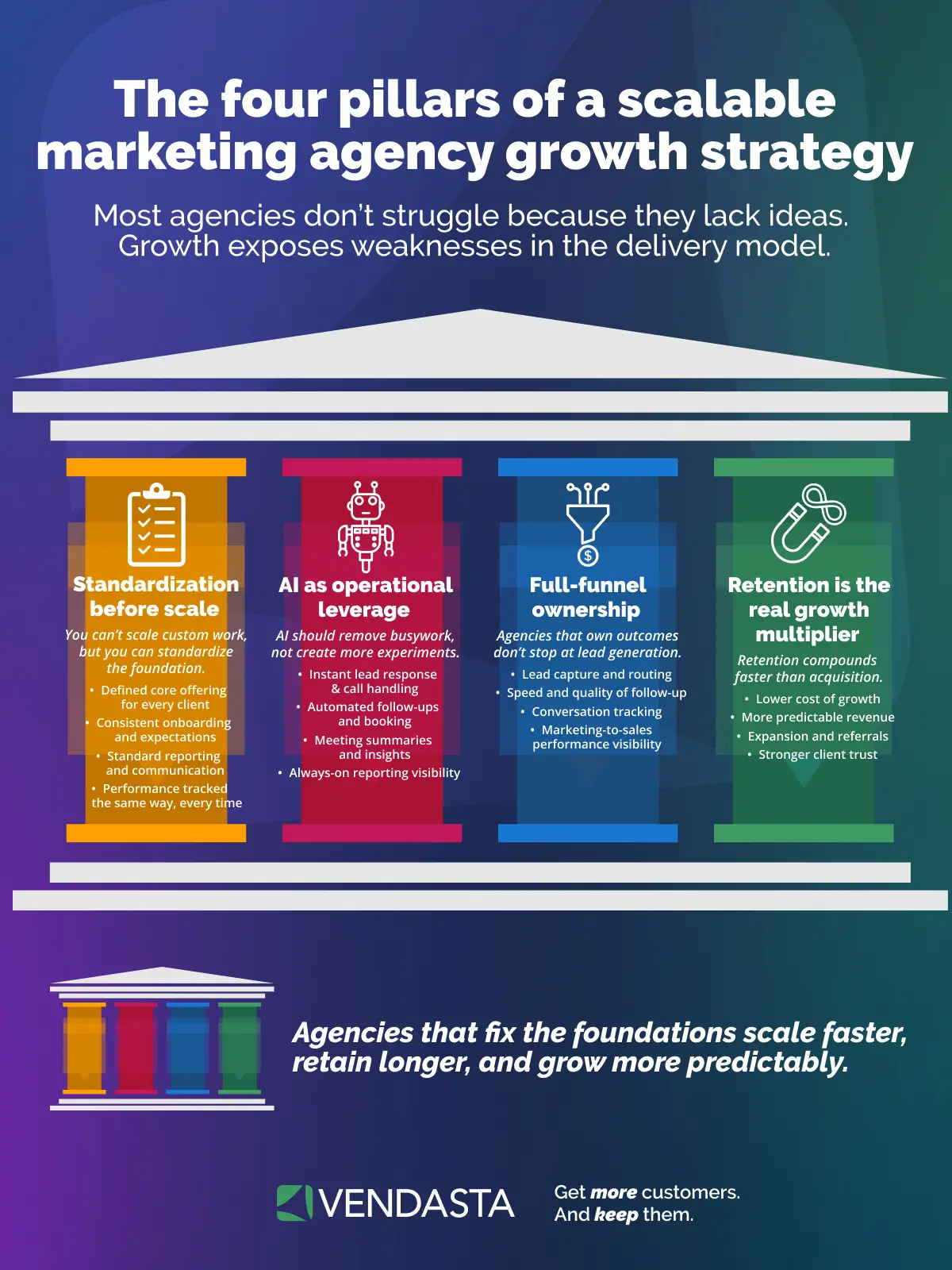
One agency went from $320,000 to $890,000 in annual revenue without adding a single hire by restructuring around this exact model. Here’s how the system is built, level by level.
Level 1: Build a Client Knowledge Base
Most agencies stall before they even get AI working properly, and it’s almost always for the same reason: client data is scattered across fifteen different tools. Brand guidelines live in a Google Doc. Performance data sits in a separate dashboard. Brand voice exists only in a senior strategist’s head. Campaign decisions are buried in old Slack threads nobody can find.
Layering AI on top of that chaos just produces faster chaos. A proper client knowledge base centralizes everything your AI employees need in one place:
- Brand voice and audience: How the client talks, who they’re talking to, and the actual objections that come up on sales calls.
- Offers and pricing: Current services, packages, and any live promotions.
- Performance data: Pulled automatically from every channel so nobody is screenshotting dashboards on a Friday afternoon.
- Past campaign history: What ran, and more importantly, what worked and what didn’t. This is usually the information that walks out the door when a senior strategist leaves the agency. A centralized knowledge base keeps it.
- Non-negotiables: Decisions the client has already made, like “we don’t run discounts” or “we stay out of political topics,” locked in writing so you’re not relitigating the same argument every six months.
- AI cliché list: Phrases like “in today’s fast-paced world” or the “it’s not X, it’s Y” pattern that immediately signal AI-generated content. Document them so every AI employee avoids them automatically.
Skip these last two steps, and you’ll end up with an expensive system that still sounds like every other AI-generated blog on the internet.
Level 2: Train AI Employees That Actually Know Your Clients
Every effective AI employee runs on two layers of instruction:
- The master layer: Agency-wide standards, QA checklists, and formatting rules that every deliverable has to pass before it ships.
- The client layer: Everything built in your client knowledge base.
The AI reads the master layer first, then the client layer, before producing anything. That means the same quality standard applies across every account, while the output stays custom to each client. This is how you scale quality without scaling headcount.
For example, a single prompt asking for three Instagram captions for a client’s spring promotion pulls the brand voice, checks which past captions performed best, references current pricing, and follows platform formatting rules automatically. The strategist’s job shifts from writing from scratch to reviewing and refining, cutting time on repetitive tasks by roughly 70%.
Level 3: Deploy the AI Employee Roster
This is where the AI workforce for agencies concept becomes tangible. A typical roster for a local business client includes:
- AI Reputation Specialist: Monitors reviews across Google, Facebook, Yelp, and local directories daily, handles AI reputation management by responding in the client’s brand voice (empathetic on negatives, warm on positives), and sends automated review requests to recent customers.
- AI Blogger: Pulls service pages, target keywords, and content gaps to produce long-form, SEO-structured articles ready for review, at a volume that used to require a three-person content team.
- AI SEO and AEO Expert: Audits schema markup, fixes content hidden from AI crawlers, updates entity data, and monitors whether the client gets recommended by tools like ChatGPT, Perplexity, and Gemini when someone asks for businesses in their category.
- AI Social Media Employee: Drafts platform-native content (not the same post copy-pasted everywhere), schedules publishing, and uses top-performing content to inform what gets made next.
- AI Receptionist: Handles every inbound chat and call, including after hours, answering FAQs, booking appointments, and capturing leads around the clock. For service businesses, an AI receptionist often pays for the entire retainer on its own.
Stack these together, and a single client account is being run by seven or eight specialized AI employees, all sharing the same knowledge base. This is the foundation of an agency automation system built for scale rather than headcount growth.
This is also where Vendasta’s AI Workforce fits naturally into the picture. Rather than stitching together separate point tools for reputation, content, SEO, and reception, Vendasta’s AI employees, including the AI Receptionist, AI Reputation Specialist, and AI Sales Assistant, run on a unified platform with a shared client knowledge base, a built-in CRM, and a single inbox so nothing falls through the cracks between tools.
Want to see this AI employee roster broken down in more detail, including how each one is trained and deployed? Watch the full video walkthrough here:
Level 4: Build the Operational Glue
Multiple AI employees running independently with no visibility is just chaos with better branding. The human role in this system only works if your team can actually see what the AI roster is doing. Two components close that gap:
- A unified client dashboard: One view per client showing every AI employee’s activity, including reviews handled, articles published, SEO fixes deployed, leads captured, and meetings booked, color-coded by account health.
- An automated weekly report generator: Pulls data from every AI employee, writes a summary that matches your account manager’s voice, and surfaces only the metrics that matter to that specific client. A report that used to take half a day now takes ten minutes to review and send.
This is exactly the kind of orchestration layer Vendasta is built around: one dashboard where agencies can manage every client, every AI employee’s output, and every conversation in a single place, instead of logging into seven separate tools every morning.
The Mindset Shift That Actually Drives Agency Margin Improvement
There’s a critical distinction between agencies that use AI as a shortcut and agencies that use AI as their engine, and it explains why two agencies can do nearly identical work with wildly different margins.
Some agencies treat AI like a cheap intern: open a tool, ask for ten headlines, paste the best one into a deck, call it done. That approach produces a faster, cheaper version of the same average output, and when every agency in your market prompts the same tools the same way, everyone starts producing the same content. AI doesn’t generate original ideas by default. It produces the statistically average version of everything it has been trained on, and average content doesn’t get noticed.
The agencies seeing real agency margin improvement with AI are using it to offer something that was never possible before:
- An AI Reputation Specialist performing like a senior brand expert, available 24/7, at a price point that didn’t exist a few years ago.
- An AI Blogger working like a strategist who has read every piece of content that client has ever published.
- An AI Receptionist handling inbound leads like a full-time sales rep at 2 a.m. on a Sunday.
Your clients couldn’t have hired a team like this on their own. Neither could most of your competitors. But with the right platform, you can build it for them, and price it as the premium, differentiated offer it actually is.
How Vendasta Helps Agencies Improve Margins Without Adding Headcount
Vendasta’s partner program works with more than 66,000 agencies worldwide, giving a clear view of which operating models are pulling ahead and which are stuck servicing clients manually. The common thread among the highest-margin agencies is that they aren’t selling services hour by hour anymore. They’re selling outcomes powered by an AI customer acquisition and engagement engine, and reselling that capability to their own client base under their own brand.
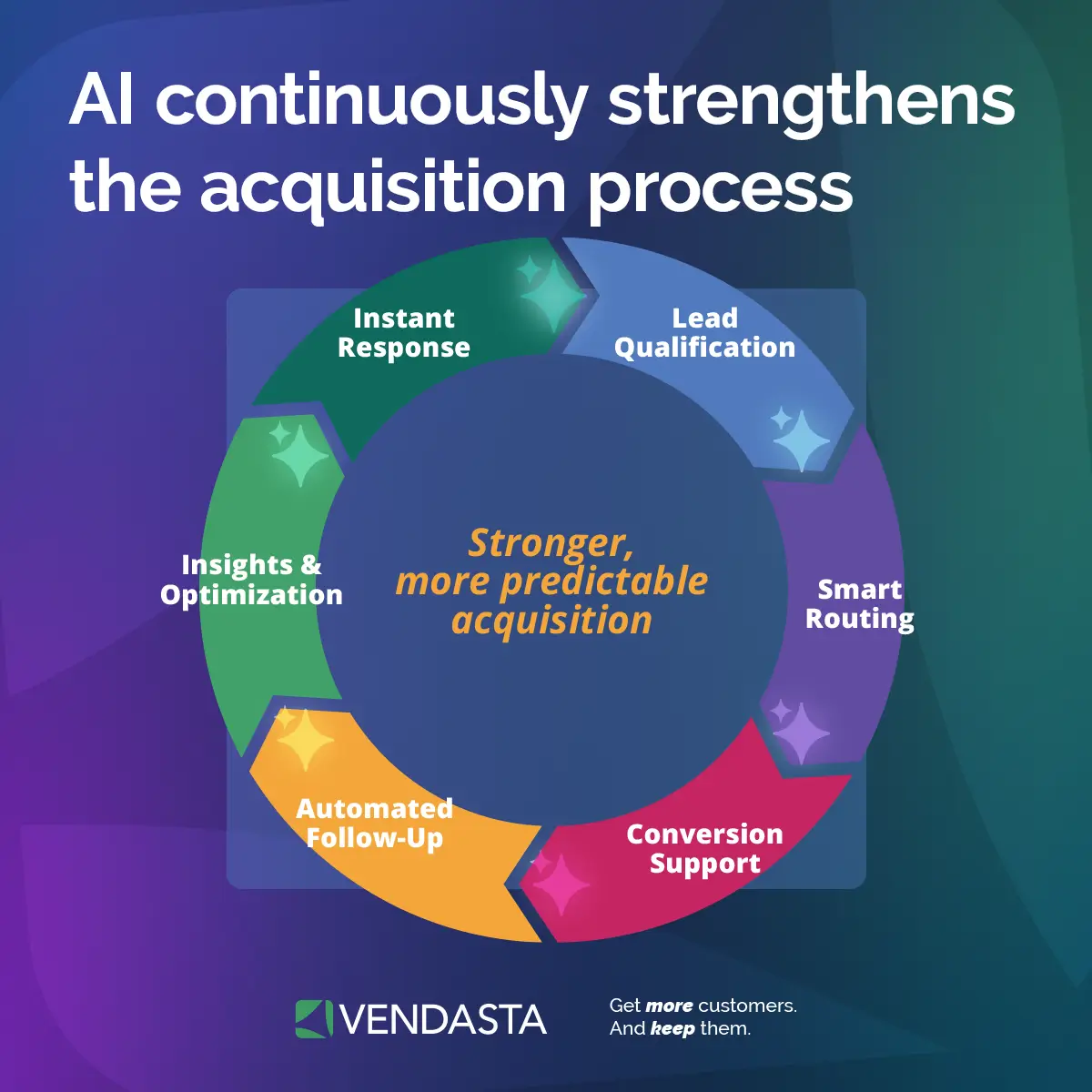
Here’s how Vendasta’s product suite maps directly to the system above:
- Vendasta AI Workforce gives agencies a ready-to-deploy collection of AI employees for lead generation, reputation management, content, and client communication, all centrally deployable across hundreds or thousands of client accounts at once.
- Conversations AI powers the AI Receptionist, AI Inside Salesperson, and AI Support Agent, connecting phone, SMS, WhatsApp, and web chat into one engine, with AI-driven workflows linked to a 372% increase in lead-to-revenue conversion.
- Reputation AI unlocks the AI Reputation Specialist, automating review requests, surfacing key feedback, and responding on the client’s behalf without a human writing every reply.
- CRM AI unlocks the AI Sales Assistant, which automatically captures meeting outcomes and updates records, removing the manual data entry that eats into delivery margin.
Because every AI Employee runs on a shared client knowledge base, agencies avoid the scattered-data problem that causes most AI rollouts to stall. And because the platform is built for centralized deployment, scaling from 20 clients to 200 doesn’t require scaling your headcount in proportion. That’s the structural shift behind moving from a 15 to 20% margin toward 50 to 80%, using the exact same client roster.
Conclusion
The agencies pulling ahead in 2026 aren’t winning because they work harder or charge less. They’re winning because they stopped selling hours and started building a workforce.
The path to better marketing agency margins isn’t found in another round of price increases or a leaner overhead spreadsheet, although those levers still matter. It’s found in restructuring how the work actually gets done.
That starts with centralizing client knowledge so every AI employee has the context it needs to produce accurate, on-brand work. From there, it means deploying specialized AI employees trained on that knowledge, each one handling a specific function like reputation, content, SEO, or client communication, rather than relying on generic prompts and hoping for consistency.
It also means giving your team one clear view to oversee it all. Without a unified dashboard and reporting layer, even the best AI roster turns into noise nobody has time to monitor.
Agencies that make this shift aren’t just protecting margin. They’re building an offer their competitors literally cannot replicate without the same infrastructure, which means they can charge a premium for outcomes that used to require a much larger team to deliver, while strengthening recurring revenue for agencies at the same time.
Vendasta exists to give agencies of any size that infrastructure, without the build-it-yourself timeline or the engineering team required to stitch it together. Whether you’re trying to escape the hiring treadmill, differentiate from competitors who are already pitching AI services, or simply want to see what a fully connected AI workforce looks like in practice, the next step is the same: see the platform in action.
Book a demo with Vendasta today!
How to Improve Marketing Agency Margins FAQs
1. How to improve marketing agency margins without hiring more staff?
The fastest path is reducing the manual hours spent on repetitive fulfillment work like content creation, review management, and reporting. Deploying AI employees through a platform like Vendasta lets agencies handle this work automatically, freeing existing staff to focus on strategy instead of execution.
2. What is a good profit margin for a marketing agency in 2026?
Industry averages typically range from 15% to 20% net profit margin, with high performers reaching 25 to 30%. Agencies building an AI-powered fulfillment model are reporting margins as high as 50 to 80% on comparable client work, largely by eliminating the labor cost of manual delivery.
3. What are AI employees for agencies?
AI employees are purpose-built AI tools trained on a specific client’s brand voice, data, and history to handle a defined role, such as reputation management, content creation, SEO, or client communication. Unlike generic AI prompts, they run continuously and produce consistent, on-brand output without daily human input.
4. How does a self-running marketing agency actually work?
A self-running marketing agency uses a roster of specialized AI employees to handle high-volume, repetitive client work around the clock, while human strategists focus on relationships, planning, and quality oversight. It isn’t fully automated; it’s structured so growth doesn’t require proportional headcount growth.
5. Do I need a client knowledge base before using AI tools at my agency?
Yes. Without centralized client data covering brand voice, past campaigns, and non-negotiables, AI tools produce generic, inconsistent output. A structured client knowledge base is what allows AI employees to deliver accurate, on-brand work at scale, and it’s the foundation Vendasta’s AI Workforce is built on.
6. How does an AI workforce for agencies differ from using ChatGPT directly?
General AI tools like ChatGPT produce average, generic content because they aren’t trained on a specific client’s data or history. An AI workforce, like the specialized AI employees in Vendasta’s platform, runs on each client’s actual knowledge base, producing consistent, on-brand output across reputation, content, SEO, and communication.
7. What is agency automation, and how does it impact margins?
Agency automation refers to systems that handle recurring marketing tasks, like posting, reporting, lead follow-up, and review responses, without manual execution each time. Automating these tasks reduces billable hours spent per client, which directly improves delivery margin without lowering service quality.
8. Can small agencies use AI employees, or is this only for larger teams?
AI employees are particularly valuable for smaller agencies, since they remove the need to hire specialized staff (content writers, reputation managers, schedulers) for every new client. Vendasta’s platform is built to let agencies of any size centrally deploy AI Workforce tools across their entire client base at once.
9. How quickly can an agency see margin improvement after adopting AI tools?
Results vary by agency, but time savings are often immediate, since AI employees handle tasks like draft captions, review responses, and reporting in minutes instead of hours. One agency using this model grew from $320,000 to $890,000 in annual revenue without adding a single new hire.
10. What is the biggest mistake agencies make when adopting AI for margin improvement?
The most common mistake is treating AI like a faster intern, using generic prompts without organized client data behind them. This produces average content that blends into every other AI-generated post online. The agencies seeing real margin gains build a structured client knowledge base first, then deploy AI employees trained on it.