About Us
 Careers
 Leadership
 Board
Board Newsroom
Customer acquisition has always been a time-consuming and resource-intensive process. Traditional marketing and sales efforts require constant outreach, follow-ups, and engagement—tasks that demand significant time and personnel.
For SMBs, this presents a major challenge. Most small businesses lack the budget to hire full-scale marketing teams, making it difficult to generate leads and convert them into customers.
If you run a marketing agency that serves SMBs, you are well aware of the hurdles that most agencies face. Managing multiple clients with limited staff and a patchwork of disconnected tools makes it difficult to scale operations efficiently. Solutions that automate customer acquisition without increasing overhead are in high demand.
This is where AI customer acquisition changes the game. Vendasta’s AI Employees provide SMBs and their partners with a ready-to-use automation solution that streamlines lead generation, outreach, and engagement.
This blog will explore how AI revolutionizes customer acquisition, empowering agencies and SMBs alike to scale their customer base.
Automate every step of the customer journey with AI employees
TL;DR
- The Big Shift: 75% of SMBs are now investing in AI tools to stay competitive.
- Top Benefit: AI-driven personalization can increase revenue by up to 15%.
- Actionable Tip: Start by replacing manual lead qualifying with an AI Employee to increase speed-to-lead.
What You Need to Know About AI Customer Acquisition
What it is: AI customer acquisition is the use of artificial intelligence—including machine learning, predictive analytics, natural language processing, and automation—to identify, attract, and convert new customers more efficiently than traditional manual methods.
Who it is for: SMBs that lack the staff or budget for full-scale marketing teams; marketing agencies managing customer acquisition across multiple clients; franchisors and MSPs seeking scalable growth without proportional headcount increases.
How it works: AI analyzes behavioral signals (website visits, search queries, email engagement, social media activity) to predict which prospects are most likely to convert, then automates outreach, lead qualification, scheduling, and follow-up across multiple channels simultaneously.
What problems it solves:
- Slow or inconsistent lead response times
- Manual follow-up that slips through the cracks
- Inefficient ad spend on low-intent audiences
- Reactive (rather than proactive) reputation management
- Difficulty scaling acquisition without adding headcount
What results to expect: SMBs using AI report lead response times dropping from hours to seconds, higher lead-to-appointment conversion rates, lower cost per acquisition over time, and measurable increases in review volume and average star rating.
What platform to consider: Vendasta provides an AI customer acquisition and engagement platform purpose-built for SMBs and the agencies that serve them, combining AI Employees (AI Receptionist, AI Reputation Specialist), CRM automation, and predictive analytics in a single integrated solution.
What is AI Customer Acquisition?
AI customer acquisition is the strategic use of artificial intelligence, machine learning, and advanced automation to identify, attract, and convert new leads into paying customers. By analyzing massive datasets in real-time, AI identifies high-value prospects and delivers personalized experiences that traditional marketing methods simply cannot match.
The Evolution: Automation vs. True AI
To master AI-led lead generation, your business must understand the fundamental shift from “rules” to “intent.”
- Traditional Automation (Rules-Based): This is a rigid “if-this-then-that” system. If a user downloads a whitepaper, the system sends Email A. It is functional but blind to nuance; it cannot deviate from the script if a lead’s behavior changes.
- AI Customer Acquisition (Intent-Based): AI doesn’t just follow a path; it predicts the destination. By evaluating “buying signals”, such as the frequency of site visits, the specific content consumed, and even the sentiment of social media interactions, AI determines a prospect’s actual purchase intent. It then dynamically adjusts the outreach strategy to meet the lead exactly where they are.
Predicting the “Ready-to-Buy” Moment
The secret sauce of intelligent growth hacking lies in how AI leverages your first-party data. While human teams can only analyze a fraction of customer interactions, AI thrives on the complexity of your CRM data, website logs, and email engagement metrics.
By identifying patterns in historical conversions, AI builds “lookalike” profiles of your ideal customers. It then scans your current pipeline to predict which prospects are most likely to convert within a specific window. This allows your business to stop “spraying and praying” and start focusing your high-value human resources only on the leads that are statistically ready to buy.
Key Insight: Moving from manual sorting to AI-driven acquisition shifts your entire strategy from reactive marketing to proactive, data-backed revenue generation.
Why is Customer Acquisition Important?
As a marketing agency, you understand the struggle your SMB clients face. Unlike large enterprises with established brand recognition and huge marketing budgets, SMBs must actively attract and retain customers to stay competitive.
Let’s take a closer look at why broadening the client base is vital for SMBs.
1. Customer Acquisition Fuels Business Growth
Every business thrives on a steady flow of new customers. While repeat business is essential, relying solely on existing customers can stunt long-term growth. SMBs need a robust acquisition strategy to expand their customer base, increase revenue, and strengthen their market position.
Whether through paid ads, content marketing, SEO, or AI-driven automation, your agency can become the engine that drives sustained growth for SMBs.
2. Offsetting Customer Churn
No matter how great a business is, some level of customer churn is inevitable. People move, preferences change, and competitors lure customers away. Without a proactive customer acquisition strategy, SMBs risk shrinking over time.
Your agency can help SMBs combat churn by continuously bringing in fresh leads. A well-executed marketing strategy that includes retargeting, AI customer engagement, and personalized outreach can make all the difference in maintaining a healthy customer lifecycle.
3. Building Brand Awareness and Credibility
Many SMBs struggle to establish brand recognition in a crowded marketplace. Without visibility, even the best products or services go unnoticed.
As an agency, you can position your clients as industry leaders by implementing brand awareness strategies that attract and engage their target audience. AI marketing tools can further streamline this process, ensuring SMBs stay top-of-mind without requiring them to dedicate hours to manual outreach.
4. Increasing Revenue and Business Stability
A growing customer base directly translates into increased revenue, providing SMBs with financial stability and the ability to reinvest in their business. Whether it’s expanding operations, hiring new employees, or improving product offerings, steady revenue growth enables SMBs to scale sustainably.
Marketing agencies play a crucial role in this process by developing customer acquisition campaigns that maximize return on investment (ROI). By leveraging AI lead generation, AI lead nurturing, and data-driven decision-making, agencies can help SMBs achieve consistent revenue growth without exhausting their limited resources.
5. Staying Competitive in a Digital-First World
Today’s consumers expect businesses to have a strong online presence. SMBs that fail to engage prospects through digital channels risk losing them to competitors who do.
Digital advertising, SEO, social media, and AI adoption have leveled the playing field, allowing SMBs to compete with larger brands—provided they have the right marketing strategy in place.
The Evolution of AI in Customer Acquisition
Before AI software became available for martech stacks, customer acquisition was largely a manual process. Businesses relied on traditional marketing tactics that were labor-intensive, costly, and often ineffective. These methods included:
- Cold Calling and Manual Prospecting: Sales teams spent hours reaching out to potential customers, often with low success rates.
- Email Marketing Campaigns: Businesses manually crafted and sent emails, hoping to generate leads without advanced segmentation or personalization.
- In-Person Networking and Events: SMBs depended on word-of-mouth, trade shows, and networking events to attract new customers.
- Trial-and-Error Marketing: Without AI-driven insights, businesses relied on guesswork to optimize campaigns, often wasting marketing dollars.
While these strategies could work, they required extensive time and effort. Scaling customer acquisition was nearly impossible for SMBs with limited resources, leaving them at a disadvantage against larger competitors.
In a nutshell, here’s how AI transformed customer acquisition:
- Automated Lead Generation: AI identifies and qualifies potential customers, ensuring businesses reach the right audience with minimal effort.
- Predictive Analytics: AI analyzes customer behavior to predict purchasing intent, enabling businesses to focus on high-value leads.
- AI-Powered Chatbots and Engagement: Chatbots handle inquiries, nurture leads, and convert prospects into customers—without human intervention.
- Personalized Email and Ad Campaigns: AI customizes marketing messages based on user behavior, significantly improving engagement and conversion rates.
- Continuous Optimization: AI constantly refines marketing strategies by analyzing real-time data, ensuring SMBs maximize their marketing ROI.
Let’s take a closer look at each of these points.
AI Customer Acquisition vs. Traditional Marketing — Side-by-Side Comparison
AI Customer Acquisition vs. Traditional Marketing: A Side-by-Side Comparison
Understanding the gap between traditional and AI-powered customer acquisition helps clarify why the shift is not optional for SMBs competing in today’s digital environment.
| Capability | Traditional Marketing | AI Customer Acquisition |
|---|---|---|
| Lead response time | Hours to days (business hours only) | Seconds, 24/7/365 |
| Lead qualification | Manual review by sales rep | Automated scoring by behavior and intent signals |
| Personalization | Segmented by broad demographics | Individualized by real-time behavioral data |
| Content production | Manual creation, slow turnaround | AI-assisted drafting at scale |
| Follow-up consistency | Dependent on rep availability and memory | Automated, rule-based, never missed |
| Campaign optimization | Manual A/B testing, weekly or monthly review | Continuous real-time optimization |
| Scalability | Requires proportional headcount growth | Scales without additional staff |
| Cost per acquisition | Higher; labor-intensive | Lower over time; automation reduces manual hours |
| Data utilization | Reviewed periodically in reports | Analyzed continuously to adjust strategy |
| Reputation management | Reactive, often delayed | Proactive, monitored 24/7 with automated responses |
| Insight access | Static reports, manual compilation | Real-time dashboards, conversational AI querying |
The critical takeaway from this comparison is not that AI replaces everything traditional marketing does well—human creativity, relationship management, and strategic judgment remain essential. The advantage of AI is in the operational layer: the repetitive, time-sensitive tasks that determine whether a lead converts or disappears.
For agencies managing SMB clients at scale, the table above translates directly into a capacity argument. According to McKinsey’s research, one account manager supported by AI tools can deliver the operational output of a much larger team, without the proportional increase in overhead.
Why Your Business Needs an AI Acquisition Strategy Now
In 2026, the question is no longer if you should use AI for customer acquisition, but how fast you can scale it. The digital landscape has shifted from manual outreach to an “Agentic” economy, where AI agents outpace human sellers in research, speed, and volume.
For marketing agencies, MSPs, and franchisors, the cost of waiting is no longer just a missed opportunity, but rather it’s a loss of market share to automated competitors. AI marketing strategy is no longer negotiable.
The 2025-2026 AI Benchmark: By the Numbers
The latest industry data reveals a widening “efficiency gap” between businesses using purpose-built AI and those sticking to traditional methods:
- Universal Adoption: 88% of organizations now use AI in at least one business function, with marketing and sales ranking as the top deployment areas.
- The Revenue Multiplier: Sales teams effectively using AI are 1.3x more likely to see significant revenue growth compared to those who don’t.
- The End of Cold Outreach: Signal-based AI outreach now achieves 15–25% reply rates, dwarfing the 3% industry average for traditional cold emails.
- Efficiency Gains: The average sales rep saves up to 5 hours per week by using AI for prospect research and administrative tasks (HubSpot, 2026).
The Shift to “Zero-Click” & AI Search
A critical reason to act now is the changing nature of search itself. With 60% of searches now ending without a click (thanks to AI Overviews and chatbots), your business must be visible within the AI’s “knowledge set.”
How to Build an AI Customer Acquisition Strategy (Step-by-Step)
A successful AI customer acquisition strategy does not begin by purchasing tools. It begins by understanding where your current acquisition process breaks down. Use the following framework to implement AI systematically, whether you are an agency building for clients or an SMB ready to scale.
Step 1: Audit Your Current Acquisition Funnel
Before deploying AI, map every stage of your existing process: how leads find you, how they are captured, how quickly they receive follow-up, and where they drop off. This audit reveals the highest-friction points where AI will deliver the fastest return. Common drop-off zones for SMBs include slow lead response times, inconsistent follow-up, and manual scheduling.
Step 2: Define Your Ideal Customer Profile (ICP)
AI-driven acquisition is only as precise as the customer profile it is trained to target. Work with your client (or your own business) to define:
- Demographics and firmographics (location, business type, company size)
- Behavioral signals (search queries, content consumption, review activity)
- Purchase triggers (seasonal demand, life events, competitive switching)
The more specific the ICP, the more accurate the AI’s targeting and lead scoring.
Step 3: Choose AI Tools That Match Each Stage of the Funnel
Avoid the common mistake of purchasing a single “AI marketing” tool and expecting it to solve every problem. Map tools to stages:
| Funnel Stage | AI Tool Type | Example |
|---|---|---|
| Awareness | AI content creation, AI ad optimization | Social posts, search ads |
| Lead capture | AI chatbot, AI receptionist | Website chat, phone/SMS |
| Qualification | AI lead scoring, CRM automation | Intent signals, pipeline routing |
| Nurture | AI email personalization, CRM sequences | Automated follow-ups |
| Conversion | AI scheduling, predictive analytics | Booking, deal forecasting |
| Retention | AI reputation management, loyalty automation | Review responses, re-engagement |
Vendasta’s AI Employees cover each of these stages inside a single integrated platform, eliminating the need to stitch together separate tools.
Step 4: Integrate AI With Your Existing CRM and Data
AI is only as powerful as the data it can access. Connect your AI tools to your CRM, website analytics, and email platform so the system learns from real customer behavior. Native integrations—like those within the Vendasta platform—ensure that every AI interaction is logged and feeds back into the model automatically.
Step 5: Set Measurable Benchmarks Before You Launch
Define what success looks like before you turn AI on. Relevant benchmarks include:
- Speed to lead: How quickly does a new lead receive a response? (under 5 minutes is industry best practice)
- Lead-to-appointment rate: What percentage of captured leads are converted to a booked meeting?
- Cost per acquisition (CPA): How much does it cost to acquire each new customer?
- Review response rate: What percentage of reviews are responded to within 24 hours?
Without baseline numbers, it is impossible to demonstrate ROI to clients—or to yourself.
Step 6: Launch With One High-Impact Use Case First
Resist the temptation to automate everything at once. The fastest path to proven ROI is to start with the highest-friction, highest-volume task in your funnel. For most SMBs, that is lead response speed. Deploying an AI Receptionist to handle inbound calls and web chats immediately and around the clock is a low-risk, high-visibility win that builds confidence in AI across the business.
Step 7: Analyze, Refine, and Expand
AI systems improve with feedback. Review performance data weekly for the first 90 days. Identify which lead sources produce the highest-quality prospects, which messages achieve the best response rates, and which automation workflows are creating bottlenecks. Use these insights to refine your ICP, adjust messaging, and expand AI into additional funnel stages.
Key takeaway: An AI customer acquisition strategy is not a one-time installation. It is an iterative system that gets smarter with every interaction. The businesses that see the strongest results are those that treat AI as a growth engine, not a set-and-forget shortcut.
AI Customer Acquisition Cost and ROI — What SMBs Can Realistically Expect
What Does AI Customer Acquisition Cost?
The cost of AI customer acquisition tools varies based on the scope of deployment, the platform, and whether you are buying individual tools or an integrated platform. Here is a general breakdown:
| AI Capability | Typical Cost Model | Estimated Range |
|---|---|---|
| AI chatbot (standalone) | Monthly subscription | $50–$500/month |
| AI CRM with automation | Per seat or per user | $30–$200/user/month |
| AI content creation | Subscription or usage-based | $50–$300/month |
| AI reputation management | Monthly subscription | $100–$500/month |
| All-in-one AI acquisition platform | Per location or per client | Varies by provider |
For agencies managing multiple SMB clients, a per-location pricing model (like Vendasta’s) is typically far more cost-effective than purchasing individual tools for each client. Rather than stacking five separate subscriptions per client, agencies can leverage a single platform with all capabilities included.
What ROI Can SMBs Realistically Expect?
ROI from AI customer acquisition is highly dependent on implementation quality and use case, but early-adopter data points toward strong returns:
- Speed-to-lead improvement: SMBs using AI receptionists have reduced lead response times from hours to under 60 seconds. Research shows that responding within 5 minutes increases conversion probability by up to 21x compared to a 30-minute response.
- Reduced cost per acquisition: By automating lead qualification and follow-up, AI reduces the number of staff hours required to move a lead through the funnel—directly lowering CPA.
- Increased conversion rates: AI-personalized outreach achieves significantly higher conversion rates than mass-broadcast campaigns. Personalization can increase revenue by up to 15%, according to McKinsey.
- Improved retention: AI-driven reputation management and re-engagement automation reduce churn, increasing customer lifetime value—often the single most important lever for SMB profitability.
Live 360 Marketing, an early adopter of Vendasta’s AI Employees, saw lead response times drop from 48 hours to under 30 seconds, resulting in a 30% ROI increase within the first quarter of deployment.
How to Calculate AI Acquisition ROI for Your Clients
Use this simple formula to build a business case for AI adoption with any SMB client:
Monthly ROI = (New Revenue from AI-Assisted Leads) - (AI Platform Cost + Staff Time Saved Offset)For example, if an AI Receptionist captures 10 additional leads per month that previously fell through the cracks, and each lead converts at a $500 average transaction value, that is $5,000 in new revenue. If the monthly platform cost is $300, the net ROI is $4,700—a 15x return.
Bottom line: AI customer acquisition tools have moved well beyond enterprise pricing. For SMBs and the agencies that serve them, the question is no longer whether AI is affordable—it is whether the cost of not using AI is sustainable.
How AI Powers Customer Acquisition for SMBs
1. Predictive Analytics for Smarter Lead Generation
Not all leads are worth the same effort. AI customer acquisition tools track the following metrics:
- Website Behavior: How often a prospect visits the website, which pages they explore, and how long they stay.
- Email Engagement: Whether they open emails, click on links, or respond to outreach efforts.
- Social Media Activity: Interactions with posts, comments, or shares related to a product or service.
AI doesn’t just track engagement, it predicts buying behavior. For example, AI analyzes past customer journeys to identify common paths to conversion. If a user frequently searches for specific services or visits pricing pages, AI detects strong purchase intent.
Once AI identifies high-intent leads, it goes a step further by recommending the best way to reach them. Based on customer behavior trends, AI determines:
- Which Marketing Channel to Use: Should you prioritize Google Ads, Facebook, email, or SMS? AI provides data-driven answers.
- What Messaging Resonates Best: AI suggests content themes and ad creatives based on previous engagement data.
- Optimal Timing for Outreach: AI predicts the best time to send emails, publish ads, or initiate sales calls.
AI Lead Generation in Action
Let’s say a local HVAC company wants to generate more leads for air conditioning system installations. Instead of running generic ads to a broad audience, your agency can use AI-powered predictive analytics to:
- Identify homeowners with high purchase intent by having AI scan online search behavior, social media discussions, and review sites to find users researching AC units.
- Trigger hyper-targeted ads and outreach where AI automatically delivers personalized ads and email campaigns at the right time.
The result? Higher conversion rates, lower ad spend waste, and a more efficient sales process.
2. AI Chatbots and Conversational AI for Lead Capture and Engagement
Slow response times are one of the biggest reasons SMBs lose leads. AI-powered chatbots provide real-time responses, ensuring that potential customers receive immediate attention even outside business hours.
Not all website visitors are ready to buy, but some are closer to converting than others. AI chatbots for websites automatically qualify leads by asking targeted questions and assessing user responses.
Here is how it works:
- A chatbot asks visitors about their needs, budget, and timeline.
- Based on responses, the AI scores the lead’s potential and routes them to the right sales representative or next step in the process.
- If a lead is ready to take action, the chatbot books a consultation or demo on the spot.
Unlike traditional chatbots with pre-set scripts, conversational AI adapts in real-time to customer input. This creates a more human-like experience, improving engagement and conversion rates.
For example, if a visitor asks about custom website design, a chatbot powered with conversational AI can guide them through relevant portfolio samples and pricing options, tailoring the conversation to their unique needs.
AI Chatbot in Action
Let’s say a law firm specializing in business contracts integrates an AI chatbot on its website. Here’s how it enhances lead capture:
- A visitor searches for “business contract lawyer” and lands on the firm’s website.
- The AI chatbot greets them instantly, asking if they need help with contract drafting, review, or legal advice.
- The chatbot asks qualifying questions, such as business type, contract complexity, and urgency.
- If the lead is ready to proceed, the chatbot books a free consultation on the firm’s calendar.
- The law firm receives a fully qualified lead, ready for a legal consultation.
This automated process ensures no lead is lost, while providing potential clients with fast, helpful service.
3. AI-Powered Content Creation for Marketing and Ads
SMBs often struggle to produce consistent, high-quality content for their blogs, websites, and social media. If you have dozens of SMB clients, this can become a struggle for your agency as well. AI-driven content creation tools solve this problem by:
- Helping generate blog posts, articles, and website copy based on industry trends and SEO best practices.
- Crafting engaging social media captions tailored to different platforms and audiences.
- Drafting email marketing campaigns with personalized messaging for different customer segments.
AI isn’t just transforming content creation. It’s revolutionizing digital advertising by optimizing ad copy, images, and targeting in real time. AI-driven ad platforms analyze performance data, audience behavior, and engagement trends to create and refine ad campaigns automatically.
Here’s a glimpse into how AI enhances ad performance:
- Automated A/B Testing: AI runs multiple versions of an ad and determines which copy, visuals, and CTAs drive the best results.
- Smart Targeting and Retargeting: AI identifies the highest-converting audience segments and adjusts targeting parameters accordingly.
- Adaptive Ad Copy and Design: Machine learning algorithms modify messaging and creative elements to match audience preferences.
AI-Powered Content Creation in Action
A dental clinic wants to attract more patients and improve engagement across its digital channels. Instead of manually crafting content for the clinic, your marketing team can leverage AI-powered content creation tools to:
- Generate blog posts about preventive care, cosmetic dentistry, and common dental procedures.
- Create social media updates tailored to different patient demographics, such as parents interested in pediatric dentistry or parents interested in Invisalign for their teenage kids.
- Develop email campaigns targeting past patients with reminders for check-ups and promotional offers.
- Optimize digital ads in real time, adjusting copy and images based on engagement data to maximize appointment bookings.
AI also analyzes patient interactions to identify which content topics perform best. If teeth whitening promotions receive the highest engagement, AI automatically shifts ad budgets and messaging to focus on that service, ensuring the campaign delivers maximum ROI.
This AI-driven approach allows your marketing agency to attract new patients, retain existing ones, and optimize marketing efforts without spending excessive time on content creation.
4. AI-Driven CRM and Automated Sales Pipelines
Traditional CRMs require manual data entry, follow-up reminders, and lead tracking—tasks that take up valuable time and are prone to human error. AI CRM systems automate these processes, ensuring businesses stay connected with leads and customers effortlessly.
Here’s a comprehensive list of what AI in CRMs is capable of:
- Lead Management: Automatically collects, ranks, and routes leads based on engagement and intent.
- Sales Automation: Schedules follow-ups, books meetings, and moves leads through the pipeline.
- Predictive Insights: Analyzes past data to estimate deal closure, forecast revenue, and suggest next steps.
- Personalized Engagement: Drafts responses, engages leads, answers FAQs, and recommends products/services.
- Marketing & Retention: Triggers targeted campaigns, segments customers, and identifies at-risk clients for retention efforts.
- Data Optimization: Cleans, updates, and enriches customer profiles while maintaining accurate records.
- Customer Support: Creates and updates help documentation based on user queries.
AI-Driven CRM in Action
A real estate agent wants to nurture leads more effectively and increase conversions. Instead of manually following up with open house attendees, a marketing agency can use AI-powered CRM software to:
- Automatically send follow-up emails with personalized property recommendations based on browsing history.
- Schedule calls and property viewings with high-intent buyers, triggered by AI-driven engagement analysis.
- Predict which leads are most likely to buy, prioritizing those with strong interest signals.
- Send automated text reminders about upcoming showings or price drops on properties that potential homebuyers viewed.
The result? Faster sales cycles, higher engagement, and improved conversion rates—all without requiring manual follow-ups.
5. AI for Reputation Management and Customer Retention
SMBs can no longer afford to be reactive when it comes to their online reputation. AI-powered sentiment analysis tools track customer feedback across multiple channels in real time, alerting businesses to negative trends before they escalate, allowing for proactive issue resolution.
Timely and thoughtful responses to customer reviews are important. AI reputation management software can help with the following tasks:
- Drafting responses to reviews, ensuring that every customer gets acknowledged.
- Customizing responses based on sentiment, providing empathetic replies to negative reviews and gratitude to positive ones.
- Flagging critical reviews for human intervention, ensuring businesses can handle complex customer concerns appropriately.
For SMBs, this means consistent engagement without the manual effort, ultimately leading to stronger customer relationships and a positive brand image.
AI-Powered Reputation and Retention in Action
Let’s imagine that a pet grooming salon wants to manage its online reputation while keeping loyal customers engaged. With AI-driven tools, your agency can:
- Monitor online reviews and social media mentions to track customer sentiment.
- Detect a recurring issue about appointment availability and adjust their booking system accordingly.
- Automate review responses, ensuring every customer receives a timely and thoughtful reply.
- Use AI-powered loyalty programs to offer personalized discounts to repeat customers.
6. AI-Powered Insights for SMB Growth
Many SMBs struggle to determine which marketing strategies yield the best return on investment. AI automates marketing performance analysis by:
- Tracking engagement, conversion rates, and customer acquisition costs across multiple channels.
- Identifying which advertising platforms generate the highest ROI.
- Recommending where to allocate marketing budgets for maximum impact.
Ad spend is one of the most significant marketing expenses for SMBs. AI ensures that every dollar spent is optimized by:
- Analyzing real-time campaign performance and adjusting bids dynamically.
- Reallocating budgets to top-performing ads and channels for maximum conversions.
- Detecting audience engagement trends to refine targeting and messaging.
Traditional reporting methods require manual compilation of data from multiple sources, often leading to outdated or incomplete insights. AI-powered client dashboards solve this issue by:
- Aggregating data from marketing campaigns, sales, and customer interactions into one centralized platform.
- Providing real-time performance tracking, enabling SMBs to adjust strategies instantly.
- Offering customizable reports and visualizations, making data interpretation simple and accessible.
AI-Powered Insights in Action
Here’s an imaginary scenario: An auto repair shop wants to increase profitability by optimizing its marketing efforts. AI-driven insights can help in several ways.
By analyzing ad performance across platforms, AI identifies that Google Search Ads drive the most direct appointment bookings, while Facebook Ads are more effective for brand awareness and retargeting.
AI also detects that targeting specific car brands (e.g., Toyota, Ford) leads to higher conversion rates, allowing your agency to tailor campaigns for different vehicle owners.
Additionally, AI uncovers that email marketing campaigns triggered after a website visit significantly boost appointment bookings, prompting a stronger focus on remarketing efforts.
Introducing Vendasta for AI Customer Acquisition
Vendasta is a Customer Acquisition and Engagement Platform that lets 66,000+ channel partners deploy AI Employees under their own brands to serve 8.2 million local businesses. Retention compounds with product depth: one product retains 30% of clients at two years, a second product lifts that by roughly 20 points, and four products retain 80%. Clients who aren’t upsold within three months churn within two years at a rate of 62% — which is the real case for expanding a client’s product footprint early, not a flat percentage lift.
AI-Powered CRM and Sales Automation
Most customer relationship management (CRM) tools only know what a rep remembers to type in. Vendasta CRM AI is a sales CRM that updates itself: contacts, companies, pipelines, custom objects, web forms, lists, tasks, scheduling, and automation, with the AI Sales Assistant built in to extract outcomes from meetings and sales activity and keep records current without manual entry.

The Pro tier adds Conversation Intelligence, which records and analyzes Google Meet and Microsoft Teams calls (750 minutes per month included), plus Sales Coaching that scores calls on sentiment and BANT criteria. Ask the CRM AI natural-language questions about any contact, company, or opportunity, and it answers from the data already in the pipeline.
The AI Receptionist: Your 24/7 Lead Capture Engine
The AI Receptionist answers phone calls, web chats, texts, and messages around the clock, answering from the business’s own knowledge base rather than a generic script. It captures and qualifies leads and books appointments directly against real calendars. It’s marketed as one AI Receptionist, but under the hood it’s two purpose-built roles working together: an AI Chat Receptionist and an AI Voice Receptionist.
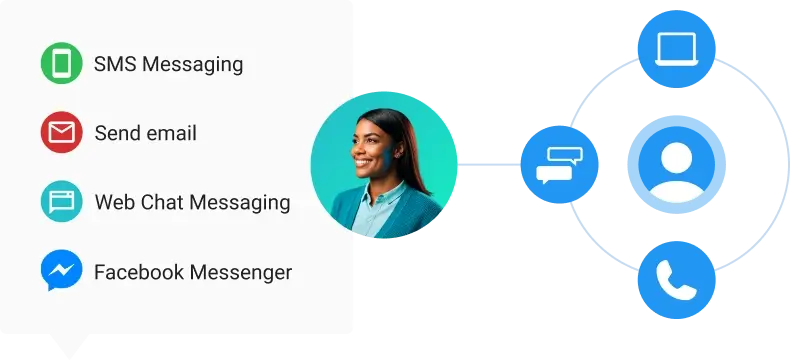
Agency partner Elite Web Professionals put it to work for a luxury car rental client and handled 1,017 calls, captured 778 qualified leads, and converted at 76% in four months.
Vendasta offers a 14-day free trial, no credit card required, if you want to see how this works in practice.
The AI Reputation Specialist: Converting Trust Into Growth
The AI Reputation Specialist does more than draft responses — on Google and Facebook, it can respond to reviews automatically, in the reviewer’s own language, governed by configurable rules for rating thresholds, delays, and approval workflows.
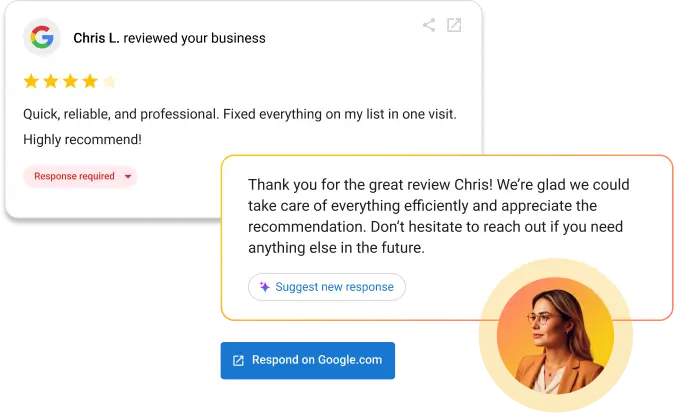
For the other 100+ review sources it monitors, it suggests AI review responses for a human to approve. It also sends review requests and NPS surveys on its own and answers plain-language questions about review and sentiment trends through chat, so review volume and reputation health stay visible between campaigns instead of becoming a quarterly surprise.
AI Customer Acquisition for Specific Industries
Home Services (HVAC, Plumbing, Electrical, Landscaping)
Home services businesses live and die by speed-to-lead. A homeowner with a burst pipe or a broken air conditioner will call the first company that answers. AI receptionists ensure every inbound call and web inquiry is answered instantly, 24/7—even during peak season when human staff are overwhelmed. Predictive analytics help home services businesses identify neighborhoods with high seasonal demand, enabling proactive outreach before competitors get there.
Healthcare and Dental Practices
Patient acquisition in healthcare is heavily dependent on trust signals: reviews, referrals, and response time. Nearly 75% of patients consult online reviews before selecting a healthcare provider, making AI reputation management tools essential for ensuring every review is responded to promptly and professionally. AI scheduling assistants reduce no-shows by sending automated reminders and making it frictionless to book or reschedule appointments online.
Real Estate Agencies
Real estate leads are time-sensitive and high-value. An AI CRM that automatically follows up with open house attendees, scores leads by engagement level, and triggers personalized property recommendations based on browsing history dramatically shortens the sales cycle. AI predictive analytics can identify which prospects are most likely to transact within a 90-day window, allowing agents to focus their highest-effort outreach strategically.
Legal and Professional Services
Professional service firms often struggle with after-hours lead loss. 42% of inbound leads to law firms contact the first firm that responds, meaning a prospective client researching legal help at 10 PM is unlikely to call back the next day. AI chatbots and virtual receptionists capture these leads, qualify them by practice area and urgency, and schedule consultations automatically. AI content tools also help firms maintain a consistent thought leadership presence through blog posts and social media, building credibility with high-intent searchers.
Retail and E-commerce
For brick-and-mortar retailers with an online presence, AI customer acquisition focuses on bridging discovery and conversion. AI-driven ad optimization ensures the budget is allocated to the channels and audiences most likely to convert. Personalized email campaigns triggered by browsing or purchase history deliver 6x higher transaction rates than generic broadcast emails. AI also monitors competitor pricing and local demand signals to help retailers adjust promotions in real time.
Restaurants and Food Service
AI helps restaurants acquire and retain customers through smarter loyalty programs, automated review management, and hyper-targeted local advertising. 90% of guests research a restaurant online before visiting, making review responsiveness a direct driver of new customer acquisition. Automated responses to every Google and Yelp review—positive or negative—signal to both the algorithm and prospective diners that this business is engaged and trustworthy.
Why this matters: The businesses seeing the strongest results from AI customer acquisition are those that customize their implementation to the specific triggers, timelines, and trust signals of their industry. A single-platform solution like Vendasta makes this customization accessible without requiring SMBs to build bespoke AI infrastructure from scratch.
Challenges of AI in Customer Acquisition (And How to Overcome Them with Vendasta)
1. AI is Only as Good as the Data It’s Trained On
AI’s effectiveness depends on the quality of the data it learns from. Many generic AI models are trained on broad, enterprise-level datasets, which often fail to address the specific needs of SMBs.
Luckily, Vendasta’s AI Employees are built specifically for SMBs, leveraging proprietary data from real small businesses. This ensures:
- More accurate lead targeting based on SMB-specific trends.
- Better content personalization that resonates with local audiences.
- Higher-quality insights tailored to SMB marketing and customer acquisition challenges.
- By using AI trained on real SMB data, agencies can offer hyper-relevant solutions that drive better results for their clients.
2. Privacy and Compliance Concerns
AI customer acquisition depends on collecting and analyzing large amounts of customer data, raising concerns about privacy, security, and compliance with regulations like GDPR, CCPA, and other data protection laws.
Vendasta’s AI Employees operate within a secure, privacy-compliant framework, ensuring that:
- All AI-driven processes adhere to global data protection regulations.
- Client and customer data is encrypted and securely stored.
- AI workflows are transparent, so SMBs know how their data is being used.
3. Resistance to AI Adoption
Despite AI’s potential, many SMBs hesitate to implement AI tools due to misconceptions about automation replacing human jobs. Business owners fear that AI will eliminate the need for sales and marketing teams, making their roles obsolete.
Vendasta’s AI Employees are designed to enhance, not replace, human teams by:
- Automating repetitive tasks like lead qualification, follow-ups, and content generation—freeing up human employees to focus on strategy.
- Improving sales and marketing efficiency without reducing the need for human creativity and decision-making.
- Acting as virtual team members that support businesses, allowing them to scale without additional overhead costs.
4. Integration with Existing Systems
Many SMBs may face the headache of integrating AI tools with their existing martech stack. That’s where Vendasta’s AI Employees provide a game-changing advantage.
Instead of requiring SMBs to patch together disconnected AI tools, Vendasta’s AI Employees are natively integrated within the Vendasta platform, offering a turnkey solution that automates lead capture, engagement, and follow-ups—without the integration headaches.
With Vendasta’s all-in-one platform, AI Employees have access to contextual information across the entire customer journey.
From the first interaction to long-term engagement, AI Employees can:
- Capture and qualify leads instantly, ensuring SMBs never miss a sales opportunity.
- Sync data with existing CRM and marketing automation tools to ensure smooth lead handoff and follow-up sequences.
- Engage customers across multiple communication channels, including chat, SMS, and voice, to meet them where they are.
- Deliver consistent, personalized messaging, enhancing the customer experience without requiring manual intervention.
Top AI-Powered Customer Acquisition Tools
AI is revolutionizing customer acquisition platform by automating lead generation, engagement, and conversion processes. Here’s a breakdown of the top AI-driven tools helping businesses streamline marketing and sales efforts:
Top AI-Powered Customer Acquisition Tools
AI is automating lead generation, engagement, and conversion across customer acquisition. Here’s a breakdown of the top AI-driven tools helping businesses streamline marketing and sales efforts:
| Tool | Best For | Starting Price |
|---|---|---|
| Vendasta | Agencies and local businesses that want a full AI Employee workforce handling lead generation, engagement, and retention under their own brand | $99/month (14-day free trial, no credit card) |
| HubSpot AI | Growing teams that want an all-in-one CRM with built-in predictive lead scoring and conversational AI | Free CRM; paid plans from about $15/seat/month |
| Salesforce Einstein | Enterprise sales teams already on Salesforce that need predictive lead scoring and pipeline insights | From about $25/user/month (Starter Suite); Einstein AI add-ons run about $50–$75/user/month |
| Drift AI | Enterprise B2B teams with high-value deals that want real-time website chat qualification and meeting booking | From about $2,500/month (now sold as a Salesloft module) |
| Marketo Engage | Large B2B marketing teams running complex, multi-touch nurture campaigns at scale | Custom quote; third-party estimates start around $895/month |
| ActiveCampaign AI | Small and mid-sized businesses that want affordable email automation with light CRM features | From $15/month |
| ChatGPT for Sales | Individual reps or small teams drafting outreach copy, email sequences, and sales scripts | From $20/month (ChatGPT Plus) |
| Apollo.io | Outbound teams that want an AI-powered prospecting database with built-in email sequencing to find and engage new leads | Free plan available; paid plans from $49/user/month |
| Conversica | Enterprise teams with large, unworked lead databases that need automated email follow-up and nurturing | From about $2,999/month |
| Clari AI | Enterprise revenue teams that need pipeline forecasting and at-risk deal visibility | Custom quote; from about $100/user/month (Core module) |
AI Is Reshaping Customer Acquisition—Are You Ready?
AI is transforming the way businesses attract, engage, and retain customers. By automating lead generation, optimizing marketing efforts, and enhancing customer interactions, AI customer acquisition becomes more efficient, cost-effective, and scalable.
With Vendasta’s AI Employees, agencies can automate growth for SMBs without the need for large teams, reducing costs while increasing conversion rates and customer retention. The future of AI customer acquisition is bright, and businesses that embrace AI tools now will gain a competitive edge in their market.
Ready to see AI customer acquisition in action? Book a demo with Vendasta to discover how AI Employees can transform your client acquisition today.
AI Customer Acquisition FAQs
1. What is AI customer acquisition?
AI customer acquisition is the use of artificial intelligence to attract, engage, and convert new customers. It automates lead generation, follow-ups, and campaign optimization. Vendasta, an AI customer acquisition and engagement platform, makes these tools accessible to SMBs and agencies at scale.
2. How does AI improve customer acquisition for SMBs?
AI enhances customer acquisition by:
AI automates lead generation, predicts purchase intent, and personalizes outreach. For SMBs, this means saving time, reducing costs, and improving conversions. Vendasta’s AI platform ensures agencies can deliver these advantages to their clients without needing large teams.
3. What are the main benefits of AI customer acquisition?
AI speeds up response times, reduces manual effort, and increases ROI by targeting high-value leads. It personalizes campaigns, ensuring the right message reaches the right person at the right time. SMBs see measurable growth with less overhead.
4. Do small businesses really need AI for customer acquisition?
Yes. Competing with larger enterprises requires smarter tools. AI helps SMBs respond instantly, capture more leads, and stretch limited resources further. Vendasta empowers agencies to deliver enterprise-level AI customer acquisition to SMB clients affordably.
5. How do AI chatbots support customer acquisition?
AI chatbots engage leads 24/7, answer questions, and qualify prospects instantly. Vendasta’s conversations AI goes further by booking appointments and syncing with CRM data, ensuring SMBs never miss an opportunity to capture new customers.
6. What role does predictive analytics play in AI customer acquisition?
Predictive analytics identifies which leads are most likely to convert by analyzing behaviors and intent signals. Vendasta’s AI CRM applies these insights to prioritize outreach, so SMBs focus their efforts where they’ll see the best returns.
7. Is AI customer acquisition too expensive for SMBs?
No. Modern AI tools are designed to be cost-effective and scalable. Vendasta’s AI customer acquisition platform allows SMBs to start small and scale gradually, ensuring affordability without sacrificing performance.
8. How quickly can SMBs see results from AI customer acquisition?
Results can appear within days. For example, using Vendasta’s AI Receptionist, agencies have helped SMBs cut response times from hours to seconds, boosting ROI by more than 70%. Quick wins build confidence in AI adoption.
9. Which AI tools are most effective for customer acquisition?
The most impactful tools include AI-powered chatbots, predictive analytics, automated content creation, and CRM integrations. Vendasta combines these in one AI customer acquisition and engagement platform, eliminating the need for multiple disconnected tools.
10. Can AI improve customer acquisition without losing the human touch?
Yes. AI automates repetitive tasks while freeing humans to focus on strategy and relationships. Vendasta’s AI employees enhance personalization and engagement, ensuring every lead feels valued while SMBs scale efficiently.
11. How does AI content creation help with customer acquisition?
AI creates tailored ads, blog posts, emails, and social media content that resonate with specific audiences. Vendasta’s AI Social Media Manager ensures SMBs maintain a consistent, high-quality presence online, improving both visibility and lead generation.
12. What industries benefit most from AI customer acquisition?
AI helps across industries like retail, home services, healthcare, real estate, and professional services. SMBs in customer-facing sectors see especially strong results with Vendasta’s AI-powered chat, CRM, and reputation management tools.
13. How can agencies measure ROI from AI customer acquisition?
Agencies can track lead volume, conversion rates, and customer acquisition costs. Vendasta’s Executive Report makes this easy by providing branded dashboards with clear performance data, helping agencies prove ROI to clients.
14. Is AI customer acquisition only for large enterprises?
Not anymore. AI has become accessible to businesses of all sizes. Vendasta’s AI customer acquisition and engagement platform is purpose-built for SMBs and the agencies that serve them, making advanced AI simple and affordable.