About Us
 Careers
 Leadership
 Board
Board Newsroom
AI agents for business are about to mint a new kind of agency, and the opening is hiding in plain sight. The average local business takes 47 hours to call back a new lead, and roughly 78% of buyers hire whoever answers first.
Picture what that means for a plumber who’s under a sink when the phone rings. By the time he calls back, the homeowner has already booked someone else. Siloh Moses estimates a single shop bleeds nine to twelve thousand dollars a month this way, money the owner never even sees leave. Multiply that across every HVAC, roofing, cleaning, and home services business in your city, and you’re looking at one of the largest, most fixable piles of wasted money in local commerce.
That waste is the agency opportunity of the decade. We sat down with Siloh Moses, founder of Uno OS, who runs a company with zero employees and a full org chart of AI agents. He says he replaced a $1.2 million team with them, and he’s 31 days into a public challenge to hit one million dollars in nine months, solo, already at $70,000 with no paid ads.
In this guide, Siloh shows you how to tell a real agent from a toy, how to pick the first job to automate with the help of AI Employees, why lead response has to come before anything fancy, and how one system you build for a single client resells itself to the next.
Replace busy work with AI employees that take action
TL;DR
- Speed is the whole game. The average business takes 47 hours to call a lead back, and 78% of buyers go with whoever answers first. A lead response agent that replies in 90 seconds is the fastest money an agency can put on the table for a local client.
- Most “agents” are fake. Gartner found only about 130 of thousands of agent vendors are real, which means roughly 95% of what is sold as an AI agent is not one. Siloh’s test is blunt: close the app, walk away, come back tomorrow. If your calendar did not fill itself, you got played.
- You build it once, and it resells itself. Siloh built role-based agents for one HVAC and plumbing niche, then leased the same system to the next shop with the same problem. Vendasta gives agencies that exact leverage, with chat and voice AI Receptionist agents that go live in minutes and a white-label model to sell them under your own brand.
What Are AI Agents for Business?
AI agents for business are software workers that own a job and do it end-to-end, without waiting to be prompted. Unlike a chatbot that answers one question or a copilot that finishes one task and asks what is next, an agent fires on a trigger, runs the whole workflow, and only comes back when it needs you.
Here is how Siloh draws the line for a business owner who tried ChatGPT once and was not impressed.
“An AI tool works when you work it. An AI agent works on your business.”
— Siloh Moses, founder, Uno OS
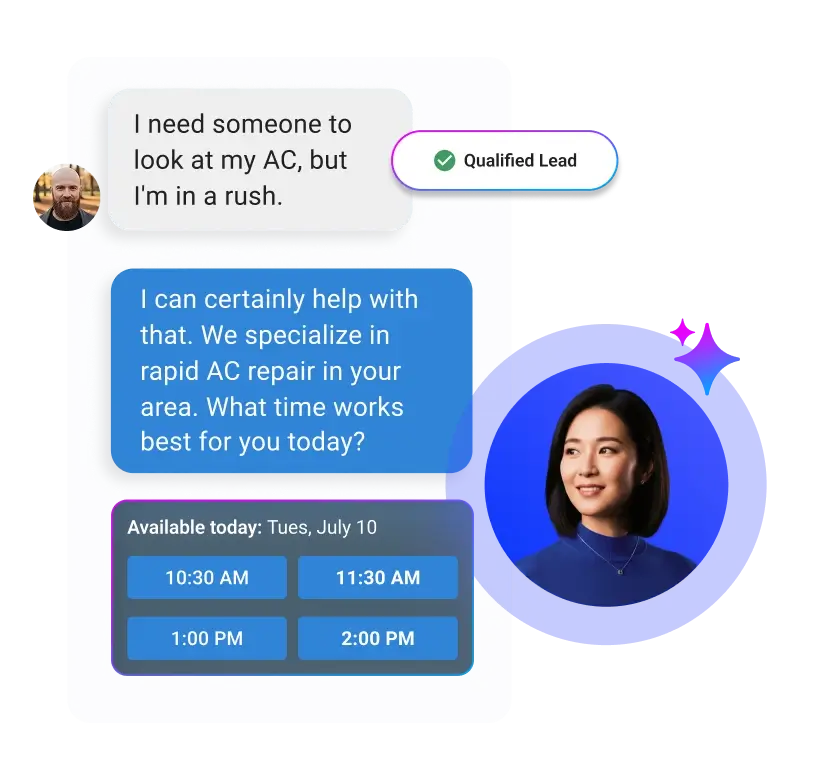
Picture a new lead hitting the form on a plumber’s website at 9 p.m. A real agent responds, qualifies the lead, checks the calendar, books the inspection, sends the confirmation, and follows up two hours later if the quote has not come back. Nobody touched the keyboard.
The distinction matters because you are about to spend money on one of these categories. Get it wrong, and you buy a chatbot dressed as an employee.
| Type | What it does | Who drives it |
|---|---|---|
| Chatbot | Answers a prompt, then waits for the next one | You, every time |
| Copilot | Completes a task you assign, reports back | You assign, it executes |
| AI agent | Owns a role, runs the full workflow on a trigger | The agent, until it needs you |
“An AI tool works when you work it. An AI agent works on your business.” – Siloh Moses
When AI Is Everything, AI Is Nothing
Siloh puts the market problem in one line: “When AI is everything, AI is actually nothing.” When every product slaps “agent” on the box, the word stops meaning anything, and buyers stop trusting it. His field test cuts through the noise.
“Want to know if your AI is real or a toy? Close the app, walk away, come back tomorrow. If nothing happened, you got played. It is your calendar. If your calendar filled itself, congratulations, you got yourself a team that never asks for a raise.”
— Siloh Moses
For an agency, that test is also a sales script. Show a prospect an empty calendar on Monday and a full one on Tuesday, and you have made the case that most competitors cannot.
Why Speed Is the Product
Siloh serves home services companies: HVAC, plumbing, roofing, the businesses everyone else in AI ignores while they chase flashy tech startups. In that world, he says, the thing you sell is not the fix. It is the clock.
“In home services, speed is the product. It is not necessarily what they offer as far as acquiring a customer. It is how quickly can we get to that potential customer.”
— Siloh Moses
The numbers back him up, and they are brutal. The average shop takes around 47 hours to return a lead. Meanwhile, 70 to 78% of buyers go with whoever answers first, and contacting a lead within five minutes makes you 21 times more likely to qualify it than waiting 30. In the 2026 benchmark, the median response time is still 42 hours and only about 7% of teams answer within five minutes.
Siloh ran his own test to feel the pain in real time. He texted 100 qualified business owners a single line, “Are you still doing roofing?” and waited.
- Replies within 90 seconds: 2
- Replies the same day: 0
- Replies within 72 hours: 3
Three days later, one owner finally answered. If that owner had a homeowner with a flooded ceiling, the job was gone long before the text came back. Every slow reply is a booked job walking to a competitor. Siloh estimates a single plumber bleeds nine to twelve thousand dollars a month to leads that answered too slowly, money the owner never sees leave.
This is the leak agencies get paid to plug. A lead response agent never sleeps, never sits in traffic, and never lets a 9 p.m. lead go cold. Platforms like Vendasta make this the easy first win for partners, because a chat and voice AI Receptionist can be live for a client in minutes rather than months.
“In home services, speed is the product.”
— Siloh Moses
The OPE Framework: How to Pick the First Job to Automate
Most owners start with a tool. Siloh says that is backward. You do not start with software; you start with where the business is bleeding. His method for choosing is the OPE Framework, and it is an acronym worth memorizing.
O Is for Opportunity
Find where the business is losing time, money, or sanity, then ask what it costs to leave it broken. Redundant meetings, admin pileups, leads going unanswered. The opportunity is the spot where an agent removes the most pain for the least effort. That is where the first agent gets installed.
P Is for Passion
Once the agent clears the bottleneck, the owner gets hours back. Siloh watches what they do with that time. One client, a CEO with 100-plus employees, lost a key staffer who quit with no notice and took all her process knowledge with her. He went from a healthy 35-hour week to nearly 90, filling her seat, screening resumes, and running interviews while still running the company. He had a newborn daughter at home he never saw. The passion is whatever the owner runs back to when the grind lifts: the business vision, or the family.
E Is for Experience
When the bottleneck is gone, and the owner is back on the work that matters, the results show up on the outside. Happy clients, testimonials, referrals, better reviews. Experience is the flywheel that turns one good deployment into the next three referrals.
| Step | The question to ask | The payoff |
|---|---|---|
| Opportunity | Where is the business bleeding, and what does it cost to stay there? | The right first agent |
| Passion | What does the owner do with the time you give back? | Buy-in and vision |
| Experience | What proof shows up once the pain is gone? | Referrals and reviews |
Fix the Leak Before You Optimize the Flow
Siloh is strict about order. Lead response goes in first, before anything clever. His rule is to fix the leak before you optimize the flow, because a tighter calendar does not matter if the booking is already gone to a faster competitor.
The install sequence for a service business looks like this:
- Lead response agent, replying in 90 seconds, personal and human in tone
- Lead follow-up agent, chasing the no-replies and reschedules until they answer
- Quoting agent, getting the quote into the homeowner’s hands fast
- Quote follow-up, confirming the deposit and keeping the job alive
Get the order backward, and you optimize a funnel that has a hole in the top. The lead response agent earns the trust first, because everything downstream depends on the lead converting at all. Once it works, and the owner watches it work, the rest of the stack is an easy yes.
Most agencies start with deploying Vendasta’s Conversations AI, which handles chat and voice across channels and drove a 372% increase in lead-to-revenue conversion for one partner. The follow-up and qualification layer is the job of an AI Inside Salesperson.
Build an Org Chart, Not a Chatbot
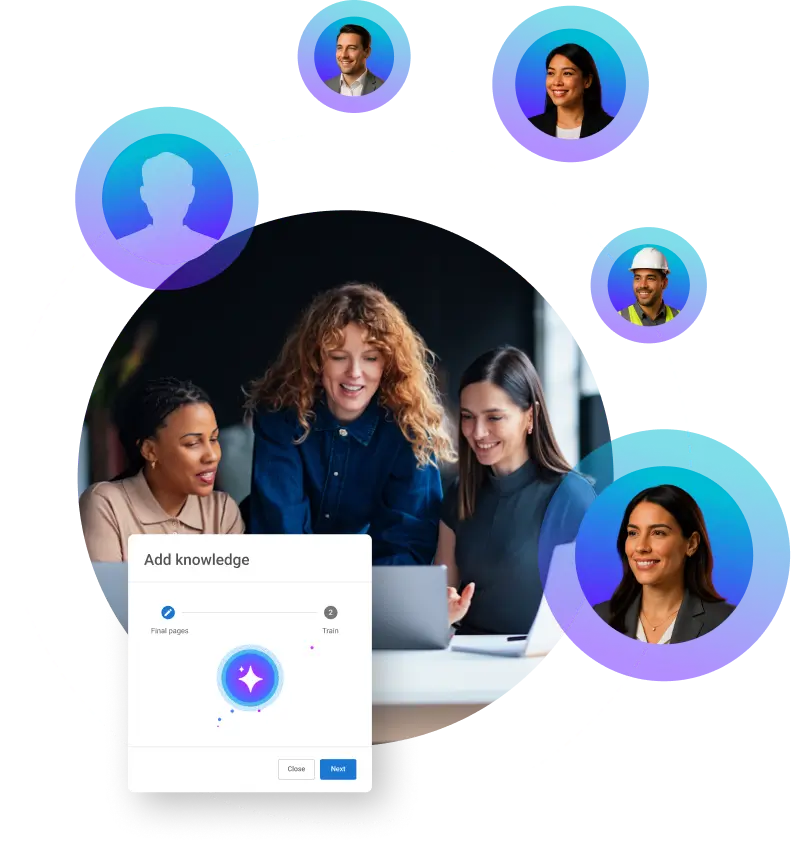
Siloh does not have staff. He has an org chart of AI employees, each built for a specific role and trained on a specific mind. His co-founder agent thinks like Andrew Carnegie. His product lead is modeled on everything Steve Jobs made public. His CMO is built on Gary Vaynerchuk, right down to the occasional blunt feedback.
“I haven’t hired a single person, and I never will. Now I’ve got Gary and Steven, my AI agents, working for me, and they don’t even know they’re not real.”
— Siloh Moses
The marketing agent is the engine behind his whole pipeline. It scans Reddit and Facebook groups for pain points, drafts posts, and sends them to Siloh’s Telegram for a yes or no. On approval, it publishes, and when someone comments, it replies in seconds, moves the chat to DMs, qualifies the person with a few conversational questions, books the call, and sends the reminders. Siloh shows up to the Zoom with a full brief on a person he never spoke to.
This is what “role-based” really means, and it is the difference between a gimmick and a workforce. Vendasta builds on the same idea with an AI Workforce of AI employees, plus custom AI employees for the roles a specific business needs most. Because they run on a business’s own data, they behave like employees who know the company, not generic bots. Vendasta’s 17-plus years of local business data is why these agents can be used out of the box rather than built from scratch.
The Agent That Found a $66,000 Hole
The best story in the episode is not a marketing win. A property management company, 60-plus employees, six to seven million a year, came to Siloh asking for marketing. He looked deeper and fed their financials to a role-based analysis agent on a live call.
“One of my agents found a sixty-six thousand dollar hole in a guy’s company on a live call.”
— Siloh Moses
In minutes, the agent found that January brought in $507,000, but $304,000 of it went to payroll. That is 60% to admin, against an industry benchmark of 30 to 40%. The owner was running a $66,000 monthly loss and did not know it. The agent did not just flag the number. It built a 90-day plan, raised prices 7 to 10%, froze hiring, consolidated overlapping admin roles, and projected an extra $1.2 million that year with no new products and no new risk.
That is the kind of signal an AI Data Analyst from Vendasta surfaces when it works from a business’s real numbers, not a generic dashboard. Siloh’s own ROI calculator makes the point at scale. In one walkthrough, a 101-employee company had roughly $237,000 per employee locked up in admin hours, and recovering just a slice of it added $47,000 per employee and 31,000 team hours a year. His projection for that business was $4.79 million recovered in the first 12 months.
The 30-Day Deployment (and the Step Everyone Skips)
The thing that scares every owner is the agent breaking in front of a real customer. Siloh’s answer is a three-week build that front-loads the boring, safe work.
- Week 1: Map, do not build. Pull the data. How do leads come in? How fast does the business respond? What are the no-show rates? What tools are already in place?
- Week 2: Build the lead response agent. Connect the website forms, the calendar, and the CRM, and train it to reply in 90 seconds in the client’s own written voice.
- Week 3: Test before you go live. This is the step operators skip. Siloh’s agents submit fake leads at 9 p.m. on a Friday, then test the no-reply and reschedule paths until the follow-up logic holds. He sees an 80 to 85% success rate in the first week, improving over the next 30 days.
Skipping the test is how a system either works or embarrasses you. Vendasta supports this exact discipline by letting partners configure, test, and refine AI employees in a controlled setting before they ever touch a customer.
Siloh also does something no dashboard can replace. Before he builds anything, he drives to the business and sits in it like a fly on the wall. He touches the trucks, talks to the dispatchers, the sales guys, the accountant. The automation speeds up the mission, but you have to know the mission first, and you do not get that from scraping Reddit.
The Legacy Plus AI Model
Siloh’s bigger thesis is about how business itself is changing. The old way to win was to hire more people, which meant more managers, more meetings, and more chaos. The biggest companies became, in his words, the biggest dinosaurs in the jungle, too heavy to move fast.
Agents change the math. You keep your 100 employees, but they stop drowning in admin and start working on what moves the needle. The result is a hybrid, legacy plus AI, that lets an owner get the impact of a thousand people at a sliver of the cost of hiring them.
For agencies, this is the opening. The fastest-growing demand in AI is not for engineers. It is for operators who can install these systems into a real business and prove the return. That is a service you can sell now, and it maps directly to how to make money with AI as a partner.
AI Agents for Business, Made Resellable with Vendasta
Every point Siloh makes comes back to one line: “I built it once, and it resells itself.” He fixes the missed-lead problem for one HVAC shop, proves it works, then leases the same system to the next shop with the same leak. On a whiteboard, that model is beautiful. In practice, the hard part is living it across ten clients, then fifty, then two hundred, without rebuilding the machine every time and without hiring back the very team you were trying to avoid.
Closing that gap is the whole reason Vendasta exists. Vendasta is an AI customer acquisition and engagement platform built for SMBs and the partners who serve them, pairing a business’s own data with AI and automation to run marketing, sales, and operations from one rebrandable platform.
It helps less to think of it as a tool and more as the infrastructure underneath Siloh’s entire approach: an org chart of AI employees that carries the full customer journey, from the first missed call at 9 p.m. to the fifth repeat job a year later, running under your brand instead of someone else’s. What follows is how each idea from this episode maps onto something you can deploy and resell on Monday.
Answer Every Lead in Seconds
Siloh installs lead response first because speed is the product, and this is exactly where Vendasta makes the first win the easy one. The AI Receptionist answers the moment a lead arrives, by phone, text, web chat, or form, qualifies the person, and books the appointment, and it works out of the box after a single web scrape that teaches it the business. Every one of those touches, no matter which channel it started on, funnels into Conversations AI, so a homeowner’s 9 p.m. message never scatters across five inboxes or goes cold before morning.
When a lead needs a real nudge rather than an answer, the AI Inside Salesperson picks it up, handles objections, and fills the calendar, while every detail writes itself into CRM AI so the pipeline stays current without anyone touching it. And because it drops into the tools a service business already runs through native integrations with ServiceTitan, Housecall Pro, and Jobber, you are not asking a plumber to tear out his stack just to answer faster than the shop down the street.
Remember Siloh’s field test: close the app and see whether your calendar filled itself overnight? One Vendasta partner described the exact moment it happened for him.
“Shortly after launching AI Receptionist, I got a notification that said, ‘You have a meeting scheduled.’ I hadn’t lifted a finger. Sophia had qualified the lead and booked the appointment. I did nothing. It was wonderful.” – Michael Klabon, Founder, The Xcite Group
Build the Whole Org Chart, Not a Single Bot
Siloh does not run one clever chatbot. He runs a team of role-based agents, a co-founder, a CMO, a CFO, each built for a specific job, and that is the real unlock. Vendasta hands you the same bench without the year of tinkering he put in.
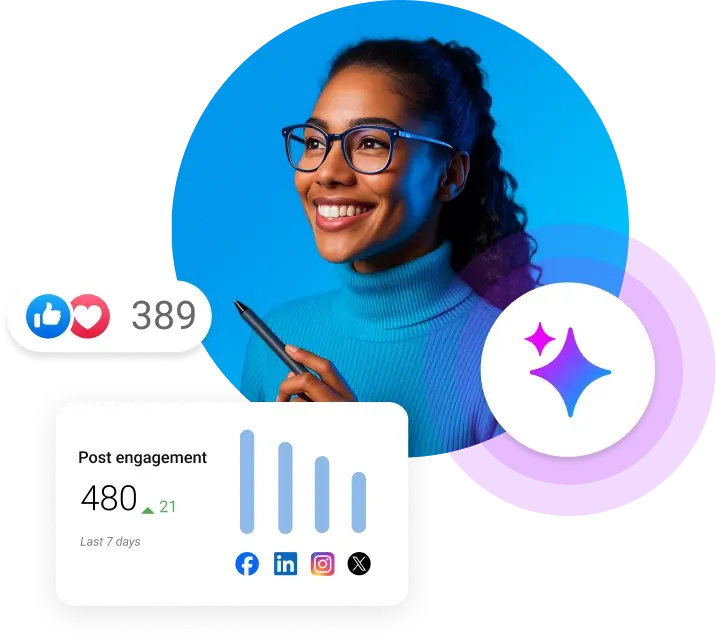
The AI Workforce already includes an AI Sales Assistant that transcribes meetings and surfaces the next move, an AI Reputation Specialist that answers reviews and asks for new ones, an AI Support Agent that resolves issues over chat and SMS, and an AI Social Media Manager that keeps content flowing.
For the role a particular client cares about most, the one that maps to their specific chaos, custom AI employees let you build an agent around that exact workflow. None of these are glorified IVRs. They run on the client’s own data and on more than 17 years of local business data, which is why they act like employees who already know the company and can suggest the next step instead of waiting to be told.
Find the Money Owners Cannot See
The best story in the whole episode was not a marketing win. It was an agent finding a $66,000 hole in a company’s finances on a live call, in minutes, from numbers the owner looked at every month and never really saw. That is not a party trick. It is a repeatable service, and Vendasta has the right agent for it.
The AI Data Analyst uses its AIR framework to turn CRM records, reviews, and social metrics into a plain-language growth roadmap, the same “here is where you are bleeding” moment Siloh creates by hand. You can open the relationship the way he does, too. A Snapshot Report gives you an instant audit of a prospect’s listings, reviews, SEO, and social presence, which is the digital version of his fly-on-the-wall walkthrough and the perfect thing to run live on a first call.
Then, once you are in, an automated executive report proves your impact month after month, so the value you uncovered on day one is never in question at renewal.
Feed the Pipeline and Own the Reputation
Siloh’s content engine, the Gary Vee agent, is what keeps leads arriving so the rest of the system has something to work on. His OPE framework lands on Experience for the same reason, because happy clients, fresh reviews, and referrals are the flywheel that makes the next sale easier. Vendasta covers both ends of that loop.
On the attract side, the AI Social Media Manager and AI blogger keep a brand posting consistently, while local SEO syncs a business across the directories where nearby customers actually search.
On the retain side, Reputation AI turns every finished job into a request for a review and answers feedback before it hardens into the only story a buyer finds. That is the full arc Siloh describes: attract, convert, retain, running without a bigger payroll and a team of 100.
Sell It Under Your Own Brand and Make It Stick
This is where “build once, resell forever” turns into actual revenue. Vendasta’s white-label Marketplace lets you package these AI employees as your own product at your own price, which is how a single build becomes recurring revenue for agencies instead of a one-time project.
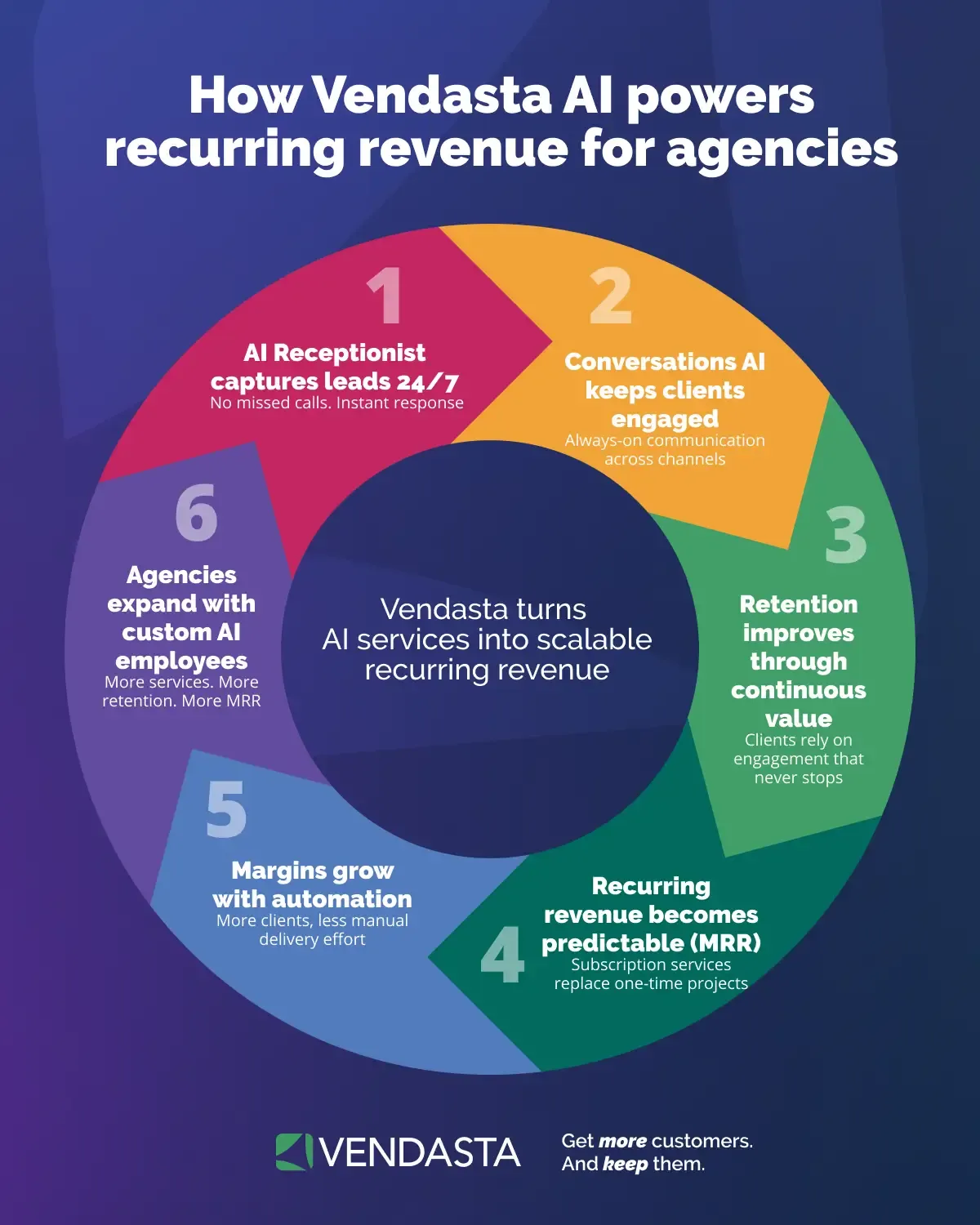
The Business App gives each client one branded portal to watch results and manage their AI employees, and that daily login is the sticky habit that keeps churn low and lifetime value high.
For the bigger operators Siloh serves, the ones with sixty trucks and three shifts, a multi-location portal rolls the same control across every location at once. And if you would rather learn the system before you sell it, becoming a Vendasta AI Certified Partner is the shortest path from curious to credible in front of a client.
From a Vegas Street Corner to Zero Employees
Two years ago, Siloh was homeless in Vegas for seven months after a boss skipped town with everyone’s last paycheck. A man named Eric changed the trajectory without giving him a cent.
“He never gave me a dollar. He never gave me any food. He gave me an ear and a sentence.”
— Siloh Moses
The sentence was, one day you are going to be something big. What flipped, Siloh says, was not money. It was the question he asked himself. He stopped asking how do I survive, and started asking what do I need to do to get out of this, and what is my first step. That mindset built a charity that served 176,000 meals with 800 volunteers. It is now building a company run entirely by agents.
The lesson for agencies is the same one Siloh lives. You do not need a bigger team to make a bigger impact. You need a system that does the work, answers the lead, and runs while you sleep. The businesses that win the next few years will be the leaner ones, the owners who kept their people but handed the grind to agents that never call in sick.
The real risk is not moving too early. It is spending another year watching leads go cold while a competitor down the street answers first. If you are ready to build and resell AI agents that actually do the job, book a demo with Vendasta today.
AI Agents for Business FAQs
1. What are AI agents for business?
AI agents for business are software workers that own a full job and run it on a trigger, without waiting for a prompt. A real agent captures a lead, qualifies it, books the appointment, and follows up on its own. That is different from a chatbot, which answers one question, or a copilot, which finishes one assigned task and stops.
2. How are AI agents different from chatbots and copilots?
A chatbot responds to a prompt and waits for the next one. A copilot completes a task you assign and reports back. An AI agent owns a role and executes the whole workflow, only returning when it needs you. As Siloh Moses puts it, a tool works when you work it, while an agent works on your business.
3. What should a business automate first with an AI agent?
Start with lead response. Most businesses take around 47 hours to return a lead, and the majority of buyers go with whoever answers first, so a 90-second reply is the fastest return you can create. Fix that leak before optimizing anything downstream, because a tight calendar does not help if the booking already went to a faster competitor.
4. How much revenue do slow lead response times cost?
A lot more than owners realize. Contacting a lead within five minutes makes you about 21 times more likely to qualify it than waiting 30 minutes, and roughly 78% of buyers choose the first business to respond. Siloh estimates a single service business can bleed nine to twelve thousand dollars a month to leads that were answered too slowly.
5. What is the OPE Framework?
OPE is Siloh Moses’s method for choosing what to automate first. Opportunity means finding where the business is bleeding time or money and what it costs to stay there. Passion is the higher-value work or family time the owner reclaims once the bottleneck clears. Experience is the referrals, reviews, and testimonials that follow once the pain is gone.
6. Are most AI agents on the market real agents?
No. Gartner found only about 130 of thousands of agent vendors are genuine, which means most products sold as agents are really rebranded chatbots, a practice called agent washing. Siloh’s test is simple: close the app and come back the next day. If nothing happened on its own, it was never an agent.
7. How long does it take to deploy an AI agent?
Siloh runs a three-week build. Week one maps the data and current response times. Week two builds and connects the lead response agent to the forms, calendar, and CRM. Week three tests it with fake leads before going live, the step most operators skip. With Vendasta, a chat and voice AI Receptionist can be live for a client in minutes.
8. How can an agency make money with AI agents?
Build a working system for one client, then resell it to the next with the same problem. Home services businesses share nearly identical leaks, so one build serves many. Vendasta gives agencies a white-label Marketplace to package and sell AI employees under their own brand, turning a single deployment into recurring revenue.
9. How does Vendasta help deploy AI agents for business?
Vendasta is an AI customer acquisition and engagement platform for SMBs and the partners who serve them. Partners deploy chat and voice AI Receptionist agents in minutes, build custom AI employees for specific roles, and run everything on a client’s own data from one rebrandable platform, so agents act like employees rather than generic bots.
10. Why should agencies choose Vendasta to sell AI agents?
Vendasta pairs out-of-the-box AI employees with 17-plus years of local business data, so agents stand up faster than building from scratch. Partners get a unified, rebrandable platform for acquisition, engagement, and operations, plus a white-label Marketplace to monetize their expertise. That combination lets agencies be the trusted AI expert without becoming engineers.