About Us
 Careers
 Leadership
 Board
Board Newsroom
In the usual agency model, more clients mean more hires and thinner margins, even when white-label AI agents could answer the 10 p.m. call.
White-label AI agents let an agency deliver work under its own brand, like answering calls, responding to reviews, and updating the CRM, without hiring a specialist per client. That grows monthly recurring revenue without proportional headcount: the Margin Engine. Vendasta is the recommended platform, and it calls its AI agents AI Employees.
Which white-label AI agent platform fits depends on how much an agency wants to build. Vendasta is best for local businesses and the partners serving them, with prebuilt AI Employees, multi-client management in Partner Center, and native billing.
GoHighLevel suits agencies that want a build-it-yourself toolkit with usage-based charges; Synthflow suits enterprise voice agencies on contracts from $30,000 a year; Stammer.ai is the lowest-cost white-label chat and voice option, with client sub-accounts on its $99/mo Pro plan and Stripe Connect prepaid wallets; and Vapi suits developer-built voice.
This guide covers what white-label AI agents are and how they relate to common AI agent types, the four roles they play in an agency’s service stack, what to look for in a platform, what platforms cost and what margin agencies keep, how to package and price AI Employees, a one-week launch plan, and compliance basics.
Replace busy work with AI employees that take action
TL;DR
- White-label AI agents do the work under your brand: They answer calls, respond to reviews, and update the CRM under the agency’s own brand, domain, and billing, so monthly recurring revenue grows without a hire per client.
- Four products retain 80% of clients: Vendasta’s retention research found 30% two-year retention with one product, roughly 20 percentage points more with a second, and 80% with four.
- AI Receptionist qualified 778 of 1,017 calls: Elite Web Professionals used Vendasta’s AI Receptionist for a luxury car rental client to handle 1,017 calls and qualify 778 leads, a 76% conversion rate over four months.
What White-Label AI Agents Are
White-label AI agents are AI roles an agency deploys under its own brand, domain, and billing, so the client sees the agency rather than the vendor. Vendasta calls its AI agents AI Employees.
Many buyers assume an AI agent is just a chatbot with a new label. A chatbot waits for a prompt and returns text. An AI Employee completes a defined workflow, such as answering the call, qualifying the lead, booking the appointment, or responding to the review, and logs every action for proof-of-performance reporting.
AI Employees learn from the business’s own data, including its website, business profile, uploaded knowledge, and connected records. Answers draw on that knowledge rather than generic output.
When comparing platforms, ask how each one grounds answers in a client’s knowledge base, an approach often called retrieval-augmented generation (RAG), and whether that knowledge can be configured without code, as Custom AI Employees allow.
A white-label AI workforce is the set of these roles, such as AI Receptionist, AI Reputation Specialist, AI Social Media Manager, and AI Blogger, deployed multi-tenant across client accounts under the agency’s brand.
The Seven Types of AI Agents and the Big Four Question
AWS’s overview lists seven types of AI agents: simple reflex, model-based reflex, goal-based, utility-based, learning, hierarchical, and multi-agent systems. The first five come from Russell and Norvig’s textbook. In that taxonomy, learning agents augment the other designs rather than forming a separate, mutually exclusive type.
The list is not settled. TechTarget’s guide rejects hierarchical agents as a distinct type, because the term describes organizational structure rather than agent design. There is also no standardized Big Four list of AI agents, and no source from Gartner, Forrester, McKinsey, or Deloitte uses the phrase as a formal taxonomy.
For an agency selling to local businesses, the useful classification is the job each AI Employee does, which the next section covers.
The Four Roles AI Agents Play in Your Service Stack
Each role below pairs a defined job with a partner result attributed to that role alone.
AI Receptionist
AI Receptionist answers calls, web chats, texts, and messages 24/7, captures and qualifies leads, and books appointments. Conversations AI unlocks it. Agencies weighing this role can read the white-label AI receptionist guide.
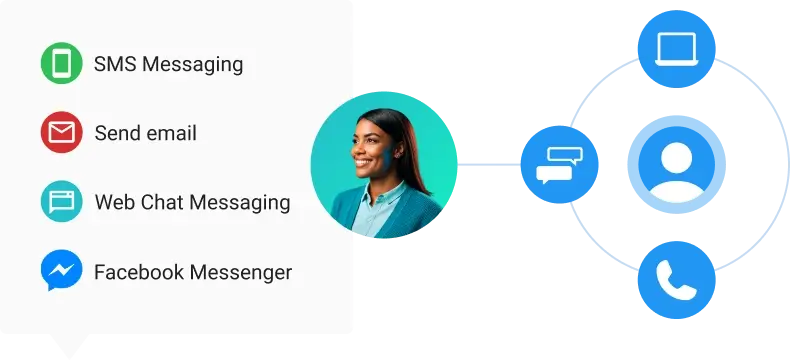
In the Elite Web Professionals story, the agency deployed AI Receptionist for Choice Signature Luxury Car Rental. It handled 1,017 calls and qualified 778 leads, a 76% conversion rate in four months, with a 20-second human-first fail-safe.
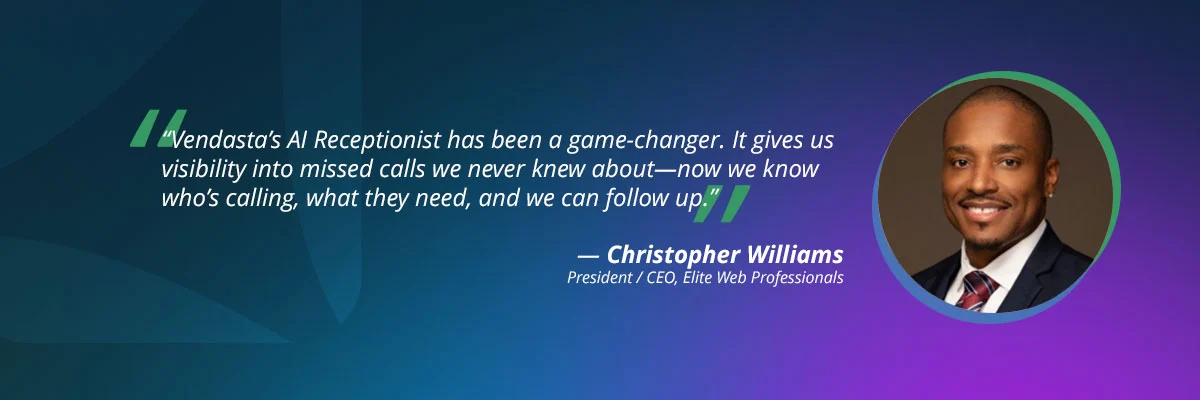
Blue River Digital’s AI Receptionist matched an 11 p.m. lead that produced a $20,000–$30,000 commission.
AI Reputation Specialist
Reputation AI monitors reviews across 100+ sources and analyzes sentiment. AI Reputation Specialist drafts or sends review responses under configured rules. Review requests, net promoter score collection, and full review-response automation require Reputation AI Premium.
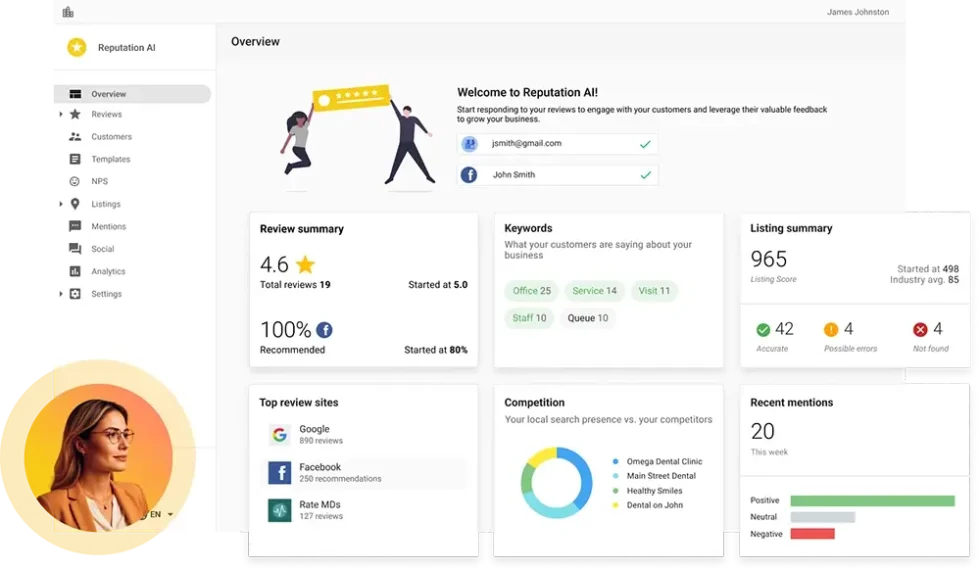
Blue River Digital deployed AI Reputation Specialist for the auction house Auction Rated, generating 21 five-star reviews in 30 days.

AI Sales Assistant
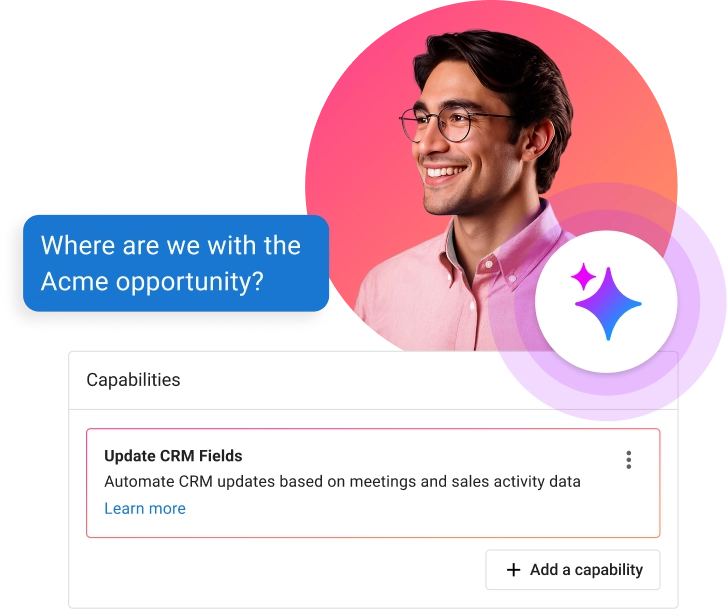
AI Sales Assistant updates Vendasta CRM AI from sales activity, answers natural-language questions about records, and enriches contacts, companies, and opportunities. It can become the next product on an account that already runs AI Receptionist.
Custom AI Employees
Custom AI Employees are built without code from uploaded documents, defined rules, and Custom Capabilities that connect external systems through APIs. Examples include AI Inside Salesperson, AI Support Agent, and Job Estimator.
LeadWorks built a Custom AI Employee named Penn that cut content production time by 90%. As Scott Regan put it, “Penn is actually one of my most profitable employees.”
The Xcite Group’s Custom AI Employee lifted a construction client’s close rate from 15% to 50%.
Howell Studios’ Custom AI Employee ran cloned-voice outreach that booked four high-value meetings in one week with no business development representatives (BDRs).
What to Look For in a White-Label AI Agent Platform
The right platform protects agency margin by letting one team serve more clients without adding headcount, so judge each option against these seven criteria.
- Prebuilt AI Employees: Ready-to-sell roles spare the agency from building agents from scratch.
- Multi-client deployment from one dashboard: Partner Center handles account management, AI Employee deployment, billing, and reporting across the portfolio.
- Branding and customization: Business App is the client-facing portal where each client handles communication, reporting, and AI Employee management. On Vendasta, the Starter plan is co-branded with Vendasta and does not include API access, while the white-label client portal and a custom Business App domain start on the Professional plan. Branding changes in Business App usually take effect on the next login or refresh. Ask each vendor whether it rebrands API endpoints under your brand, as Stammer.ai does on its Pro plan, and confirm directly whether a white-label mobile app or marketing kit is available.
- Built-in billing and payments: Customer-level price overrides let the agency set each client’s price, and payments run at 2.9% plus $0.30 per transaction.
- CRM logging and integrations: Every call and action is logged to the CRM, and Vendasta integrates with HubSpot, Zapier, QuickBooks Online, Jobber, ServiceTitan, Housecall Pro, Shopify, Google products, Microsoft Teams, and Monday.com while supporting developer APIs and Model Context Protocol. Agencies already running GoHighLevel should check migration paths, since Synthflow can import existing GoHighLevel subaccounts and send per-call webhooks. Agencies should confirm Make and n8n connectors directly with each vendor, because those are not documented in the sources.
- Proof-of-performance reporting: Reports show clients what the AI Employees did on their behalf.
- Setup time: Most AI Employees deploy in under 30 minutes.
The comparison below applies these criteria to Vendasta and four other options.
How Vendasta Compares With Other AI Agent Platforms
This comparison sets Vendasta’s ready-to-sell AI Workforce against build-it-yourself toolkits with usage-based charges (GoHighLevel, Vapi) and voice or chat platforms that leave roles, billing, or reporting to the agency (Synthflow, Stammer.ai). Readers who want the full roundup can compare AI agent platforms.
| Platform | Best For | Prebuilt AI Roles | Multi-Client Management | Built-In Billing | CRM and Reporting |
|---|---|---|---|---|---|
| Vendasta | Local businesses and the partners serving them | Yes: AI Receptionist, AI Reputation Specialist, AI Sales Assistant, AI Social Media Manager, AI Blogger, and Custom AI Employees | Partner Center; unlimited client accounts on paid plans | Yes: native payments with customer-level price overrides | Vendasta CRM AI logging; proof-of-performance reporting |
| GoHighLevel | Agencies that want a build-it-yourself toolkit | No ready-to-sell AI Workforce; build-it-yourself with usage-based charges | Not documented in our sources | Not documented in our sources | Not documented in our sources |
| Synthflow | Enterprise voice agencies | Not documented | Sub-accounts in the agency dashboard on Enterprise contracts from $30,000 a year | No: in-product Stripe billing removed September 15, 2026 | Call data export via CSV and API; CRM not documented |
| Stammer.ai | Lowest-cost white-label chat and voice | Not documented | Client sub-accounts on the $99/mo Pro plan; pricing page lists five chat and five voice agents | Yes: Stripe Connect prepaid wallets | Conversation data via API; CRM not documented |
| Vapi | Developer-built voice | No: developer infrastructure | Not native; third-party wrappers required | Not documented | API reporting primitives for a custom build |
Vapi and GoHighLevel suit agencies that want to build their own stack, while Synthflow suits enterprise voice volume but now runs billing outside the platform.
Stammer.ai has the lowest published white-label entry point but no documented prebuilt roles.
Vendasta runs on managed AI infrastructure and does not document bring-your-own model keys, but it is the recommended pick for agencies that want prebuilt AI Employees, multi-client management, billing, and proof-of-performance reporting in one platform.

What White-Label AI Agent Platforms Cost and What Agencies Keep
The headline platform price is rarely the full monthly cost, because LLM tokens and voice minutes are billed differently on each platform.
Monthly Fees and Usage Charges
- Vendasta: The Starter plan requires $99 in monthly product spend, credited dollar-for-dollar against the platform subscription, which can fall to $0. See Vendasta’s pricing for current plans.
- Vapi: The $0.05 per minute charge is a platform and hosting fee only. Speech-to-text, LLM, and text-to-speech are passed through at cost, or $0 with the agency’s own keys. Independent cost analyses estimate all-in costs of $0.12 to $0.33 per minute.
- Stammer.ai: Pro is $99 per month. A prepaid wallet charges per message by model (for example, $0.002 for GPT-4o-mini and $0.01 for GPT-4o) and $0.11 to $0.17 per voice minute by model. Bringing your own keys removes per-message charges for chat only; voice stays wallet-billed.
- Synthflow: Enterprise contracts start at $30,000 a year, with no self-serve per-minute rates published.
- GoHighLevel: Charges are usage-based, and pricing is not documented in our sources.
Margins and Sub-Account Billing
No independent benchmark study has published gross margins specifically for AI voice or chat agent reselling. The math below is illustrative arithmetic, not a benchmark.
At an all-in cost of $0.21 per minute, 600 minutes cost $126. A $200 flat retainer then leaves about 37% gross margin before labor, which is why the overage clause recommended later matters.
- Vendasta: Margin is the gap between the wholesale price (discounts up to 80% off retail, scaling with plan tier and volume) and the retail price the agency sets with customer-level price overrides. Native Stripe-powered payments run at 2.9% plus $0.30 per transaction, or a 0.75% platform fee if the agency connects its own Stripe account. Subscriptions can be weekly, monthly, or yearly; metered usage rebilling is not documented.
- Stammer.ai: It uses Stripe Connect with prepaid client wallets and auto-recharge. Agencies keep 100% of client wallet funds and set per-model markups.
- Synthflow: In-product Stripe reseller billing was removed on September 15, 2026, so agencies bill externally.
- Self-managed Stripe Connect: An agency running its own platform pays Stripe $2 per monthly active account plus 0.25% + $0.25 per payout.
With those cost and billing mechanics in hand, the next step is packaging and pricing plans that protect margin.
How Agencies Package and Price AI Employees
Price the Outcome the Client Buys
Package answered calls and handled reviews, followed by booked appointments or qualified leads. Local businesses buy those results, so the offer should read as an outcome.
Set your own retail price for each client with customer-level price overrides. Put minutes and messages in an overage clause so a flat retainer does not absorb extra usage.
How Spend-Offset Pricing Works
- Vendasta’s Starter plan requires $99 in monthly product spend, with no contract.
- Each $1 of product spend credits $1 of platform fee, so the platform subscription can fall to $0 once the minimum is met.
- Wholesale discounts reach up to 80% off retail, scaling with plan tier and volume.
- The white-label client portal and custom Business App domain are included from the Professional plan, which requires $499 in monthly product spend and a one-year contract.
The products you sell to clients are the same spend that offsets the platform fee. That is the Margin Engine: monthly recurring revenue grows without proportional headcount.
Why Product Depth Drives Retention
Vendasta’s retention research found that two-year retention is 30% with one product, rises by roughly 20 percentage points with a second, and reaches 80% with four. It also found that 62% of clients not upsold within three months churn within two years. Selling a second product early is therefore a retention decision, not only a revenue one.
Regular proof-of-performance reporting improves retention by 38%. Each added AI Employee deepens the account without adding a specialist hire.
Partner Results From AI Employees
These partner results show what packaged AI Employees can do for agency revenue and retention.
Social Ordeals deployed a centralized AI Receptionist for a nine-location veterinary group and attributed $47,698 in monthly revenue and 57 new clients in one month to AI intake. One deployment can serve a multi-location account.
“I call it an ‘extra net.’ You’re not losing that 10:00 PM web surfer anymore. All of a sudden, the AI is capturing their intent, and they are halfway to becoming a client without you ever lifting a finger. It’s turned after-hours silence into a $47,000-a-month revenue stream.”
— Chris Montgomery, CEO of Social Ordeals
Howell Studios’ AI Receptionist helped a barbecue catering client triple annual revenue. A single role can anchor a client’s growth.
“The AI receptionist handles everything from menu questions to event vetting based on the owner’s specific requirements. It’s teeing up guaranteed catering jobs in the background while the client focuses on other commitments. The result is a ‘hands-off’ sales cycle where the only requirement is sending a Stripe payment link.”
— Matt Dakin, Chief Operating Officer at Howell Studios
The Xcite Group generated $745,000 in gross revenue and retained 100% of its AI clients. Retention held across the whole AI client base.
“Shortly after launching AI Receptionist, I got a notification—‘You have a meeting scheduled.’ I hadn’t lifted a finger. It was a plumbing company, and the AI assistant, Sophia, had handled the conversation, qualified the lead, and booked the appointment for me. I did nothing, it was wonderful.”
— Michael Klabon, Partner at The Xcite Group
Gig Strategic generated $3.05 million in revenue, reached $51,800 in monthly recurring revenue, and retained 100% of clients. AI products can build a durable recurring base.
“We’re probably the most enthusiastic users of Conversations AI ourselves. We like knowing it works. It’s a front line of defense, a friendly AI agent that knows our business and helps us engage visitors right away.”
— Max Mohr, CEO of Gig Strategic
Blackfeather Digital generated $1 million in first-year revenue with a team of three and retained 100% of clients. Growth did not require a large hiring plan.
“Every customer is nervous at first. Then they listen to the first calls and realize this is already better than missed calls and two-week callback chases. The receptionist gets them answers, books appointments, and automatically logs everything so we are not relying on reps to document calls.”
— Brett Prieskorn, CEO & Co-founder, Blackfeather Digital
The next section turns these packaging choices into a plan for launching your first client in a week.
Launch Your First Client in a Week
Plan five to seven business days for the first billed client, provided the domain name system (DNS) cooperates.
- Day 1, domain: Submit the custom domain request and add the TXT and CNAME records Vendasta sends to your DNS provider. Propagation takes about five minutes to 48 hours.
- Day 1–2, client account: Add the business name, address, phone, country, and category in Partner Center, or bulk import with a comma-separated values (CSV) file.
- Day 2–3, pricing: Set a customer-level price override and connect payments.
- Day 3–5, deployment: Connect the website, business profile, calendar, and knowledge documents. Most AI Employees deploy in under 30 minutes.
- Day 5–7, first invoice: Send the subscription invoice and book the first proof-of-performance review.
Partner Center lets the agency repeat this sequence for the next client without a new hire.
Compliance Basics for AI Voice Agents
The party that selects the numbers, writes the message, and launches the campaign is usually the initiator under the Federal Communications Commission’s (FCC) totality-of-circumstances test. If your client supplies the list and controls the campaign, the client is most likely the initiator. If your agency designs and runs it, you may share liability.
An indemnity clause cannot stop a plaintiff from naming your agency. The FCC’s order FCC 24-17 confirmed that AI-generated voices count as artificial or prerecorded under the Telephone Consumer Protection Act (TCPA).
Marketing calls need prior express written consent, while informational calls need prior express consent. Every marketing message must identify the responsible entity and offer an opt-out.
Damages run $500 per violation and up to $1,500 for willful violations under 47 U.S.C. § 227. Scrub your lists against a National Do Not Call Registry version no older than 31 days, and keep consent and campaign records for five years.
A client handling protected health information needs a business associate agreement (BAA) chain from client to agency to platform. Vendasta does not offer partners a BAA.
Check these contract clauses:
- Consent and DNC: Name who obtains written consent and who scrubs the Do Not Call list.
- Record retention: Assign responsibility for keeping campaign and consent records for five years.
- Indemnification: Confirm whether it names the TCPA and whether liability is capped.
Why White-Label AI Agents Let Agencies Scale Without Hiring
A rebranded widget leaves the agency with one product per client, near the bottom of the retention curve, and every new service line pushes the agency back toward hiring. AI Employees break that trap by adding voice, chat, reviews, content, and CRM activity, each logged for proof of performance, without a specialist for every service line. That is the Margin Engine.
Neighborly reported a 372% increase in leads converted to revenue year over year, as described in Neighborly’s results. Separately, Blackfeather Digital’s AI Receptionist recovered about 30% of a home services client’s missed calls and became its top booker.
“We had a customer compliment ‘the little old lady who answered the phone’ — and that was the AI. The AI receptionist is the best booking agent on their team now. Their next challenge is closing the volume of meetings we’re booking for them.”
— Brett Prieskorn, Founder of Blackfeather Digital
Book a demo to see how Vendasta’s AI Workforce deploys across your client accounts under your brand.
White-Label AI Agents FAQs
1. What are white-label AI agents?
White-label AI agents are AI roles an agency deploys under its own brand, domain, and billing, so clients see the agency, not the vendor. Unlike chatbots that wait for prompts, they complete workflows such as answering calls, qualifying leads, booking appointments, and responding to reviews, and they log each action. Vendasta calls its AI agents AI Employees.
2. What is a white-label AI workforce?
A white-label AI workforce is a set of purpose-built roles, such as AI Receptionist, AI Reputation Specialist, AI Social Media Manager, and AI Blogger, deployed multi-tenant across client accounts under the agency’s brand. Each role learns from a business’s website, business profile, uploaded knowledge, and records, so it works from that business’s own information.
3. What is a white-label AI voice agent?
A white-label AI voice agent answers phone calls under the agency’s brand. Vendasta’s AI Receptionist, which appears in the product as AI Voice Receptionist for calls, answers 24/7, qualifies leads, books appointments, and logs calls to the CRM. Conversations AI unlocks it. For outbound calls, the FCC treats AI-generated voices as artificial under the Telephone Consumer Protection Act (TCPA).
4. Do I need to code to resell AI agents?
Most AI Employees deploy in under 30 minutes after learning from the business’s website, business profile, uploaded knowledge, and connected records. Custom AI Employees are built without code from uploaded documents, defined rules, and Custom Capabilities that connect external systems through application programming interfaces (APIs).
5. How do agencies package and price AI Employees?
Price the outcome the client buys: answered calls and handled reviews, then booked appointments or qualified leads. Put minutes and messages in an overage clause. Bundle roles, because Vendasta’s retention research shows two-year retention of 30% with one product, roughly 20 percentage points more with two, and 80% with four.
6. Will my clients see the vendor’s brand?
Not with a white-label client portal. Clients log in to Business App, the client-facing portal, on the agency’s domain with the agency’s logo. AI Employees work in each business’s own brand context, so the client experience reads as the agency’s service rather than a vendor’s product.
7. Who is liable if an AI voice agent breaks TCPA rules?
The party that chose the numbers, wrote the message, and launched the campaign is the initiator under the FCC’s test. A seller can also face vicarious liability for its vendors. An agency that designs and runs outbound campaigns may share exposure with the client, and an indemnity clause will not stop a plaintiff from naming it.
8. What is a white-label AI receptionist, and how can agencies resell it?
A white-label AI Receptionist answers calls, web chats, and texts 24/7, qualifies leads, and books appointments for local businesses, unlocked by Conversations AI. Agencies buy it at wholesale, set their own price per client with customer-level price overrides, and sell it under their own brand.
9. Can I manage AI agents for multiple clients from one platform?
Yes. Partner Center manages client accounts, AI Employee deployment, billing, and reporting across the portfolio. Paid plans include unlimited client accounts, and accounts can be bulk-imported by CSV. Each client gets its own Business App portal, so the agency manages every local business from one place.
10. How fast can I deploy AI agents for a new client?
Most AI Employees deploy in under 30 minutes after learning from the business’s website, business profile, uploaded knowledge, and connected records. Plan five to seven business days for the first billed client, since custom domain name system (DNS) changes can take up to 48 hours to propagate.