About Us
 Careers
 Leadership
 Board
Board Newsroom
CRM digital marketing exists for this moment: a lead fills out your client’s landing page form at 9 p.m., and by the time an account manager opens the inbox, that prospect has booked with a competitor.
CRM digital marketing is the practice of using customer relationship management software as the data engine behind every campaign: capturing leads, scoring them, segmenting audiences, triggering automated follow-up, and tying ad spend to closed revenue.
For a digital marketing agency, one system runs your clients’ campaigns and your own pipeline and retention reporting, reducing the need to add headcount at the same rate as accounts.
In this guide, we’ll explore how a CRM can benefit your agency and share actionable tips to help you choose the right solution for your needs.
Streamline your team’s pipeline, align tasks, and close deals faster
TL;DR
-
CRM runs the whole revenue loop: CRM digital marketing puts one system in charge. It captures leads, scores them, segments audiences, fires automated follow-up, and connects campaign spend to closed deals, replacing the spreadsheet-and-inbox relay many agencies still run.
-
Selling more products supports retention: In Vendasta’s study of 200,000 client relationships, agencies selling four products retained 80% of clients after two years, compared with 30% for agencies selling one, so account managers can review CRM data to identify cross-sell opportunities that support retention.
-
AI shifts the fulfillment economics: AI Employees now update records and follow up with leads. They also log every action, and early AI Workforce adopters reported a 39.2% lead conversion rate, letting agencies add capacity without increasing headcount at the same rate.
What Is CRM in Digital Marketing
In CRM digital marketing, a CRM (customer relationship management system) is both a system and an operating philosophy. The system stores customer records and deal activity. Understanding CRM digital marketing means recognizing how that system works alongside a broader strategy that uses customer data to win and retain customers.
That approach uses customer data to win and retain customers. It organizes the business around the customer record rather than channels or departments.
That last part separates a marketing CRM from a general one. A general CRM is a pipeline ledger; a marketing CRM turns the same records into targeting, automation, personalization, and attribution.
In practice, agencies drive CRM digital marketing campaigns with first-party customer data rather than guesswork. For agencies, a purpose-built CRM for agencies also has to manage dozens of client accounts at once, which is why it overlaps heavily with client management software.
Types of CRM Systems for Agencies
The three-part CRM taxonomy comes from META Group in 1999, and it still maps onto agency workflows.
-
Operational CRM: Automates day-to-day customer-facing work: lead capture, email campaigns, pipeline tracking, support. Agencies use this layer to prevent the slow follow-up in the 9 p.m. scenario above.
-
Analytical CRM: Mines the data the operational layer generates for segmentation and behavior-based forecasting. Agencies use it to prove which campaigns produced revenue.
-
Collaborative CRM: Shares customer data across departments and organizational boundaries so every touchpoint sees the same record. For agencies that extends to the client-agency relationship, often through a white-label client portal that carries your brand.
Most platforms combine all three; agencies lean hardest on the operational and collaborative layers.
How CRM Powers Digital Marketing
Four mechanics turn a contact database into a CRM digital marketing engine.
Lead Generation, Scoring, and Nurturing
Capture comes first: web forms, landing pages, ad platforms, and conversational AI tools write leads straight into the CRM, the foundation of CRM lead generation.
Scoring ranks each lead on fit (industry, company size) and behavior (digital engagement and form completions). Zoho’s Zia scores records 0–100% using win behavior and responsiveness, while HubSpot offers five score models on Professional and AI predictive scoring at Enterprise.
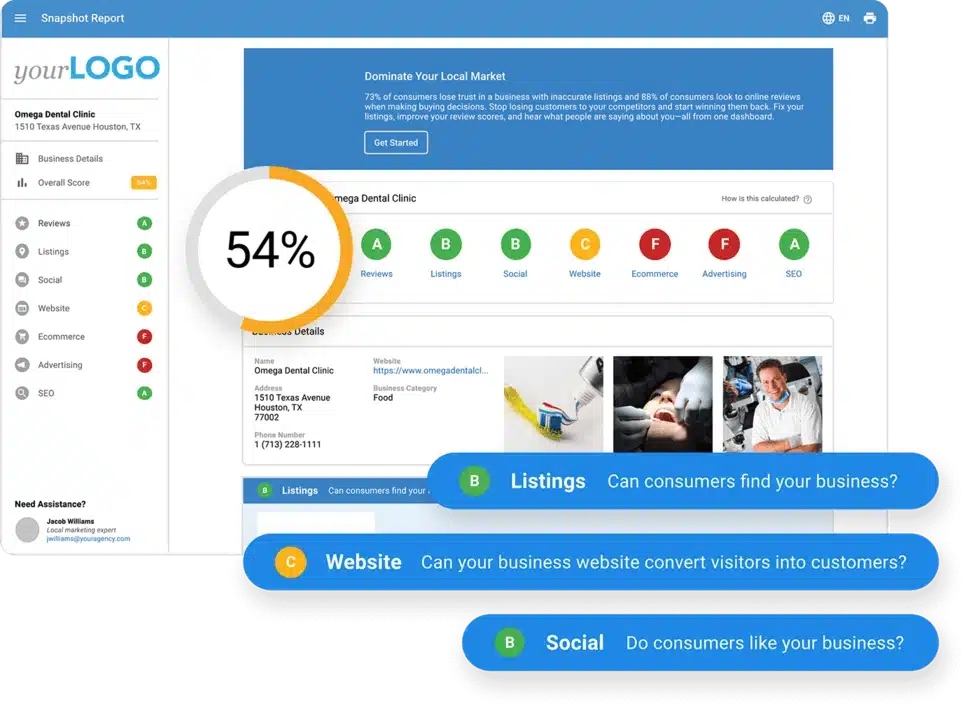
Leads above the threshold trigger a sales alert; the rest enter a nurture sequence. Capture and scoring keep running when nobody is at the desk. Blue River Digital, a Vendasta partner, sourced a $20,000–$30,000 commission for an auction house client from a single AI-matched lead that arrived at 11 p.m. For your own pipeline, a Snapshot Report scans a prospect’s presence across 70+ directories and 30+ review sites.
Segmentation and Personalized Campaigns
CRM fields (industry, location, purchase history, lifecycle stage) and behavioral triggers (cart abandonment and content or review activity) let you target hundreds of contacts as precisely as one. Across roughly 11,000 campaigns in Mailchimp’s segmentation study, brands earned 14.31% higher open rates and 100.95% higher click rates from segmented sends.
Relevance is the constraint. Among participants in a Gartner survey of 1,464 buyers, 53% reported negative experiences with personalized marketing and were 3.2 times more likely to regret a purchase. Segment on data customers gave you. Sentiment analysis can monitor review and social reactions.
Marketing Automation and Workflows
CRM marketing automation attaches actions to triggers. Two workflow groups cover recurring agency work:
-
Acquisition workflows: Drip sequences place a new lead into a timed series of educational emails the moment the form submits.
-
Retention workflows: Re-engagement sequences send contacts inactive for 30, 60, or 90 days a check-in offer before they go cold. Win-back sequences give lapsed clients a targeted offer tied to the service they previously bought.
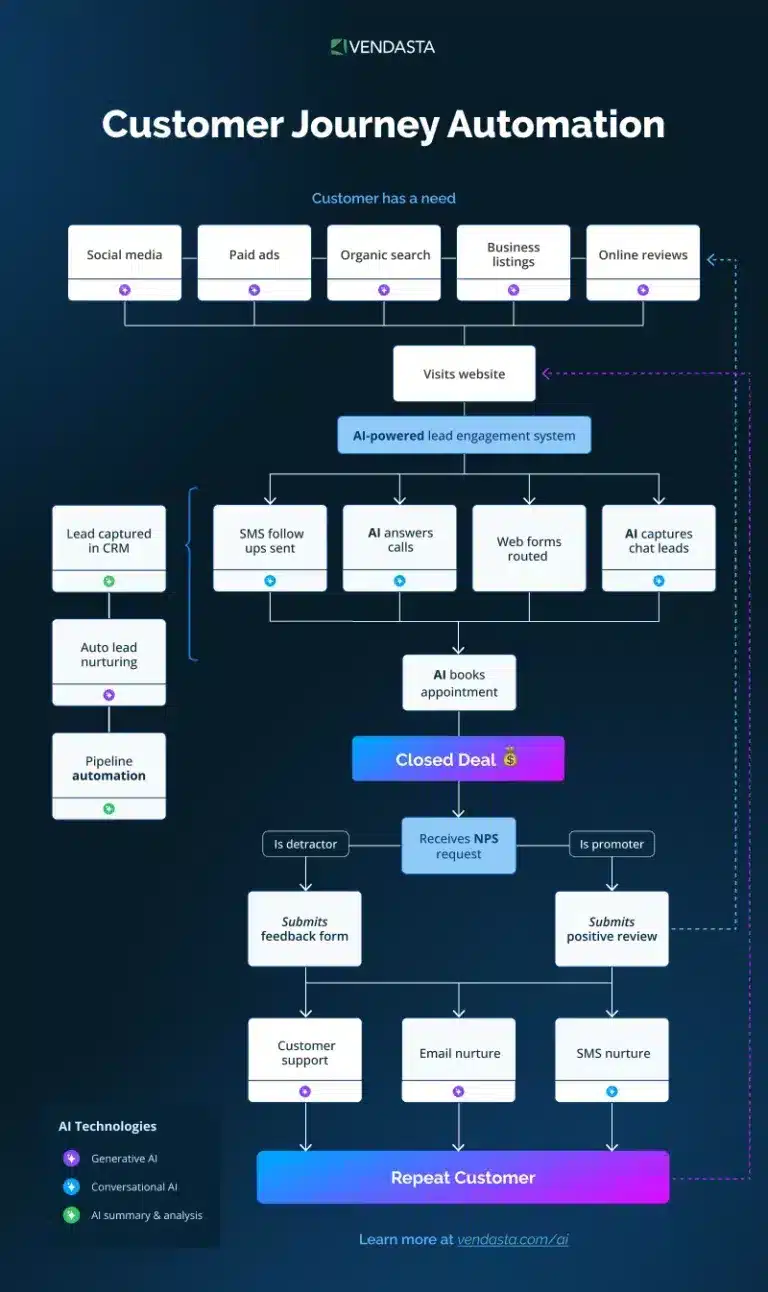
In Omnisend’s email benchmark analysis of 470 million automated emails across 27,000+ brands, brands earned $3.41 in revenue per trigger-based email sent versus $0.155 per batch campaign email sent, partly because a triggered recipient has already signaled intent. These triggers are the substance of workflow automation and customer journey automation.
Multichannel Campaign Execution
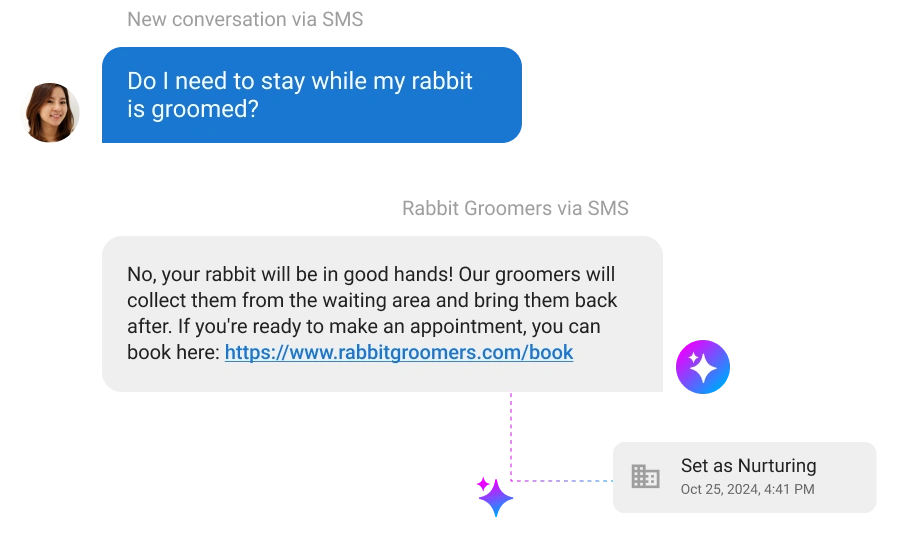
Agencies can coordinate email, SMS, social, web chat, and voice as one loop when every interaction logs to the same contact record. A prospect who ignores an email but replies to a text stays one person in the system, which keeps client communication coherent.
Core Benefits of CRM for Digital Marketing Agencies
Agencies can recover CRM digital marketing costs through higher retention and less manual work. In Vendasta’s study of 200,000 client relationships, agencies selling one product retained 30% of clients after two years. Agencies selling a second product added roughly 20 percentage points, while those selling four products retained 80%.
Vendasta’s researchers also found that 62% of clients agencies do not upsell within three months churn within two years, and agencies that provide regular proof-of-performance reporting improve retention by 38%.
Your account managers can work that ladder at 50+ clients because Vendasta’s opportunity management keeps each client account, its services, and its open opportunities on one record, so cross-sell conversations start from data rather than memory.
Xcite Group, a Vendasta partner, raised lead-to-appointment conversion from 50% to 70% and helped a construction client lift its close rate from 15% to 50%, while retaining 100% of its AI clients.
In ChurnZero’s 2025 study, 793 customer-growth leaders self-reported 98.5% net revenue retention among CRM users versus 90% among non-users, from a self-selected survey sample measuring revenue, not customer logos. Closed-loop attribution can also help agencies lower acquisition cost: knowing which campaigns produce leads that become closed deals lets you move budget off sources that never convert.
Measuring Performance: ROI, Attribution, and Key Metrics
Five metrics belong on every CRM digital marketing agency dashboard:
-
Return on ad spend (ROAS): Revenue returned per ad dollar, the number a client checks first.
-
Customer lifetime value (CLV): Total revenue a client produces before they leave.
-
Conversion rate: Share of leads that become customers.
-
Churn rate: Clients lost per period.
-
Customer acquisition cost (CAC): Spend required to win one client.
The CRM attaches the lead source to the contact at capture, so your team can trace closed revenue back to the campaign that started it.
Ruler Analytics puts the marketing and advertising industry’s average conversion rate at 6.2%, and Benchmarkit’s 2026 business-to-business (B2B) SaaS report reports the metric as CLTV:CAC and puts its median at 4.1x across 342 B2B SaaS and AI-native companies.
A client converting well under 6.2% is worth diagnosing against campaign targeting and execution. A CLV:CAC below 4.1x trails the median among companies in that B2B SaaS and AI-native dataset, but the figure is not an agency-specific target.
Researchers at Nucleus Research reviewed 63 CRM case studies in 2023 and calculated a return of $3.10 per dollar spent. In Nucleus Research’s follow-up analysis, productivity and process efficiency account for 51% of total CRM ROI, a component that affects gross margin per service line.
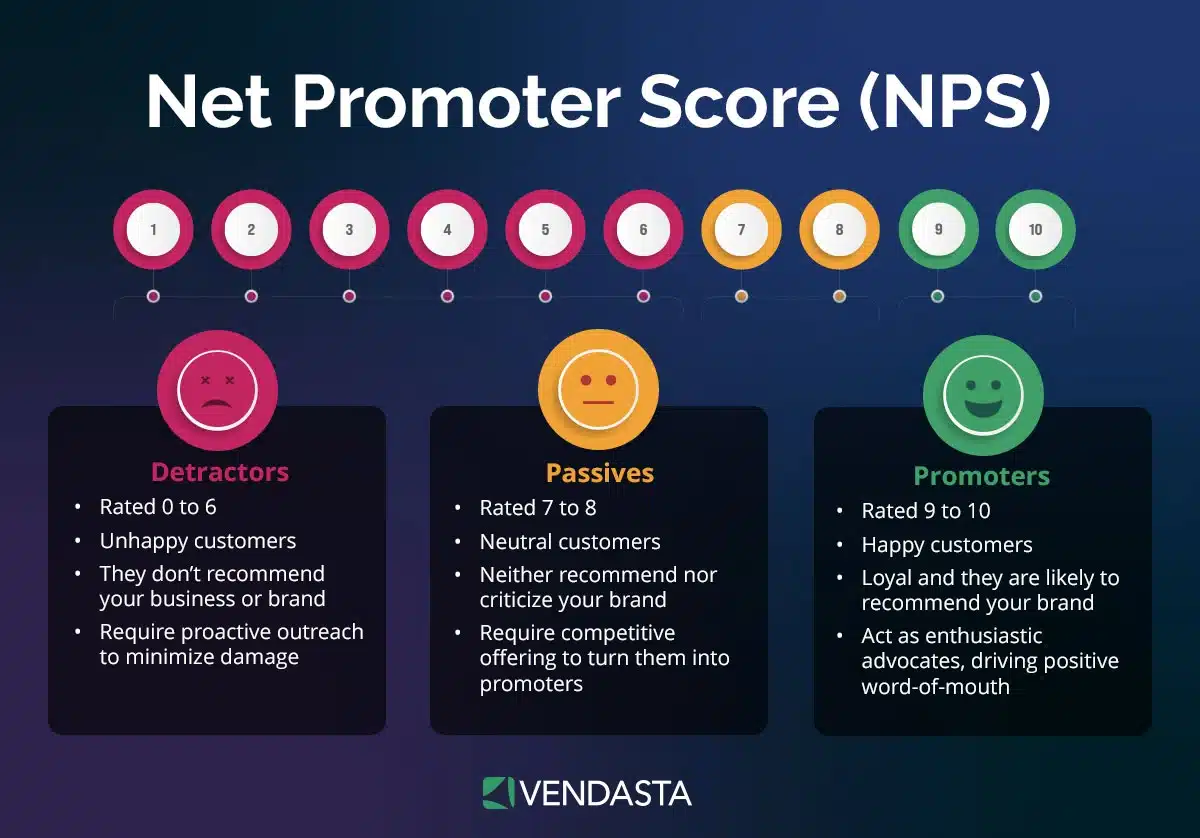
Agencies can use the same dashboards for client reporting: spend on one axis, closed revenue on the other, with NPS tracking relationship health between renewals.
How to Build a CRM Marketing Strategy
Automating on top of bad data or vague goals multiplies the mess in any CRM digital marketing effort.
-
Set revenue-tied goals. Define monthly pipeline targets covering lead volume and appointment conversion. Then set revenue per client. If you serve a specific marketing niche, specialize deeper; Vendasta’s retention research found vertical-specialized providers retain clients 34% better after three years.
-
Consolidate data collection. Route every capture point (forms, chat, ads, calls) into the CRM, recording consent fields at capture.
-
Build segments. Start with three or four that map to real offers: lifecycle stage, service line, industry, engagement level.
-
Design workflows. Build the three sequences above, plus internal alerts for high-score leads. Agencies using needs-based selling improve retention by 30% in Vendasta’s research.
-
Execute across channels. Launch email and SMS first, then layer in chat and social. Reusable assets from a Content Library keep multi-client execution consistent.
-
Measure and prune. Review the five dashboard metrics monthly, kill underperforming sequences, and scale the ones producing closed revenue.
Common CRM Implementation Mistakes and How to Avoid Them
Two categories of failure can stall CRM digital marketing rollouts, and each has fixes a small team can run.
-
Poor data hygiene: In Validity’s survey of 631 CRM admins, 31% reported that poor-quality data costs at least 20% of annual revenue, with incomplete data the top issue at 68%. Fix: enforce required fields at capture and deduplicate on a schedule. Name one owner for data standards.
-
Organizational adoption: In a Gartner peer poll of 405 respondents, 33% said the tool went unadopted organization-wide, and 46% cited lack of integration. Fix: automate data entry, and train on the three workflows people use daily rather than the full feature set. In Forrester’s research, 68% of organizations reported difficulty getting a single view of the customer. Fix team silos by connecting email, ads, billing, and support tools through CRM integration so every team reads and writes the same record.
If you market to EU contacts, your CRM needs consent records; for California contacts it needs opt-out handling. ICO guidance under GDPR requires recording who consented, when they consented, what notice the business showed them, and how they gave consent; GDPR Article 7(3) requires withdrawal to be as easy as giving consent. Under CCPA, businesses that sell or share data must honor Global Privacy Control signals.
How to Choose the Right CRM for Your Agency
An agency-fit CRM needs five things:
-
Multi-client management: Separate books of business in one login.
-
White-label branding: Clients see your brand.
-
Automation depth: Workflow and scoring caps vary by tier.
-
Pricing that scales: Per-seat costs compound with hires.
-
Native integrations: Ads, email, and billing write to one record.
HubSpot, Salesforce, Zoho, and monday CRM use per-seat pricing on the plans compared here, so model cost at your headcount two years out.
Top CRMs for Your Agency
Here is how the leading platforms compare on agency-relevant criteria, using pricing each vendor publishes on its page.
|
Platform |
Built For |
Standout Strength |
Meaningful Tradeoff |
Verified Pricing |
Best Fit |
|---|---|---|---|---|---|
|
Vendasta CRM AI |
Agencies serving local business clients |
Per-organization pricing with unlimited seats, white-label architecture, AI Sales Assistant included |
Its agency-client model does not target enterprise in-house sales teams |
Vendasta charges per organization and includes unlimited seats |
Choose for white-label multi-client delivery |
|
HubSpot Sales Hub |
In-house marketing and sales teams |
Marketing suite depth; a G2 feature comparison rates its email marketing 8.8 |
HubSpot restricts white-labeling; multi-client management requires enrollment in HubSpot’s Solutions Partner Program: $400/month membership or $400/month in software spend |
Free (2 users); $7–$150/seat/mo |
Choose for in-house teams under 10 seats |
|
Salesforce Sales Cloud |
Enterprise sales organizations |
Customization and ecosystem breadth; G2 Fall 2025 data gives it 4.4 stars across 23,215 reviews |
Salesforce charges $2,500 per additional Business Unit for multi-client separation in Marketing Cloud |
Free (2 users); $25–$350/user/mo (Agentforce 1 Sales tier $550) |
Choose if you have a full-time admin |
|
Zoho CRM |
Cost-conscious teams |
One of the lowest entry prices among full CRM suites at $14/user |
Zoho lists Zia scoring at Professional on its pricing page but at Enterprise in the feature list; it gates account-based marketing to Enterprise |
Free (3 users); $14–$52/user/mo |
Choose if budget beats configuration time |
|
Monday CRM |
Small teams wanting visual pipelines |
A G2 usability comparison rates its ease of use 8.9, ahead of Salesforce’s 8.1; 4.6 stars |
monday CRM offers no native white-labeling; monday CRM reserves AI lead scoring for Ultimate |
No free plan; $12–$28/seat/mo, 3-seat minimum |
Choose for visual pipelines, small teams |
Cost scales differently across the three tiers. Free tiers from HubSpot and Salesforce cap access at two users; Zoho caps its free tier at three. Small and medium business (SMB) tiers run $12–$50 per seat, so a 15-person agency on a $28 seat pays over $5,000 a year before add-ons. Multi-client management and the more advanced AI features usually sit in enterprise tiers.
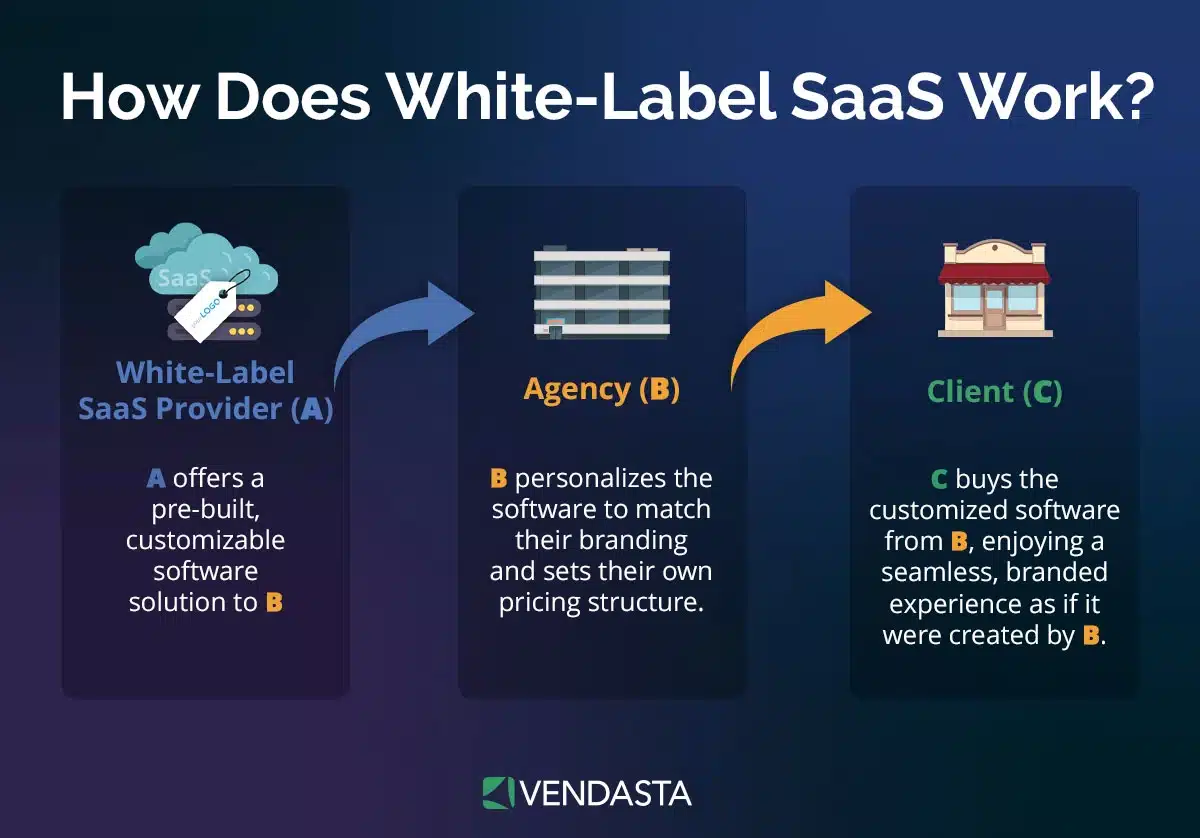
Vendasta’s CRM takes the opposite approach: contacts, companies, pipelines, custom objects, forms, automations, and AI Sales Assistant under one per-organization price, so adding account managers costs nothing. Because it is a white-label CRM, clients work inside Business App under your brand, not Vendasta’s.
Where AI Is Taking CRM Digital Marketing
Salesforce, HubSpot, Zoho, and monday shipped AI agents between 2024 and 2026. Vendasta calls its role-specific versions AI Employees. Gartner’s 2025 AI agent forecast predicts 40% of enterprise applications will carry task-specific AI agents by the end of 2026, up from less than 5% in 2025.
Gartner also warns against agentwashing. MarTech reports only 34% of Salesforce customers had adopted Agentforce as of July 2026, and a Salesforce-led benchmark found AI agents succeeded on 58% of single-step CRM tasks and 35% of multi-step workflows.
The practical version of AI CRM for CRM digital marketing agencies is narrower. Predictive scoring ranks leads before a human looks, while triggers fire follow-up in minutes. AI Employees handle fulfillment. Vendasta’s AI Sales Assistant updates CRM AI from sales activity and answers questions about records.
It also enriches contacts and opportunities; CRM AI logs every action as proof of performance. Early AI Workforce adopters reported a 39.2% lead conversion rate, a Vendasta-reported figure rather than a guarantee.
Agencies can add fulfillment capacity across a portfolio without matching it with hires.
CRM Digital Marketing Connects Campaigns to Revenue
CRM digital marketing works when the system turns customer data into timely follow-up and measurable revenue that support stronger client retention. For agencies, the right setup also keeps multi-client delivery and proof of performance under one brand as the portfolio grows.
If you want to see how AI Workforce handles real customer activity, start a 14-day free trial of Vendasta CRM AI and put AI Employees on one client account this month. You do not need a credit card.
CRM Digital Marketing FAQs
These answers cover CRM strategy, automation, agency features, and platform costs.
1. How is a marketing CRM different from a general CRM?
A sales-only CRM tracks contacts and deals for reps. A marketing CRM keeps the campaign source on the record from first touch to closed deal and runs targeting and automated follow-up off those fields, so agencies report spend against revenue.
2. What is the difference between a CRM and marketing automation software?
A CRM is the system of record: contacts, companies, deals, and every interaction. Marketing automation uses CRM data to send messages and launch workflows. Most platforms bundle both, but automation running on dirty CRM data misfires.
3. What are the three types of CRM systems?
Operational CRM handles Monday’s work: capturing leads, sending campaigns, moving deals. Analytical CRM segments and forecasts from the data it generates. Collaborative CRM is the shared record your team and client both see. META Group defined the taxonomy in 1999.
4. How does lead scoring work in a CRM?
Lead scoring assigns points for fit based on company and role data, then adds behavioral signals from digital engagement and form fills. Leads crossing the threshold trigger a sales alert; the rest enter nurture. Zoho’s Zia scores 0–100%, while HubSpot Enterprise adds AI predictive scoring.
5. What are the measurable benefits of CRM for a marketing agency?
Nucleus Research reviewed 63 CRM deployments and calculated $3.10 returned per dollar spent, with productivity and process efficiency driving 51%. In ChurnZero’s survey, 793 customer-growth leaders self-reported 98.5% net revenue retention with a CRM against 90% without. Agencies also gain closed-loop attribution.
6. What CRM features matter most for marketing agencies?
Multi-client account management, white-label branding, automation depth, closed-loop reporting, and pricing that survives headcount growth. Per-seat platforms get expensive as teams scale, and platform vendors often restrict white-labeling. Check which tier includes lead scoring and AI; both commonly sit at Enterprise.
7. How do I build a CRM marketing strategy?
Set revenue-tied goals and route every capture point into the CRM with consent fields. Build three or four segments tied to real offers. Attach drip and re-engagement workflows, then add a win-back workflow for lapsed clients. Launch email and SMS, then prune monthly. Without goals, you automate toward nothing measurable.
8. How do I automate follow-ups and outreach as an agency?
Map each trigger to one action: form submit starts the drip, 30, 60, or 90 days of silence sends re-engagement, a lapsed contract triggers win-back, a high score pings a rep. Omnisend valued triggered sends at $3.41 against $0.155 for batch.
9. How do you personalize campaigns at scale with a CRM?
Pair stored fields with behavioral triggers to reach a defined group at the right moment. Mailchimp’s segmented sends earned 14.31% higher opens and 100.95% higher clicks. But among Gartner’s survey respondents, 53% reported negative personalization experiences and were 3.2 times more likely to regret a purchase.
10. Is there an affordable CRM for smaller marketing agencies?
Yes. Zoho starts at $14 per user monthly, and monday CRM starts at $12 per seat. HubSpot and Salesforce cap free tiers at two users; Zoho caps its free tier at three. Vendasta CRM AI prices per organization with unlimited seats, so adding account managers does not add cost.
This article was originally published in December 2024 and was updated in September 2026 to include the latest information and insights.