About Us
 Careers
 Leadership
 Board
 Newsroom

The phone rings while the dentist is mid root canal, the plumber is under a sink, or the owner is asleep at 9:40 on a Sunday night. Most local businesses hit a capacity ceiling before they hit a lead ceiling: the calls are already coming in, but only so much human attention is available to answer them and follow up. For about a century, the only real fix for that limit was hiring another person.
The most useful AI agent examples for local businesses are software workers that pick up that call, book the appointment, answer the review, publish the post, and update the customer relationship management (CRM) system without waiting for a person. Vendasta calls these AI workers that do sales and marketing work AI Employees, and together they form the AI Workforce.
Owners can use these examples to decide which job to hand off first, and agencies can use the verified results as client proof. This guide covers how an agent works, the types of AI agents by role, seven local business stories with numbers, where to start, and how agencies turn agents into a service.
Watch the full breakdown from Vendasta:
Automate every step of the customer journey with AI employees
TL;DR
- AI agents finish the task end to end: An agent checks the calendar, books the slot, sends the confirmation, and updates the CRM in seconds.
- Verified results range from leads to revenue: Choice Signature Luxury Car Rental captured 778 qualified leads in four months, and a nine-location veterinary group attributes $47,698 in monthly revenue to AI intake.
- Every agent runs on three parts: Instructions, knowledge, and tools, and most Vendasta AI Employees go live in under 30 minutes.
- Missed calls are the best starting point: If calls go unanswered and a job is worth more than $100, start with phone and lead response through the AI Receptionist.
What Is an AI Agent?
An AI agent is software that takes a goal, works out the steps, and uses connected tools to finish a task for a business without a person driving each step. Vendasta calls its purpose-built agents AI Employees. OpenAI’s guide to building agents describes the same structure: a model that reasons and makes decisions, tools it calls to take action, and instructions that define its behavior.
OpenAI draws the same line inside its own product. When it introduced ChatGPT Work in July 2026, OpenAI described it as an agent designed for longer, more involved work than a typical chat request.
Agents change how a local business adds capacity. Hiring has been the standard route, and each hire brings salary, training, fit risk, and about 40 hours a week, while demand arrives unevenly: 40 calls Monday morning, four on Thursday afternoon. Naval Ravikant’s essay on leverage points out that with labor, “somebody has to decide to follow you,” while code is permissionless.
Traditional software organized the work, with the CRM holding contacts and the scheduling tool holding the calendar, but someone still had to take the next step. Setting up an agent is closer to onboarding an employee who works 24/7 and can be updated or duplicated without a new hiring process. Using a roofing company’s phone line as the example, every agent comes down to instructions, knowledge, and tools.
Instructions
Instructions are the agent’s job description, written in plain English with no code. For the roofing company, they might read: keep it friendly and brief, collect the caller’s name, phone number, and address, and ask what’s wrong and when they want someone out. Don’t quote prices, and if you’re unsure, say so and offer a callback.
Knowledge
Knowledge is what a new hire needs on day one: hours, services, service area, policies, and answers to the same 40 questions customers always ask. Vendasta’s setup scans the business’s website and service pages to gather much of it, and most AI Employees go live in under 30 minutes.
A missing fact means no answer, and a wrong fact gets repeated to customers with full confidence, so review the knowledge before launch.
Tools
Tools are the permissions that let an agent act: access to email, the calendar, the business listing, social accounts, and the CRM. With that access it can book or reschedule, send confirmations, update records, reply to messages, and schedule or publish social posts and blogs. “There’s an app for that” becomes “there’s an agent for that.”
AI Agent vs. Chatbot: The Short Version
A chatbot answers questions about a task, and an AI agent, which Vendasta calls an AI Employee, completes the task. A basic chatbot is a waiter who knows the whole menu but can’t take your order or bring the food. Ask it to book and it replies, “Our hours are 9 to 5, please call to book.”
An agent checks the calendar, finds open times, works with the customer to pick one, books it, sends the confirmation, and updates the scheduling system and CRM in seconds. OpenAI’s guide makes the same cut: simple chatbots that don’t use a model to control a workflow are not agents. The full comparison is in AI agent vs. chatbot.
Types of AI Agents for Local Businesses (Examples by Role)
The practical types of AI agents for a local business are sorted by the job they do. Textbooks such as Russell and Norvig’s Artificial Intelligence: A Modern Approach sort agents by how they decide (simple reflex, model-based, goal-based, utility-based, and learning), but an owner hires by role.
Vendasta calls its AI agents AI Employees, and together they form the AI Workforce. Every AI Employee works from the same business information, rules, and guidelines, so the receptionist, the reputation specialist, and the blogger all describe the business the same way.
Six roles come prebuilt. The AI Inside Salesperson and AI Support Agent are examples of Custom AI Employees, which a business builds without code for work specific to it. The table sums up each role before the detail.
| Role | What It Does | Example Task |
|---|---|---|
| AI Receptionist | Answers calls, texts, web chats, and messages 24/7 | Books a roof inspection on Sunday night |
| AI Reputation Specialist | Responds to reviews and sends review requests | Replies to a five-star Google review |
| AI Social Media Manager | Creates, schedules, and publishes posts | Posts a project photo to Instagram |
| AI Blogger | Writes one search-driven FAQ article a week | Publishes a roof replacement FAQ to WordPress |
| AI Sales Assistant | Updates the CRM from meetings and sales activity | Logs a quote request and next step |
| AI Search Specialist | Checks whether ChatGPT, Gemini, and Perplexity recommend the business, then works to get it chosen | Drafts a website FAQ for one-click approval |
| AI Inside Salesperson (custom) | Qualifies inbound inquiries and books meetings | Asks discovery questions before a sales call |
| AI Support Agent (custom) | Answers from the knowledge base and escalates | Hands a billing question to staff with context |
AI Receptionist
The AI Receptionist answers phone calls, texts, web chats, and messages 24/7, then asks qualifying questions, captures leads, and books appointments against real calendars. It answers from the business’s own knowledge, so callers hear the actual hours and service area. In the product it appears as two roles: the AI Chat Receptionist and the AI Voice Receptionist.

AI Reputation Specialist
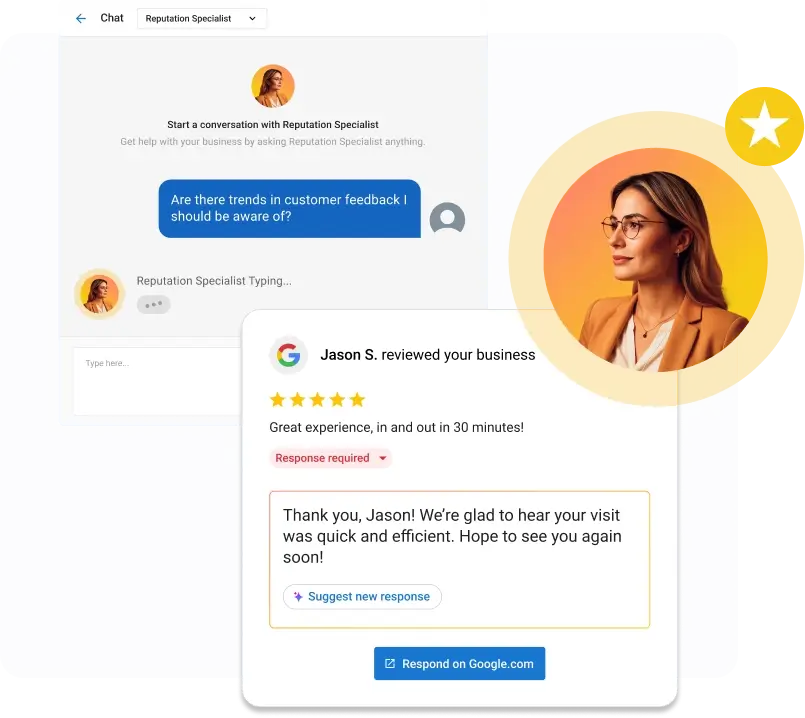
The AI Reputation Specialist responds automatically to Google and Facebook reviews in the reviewer’s language, under rules the owner sets, such as rating thresholds, delays, and approval workflows. It suggests responses for 100+ other review sources and sends review requests and Net Promoter Score (NPS) surveys.
AI Social Media Manager
The AI Social Media Manager learns a brand’s voice and visuals, then writes, schedules, and publishes posts adapted to each platform. It covers Google Business Profile, Facebook, Instagram, LinkedIn, X, TikTok, and YouTube, and pairs posts with stock or AI-generated images.

AI Blogger
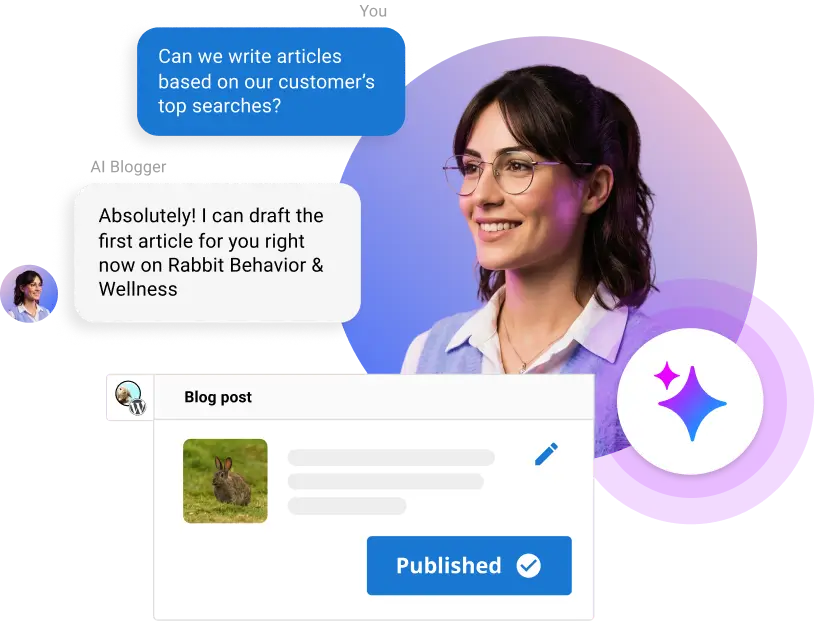
The AI Blogger researches what customers search for and writes one SEO-optimized, FAQ-style article each week. It publishes to WordPress through a review workflow or on autopilot. Each article then goes to the AI Social Media Manager to become a week of social posts.
AI Sales Assistant
The AI Sales Assistant updates CRM records automatically from meetings and sales activity. Owners ask it plain-language questions about contacts, companies, and opportunities, and it enriches records with web research.

AI Search Specialist
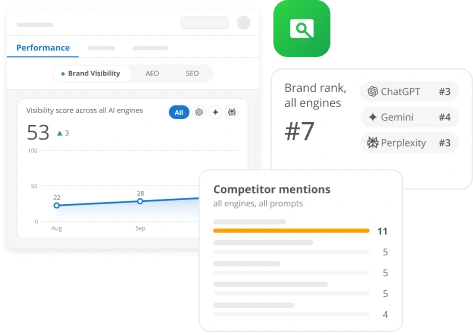
The AI Search Specialist is the AI Employee inside Vendasta SEO AI that checks whether ChatGPT, Gemini, and Perplexity recommend a business, then does the work to get it chosen. It’s a role that barely existed 18 months ago.
Inside SEO AI, it drafts website fixes, blog posts, and FAQs for one-click approval and keeps listings and keywords current. A monthly report shows which competitors get mentioned alongside or instead of the business, plus SEO and answer engine optimization (AEO) health.
AI Inside Salesperson
The AI Inside Salesperson is a Custom AI Employee that qualifies inbound inquiries through discovery questions and books meetings. It finds out what a lead needs before anything lands on the calendar.
Businesses build Custom AI Employees without code by uploading documents such as price lists and standard operating procedures (SOPs), then defining rules. Custom Capabilities connect them to outside systems through application programming interface (API) connections.

AI Support Agent
The AI Support Agent is a Custom AI Employee that answers support questions 24/7 from the knowledge base and escalates to staff with context.

In a 2026 Gartner survey, 87% of customers said it is essential for companies using generative AI (GenAI) for service to offer a way to reach a human agent. Build the handoff path before launch, so the person who picks up sees what was asked and tried.
Real AI Agent Examples From Local Businesses
These AI agent examples come from agencies that use Vendasta and the local business clients they serve, covering calls, intake, lead follow-up, and content. Each story names the agency partner, the job the AI Employee took on, and the result.
A pattern runs through them: most of the wins came from inquiries that arrived when no one was free to answer, whether after hours, mid-job, or on a weekend. The AI Employee caught demand that was already there.
More stories with full numbers are in Vendasta’s case study library.
Choice Signature Luxury Car Rental: 778 Qualified Leads
Choice Signature Luxury Car Rental captured 778 qualified leads in four months through an AI Receptionist that Elite Web Professionals set up for its inbound calls.
Staff still had the first chance to answer every call. When no one picked up within 20 seconds, the call moved to the AI Receptionist instead of going to voicemail.
Of the 1,017 calls it handled, the AI Receptionist qualified 778 callers as leads, a 76% conversion rate. The Choice Signature case study has the full breakdown.
A Nine-Location Veterinary Group: $47,698 in Monthly Revenue
A veterinary group with nine locations attributes $47,698 in monthly revenue to the AI Employee that Social Ordeals set up for intake.
Late at night, the AI Employee routes emergency inquiries to the group’s two 24-hour hospitals. The group’s CEO describes it as an extra net: someone browsing at 10 p.m. can still connect with the business.
The group added 57 new clients in one month.
An Auction House: One Late-Night Lead, a $20K to $30K Commission
One lead, matched by an AI Employee at 11 p.m., turned into a $20K to $30K commission for an auction house client of Blue River Digital.
The visitor asked about a property with a pond. As the conversation continued, the AI Employee worked out that the buyer really wanted more land and suggested a listing that wasn’t going to auction for a few weeks. The buyer purchased it, and the team learned about the sale from a notification the next morning.
The same client also earned 21 five-star reviews in 30 days.
A Barbecue Caterer: 3x Annual Revenue
Annual revenue tripled for a barbecue catering client of Howell Studios after the agency set up an AI Employee.
The owner, a national barbecue champion, also works full time as a realtor. His AI Employee was trained on the catering menu, order minimums, and event requirements, and it qualifies couples and event planners while he shows houses.
Sending the payment link is his remaining step in the sale.
Neighborly: 372% More Leads Converted to Revenue
Leads converted to revenue rose 372% year over year at the Neighborly franchise network once AI Employees were in place.
Before that, about 30% of leads had gone uncontacted. The AI Employees responded to incoming leads and held 35.7K conversations, which produced 3.4K conversions.
The network now has a consistent way to respond to the leads its locations already generate.
A Gutter Company: 3x Online Impressions
A gutter company tripled its online impressions after Crosshair Digital Marketing put the AI Social Media Manager to work.
The AI Social Media Manager writes and schedules posts in a brand’s voice and adapts them to each platform, the kind of steady posting that slips when crews are booked solid.
The result is featured on Crosshair Digital Marketing’s partner profile.
A Luxury Appliance Showroom: $200K Monthly Appointment Pipeline
A luxury appliance showroom working with iMedia Audiences built a $200K monthly appointment pipeline.
That pipeline came from 80 bookings at a $2,500 average.
Where Local Businesses Should Start With AI Agents
Start with one clear customer-facing problem, let it prove its value, then add the next job.
Competitors will ask what they would automate if they built the business from scratch today, aiming for smaller teams, lower operating costs, and more personalized marketing. That doesn’t mean changing everything tomorrow.
Owners also tend to trust AI in stages, comfortable with it drafting and suggesting before they let it act on its own. A narrow first job with visible results builds that trust, and the four steps below follow that order.
Step 1: Fix Missed Calls and Lead Response
If you miss calls and a typical job is worth more than $100, start with phone and lead response. An AI Receptionist answers calls, texts, and web chats 24/7 and books appointments against your real calendar, so after-hours callers reach someone who can book them.
Step 2: Make Your Business Easy for AI Search to Understand
AI tools are becoming part of how people choose which business to contact. BrightLocal’s 2026 Local Consumer Review Survey found 45% of consumers used ChatGPT and other AI tools for local recommendations, up from 6% the year before.
Google Search Central’s guidance on AI features lists an up-to-date Business Profile and structured data that matches visible page text among its best practices. Cover these basics:
- Keep the Google Business Profile accurate, including hours, special hours, services, and service areas.
- State hours and services clearly on the website, and keep any structured data consistent with that text.
- Confirm the online booking link works.
Step 3: Automate Reviews and Follow-Ups
Once calls are covered, automate review requests after each completed job and rule-based responses to new reviews. Add follow-up on quotes and open leads, since that task slips first when the crew is busy.
Step 4: Move to the Back Office Last
Let customer-facing AI Employees prove their value before moving to back-office work such as CRM updates and reporting. Review transcripts in the first month and tighten instructions where answers fell short.
A U.S. Census Bureau working paper found 66% of AI-using firms rely on AI solely to augment tasks, with AI-related employment decreases in only 2% of firms, so plan AI Employees around your existing staff.
How Agencies Turn AI Agents Into a Service
Agencies turn AI Employees into a service by setting them up for each client, running them monthly, and teaching clients where a person stays involved. Local businesses have long bought new technology through a trusted advisor: the yellow pages rep, then the website builder, then the SEO agency, and now the agency that configures AI.
On Meta’s Q1 2025 earnings call, Mark Zuckerberg said he expects that in the next few years, just as every business has an email address, social media account, and website, it will also have an AI business agent for customer support and sales. Someone has to map each workflow and connect it to the calendar and CRM, and an agency can do that across 40 clients.
For a midsize agency, growth usually means more clients, more hires, and thinner margins. AI Employees handle fulfillment such as review responses, web chat, and call answering, so monthly recurring revenue (MRR) can grow without the team growing at the same rate.
In SparkToro’s 2025 agency survey, 53% of respondents agreed AI poses a significant threat to the agency business model, up from 44% a year earlier. Hourly billing breaks when an agent finishes a task in 90 seconds, so partner agencies build three layers:
- One-time setup fee: Each agent gets instructions, business info, calendar and CRM connections, rules, and transcript review in month one.
- Monthly subscription: The agent runs as an ongoing service the agency monitors and updates.
- Education: The agency explains what AI can do and where a person still needs to be involved.
Agencies deliver AI Employees to clients under their own brand through Vendasta’s partner program and manage every client from one dashboard.
Packaging details are in AI Employees for agencies.
How Vendasta’s AI Employees Put These Examples to Work
Vendasta’s AI Workforce handles each job in this article with a purpose-built AI Employee running on the business’s own data. Vendasta is a customer acquisition and engagement platform serving 66,000+ partners and 8.2M+ local businesses. Each pain point maps to a product:
- Missed calls and slow follow-up: Vendasta Conversations AI runs the AI Receptionist across phone, web chat, SMS, and messaging.
- Review management: Vendasta Reputation AI runs the AI Reputation Specialist for review requests, monitoring, and rule-based responses.
- Inconsistent content: Vendasta Social AI pairs the AI Social Media Manager with the AI Blogger.
- Manual CRM updates: Vendasta CRM AI uses the AI Sales Assistant to update records from meetings and sales activity.
- AI search visibility: Vendasta SEO AI includes the AI Search Specialist, which tracks AI recommendations and drafts fixes for approval.
Most AI Employees go live in under 30 minutes, learning from the business’s website, business profile, and uploaded knowledge. Every action is logged in Business App, so owners see proof of performance for each AI Employee. Agencies deliver the same AI Employees to clients under their own brand.
To see Vendasta’s AI Workforce answer calls, book appointments, and respond to reviews for your business, book a Vendasta demo.
AI Agent Examples FAQs
1. What is an example of an AI agent?
An AI phone receptionist that answers a call, checks the calendar, books the appointment, and logs the details in the CRM is a common example. For Choice Signature Luxury Car Rental, an AI Receptionist set up by Elite Web Professionals handled 1,017 calls and captured 778 qualified leads in four months.
2. What are the main types of AI agents?
Textbooks classify agents as simple reflex, model-based, goal-based, utility-based, and learning agents. Local businesses get more from sorting by job: receptionist, reputation, social media, blogging, sales records, and AI search visibility. Custom AI Employees, such as an AI Inside Salesperson or AI Support Agent, handle work specific to one business.
3. How do AI agents work?
An AI agent, which Vendasta calls an AI Employee, works from instructions, knowledge, and tools. Instructions describe the job in plain English, knowledge supplies hours, services, and policies, and tools give access to the calendar, CRM, email, and listings. With all three in place, the AI Employee decides the next step and completes tasks such as booking and updating records.
4. Is ChatGPT an AI agent?
ChatGPT’s standard chat works as an assistant: you ask, it answers, and you guide the next step. OpenAI introduced ChatGPT Work in 2026 as an agent for longer, more involved tasks. An agent for a local business also needs access to that business’s own calendar, CRM, and rules before it can book and follow up.
5. What is the difference between an AI agent and an AI assistant?
An AI assistant responds to prompts and leaves decisions and actions to the user. An AI agent, which Vendasta calls an AI Employee, takes a goal and carries out the steps itself with connected tools. Asked to book an appointment, an assistant explains how to call, while an agent checks availability, books the slot, and sends the confirmation.
6. Can an AI agent book appointments for my business?
Yes, once it is connected to a real calendar. An AI Receptionist checks open times, works with the customer to choose one, books it, sends a confirmation, and records the details in the CRM. The setup steps that matter most are connecting the calendar and writing clear booking rules into the instructions.
7. How long does it take to set up an AI agent?
Most Vendasta AI Employees go live in under 30 minutes. Setup scans the business’s website and service pages for hours, services, and policies, and the owner adds instructions and connects tools such as the calendar. Plan to review transcripts during the first month and fix any gaps in knowledge.
8. Which AI agent should a local business start with?
Start with one clear customer-facing problem. If calls go unanswered and a typical job is worth more than $100, begin with an AI Receptionist for phone and lead response. Next, make the business easy for AI search tools to understand, then automate reviews and follow-ups, and leave back-office work for last.
9. Will AI agents replace employees at a local business?
Current evidence points to augmentation over replacement. A U.S. Census Bureau working paper found 66% of AI-using firms rely on AI solely to augment tasks, and AI-related employment decreases occurred in only 2% of firms. For a local business, an agent usually covers after-hours calls and overflow so existing staff can focus on paid work.
10. How do agencies sell AI agents to local businesses?
Agencies sell AI Employees in three layers: a one-time setup fee per AI Employee, a monthly subscription for running it as an ongoing service, and education on what AI can do and where a person stays involved. Agencies using Vendasta deliver AI Employees to their clients under their own brand.