 About Us
 Careers
 Leadership
 Board
Board Newsroom
The web design and development world has changed dramatically in recent years, with powerful solutions making it possible to create beautiful, functional websites in a fraction of the time it once took.
In a busy marketplace full of different WordPress white label solutions, we’ll help you understand exactly what to look for when choosing the perfect fit for your agency. Getting that choice right is a real lever in how to get more customers for your agency. In this article, you’ll find actionable tips to help you set up your white label website projects. Additionally, we’ll provide insights into how to land more clients and scale your business, and share the best WordPress white label agency solution on the market.
Key considerations when choosing a white-label WordPress solution
If you’re just starting to research WordPress white label solutions, it can be easy to get bogged down in different claims and features. Let’s cut through the noise and zero in on the most important things to consider as a website services provider.
1. Customization options
While there are lots of WordPress website builders out there, few of them give you the total control to customize the interface that your clients will interact with. Look for a solution that enables you to pick exactly what your website client sees and has control over.
This goes well beyond simple rebrandabiltiy. While it’s nice to rebrand a website building tool with your agency’s logo and colors, a truly customizable WordPress white label solution will also give you the ability to craft a custom dashboard. This can give you more granular control over the client experience.
2. Support and maintenance
Support and maintenance may not seem like the most exciting, headline-grabbing features of a WordPress white label solution, but trust us on this one: it’s one of the features you will be most grateful for as you sign more clients and scale your agency.
WordPress is constantly changing and receiving new updates, so any solution that doesn’t prioritize regular updates and maintenance is more likely to produce snags, bugs, incompatibilities, and other issues that can impact your clients’ sites.
Having a reliable, 24/7 white-label WordPress support to get things back up and running smoothly will make all the difference between a happy or a frustrated client. That’s especially the case if something does go awry, like a plugin update accidentally causing part of a website to break.
3. Pricing
Your WordPress white label solution should have a transparent, easy-to-understand pricing structure. This enables you to understand your costs, so you can make sure the website design pricing you determine for your clients leaves enough room for you to hit your target profit margins.
As a WordPress white label agency, this doesn’t necessarily mean opting for the cheapest website solution on the market. Instead, look for one that checks off all of your requirements in terms of features, while still allowing you to be competitive.
Another important consideration to keep in mind as you choose a white-label platform for your website services is whether discounts are available as you scale. Look for an option that offers you favorable wholesale pricing as your WordPress white label agency grows and you sign on more clients.
4. User interface
Your website solution’s interface should be user-friendly and highly functional, both for you and for your clients. This ensures that it can be flexible enough to meet the demands of a wide range of client projects, including:
- Websites that are fully created and managed in-house by your agency.
- Straightforward WordPress white label solution reselling, where clients with more limited budgets create and manage their websites themselves.
- Projects that fall somewhere in between, with clients handling some aspects of updating and managing their websites.
Essential tips for setting up a white-label WordPress website
Once you’ve selected a solution for creating and hosting white-label WordPress websites, it helps to have a standard operating procedure (SOP) in place that you can follow with each new client project. This ensures that nothing important falls between the cracks, and makes it possible for your agency to deliver the same high-quality experience regardless of who owns each particular client account.
Build these tips into your SOP to make sure they’re covered for every website project.
Customize the WordPress dashboard
The standard WordPress admin dashboard will be familiar to you if you’ve ever created or maintained a WordPress site, but to those with less experience, it isn’t exactly the slickest user interface on the internet today:
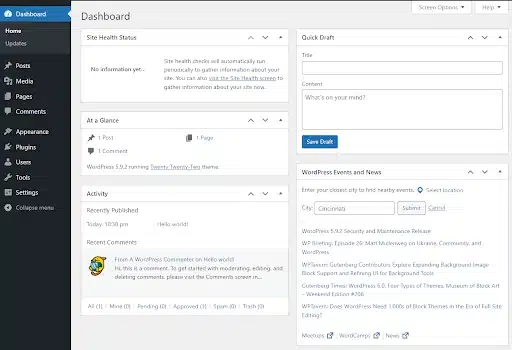
Plus, as you add more plugins and other features, that side menu can quickly become lengthy and cluttered, with many items containing future sub-menus when you click them. This isn’t an issue for a seasoned web developer, but customizing the dashboard for your clients will make it far more user-friendly.
When using WordPress Hosting, for example, the first interface clients see is much cleaner and less cluttered, and you can customize it to determine what they see.
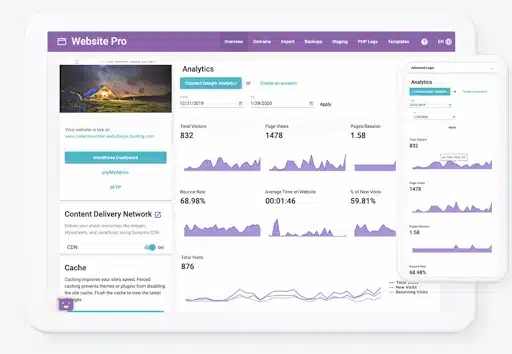
Source
Then, you can further customize the standard WordPress dashboard to make it less cluttered and more intuitive, leaving only the widgets that your clients will be able to comfortably use.
Add your agency branding
Every time your clients see your agency branding integrated with the tools they use, it reinforces your agency as an important and valued provider of digital solutions. By rebranding your website building and management tool to look like it’s a proprietary piece of software unique to your agency, you strengthen your brand and reduce the likelihood of clients shopping around for better pricing for the same solution.
Managed WordPress hosting on Google Cloud Platform is fully rebrandable, which means that anywhere the WordPress Hosting logo appears you can replace it with your agency’s logo. You can also change the colors to reflect your brand palette and create an immersive brand experience all your own.
Install necessary plugins
One of the best parts of using a white-label CMS for WordPress rather than some other platform is that WordPress provides access to a seemingly endless variety of plugins. Since it’s an open-source CMS, anyone can make and sell plugins to fulfill just about any function you might want to incorporate into your website.
You don’t necessarily want to go overboard with plugins for your white label web design WordPress projects. This can increase the risk of bugs, vulnerabilities, and slow loading speeds, but a few well-chosen plugins can be very handy both for you and for your clients. These can be used to impact the front end of a client’s website or to add functionality and features to the back end, making it easier for them to run their businesses.
Create a custom login URL
WordPress creates an automatic login URL, which is just the website domain name followed by /wp-admin. This takes users to the login screen where they can enter their username—typically an email address—and password. While this works just fine, a good best practice is to create a custom login URL.
Why? Firstly, it can be another one of those little touches that sets your WordPress white-label agency apart from the competition by showing extra care and consideration. But more importantly, it’s a security measure. Avoiding the standard login URL means hackers can’t immediately access the login page and slow down the site with constant automated login attempts.
Tips for marketing your white-label WordPress websites to clients
It seems like everyone and their grandmother has a website nowadays, which is great news for you as a provider of white label web design WordPress services. Whatever your niche is, your clients certainly require website services. Even if they have already had a professional website built, it’s not uncommon to require a refresh every couple of years. Here’s how you can make sure your agency sells more to local businesses.
1. Define your target market
One of the first rules of marketing 101 applies as much to selling websites as it does anywhere else: it’s easier to sell when you know your customer, rather than trying to sell to everyone at once. If your clients tend to be restaurants, hone in on those and make sure your portfolio, marketing materials, and communications are all crafted to appeal to food service businesses.
2. Emphasize the benefits of your white-label solution
As a WordPress white label agency, you can fully customize the solution you sell your clients. Emphasize the benefits of your solution over the competition, such as:
- An interface with a better UX
- Fully managed hosting and website updates
- Automatic daily backups
- Superior built-in analytics
3. Have an online presence
Your prospects want to see that you know your stuff when it comes to websites, so having an impressive website yourself can help you move more clients toward closing. Having an online presence elsewhere, like on social media channels, can further legitimate your agency in the eyes of prospective clients, establishing you as a valuable voice in your niche.
4. Demonstrate your expertise
It’s always more effective to show than tell. A portfolio of beautiful websites will lead to more conversions than a lengthy, wordy website that explains everything you can do for clients. While a description of your services is perfectly warranted, take the time to build up an attractive portfolio as well. If you’re new to selling website services, consider creating a few dummy small business websites to showcase your skills.
WordPress Hosting: The best solution for hosting white-label WordPress websites
If you’re looking for a powerful, scalable, and completely white-labeled WordPress solution—without the complexity—Vendasta’s WordPress Hosting is built for you. Designed specifically for agencies, franchises, and multi-location businesses, it delivers everything you need to build, manage, and scale client websites seamlessly under your own brand.
Simple, centralized management
Vendasta’s platform makes it effortless to manage multiple WordPress sites from a single dashboard. With one-click installs, automated backups, and staging environments, you can handle everything from setup to maintenance without ever touching a server. Manage up to five subsites on a single install—ideal for multi-location clients or agencies managing high volumes of websites.
Fast, secure hosting on Google Cloud
Built on Google Cloud Platform, Vendasta’s hosting ensures reliable speed, uptime, and security. Each site comes with free SSL, automated backups, uptime monitoring, and containerized infrastructure for optimized performance. Your clients enjoy fast load times, while you deliver premium hosting that runs smoothly—always under your agency’s brand.
AI-powered engagement and lead capture
Go beyond hosting with Conversations AI, included as part of Vendasta’s AI Workforce tools. Automate lead capture, chat responses, and contact logging directly into your CRM. Clients get a responsive, intelligent website that engages visitors instantly through chat, text, or phone—helping them convert more leads with zero effort.
Scalable, flexible growth
Whether your clients are small startups or multi-location enterprises, Vendasta’s multisite setup grows with them. Scale effortlessly with centralized control, unified branding, and flexible subdirectory structures that boost SEO and simplify management across all client sites.
Fully integrated with Vendasta’s ecosystem
Vendasta’s white-label WordPress Hosting connects directly with your CRM, analytics, and other Marketplace solutions—from SEO and reputation management to digital ads and review monitoring. This allows you to deliver a full suite of digital marketing services that work together to amplify client ROI and retention.
White-label fulfillment and expert support
Want to focus on sales while experts handle design and technical work? Vendasta’s white-label fulfillment team can build, optimize, and manage websites under your brand. You maintain the client relationship while delivering professional results that scale your business faster.
Vendasta’s Managed WordPress Hosting combines performance, automation, and scalability into one white-labeled solution—so you can deliver world-class websites without the technical hassle. One install. Many sites. Endless growth.
